

Bloomberg

Europe Industrial Profits Soar Despite Inflation, Gloomy Outlook

(Bloomberg) — As Europe edges toward a full-blown energy crisis and recession, its manufacturing giants are raking in the cash. 

Luxury-car leader Mercedes-Benz joined Europe’s biggest chemicals maker BASF, Swiss building-materials producer Holcim, shipping company Hapag-Lloyd and others to report a jump in profit and raise earnings forecasts for the year.

Even as energy and raw materials costs soar and inflation drags on the economic outlook, carmakers Volkswagen and Stellantis beat profit expectations and said order books are brimming with demand for their models. 

The results offer a stark contrast to the wave of grim economic news sweeping across Europe as Russia continues to choke the continent’s gas supply, fueling inflation and threatening production. Manufacturers sounded a common theme: demand for their cars, chemicals and industrial materials has remained strong despite plummeting leading indicators like business and consumer confidence.

So far, they’ve been able to pass along the higher costs of production to their customers. But with inflation setting a record pace and interest rates rising, it isn’t clear how long that dynamic will hold. 

“The situation seems paradoxical: high profits combined with high uncertainty and rising costs,” said Klaus Wohlrabe, head of economic surveys at the Ifo Institute in Munich, adding that he doubted the situation would last. “People will start saving instead of going on vacation or buying a new car and the gas and energy bills have to be paid first. It may be that the very good quarterly results are followed by a hangover in some cases.”

Carmakers in particular, which have only recently seen the semiconductor shortage start to ease, still won’t be able to make cars fast enough to meet customers’ purchases or quickly work down their order books. As it reported second-quarter earnings that beat analysts’ expectations, Volkswagen said Audi orders are so high that customers will have to wait as much as a year for some of its models.

“We’ve never been in a situation like that, where the output of the industry is so heavily constrained by supply,” Volkswagen Chief Financial Officer Arno Antlitz said Thursday. “Even if the demand slows down in the second half of the year, there’s still enough head room for us” based on full order books.

With Russia continuing to reduce Europe’s gas supply, strong second-quarter earnings and rosy forecasts through the end of 2022 do little to mask the threat of tough times ahead. While carmakers will feel the pain of a broad economic downturn, industrial manufacturers are facing a more immediate potential shock if there’s a gas-supply emergency.

BASF is cutting costs to prepare for an economic slowdown and is planning to reduce its gas-heavy ammonia production. It will rely on fuel oil to generate electricity and steam at its site in Schwarzheide. As the chemical maker cuts consumption, it’s also considering selling unused natural gas back to Germany’s grid, people familiar with the matter said. 

French auto supplier Faurecia SE set aside $100 million to build its own “safety stock” of energy amid risks of shortages. 

For carmakers, the picture is complicated. Sales in Europe have plummeted for the past year, but Mercedes, Volkswagen, BMW and others have seen profits soar by shifting production to their highest margin models as the semiconductor shortage and Covid lockdowns idled factories. 

“Pricing and mix remains the key driver for the earnings” beating expectations among carmakers, said Stifel analyst Daniel Schwarz. “The key questions remain on 2023: when will supply eventually recover, and will demand and pricing hold up in a recession scenario?”

Stellantis said Thursday it now expects the wider European market to shrink 12% by the end of the year, after previously seeing only a 2% decline.

Like other major manufacturers, the positive results came with concerns about high inflation, supply-chain problems and a worsening energy supply crisis. Carmakers continue to battle a dearth of chips that has led to widespread production halts. Most manufacturers are seeing signs of the logjam easing, though they’re still far from assured to procure enough of the high-tech components. 

“It’s still impressive to see car makers continuing to increase that much their price-mix even if volumes are not there,” says Ariane Hayate, a fund manager at Edmond de Rothschild Asset Management in Paris. “Results are clearly above expectations but macro uncertainty will continue to weight on this very cyclical sector.”

More stories like this are available on bloomberg.com

©2022 Bloomberg L.P.
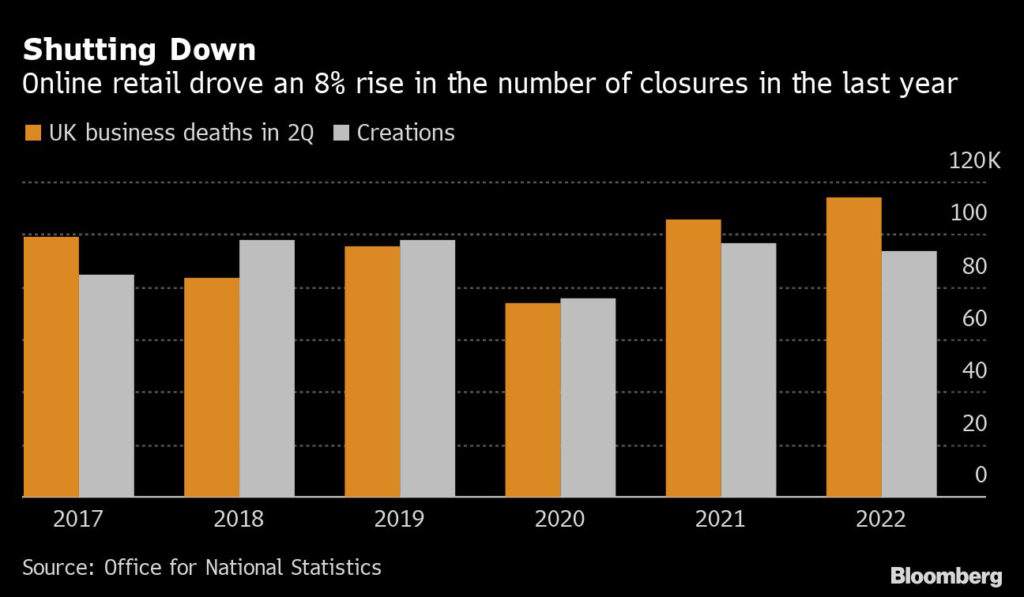
UK Online Stores Saw Big Jump in Closures After Covid Curbs Were Lifted

(Bloomberg) — The online retailers that boomed in the UK during the pandemic have suffered a significant shakeout since the government eased Covid-19 restrictions, new figures show.

The number of retail firms shutting down rose 40% from a year ago in the second quarter, the Office for National Statistics said Thursday. The surge was the main factor behind an 8% increase in total business closures. 

“Retail sale via mail order or via internet and other retail sale not in stores, stalls or markets are the two main industries contributing to the increase in closures within retail,” the ONS said Thursday. “These closures follow significant increases in creations during the second half of 2020 and the first half of 2021.”

Non-store retailers sprouted when lockdown curbs closed premises and the fear of contracting Covid-19 kept many people at home. However, the reopening of the economy a year ago has seen shoppers return to high streets and spend less online.  

The ONS data show the number of business removed from or added to a government register of operating enterprises. A firm is taken off the Inter-Departmental Business Register if its turnover and employment are zero for several periods, or if the ONS is made aware that the business has ceased trading.

The number of firms removed was 113,700 in the second quarter, the highest figure for the period since the series began in 2017. Ten out of 16 main industrial groups recorded an increase.

Firms closing had an average of 2.3 employees, fewer than before the pandemic.  

“However, the trend towards increasingly smaller businesses closing may be ending,” the ONS said.


More stories like this are available on bloomberg.com

©2022 Bloomberg L.P.
Plug-In Hybrid Cars Are Running Out of Road

(Bloomberg) —

Everybody likes to have options to choose from, or at least they think they do. That’s part of what led some automakers to bet heavily on plug-in hybrid electric vehicles, or PHEVs, which offer consumers a way to get a sampling of the EV experience without jumping fully in.

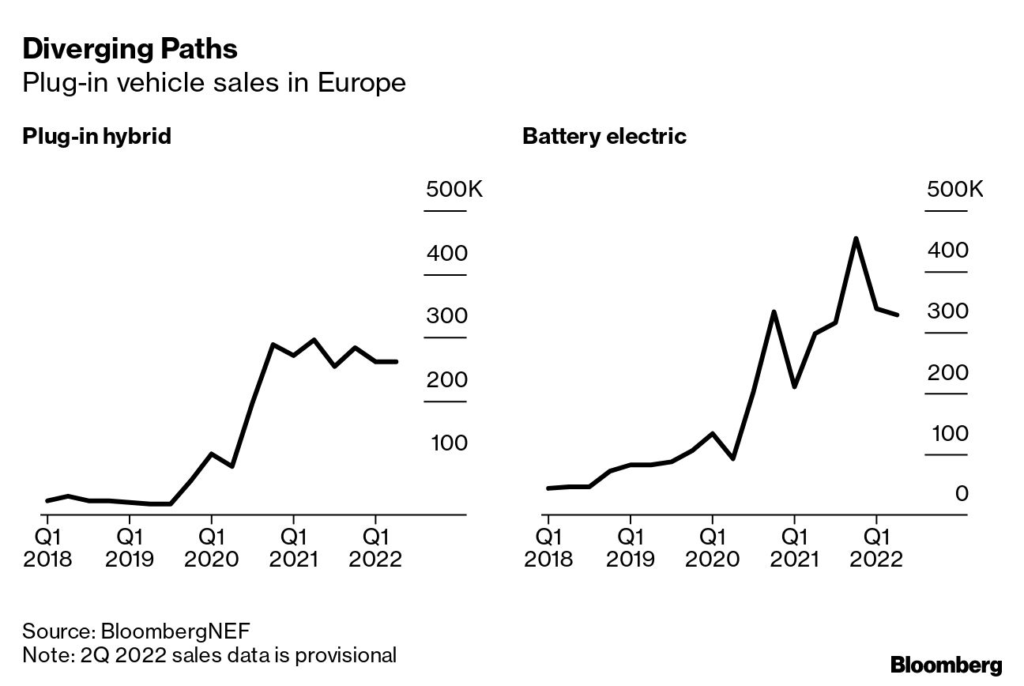
PHEVs are often described as a transition technology — a bridge to a fully electric future. But sales of these models are faltering in Europe, which has been their most important market to date. The latest data shows two very different trajectories between plug-in hybrids and battery-electric vehicles, or BEVs.

Country-level data paints an even starker picture. Sales of PHEVs in France fell 28% in June. In Germany — another former stronghold for the technology — registrations dropped 16%. In the UK, plug-in hybrids were neck-and-neck with BEVs as recently as 2019. Now, two battery-electric cars sell for every one PHEV.

Some of this is to be expected. In 2020 and 2021, automakers had to meet Europe’s stricter CO2 targets for new vehicles, and plug-in hybrids were treated favorably under the regulations. Many automakers didn’t have their new BEV architectures fully ready. When faced with two options — to market fully electric vehicles underpinned by modified internal combustion platforms, or PHEVs — many opted for the latter.

Europe’s vehicle CO2 regulations don’t tighten again until 2025. As more automakers get their fully electric platforms ready for model launches, BEVs look poised to continue their ascendency of the sales charts. Consumers are clearly ready, with wait times already stretching well into next year for most of the popular fully electric models in Europe.

Will Elon Musk take over Twitter? Which of the S&P 500’s biggest stocks has the most upside? Share your views in this week’s MLIV Pulse survey. It takes only one minute and is anonymous.

Many PHEV owners are happy with their cars. But from a policy perspective, there’s an elephant in the room: drivers often don’t end up charging these vehicles all that frequently. A recent study of 9,000 vehicles from the International Council on Clean Transportation found that real-world fuel consumption from PHEVs was 2.5 to 5 times higher than what’s approximated under official laboratory testing procedures.

That gap between theory and practice is part of the reason national governments are cutting purchase subsidies for PHEVs faster than for fully electric models. The UK, for example, eliminated purchase subsidies for plug-in hybrids in 2018, while Germany announced just this week that PHEV subsidies will end this year.

One critical distinction here is that the share of electric kilometers driven on a PHEV depends heavily on who owns it. Among privately owned vehicles, the ICCT study found real-world electric-driving share was 45% to 49%. Not bad, though still short of what the official test cycles assume. For company cars, that dropped to a dismal 11% to 15%. Company vehicles are a huge part of the market in Europe, accounting for more than half of new-car sales in many countries.

Upcoming policy changes could further erode the case for PHEVs. The European Commission is expected to introduce new “utility factors” for PHEVs from 2027. These are the values intended to reflect how often the vehicles are driven in electric mode, and critically, what CO2 emissions value they’re assigned.

The goal for the regulation is to use real-world driving behavior from both private and company-owned vehicles to set the values, using on-board monitors. Unless something dramatic changes in the next few years, this will make PHEVs a less attractive way for automakers to meet emissions regulations. Manufacturers will see this change coming down the road and start to allocate investments accordingly.

Relatively strong sales of plug-in hybrids in China are keeping the global numbers afloat for now. PHEV sales there more than doubled last year, led by offerings from BYD and Li Auto, though even that wasn’t enough to keep pace with growth in BEV demand. China has more high-rise apartment dwellers with limited home-charging options, but the government is making a huge push to build out public-charging options and help keep the BEV market expanding quickly. The municipal government in Shanghai is also set to remove favorable treatment for PHEVs beginning in 2023, and others could follow.

If plug-in hybrids are a bridge, it’s starting to look like a short one.

More stories like this are available on bloomberg.com

©2022 Bloomberg L.P.

Alibaba’s Gains From Primary Listing Plan Wiped Out in Two Days

(Bloomberg) — Euphoria surrounding Alibaba Group Holding Ltd.’s primary listing plan has evaporated in just two sessions, as focus shifts to the firm’s earnings announcement due next week.

Shares of the e-commerce giant slid 1.8% on Thursday, putting it back at levels seen before announcing it would seek the listing status. Goldman Sachs Group Inc. said the move may draw $16 billion of inflows into the company’s shares.

The reversal is another reminder that sentiment toward Chinese tech shares remains fragile as investors search for clues on the earnings outlook while trying to gauge whether a yearlong crackdown on the sector is drawing to a close. A recent rebound in internet stocks has fizzled out after new punitive measures damped sentiment.

“Investors turn their viewpoint on macroeconomic outlook of China and company’s earnings,” said Banny Lam, head of research at CEB International Investment Corp. “The recent housing crisis, weak 2Q 2022 GDP growth and global monetary tightening environment cloud China’s 2H 2022 growth outlook and company earnings.” 

Alibaba is expected to report its first-ever negative quarterly revenue growth during results due Aug. 4 amid a slowdown in the Chinese economy and fierce competition. The company refrained from providing a full-year revenue forecast when it released its earnings in May, citing uncertainties caused by the virus outbreak.

Alibaba Primary Listing May Lure Billions of Dollars From China

The tech giant may announce a 0.9% drop in revenue for the quarter ended June from a year earlier, a sharp reversal from the 9% gain posted in the previous three months, according to analysts’ estimates compiled by Bloomberg.

(Updates with Thursday’s closing price in the second paragraph)

More stories like this are available on bloomberg.com

©2022 Bloomberg L.P.
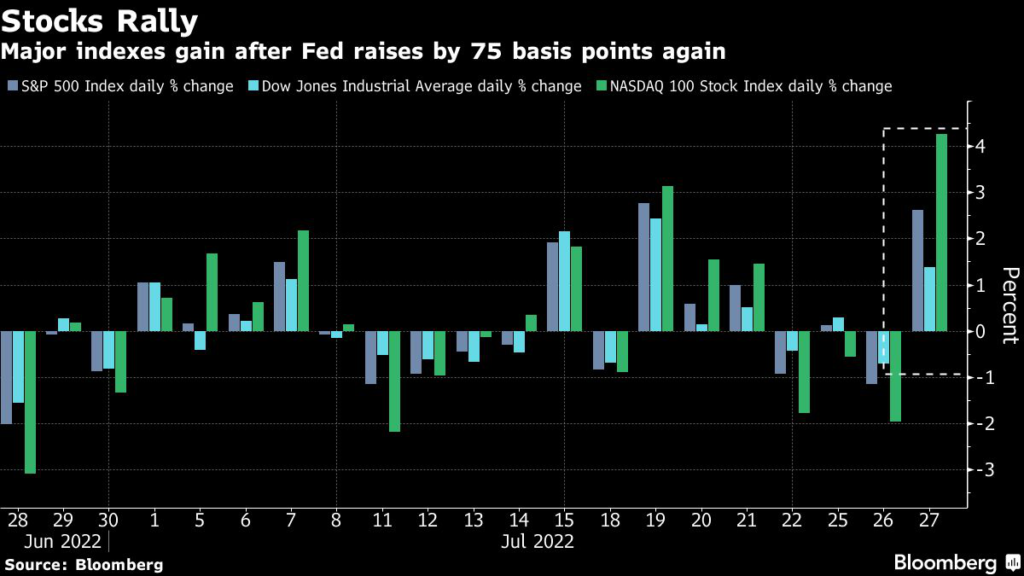
Stocks Push Higher Amid Bets on Slower Fed Hikes: Markets Wrap

(Bloomberg) — Stocks rose on Thursday as the prospect of a slower pace of Federal Reserve monetary tightening filtered across global markets. Investors are turning their focus to the busiest day of the earnings season along with key economic data.

Mining and energy shares gained in Europe as oil advanced. Solar energy and renewables stocks rallied in Europe and premarket trading after US Senator Joe Manchin and Senate Majority Leader Chuck Schumer struck a deal on a tax and energy policy bill, with Vestas Wind Systems A/S surging more than 12%. Chinese developers jumped after a report said banks may provide support.

A dip in futures suggested the US rally could stall when Wall Street reopens, with technology stocks set to pull back after their biggest jump since November 2020. Big Tech will be a particular focus on Thursday with results from Amazon.com Inc., Apple Inc. and Intel Corp. 

The Fed raised rates by 75 basis points for a second month, saying such a move is possible again and reiterating its desire to curb inflation. Chair Jerome Powell added the pace of hikes will slow at some point and policy will be set meeting-by-meeting. That shift comes amid signs of an economic slowdown. 

“As the tug-of-war between inflation and recession fears plays out in the second half of the year, we expect to see highly volatile markets,” Richard Flynn, UK Managing Director at Charles Schwab, wrote in a note.

Treasury yields were little changed and the dollar slipped. Swaps tied to the date of Fed policy meetings imply a 3.3% peak for the fed funds rate around year-end — not much higher than the current range of 2.25% to 2.5%. 

US and European firms worth more than $9.4 trillion will report their results on Thursday. The latest US earnings were mixed, with Facebook parent Meta Platforms Inc. posting its first ever quarterly sales decline as Ford Motor Co. beat estimates. Barclays Plc’s earnings fell short of forecasts after the bank booked charges and penalties in the US. 

Among individual stock moves, Moncler and Gucci owner Kering advance after the their respective first-half results showed that demand for luxury items is holding up.

Shell Plc gained as it accelerated share buybacks after reporting record profit. Stellantis NV advanced as it expects to overcome supply-chain snarls to extend strong earnings into the second half of the year. Airbus SE fell after cutting its delivery goal and slowing a ramp-up in production of its best-selling narrow-body model. 

Meanwhile, confidence in the euro-area economy fell to the weakest in almost 1 1/2 years as fears of energy shortages haunt consumers and businesses, and the European Central Bank’s first interest-rate increase in a more than decade feeds concerns that a recession is nearing.

The knee-jerk relief in markets on possible crumbs of comfort from the Fed outlook echoes a pattern seen after earlier hikes. Those bouts of optimism stumbled on recession risks from a global wave of monetary tightening, Europe’s energy woes and China’s property sector and Covid challenges.

Read more: Specter of Next-Day Losses Haunts Stock Bulls’ Post-Fed Rally

“We do feel the hikes are going to slow from these levels,” Laura Fitzsimmons, JPMorgan Australia’s executive director of macro sales, said on Bloomberg Television. But financial-industry participants are skeptical about the pricing indicating Fed rate cuts in 2023, she added.

Former New York Fed President Bill Dudley said markets are underestimating just how far the Fed will go to tame decades-high inflation. The next key data are US growth and a read on cost pressures. The nation is seen avoiding a technical recession amid a moderation in the core PCE deflator. 

The Fed can’t “downshift gears too much” in part because core inflation is poised to decline at a “glacially slow pace,” Seema Shah, chief global strategist at Principal Global Investors, wrote in a note. She expects the Fed to lift borrowing costs above 4% next year. 

Elsewhere, traders are awaiting a phone call between President Joe Biden and China’s Xi Jinping, which could touch on US tariffs and other points of tension.

Here are some key events to watch this week:

  • Apple, Amazon earnings, Thursday
  • US GDP, Thursday
  • Euro-area CPI, Friday
  • US PCE deflator, personal income, University of Michigan consumer sentiment, Friday

Musk, Tesla and Twitter are this week’s theme of the MLIV Pulse survey. Also share your views on the S&P 500’s biggest stocks. Click here to get involved anonymously.

Some of the main moves in markets:

Stocks

  • The Stoxx Europe 600 rose 0.2% as of 10:05 a.m. London time
  • Futures on the S&P 500 fell 0.4%
  • Futures on the Nasdaq 100 fell 0.9%
  • Futures on the Dow Jones Industrial Average fell 0.2%
  • The MSCI Asia Pacific Index fell 0.2%
  • The MSCI Emerging Markets Index was little changed

Currencies

  • The Bloomberg Dollar Spot Index fell 0.2%
  • The euro was little changed at $1.0204
  • The Japanese yen rose 0.9% to 135.33 per dollar
  • The offshore yuan was little changed at 6.7454 per dollar
  • The British pound rose 0.2% to $1.2178

Bonds

  • The yield on 10-year Treasuries was little changed at 2.79%
  • Germany’s 10-year yield advanced four basis points to 0.99%
  • Britain’s 10-year yield advanced three basis points to 1.99%

Commodities

  • Brent crude rose 1.2% to $107.91 a barrel
  • Spot gold rose 0.7% to $1,746.41 an ounce

(An earlier version of this story was corrected to show Bill Dudley is a former New York Fed president.)

More stories like this are available on bloomberg.com

©2022 Bloomberg L.P.
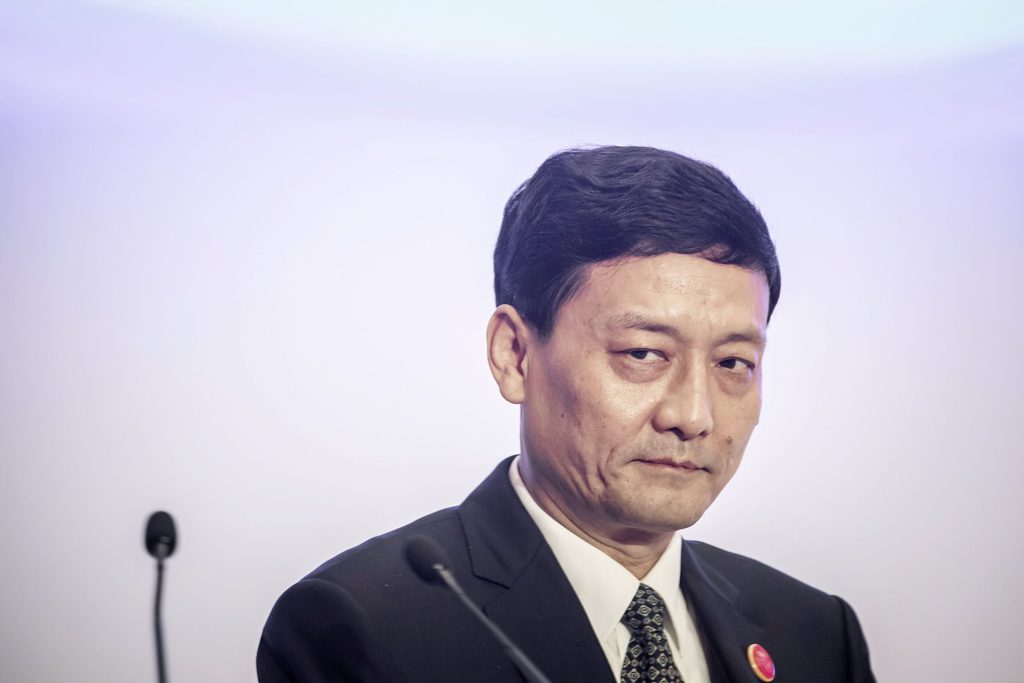
China Investigates Industry Minister Over Suspected Violations

(Bloomberg) — China is investigating Minister of Industry and Information Technology Xiao Yaqing on suspicion of “legal and disciplinary violations,” the country’s top anti-graft agency said in a statement.

The agency didn’t offer further details. Xiao’s ministry is the regulator for the country’s major heavy industries, telecom and electronics sectors, overseeing companies from Huawei Technologies Co. to Xiaomi Corp.


More stories like this are available on bloomberg.com

©2022 Bloomberg L.P.
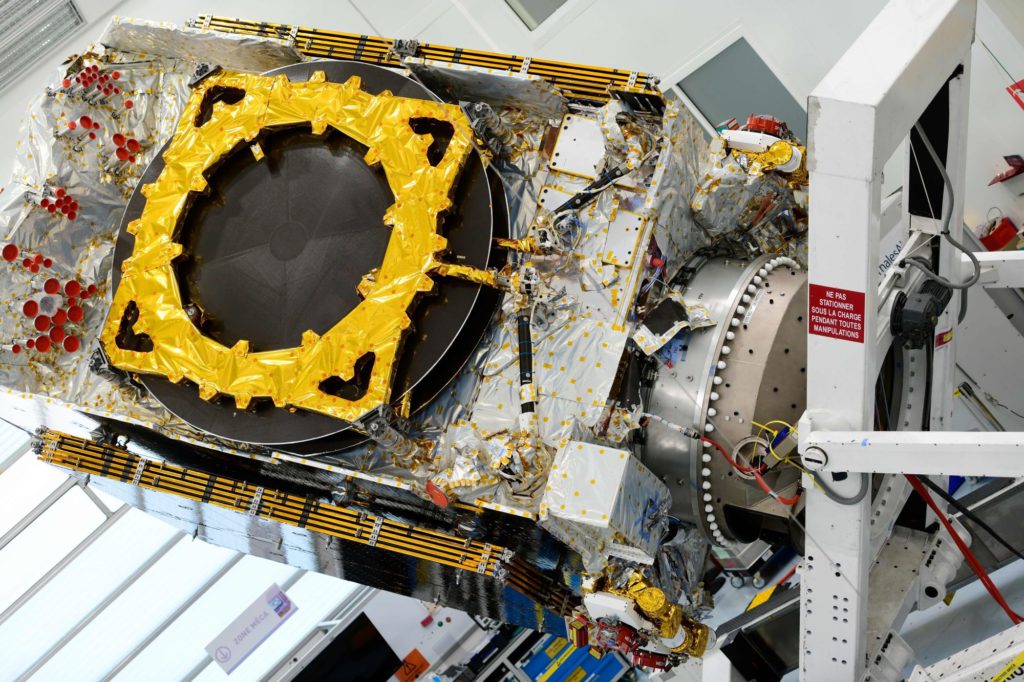
France and UK Try to Put Brexit Behind Them – In Space

(Bloomberg) — A satellite merger between France’s Eutelsat Communications SA and Britain’s OneWeb relies on an unusual power-sharing arrangement that will test the two nations’ cooperation on industrial strategy, the European Union and Russia.

The two government-backed businesses agreed to combine on Tuesday, only after the French satellite operator got the green light from President Emmanuel Macron, according to a person familiar with the discussions. A representative for the French presidency declined to comment on its involvement in the deal. 

Read More: Eutelsat, OneWeb to Merge in $3.4B All-Share Deal: M&A Snapshot

The $3.4 billion combination will create a European satellite operator that can compete with projects from the likes of Elon Musk and Jeff Bezos to blanket the earth in a new kind of low-earth orbit or “LEO” broadband.

LEO technology — which works via constellations of small satellites that are closer to the ground and provide faster connections than Eutelsat’s existing geostationary system — has become a geopolitical battleground, with operators promising governments surveillance, intelligence and command mission capabilities. 

Read More: Musk’s Starlink Gives Ukraine Internet in Peek at New Space Race

“Governmental and military uses are really key,” Eutelsat Chief Executive Officer Eva Berneke said in an interview with Bloomberg on Wednesday. “We have some very big American competitors, we will probably have some very big Chinese competitors, and we’ll probably also have some Russians, once they get their space industry back together.”

The EU and Macron have earmarked billions for investment in space and satellite programs, and Eutelsat is aiming to win a role in European Commissioner Thierry Breton’s planned LEO project, according to Berneke and a French government official.

However, Britain’s role could cause complications. A golden share granting specific rights to the UK, which left the EU in 2020, may not qualify for Breton’s vision of a sovereign constellation free of any control from a third country, according to an EU official, who asked not to be named because they aren’t authorized to speak to the press. It’s up to private entities to explain how they comply with the criteria, the person said.

Christophe Grudler, the parliamentarian in charge of the EU’s constellation project, said using OneWeb-Eutelsat seems “impossible” in a statement. “The European Union needs to be in complete control of its satellites, without risking being hampered by an outside actor,” he wrote. “Europe will not compromise on this point.”

“The European Union needs to be in complete control of its satellites, without risking being hampered by an outside actor,” said Christophe Grudler, parliamentarian in charge of EU’s constellation project. “Europe will not compromise on this point.”

Berneke said the specification for the EU constellation hasn’t been confirmed, but she thinks it will be possible to carve out a specialized unit in the combined business to satisfy these criteria. 

Since it left the EU, the UK has been cut out of the secure layer of the bloc’s GPS-like satellite system Galileo, leaving it to study ways of building its own positioning and timing system.

Stakeholders have also considered the risk UK Brexiters balk at the perception of selling an important asset to the French, said one person involved with the discussions. Former UK science minister George Freeman tweeted to say the deal could “hand over another key industrial asset to UK competitors” unless Britain’s rights were protected.

A representative for the European Commission said that the Commission assesses any party that wants to participate in future procurements “for the preservation of the security, integrity and resilience of operational systems of the union,” and declined to comment further on the investment decisions of private companies. 

A spokesperson for the UK government pointed to an earlier statement in support of the deal and declined to comment further. 

The UK and France will each have board seats in the combined company, and France will have sway over 10% of voting rights through BPIFrance. Britain will have 11%, plus a separate golden share in OneWeb, which gives it national security controls.

The parent business will be Eutelsat, and it will be headquartered and primarily listed in Paris. CEO Berneke and Eutelsat’s chair will continue in their posts, while OneWeb’s Executive Chairman Sunil Bharti Mittal will act as vice president.

Russia, China

Russia will be high on the new board’s agenda. The Kremlin is holding 36 OneWeb satellites hostage after the Russian space agency pulled support for a planned launch in Kazakhstan. That’s raising concern in the European Commission that Russia may have had the opportunity and ability to compromise the satellites’ systems, a person familiar with the body’s thinking said. 

The UK had refused to accede to Russian President Vladimir Putin’s demand to give up its shareholding in OneWeb and pledge not to use the satellite company for military purposes. 

Eutelsat will have to balance efforts to recover OneWeb’s satellites with its business selling broadcasting services into Russia, which accounts for about 6% of revenues, according to analysts at Berenberg. The company has said the deal won’t lead to any material deterioration in sales to Russian customers. 

Then there’s the Chinese. China Investment Corp., a Beijing sovereign wealth fund, is one of Eutelsat’s biggest shareholders. British leaders, including the candidate for Prime Minister Rishi Sunak, consider China a top threat in technology. 

A Eutelsat spokesman played down concerns, saying the Chinese fund holds under 4% of the company’s stock in a passive stake, which will be diluted down below 2% after the deal.

The Russian state space corporation, Roscosmos, didn’t immediately respond to an email requesting comment. A representative for OneWeb declined to comment. 

Golden Share

The tie-up also revives questions about who will make new spacecraft, a political prize of high-tech jobs and industrial capacity. 

OneWeb’s “Gen 1” satellites have been made at a factory in Florida in a venture with Franco-German aerospace giant Airbus. That factory probably won’t make “Gen 2” because Airbus has secured other orders for the facility, Berneke said. 

OneWeb executives previously raised hopes Gen 2 would be made in the UK, but the contract is up for grabs, Berneke said. 

On Tuesday, the UK said its golden share in OneWeb will continue to grant it “first-preference rights over domestic industrial opportunities” like “preferring businesses in the UK for future procurement for manufacturing on a commercial basis.”

The UK also said it would be “a preferred location for future OneWeb launches.”

Until recently, they’ve all been sent up using France-backed Arianespace, making OneWeb that company’s most frequent client. 

More stories like this are available on bloomberg.com

©2022 Bloomberg L.P.
Billionaire CEO Seeks to Reset Fintech Pioneer After IPO Fiasco

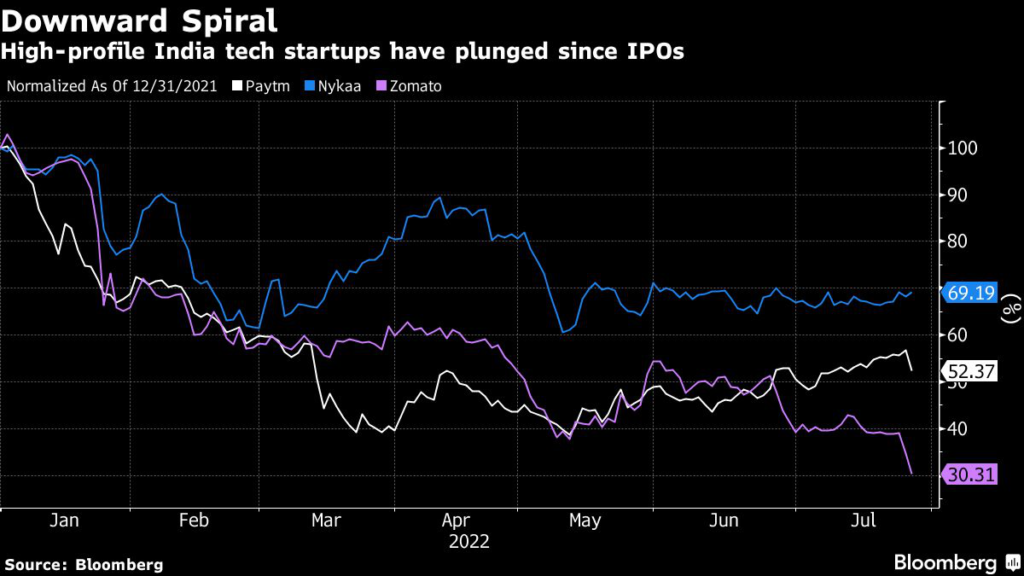
(Bloomberg) — Paytm was the poster boy for India’s tech startups, only to lose two-thirds of its value since its IPO and become a symbol of the industry’s crash. Now its founder promises a sharpened focus on financial performance to convince investors of the money-losing company’s prospects.

The digital-payments provider is set to become India’s first internet company to hit $1 billion in annual revenue by the end of this fiscal year in March, said Vijay Shekhar Sharma, 44. The brand, known formally as One97 Communications Ltd., is also shifting its attention from growth toward profitability, Sharma said in his first extensive interview following the high-profile public debut in November.

“We’re earnestly chasing the $1 billion goal,” he said during an hours-long conversation last week at Paytm’s new chrome-and-glass headquarters in Noida, outside New Delhi, in a vast green expanse filled with wandering cattle. “For me, the public listing was a sort of graduation, and taking Paytm to break-even and to profits gives me a clarity of purpose.”

Paytm’s stock-price collapse exacerbated a crisis for India’s startups, sending valuations plummeting as investors began to grow cautious about their earnings potential. Young firms — dozens of which had hit unicorn status as capital flowed to everything from online retail to digital learning in the country of 1.4 billion — suddenly saw their fundraising plans grind to a halt. To make matters worse, the war in Ukraine and fears of a global recession further clouded the picture for startups worldwide in 2022.

Describing his approach as a rewind-and-reset, Sharma is on a mission to win back investors. And he’ll have his hands full: Paytm’s operating losses widened over the past year to about $350 million, competition is intensifying and investors have lambasted the lack of clarity in the company’s business model.

One step toward regaining trust is a demystifying of Paytm’s revenue structure, said the founder, who is also the company’s chief executive officer. He said its work can be simplified to two short lines: Paytm is in the business of payments, and it sells loans.

India’s payments market differs from that of more developed countries, as it bypassed card-based systems popular in regions such as Europe and the US to jump directly from cash to mobile device payments. While that’s attracted droves of contenders like Alphabet Inc.’s Google Pay, Amazon.com Inc.’s Amazon Pay and Walmart Inc.’s PhonePe, Sharma is confident Paytm’s products — some modeled on success cases in other markets — will help it retain its leadership position.

Its Sound Box, for instance, is a $2-a-month subscription which instantly reconciles payments and announces a successful purchase via a speaker at the merchant’s counter. Another product generates a unique QR code for each transaction and lets shoppers pay swiftly through Paytm’s smartphone application as well as other apps — a model already prevalent in China.

“I want to make Paytm the most relevant payments company of our times,” he said, dressed in a checked shirt and blue jeans, seated in a conference room framed against a distant backdrop of high rises.

To expand Paytm’s reach, Sharma has steadily ramped up its lending business. While taking on traditional banks is a challenge, Paytm is convinced it’ll win over users in what is currently a credit-starved market.

In both payments and lending, Paytm has started to publish more metrics. It’s revealed more data on users, revenue streams and loan disbursals, treating investors on par with board members — and so far, the numbers have been beating internal expectations, Sharma said.

Sharma, who grew up the son of a teacher in the small town of Aligarh in central India, founded Paytm parent One97 Communications over two decades ago. The company began offering digital payments in 2014, and has since snared a who’s who of global investors including Masayoshi Son’s SoftBank Group Corp., Warren Buffett’s Berkshire Hathaway Inc. and Jack Ma’s Ant Group Co., growing into the country’s most ubiquitous payments brand.

If the early years were challenging, this has been Paytm’s most grueling phase ever. The IPO shone light on Paytm’s business model, allowing investors to more closely scrutinize the company’s earnings logic and valuation. The founder defended both, citing the successful listings of internet peers like Nykaa and Zomato Ltd. and bankers’ advice on the maturity of Paytm’s revenue model. Paytm plunged 27% on the first day and is currently down more than 60% from its IPO price.


“On hindsight, the pricing and the timing look haywire,” said Sharma. “Used to private exits where things are a lot more under control, we weren’t prepared for this.”

In the past months, Sharma has told investors that his strategy will allow Paytm to reach operational break-even by September 2023. The company has slashed spending and is considering an exit from a pricey cricket sponsorship and terminating an agreement to acquire insurer Raheja QBE General Insurance.

“Earlier the team used to be like, ‘Cricket sponsorship? that’s so cool!’ to now, ‘How much money can we save if we gave that up?’” the CEO said.

Skeptics say profitability will remain an uphill battle. Analysts at Macquarie Capital Securities (India) Pvt., who were early to predict Paytm’s stock decline, said in March that the shares would plummet further to 450 rupees. Sharma said board member and early investor Ravi Adusumalli, founder of Elevation Capital, recently told him he’d prefer $1 billion in profit over $1 billion in revenue.

Putting his money where his mouth is, Sharma said his personal stock grants will vest only after the shares stay sustainably above the IPO offer price.

“I’m going to be the last person to be paid in this company,” he said. “One day soon, we will get our due.”

More stories like this are available on bloomberg.com

©2022 Bloomberg L.P.

Artists Use Crypto to Take the `Industry’ Out of Music Industry

  • Listen to Bloomberg Crypto on the iHeartRadio App
  • Listen to Bloomberg Crypto on Apple Podcasts
  • Listen to Bloomberg Crypto on Spotify  

(Bloomberg) — Earlier this year,  pop music duo The Chainsmokers released 5,000 nonfungible tokens for free. These NFTs gave fans a 1% cut of the streaming royalties from their latest album, as well as priority access to concert tickets and free merchandise. The Chainsmokers aren’t the first musicians to experiment with crypto, NFTs or blockchain, and they’re unlikely to be the last.  

Royal, a startup that’s looking to give fans more access and more investment opportunities related to the bands they love, partnered with The Chainsmokers to give their fans a stake in their success. Royal CEO Justin Blau joins this episode, along with Bloomberg reporter Hannah Miller.

Follow us on Twitter @crypto, and subscribe to the Bloomberg Crypto Newsletter at https://bloom.bg/cryptonewsletter 


More stories like this are available on bloomberg.com

©2022 Bloomberg L.P.

Artists Use Crypto to Take the ‘Industry’ Out of Music Industry

  • Listen to Bloomberg Crypto on the iHeartRadio App
  • Listen to Bloomberg Crypto on Apple Podcasts
  • Listen to Bloomberg Crypto on Spotify  

(Bloomberg) — Earlier this year,  pop music duo The Chainsmokers released 5,000 nonfungible tokens for free. These NFTs gave fans a 1% cut of the streaming royalties from their latest album, as well as priority access to concert tickets and free merchandise. The Chainsmokers aren’t the first musicians to experiment with crypto, NFTs or blockchain, and they’re unlikely to be the last.  

Royal, a startup that’s looking to give fans more access and more investment opportunities related to the bands they love, partnered with The Chainsmokers to give their fans a stake in their success. Royal CEO Justin Blau joins this episode, along with Bloomberg reporter Hannah Miller.

Follow us on Twitter @crypto, and subscribe to the Bloomberg Crypto Newsletter at https://bloom.bg/cryptonewsletter 


More stories like this are available on bloomberg.com

©2022 Bloomberg L.P.

Close Bitnami banner
Bitnami