
Bloomberg

Samsung’s Profit Is Latest Tech Casualty to Recession Fears

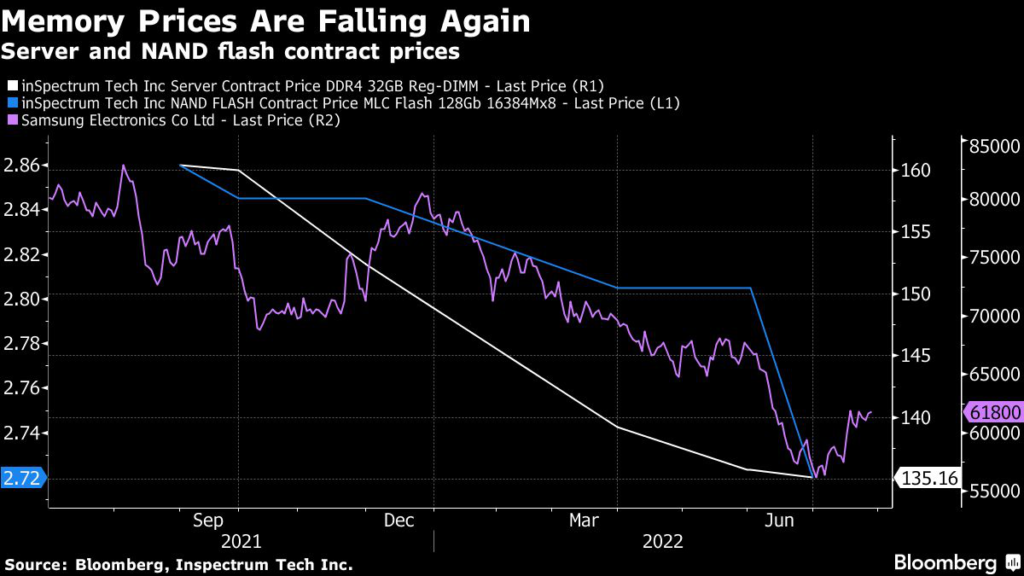
(Bloomberg) — Samsung Electronics Co.’s quarterly profit missed estimates after cooling demand for consumer gadgets hit its chip division, spurring concerns about the outlook for Big Tech in 2022.

The world’s largest producer of smartphones and displays reported a less-than-expected 16% rise in net income, reflecting how it’s still navigating rising uncertainty around a potential global recession. Revenue from its semiconductor division, which as the world’s largest producer of memory is an indicator of electronics demand, missed analysts’ estimates by about 22%.

Apple Inc., Amazon.com Inc. and Microsoft Corp., which are all major buyers of chips, are reining in budgets for next year and, in turn, denting chipmakers’ capacity expansion plans. Samsung warned of weakening demand for PCs and mobile phones in the second half of the year, joining a growing cadre of tech giants sounding the alarm over global economic uncertainty. Smartphone processor maker Qualcomm Inc. gave a downbeat quarterly outlook on weakening consumer spending, while memory rival SK Hynix Inc. forecast waning growth and rising inventories ahead. 

What Bloomberg Intelligence Says 

“DRAM contract prices started dropping slightly from April sequentially, stayed flat in May and ended June slightly lower. Monthly DRAM exports have been steady at about $3.5 billion from July 2021, suggesting the rate of growth may shrink further from July this year.”

– Masahiro Wakasugi, BI analyst 

Click here for the full research. 

Samsung’s shares stood largely unchanged in Seoul. 

Korea’s largest company on Thursday said its net income rose to 10.95 trillion won ($8.3 billion) in the three months ended June, missing projections for 11.2 trillion won. Sales from the semiconductor division grew a smaller-than-predicted 24% to 28.5 trillion won, missing estimates for about 36.7 trillion won. The smartphone and networking division however grew 29% to 29.3 trillion won, slightly ahead of expectations.

A tricky balancing act lies ahead for Samsung, as the company, its manufacturing clients and its suppliers all struggle to gauge the extent of future weakness in consumer demand amid component shortages and rising materials costs. 

“With the huge amounts of uncertainty in the market, driven by a wide variety of macro issues, we will flexibly supply memory chips by using inventory,” said Han Jinman, executive vice president at Samsung’s semiconductor business at a post-earnings conference call.


Lead times remain long for tools to make semiconductors, due to chronic issues with parts supplies. In the long run, this could mean delays in adopting new lines that process more powerful chips faster, Han said. “There are structural constraints in production. We expect market bit growth of DRAM will be significantly lower next year.”  

Regarding short-term investments in equipment, Han reiterated the company’s stance to flexibly respond by regularly reviewing changing market conditions.  

In the longer run, chip sales are growing much more slowly than expected and will begin to decline in 2023, Gartner said in a report, marking an end to one of the sector’s biggest boom cycles. 

Hynix said Wednesday it revised down its chip shipment growth for the current quarter and added it’d significantly adjust its capex for next year due to a high level of inventories throughout the market. In contrast, Texas Instruments Inc., which has a wider range of chip products, gave a bullish outlook for the current quarter as it sees demand recovery after lockdowns in China hit sales.  

“The global semiconductor market is entering a period of weakness, which will persist through 2023 when semiconductor revenue is projected to decline 2.5%,” Richard Gordon, a Gartner analyst, said in the report. PC shipments will contract 13% in 2022 after two years of growth, Gartner predicts, while smartphone sales will rise just 3.1% this year after surging almost 25% in 2021. 

(Adds company comments in sixth to ninth paragraphs)

More stories like this are available on bloomberg.com

©2022 Bloomberg L.P.
VW’s China Presence Key to Global Ambitions, Outgoing Boss Says

(Bloomberg) — Volkswagen AG must maintain its focus on China to continue being one of the world’s leading automakers — no matter who its chief executive is — according to the person who’s led the company’s operations in the nation since 2019.   

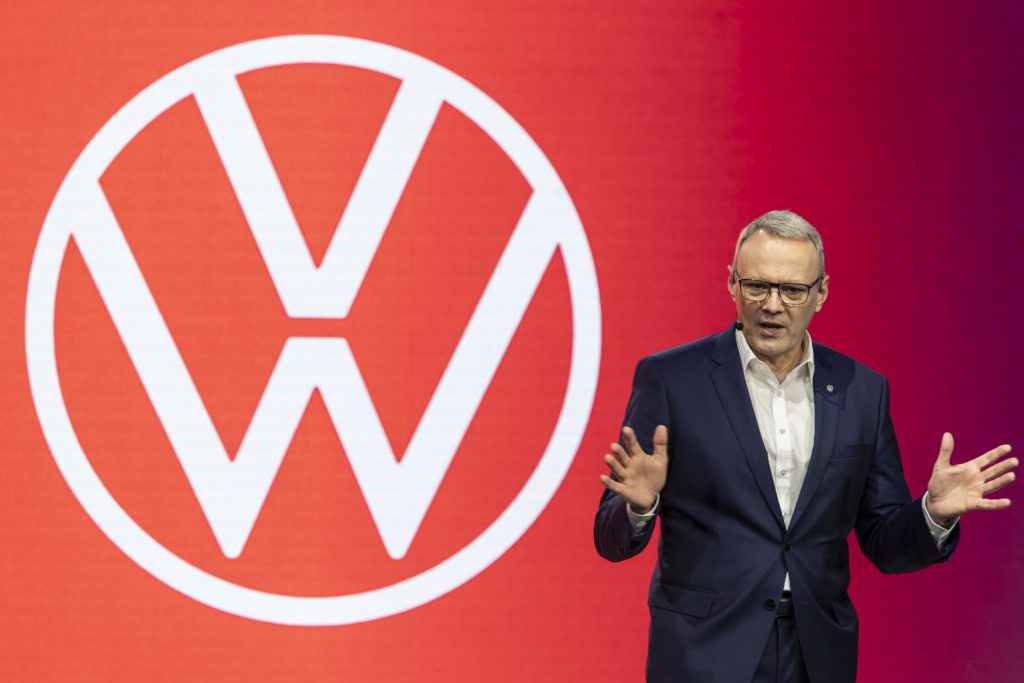
Stephan Wollenstein, who first came to the country in 2004 and will step down as China CEO at the end of this month, said he’s witnessed a “fundamental paradigm shift” in the auto industry, which has forced global carmakers including VW to focus on China, now the world’s biggest auto market.  

“If you’re not in China and if you don’t cope with China’s speed and treat China specifically, I have my doubts that you will be a leading manufacturer in the next 5-to-10 years,” he said. 

VW has a “pretty solid projection” that China’s auto sales will grow to 28 million to 30 million by 2030, accounting for about 30%-35% of the global auto market, Wollenstein said in an interview. China is a key market for VW, accounting for roughly 40% of its global deliveries in the first quarter. The company employs more than 90,000 people in the country and operates over 40 vehicle and components factories along with partners.

After shipping a record 4.23 million vehicles in China in 2019, VW’s sales slid to 3.3 million in 2021 as the pandemic took a toll. Deliveries have continued on that downward trend, falling 20% to 1.47 million in the first half of this year as Covid outbreaks in Shanghai and Changchun disrupted production. Nevertheless, the company is sticking to its annual sales target of 3.8 million as pent-up demand drives a rebound in sales.

Wollenstein said closed-loop systems that enable staff to work during lockdowns by living onsite are “not sustainable at all” if factories can’t get parts delivered. They only work in a situation where a factory is stocked with parts and can keep operating, he said. Supply chain snarls during lockdowns had a knock-on effect on many manufacturers in China. 

Read more: VW Bets on EVs for China Growth as Chip Shortage Hits Sales 

The changing of the guard at VW’s China unit comes amid upheaval at head office, with Herbert Diess last week replaced as CEO by Porsche chief Oliver Blume in an abrupt shake-up. Diess has called China the company’s “second home market,” saying VW’s business there generates more than 4 billion euros ($4.2 billion) in profit every year.

Read more: VW Appoints Porsche CEO to Succeed Diess After Tumultuous Tenure

The global auto market has changed massively during Wollenstein’s 14 years in China, he said. The nation is now “the powerhouse of the next generation of automotive trends” including electric vehicles and connected and intelligent cars, he said.   


To that end, VW is realigning its China management, led by incoming CEO Ralf Brandstaetter, to give it more autonomy and streamline decision making.  

China’s consumers are being spoiled for choice, particularly in EVs, from upstarts Nio Inc. and Xpeng Inc. whose feature-packed cars and lifestyle accessories are attracting customers; BYD Co., whose sales of pure-electric and plug in hybrids are surging, and EV pioneer Tesla Inc., which has bounced back strongly from Covid lockdowns.  

“This is all in the race of standing out and making a difference to be seen and having a chance to last,” Wollenstein said of his Chinese competitors. 

VW plans to hire 1,000 engineers in China by the end of this year, including in software, and will look at acquisitions and partnerships to expand, he said. VW’s software unit Cariad also entered China this year, its first step outside Europe.

“I am often joking that I’m not so sure whether we are the most international Chinese carmaker or the most Chinese international carmaker,” Wollenstein said.

The automaker has also taken steps to shore up supply chains after being hit by the global semiconductor shortage and surging competition for metals used in EV batteries. It has formed a partnership with STMicroelectronics NV to jointly develop chips, and struck agreements with Zhejiang Huayou Cobalt Co. and Tsingshan Holding Group Co. to help secure nickel and cobalt.   

One of the biggest challenges for Brandstaetter will be to balance VW’s presence in Xinjiang — where it operates a car factory and faces mounting pressure to address allegations that ethnic Uyghurs are suffering from coercive labor practices — with local demands to remain in the region.  

“Whatever way we turn on the tiny operation in Xinjiang we can never make it right to both stakeholder sides,” Wollenstein said. 

More stories like this are available on bloomberg.com

©2022 Bloomberg L.P.
Stocks Up Amid Bets on Slower Fed Hikes: Markets Wrap

(Bloomberg) — Stocks rose in Asia on Thursday, bonds climbed and the dollar fell as the prospect of a slower pace of Federal Reserve monetary tightening filtered across global markets.

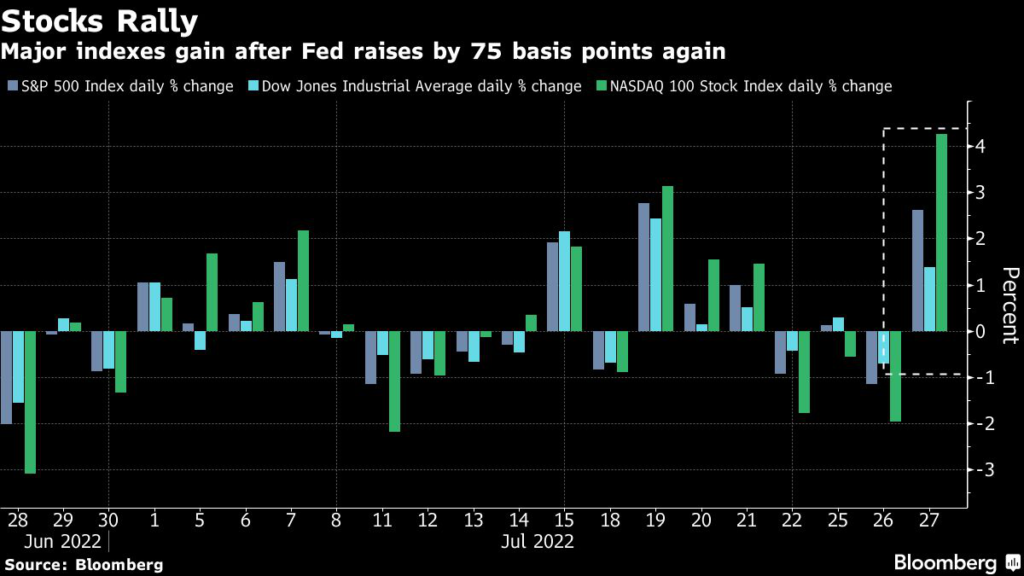
An Asian share gauge added about 1%, bolstered by gains in the Chinese technology sector. That followed Wednesday’s 2.6% surge in the S&P 500 and 4.3% jump in the Nasdaq 100 — though futures suggested the US rally may cool.

The Fed raised rates by 75 basis points for a second month, said such a move is possible again and reiterated its desire to fight inflation. Chair Jerome Powell added the pace of hikes will slow at some point and policy will be set meeting-by-meeting. That shift comes amid signs of an economic slowdown. 

Treasuries advanced, lowering the 10-year yield to 2.77%. Swaps tied to the date of Fed policy meetings imply a 3.3% peak for the fed funds rate around year-end  — not much higher than the current range of 2.25% to 2.5%. 

The yen strengthened 1% against the dollar in the fallout from the Fed decision. Oil advanced toward $99 a barrel, gold edged up and Bitcoin was steady.

The knee-jerk relief in markets on possible crumbs of comfort from the Fed outlook echoes a pattern seen after earlier hikes. Those bouts of optimism stumbled on recession risks from a global wave of monetary tightening, Europe’s energy woes and China’s property sector and Covid challenges.

Read more: Specter of Next-Day Losses Haunts Stock Bulls’ Post-Fed Rally

“We do feel the hikes are going to slow from these levels,” Laura Fitzsimmons, JPMorgan Australia’s executive director of macro sales, said on Bloomberg Television. But financial-industry participants are skeptical about the pricing indicating Fed rate cuts in 2023, she added.

Former New York Fed President Bill Dudley said markets are underestimating just how far the Fed will go to tame decades-high inflation. The next key data are US growth and a read on cost pressures. The nation is seen avoiding a technical recession amid a moderation in the core PCE deflator. 

Terminal Rate

The Fed can’t “downshift gears too much” given that core inflation is poised to decline at a “glacially slow pace,” Seema Shah, chief global strategist at Principal Global Investors, wrote in a note. She expects the Fed to lift borrowing costs above 4% next year.

The latest US earnings were mixed. Facebook parent Meta Platforms Inc. posted its first ever quarterly sales decline. Chip firm Qualcomm Inc. gave a lackluster forecast. Ford Motor Co.’s performance beat estimates. Best Buy Co. cut its profit forecast, saying inflation is hitting consumer demand.

Elsewhere, traders are awaiting a phone call between President Joe Biden and China’s Xi Jinping, which could touch on US tariffs and other points of tension.

Separately, Securities and Exchange Commission Chair Gary Gensler said the US and China must reach an agreement “very soon” over access to audit work papers for Chinese firms. Otherwise they face being kicked off US exchanges.

Here are some key events to watch this week:

  • Apple, Amazon earnings, Thursday
  • US GDP, Thursday
  • Euro-area CPI, Friday
  • US PCE deflator, personal income, University of Michigan consumer sentiment, Friday

Musk, Tesla and Twitter are this week’s theme of the MLIV Pulse survey. Also share your views on the S&P 500’s biggest stocks. Click here to get involved anonymously.

Some of the main moves in markets:

Stocks

  • S&P 500 futures fell 0.1% as of 11:48 a.m. in Tokyo. The S&P 500 rose 2.6%
  • Nasdaq 100 futures fell 0.3%. The Nasdaq 100 advanced 4.3%
  • Japan’s Topix index rose 0.1%
  • Australia’s S&P/ASX 200 index climbed 0.7%
  • South Korea’s Kospi index added 0.9%
  • China’s Shanghai Composite index rose 0.9%
  • Hong Kong’s Hang Seng index was up 0.2%
  • Euro Stoxx 50 futures increased 0.6%

Currencies

  • The Bloomberg Dollar Spot Index fell 0.1%
  • The euro was at $1.0203
  • The Japanese yen was at 135.36 per dollar, up 0.9%
  • The offshore yuan was at 6.7485 per dollar, down 0.1%

Bonds

  • The yield on 10-year Treasuries declined one basis point to 2.77%
  • Australia’s 10-year bond yield dropped seven basis points to 3.18%

Commodities

  • West Texas Intermediate crude was at $98.72 a barrel, up 1.5%
  • Gold was at $1,737.20 an ounce, up 0.2%

(Corrects eighth paragraph to show Bill Dudley is a former New York Fed president.)

More stories like this are available on bloomberg.com

©2022 Bloomberg L.P.

Elon Musk’s Starlink Eyed For Philippine Rollout Before End-2022

(Bloomberg) — Elon Musk’s Starlink will likely roll out its satellite Internet services in the Philippines before yearend, the nation’s Department of Information and Communications Technology said.

Starlink, which is operated by SpaceX, is expected to help in President Ferdinand Marcos Jr.’s push to make Internet available in remote areas, ICT Secretary Ivan John Uy said in a statement Thursday.

“This will bridge the digital divide in an archipelagic country like the Philippines where laying fiber cables or establishing cell towers in mountainous areas can be challenging,” said Uy, who held a joint briefing with SpaceX executive Rebecca Hunter on Wednesday.

Starlink will not compete with the existing telecommunications providers in the country, but will provide Internet connectivity to underserved areas, Hunter said in the same statement. Starlink got the Philippine government approval in May to build and operate broadband facilities.

The communications and technology agency, in partnership with local governments, will initially cover the cost of the Starlink service in remote areas, according to BusinessWorld. The Starlink kit will carry a price tag of $599 while the monthly service will be $99, the newspaper reported.

More stories like this are available on bloomberg.com

©2022 Bloomberg L.P.
99 Group Raises Funds After Carousell Takeover Talks Collapse

(Bloomberg) — Carousell Pte’s bid to buy property portal 99 Group fell through after the online classifieds marketplace ended talks to go public via a merger with a blank-check company, according to a person familiar with the matter.

99 Group terminated the talks after Carousell failed to reach a merger agreement with L Catterton Asia Acquisition Corp., a key part of the deal, the person said, asking not to be named as the matter is private. Representatives for Carousell and 99 Group declined to comment.

A combination of Carousell and 99 Group would have united two major Singaporean online listings companies, allowing them to challenge rivals such as real-estate portal PropertyGuru Pte. as home prices rise in the affluent island nation. Enthusiasm for deals with special purpose acquisition companies has waned amid heightened market volatility with a growing number of prominent deals fizzling out.

99 Group has decided to raise additional capital to keep expanding its business, it said in a statement Thursday. The property portal is raising $52 million in a funding round led by Gaw Capital to build up capabilities and branch out to other markets in Southeast Asia.

Carousell had offered more than $150 million in cash and stock to acquire 99 Group, a person familiar with the matter said in February. It was among multiple bidders interested in the property portal, another person said.

99 Group, launched in 2014, runs online property classifieds platforms including 99.co, SRX, iProperty.com.sg and Rumah123.com, according to its website. The company also has a presence in Indonesia and counts Facebook co-founder Eduardo Saverin, Sequoia Capital India, East Ventures and REA Group among investors.

Carousell’s bid for 99 Group was a sign of its ambitions to deepen its presence in high-ticket categories including property while it mulls an exit strategy. The company recently acquired platforms including sneaker marketplace Ox Street, secondhand fashion retailer Refash and smartphone reseller Laku6.

Founded in 2012 by Siu Rui Quek, Marcus Tan and Lucas Ngoo, Carousell last year raised funds at a $1.1 billion valuation. The marketplace, which counts Telenor ASA, Rakuten Ventures, Naver, and Sequoia Capital India among its backers, is in eight markets across Southeast Asia, Taiwan and Hong Kong, allowing users to buy and sell a diverse range of products including cars, houses, gadgets and fashion accessories.

More stories like this are available on bloomberg.com

©2022 Bloomberg L.P.
Amundi Bolsters China Expansion With New Mutual Fund Plan

(Bloomberg) — Europe’s largest asset manager is planning to set up a wholly-owned mutual fund business in China, according to a person familiar with the matter, beefing up its multi-pronged strategy in the country despite macro headwinds. 

Amundi SA has yet to decide whether the new entity will be based in Shanghai or Beijing, and hasn’t submitted a regulatory application, the person said, requesting not to be named because the matter is private. An external representative for the company couldn’t immediately comment on a query sent via email. 

The Paris-based $2.2 trillion manager is escalating its forays into one of the world’s fastest-growing wealth markets, where it’s been seeking to build a secondary home base. The company is turning more bullish on Chinese stocks, as it sees potential positive catalysts. 

Amundi is planning to more than double assets under management in China, Hong Kong and Taiwan by 2025, from about $120 billion, Greater China Chairman Zhong Xiaofeng said a year ago. The company’s wealth management joint venture with Bank of China Ltd. was approved by regulators in 2019, adding to a fund management venture with the Agricultural Bank of China Ltd. 

“Since April we have made a call to be overweight China and it has been the best choice,” Chief Investment Officer Vincent Mortier told Bloomberg in an interview in Singapore Wednesday. “We think it is still valid even though prices have gone up.” 

Chinese stocks will continue to do better as the nation’s Covid Zero policy could “disappear later this year,” regulatory pressures have become more stable, and the company is also “positive” on the Chinese currency in the medium term, he said. 

While Amundi is still cautious on big Chinese tech firms, it’s “liking part of the technology sector,” Mortier said, citing e-commerce and biotech without naming specific stocks.

The asset manager is also “selectively” positive on the real estate sector, believing Chinese authorities can handle the property crisis well, he added. 

The company trimmed China exposure during the first quarter’s selloff. It remains optimistic about the market even after a recent rally.

Amundi is adding more resources to win a bigger slice of China’s retail wealth management space that could grow to $3.4 trillion by 2023, according to estimates by Deloitte.

Competition is intensifying. Fidelity International Ltd. and Neuberger Berman Group have won approvals to set up wholly-owned fund units after BlackRock Inc. became the first global manager to launch such a business. Schroders and Van Eck Associates Corp. are still waiting for approval for their applications. 

More stories like this are available on bloomberg.com

©2022 Bloomberg L.P.
Senate Deal Includes EV Tax Credits Sought by Tesla, Toyota

(Bloomberg) — A breakthrough deal between senators Chuck Schumer and Joe Manchin includes the extension of a popular consumer tax credit for the purchase of electric vehicles, a big win for EV makers like General Motors Co., Tesla Inc. and Toyota Motor Co.

The credit is included in a broader legislative package that revives key portions of President Joe Biden’s domestic political agenda and contains about $369 billion on climate and energy spending. 

It will allow carmakers to continue offering $7,500 in tax credits for the purchase of new “clean cars” with some conditions: they will need to be built with minerals that are extracted or processed in a country the US has a free trade agreement with, and have a battery that includes a large percentage of components that were manufactured or assembled in North America. 

Consumers who make clean car purchases at registered dealers would be allowed to receive discounts at the point of sale that are equal to the value of their credits for the first time. Car buyers would also be eligible to receive $4,000 for used clean cars for the first time.

The policies “will ensure that America builds the core technologies of the 21st Century here at home, and it will allow us to win the global clean transportation race,” the Zero Emission Transportation Association, an industry group that advocates for a faster switch to electric models, said in a statement.

Proposed legislation removes prior requirements that called for qualified vehicles to have solely plug-in electric drive motors and a prior 200,000-vehicle per manufacturer cap that automakers have chafed at as several manufacturers exceeded that threshold.

The deal also includes a cap on the suggested retail price of eligible vehicles of $55,000 for new cars and $80,000 for pickups and SUVs. Credits would be capped to an income level of $150,000 for a single filing taxpayer and $300,000 for joint filers for new vehicles, and at $75,000 and $150,000 for used cars. 

Biden’s package “doubles down on supporting American workers, and puts us in the driver’s seat to win the global clean energy race,” Senator Debbie Stabenow, a Michigan Democrat who has pushed for the new policies, said in a message posted to Twitter. 

EV supporters have argued the tax credits are necessary to spur development of the nascent plug-in car market, which is seen as crucial to reduce the use of fossil fuels and achieve Biden’s ambitious climate goals. If passed, the package would help replenish existing tax credits that have already been exhausted for some automakers. 

Manchin and Schumer have staked out starkly different positions on the viability of electric cars. Schumer has called for all cars that are manufactured in America to be electric by 2030, while Manchin has called the idea of the federal government subsidizing EVs “ludicrous.”

A prior Biden administration proposal suggested allowing unionized carmakers to offer an additional $4,500 to EV car buyers, but the provision was opposed by Manchin after facing strong blowback from companies such Tesla and Toyota, who argued it would have given an unfair advantage to their Detroit-based rivals. 

Carmakers sold a record 652,000 electric vehicles last year, but they made up only 4.4% of new car sales, according to an analysis by BloombergNEF. The percentage doubled from slightly over 2% in 2020. SUVs and pickup trucks comprised about 70% of total 2021 sales, according to Kelley Blue Book, showing the industry still has a long way to go before it comes close to achieving widespread adoption of EVs. 

(A previous version of this story corrected details on income level caps in 7th paragraph.)

(Adds comment in 8th paragraph)

More stories like this are available on bloomberg.com

©2022 Bloomberg L.P.

AirAsia, Skyports Consider Malaysian Airports for Flying Taxis

(Bloomberg) — AirAsia Aviation Group Ltd. and the UK’s Skyports Ltd. will jointly explore building landing sites for flying taxis in Malaysia, as tycoon Tony Fernandes looks to expand into the urban air mobility business. 

Capital A Bhd.’s budget carrier signed an agreement with Skyports to study ground infrastructure and scout potential sites for vertical take-off and landing stations, known as vertiports. The one-year pact will initially focus on building facilities in Malaysia’s capital Kuala Lumpur, the companies said in a statement Thursday. 

Interest in electric vertical take-off and landing vehicles, or eVTOLs, has grown in recent years, with airlines around the world ordering hundreds of them, even though they don’t have regulatory approval to fly passengers and their range is nowhere near that of standard aircraft built by Boeing Co. and Airbus SE. The shift has been hastened by congested cities and mounting pressure on the aviation industry to cut emissions.

AirAsia reached a non-binding agreement with aircraft-leasing firm Avolon Holdings Ltd. in February to rent at least 100 Vertical Aerospace Ltd. flying taxis, joining the likes of American Airlines Group Inc., Virgin Atlantic Airways Ltd. and Japan Airlines Co.

Skyports, which competes with London-based startup Urban Air Port Ltd., signed a pact with Park24 Co. in May to explore building vertiport facilities and integrate with the Japanese company’s parking and car-sharing network. 

More stories like this are available on bloomberg.com

©2022 Bloomberg L.P.

Sequoia Enters Pakistan’s Startup Economy by Backing Fintech

(Bloomberg) — Pakistani fintech company Dbank pulled off the nation’s largest early-stage fundraising round, which also marked venture giant Sequoia Capital’s entry into the nation’s startup economy.

Dbank raised $17.6 million in the seed round co-led by Sequoia Capital Southeast Asia and Kleiner Perkins. Digital banking platform Nubank, RTP Global, Rayn and local partner Askari Bank Ltd. also participated.

Pakistan, the world’s fifth-most populous nation, came under the spotlight with record funding of about $350 million in startups last year. The South Asian nation is in the early stages of its startup economy.

Still, the nation is feeling the impact of the global downturn with Uber Technologies Inc.’s Careem Inc. unit suspending food deliveries and Airlift Technologies Pvt. shutting down after raising the nation’s largest-ever round last year.

Dbank was formed by two former Google employees, Tania Aidrus and Khurram Jamali, who have worked together for over a decade. The company has applied to become a digital retail bank in Pakistan, with an aim to operate in the Pan-Islamic world.

Pakistan as an emerging market has immense potential, according to Mamoon Hamid, a partner at Kleiner Perkins. Dbank is targeting the country’s 110 million adults without access to banking services, which makes it the third-largest unbanked nation after India and China, according to World Bank. 

“Pakistan has a fast-growing middle class with increasingly sophisticated banking needs,” said Johan Surani, vice president at Sequoia Southeast Asia. “This signals a unique opportunity to build a large, customer-centric bank for millions of people.”

More stories like this are available on bloomberg.com

©2022 Bloomberg L.P.
Australia’s Retail Sales Cool as Rising Rates, Prices Take Toll

(Bloomberg) — Australian retail sales increased at the slowest pace this year, in a sign that interest-rate increases to contain quickening inflation are beginning to weigh on household spending.

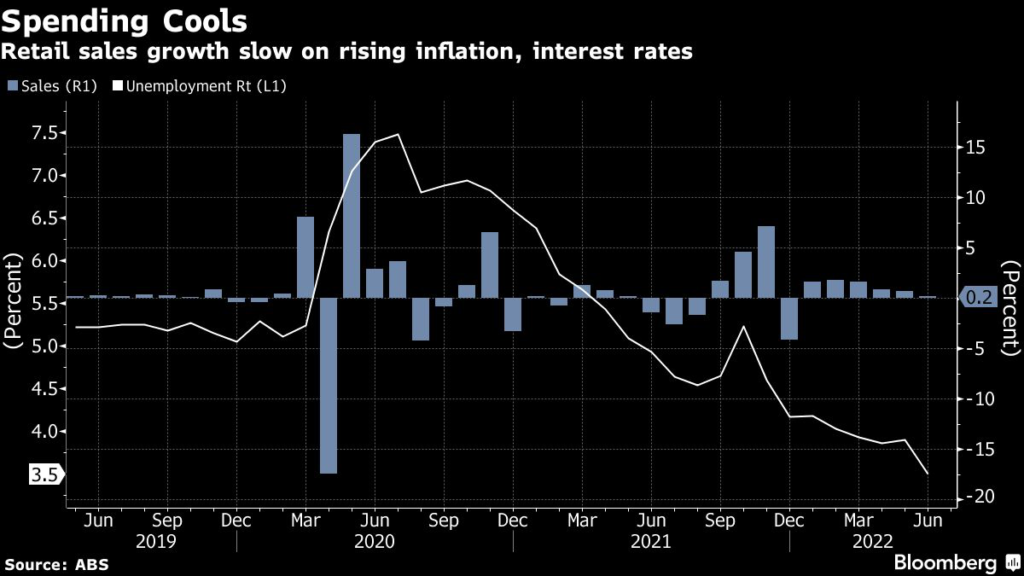
Sales rose 0.2% in June, less than half the 0.5% gain predicted by economists, Australian Bureau of Statistics data showed Thursday. Australian three-year government bond yields slipped following the report.

The figures suggest rising prices of petrol and food, as well as higher borrowing costs, are beginning to impact consumers. The RBA has lifted rates by 125 basis points since May to 1.35% and is widely expected to raise again next week as it tries to bring inflation back to its 2-3% target from 6.1%.

“Results were mixed across the six industries, with turnover rising in three of them and falling in the others, as cost-of-living pressures appear to be slowing the growth in spending,” Ben Dorber, director of Quarterly Economy Wide Statistics at the ABS, said in a statement.

Today’s figures will disappoint RBA policy makers who have expressed confidence in the economy’s ability to withstand further rate hikes. Private consumption accounts for almost 60% of Australia’s A$2.1 trillion annual economic output.

Money market bets imply a cash rate of 3.1% by year’s end. 

The latest data showed cafes, restaurants, and takeaway food services posted the largest rise, up 2.7%, followed by a 1.3% gain in clothing, footwear, and personal accessories. Food and household goods declined by 0.3% apiece.

A National Australia Bank Ltd. index of online retail sales showed a contraction in June, suggesting inflationary pressures and rising borrowing costs are beginning to weigh on the consumer.

“Given the increases in prices we’ve seen in the Consumer Price Index, it will also be important to look at changes in the volumes of retail goods, in next week’s release of quarterly data,” Dorber said.

Quarterly data on volumes will be released on Aug. 3.

More stories like this are available on bloomberg.com

©2022 Bloomberg L.P.

Close Bitnami banner
Bitnami
