

Bloomberg

Manchin Backs $369 Billion Energy-Climate Plan, Rejects SALT

(Bloomberg) — Senator Joe Manchin and Majority Leader Chuck Schumer have struck a deal on a tax, energy and climate bill, breaking a deadlock on the Democrats’ long-sought legislation to enact major parts of President Joe Biden’s agenda.

The plan, announced by the two Democrats on Wednesday evening, would generate an estimated $739 billion in revenue, spend $433 billion and reduce deficits by $300 billion over a decade. That’s still much smaller than the Biden administration’s plans before encountering Manchin’s repeated opposition.

Revenue would come from a 15% corporate minimum tax, allowing Medicare to negotiate drug-price cuts, and from boosting tax enforcement by increasing the Internal Revenue Service budget. The package would raise $14 billion from taxing carried interest, or profits made by some investment managers, at a higher rate.

The surprise agreement hit just hours after the Federal Reserve announced another 75 basis-point hike in interest rates, furthering its campaign to rein in the fastest inflation in four decades. Schumer and Manchin billed their plan as aimed at stabilizing prices, though economists have said smaller-scale fiscal measures are unlikely to have much impact.

The two lawmakers said in a joint statement that the Senate would vote on the legislation next week.

The package is a substantial reduction from the $3.5 trillion Build Back Better agenda that congressional Democrats discussed a year ago, which was whittled down to a House-passed $2.2 trillion bill.

Still, just weeks ago plans to salvage some parts of Biden’s agenda were at a standstill. The current deal represents a partial reversal of Manchin’s position earlier this month, when he told Schumer he couldn’t support a package of climate change measures and tax increases because of rising consumer prices after inflation hit 9.1% and wanted to wait until September to act.

It also is a major strategic win for Schumer. It was announced just hours after the Senate passed a $52 billion semiconductor industry subsidy bill on a bipartisan basis. Senate Republican leader Mitch McConnell had threatened to block that legislation if Democrats went through with their partisan tax and climate package. He relented after Manchin balked because of his inflation concerns.

The agreement came about after Manchin approached Schumer on July 18 to restart their negotiations, which continued until the deal struck on Wednesday, according to a person familiar with the matter.

“Democrats have already crushed American families with historic inflation. Now they want to pile on giant tax hikes that will hammer workers and kill many thousands of American jobs,” Senate GOP leader Mitch McConnell tweeted. “First they killed your family’s budget. Now they want to kill your job too.”

Manchin said in his statement he supports increasing IRS enforcement and ending the carried interest tax break that is used by private equity fund managers to cut their tax bills. 

He said he backs a 15% domestic corporate minimum tax, which Biden has previously proposed, but that it should only apply the largest US companies that are worth at least $1 billion. Manchin did not make any reference to the 15% global minimum tax that Treasury Secretary Janet Yellen helped broker with nearly 140 countries last year.

Manchin opposed expanding the state and local tax, or SALT, deduction that several House Democrats from New York and New Jersey have said is a priority. The deal also excludes a surtax on millionaires and tax on stock buybacks that Schumer was pushing for earlier in the month. 

The agreement would provide $369 billion for “energy and climate change” according to a one-page summary. On the traditional-energy side, Manchin said Biden, Schumer and House Speaker Nancy Pelosi had agreed to advance permitting reforms that could benefit fossil fuel producers. On the other, the deal would include electric vehicle tax credits sought by automakers like Tesla and Toyota, including a credit for used vehicles for the first time.

Subsidies for Obamacare premiums would also be extended for three years.

Before the Senate can vote, the parliamentarian must determine if all the provisions comply with Senate budget rules to allow Democrats to pass the bill with just 50 votes, bypassing a Republican filibuster by using what’s known as the budget reconciliation process.

Every member of the Democratic caucus would need to vote for the deal for it to pass by a simple majority in the 50-50 Senate, and that has made Manchin, who represents a solidly Republican state, a linchpin in negotiations.

Sinema’s vote

Another key Democratic vote is Senator Kyrsten Sinema of Arizona. She has in the past declined to support ending the carried-interest tax break.

Asked whether she would vote for the agreement, a spokeswoman for the Arizona lawmaker said that she has not made a decision yet.

“Senator Sinema will need to review the text,” said her press secretary, Hannah Hurley. “We don’t have comment at this time.”

The Biden administration isn’t sure yet if Sinema will back the bill, officials familiar with the matter said, though one said provisions in the deal are built largely around things she has signaled support for. 

In a sign of caution, Biden considered giving a speech Wednesday night after the deal was announced — before deciding against it. He is considering whether to give one Thursday, an official said.

The House is about to go on its August break, but Democratic leaders said the chamber would be called back to session if the Senate approves the Schumer-Manchin plan next week.

Progressive Democrats, who just weeks ago said Manchin was destroying the planet by obstructing the Biden agenda, embraced his latest move.

“This is a day for us to have a little bit of hope,” said top House progressive Pramila Jayapal of Washington. “It would be life changing for people around the country and around the world.”

(Updates with additional details)

More stories like this are available on bloomberg.com

©2022 Bloomberg L.P.

Government Hackers Use Mobile Spyware to Target US Diplomats’ Phones, Schiff Says

(Bloomberg) — Government hackers are likely using commercial spyware to breach phones belonging to US officials stationed around the world, the chairman of the House intelligence committee said on Wednesday.

Reports last year that attackers infiltrated the phones of US diplomats in Uganda using a kind of spyware known as Pegasus, developed by the Israeli vendor NSO Group, provide only a hint of the scale of the issue, said Representative Adam Schiff, the California Democrat and chairman of the House Permanent Select Committee on Intelligence.

“It is my belief that we are very likely looking at the tip of the iceberg, and that other US government personnel have had their devices compromised, whether by a nation-state using NSO’s services or tools offered by one of its lesser known but equally potent competitors,” Schiff said during a committee hearing on commercial surveillance technology, known as spyware.

The Biden administration has begun to address the use of commercial spyware tools following a series of revelations by activists and media organizations. The most sophisticated spyware, such as Pegasus, can access a victim’s messages, camera and microphone without the victim clicking on a single link.

In one case, a victim was simultaneously targeted by two programs – Pegasus and another hacking tool called Predator, made by the Israeli company, Cytrox Ltd., said John Scott-Railton, senior researcher at Citizen Lab, an internet watchdog group at the University of Toronto.

“I see the threat from proliferation as inevitable,” Scott-Railton told the committee, warning the technology could spread beyond nation-state purchasers to non-state actors and even to ransomware. “It’s totally out of control.”

Carine Kanimba, a US citizen who said her father was lured from his home in San Antonio, Texas, before being abducted in Dubai and imprisoned in Rwanda, told the committee her phone had been targeted by NSO’s Pegasus spyware. Her father, Paul Rusesabagina, whose actions during the 1994 Rwandan genocide to save people inspired the movie “Hotel Rwanda,” had spoken out against human rights abuses in Rwanda.

An NSO Group spokesperson said customers can’t target US numbers and its software cannot be operated on US soil except by a US agency. It said it terminates contracts when illegal use is found. The company didn’t directly respond to series of questions from Bloomberg about Wednesday’s testimony.

Shane Huntley, director of a security team at Alphabet Inc.’s Google, told the committee his group had found 30 spyware tools in recent years.

Spyware vendors are increasingly selling their tools to authoritarian governments, according to written testimony that Microsoft Corp. submitted to the committee. In one case, Microsoft said, it disrupted the use of a tool that hackers used to breach law firms, banks and consultancy firms in Austria, the UK and Panama. The expanding industry is worth more than $12 billion, according to Microsoft’s testimony.

“For there to be real change, the United States will need to help advance global norms on surveillance software and the protection of human rights and privacy,” Microsoft said in its testimony.  

The US should add more spyware groups to the entity list and regulate the use of spyware sold by “cyber mercenaries,” the company said.  

The hearing came amid growing scrutiny on the spyware industry. 

Meta Platforms Inc.-owned WhatsApp has filed a lawsuit against NSO Group, accusing the company of aiding hackers who breached WhatsApp users. 

The US Department of Commerce’s move in November to block four companies, including NSO Group, from accessing US technology by adding them to a so-called Entity List, hasn’t prevented spyware sales, said Schiff. Representative Mike Turner, an Ohio Republican on the House intelligence committee, said the US needed to put a greater emphasis on the threat, which he described as exceptionally hard to track and combat. 

National Security Council spokesperson Adrienne Watson said in a statement that the administration was seeking to counter foreign commercial hacking tools that get misused and to ban their purchase by the US government.

(Updates with NSC Comment, starting in final paragraph.)

More stories like this are available on bloomberg.com

©2022 Bloomberg L.P.
Samsung’s Profit Misses as Recession Claims Latest Tech Casualty

(Bloomberg) — Samsung Electronics Co.’s quarterly profit missed estimates after cooling demand for consumer gadgets hit its chip division, spurring concerns about the outlook for Big Tech in 2022.

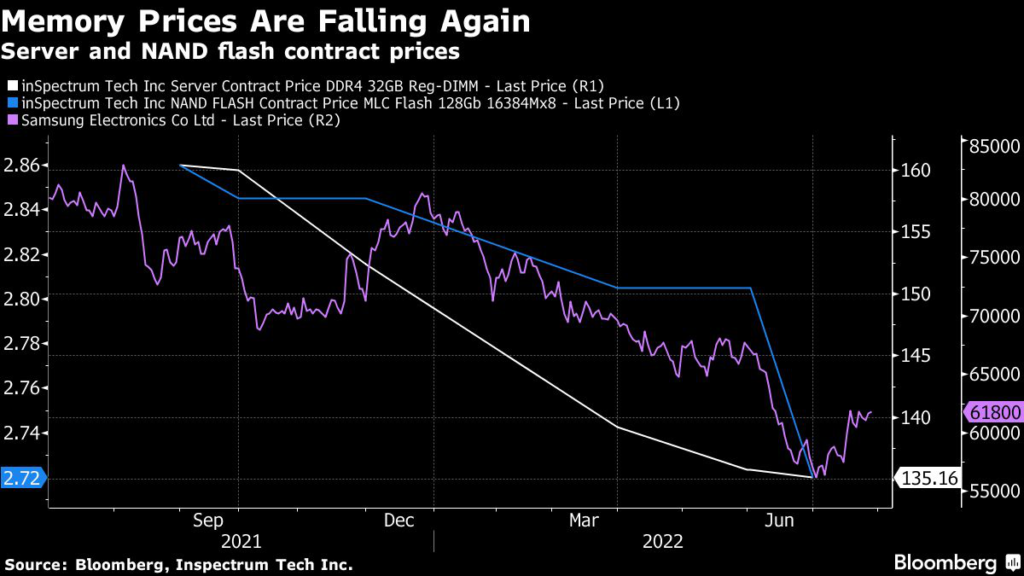
The world’s largest producer of smartphones and displays reported a less-than-expected 16% rise in net income, reflecting how it’s still navigating rising uncertainty around a potential global recession. Revenue from its semiconductor division, which as the world’s largest producer of memory is an indicator of electronics demand, missed analysts’ estimates by about 22%.

Apple Inc., Amazon.com Inc. and Microsoft Corp., which are all major buyers of chips, are reining in budgets for next year and, in turn, denting chipmakers’ capacity expansion plans, adding to tepid consumer demand. Samsung rival SK Hynix Inc. warned of waning memory growth and rising inventories, becoming the latest tech giant to sound the alarm over global economic uncertainty.

Click here for a live blog of Samsung’s post-earnings call.

What Bloomberg Intelligence Says 

“DRAM contract prices started dropping slightly from April sequentially, stayed flat in May and ended June slightly lower. Monthly DRAM exports have been steady at about $3.5 billion from July 2021, suggesting the rate of growth may shrink further from July this year.”

– Masahiro Wakasugi, BI analyst 

Click here for the full research. 

Samsung’s shares stood largely unchanged in early trading in Seoul. 

Korea’s largest company reported net income rose to 10.95 trillion won ($8.3 billion) in the three months ended June, missing projections for 11.2 trillion won. Sales from the chip  division grew a smaller-than-predicted 24% to 28.5 trillion won, missing estimates for about 36.7 trillion won. The smartphone and networking division however grew 29% to 29.3 trillion won, slightly ahead of expectations.

In the longer run, chip sales are growing much more slowly than expected and will begin to decline in 2023, Gartner Inc. said in a report, marking an end to one of the sector’s biggest boom cycles. 

Hynix said Wednesday it revised down its chip shipment growth for the current quarter and added it’d significantly adjust its capex for next year due to a high level of inventories throughout the market. In contrast, Texas Instruments Inc., which has a wider range of chip products, gave a bullish outlook for the current quarter as it sees demand recovery after lockdowns in China hit sales. 

“The global semiconductor market is entering a period of weakness, which will persist through 2023 when semiconductor revenue is projected to decline 2.5%,” Richard Gordon, a Gartner analyst, said in the report. PC shipments will contract 13% in 2022 after two years of growth, Gartner predicts, while smartphone sales will rise just 3.1% this year after surging almost 25% in 2021. 

More stories like this are available on bloomberg.com

©2022 Bloomberg L.P.
Social Media Scam Artists Prey on India’s Amateur Investors

(Bloomberg) — India’s mom-and-pop investors are facing testing times. During a pandemic-era surge in the stock market, millions poured their savings into equities, drawing on advice from unauthorized financial advisers and social media “gurus” to help identify the next big ticket.

But a recent slide in stock values has laid bare the dangers of India’s lax capital market regulations. Many amateur retail investors, especially the young, sought to make a quick buck by consulting informal groups on platforms like WhatsApp and Telegram. Recourse for investments gone awry is limited: In India, fines for everything from insider trading to wire fraud are a fraction of those imposed in some western nations.

India’s regulators are now cracking down on internet scams. The Securities and Exchange Board of India recently urged investors to stay vigilant of so-called “pump and dump” schemes — a type of securities fraud that involves artificially inflating prices — and not rely on stock tips from unverified online services.

It’s an increasingly fraught topic around the world. Securities regulators from Spain to Australia are mulling ways to enforce restrictions against social media influencers. Earlier this year, SEBI shut down a Telegram channel called “Bullrun2017” that purported to specialize in penny or small-cap stocks. Group administrators bought shares of small companies, recommended them to their 50,000 or so subscribers, and then sold them for a profit, according to a SEBI order.

In March, the regulator raided premises linked to seven individuals and one company running nine Telegram channels with more than five million subscribers. They utilized a similar strategy of inflating prices and then selling stocks at a high. Telegram declined to comment.

“Most of these paid services are not good,” said Aditya Trivedi, 25, who runs a popular Telegram group that provides free advice on trade calls. “They regularly post fake screenshots of their profits to stimulate greed. A small guy gets swayed by the hope that they will also make money.”

Trivedi, who has more than 30,000 followers and learned trading from Twitter, said companies often get in touch with influencers like him for paid advertisements to boost the value of their shares. He said he has refused such requests.

Loopholes Persist

The broad challenges of policing social media do not help. In April, Twitter was suddenly flooded with recommendations from several verified handles to invest in shares of Supreme Engineering Ltd. — a special alloys and wire products manufacturer based in Mumbai — after it secured a government contract. Following the online promotion, the penny stock gained close to 21%. 

Twitter and Supreme Engineering didn’t respond to requests for comment.

Enforcement is often tricky in India. Unlike in many western nations, where laws protecting investors are daunting and lengthy jail sentences are a real prospect for rule-breakers, India’s tangled legal system hardly acts as a deterrent. Many cases drag with no resolution. The capital market regulator was only granted the authority to arrest securities law offenders a few years ago.

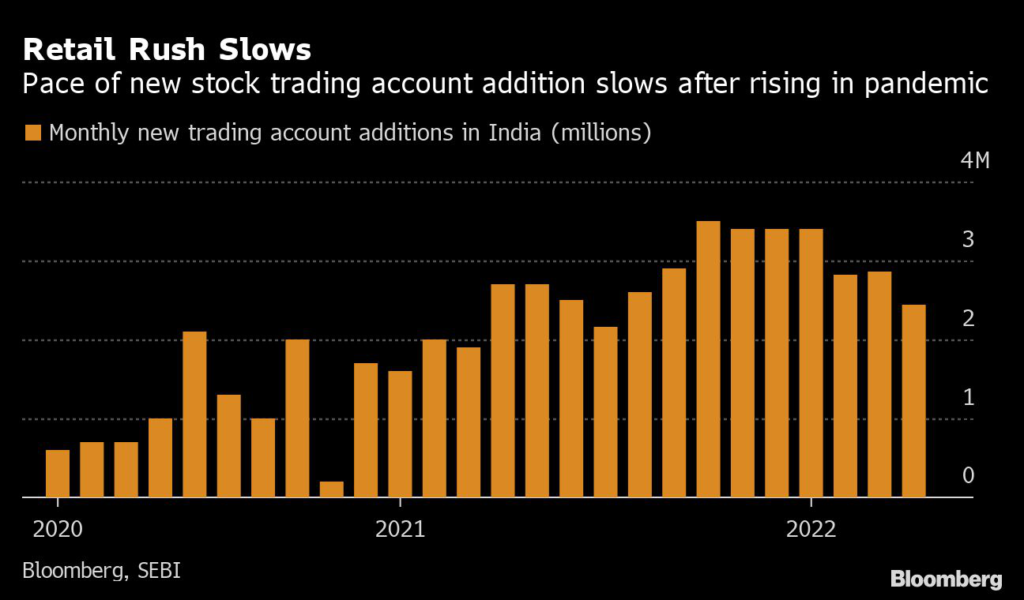
What’s clear is domestic retail investors are here to stay. India has seen a steady rise in such investors over the past five years as a stagnant real estate market and low interest rates pushed the middle class to explore equity markets. This new cohort of investors is now a key shock absorber for India’s $3.2 trillion stock market, following a plunge in global indexes due to rising oil prices and the Russia-Ukraine war.

The number of new electronic trading accounts opened each month has increased six-fold between 2019 and 2022, according to India’s finance minister, Nirmala Sitharaman.

But online fraud has surged in tandem with the growth of inexperienced investors. Indian consumers were 10% more likely than the global average to encounter a scam and three times more likely to continue with a ruse, according to a recent study from Microsoft Inc. The report consulted more than 16,000 internet users in 16 countries.

Vivek Mashrani, a former banker and founder of Techno Funds Ventures Pvt Ltd, an investor education firm, said the internet has supplanted television as the medium of choice for such scams in India. “Wherever there are audience eyeballs, people will use those channels directly or indirectly for their vested interest,” he said.

Many scammers have taken advantage of India’s shortage of registered investment advisers. The country currently has about 62 million unique investors, according to the National Stock Exchange of India, compared with just 1,330 advisers. According to SEBI rules, only certified analysts are permitted to provide financial services.

But loopholes persist, particularly online. In 2016, SEBI proposed barring unregistered individuals or firms from providing investment tips through social media. Still, the recommendation has yet to yield clear rules about whether advice can be provided in an informal educational capacity, an ambiguity many continue to exploit. 

“Considering the increasing influence of social media platforms over investors, SEBI is likely to make amendments in its regulations to fill the gaps,” said Sumit Agrawal, a former assistant legal adviser to SEBI. “The success of such changes will be dependent on the way these regulations will be enforced.”

SEBI didn’t respond to several emails and calls seeking comment.

Identifying Traps

Kanika Arora, 34, an accountant from Mumbai, is one investor who said she fell into such a trap last year.

After subscribing to portfolio management services offered on Telegram by Namdev Mane Trading Academy, the eponymous founder contacted her directly on the platform. “I personally would be doing buying and selling in your account,” Mane wrote, noting that he would collect 40% of the profits and charge a one-time fee of about $60. “Please note that you can’t make money by trading yourself.”

Within a few months, Arora said she had lost more than half of her 100,000 rupees (about $1,250) investment.

“Ultimately, I was at fault for trusting someone who was not a SEBI-registered portfolio manager and hence I did not take any further action,” she said, adding that a friend had recommended Mane’s services.

In an interview, Namdev Mane, who lives in the city of Pune, said he’s an options trader and holds an MBA, but wasn’t registered with SEBI as an investment adviser. He denied wrong-doing, noting that he provides calls on Indian indexes, but doesn’t offer stock advice.

“Market loss is not equivalent to fraud,” he said. “I am not forcing anyone to take my services.”

Mashrani, the former banker, said Indian regulators need to boost the number of investment advisers by easing some restrictions. The NSE cautioned retail traders this month about reckless derivatives trading after observing that many online influencers were promoting complex options trading to inexperienced clients.

“More qualified people are needed to be allowed in the formal channel,” Mashrani said. “That will automatically eradicate the unregulated guys.”

More stories like this are available on bloomberg.com

©2022 Bloomberg L.P.

A Third of UK Workers Plan to Take A Second Job to Pay the Bills

(Bloomberg) — Almost a third of UK workers plan to take on a second job to help pay the bills and cope with the harshest cost-of-living crisis in memory, according to new research.

A national survey of 2,000 workers by Indeed Flex, an online marketplace for flexible employment, found that 32% of people plan to do temporary work of top of their existing job to boost their income.

Of those polled, 19% already have a second, temporary job. Another 11% plan to take on a few more shifts and 8% want a lot more shifts, the survey found.

The figures underline the scale of the squeeze some households are facing as basic living costs rocket far faster than wages.

Food prices are climbing at more than 8%, and regulated energy bills are expected to rise by a further 60% in October to over £3,000 – a total increase of about 150% in a year. Prices at the petrol pump have also hit record highs.

Wages, meanwhile, are falling in real terms at the fastest rate on record as pay fail to track inflation, now at a 40 year high of 9.4%.

“Our research reveals that many workers have sold unwanted clothing and household goods to bring in extra cash, but temporary work is a more reliable source of income,” said Novo Constare, chief operating officer and co-founder of Indeed Flex. “The financial benefits of temping have been thrust center stage. Temping offers an instant way for them to top up their earning power.”

Workers in London are the most likely to take up a temporary job. Almost a fifth, 17%, of those planning to do temp work as a result of the rising cost of living are in the capital, while 12% are in North West England, 11% in the South East and 10% in the West Midlands. 


More stories like this are available on bloomberg.com

©2022 Bloomberg L.P.
Crypto Should Get Its Own Laws to Aid Ownership Claims, UK Says

(Bloomberg) — The UK needs to reform legislation to specifically account for cryptocurrencies and nonfungible tokens, the country’s Law Commission said, arguing that existing laws aren’t robust enough to govern the fledgling sector.

Laws regarding personal property should be changed to include a distinct category for so-called “data objects”, which would encompass intangible, and sometimes unique, assets like crypto tokens, the commission said. The organization, an independent agency, makes recommendations to the government. 

If implemented, the reforms would make it easier for courts to decide ownership claims over tokens, and to identify risks that are unique to crypto. It could also put the UK at the forefront of establishing where crypto and decentralized finance fits into private law globally, establishing a precedent that other international legal regimes could follow.

The commission floated the possibility that courts should be allowed to award damages denominated in cryptocurrencies but stopped short of formally recommending the proposal. It would enable courts to sidestep the issue of exactly when a cryptocurrency needs to be converted into fiat for settlement, a topic that is particularly timely as billions of dollars are tied up in the bankruptcy proceedings of major crypto companies like Celsius and Three Arrows Capital.

The proposals come in the wake of a speech by one of the country’s most senior judges, Geoffrey Vos, who said the UK had a chance to provide the international legal and regulatory foundations for using cryptoassets and distributed ledger technology, if it could be bold enough to take the first step. 

“We are in a period of very significant opportunity,” Vos said. “If English law and the UK’s jurisdictions can provide the legal backdrop of choice to DLT systems, a big economic prize will follow.”

Matthew Kimber, a lawyer for the commission who contributed to the proposals, said the new category could be used for additional areas of financial market infrastructure such as voluntary carbon credits, a move that could give non-crypto sectors the confidence to adopt blockchain-esque global liquidity structures.

The UK is exploring legislation and regulation for digital assets in several areas, recently cementing plans to provide the Financial Conduct Authority with more powers over cryptocurrency companies and bring so-called stablecoins under existing banking regimes. The Law Commission’s proposals are provisional while it gains feedback from market participants, but its recommendations are typically implemented by UK government once finalized. 

More stories like this are available on bloomberg.com

©2022 Bloomberg L.P.
Visa, Mastercard Swipe Fees Targeted in Planned Senate Bill

(Bloomberg) — Two US senators plan to introduce legislation as early as this week that would give merchants the ability to route Visa Inc. and Mastercard Inc. credit-card transactions over alternative networks.

The legislation — set to be introduced by Democratic Richard Durbin of Illinois and Republican Roger Marshall of Kansas — would direct the Federal Reserve to make sure that banks with more than $100 billion in assets ensure that their credit cards provide a choice of at least two networks that can be used to process electronic credit-card transactions, according to a handout provided by Durbin’s office. 

“This would inject real competition into the credit-card market — opening the door for new market entrants such as current debit-only networks, encouraging innovation and enhanced security, creating backup options if a network crashes, and exerting competitive constraints on Visa and Mastercard’s fee rates,” according to the handout.

A spokesman for Purchase, New York-based Mastercard had no immediate comment, while a representative for San Francisco-based Visa didn’t respond to requests for comment. 

With the bill, Durbin and Marshall are taking aim at a key source of revenue for the two companies, which set the fees merchants are charged each time a consumer swipes one of their cards at checkout. Banks collect the bulk of these so-called swipe fees before handing over a slice to the two payments giants. 

Visa shares dropped as much as 5.3% Wednesday afternoon, and were down 0.6% at 3:14 p.m. in New York, while Mastercard slipped as much as 2.9% before recovering to rise 0.9%

The move by Durbin and Marshall comes after the two firms introduced a series of changes to swipe fees earlier this year, sparking outcry among retailers who say they’re already dealing with the effects of inflation at a 40-year high.

Fee Changes

Visa, for its part, cut the fees it charges firms with less than $250,000 in Visa consumer credit-card volume by 10% — a move that it says applies to the vast majority of U.S. businesses. At the same time, though, the payments company increased the fees it charges for most online spending. 

Mastercard, on the other hand, lowered the fees it charges for any transaction under $5 by about 300 basis points while decreasing the rates it charges hotels, rental-car companies, daycare facilities and casual-dining restaurants. The company also increased its so-called digital-enablement fee, which it charges on all online transactions.

These fees often amount to just pennies per transaction. But, last year alone, merchants paid $137.8 billion in processing fees, up 24% from 2020, according to the industry publication The Nilson Report.

This isn’t the first time Durbin has taken aim at swipe fees. In 2010, Congress passed the so-called Durbin Amendment, which required banks to put two unaffiliated networks on every debit card they issue. Merchants, then, are supposed to have the ability to choose which network handles transactions. 

Banks typically issue debit cards with either Visa or rival Mastercard, but there are also smaller, lesser-known networks with names like Pulse, Shazam and Star. These networks often charge a lower fee, averaging just 25 cents per transaction in 2020, compared with 35 cents for debit spending routed over Visa’s debit networks, according to data compiled by the Federal Reserve.

‘Complete Overhaul’ 

Lenders rely on swipe fees to offer rewards for credit card users, so banks may have to introduce new annual fees to preserve those perks for customers, said Dan Perlin, an analyst at RBC Capital Markets. And while banks and merchants have long since adjusted their debit systems to comply with the Durbin Amendment, other analysts were quick to note that the same functionality doesn’t currently exist in the world of credit cards.  

“Enabling dual network capabilities for credit cards would require a complete overhaul of the existing technology for credit card transaction processing including making networks interoperable, enabling issuer processors to handle alternative network messages, and a complete re-issuance of all credit cards for banks with more than $100 billion in assets, among other technological and functional challenges,” analysts at Credit Suisse Group AG said in a note to clients. 

Trade groups representing banks and payment companies immediately cried foul on Wednesday, arguing the bill could create security concerns in the payments industry and may lead to more foreign payment networks — including China’s UnionPay — handling US credit card transactions. 

“It’s highly conceivable and highly likely that a lot of these transactions might end up running over a foreign network,” said Jeff Tassey, chairman of the Electronic Payments Coalition. 

Merchants, though, have been adamant that a bill like the one Durbin and Marshall are proposing would allow them to ultimately lower prices for consumers. That would come as US inflation accelerated to a 40-year high in June, a sign that price pressures are becoming entrenched in the economy. 

“For the retailers, it means everything,” said Leon Buck, vice president for government relations for banking and financial services at the National Retail Federation. “It would allow us to negotiate a fairer, lesser, more equitable price.” 

Take convenience stores, which are known for razor-thin margins. NACS — a trade group representing the industry — said swipe fees climbed 26% for the industry in 2021 compared to the year earlier and another 33% in the first quarter alone. 

“Our estimate is that having basic competition ought to be about $11 billion in savings overall,” said Doug Kantor, general counsel for NACS and an executive committee member for the Merchants Payments Coalition trade group. “You ought to see a vast majority of that going to consumers.”

(Updates with additional information and analyst commentary in 13th paragraph)

More stories like this are available on bloomberg.com

©2022 Bloomberg L.P.

Best Buy Follows Walmart, Target With Cut to Profit Forecast

(Bloomberg) — Best Buy Co. cut its profit and sales outlook, saying inflation is pummeling consumers and eroding demand for electronics. 

Operating income will only be about 4% of revenue in the current fiscal year based on “current planning assumptions,” Best Buy said in a statement Wednesday. The retailer had previously expected at least 5.2%. Comparable sales will tumble 11%, versus an earlier forecast that they would fall no more than 6%. 

Best Buy’s worsening outlook hammers home the pressure on discretionary purchases as the highest inflation in four decades forces US consumers to spend more for basic goods. Walmart Inc. issued a profit warning earlier this week that stoked fears of a recession, saying shoppers were pulling back from big-ticket purchases and items such as clothing. Target Corp. cut its profit outlook last month.

“As high inflation has continued and consumer sentiment has deteriorated, customer demand within the consumer electronics industry has softened even further,” Best Buy Chief Executive Officer Corie Barry said in the statement.  

The shares fell 2.3% in late trading on Wednesday, paring much of their sharp decline immediately after the announcement. Best Buy had tumbled 27% this year through the close, while an S&P 500 index of consumer-discretionary companies sank 25%. 

In the second fiscal quarter, which ends July 30, operating income will be about 3.7% of revenue, Best Buy said. Comparable sales will drop approximately 13% and inventory will be little changed from its level a year earlier. The company is scheduled to report full results on Aug. 30. 

The dour short-term assessment contrasts sharply with the upgraded fiscal 2025 outlook Best Buy unveiled in March, when it outlined expected gains from its membership program, remodeled stores and new services in health care and digital advertising. While those goals aren’t out of reach, the company faces a harder slog this year. 

Increased Discounts

What’s bad for Best Buy may be good for its customers, because the retailer predicted “increased promotional activity” for consumer electronics. Still, it’s unclear how much appetite is left for televisions, computers and other gadgets after shoppers binged on such goods earlier in the pandemic. Now, many are eager to spend on activities such as eating out and traveling, which were previously off limits. 

Best Buy’s decision to cut its sales forecast underscored the weakness in electronics. Walmart and Target — which sell groceries and a wide selection of other goods as well as electronics — didn’t cut their sales projections. 

The merchandise Best Buy sells isn’t necessarily getting more expensive. Television prices, for example, dropped 13% during the 12 months ending in June, part of a broader drop in video and audio goods, according to the US Labor Department. Computer prices were little changed. 

But with food and fuel costs soaring over the last year and the overall price level way up, there’s less money left over for discretionary purchases. Faced with “ongoing uncertainty as it relates to macroeconomic conditions and consumer electronics demand,” Best Buy said it had paused share buybacks while remaining committed to its quarterly dividend.  

“It is difficult to assess the duration of the softer sales environment and the impact on our business,” Chief Financial Officer Matt Bilunas said. 

(Updates with second-quarter forecast in sixth paragraph)

More stories like this are available on bloomberg.com

©2022 Bloomberg L.P.
Qualcomm Gives Lackluster Forecast, Renewing Slowdown Fears

(Bloomberg) — Qualcomm Inc., the biggest maker of chips that run smartphones, gave a lackluster forecast for the current period, saying that a weakening economy will hurt consumer spending on mobile devices.

Revenue will be $11 billion to $11.8 billion in the fiscal fourth quarter, Qualcomm said in a statement Wednesday. That compares with an average analyst estimate of $11.9 billion. Excluding certain items, earnings will be $3 to $3.30 a share, versus the $3.26 average projection.

Qualcomm shares, which have outperformed a general slump in chip stocks this year, slipped about 2.4% in extended trading following the announcement.

Rising inflation has eaten into consumer spending power and hurt sales of smartphones, the key market for Qualcomm’s chips. While Chief Executive Officer Cristiano Amon is pushing into different areas — including vehicles, networking gear and computers — the company still relies on phones to fuel growth.

A weaker outlook for the economy prompted Qualcomm to shave about 20 cents from its profit projection for the current period, executives said on a conference call with analysts.

Qualcomm now expects smartphone shipments to decline in the mid-single-digit percentage range in 2022 from the prior year — a dimmer outlook than it had previously. The chipmaker’s customers are cutting back on purchases of components for midrange and lower-end Android phones as they try to work through excess inventory.

While demand for premium phones is still relatively robust, there will be fewer 5G phones sold than Qualcomm had projected.

“The market is likely to be smaller than we originally forecast,” Amon said. “The weakness we saw was in the mid to low tiers.”

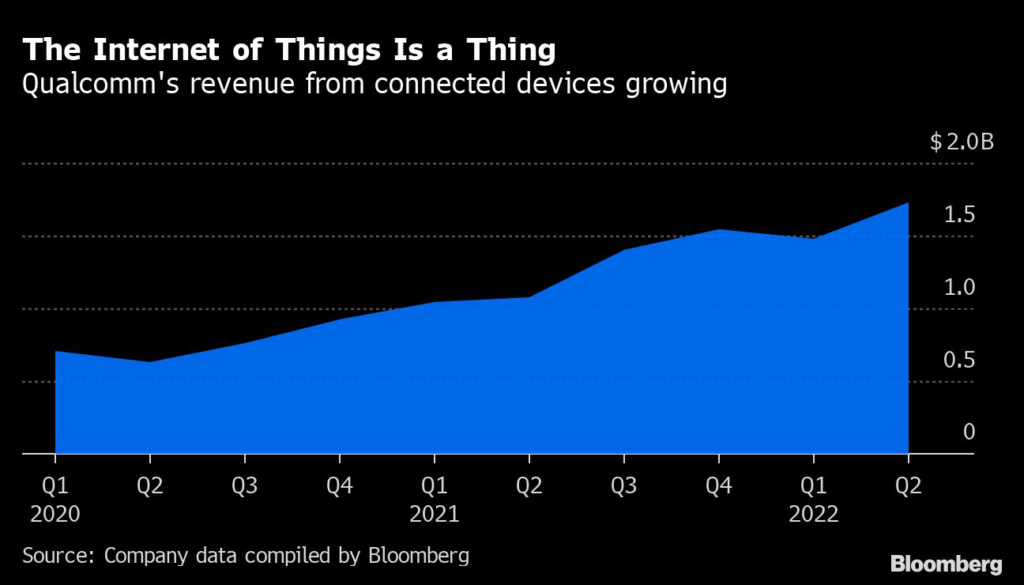
Amon pointed to record revenue from Qualcomm’s automotive and so-called Internet of Things chips, but echoed tech peers in acknowledging a “challenging” economy.

Qualcomm’s main product is the processor that runs many of the world’s smartphones. It also sells the modem chips that connect Apple Inc.’s iPhone to high-speed data networks. In addition, Qualcomm licenses the fundamental technology that underpins modern phone networks, bringing it another revenue stream.

Smartphone sales will climb just 3.1% this year after surging almost 25% in 2021, market research firm Gartner Inc. predicts. 

Sales of Qualcomm’s phone-related chips surged 59% to $6.1 billion in the fiscal third quarter, compared with an estimate of $6 billion. Revenue from the Internet of Things — a category that includes smart appliances and other devices — was $1.83 billion. That compares with an average projection of $1.84 billion. Sales from chips used in vehicles increased 38% to $350 million, but fell just short of more bullish estimates. 

The company generated $10.9 billion in total revenue, in line with estimates. Profit in the three months that ended June 26 was $2.96 a share, compared with Wall Street’s average estimate of $2.86. 

The company is unusual in the chip industry because a large chunk of its profit comes from licensing. Makers of phones pay to use Qualcomm’s technology, regardless of whether they buy its chips, because the company owns patents that cover some of the fundamentals of mobile communications.

Separately, Qualcomm said it has signed an extension of its technology licensing agreement with the world’s largest phone maker, Samsung Electronics Co. And the South Korean company agreed to use Qualcomm chips in its Galaxy phones, tablets and computers. Samsung will license Qualcomm’s technology until the end of 2030, the two companies said in a statement.

(Updates with executive comments in fourth paragraph.)

More stories like this are available on bloomberg.com

©2022 Bloomberg L.P.
ServiceNow Slips After Cutting Sales Forecast on Dollar, Demand

(Bloomberg) — ServiceNow Inc., a maker of business workflow software, declined in extended trading after reducing its full-year revenue forecast on the strength of the dollar and a potential pull back in demand.

Annual subscription revenue, which makes up the overwhelming majority of company sales, will increase 24% to a midpoint of $6.92 billion, the Santa Clara, California-based company said Wednesday in a statement. In April, ServiceNow projected full-year sales growth of 26%, with a midrange of $7.03 billion. The company said currency fluctuations would cost $220 million in 2022 revenue.

While the revision of the outlook is mainly due to the strength of the US dollar, it also factors in a potential reduction in demand, which hasn’t materialized, said Chief Executive Officer Bill McDermott in an interview. “We’re going to see some longer sales cycles” given the uncertainty of the economy, he said. 

Current remaining performance obligations, which are contract sales that will be recognized as revenue in the next 12 months, will be reduced by about 2 percentage points in the current quarter because of seasonality in customer renewals, the company said. “We always do much more CRPO in Q4 because that’s where the lion’s share of our renewals are,” McDermott said. 

The performance obligations will “pop back up in Q4,” Chief Financial Officer Gina Mastantuono said during a conference call after the results. The software maker’s 99% customer renewal rate gives her confidence that pending deals will be completed as the year continues, she added.

ServiceNow sells applications that help companies organize and automate their personnel, customer service and information technology operations. McDermott is targeting $16 billion annual revenue by 2026. 

The shares fell about 6% in extended trading after closing at $448.60 in New York. The stock has declined 31% this year, and earlier this month saw its largest one-day plunge in six years after McDermott outlined concerns about the economic environment in a TV interview.

The comments on the TV interview weren’t “ServiceNow specific — that was really about the global macro,” McDermott said when asked about the market response. “There’s kind of a tendency to overreact on the negative.”

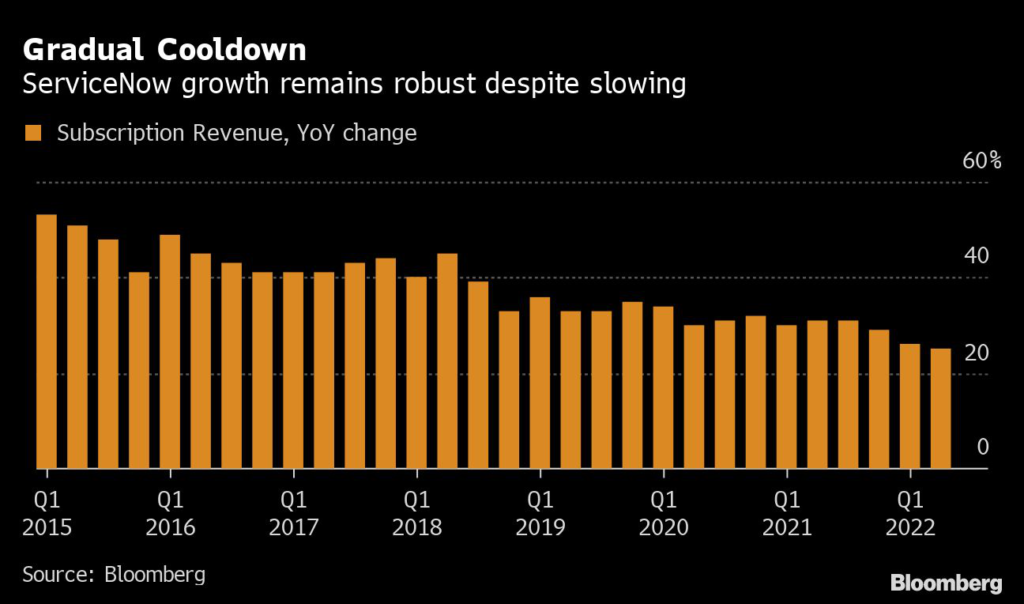
In the second quarter, subscription revenue increased 25% to $1.66 billion, a slowdown from 26% annual growth in the first quarter and just below the average analyst estimate of $1.67 billion. Current remaining performance obligations gained 21% to $5.75 billion, missing an average estimate of $5.9 billion.

Profit, excluding some items, was $1.62 a share in the period ended June 30, compared with an average estimate of $1.55 a share. ServiceNow said it had 1,463 customers with more than $1 million in annual contract value when the period ended, a 22% increase from a year earlier.

“ServiceNow remains a core component of our customers’ digital transformation strategy and we continue to see a very strong pipeline,” Mastantuono said in the statement.

Tech firms that have significant overseas exposure, including Oracle Corp., Salesforce Inc. and Microsoft Corp., have seen growth curtailed by a surging US dollar. ServiceNow said currency weighed on second-quarter growth by 4.5 percentage points.

Even with the forecast reduction, ServiceNow’s cloud growth story remains intact, said Bloomberg Intelligence’s Anurag Rana. The company controls about 35% of the fast-growing market for information technology service management, and continued corporate migration to the cloud could fuel years of double-digit growth, according to a Bloomberg Intelligence report.

McDermott was known as a dealmaker during his tenure as CEO of German software giant SAP SE. However, he said he’s not looking for acquisitions for ServiceNow even though the recent market downturn has left more companies with “realistic” valuations.

“Even if I could get them at the perfect price, its not necessary based upon the trajectory we’re on,” he said.

More stories like this are available on bloomberg.com

©2022 Bloomberg L.P.

Close Bitnami banner
Bitnami
