Bloomberg

Senate Moves Forward With $52 Billion in Semiconductor Funding

(Bloomberg) — The US Senate voted by a wide margin to begin debate on legislation to provide more than $52 billion in grants and incentives for the American semiconductor industry, a major milestone for the long-stalled package that proponents say is vital to national security.

The 64-34 procedural vote on Tuesday night met the criteria set by Senate Majority Leader Chuck Schumer to add research and development initiatives circulated by Republican Todd Young and Democrat Kyrsten Sinema to the legislation, which could be passed by the Senate next week.

Schumer before the vote called it “legislation our country desperately, desperately needs.”

Details of the bill, a scaled-down version of the original and more expansive measure intended to make the US more competitive with China in technology and advanced manufacturing, are still being worked out. 

In addition to money to assist semiconductor companies building fabrication plants or “fabs” in the US, a draft bill circulated by the Senate leadership includes a 25% investment tax credit for manufacture of semiconductors and tools to create semiconductors, $500 million for an international secure communications program, $200 million for worker training and $1.5 billion for public wireless supply-chain innovation.

The provisions proposed by Young and Sinema would establish a directorate for technology and innovation within the National Science Foundation to support basic and applied research and bolster education in science, technology, engineering and mathematics. Schumer had said the Senate needed at least 60 votes to show support for those provisions.

The legislation also would have to pass the House, where Majority Leader Steny Hoyer said Democrats would support the Senate version, even if some wanted a broader bill.

“We need to do the chips part and if we don’t do that we will lose chip manufacturing to other places,” he said.

Senate GOP leader Mitch McConnell, who had previously threatened to block the wider legislation until Democrats dropped their plans for a tax and climate package,  voted against starting debate. He said earlier in the day that he wanted to see what is in the eventual legislation first, even though he called the domestic chip manufacturing “a national security issue of significant proportion.”

The Biden administration, lawmakers from both parties and the semiconductor industry have called the chips incentives urgent amid a global shortage and supply chain disruptions that have affected industries including automobiles, electronics and appliances. The US still leads the world in chip design, but manufacturing has shifted to Asia. The legislation aims to bring more chipmaking back to the US.

Some companies, including Intel Corp., and a lobbying group, the Semiconductor Industry Association, have been seeking changes to the legislation to allow production of more advanced chips in China. The current language bans investment in plants that produce chips smaller than 28 nanometers while some facilities in the country are already producing 16 nanometer chips.

“Legislation this complex and important requires input from all stakeholders,” Intel spokesperson Nancy Sanchez said in an emailed statement. “Intel and many companies in our industry have come together with our trade association to provide input to policymakers in order to ensure that we have the best legislation possible and don’t inadvertently undermine the global competitiveness of companies that receive CHIPS funds.”

More stories like this are available on bloomberg.com

©2022 Bloomberg L.P.

Century-Old Philippine Group to More Than Double Power Capacity

(Bloomberg) — Aboitiz Equity Ventures Inc., a 102-year-old Philippine conglomerate and one of the nation’s largest power producers, plans to more than double its generation capacity to help tap a revival in consumer demand.

The Cebu-based company is targeting 9,200 megawatts by 2030, adding to the existing capacity of over 4,000 megawatts, President and Chief Executive Officer Sabin Aboitiz, 58, said in an interview with Bloomberg Television’s Yvonne Man. With a ban on new coal-fired plants, the group is looking at a mix of gas and renewables for the expansion, he said. 

“There’s a lot of opportunity we’re seeing on gas because that’s the cleanest as a base load,” Aboitiz said. Japanese utility JERA Co., which in 2021 bought a 27% stake in unit Aboitiz Power Corp., will help with the conglomerate’s “gas direction” mostly in the main Luzon island, he said.

Founded by the son of a Spanish settler in the late 1800s as a hemp-trading venture and formally incorporated in 1920, Aboitiz has now grown into a group with businesses spanning banking, food and infrastructure. As the $361 billion Philippine economy rebounds from the Covid-19 pandemic, the conglomerate is counting on the recovery to spur electricity consumption. The Southeast Asian nation is aiming for at least a 6% annual growth in gross domestic product in the next six years.

The company is also making an aggressive push into renewables, riding on a government program to have 15,304 megawatts renewables-based capacity by 2030, nearly triple from 2010. The target eventually is to have half the capacity in renewables, the executive said, adding it’s seeking to build geothermal, solar and wind plants, while expanding the group’s hydro power capacity from 1,500 megawatts. 

The conglomerate is looking at countries like Vietnam to set up power projects, and is scouting for partners, Aboitiz said. 

Aboitiz is also seeking to reduce its dependence on energy by stepping up its other ventures such as water, telecommunications towers, property and data businesses. Power now accounts for 85% of the group’s revenue. By 2030, he wants power, banking and infrastructure to contribute 25% each. 

“We’ve been transforming for years,” Aboitiz said. “But now the speed of change is happening so quickly. We want to transform from a hundred-year-old man to a 25-year-old athlete.”

More stories like this are available on bloomberg.com

©2022 Bloomberg L.P.

Netflix Sees Return to Growth After Million-Customer Loss

(Bloomberg) — After losing more than a million customers in the first half of 2022, Netflix Inc. has a message for investors: It could have been worse.

The leader in paid streaming TV lost 970,000 subscribers in the second quarter, according to a statement Tuesday. That was less than half what Wall Street feared, thanks in large part to a new season of “Stranger Things,” the service’s most popular English-language series.

That cheered investors, who sent the stock up as much as 12% in extended trading. This quarter, Netflix expects to sign up 1 million subscribers in the current three-month period. While that’s well short of the 1.83 million analysts forecast this period, it reverses the losses of the first half.

Shares of Netflix jumped as high as $225 in extended trading. They closed at $201.63 in New York Tuesday, down 67% this year.

Despite concerns about increased competition and a potential recession, Netflix remains confident in its position. The company said its share of total TV viewing in the US hit an all-time high in June at 7.7%. 

Management has responded to the subscriber slide by cutting costs and adjusting its strategy on several fronts. The company plans to introduce a lower-priced version of the service with advertising around early 2023, and is testing ways to charge customers for password sharing.

“We’re talking about losing 1 million instead of 2 million — our excitement is tempered by the less-bad results,” Chairman Reed Hastings said on an earnings call moderated by analyst Doug Anmuth of JPMorgan Chase & Co. “But looking forward, streaming is working everywhere. Everyone is pouring in.”

For the second quarter, revenue grew 8.6% to $7.97 billion, Netflix said. That missed Wall Street estimates of $8.04 billion, in part because of the strong dollar.

Read more: Streaming-video stocks rise on Netflix news

During the quarter, Netflix lost 1.3 million customers in the US and Canada, its largest region, and another 770,000 in Europe, the Middle East and Africa, its second-largest. Those are the steepest quarterly declines the company has reported in either place since it started supplying individual results from those markets.

Growth in the Asia-Pacific region offset those declines. Netflix added 1.1 million customers in APAC, after cutting prices in India.

Hastings had positioned Netflix as an advertising-free alternative to cable TV, but now says commercials are necessary to appeal to people who find the service too expensive. Netflix has raised prices several times and is now one of the most expensive streaming services. 

The company will introduce the advertising-supported option first in a handful of countries, and just tapped Microsoft Corp. to handle ad sales and technology. Advertising will start small and look a lot like other video businesses ads. But Netflix believes it can be substantial, Chief Operating Officer Greg Peters said.

Read more: Netflix chooses Microsoft as ad partner

Netflix has also started to release new episodes of shows in batches, breaking with its tradition of dropping every episode of a season at the same time. It released the drama “Stranger Things” and the final season of “Ozark” in two batches.

The batching strategy allows Netflix to extend the life of its biggest shows. When every episode is released at once, the majority of the viewing happens in the first couple of weeks. The number of people who cancel Netflix has jumped 87% since a year ago, according to Antenna.

The popularity of the fourth season of “Stranger Things” exceeded the expectations of Netflix executives. The supernatural drama has been one of the service’s most successful titles since its debut in 2015, and turned star Millie Bobby Brown into one of the most in-demand female actors in Hollywood.

The release of “Stranger Things” meant that fans who had Netflix in the second quarter would want to keep the service until the start of the third quarter to finish the season. The company is looking to turn hits like “Stranger Things” into franchises that can outlast any individual show. The creators of the show are developing a spinoff series, and Netflix has also announced plans for a Broadway play.

On Tuesday, Netflix said it will acquire Animal Logic, an Australian animation studio that worked on “The Lego Movie.”

“We have some headwinds right now; we’re navigating through them,” co-Chief Executive Officer Ted Sarandos said on the call. “This company and this team has navigated through a lot of change.”

Total subscribers in the second quarter came to 220.7 million, compared with estimates of 220.2 million. Earnings of $3.20 a share beat analysts’ projections.

This quarter, Netflix forecasts revenue of $7.84 billion, shy of Wall Street estimates of $8.1 billion. The company sees earnings of $2.14 a share, compared with estimates of $2.72, and says total membership will reach 221.7 million, also shy of estimates.

(Updates with quote from chairman in seventh paragraph.)

More stories like this are available on bloomberg.com

©2022 Bloomberg L.P.

Google, Oracle Data Centers Knocked Offline by London Heat

(Bloomberg) — London data centers used by Google and Oracle Corp. buckled on Tuesday after a record-setting heat wave hit Britain, knocking some websites offline.

Both companies cited problems with “cooling systems” for causing the outages. Oracle’s first message appeared on its service page in late morning New York time, noting that “unreasonable temperatures” had affected cloud and networking equipment in its South London facility. 

By the afternoon, Alphabet Inc.’s Google reported a similar problem at its London site. On a customer-service website, the company said the disruption had hit a “small set” of its cloud-computing users. Google said it was powering down some parts of its cloud services “to prevent damage to machines and an extended outage.”

Read More: Hosepipes on Roofs Are Keeping UK’s Data Centers Cool

Several hours later, Google still listed some of its cloud services as down in the region. The WordPress web-hosting service blamed the Google outage for knocking out its service in Europe.

Temperatures topped 40 degrees Celsius (104 degrees Fahrenheit) in the UK on Tuesday, when fires broke out across London.

More stories like this are available on bloomberg.com

©2022 Bloomberg L.P.

JPMorgan Trader Spoofed So Fast Colleagues Urged Ice on Fingers

(Bloomberg) — Gregg Smith clicked his computer mouse so rapidly to place and cancel bogus gold and silver orders for Bear Stearns Cos. and later JPMorgan Chase & Co. that his colleagues would joke that he needed to put ice on his fingers to cool them down afterward, or that he must be double-jointed.

That’s how his former protege, Christian Trunz, described for jurors how he watched Smith use so-called “spoof” trades — large orders intended to manipulate prices that were quickly canceled. Trunz, 37, said he learned how to spoof from Smith and others after joining Bear Stearns out of college in 2007, shortly before the bank was acquired by JPMorgan.  

To place and cancel the orders fast required a “rapid succession of clicking on a mouse,” and Smith, the desk’s top trader, was particularly good at it, Trunz told a federal jury in Chicago on Tuesday. That clicking was easy for everyone on the desk to hear, according to Trunz, who sat next to Smith for years and said he often pulled his chair alongside his mentor’s computer screen to watch him trade.

Trunz is the third former trader to testify at the fraud and racketeering trial of Smith and two senior employees at JPMorgan’s precious-metals desk: Managing Director Michael Nowak and hedge-fund salesman Jeffrey Ruffo. They’re accused of systematically cheating to help themselves and their top clients for years.

“This was an open strategy on the desk,” said Trunz, who has pleaded guilty to spoofing charges and is cooperating with prosecutors. “It wasn’t hidden.”

Read More: Spoofing Gold Price ‘Common’ at Bear Stearns, Ex-Trader Says 

Speed was essential to successfully spoof, especially as a growing share of the precious-metals market was being dominated by firms using computer algorithms to buy and sell futures contracts in fractions of a second, according to Trunz.

“We fully believed this was a battle” between the bank and the so-called algos, Trunz said. “This was the first time when machines were interacting with humans on a trading platform. It was man versus machine.” 

The goal of spoofing was to trick the rival computers into buying or selling to benefit JPMorgan’s position, by using a large volume of bogus orders to create the false market impression, he said.

“Those trades were deceptive,” Trunz said of the thousands of spoof orders the desk placed over the years. “They were used to bring out a reaction from those algorithms to get what we needed done.”

Read More: JPMorgan Gold Trader Turned Whistle-Blower Admits to Lies

Trunz, whose father worked at JPMorgan for decades and was a senior executive, was trading precious metals for the bank in New York, Singapore and London from 2007 to 2019, when he pleaded guilty. He said he idolized Smith, Nowak and Ruffo and sought to learn as much as he could from them so he could emulate their success. 

Trunz said he sat next to Smith for five years until 2013, and when he moved to London in 2014, worked closely with Nowak, who he got to know well. Ruffo was “the best salesman on the street,” with a long list of big clients, and was the primary reason JPMorgan had kept the Bear Stearns team intact after the acquisition, Trunz said.

Smith spoofed almost every day, Nowak did so about once a week, and Ruffo, while not a trader, would sit next to Smith and encourage him to spoof the market to execute client orders at the best possible prices, Trunz said. It wasn’t unusual to hear Ruffo urge Smith to “keep clicking, keep going,” with a spoof trade, Trunz said. 

“We all traded that way,” Trunz said. “We utilized that strategy on the desk to make money for ourselves and for our clients.”

Read More: Spoofing Is a Silly Name for Serious Market Rigging

Smith would sometimes spoof markets one way, then the other when filling orders for Ruffo’s top hedge fund clients to make sure they felt like they were getting a good price, Trunz said.

Prosecutors showed jurors internal chat logs between Ruffo and Moore Capital Management’s Christopher Pia from April 3, 2008, in which the hedge fund trader had directed Ruffo to sell 100,000 ounces of silver for him. Smith filled the order, then rapidly placed a large number of additional sell orders that he quickly canceled as the price of silver dropped.

Ruffo then congratulated Pia on his decision to sell. “Did well with that, lower already,” he said in a message. 

Asked to explain why Smith made the spoof trades, Trunz said, “Gregg looks like he was able to execute at a great level. Chris Pia looks like he made a great decision to sell 100,000 ounces when he did.” Trunz added, “Everybody has an ego.”

The case is US v. Smith et al, 19-cr-00669, US District Court, Northern District of Illinois (Chicago)

More stories like this are available on bloomberg.com

©2022 Bloomberg L.P.

Ukraine Latest: Putin Says Nord Stream Volume Could Fall Again

(Bloomberg) — Russian President Vladimir Putin held talks with the leaders of Iran and Turkey in Tehran on Tuesday, a summit that was focused on enforcing a peace deal in Syria but was largely overshadowed by the war in Ukraine.

Russia is poised to restart gas exports via the Nord Stream 1 pipeline to Germany at a reduced capacity on Thursday, though Putin warned that volumes could decline if a turbine sent for servicing, and held up by sanctions, isn’t returned in a timely fashion. 

The EU is set to propose a voluntary 15% cut in natural gas use by member states starting next month on concern Russia may halt supplies of the fuel. An IMF working paper warned that a cutoff of Russian gas could result in a hit of as much as 2.65% to the European Union’s economy. 

(See RSAN on the Bloomberg Terminal for the Russian Sanctions Dashboard.)

Key Developments

  • EU Set to Target 15% Cut in Gas Demand on Russian Supply Woes
  • Putin Arrives in Iran for Raisi, Erdogan Talks Dominated by War
  • Seaport Trades Billions of Russian Bonds as Wall Street Retreats
  • Germany to Wait Until Early Next Week to Count Russia Gas Damage
  • Russian Gas Halt May Spark 2.65% Hit for EU Economy, Study Shows
  • Gazprom Poised to Restart Gas Flows Through Nord Stream Pipeline
  • EU, China to Cooperate on Tackling Food Crisis, Fertilizers

On the Ground

Russia struck the Odesa region with seven missiles overnight, one of which was shot down by air defense, while six hit a village, according to the Ukrainian military’s southern command. Six people, including a child, were injured. Kremlin forces are trying to create conditions for resuming the offensive in the Donetsk region, Ukraine’s General Staff said in a statement. The Russian military continued shelling, hitting areas from Chernihiv region in the north to Dnipropetrovsk region in the south, according to Ukrainian officials.

(All times CET)

Putin Says Nord Stream Volume Could Drop Over Turbine (11:30 p.m.)

The Russian president warned that supply volumes of natural gas through the Nord Stream pipeline will drop again if there’s a delay in the return of a turbine sent for repairs to Canada that was held up by sanctions.

Volume could drop to around 30 mcm/day if only one turbine is functioning instead of the two that are currently operating, Putin said in a televised briefing after his talks in Iran. He also said that another turbine needs to be sent for regular maintenance around July 26. 

Minister Praises Bolstered Defense, Jokes About Moskova Sinking (9:36 p.m.)

Ukraine Defense Minister Oleksii Reznikov said US and European weaponry — including the High Mobility Artillery Rocket System, or HIMARS — has “significantly slowed down the Russia advances and dramatically decreased the intensity” of its artillery barrages, “so it’s working.”

Speaking virtually at an event hosted by the Atlantic Council in Washington, Reznikov said he’s requested NATO artillery paired with drones for reconnaissance to “direct precise shooting.” Artillery alone “will not be enough,” he said.

The minister also joked about Ukraine’s sinking in April of the Russian cruiser Moskova, saying it’s created “the best dive site in the Black Sea for divers of all the world.”

Putin Says Not All Ukraine Grain Issues Are Resolved (7:04 p.m.)

Not all issues related to the export of grain from Ukraine’s Black Sea ports are resolved, but there’s progress, Putin told Turkey’s Erdogan at a meeting in Iran. 

“With your mediation, we’ve moved forward,” Putin said in televised comments. “Not all issues have been resolved yet, but there is movement and that is already good.”

Russia Poised to Restart Gas Flows Through Nord Stream (5:49 p.m.)

Gazprom PJSC is poised to resume gas flows via the Nord Stream 1 pipeline on time at a reduced capacity Thursday after the completion of scheduled maintenance, according to people familiar with the matter.

Shipments will resume on Thursday, but remain below normal after the Russian gas giant declared force majeure on some European clients, said the people, who asked not to be named because the information is private. Flows via Russia’s biggest link to Europe were capped at 40% of capacity before the work. 

EU Budget Commissioner Johannes Hahn said earlier that he doesn’t expect Russia to restart the link on July 21 as planned.

Ukraine Plans Eurobond Payment Freeze, Ekonomichna Pravda Says (5:18 p.m.)

Ukraine’s cabinet approved a two-year freeze on Eurobond payments to conserve its hard-currency reserves, Ekonomichna Pravda reported, citing an unidentified official who attended the meeting. 

The decision still must be approved by the parliament’s budget committee, according to the report. Finance Minister Serhiy Marchenko didn’t reply to a text message or phone call seeking comment. 

Ukraine, which has $24.5 billion in foreign debt, has been in an increasingly precarious position financially as the war saps its ability to pay its bills. Last week, its state-owned energy company NJSC Naftogaz Ukrainy moved to delay payments on its bonds. 

Read more: Ukraine’s Debt Future in Flux as State Gas Giant Asks for Delay

Seaport Trades Billions Of Dollars of Russian Bonds (4:35 p.m.)

Investment bank and brokerage firm Seaport Group LLC has traded several billion dollars of Russian government bonds in recent weeks, becoming one of the main venues for clients to buy and sell securities that many of Wall Street’s biggest firms will no longer handle.

Seaport’s brokerage business, best known for trading debt and distressed situations, continues to settle and trade billions of Russian sovereign bonds daily and remains a buyer of such assets, it told clients last week in a note seen by Bloomberg News.

While the Biden administration hasn’t explicitly outlawed the brokering of such debt, the US Treasury in June forbid US investors from acquiring the securities. 

Ukraine-Linked Cyber Attacks Could Lead to Escalation, EU Says (3:51 p.m.)

Russia’s war in Ukraine has been accompanied by a significant increase in malicious cyber attacks around the world that risk possible escalation of tensions, Josep Borrell, the EU’s foreign policy chief, said in a statement.

Borrell said recent denial-of-service attacks against several EU member states claimed by pro-Russian hacker groups were “another example of the heightened and tense cyber threat landscape.” He said a “striking and concerning” number of hackers have been indiscriminately targeting essential entities globally.

IMF Warns of Economic Fallout From Potential Gas Cutoff (3:05 p.m.)

A natural gas halt would probably reduce gross national expenditures in the EU by at least 0.4% over one year, researchers Silvia Albrizio, John Bluedorn, Christoffer Koch, Andrea Pescatori and Martin Stuermer said in an IMF working paper. 

Earlier, a European Commission estimate forecast a gas embargo could reduce the bloc’s gross domestic product by as much as 1.5% if next winter is cold, according a draft EU document seen by Bloomberg News. 

Russia Expects Grain Talks to Restart Soon, Tass Says (2:42 p.m.)

Russia expects talks over Ukrainian grain exports will continue in the near future, Kremlin spokesman Dmitry Peskov said, state-run Tass reported.

Putin and Erdogan will “100%” discuss efforts to reach a deal on unblocking exports of millions of tons of Ukrainian grain from Black Sea ports, Kremlin foreign policy aide Yuri Ushakov said, Tass reported Monday. Grain talks between Russia, Turkey, Ukraine and UN representatives could resume on July 20-21, the news service said last week. 

Russians Drive Record Turkish Home Sales to Foreigners (1:39 p.m.)

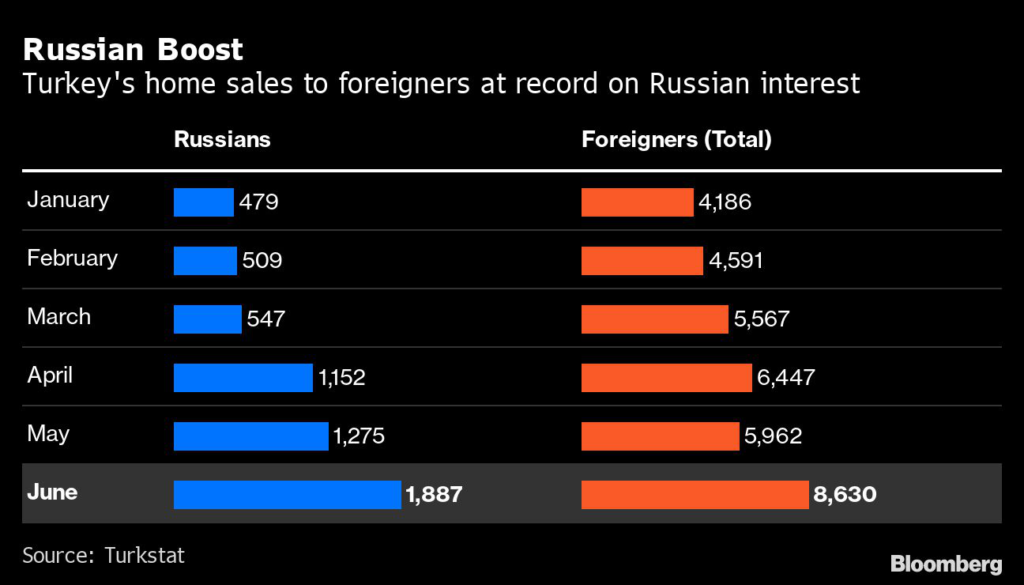
Sales of Turkish homes to foreigners jumped more than 80% in June from a year ago to a record 8,630, thanks primarily to accelerating demand from Russian citizens since the start of the war in Ukraine. 

Russians purchased 1,887 properties last month, and have now bought 5,849 homes in Turkey this year, making them the biggest buyers by nationality. 

Russia to Start Buying Grain in August, Interfax Says (1:17 p.m.)

Russia’s Agriculture Ministry plans to purchase as much as 1 million tons of grain from Siberia, Urals and central Russia this year, starting in August, Interfax reported, citing the ministry. 

The purchases will be for the State Intervention Fund, according to Interfax. The announcement comes as global wheat prices are much higher than usual for this time of year, after Russia’s invasion of Ukraine cut Kyiv’s grain shipments and other major producers are hit by drought.

Read more: Russia’s Wheat Exports Are Off to Flying Start Amid Bumper Crop

Ukrainian Parliament Dismisses Prosecutor General (12:50 p.m.)

Ukraine’s parliament voted to dismiss Chief Prosecutor Iryna Venediktova after she was suspended by President Volodymyr Zelenskiy this week in a shakeup of the nation’s security services.

Her ouster follows accusations from Zelenskiy’s office that the state prosecutor’s office and the state security service — whose head the president also dismissed — employed more than 60 people who worked for Russia and leaked information to undermines Ukraine’s efforts to beat back Moscow’s invasion.

Zelenskiy’s deputy chief of staff, Andriy Smyrnov, said Tuesday the president expected officials to step up work to remove traitors from state security bodies and investigations would be launched into Venediktova and Ivan Bakanov, who led the security service.

EU Proposes New Sanctions on Sberbank (12:16 p.m.)

The European Union has proposed additional sanctions on Sberbank, Russia’s largest bank, according to people familiar with the matter.

The measures against Sberbank, which has already been cut off from the international payments system SWIFT, would include a total asset freeze, the people said. Under the current proposal the measure would kick in after six months. EU sanctions need the backing of all member states and details could change before that happens.

The EU’s latest package of proposals includes a derogation to allow listed banks to continue transactions related to essentials such as food and agricultural goods. The suite of measures also includes a proposal that would oblige sanctioned individuals to register their assets and a ban on imports of Russian gold. At a meeting of EU ambassadors on Monday, a number of member states asked that the gold ban also cover jewelery, the people said.

Russians Split Over Peace Talks, The Bell Says (12:00 p.m.)

Russians were evenly divided over the need to hold peace talks or continue what the authorities call a “special military operation” in Ukraine, The Bell reported, citing a non-public June survey by state pollster VTsIOM.

The VTsIOM poll found 44% in favor of each option, with 12% declining to answer the question, The Bell said, citing an unidentified person close to the Kremlin who was familiar with the survey of 1,600 Russians conducted in late June. In another question, 57% said they favored continuing the war compared to 30% supporting ending it as soon as possible, The Bell said.

VTsIOM did not immediately respond to a request for comment.

EU Aims to Replenish Weapons Stock (11:15 a.m.)

The European Union is proposing a 500 million-euro ($508 million) investment tool to incentivize a minimum of three member states to buy weapons jointly, including artillery, air defense systems and anti-tank missiles. 

“This initiative will make it possible to replenish part of the stocks following Europe’s united and supportive response by way of transfer of arms to Ukraine,” EU Internal Market Commissioner Thierry Breton said, adding the project would “boost our European industrial base.”

The measure would draw from the bloc’s budget for the next two years, and only European companies based in Europe will be able to benefit. 

Ukraine Picks Chief Anti-Graft Prosecutor (11:00 a.m.)

Ukraine appointed a new head of the anti-corruption prosecutors’ office after months of delay, fulfilling a requirement from the European Union and other international financial donors.

The former Soviet state, which is seeking closer integration with the West as it fights off Russia’s military invasion, has agreed to a demand by the bloc and the International Monetary Fund to demonstrate progress in fighting endemic corruption as a condition to receiving financial aid.

Ukraine Military Commander Says Situation Has Stabilized (9:12 p.m.)

Ukraine’s military chief, Valeriy Zaluzhnyi, said Ukraine “has managed to stabilize the situation” in the country. 

“It is complex, intense, but completely controlled,” Zaluzhnyi said on Facebook after speaking with General Mark Milley, chairman of the US Joint Chiefs of Staff. “An important factor contributing to our retention of defensive lines and positions is the timely arrival of M142 HIMARS, which deliver surgical strikes on enemy control posts, ammunition and fuel storage depots.”

Zaluzhnyi and Milley also discussed a meeting of the Ukraine Defense Contact Group, scheduled for Wednesday, where military needs will be discussed.

First Lady to Address US Congress Wednesday (8:01 p.m.)

Olena Zelenska, the first lady of Ukraine and wife of President Zelenskiy, will accept a human rights award at the Victims of Communism Museum on Tuesday, according to a statement from the organization.

Zelenska, who met with US first lady Jill Biden during an unannounced visit to Ukraine in May, was invited to address the US Congress on Wednesday by Speaker Nancy Pelosi.

(A previous version corrected Smyrnov’s title.)

More stories like this are available on bloomberg.com

©2022 Bloomberg L.P.

Morgan Stanley Says Buy Salvadoran Bonds Battered by Bitcoin Bet

(Bloomberg) — Morgan Stanley is ready to scoop up battered bonds from El Salvador, which are some of the worst-performing notes this year as the president’s bet on Bitcoin backfires. 

The government’s $7.7 billion in eurobonds have been “overly punished” by the market despite El Salvador having better metrics than other distressed peers, Simon Waever, the global head of emerging-market sovereign credit strategy at the bank, wrote in a note Tuesday. 

The country’s 2027 bond has slumped 32 cents on the dollar to 28 cents this year, touching a record low of 26.3 cents on Friday. 

“Markets are clearly pricing in a high probability of the autarky scenario in which El Salvador defaults, but there is no restructuring,” he wrote. 

Waever estimates the debt should trade on average at 43.7 cents on the dollar, even if the country is heading for default, though he recognizes it is unlikely to reach that level soon as global liquidity tightens. The calculations don’t include an $800 million dollar coming due in January of 2023, which trades much higher at 65 cents on the dollar. 

The country could muddle through without missing payments for at least another year, Waever wrote. It runs a primary surplus and has smaller maturities coming due than other distressed peers like Argentina, Egypt and Ukraine. 

Emergency Curbs Protests as Sri Lanka Awaits New President 

The market pessimism toward El Salvador has often been attributed to President Nayib Bukele’s unpredictable policies — from firing some of the country’s top judges to making Bitcoin legal tender and announcing a failed dollar-bond sale linked to the token. 

Since peaking in November, the price of Bitcoin has lost nearly a third of its value, prompting losses of about 48% with Bukele’s Bitcoin gamble that started in September. The nation currently holds about $56 million in Bitcoin, according to data compiled by Bloomberg. 

El Salvador’s Big Bitcoin Gamble Backfires to Deepen Debt Woes

Those policies have also weighed on talks with the International Monetary Fund. 

“For a restructuring to work, it nearly always needs the IMF involved and or there to be a clear push for reform by the government,” Waever wrote. “Given this may not be the set-up in a potential restructuring, it could easily end up being a protracted negotiation.” 

More stories like this are available on bloomberg.com

©2022 Bloomberg L.P.

S&P 500 Struts Stuff With Best Day in Three Weeks: Markets Wrap

(Bloomberg) — US stocks surged in a broad-based rally as investors assessed the outlook for earnings and as speculation grew that markets may have come close to bottoming out.

The S&P 500 defied the late-day reversal that has been a cornerstone of this volatile market, closing near session highs in its biggest one-day gain since June 24 as all 11 industry groups advanced. The tech-heavy Nasdaq 100 outperformed major benchmarks, ending 3.1% higher, with megacaps Apple Inc. and Alphabet Inc. bouncing back from Monday’s losses. 

Stocks favored by short sellers were among the biggest gainers on the day, suggesting that bearish traders were forced to cover positions moving against them. In extended trading, Netflix Inc. gained after reporting a second-quarter subscriber loss that was less than expected. 

With the potential for earnings disappointments baked into markets, any upside surprises may lead to outsized gains. Investors remain on high alert for signs that high inflation and monetary tightening are squeezing consumers and employment, with allocation to stocks plunging to levels last seen in October 2008 and exposure to cash surged to the highest since 2001, according to the latest Bank of America Corp.’s monthly fund manager survey.

“Earnings, so far, there’s been some caution and there’s been a little bit of dialing down of expectations, but I don’t think the worst-case scenarios are really in play anymore,” Shawn Cruz, head trading strategist at TD Ameritrade, said in an interview. “We’ve heard from the big banks, we’ve heard from IBM, we’ve heard from Johnson & Johnson, we’ve heard from enough companies that have had a big enough footprint that if there is something at the macro level severely impacting these businesses, it would have shown up in a lot of these earnings.”

On the earnings front, Hasbro Inc., the largest US toy company, gained after earnings beat analyst estimates, while International Business Machines Corp. fell as the tech company lowered its forecasts for free cash flow. Johnson & Johnson reversed early gains as it lowered its earnings and revenue forecast for the year. 

In other company news, Twitter Inc. shares gained as a Delaware judge allowed the social media company to fast-track its lawsuit against Elon Musk, with the trial set to take place in October.

The dollar fell against all Group-of-10 peers except the yen. Treasuries traded lower, with the 10-year yield rising back above 3%.

Rapid Dollar Retreat Stirs Debate About Whether Peak Has Passed

Meanwhile, the euro rose to its highest level in about two weeks after Bloomberg News reported the European Central Bank may consider raising interest rates on Thursday by double the quarter-point outlined previously to counter worsening inflation. 

Markets are pricing in about 38 basis points of tightening on Thursday, when the ECB is expected to raise rates for the first time in more than a decade. That reflects about a 50/50 chance of a 50-basis point increase. 

The ECB is under pressure to subdue inflation, but the potential for a Russian gas shutdown could plunge Europe into recession. The European Union is preparing to tell members to cut gas consumption “immediately” to preserve supplies for winter, according to a report. Gazprom PJSC was said to be poised to restart gas exports through the Nord Stream pipeline on Thursday at reduced capacity.

Elsewhere, oil rebounded, with West Texas Intermediate crude rising to $104 a barrel, while a rally in cryptocurrencies took Bitcoin out of a one-month-old trading range, up above $23,000. 

More market commentary:

  • “Stocks have been beaten down,” Kristina Hooper, chief global market strategist at Invesco, wrote in a note. “That doesn’t mean we won’t see more downside for some stock markets around the world, especially given that earnings expectations are likely to be adjusted downward. But I believe we are far closer to the bottom than the top.”
  • “There is a growing feeling in the market that the gradual and cautious normalization process the ECB started at the end of 2021 has been the wrong decision and that to make up for that slow and late,” wrote Fawad Razaqzada, market analyst at City Index. “Indeed, even until its June meeting, the ECB was pre-committing to a 25-basis point hike in July. But with the broad weakening of the euro helping to import more inflation in the eurozone, the ECB could surprise with a 50 bp hike.”
  • “Sharp dollar pullback has boosted equities,” Christopher Murphy, co-head of derivatives strategy at Susquehanna International Group, wrote in a note.”But the dollar rally was extended and due for a pullback (it can’t go up in a straight line) just like it was in late April. If the dollar pullback is temporary, the equity rally might be as well.”

How far will the Fed go in this hiking cycle? It takes one minute to participate in the confidential MLIV Pulse survey, so please click here to get involved. 

Key events to watch this week:

  • Earnings this week include Netflix, Tesla
  • US Treasury Secretary Janet Yellen visits South Korea. Tuesday
  • Reserve Bank of Australia releases July minutes. Tuesday
  • UK Chancellor Nadhim Zahawi and Bank of England Governor Andrew Bailey speak at event. Tuesday
  • Bloomberg Crypto Summit in New York. Tuesday
  • Bank of Japan, European Central Bank rate decisions. Thursday
  • Nord Stream 1 pipeline scheduled to reopen following maintenance. Thursday

Some of the main moves in markets:

Stocks

  • The S&P 500 rose 2.7% as of 4 p.m. New York time
  • The Nasdaq 100 rose 3.1%
  • The Dow Jones Industrial Average rose 2.4%
  • The MSCI World index rose 2%

Currencies

  • The Bloomberg Dollar Spot Index fell 0.5%
  • The euro rose 0.8% to $1.0225
  • The British pound rose 0.4% to $1.2000
  • The Japanese yen was little changed at 138.22 per dollar

Bonds

  • The yield on 10-year Treasuries advanced four basis points to 3.02%
  • Germany’s 10-year yield advanced six basis points to 1.28%
  • Britain’s 10-year yield advanced two basis points to 2.18%

Commodities

  • West Texas Intermediate crude rose 1.3% to $103.96 a barrel
  • Gold futures were little changed

More stories like this are available on bloomberg.com

©2022 Bloomberg L.P.

Bitcoin Jumps to Highest Since the Aftermath of Celsius Meltdown

(Bloomberg) — A rally in cryptocurrencies Tuesday took Bitcoin out of a one-month-old trading range and ignited big jumps in smaller tokens commonly referred to as altcoins.

The largest virtual coin climbed as much as 10% to $23,684, a level it was last at in mid-June, or just after the collapse of crypto lender Celsius Network. Ether at one point added almost 11%. Solana also achieved a double-digit percentage gain.

Bitcoin has struggled to escape a $19,000 to $22,000 range as investors lick their wounds from a rout sparked by tightening monetary policy and exacerbated by the toppling of Celsius and the TerraUSD stablecoin in May. It has retreated from a record high of almost $69,000 in November.

“I think the worst happened,” Galaxy Digital Chief Executive Mike Novogratz said at the Bloomberg Crypto Summit. Novogratz reiterated that he still maintains a five-year forecast of $500,000.

A sustained break above $22,000 could renew the speculative momentum that can grip crypto assets in the blink of an eye. Expectations for Federal Reserve interest-rate hikes are less aggressive now, which may help. 

US stocks rallied as investors assessed the outlook for earnings amid speculation disappointments may be already priced into markets. Bitcoin has been highly correlated to movements in equities.

Ether is extending a rally that began last week after developers of the Ethereum blockchain gave a target for the long-anticipated software update that is projected to lower the network’s energy usage.

Altcoins often outperform Bitcoin during rallies and underperform when prices are falling, in part because they’re a favorite of more speculative traders and tend to be less liquid.  

Some enthusiasts are forecasting that Bitcoin will recoup this year’s losses once the Fed’s tightening cycle is done. 

“We’ll have a powerful up move after that. So we’re in that zone — this is the accumulation zone.” Eric Peters, founder and chief executive officer of One River Asset Management said at the Bloomberg Crypto Summit. “You’re in that period of time where you’re not supposed to be selling, you’re supposed to be buying.”

The recent rebound in Bitcoin has pared its loss this year to about 50%. The overall market value of digital tokens has retaken the $1 trillion level.

More stories like this are available on bloomberg.com

©2022 Bloomberg L.P.
US Senators Push for Last-Minute Tax Break in Semiconductor Bill

(Bloomberg) — A bipartisan group of lawmakers is making a last-minute attempt to revive a tax break for corporate research and development in the semiconductor funding bill that the Senate is debating this week.

Senator Todd Young, the Indiana Republican who has been leading the negotiations for his party, told reporters Tuesday that lawmakers are discussing a one-year extension to a tax break for R&D costs that expired at the end of 2021. The addition, which is still being debated, would let companies deduct research expenses in the year they’re incurred, rather than a multi-annual period.

The addition would be a boon to technology, pharmaceutical and manufacturing companies with lots of R&D expenses, including Alphabet Inc.’s Google, Pfizer Inc., and Ford Motor Co. Without the change, companies starting this year will have to spread out the writeoffs for their domestic expenses over five years and the foreign costs over 15 years.

Corporations seeking the change say it’s critical to pass the tax break soon, because they’re currently incurring research costs that aren’t eligible for preferential tax treatment. 

The measure has support from a broad swath of senators, including Democrats Mark Warner of Virginia and Jon Tester of Montana, and Republican Shelley Moore Capito of West Virginia. The extension of the tax break passed the House last year as part of President Joe Biden’s Build Back Better plan.

Other Vehicle

“I support it,” Tester said Tuesday. “We just need the votes.”

The attempts to add the R&D tax break — valued at an estimated $2 billion, according to Young — may yet fall short, as lawmakers continue to squabble over last-minute additions. Senate Majority Leader Chuck Schumer is pushing for a vote as soon as this week.

Young is also pushing to add provisions that would establish a directorate for technology and innovation within the National Science Foundation to support basic and applied research and bolster education in science, technology, engineering and mathematics. 

Those further measures were included in a draft of the bill that was circulating Tuesday afternoon that didn’t include the tax break.

The overall legislation is a scaled-down version of a more expansive bill intended to make the US more competitive with China in technology and advanced manufacturing. That legislation has been hung up for months in negotiations between the House and Senate over how to merge their different versions. 

If the R&D tax break is left out, it’s still likely to be considered by the Senate this year. Senator Tim Kaine, a Virginia Democrat, said it’s “not impossible” for it to be included in the semiconductor package, but more likely to be in a subsequent vehicle — such as a government funding bill later this year.

“There’s bipartisan support for that. However, I think that gets done in the year-end bill,” John Thune, the No. 2 Republican in the Senate, said. “I think that gets fixed one way or the other.”

More stories like this are available on bloomberg.com

©2022 Bloomberg L.P.

Close Bitnami banner
Bitnami