Bloomberg

Just Eat Moves to Eliminate 350 Delivery Jobs in France

(Bloomberg) — Just Eat Takeway.com NV may eliminate 350 jobs in France due to “difficult market dynamics” in the country, the latest delivery company to announce cuts as the industry grapples with slowing growth.

The plan, which is still being negotiated with unions, will involve firing permanent delivery staff in 26 cities across France, the Dutch company said in an emailed statement on Wednesday. Just Eat is exploring options in these cities and could outsource its deliveries to other companies, a spokesperson said.

The company is scaling back plans to build up its own logistics network of couriers delivering meals to compete with the likes of Uber Eats and Deliveroo Plc. In its original model, Just Eat matched customers to restaurants and let the eateries deliver themselves. While Chief Executive Officer Jitse Groen in 2020 told analysts that a logistics business couldn’t be profitable in Europe, he has since changed tack, with his firm building up a fleet of couriers.

Industrywide, delivery apps — which saw huge gains in the wake of the Covid-19 pandemic, when they became a lifeline to customers stuck indoors — are having to find ways to improve their profitability and roll back expansion plans as customer growth trails off. 

Rival Deliveroo cut this year’s projections for order growth by more than half on Monday. Fast-delivery startup Gopuff said earlier this month that it would eliminate 10% of its staff and close dozens of warehouses. Germany’s Gorillas Technologies GmbH is exploring options, including the sale of its business or a merger with competitors, people familiar with the talks said in June. 

Employees in Just Eat’s French headquarters will also be reduced, and the company will keep permanent delivery staff in Paris only, it said. The proposed cuts are an extension of a first restructuring plan announced in April, which targeted 20 cities in France, and were first reported by newspaper Le Monde on Tuesday.

“Our current priority is to support all affected employees throughout this process,” the company said in the statement. “We remain fully invested in continuing to provide the highest quality of service to our restaurant owners and consumers.”

More stories like this are available on bloomberg.com

©2022 Bloomberg L.P.

ASML Cuts Sales Forecast Amid Continued Testing Delays

(Bloomberg) — ASML Holding NV cut its revenue growth guidance in half for this year because fast-track shipping of its chip-making machines led to delayed sales recognition.

Sales growth this year will come in at 10%, ASML said, adding that the value of machines on a fast shipping schedule will more than double to 2.8 billion euros next year as it races to get equipment to customers amid a chip shortage.

Shares of ASML dropped as much as 4.8% after the earnings result. They were trading 1.1% down at 479.3 euros per share as of 9:44 a.m. in Amsterdam on Wednesday.

“The demand is still significantly higher than what we can make,” CEO Peter Wennink said in a statement. “This was the situation in the last quarter it’s still the same.” But despite the “very strong” demand in automative, the company sees a slowdown particularly in products such as PCs and smartphones.

The company’s net sales forecast for the third quarter fell short of analyst expectations. It predicts sales of 5.1 billion euros ($5.22 billion) to 5.4 billion euros for the third quarter compared with an estimate of 6.48 billion euros in a Bloomberg analyst survey.    

“Initial reaction will be negative, but it could create an opportunity as the overall picture remains strong,” Oddo BHF analyst Martin Marandon-Carlhian wrote in a note to clients. He said ASML will “continue to benefit from the structural growth of the lithography market in 2022 and far beyond.”

The company began skipping some final testing in its factories last year to speed up delivery. This meant clients get their machines more quickly, but ASML had to delay sales recognition for those shipments until formal customer acceptance. 

The value of fast shipments in 2022 leading to delayed revenue recognition into 2023 is expected to increase to 2.8 billion euros from a previous forecast of about 1 billion euros, the company said.

“What we saw in the second quarter, which is basically an acceleration of supply chain constraints, is actually also happening in the third quarter,” Wennink said. “And I think it will happen throughout the remainder of the year.”

ASML shares have been under extra pressure in recent weeks as the US pushes the Netherlands to ban the chip-tool maker from selling some deep ultraviolet lithography systems to China. Washington is focused on banning sales of the most advanced type of DUV technology, immersion lithography machines, Bloomberg reported earlier this month, citing people familiar with the matter.

Read more: US Pushes for ASML to Stop Selling Chipmaking Gear to China

The Dutch government, which confirmed US officials are seeking to expand an existing moratorium on the sale of such systems to the Asian nation, has yet to agree to any additional restrictions. ASML opposes the proposed ban because DUV lithography equipment is already a mature technology, Wennink said earlier this year. 

“The geopolitical situation, the technological sovereignty that countries are after is driving” big investment and subsidy programs, he said in a separate statement Wednesday. He said ASML expects a “quadrupling or quintupling” of the semiconductor content in the longer term despite “mixed signals” in the short term.

ASML has cornered the market for the latest advanced extreme ultraviolet lithography equipment needed to make cutting-edge chips that are faster, cheaper and more efficient. 

The Dutch company’s customers include Samsung Electronics Co. and Taiwan Semiconductor Manufacturing Co., which have been investing heavily to keep up with rebounding demand as lockdowns ended. It competes with Japan’s Nikon Corp. in deep ultraviolet machines used to produce more mature chips.  

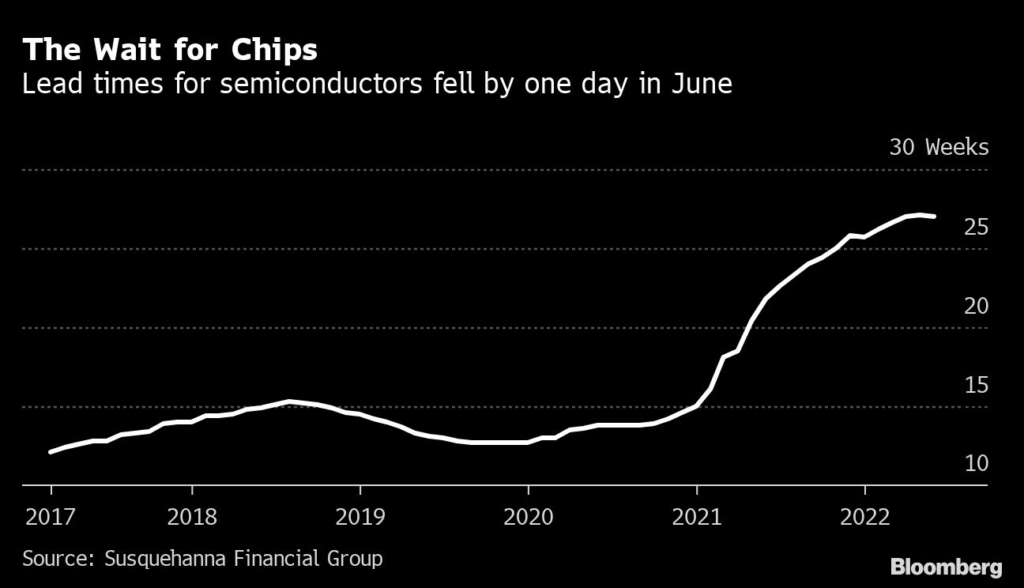
The delivery times for semiconductors fell by a day in June, a sign of modest relief after chronic shortages that have plagued automakers and other industries for more than a year. Still, lead times — a closely watched gap between when a semiconductor is ordered and when it is delivered — averaged 27 weeks last month.

Key Insights

  • In the second quarter, ASML sold a total of 91 lithography machines.
  • In 2022, it’s planning to ship 55 EUV devices, which etch smaller circuits while increasing capacity and speed, but it will only book revenue for 40 systems because of the sales recognition delay.
  • The company said it’s revised its dividend policy to make payments on a quarterly basis, starting with an interim dividend of 1.37 euros per ordinary share that will be made payable on Aug. 12.
  • ASML stock dropped about 32% since the start of the year, in line with a 30% retreat in the Stoxx Europe technology index.


(Updates with the move in shares in the third paragraph)

More stories like this are available on bloomberg.com

©2022 Bloomberg L.P.

ASML Cuts Forecast After Racing to Deliver Chip-Making Gear

(Bloomberg) — ASML Holding NV cut its revenue growth guidance in half for this year because fast-track shipping of its chip-making machines led to delayed sales recognition.

Sales growth this year will come in at 10%, ASML said, adding that the value of machines on a fast shipping schedule will more than double to 2.8 billion euros next year as it races to get equipment to customers amid a chip shortage.

Shares of ASML dropped as much as 4.8% after the earnings result. They were trading 1.1% down at 479.3 euros per share as of 9:44 a.m. in Amsterdam on Wednesday.

“The demand is still significantly higher than what we can make,” CEO Peter Wennink said in a statement. “This was the situation in the last quarter it’s still the same.” But despite the “very strong” demand in automative, the company sees a slowdown particularly in products such as PCs and smartphones.

The company’s net sales forecast for the third quarter fell short of analyst expectations. It predicts sales of 5.1 billion euros ($5.22 billion) to 5.4 billion euros for the third quarter compared with an estimate of 6.48 billion euros in a Bloomberg analyst survey.    

“Initial reaction will be negative, but it could create an opportunity as the overall picture remains strong,” Oddo BHF analyst Martin Marandon-Carlhian wrote in a note to clients. He said ASML will “continue to benefit from the structural growth of the lithography market in 2022 and far beyond.”

The company began skipping some final testing in its factories last year to speed up delivery. This meant clients get their machines more quickly, but ASML had to delay sales recognition for those shipments until formal customer acceptance. 

The value of fast shipments in 2022 leading to delayed revenue recognition into 2023 is expected to increase to 2.8 billion euros from a previous forecast of about 1 billion euros, the company said.

“What we saw in the second quarter, which is basically an acceleration of supply chain constraints, is actually also happening in the third quarter,” Wennink said. “And I think it will happen throughout the remainder of the year.”

ASML shares have been under extra pressure in recent weeks as the US pushes the Netherlands to ban the chip-tool maker from selling some deep ultraviolet lithography systems to China. Washington is focused on banning sales of the most advanced type of DUV technology, immersion lithography machines, Bloomberg reported earlier this month, citing people familiar with the matter.

Read more: US Pushes for ASML to Stop Selling Chipmaking Gear to China

The Dutch government, which confirmed US officials are seeking to expand an existing moratorium on the sale of such systems to the Asian nation, has yet to agree to any additional restrictions. ASML opposes the proposed ban because DUV lithography equipment is already a mature technology, Wennink said earlier this year. 

“The geopolitical situation, the technological sovereignty that countries are after is driving” big investment and subsidy programs, he said in a separate statement Wednesday. He said ASML expects a “quadrupling or quintupling” of the semiconductor content in the longer term despite “mixed signals” in the short term.

ASML has cornered the market for the latest advanced extreme ultraviolet lithography equipment needed to make cutting-edge chips that are faster, cheaper and more efficient. 

The Dutch company’s customers include Samsung Electronics Co. and Taiwan Semiconductor Manufacturing Co., which have been investing heavily to keep up with rebounding demand as lockdowns ended. It competes with Japan’s Nikon Corp. in deep ultraviolet machines used to produce more mature chips.  

The delivery times for semiconductors fell by a day in June, a sign of modest relief after chronic shortages that have plagued automakers and other industries for more than a year. Still, lead times — a closely watched gap between when a semiconductor is ordered and when it is delivered — averaged 27 weeks last month.

Key Insights

  • In the second quarter, ASML sold a total of 91 lithography machines.
  • In 2022, it’s planning to ship 55 EUV devices, which etch smaller circuits while increasing capacity and speed, but it will only book revenue for 40 systems because of the sales recognition delay.
  • The company said it’s revised its dividend policy to make payments on a quarterly basis, starting with an interim dividend of 1.37 euros per ordinary share that will be made payable on Aug. 12.
  • ASML stock dropped about 32% since the start of the year, in line with a 30% retreat in the Stoxx Europe technology index.


(Updates with the move in shares in the third paragraph)

More stories like this are available on bloomberg.com

©2022 Bloomberg L.P.

Volvo Car Sees 2022 Sales Flat-to-Lower on Supply Disruption

(Bloomberg) — Volvo Car AB said retail sales this year will be flat or slightly lower than 2021 after semiconductor shortages and Covid lockdowns continued to weigh on production in the second quarter.

Retail sales declined 27% in the three months through June as Covid lockdowns in China and persistent supply-chain lags cut deliveries, Volvo said Wednesday. Previously the Swedish carmaker predicted some growth in deliveries this year. 

Operating income during the second quarter came in at 10.8 billion kronor ($1.1 billion), boosted by proceeds from the listing of electric-vehicle unit Polestar. The company’s shares fell as much as 5.8% in early trading. 

Carmakers are struggling to grow sales as ongoing supply-chain jams and a souring economic outlook weigh on the industry. Volvo Cars, which aims to produce only electric vehicles by 2030, has bet its more aggressive transition away from internal combustion engines will drive profitability.

Echoing other carmakers, Volvo Cars said it saw an improvement in supply chains late in the second quarter, helping production resume. Yet, due to the lag between production and retail deliveries, the improvements won’t be felt in this year’s sales results, the carmaker said.

“We are largely through those supply constraints that we saw in the first quarter,” Chief Executive Officer Jim Rowan said, noting that a shortage of a specific semiconductor hampered the carmaker.

Rowan added that lockdowns in China significantly changed the outlook: “We never foresaw it would last so long.”

“It’s not where we want to be longer term,” Rowan said. “But given the turbulence that we’ve been navigating in the second quarter, I think it’s a decent foundation we can build on once we get back to full supply.”

(Updates with shares in third paragraph.)

More stories like this are available on bloomberg.com

©2022 Bloomberg L.P.
Stocks Extend Rally as Demand for Havens Wanes: Markets Wrap

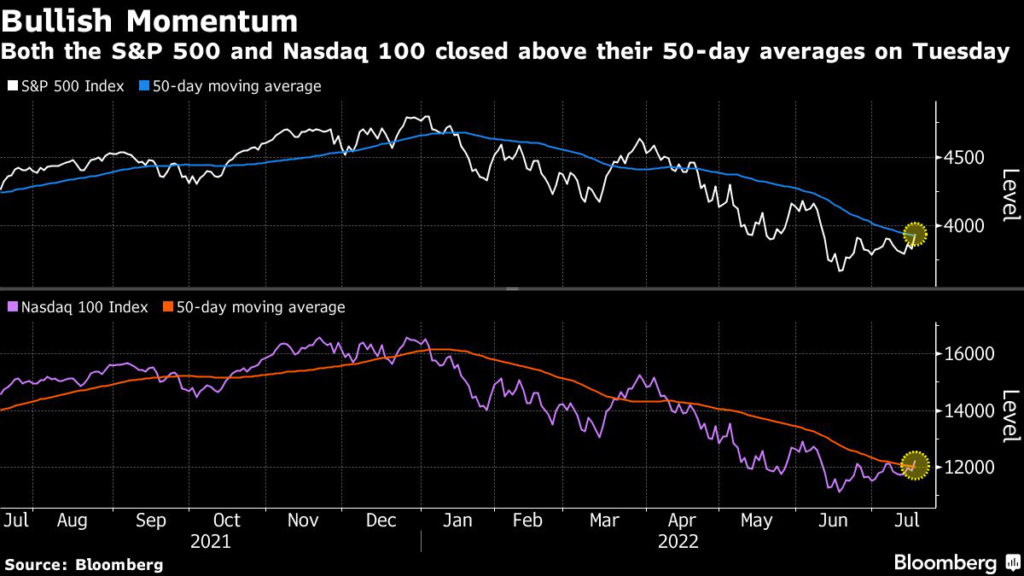
(Bloomberg) — Stocks rose Wednesday amid a retreat in the dollar and speculation that the worst of this year’s equity rout may be over. 

The Stoxx 600 Index extended a fourth straight day of gains that took it to the highest closing level in nearly six weeks, amid signs Russia will restart gas exports to Europe through the Nord Stream pipeline on Thursday, albeit at reduced capacity.

US contracts were in the green too, encouraged by a Netflix Inc. surge in extended trading on a smaller-than-expected subscriber loss.

The euro hovered around a two-week high against the dollar on the possibility of a bigger-than-expected European Central Bank interest-rate hike Thursday.

Speculation that company earnings will hold up and that the Federal Reserve will avoid very aggressive monetary tightening is giving investors some hope. Worries about a global downturn due to rising interest rates, Europe’s energy challenges and China’s Covid and property-sector woes are taking a back seat.

“Stocks have been beaten down,” Kristina Hooper, chief global market strategist at Invesco, wrote in a note. “That doesn’t mean we won’t see more downside for some stock markets around the world, especially given that earnings expectations are likely to be adjusted downward. But I believe we are far closer to the bottom than the top.”

A dollar gauge has shed about 1% this week, underscoring waning haven demand for the greenback and a brighter mood in markets. Treasuries held a decline that’s taken the 10-year yield back above 3%.

West Texas Intermediate crude oil slipped below $103 a barrel. Bitcoin hovered above $23,000 after climbing out of a one-month-old trading range.

How far will the Fed go in this hiking cycle? It takes one minute to participate in the confidential MLIV Pulse survey, so please click here to get involved. 

Key events to watch this week:

  • Earnings this week include Tesla
  • US Treasury Secretary Janet Yellen visits South Korea. Tuesday
  • Reserve Bank of Australia releases July minutes. Tuesday
  • UK Chancellor Nadhim Zahawi and Bank of England Governor Andrew Bailey speak at event. Tuesday
  • Bloomberg Crypto Summit in New York. Tuesday
  • Bank of Japan, European Central Bank rate decisions. Thursday
  • Nord Stream 1 pipeline scheduled to reopen following maintenance. Thursday

Some of the main moves in markets:

Stocks

  • The Stoxx Europe 600 rose 0.4% as of 8:30 a.m. London time
  • Futures on the S&P 500 rose 0.4%
  • Futures on the Nasdaq 100 rose 0.4%
  • Futures on the Dow Jones Industrial Average rose 0.3%
  • The MSCI Asia Pacific Index rose 1.5%
  • The MSCI Emerging Markets Index rose 1%

Currencies

  • The Bloomberg Dollar Spot Index fell 0.1%
  • The euro rose 0.3% to $1.0261
  • The Japanese yen was little changed at 138.15 per dollar
  • The offshore yuan fell 0.1% to 6.7533 per dollar
  • The British pound rose 0.2% to $1.2018

Bonds

  • The yield on 10-year Treasuries was little changed at 3.01%
  • Germany’s 10-year yield advanced one basis point to 1.29%
  • Britain’s 10-year yield declined two basis points to 2.16%

Commodities

  • Brent crude fell 1.2% to $106.06 a barrel
  • Spot gold fell 0.2% to $1,708.08 an ounce

More stories like this are available on bloomberg.com

©2022 Bloomberg L.P.

US Futures Up, Stocks Extend Rally as Dollar Dips: Markets Wrap

(Bloomberg) — Stocks extended a rally Wednesday amid a retreat in the dollar and speculation that the worst of this year’s equity rout may be over.

Technology shares fueled a climb of more than 1.5% in a gauge of Asian equities after the S&P 500’s biggest jump since June. European futures pushed higher and US contracts were in the green too, encouraged by a Netflix Inc. surge in extended trading on a smaller-than-expected subscriber loss.

The tech climb swept along Chinese firms following a report that regulators are wrapping up an investigation into ride-hailing giant Didi Global Inc. with a hefty fine — stoking hopes of an end to Beijing’s crackdown on the sector.

A dollar gauge has shed about 1% this week, underscoring waning haven demand for the greenback and a brighter mood in markets. Treasuries held a decline that’s taken the 10-year yield back above 3%.

The euro hovered around a two-week high against the dollar on the possibility of a bigger-than-expected European Central Bank interest-rate hike Thursday.

Speculation that company earnings will hold up and that the Federal Reserve will avoid very aggressive monetary tightening is giving investors some hope. Worries about a global downturn due to rising interest rates, Europe’s energy challenges and China’s Covid and property-sector woes are taking a back seat.

“Stocks have been beaten down,” Kristina Hooper, chief global market strategist at Invesco, wrote in a note. “That doesn’t mean we won’t see more downside for some stock markets around the world, especially given that earnings expectations are likely to be adjusted downward. But I believe we are far closer to the bottom than the top.”

In Europe, Gazprom PJSC is poised to restart gas exports through its Nord Stream pipeline to Europe on Thursday at reduced capacity, as the continent braces for shortages amid Russia’s war in Ukraine.

Elsewhere, crude oil slipped below $104 a barrel. Bitcoin hovered above $23,000 after climbing out of a one-month-old trading range.

How far will the Fed go in this hiking cycle? It takes one minute to participate in the confidential MLIV Pulse survey, so please click here to get involved. 

Key events to watch this week:

  • Earnings this week include Tesla
  • US Treasury Secretary Janet Yellen visits South Korea. Tuesday
  • Reserve Bank of Australia releases July minutes. Tuesday
  • UK Chancellor Nadhim Zahawi and Bank of England Governor Andrew Bailey speak at event. Tuesday
  • Bloomberg Crypto Summit in New York. Tuesday
  • Bank of Japan, European Central Bank rate decisions. Thursday
  • Nord Stream 1 pipeline scheduled to reopen following maintenance. Thursday

Some of the main moves in markets:

Stocks

  • S&P 500 futures rose 0.6% as of 1:03 p.m. in Tokyo. The S&P 500 rose 2.7%
  • Nasdaq 100 futures rose 0.6%. The Nasdaq 100 rose 3.1%
  • Japan’s Topix index rose 2%
  • Australia’s S&P/ASX 200 Index gained 1.7%
  • South Korea’s Kospi index climbed 1%
  • Hong Kong’s Hang Seng Index rose 1.9%
  • China’s Shanghai Composite Index rose 0.7%
  • Euro Stoxx 50 futures increased 0.6%

Currencies

  • The Bloomberg Dollar Spot Index fell 0.1%
  • The euro was at $1.0245, up 0.2%
  • The Japanese yen was at 138.12 per dollar, up 0.1%
  • The offshore yuan was at 6.7485 per dollar

Bonds

  • The yield on 10-year Treasuries was at 3.02%
  • Australia’s 10-year bond yield rose four basis points to 3.55%

Commodities

  • West Texas Intermediate crude was at $103.53 a barrel, down 0.7%
  • Gold was at $1,712.31 an ounce

More stories like this are available on bloomberg.com

©2022 Bloomberg L.P.
Diners Rail Against Smaller Restaurant Portions in Yelp Reviews

(Bloomberg) — Restaurant portions are getting smaller, and diners aren’t happy. 

“Shrinkflation,” or the paring down of serving sizes to offset higher costs, is a hallmark of inflationary environments such as the one the US is currently experiencing. It’s on the rise, and it has gotten so noticeable that consumers are venting about it online, review website operator Yelp Inc. said in a report on activity during the second quarter. 

“Inflation mentions in Yelp reviews are increasing more than ever before, and for the first time, we’ve seen mentions of shrinkflation-related experiences,” said Pria Mudan, Yelp’s data-science leader.

The most-complained-about restaurants are those serving lower-cost menu items, according to Yelp. These include hot dogs, burgers and pizza. 

While prices in the US have surged across the board, food costs have outpaced the general rate of inflation, rising 10.4% in June from a year ago — the largest jump since 1981. The price of bread has risen so sharply, there’s data showing consumers are pulling back from the staple. 

See also: Expensive flour, poultry start to eat into fried chicken craze

Restaurant companies are often reluctant to dramatically hike prices, so reducing serving size is another option. Domino’s Pizza Inc., reduced boneless wing orders to 8 pieces from 10, and Burger King, owned by Restaurant Brands International Inc., cut the size of its nugget orders. 

On Yelp, searches for the least expensive businesses, denoted by a single “$,” increased by 7% compared from the previous quarter, the company said. The priciest options (“$$$$”) fell by 12%. 

More stories like this are available on bloomberg.com

©2022 Bloomberg L.P.

China’s Tsinghua University Punishes Students for LGBTQ Flags

(Bloomberg) — Two students at one of China’s most prestigious universities were issued warnings for distributing LGBTQ rainbow flags, highlighting how the nation’s increasing intolerance for sexual diversity is extending further into campuses.

The pair were reprimanded for placing 10 handheld flags on a table at an on-campus supermarket in Beijing on May 14 alongside handwritten notes encouraging people to take the items, according to a person familiar with the incident who asked not to be identified publicly discussing a sensitive issue. 

That evening, Tsinghua University representatives told the pair distributing the flags was in possible contravention of school rules, the person said. About a month later, one of the students attended a meeting with school staff to discuss the incident.

In recent days, Tsinghua handed the students officials warnings, which prohibit them from receiving scholarships or awards for six months, the person said. If they break another school rule in that period, they face a more serious penalty that could appear on their personal file and rule them out for civil service and state-owned-enterprise jobs.

Discussion of the incident surfaced on popular Chinese social media platform WeChat on Monday and Tuesday, although related articles were quickly deleted from the app. The university didn’t respond to a request for comment.

READ: How LGBTQ Life in China Has Gotten Tougher Under Xi

“Moves against the rainbow flag are not unprecedented but compared with what students in the past were able to get away with this seems disproportionate,” said Darius Longarino, a senior fellow at Yale Law School’s Paul Tsai China Center. “This incident is the latest example of university authorities increasingly constraining space for LGBT advocacy and expression — even when it is mild and low-key.”

China’s LGBTQ community is coming under increased pressure as President Xi Jinping promotes more conservative and conformist values around gender and sexual identity. Shanghai’s Pride march — the nation’s only major annual celebration of sexual minorities — announced in 2020 that it would cease all activities, without giving a reason. Dozens of WeChat accounts run by LGBTQ groups at leading universities were blocked then deleted last year, sparking outrage. Some had tens of thousands of followers. Criticism of gender non-conforming men has been a rising theme in state media in recent years.

In a Twitter post, Longarino pointed to sympathetic coverage by the Communist Party backed Global Times newspaper in 2015 of an LGBT group unfurling a huge rainbow flag on a Guangdong university campus as evidence of that narrowing space.

Being gay, bisexual or trans is seen by some in China as a concept imported from the West — a misconception that draws on the fact that many foreign embassies in Beijing have highlighted gay rights. That’s left few local advocacy groups daring to attend foreign-sponsored events on such themes, at least officially. 

Still, Zhijun Hu, founder of the PFLAG China group supporting LGBTQ people, said he found the reaction at Tsinghua to such a small scale event shocking.

“I couldn’t believe when students put their rainbow flags in the shop, their university would punish them and give them a warning like that,” he said. “Why is the university so strict on its students? Maybe it’s about ideology.”

More stories like this are available on bloomberg.com

©2022 Bloomberg L.P.

Tencent-Backed Missfresh Weighs Unit Stake Sale for Funds

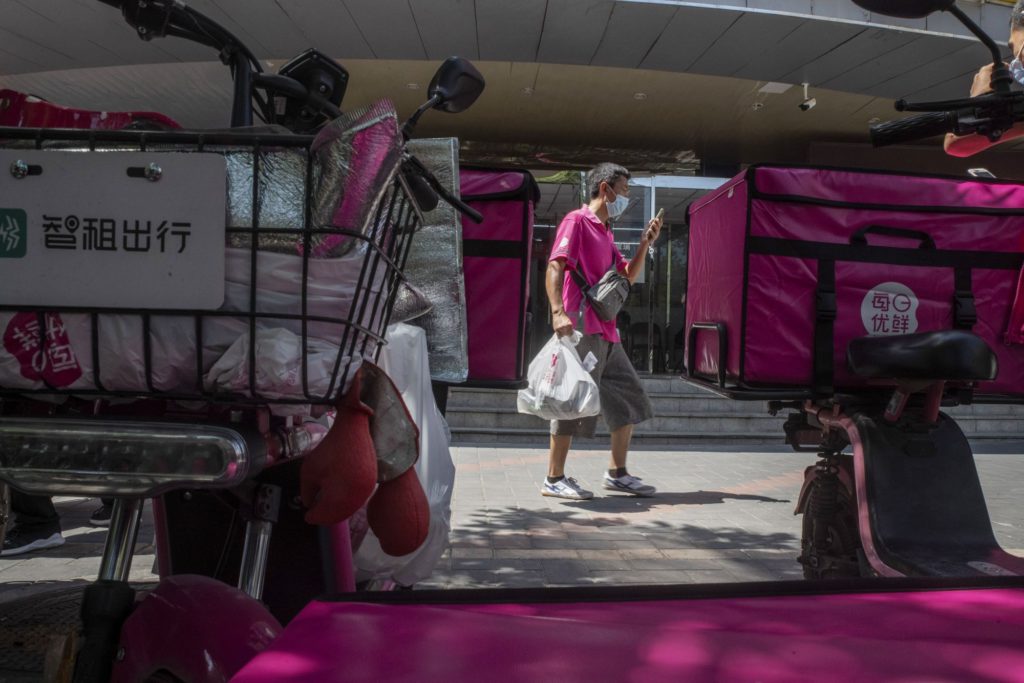
(Bloomberg) — Missfresh Ltd. is weighing selling stakes in a unit that offers services to fresh produce sellers including business consultation and setting up online stores, according to people familiar with the matter, as the struggling firm looks for a lifeline.

The Tencent Holdings Ltd.-backed firm is working with advisers to gauge investor interest for its intelligent fresh market business, said the people, who asked not to be identified as the information is private. The process kicked off late last year and Missfresh is seeking a valuation of about $100 million for the unit, the people said. That’s higher than the New York-listed company’s market value of $79 million.

Deliberations are ongoing and may not lead to any transaction, they added. A representative for Missfresh didn’t immediately respond to requests for comment.

Any deal could help salvage Missfresh which has lost 97% of its market value since its US debut in June 2021. Founded in 2014, the company offers more than 4,000 products from vegetables and seafood to snacks and cooked food, and promises deliveries as fast as 30 minutes in 16 Chinese cities, according to its website.

It raised at least $1.5 billion in private funding rounds from an array of marquee investors including Goldman Sachs Group Inc. and Tiger Global Management. The startup raised about $273 million in its US initial public offering.

Missfresh’s shares started tumbling soon after its debut as China cracked down on the tech sector and intense competition in the grocery delivery sector eroded its margins. The country’s tech giants and investors are now hitting the brakes on neighborhood retail and community buying with hundreds of startups having gone bankrupt. Covid-19 lockdowns in the country have also disrupted grocery delivery’s logistics network.

Read More: China’s Massive Community-Buying Industry Is Collapsing

In April, Missfresh said it couldn’t release its annual report for 2021 and set up an independent audit committee to conduct an internal review of some questionable transactions. The review concluded this month that certain revenue was inaccurately recorded and the staff responsible resigned. There were several class actions filed alleging Missfresh fabricated its financials during the IPO.

Last week the Beijing-based company raised 200 million yuan ($30 million) from Shanxi Donghui Group, a Chinese conglomerate that run businesses from energy and metals to tourism and agriculture. Shanxi Donghui will nominate two directors to Missfresh’s board.

More stories like this are available on bloomberg.com

©2022 Bloomberg L.P.
Netflix’s New Hit Stokes K-Drama Maker’s Stock With 82% Rally

(Bloomberg) — A new Netflix hit is supercharging the South Korean drama producer behind the series, as traders hunting for the next “Squid Game” pile in to grab opportunities in a sagging stock market.  

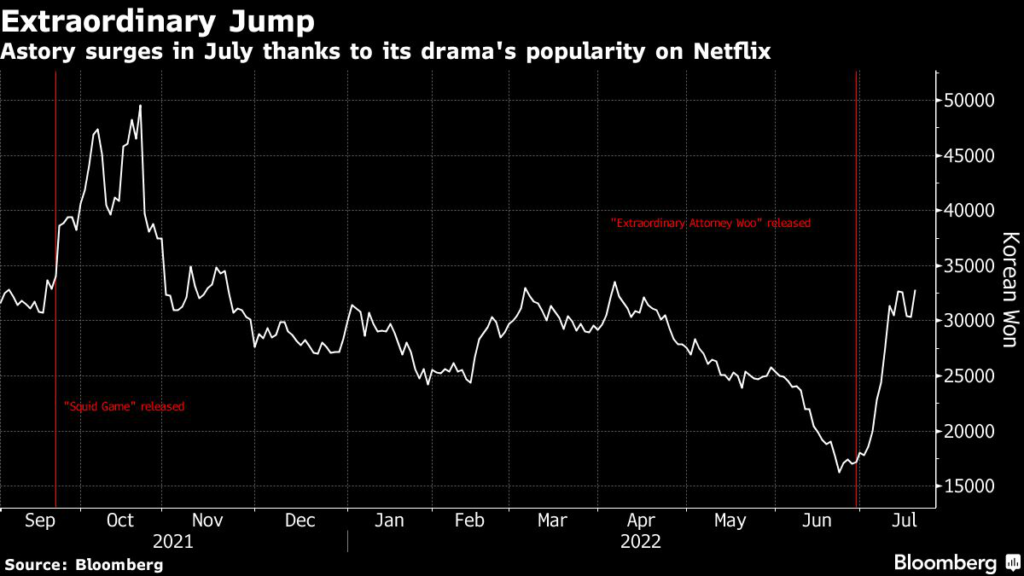
Astory Co. has rallied 82% in July, boosted by the instant hit of “Extraordinary Attorney Woo” released at the end of June. The courtroom drama about a rookie lawyer with autism spectrum disorder was the most watched non-English show on Netflix during the two weeks ended July 17.  

The sharp gains for Astory, one of Korea’s leading drama producers, follows a months-long slump that saw the stock shed nearly 70% from its October high. Korea’s entertainment stocks have been much sought-after following a number of blockbuster hits and the growing appeal of its pop culture, with popular shows delivering stock price gains to companies involved in their production and distribution.  

“We can expect more profit in the future as many channels are already proposing the second season,” Ji InHae, an analyst at Shinhan Investment Corp., said in a report.

Shares of Korean drama and other content companies jumped Wednesday after Netflix’s earnings results showed customer growth in Asia, helping the streaming giant offset declines in the US and Europe. Bucket Studio Co. and Pan Entertainment Co. surged more than 12% each.  

Read: Netflix Sees Return to Growth After Million-Customer Loss

Other stocks have also benefited from the popularity of “Extraordinary Attorney Woo.” Satellite broadcasting provider KT Skylife Co., which owns the Korean channel that airs the legal drama, saw its stock price rise over 11% so far this month. The benchmark Kospi has gained less than 2% during the period, while the smaller Kosdaq Index advanced 5%. 

“Skylife is expected to see a level-up in its ads revenues and increased competitiveness in its channel,” said Ji.  

The phenomenon, to some extent, resembles the stock-market frenzy surrounding “Squid Game” last year, when dozens of local TV and movie producers saw their stock prices skyrocket amid investor euphoria and interest from global companies including Walt Disney Co. and Apple Inc.  

Korea’s entertainment stocks, however, see sharp volatility depending on the cycle of a series, and the fading pandemic boost to its main platform — Netflix — is a case for caution to investors keen to jump on the rally. Even with this month’s surge, Astory remains down more than 30% from October. 

(Adds mention of rally in K-drama stocks in fifth paragraph)

More stories like this are available on bloomberg.com

©2022 Bloomberg L.P.
Close Bitnami banner
Bitnami

