
Bloomberg

Mid-Air Malfunctions Come on Top of SpiceJet’s Financial Woes

(Bloomberg) — SpiceJet Ltd. staged one of global aviation’s most remarkable turnarounds in 2015 after founder Ajay Singh swept in at the eleventh hour to rescue it. Less than a decade later, the Indian budget airline needs a revival of fortunes again.

Once an investor darling, SpiceJet is now the worst-performing airline stock in Asia, fighting a run of negative publicity triggered by a slew of seemingly innocuous but frequent technical glitches. The airline also hasn’t restored pilot salaries even after a surge in domestic demand and has delayed releasing quarterly results for the three months ended March citing a ransomware attack on its servers. It’s reportedly fallen behind on statutory dues, too. 

SpiceJet, known for naming its aircraft after the aromatics used to flavor food, has struggled in India’s cut-throat aviation market — the world’s fastest growing — where even before the pandemic fierce price wars led to wafer-thin margins. Covid-19, which destroyed travel, came as a potentially fatal blow for many carriers around the world, including SpiceJet, as their main revenue source dried up.

“Unless SpiceJet injects fresh funds, it will be difficult for them to survive,” said Harsh Vardhan, chairman of New Delhi-based Starair Consulting and former head of Vayudoot, a now defunct Indian regional carrier that was merged with Indian Airlines in the 1990s. Repeated technical failures have “shaken public confidence. When people keep reading about SpiceJet’s missed payments to airports and oil companies, forward bookings diminish,” he said.

The technical incidents mean the airline — which bills itself as “Red, Hot, Spicy” — is now under scrutiny from India’s aviation safety regulator. Earlier this month, the Directorate General of Civil Aviation gave SpiceJet three weeks to explain why action shouldn’t be taken against it following multiple mid-air snags. It also noted that SpiceJet has frequently invoked a clause that allows flights to proceed when some parts are malfunctioning so long as those parts aren’t essential to the flying or safety of the aircraft.

That notice from the regulator said SpiceJet has failed to establish “safe, efficient and reliable air services,” and a number of its aircraft returned to their origin or continued their journey with “degraded safety margins,” according to the missive, a copy of which was posted on Twitter.

SpiceJet said in a statement to Bloomberg that it will be “responding to the DGCA within the specified time period.”

“We are committed to ensuring a safe operation for our passengers and crew. Last month, all our planes were audited by the DGCA and found to be absolutely safe,” the airline said, noting that the DGCA has said that “on average about 30 incidents take place daily, including go-arounds, missed approaches, diversion, medical emergencies, weather, technical and bird hits. Most of them have no safety implications.”

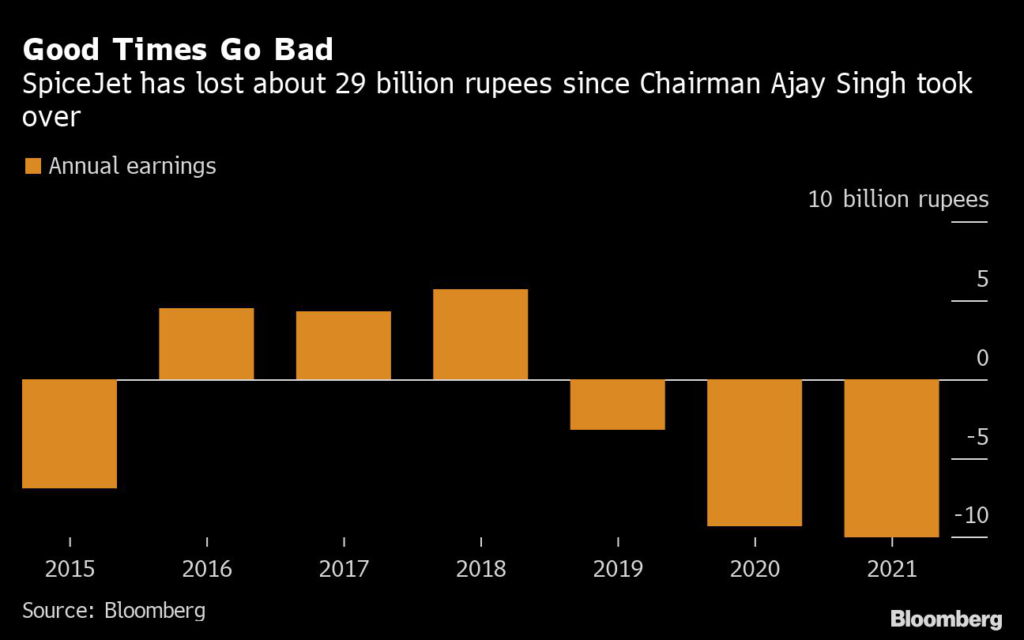
But SpiceJet’s problems don’t just end with technical malfunctions. In late 2021, the airline had cash and cash equivalents of just 729 million rupees ($9.1 million) compared with total debt of 97.5 billion rupees. It has also suffered three straight years of losses totaling 22.5 billion rupees combined.

India’s aviation regulator said a probe into the airline’s financials revealed that SpiceJet hasn’t paid vendors and suppliers on time since September, leading to a shortage of spare parts.

SpiceJet noted that its plan to spin off its cargo service SpiceXpress will result in a one-time gain of 25.6 billion rupees.

Its pilots now earn about one-third of their total take-home salaries before the pandemic after their wages were reduced to save money. SpiceJet said that since January, the airline has “steadily been raising salaries with the objective to reach pre-Covid levels.” Currently, pilot salaries are “at a very healthy level and are steadily increasing month-on-month,” it said.

People familiar with the matter also said employees haven’t been able to access their pay slips since the cyber attack and don’t have copies of their so-called Form 16, needed in India to file tax returns. The last date for filing tax returns is July 31 and the delays are making staff even more nervous, the people said, declining to be identified because they’re not authorized to speak publicly

SpiceJet said in its statement that the pay of all employees is being “credited on time, along with applicable increments.”

“Due to the ransomware attack some of our systems are not yet fully functional. They will be operational soon. When the full salary is being credited on time, there is no reason why salary slips will not be provided to employees,” the airline said, adding it will provide staff with their Form 16s before the filing date.

“Pilots aren’t happy because they’re overworked and underpaid,” said Amit Singh, a former head of pilot training at IndiGo, India’s largest airline, who founded not-for-profit organization Safety Matters Foundation. “How do you guarantee safety when there is so much stress? The pilots and cabin crew onboard are stressed, the engineers taking care of safety are stressed.”

The technical incidents started to surface in May and continued earlier this month.

On July 5, a SpiceJet flight operating a Boeing Co. 737 Max plane was diverted to Karachi due to an indicator light malfunction. Later that day, a Q400 turboprop was forced to make a priority landing in Mumbai after its windshield cracked. Another SpiceJet aircraft from New Delhi on July 2 returned to the Indian capital due to smoke in the cabin, while a technical issue with landing gear was discovered last week after a flight to Dubai arrived safely.

None of the incidents were life threatening, and all passengers were safe, but the frequency of the mishaps is garnering public attention. Travelers also say they may avoid the airline, according to a survey of more than 21,000 fliers conducted by LocalCircles.

But while people might say they won’t fly SpiceJet, there’s no visible impact of that yet. Indeed the airline is filling more seats on every plane than most of its rivals, with Directorate General of Civil Aviation data showing that in May, SpiceJet had the highest passenger load factor at 89% compared with IndiGo at 81%.

Starair’s Vardhan said it’s important to note that these sort of incidents do happen to airlines and SpiceJet’s issues haven’t exposed any serious maintenance failures. The aviation consultant hasn’t written off the beleaguered airline, saying it has been able to bring in capital and streamline its operations in the past and Singh, who has been chairman since returning to SpiceJet in 2015 when he bailed it out, is an “excellent promoter and manager.”

The 56-year-old — who started SpiceJet with London-based Indian executive Bhulo Kansagra in 2005 — swooped in last time when the airline was on the verge of collapse and under pressure to find an external investor. SpiceJet wasn’t making money at the time, had missed salary payments and some lessors were taking away planes for unpaid monthly rentals. It was forced to ground its entire fleet in late 2014. 

The business executive renegotiated with vendors, tweaked the carrier’s routes, established India’s first dedicated air cargo fleet, expanded into retail and healthcare, and helped SpiceJet get back into the black. Singh also ordered hundreds of new planes from Boeing, making SpiceJet one of the US planemaker’s biggest customers.

Whether Singh can orchestrate another rescue remains to be seen but “in the past, they’ve displayed an ability to come out of catastrophic situations,” said Mitul Shah, the head of research at Reliance Securities Ltd. 

“But it will be tougher this time as the entire aviation industry is suffering from pandemic-led losses, fuel prices are high and the weakening rupee has made imports of crude, aircraft maintenance and lease payments more expensive,” he said. “An infusion of capital is important at this juncture.”

More stories like this are available on bloomberg.com

©2022 Bloomberg L.P.

Boeing Vows It Won’t Build ‘Gliders’ as Engine Shortage Expands

(Bloomberg) — Boeing Co. is grappling with shortages of engines, semiconductors and other parts, with hiccups seemingly changing by the month and disruptions far from being resolved, executives at the US planemaker said Sunday.

“We’re in the middle of the journey” as Boeing contends with logistics snarls and shortfalls of skilled mechanics in the wake of Covid-19, Stan Deal, who heads the company’s commercial airplane division, told reporters gathered in London ahead of the Farnborough International Airshow.

But there’s a standing rule as Boeing copes with strains at engine maker CFM International Inc. — the joint venture between General Electric Co. and France’s Safran SA — that have delayed turbofans for the 737 Max. “I won’t make gliders,” Deal said, using the aerospace industry vernacular for engineless planes.

That’s in contrast to rival Airbus SE, which had around 20 A320neo gliders parked in its factories globally at the end of May. While the European planemaker is pushing ahead with plans to ramp up narrow-body output to a record 65 jets a month by the middle of next year, Boeing is taking a more cautious approach with its 737 Max under the watchful eye of US regulators.

The Arlington, Virginia-based planemaker is holding output steady at around 31 jets per month as it works to match the factory tempo for its 737 Max to parts and components that are arriving in fits and starts, like the jetliner’s LEAP turbofan engines. Boeing underestimated the toll on its workforce and that of its suppliers from layoffs amid he pandemic, Deal said. 

Deal also said Boeing is preparing to start speeding 787 Dreamliner production once the Federal Aviation Administration approves it to resume deliveries of the widebody aircraft. With that milestone looming, Boeing is pushing suppliers to step up hiring, he said.

In other highlights from Boeing’s briefing:

  • While a team of engineers is working on Boeing’s next new airplane, the company isn’t moving urgently to counter Airbus’s sales success with the A321neo. “I’m not in a rush to do another new airplane,” Deal said. “I will do another new airplane in its time.”
  • Boeing is working with the FAA to certify the 737 Max 10, and is prepared to work with Congress to extend a deadline that would allow the company to bring the jet to market without a costly cockpit redesign. Boeing CEO Dave Calhoun recently warned Boeing might scrap the Max 10 program if it’s forced to add the new crew-alerting technology. “To me, that’s not a high probability path. The high probability path and the commitment we’ve made to our customers is to get this airplane certified,” Deal said Sunday.

More stories like this are available on bloomberg.com

©2022 Bloomberg L.P.
Once-Hot Strategy of Holding Bitcoin Overnight Loses Some Luster

(Bloomberg) — Those who watch crypto charts closely might be familiar with the fact that a hypothetical strategy of buying Bitcoin at the close and selling it at the next open has historically netted big returns. Yet the past few weeks have seen it take a hit. 

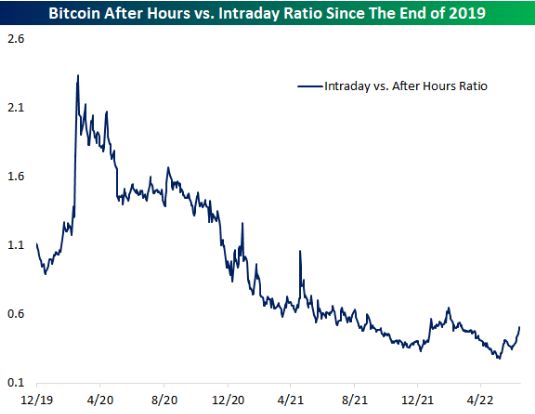
The opposite of the so-called after-hours strategy, meaning buying the open and selling at the US market’s close, has been outperforming over the past month, according to Jake Gordon at Bespoke Investment Group. That hasn’t historically been the case, with the bulk of gains typically coming outside of regular US trading hours, a phenomenon that market-watchers have long observed and puzzled over. 

“The price action of Bitcoin and Ethereum have pivoted from intraday weakness earlier this year to intraday strength,” Gordon wrote in a note. He added that it’s difficult to tell why this might be happening, though the recent deluge of news stories coming out overnight might have something to do with it. 

Crypto investors have for years been fascinated with figuring out how Bitcoin and other digital assets are swayed by news-flow or decreased liquidity while US markets — and traders — are shuttered and sleeping. Bespoke had previously found that Bitcoin has largely tended to move higher on weekends, when the stock market is closed, but that Monday through Friday, it trades flat before US equity markets open, but declines as soon as trading commences. 

That the long-prevalent strategy has now lost some of its shine is notable. Partly, it could be explained by the fact that the news flow has been heavy in recent weeks amid trouble at different crypto companies, including hedge funds and lenders. 

“It tells me that there is still a lot of bad news out there to come,” said Matt Maley, chief market strategist at Miller Tabak. “Those making the announcements know that the crypto market is so fragile that they make all the announcements when the US markets are closed.”

Still, the strategy of only holding the coin during the overnight stretch would have, as of Friday, yielded a 134% gain since the end of 2019, according to Bespoke, while buying the open and selling the close spits out a 9% return. 

More stories like this are available on bloomberg.com

©2022 Bloomberg L.P.

UAE Earmarks $820 Million to Build Satellites, Fund Space Plan

(Bloomberg) —

The United Arab Emirates will set up a 3 billion dirham ($820 million) fund to develop satellites, as well as bolster an ambitious space program that’s already put a probe into Martian orbit and includes plans to explore Venus.

The six-year development program will see the first satellite launch in three years, state-run WAM news agency reported. The fund will encourage global partnerships to establish themselves in the country, and provide incentives as part of the UAE Space Agency’s Space Economic Zones Programme. 

“The project will contribute to the UAE’s efforts to develop solutions to climate change, environmental sustainability and improved disaster management,” the country’s media office said. Applications will include detection of oil spills, monitoring ships, as well as search and rescue.

The Gulf nation said the move will make it the first Arab country to develop a constellation of Synthetic Aperture Radar Satellites. The satellites — called Sirb after the Arabic term for a flock of birds — will be built through partnerships between the public and private sector together with international firms, WAM said.

With plans to explore Venus within seven years and land on an asteroid, in addition to launching a spacecraft into Martian orbit, the UAE already has the Middle East’s most ambitious space program.

The country established a Space Agency in 2014, sent its first astronaut to the International Space Station five years later, and plans to send an unmanned spaceship to the moon in 2024.

(Updates with details from 2nd paragraph)

More stories like this are available on bloomberg.com

©2022 Bloomberg L.P.
ANZ Said To Near A$5.6 Billion Deal For Suncorp’s Banking Unit

(Bloomberg) —

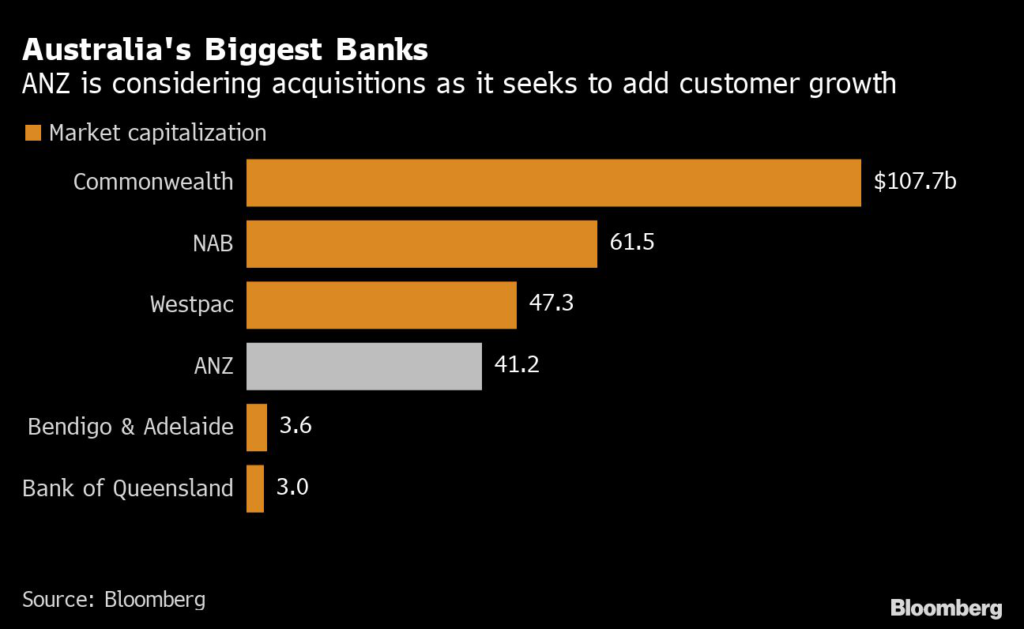
Australia & New Zealand Banking Group Ltd. is nearing a deal to acquire Suncorp Group Ltd.’s banking operations as it seeks to add customer growth, according to people familiar with the matter.

An announcement could be made as soon as this week and the lender will seek to tap equity markets with a share sale to help fund the potential takeover, said the people, who asked not to be named as the matter remained confidential. A deal could value the smaller Brisbane-based business at close to A$5.6 billion ($3.81 billion), one of the people said.

Adding Suncorp’s banking assets would be another step to bolster customer growth by ANZ, which confirmed last week it is also discussing the purchase of MYOB Group Ltd. an Australian accounting software business. 

There is no certainty ANZ and Suncorp will agree to a deal and talks could still fall apart, the people said.


Representatives for ANZ and Suncorp declined to comment.

Suncorp confirmed last month it was reviewing strategic alternatives for its banking operations. Banking and wealth accounted for 14% of full-year revenue in fiscal 2021, down on the previous 12 months, according to data compiled by Bloomberg.

The unit is an attractive target for other lenders because of its higher exposure than most Australian peers to retail customers and to Queensland state, Bloomberg Intelligence analysts Matt Ingram and Jack Baxter wrote last month. Selling the unit to become a pure-play insurer would boost Suncorp’s profitability, they said.

More stories like this are available on bloomberg.com

©2022 Bloomberg L.P.

Risk, Reward, Regulation: Central Bankers Eye Crypto Cautiously

(Bloomberg) — Central bankers are seeking to balance the opportunities offered by cryptocurrencies with the risk that slow progress on regulating them could mean more losses for consumers.

Chiefs of the Reserve Bank of Australia, Swiss National Bank and Hong Kong Monetary Authority admitted broad uncertainties on the future of digital currencies and hailed the underlying technology while speaking on a panel on the sidelines of the Group of 20 finance meetings in Bali, Indonesia. 

“Privately backed money can work for a while but it usually ends in disaster,” said RBA Governor Philip Lowe. “Periods of innovation tend to be associated with periods of speculative behavior” as people fear missing out. The central bank isn’t keen on issuing digital currencies for the retail market, but is considering a wholesale option to improve real-time gross settlements, he said.

Digital finance is a stated priority of the G-20 finance chiefs. On cryptocurrencies, policymakers have largely maintained a cautious tone as the plunge in the value of Terra and others exposed the markets’ fragility and raised questions about how to regulate them.

Why Central Banks Got Serious About Digital Money: QuickTake

“We need a very globally coordinated approach in order for regulation to be effective,” said Eddie Yue, chief executive of the Hong Kong Monetary Authority. “We need to regulate the defi platforms early rather than later. The question is how.”

Among questions he wanted to tackle on CBDCs was how to ensure sufficient liquidity, and how to incentivize banks and businesses to switch from more traditional platforms, Yue said.

The central bank chiefs cited questions around anti-money laundering, data privacy and effects on broader financial stability as priorities for regulating cryptocurrencies, even as the tokens merited a different approach than traditional money.

The “fundamental challenge” in regulating crypto is in its nature — that, “if anything, crypto was conceived to undermine central banks,” said Tobias Adrian, director of the monetary and capital markets department at the International Monetary Fund. There’s no “one size fits all” approach for CBDCs, he added.

More stories like this are available on bloomberg.com

©2022 Bloomberg L.P.
Rental-Car Prices Hit Travelers Trying to Escape Airport Hell

(Bloomberg) — European vacationers looking to avoid this summer’s airport chaos by renting a car can expect to pay record rates.

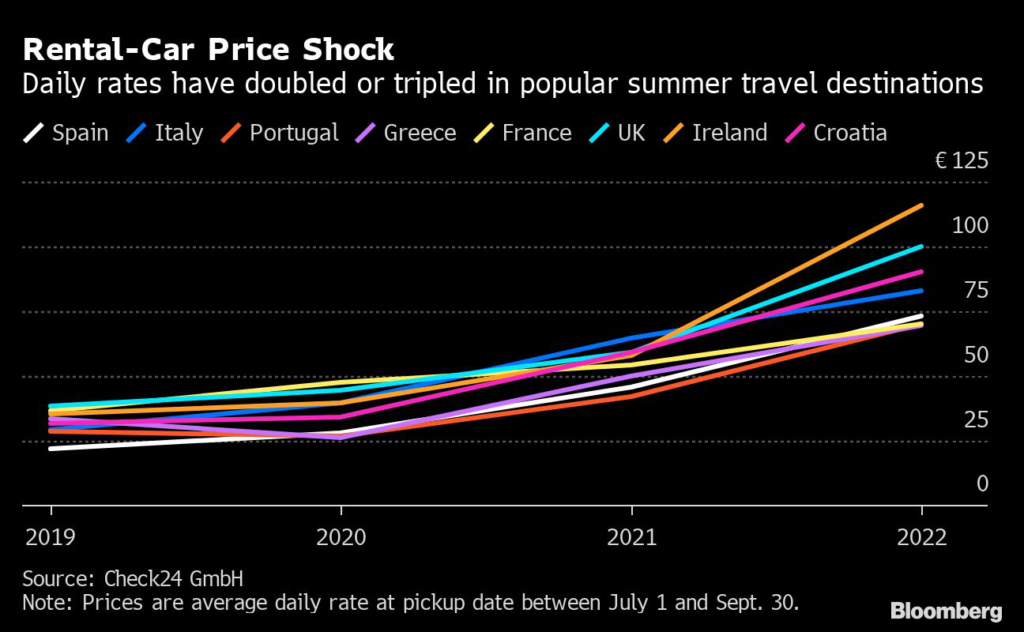
Prices that hit all-time highs in 2021 have been scaling new heights this year, with Europe’s coastal regions especially affected by inflated rates. 

Travelers in Spain, who could rent a car for a little more than 20 euros ($20) per day before the pandemic, will have to pay at least three times as much this summer. Italy and Croatia saw prices jump by more than 180%, according to data compiled by Check24. 

Matters could get even worse and last-minute travelers should act fast, advised Andreas Schiffelholz, the comparison sites’ rental-car managing director. “As pick-up dates get closer, prices will continue to increase.” 

Spiraling prices are the product of a post-pandemic wanderlust that’s been impervious to soaring inflation, a looming energy crisis and recession fears. Overnight stays in the eurozone recovered to pre-Covid levels in May, according to Oxford Economics’ Tourism Tracker. With European school holidays just beginning, the number of vacationers is poised to keep climbing. 

The travel resurgence has already wreaked havoc at European airports. At some of the continent’s busiest hubs, more than 60% of flights are seeing delays, and as many as 8% are being canceled, according to data collected by travel agency Hopper Inc. 

In response, London Heathrow put a two-month cap on daily passenger traffic and told airlines to stop selling new summer tickets. After slashing staffing at the beginning of the pandemic, airports and airlines have struggled to keep up with security and baggage handling, leading to long lines and mounting piles of misplaced luggage. 

Read more: Baggage Chaos So Bad Flyers Are Turning to Tracking Devices

Rental-car firms also shrank during the pandemic, and many haven’t gotten back to pre-Covid strength even as demand rebounded. For a second straight year, a supply-chain crisis fueled by global semiconductor shortages curbed auto production and left carmakers with fewer vehicles to sell to rental companies. 

“Many car-rental firms have reduced their fleet during the pandemic and can’t just return to regular fleet sizes now that demand is on the rise,” Schiffelholz said.

Among Europe’s largest rental firms, only Avis Budget Group Inc. and Sixt SE were able to get back to their 2019 fleet levels, company reports show. Europcar Mobility Group and Hertz Global Holdings Inc., which filed for bankruptcy amid the collapse of the travel industry in 2020, have yet to return to their former size.

Some rental-car firms have turned the bounce-back in demand into a profit windfall. According to Sixt’s Co-CEO, Alexander Sixt, prices aren’t going to fall anytime soon.

“We estimate pricing to be at this level at least for the most part of 2023,” he said. Costs for tourist accommodations, air travel and new vehicles have all risen in recent years, while car-rental prices have been stagnant for a decade, Sixt said. “These recent adjustments will stay.”

Nor does he expect an imminent decline in interest from holiday-makers. Despite additional costs from rising fuel prices, “demand predictions for this summer see no significant drop,” he said.

More stories like this are available on bloomberg.com

©2022 Bloomberg L.P.
Sweden Prefers Steel Over Bitcoin Miners as Power Gets Scarce

(Bloomberg) —

Sweden has a choice to make: Provide electricity for job-creating projects such as steel plants or devote more capacity to the Bitcoin miners that are gobbling up growing amounts of power. Energy Minister Khashayar Farmanbar says it’s no contest.

“We need energy for more useful things than Bitcoin, to be honest,” Farmanbar said in an interview. “We are moving from a period of administration to an extreme expansion where our entire manufacturing industry is seeking to electrify.”

His comments suggest Sweden, home to what could be Europe’s largest Bitcoin mining industry, may become less hospitable to the business. The government is so concerned about electricity use that it asked the Swedish Energy Agency late last month to come up with ways of tracking how much power is used for digital infrastructure, with a special focus on crypto mining. 

Bitcoin miners operate energy-intensive computers to solve complex mathematical puzzles and unlock rewards in the token. The business relies mainly on access to cheap electricity and land, rather than human labor. Profit margins are to a large extent determined by the swings in Bitcoin’s price.    

The government’s review raises the specter that life will get harder for crypto miners that have flocked to Sweden, where vast hydro reservoirs and giant wind parks have delivered some of the cleanest and cheapest electricity in the world. 

While Farmanbar declined to say what measures he may take to curb mining, one option mooted may include tweaking the order in which new power users get access to the grid so that those with a tangible benefit the society, including creating lots of jobs, get preference.

Another alternative may be to limit the preferential tax treatment that currently applies to all data centers, regardless of their use. Such incentives were never meant to attract crypto miners, but rather were aimed at multinational corporations such as Microsoft Corp. and Meta Platform Inc.’s Facebook, Erik Thornstrom, a senior adviser at industry group Swedenergy, said in an interview.

“I think the existing tax reliefs should be focused on the activities they were meant to attract in the first place,” he said. “Mining of cryptocurrencies is more questionable.”

Threat to Climate

Hive Blockchain Technologies Ltd. from Canada and Hong Kong-listed Genesis Mining Ltd. are two of the companies active in Sweden. They didn’t respond to requests for comment.  

“I think a lot of public officials including the energy minister who have strong opinions about cryptocurrency and blockchain in general need further education and awareness,” Sukesh Kumar Tedla, chairman of the Swedish Blockchain Association, said by email. “Yes, cryptocurrency mining consumes a lot of energy today but so does a lot of other innovative technologies that help run our society.”

Such arguments, however, tend to increasingly fall on deaf ears in an era of persistent global warming and more scarce access to power. 

Sweden’s financial regulator has called crypto assets a threat to the climate transition and urged a European Union-wide ban on mining, gaining support from lawmakers in countries from Germany to Spain and Norway. China has outlawed cryptocurrencies altogether.

Rising Power Demand

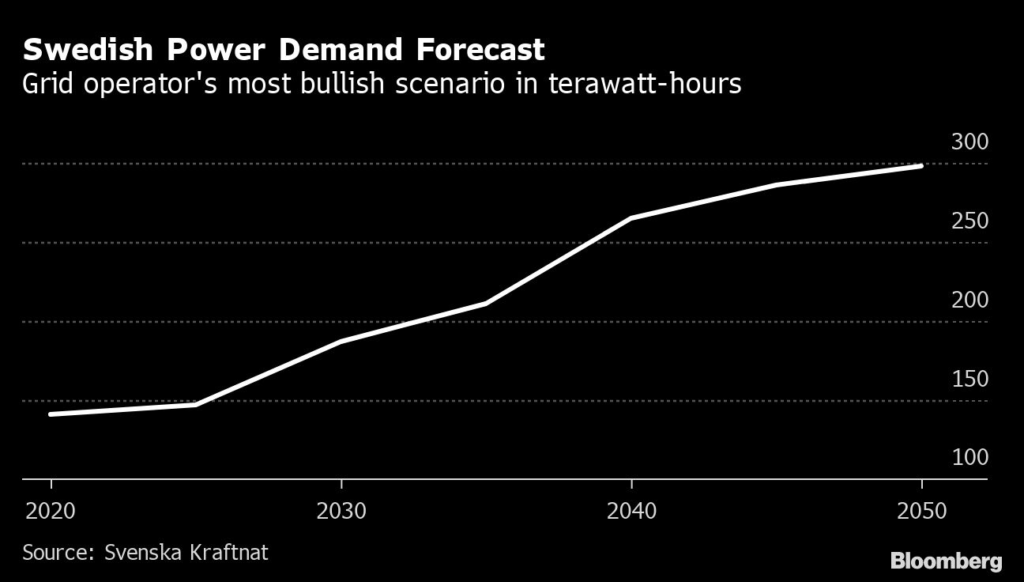
The energy crisis and the electrification of everything from transport to mining as well as new green steel and battery plants means that competition for power and connections to the grid is fiercer than ever. Swedish consumption is poised to double in the next few decades.

Bitcoin mining uses up enough electricity to supply a mid-sized country like Spain or the Netherlands, according to the European Central Bank. The size of the industry in Sweden is hard to estimate, with no public data available on how many miners there are or how much power they use. 

Data centers use a few percent of Sweden’s total power today and mining the virtual coins covers a small share of that, according to Thornstrom. But power demand from such facilities may grow eightfold by 2040, according to Sweden’s grid operator. 

Sweden’s share of Bitcoin mining is on the rise, amounting to just over 0.8% of the global processing rate in January, according to the latest data from the Cambridge University’s Centre For Alternative Finance. It was next to nothing two years earlier. 

While Germany and Ireland have larger shares on paper, their numbers are inflated by the use of virtual private networks or proxy services, according to the institution. 

Grid Access

Grid companies supplying electricity to the miners have no obligation to make their usage public. Sweden’s energy agency will report back at the end of January, but getting hold of the information could be a tough job as there is no way to track and quantify the activity at data centers or on individual computers, said Anders Wallinder, head of security of supply at the agency, by email. 

SSAB, plans to make fossil-free steel at a plant in the north, said network operators should prioritize industrial projects like its own rather than connecting users on a first-come, first-served basis like they do now. 

“You could take into account what projects provide the biggest benefits to the climate and society,” said Tomas Hirsch, head of energy at SSAB. “We could reduce Sweden’s carbon dioxide emissions by 10%.” 

That’s a claim any Bitcoin miner would be hard pressed to make — and one increasingly likely to resonate with politicians under pressure to combat global warming.   

“There will be bottlenecks, and that means you have to look into whether we are using energy in the best possible way,” said Farmanbar. “Is Bitcoin mining what we should be using power for, when we can use it for making fossil-free steel, for example? It is not entirely trivial in a free market.”

More stories like this are available on bloomberg.com

©2022 Bloomberg L.P.
US Risks Talking Itself Into a Recession, Moody’s Economist Says

(Bloomberg) — Sign up for the New Economy Daily newsletter, follow us @economics and subscribe to our podcast.

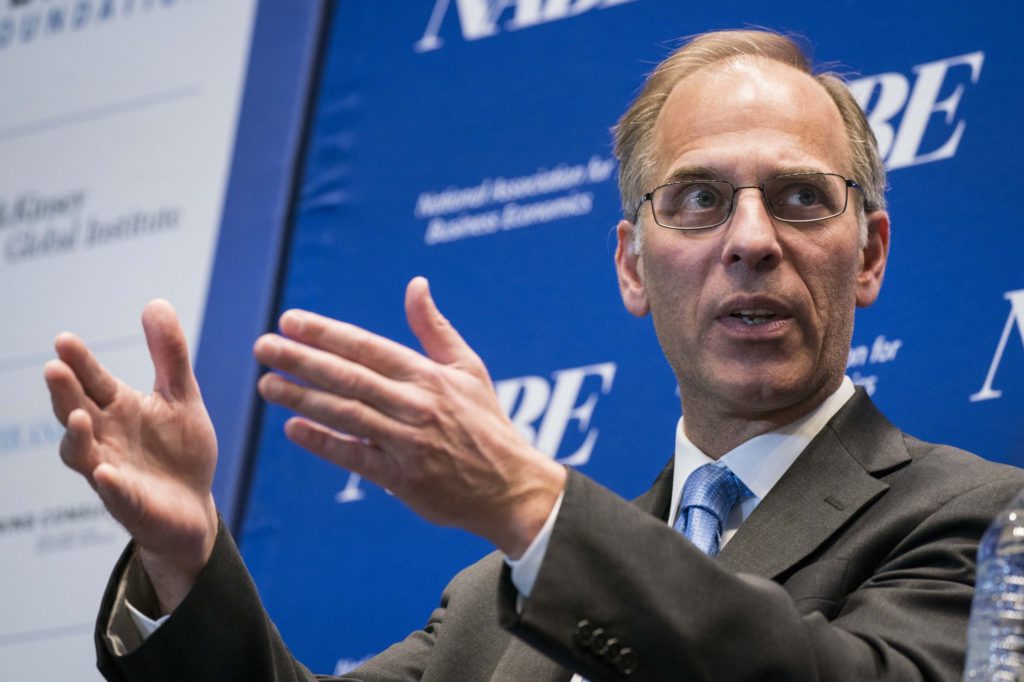
Mark Zandi, who has been an economist for more than three decades, says he’s never seen so many people convinced that a recession is imminent. 

And while he believes the US economy can still avoid such an economic downturn, sentiment is so poor that it poses its own risk — a sort of self-fulfilling recession prophecy. Zandi, the chief economist at Moody’s Analytics, joined the “What Goes Up” podcast to discuss his outlook after government data this week showed the highest level of inflation in almost 41 years. 

Below are condensed and lightly edited highlights of the conversation. Click here to listen to the entire podcast, and subscribe to “What Goes Up” on Apple Podcasts or wherever you listen. 

Q: You have downgraded your GDP outlook for this year and next year. (Zandi now expects real growth of 1% this year and 2% in 2023, versus previous forecasts of 2% and 2.5% respectively.) What is going to happen over the next 18 to 24 months? 

A: I still have no recession (in his forecasts). Obviously, recession risks are high — I mean, clearly, when inflation is so high and the Fed is on DEFCON 1 and rightfully focused on getting that inflation down by jacking up interest rates, and sentiment is miserable, right? 

I talk to CEOs, CFOs, investors, friends, family — to the person, they think we’re going into recession. I’ve never seen anything like it. I’ve seen a lot of business cycles now. And no one predicts recessions. But in this one, everyone is predicting a recession. So when sentiment is so fragile, it’s not going to take a whole lot to push us in. I think with a little bit of luck, and some reasonably good policy-making by the Fed, we’re going to be able to avoid a recession. But I don’t say that with a lot of confidence.

I don’t think we need a recession to get inflation back in. Oil prices are going to roll over. Natural gas prices are going to fall. We’re going to see vehicle prices come down as supply-chain issues iron themselves out and we get more vehicle production. Commodity prices, goods prices more broadly, are going to come in.

Q: When you downgraded your GDP growth outlook, you said odds remain that the economic expansion will continue. What specifically were you thinking there? 

A: The thing that I take the most solace in is that, in my mind, the firewall between a continuing growing economy and a recession is the American consumer. If the American consumer hangs tough, just do their part, spend like they’ve always been spending, we’ll avoid a recession. And by the way, if the American consumer hangs tough, they’ll keep the global economy moving forward as well. You know, some parts of the global economy will go in, but the US consumer’s kind of driving the train right now. 

And if you look at the American consumer, they’re in pretty good shape. Obviously, they’re getting hammered by the high inflation right now, but they’ve got a lot of excess savings they built up during the pandemic and it’s across all income groups. 

For the typical American household, by my calculation, as of June they had $7,000-$8,000 in excess savings. So if I’m paying $500 more a month for the higher inflation and I have $7,000-$8,000 in excess savings, you can do the arithmetic. That buys me a little bit of time, right? I can use that excess savings to supplement my income, to offset the ill effects of the high inflation. 

Debt is low. Debt service burdens are about as low as they’ve ever been. People have locked in the previously record-low interest rates through refinancing. So they’re very insulated from the higher rates. You know, stock prices are down, but house prices are up. People are wealthier today.

Q: Speaking of home prices, I can’t help but wonder if we are in for a pretty nasty cooling off of the housing market. And it’s just such an important component of the economy. What does housing look like to you in the next year or two? And what are the potential ripple effects of it cooling off on the rest of the economy? 

A: Oh, it’s cooling off. It’s gone into deep freeze pretty fast here. Mortgage rates at just south of 6%, almost double what they were a year ago. And you just take that higher interest rate, you multiply by the higher house price, and you look at the monthly payment that a first-time home-buyer is facing — it’s $500-$600 more now than it was a year ago. That’s prohibitive. 

So, first-time home-buyers are locked out of the market. And trade-up buyers are kind of locked in, right? Because the average rate on outstanding mortgages, given all that refinancing I talked about earlier, is 3.5% to 4%. So, if you sell your home and buy another one and get a mortgage, you’re going from three-and-a-half, four, to six. That’s a big increase in payment. So people just aren’t going to do that. 

So, you’re seeing home sales come down dramatically already and listings are starting, too. I follow different markets across the country and I get listings emailed to me, and I can just feel it. If I go back, you know, six months ago, there was nothing, no inventory. But now the list is getting longer and longer and longer. And I expect house prices in parts of the country to fall, particularly in the areas where prices have been juiced the most in the pandemic — in the Southeast, in Florida, in the Mountain West.

I expect some price declines nationwide. We might be able to sneak through with prices just essentially going flat here for a couple, three years, and let household incomes and rents and construction costs kind of catch up. But that assumes no recession. If we get into a recession, then I think that’s going to put real downward weight on house prices. 

But I’ll say two other things about this one. This is by design, right? The Federal Reserve is raising interest rates to slow growth. And that happens through the most rate-sensitive sectors of the economy. Housing is the single-most interest-rate sensitive sector of the economy. So, this is not a big surprise. It is exactly what you would expect. 

And second, I don’t expect the prices to crash, because the mortgage lending that’s been done since the financial crisis and the collapse in housing back over a decade ago has been fantastic. I should disclose this: I’m on the board of directors of MGIC, a nationwide, publicly-traded mortgage insurer, and I’m on the chair of the risk committee. So I look at underwriting very carefully and it’s been pristine since the collapse. And the other thing is, it’s all plain vanilla 30-year, 15-year fixed rate, pre-payable mortgage, nothing fancy. 

And so, I just don’t see the stresses here to result in a big, sharp decline in prices. But prices going flat nationwide and down in a fair share of markets? Yeah, I would anticipate that. And I would say that’s exactly what the Fed wants to see.

More stories like this are available on bloomberg.com

©2022 Bloomberg L.P.

Wall Street Set for New ETF Gold Rush as Single-Stock Era Begins

(Bloomberg) — A new ETF-for-everything era may have just begun on Wall Street, swelling an industry that already boasts nearly 3,000 products and $6.2 trillion in assets.

The booming world of exchange-traded funds is about to get even more crowded after the very first single-equity ETFs launched Thursday — despite a torrent of regulatory warnings over their risks while retail investors are still reeling from the crash in speculative trades from crypto to meme stocks.

The eight products from AXS Investments look like the start of a coming invasion of amped-up strategies that will seek to enhance or invert the performance of volatile companies, including Tesla Inc., Nvidia Corp. and PayPal Holdings Inc. Another proposed lineup from Toroso Investments offers to layer on a bullish options strategy in order to boost returns.

All told, at least 85 more such ETFs are currently planned, according to filings tracked by Bloomberg, covering some 37 companies.

That’s just the start. With a never-ending fee war taking costs on index-tracking ETFs to rock-bottom levels, the arrival of single-stock products opens up a lucrative avenue for issuers, with leveraged or inverse trades tracking major companies up for grabs. 

All told, the Securities and Exchange Commission may have inadvertently put new investing tools in the hands of day traders at a dangerous time with recession risk sparking bear markets. 

“We’re gonna see the floodgate absolutely open with new product launches in this arena,” said Nate Geraci, president of The ETF Store, an advisory firm. “So I think we’re gonna see ETF issuers blanket the market with all varieties of these ETFs: leverage, inverse, options overlays, you name it.” 

Amrita Nandakumar, president of Vident Investment Advisory, which offers asset management services to issuers, said at least four clients have recently asked her firm about single-stock funds. 

“The level of interest has exploded, I would say, in the last eight weeks,” she said. 

While leveraged and inverse ETFs have long existed in the US — some with a  history of blowing up — they target indexes or funds. The new single-stock products are potentially more volatile since stocks tend to make bigger moves.

SEC Chair Gary Gensler said the products “present particular risk” in a press call this week. Commissioner Caroline Crenshaw called for the agency to adopt new rules that would address potential risks. Yet single-stock products have been able to list in part thanks to rule changes in 2019 and 2020 that allow leveraged and inverse ETFs to launch without first getting the SEC’s approval. 

Single-stock products, which didn’t exist in the US at the time, may have been an “unintended consequence” of the changes, said Vident’s Nandakumar. “I wouldn’t expect the SEC to contemplate every single potential product development innovation that could come out.”

Commissioner Crenshaw warned about putting the ETFs in the hands of retail traders in particular, saying that it would be challenging for investment advisers to recommend the products while honoring their fiduciary duties.

Greg Bassuk, chief executive officer of AXS, has maintained that his firm’s suite is geared towards “sophisticated, active traders.” 

Even then, it’s clear that they will appeal to the day-trading crowd.

“It can be harder to short stocks for retail investors — so maybe these are a lower risk, easier to execute option for retail investors to get short,” said Chris Murphy, co-head of derivatives strategy at Susquehanna International Group. “Once again my concerns would be how much the slippage and cost of the ETF eats into a short position of say, Tesla, for example.”

The AXS TSLA Bear Daily (ticker TSLQ) charges an expense ratio of 1.15%, while the spot borrowing rate for shares of Tesla — a measure of the cost of shorting the stock — currently stands near 0.3%, according to data compiled by S3 Partners. However, the appeal of an ETF like TSLQ lies more in the convenience rather than the cost, Bloomberg Intelligence’s James Seyffart said. 

“If you don’t have a margin account or even if you do, it might be easier to just buy TSLQ,” he said. “You click buy, and done. But I doubt any institution is going to use something like this.”

Another concern for novice traders is that the tickers for the single-stock funds are very similar to the tickers for the stocks themselves.

“There could be some confusion in the marketplace where retail investors accidentally buy the Frankenstein ETF version of the individual stock they were actually wanting to purchase,” said The ETF Store’s Geraci.

More stories like this are available on bloomberg.com

©2022 Bloomberg L.P.

Close Bitnami banner
Bitnami
