Bloomberg

Once-Hot Strategy of Holding Bitcoin Overnight Loses Luster

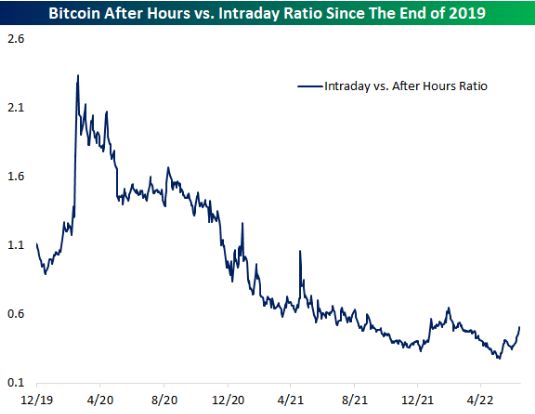
(Bloomberg) — Those who watch crypto charts closely might be familiar with the fact that a hypothetical strategy of buying Bitcoin at the close and selling it at the next open has historically netted big returns. Yet the past few weeks have seen it take a hit. 

The opposite of the so-called after-hours strategy, meaning buying the open and selling at the US market’s close, has been outperforming over the past month, according to Jake Gordon at Bespoke Investment Group. That hasn’t historically been the case, with the bulk of gains typically coming outside of regular US trading hours, a phenomenon that market-watchers have long observed and puzzled over. 

“The price action of Bitcoin and Ethereum have pivoted from intraday weakness earlier this year to intraday strength,” Gordon wrote in a note. He added that it’s difficult to tell why this might be happening, though the recent deluge of news stories coming out overnight might have something to do with it. 

Bitcoin jumped as much as 7.5% on Monday and traded at $22,229 at 11:16 a.m in London. Ether rallied 11% to its highest level since mid-June.    

Crypto investors have for years been fascinated with figuring out how Bitcoin and other digital assets are swayed by news flow or decreased liquidity while US markets — and traders — are shuttered and sleeping. Bespoke had previously found that Bitcoin has largely tended to move higher on weekends, when the stock market is closed, but that Monday through Friday, it trades flat before US equity markets open, but declines as soon as trading commences. 

That the long-prevalent strategy has now lost some of its shine is notable. Partly, it could be explained by the fact that the news flow has been heavy in recent weeks amid trouble at different crypto companies, including hedge funds and lenders. 

“It tells me that there is still a lot of bad news out there to come,” said Matt Maley, chief market strategist at Miller Tabak. “Those making the announcements know that the crypto market is so fragile that they make all the announcements when the US markets are closed.”

Still, the strategy of only holding the coin during the overnight stretch would have, as of Friday, yielded a 134% gain since the end of 2019, according to Bespoke, while buying the open and selling the close spits out a 9% return. 

(Updates with Bitcoin’s latest trading in fourth paragraph.)

More stories like this are available on bloomberg.com

©2022 Bloomberg L.P.

Dutch Fine Binance as Pressure Mounts on Largest Crypto Exchange

(Bloomberg) — The Dutch Central Bank said it fined Binance Holdings Ltd. 3.33 million euros ($3.6 million), as the world’s largest cryptocurrency exchange operator faces increased regulatory scrutiny. 

The fine was imposed in April after Binance offered crypto services in the Netherlands without the required registration with the central bank, the monetary authority announced in a statement on Monday.

Binance’s global expansion over the past few years has drawn the attention of regulators across the world. In the US, Binance is being investigated for potential securities violations. A long list of governments including South Africa, Thailand and the Cayman Islands have warned the company it wasn’t allowed to operate locally. 

The fine was reduced partly because a registration application has now been made and “Binance has been relatively transparent about its business operations throughout the entire process,” the Dutch central bank said. The company objected to the fine on June 2.

Read more: Crypto’s Richest Man Faces Regulatory Crackdown, Brutal Winter

Dutch authorities ruled in May 2020 that any company seeking to offer crypto services in the Netherlands must comply with the country’s laws against money laundering and terrorism financing. The central bank publicly warned Binance last year.

More stories like this are available on bloomberg.com

©2022 Bloomberg L.P.

Stocks Climb With Futures on Receding Rate Bets: Markets Wrap

(Bloomberg) — European stocks and US equity futures rose, while the dollar weakened as investors scaled back bets on how aggressively the Federal Reserve will tighten policy, easing recession fears. 

The Stoxx Europe 600 advanced to its highest level in more than a month, led by mining and energy shares. Futures on the S&P 500 and Nasdaq 100 indices added at least 1%. West Texas Intermediate crude traded near $100 a barrel while the Bloomberg Dollar Spot Index slipped 0.5%, extending a retreat from a record high. 

Traders are back to expecting a 75 basis points July Fed rate hike, after last week flirting with the prospect of a 100 basis points move after data showed no let-up in stubbornly high price pressures. But a drop in long-term US inflation expectations helped assuage concern that Fed policy is unequal to the hottest pressures in four decades.

Still, the outlook remains troubling for many investors. The International Monetary Fund will cut its global economic growth outlook “substantially” in its next update as nations run out of options to tackle worsening risks.

“Risk-reward at these levels has certainly improved but because we have not yet fully priced in a recession, it’s hard to say that the markets are screaming cheap,” said Anastasia Amoroso, the chief investment strategist at iCapital. 

Elsewhere, a gauge of Asian shares climbed 1.4%, boosted by a jump in Chinese technology firms. Bitcoin scaled above $22,000 amid a broad crypto advance.

Commodities were broadly stronger after US President Joe Biden’s trip to the Middle East ended without a firm commitment from Saudi Arabia to boost crude supplies. Wheat climbed after a five-day slump and copper rallied. 

US natural gas futures extended gains above the $7 level as scorching temperatures across the country boost air-conditioning demand. A heat wave in the UK and France pushed up European natural gas prices, exacerbating the region’s worst energy crunch in decades.

Officials and traders are closely watching whether the Nord Stream pipeline from Russia will fully return to service later this week, when it ends scheduled maintenance. Moscow has already curbed supplies to the continent amid tensions related to its invasion of Ukraine.

“The possibility that Russia stops, or severely reduces, their gas exports to Europe should keep markets on edge in the near-term,” Mizuho International Plc strategists Peter McCallum and Evelyne Gomez-Liechti wrote in a note to clients.

Key events to watch this week:

  • Earnings this week include Bank of America, Goldman Sachs, Tesla
  • US Treasury Secretary Janet Yellen visits South Korea. Tuesday
  • Reserve Bank of Australia releases July minutes. Tuesday
  • UK Chancellor Nadhim Zahawi and Bank of England Governor Andrew Bailey speak at event. Tuesday
  • Bloomberg Crypto Summit in New York. Tuesday
  • Bank of Japan, European Central Bank rate decisions. Thursday
  • Nord Stream 1 pipeline scheduled to reopen following maintenance. Thursday

Some of the main moves in markets:

Stocks

  • The Stoxx Europe 600 rose 1.3% as of 10:40 a.m. London time
  • Futures on the S&P 500 rose 1%
  • Futures on the Nasdaq 100 rose 1.2%
  • Futures on the Dow Jones Industrial Average rose 0.9%
  • The MSCI Asia Pacific Index rose 1.4%
  • The MSCI Emerging Markets Index rose 1.8%

Currencies

  • The Bloomberg Dollar Spot Index fell 0.5%
  • The euro rose 0.7% to $1.0147
  • The Japanese yen rose 0.3% to 138.22 per dollar
  • The offshore yuan rose 0.3% to 6.7404 per dollar
  • The British pound rose 0.9% to $1.1965

Bonds

  • The yield on 10-year Treasuries advanced four basis points to 2.95%
  • Germany’s 10-year yield advanced seven basis points to 1.21%
  • Britain’s 10-year yield advanced four basis points to 2.13%

Commodities

  • Brent crude rose 2.1% to $103.30 a barrel
  • Spot gold rose 0.9% to $1,723.25 an ounce

More stories like this are available on bloomberg.com

©2022 Bloomberg L.P.

In the Middle of Summer, Fear Sets In Over Crypto Winter

  • Listen to Bloomberg Crypto on the iHeartRadio App
  • Listen to Bloomberg Crypto on Apple Podcasts
  • Listen to Bloomberg Crypto on Spotify 

(Bloomberg) — You could argue that crypto is no stranger to a recession — in fact, it was the financial crisis of 2008 that birthed the idea of Bitcoin in the first place. But this recession is a little different: In the decade or so since that formative Bitcoin whitepaper, crypto has experienced spectacular growth. Rising prices last fall led to investor FOMO, or fear of missing out. But now, after this year’s heavy losses, investors who entered the digital asset class during its “bull market” are in the grip of crypto winter and reevaluating their entire relationships with the digital coin. For more on this shift from FOMO to oh no, Bloomberg reporter Claire Ballentine joins this episode.

Follow us on Twitter @crypto, and subscribe to the Bloomberg Crypto Newsletter at https://bloom.bg/cryptonewsletter

More stories like this are available on bloomberg.com

©2022 Bloomberg L.P.

Stocks, US Equity Futures Climb as Dollar Dips: Markets Wrap

(Bloomberg) — European stocks and US equity futures rose, while the dollar weakened as investors scaled back bets on how aggressively the Federal Reserve will tighten policy. 

S&P 500 futures were up 0.7% and the Stoxx 600 added 0.7% as well. A gauge of Asian shares climbed 1.2%, boosted by a jump in Chinese technology firms. The Bloomberg Dollar Spot Index slipped 0.4%, extending a retreat from a record high. 

Commodities were broadly stronger. West Texas Intermediate crude traded near $99 a barrel, after US President Joe Biden’s trip to the Middle East ended without a firm commitment from Saudi Arabia to boost crude supplies. Wheat climbed after a five-day slump and copper rallied. 

Investors continue to be whipsawed by concerns over inflation and the potential for a US recession. Data last week showing a drop in long-term US inflation expectations eased some fears that elevated price pressures are becoming entrenched. Strong retail sales underscored a resilient economy despite monetary tightening.

While stocks are pricing in a recession, there are signs that “this is a market that wants to start bottom fishing,” Lori Calvasina, head of US equity strategy at RBC Capital Markets, said on Bloomberg Television. “People are starting to look for things that have been de-risked.”

Traders are back to expecting a 75 basis points July Fed rate hike, after last week flirting with the prospect of a 100 basis points move to hammer inflation.

Still, the outlook remains troubling for many investors. The International Monetary Fund will cut its global economic growth outlook “substantially” in its next update as nations run out of options to tackle worsening risks.

Key events to watch this week:

  • Earnings this week include Bank of America, Goldman Sachs, Tesla
  • US Treasury Secretary Janet Yellen visits South Korea. Tuesday
  • Reserve Bank of Australia releases July minutes. Tuesday
  • UK Chancellor Nadhim Zahawi and Bank of England Governor Andrew Bailey speak at event. Tuesday
  • Bloomberg Crypto Summit in New York. Tuesday
  • Bank of Japan, European Central Bank rate decisions. Thursday
  • Nord Stream 1 pipeline scheduled to reopen following maintenance. Thursday

Some of the main moves in markets:

Stocks

  • The Stoxx Europe 600 rose 0.7% as of 8:12 a.m. London time
  • Futures on the S&P 500 rose 0.7%
  • Futures on the Nasdaq 100 rose 0.8%
  • The MSCI Asia Pacific Index rose 1.2%
  • The MSCI Emerging Markets Index rose 1.5%

Currencies

  • The Bloomberg Dollar Spot Index fell 0.4%
  • The euro rose 0.5% to $1.0135
  • The Japanese yen rose 0.2% to 138.24 per dollar
  • The offshore yuan rose 0.1% to 6.7536 per dollar
  • The British pound rose 0.6% to $1.1922

Bonds

  • The yield on 10-year Treasuries advanced three basis points to 2.95%
  • Germany’s 10-year yield advanced five basis points to 1.19%
  • Britain’s 10-year yield advanced four basis points to 2.13%

Commodities

  • Brent crude rose 2.4% to $103.54 a barrel
  • Spot gold rose 0.4% to $1,715.82 an ounce

More stories like this are available on bloomberg.com

©2022 Bloomberg L.P.

ANZ Agrees to Buy Suncorp’s Bank Operations for $3.3 Billion

(Bloomberg) —

Australia & New Zealand Banking Group Ltd. agreed to buy Suncorp Group Ltd.’s banking operations for A$4.9 billion ($3.3 billion) as it seeks to gain an edge over larger rivals by expanding in the country’s fastest growing region.

The lender plans to raise about A$3.5 billion of equity to help fund the takeover of the smaller Brisbane, Queensland-based business, which was agreed at a 12.7% discount to Friday’s closing share price. Suncorp Bank will continue to be led by Chief Executive Officer Clive van Horen who will report to ANZ head Shayne Elliott. 

Australian banks are grappling with rapidly rising interest rates and falling house prices that’s spurred some investors to reevaluate lenders’ outlooks. The deal hands the lender control of one of the country’s largest retail banks that’s also based in the fastest-growing state by population, at a time when investor focus is shifting to expansion and away from cost-cutting.

“ANZ are lagging as one of the smallest of the big four banks in Australia, so for them to expand their footprint to compete with Commonwealth Bank with something like a deal for Suncorp is really going to help them along in that respect,” said Jamie Hannah, deputy head of investments and capital markets at Van Eck Associates Corp., which holds about 2.5 million shares in ANZ. 

“With this Suncorp deal they should overtake Westpac and whether or not they can catch up to National Australia Bank in the next year or so remains to be seen,” he said.

The deal marks a significant shift for Elliott, who in May told Bloomberg TV his bank was keeping cash on its balance sheet as it watches and waits for how customers react to rising interest rates. The transaction is expected to complete in the second half of 2023. 

“With much of the work to simplify and strengthen the bank completed, and our digital transformation well-progressed, we are now in a position to invest in and reshape our Australian business,” Elliott said in the statement on Monday. “This will result in a stronger more balanced bank for customers and shareholders.”

As part of the transaction, ANZ will also acquire Suncorp Bank’s ATI capital notes at face value of about A$600 million as of June 2022, the statement said.

The deal is “equivalent of many years of organic system growth,” adding 1.2 million customers, a 20% increase, as well as a 17% step up in home loans and a 20% rise in small business clients, Elliott said in a conference call with investors following the announcement.

Suncorp said last month it was reviewing strategic alternatives for its banking operations. Banking and wealth accounted for 14% of full-year revenue in fiscal 2021, down on the previous 12 months, according to data compiled by Bloomberg.

What Bloomberg Intelligence Says… 

Suncorp’s banking unit fits ANZ well given its higher exposure than most Australian peers to retail customers and to Queensland state, according to Bloomberg Intelligence analysts Matt Ingram and Jack Baxter.

“Synergies will be tricky to gain as Suncorp branches won’t close for three years, but ANZ says the deal is neutral to 2023 EPS,” Ingram and Baxter wrote in a report Monday. 

Selling the banking unit to become a pure-play insurer would also boost Suncorp’s profitability, Ingram and Baxter wrote last month.

ANZ said in a separate statement Monday that it had also withdrawn from discussions with KKR & Co. about a potential acquisition of accounting software firm MYOB Group Ltd. 

ANZ shares remain in a trading halt as the bank executes the capital raising. Suncorp’s stock rose as much as 7.2% in Sydney trading Monday and was 4.7% higher as of 2:02 p.m.

(Updates with ANZ CEO comments on customer additions, deal value size in eighth and ninth paragraphs.)

More stories like this are available on bloomberg.com

©2022 Bloomberg L.P.

Rare Tech Stock Winner in India Taps Niche Demand for EV Design

(Bloomberg) — Strong demand for niche design services used in making electric vehicles has helped one Indian technology company’s stock surge by more than a third this year, even as inflation concerns have battered the sector globally.

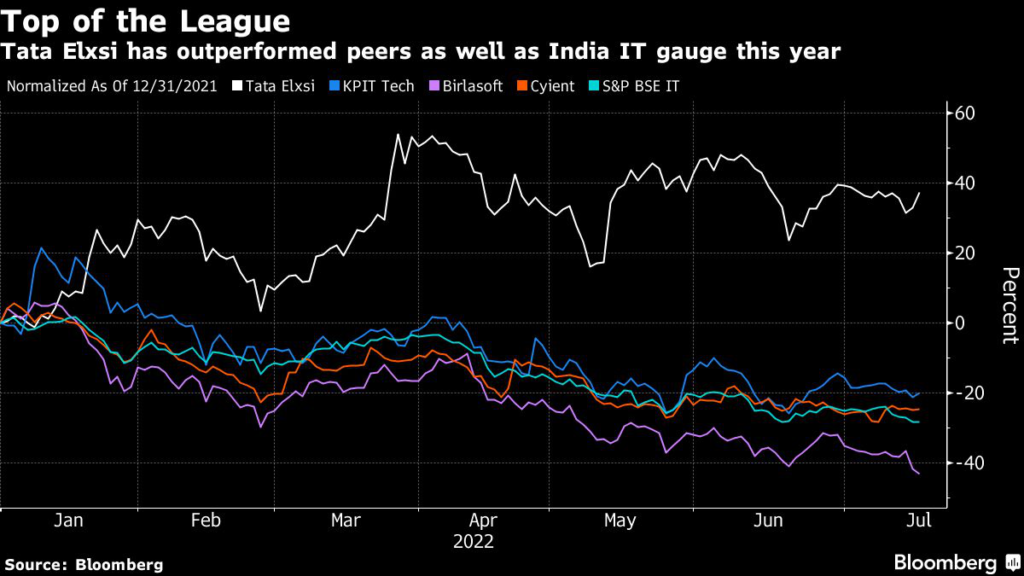
Shares of Tata Elxsi Ltd. have jumped 37% in 2022, topping a gauge of Indian tech firms that has shed 28% with all but two stocks in the red. The company’s sales and profits have climbed on large deals for cloud-based platforms and artificial intelligence used to improve products and customer experience.

Tech Stocks in India Join Nasdaq in Worst Loss Since 2008: Chart

Tata Elxsi’s orders remain robust even as the global economy flashes warning signs, according to Chief Executive Officer Manoj Raghavan. While EV titan Tesla Inc. has been downsizing some operations amid surging material costs and a weak consumer outlook, the $6.3 billion Indian firm plans to expand. 

“From all our major customers, we really have not heard any intent to reduce budgets,” Raghavan said in a conference call Friday. The Bengaluru-based firm could grow its current 10,000 headcount by as much as 50% in the year through March 2023, including new graduates and experienced workers, he said.

The company’s customers include China’s Great Wall Motor Co. and group sibling Tata Motors Ltd., according to data compiled by Bloomberg. Its net income rose 64% from a year ago in three months ended June, on 30% growth in sales.

More stories like this are available on bloomberg.com

©2022 Bloomberg L.P.

Amazon Is Starting to Price Match Tesco in Aggressive UK Grocery Push

(Bloomberg) — Amazon.com Inc.’s UK grocery business will match prices on hundreds of everyday items to those offered by rival Tesco Plc in an aggressive move against Britain’s largest supermarket chain.

Produce, meat and fish are among the categories that Seattle-based Amazon will match and lock to the prices offered by Tesco’s Clubcard loyalty initiative, according to a statement on Monday. 

The e-commerce giant is expanding its business selling groceries in the UK under its Amazon Fresh banner, and now has 19 stores, including one outside London in the town of Sevenoaks. Along with price matching, Amazon also has deals such as its private label range, and offers same-day delivery on grocery orders in some areas. 

Britain’s grocers are battling to keep prices low for shoppers while coping with soaring inflation. In addition to Amazon, they face intense competition from German discounters Aldi and Lidl. Both Tesco and J Sainsbury Plc, the country’s second-largest grocer, match hundreds of products to Aldi. 

Earlier this month, Sainsbury said it will invest more than £500 million ($592 million) over two years to keep product prices low as “customers are watching every penny and every pound.” 

Amazon Fresh launched in the UK in 2016 but it has still has only a sliver of the market and is a minnow in groceries compared to Tesco, which controls just over 27% of the market, according to data from Kantar. Overall, the Big Four grocers – Tesco, Sainsbury, Morrisons and Asda Group Ltd., between them control about two-thirds of the market.

Amazon Fresh also faces competition from online grocer Ocado Group Plc and is having to operate in a market considered to be one of the most competitive in the world.

UK supermarket shoppers are shifting their behavior and increasingly opting for own-brand labels in a bid to save pennies amid rising prices. Last month, Tesco Chief Executive Officer Ken Murphy said that consumers were “terrified” of the cost-of-living crisis.

Earlier this year, Amazon was designated as a grocery retailer by Britain’s antitrust regulator. To be governed by the rules, grocers must have annual sales of more than 1 billion pounds.

More stories like this are available on bloomberg.com

©2022 Bloomberg L.P.

Chinese Lithium Giant Pulls EVs Deeper Into Forced Labor Glare

(Bloomberg) — A lithium producer for carmakers including BMW AG and Tesla Inc. is beginning work to assess battery metals projects in Xinjiang, deepening links between electric vehicle supply chains and a region at the heart of human-rights allegations against China.  

Ganfeng Lithium Co., China’s top producer of the material, is partnering through a subsidiary with a state-backed entity to accelerate exploration for and potentially develop lithium, nickel and other critical metal assets in the region. Ganfeng’s Chairman Li Liangbin earlier this year visited Xinjiang — where activists and Western governments say Uyghurs and other Muslim citizens have been subjected to forced labor — to discuss cooperating with the local government on the plans.

Electric vehicle makers already face criticism over labor concerns and environmental damage tied to the extraction of metals used in their products. The deepening connection between Ganfeng and Xinjiang is set to draw more scrutiny from investors and consumers. Ganfeng said in November it had won a new three-year deal to provide battery-grade lithium hydroxide products to Tesla, and has previously disclosed other contracts with companies including BMW. 

Xinyu, Jiangxi-based Ganfeng prioritizes “the importance of environmental protection, social responsibility and corporate governance,” which includes defending employee rights, the company said in a statement.

In Xinjiang, “the resource is at an early stage of exploration and it’s currently uncertain whether there’s suitable projects available for future development,” Ganfeng said. The company pursues a strategy of having projects in multiple countries to help limit the impact of extracting lithium excessively in any single location, it said. 

Representatives for Tesla in China declined to comment. Ganfeng supplies BMW with lithium from mines in Australia and hasn’t informed the company about its Xinjiang venture, the German automaker said in a statement. 

The US and its allies have sanctioned individuals and entities with ties to Xinjiang and curbed some imports from the region over concerns about human rights breaches and the alleged use of forced labor. China has repeatedly denied the accusations, with Foreign Ministry spokesman Zhao Lijian previously describing the accusations as “the lie of the century.”

Why China and US Disagree on Forced Labor in Xinjiang: QuickTake

Ties to Xinjiang-exposed suppliers are becoming more problematic for a swathe of industries. The Uyghur Forced Labor Prevention Act, which came into force in the US in June, will block imports unless companies can prove they weren’t made with forced labor. Already, some solar products have been halted over questions about the source of their raw materials.

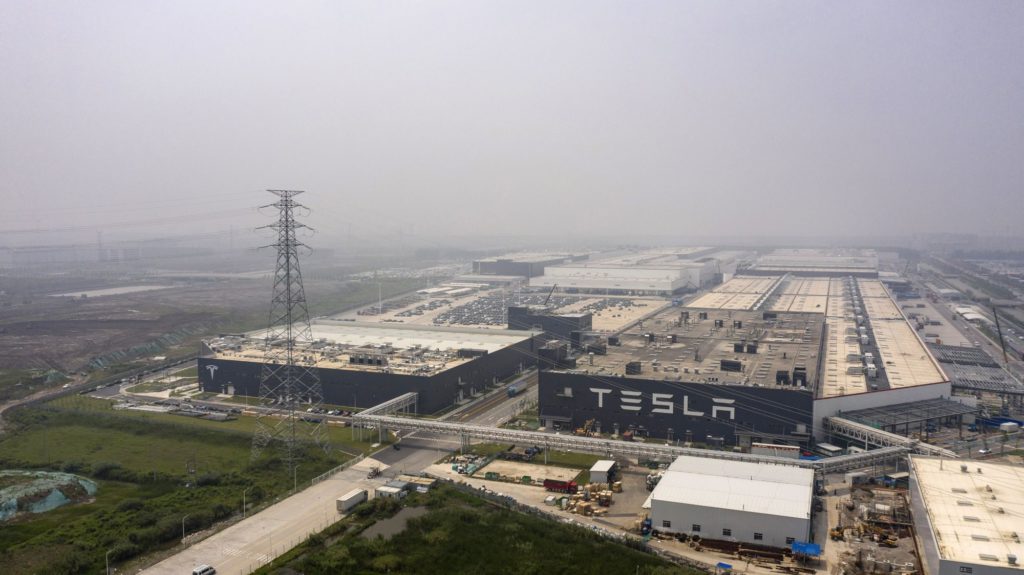
Ganfeng’s plans to expand in Xinjiang risk drawing Tesla closer to the controversy over human rights in the region. They also threaten to complicate its strategy in China, where a Shanghai factory manufactures vehicles for the world’s top EV market and also for export to Europe and elsewhere in Asia.

The automaker in a May report disclosed a list of 12 mining and refining companies that are direct suppliers, with Ganfeng included among four lithium producers. Tesla, which has invested heavily in the Chinese market and previously opened a showroom in Xinjiang, said in the report it found no instances of child labor, forced labor or inhumane treatment in audits of its suppliers.

Tesla will act to end relationships with suppliers that don’t meet standards, or fail to correct issues of concern in a reasonable time frame, according to the report.

“The risks to the EV sector of inputs coming out of Xinjiang is huge,” said Emily de La Bruyere, a co-founder of Horizon Advisory, a US-based consultancy focused on forced labor issues. “It places all of China’s battery production at risk of violating US law and global norms around human rights, and that risk is only going to grow as China continues to build up EV-relevant industries in Xinjiang.”

A joint venture between a Ganfeng unit and Xinjiang Geology and Mineral Investment (Group) Co. aims to obtain quality lithium resources, Ganfeng said in a post on an online investor forum in June. The new company was registered in May in the region’s capital Urumqi with capital of about 90 million yuan ($13.3 million). The partners will aim to take advantage of local lithium resources and contribute to the region’s economic development, according to a statement posted to WeChat. 

The new firm is 49% owned by Ganfeng Zhongkai Mining Technology — itself a joint venture between Ganfeng Lithium and Jiangsu Nonghua Intelligent Agriculture Technology Co. — with state-backed Xinjiang Geology and Mineral Investment holding the remainder, according to China’s National Enterprise Credit Informational Publicity System.

Read more: The Battery Boom Created a New Lithium Superpower in China

Companies have found themselves caught between the US and China over the issue of Xinjiang. Activists and Western associations have urged them to cut ties completely, but any moves to distance themselves from the region risk drawing the ire of the Chinese government. Tesla’s announcement that it was opening a showroom there drew criticism from groups including the Alliance for American Manufacturing.

Volkswagen AG has also faced pressure over a production facility in Urumqi, prompting Chief Executive Officer Herbert Diess to argue the automaker’s presence in Xinjiang can be a force for good. Though VW and Ganfeng announced plans in 2019 for a 10-year supply pact, the companies currently have “no direct business relationship,” the carmaker said in a statement.

In theory, Tesla and other automakers could find a way to keep their relationships with Ganfeng going while avoiding any metals that come from Xinjiang. 

Ganfeng has a vast network of operations and projects spanning Australia to Argentina, which could give clients options to avoid the use of raw materials produced from future Xinjiang sites, according to Seth Goldstein, a Chicago-based equity strategist at Morningstar Research Services, who covers Tesla and battery supply chain firms. “The customer could likely request to buy lithium from Ganfeng’s other operations,” he said. “With regards to Tesla, I don’t foresee any problems.”

But separating the materials might not be that straightforward for all consumers given the complexity of  EV supply chains that involve multiple stages of mining, refining, component manufacturing and assembly  — typically spread across multiple locations — and the dangers of that obscuring the original source of raw materials.

“Any indication that Tesla, or another EV or battery manufacturer, is in fact collaborating with businesses that seem plausibly to be using forced labor would be very concerning to investors,” said Richard Clayton, research director at SOC Investment Group, which works with union pension funds that manage assets worth more than $250 billion and hold Tesla shares.

Companies in the sector face “significant reputational, regulatory, and potentially legal risks stemming from the environmental and human rights practices” associated with battery metals mining, he said. 

More stories like this are available on bloomberg.com

©2022 Bloomberg L.P.

Vodafone New Zealand Sells Mobile Tower Assets for $1.1 Billion

(Bloomberg) — Vodafone New Zealand is selling its mobile-phone tower assets to investment firms for NZ$1.7 billion ($1.1 billion). 

Together with shareholders Infratil and Brookfield Asset Management, Vodafone’s passive mobile tower assets will be bought by investors InfraRed Capital Partners and Northleaf Capital Partners, which will each have 40% stakes in the new TowerCo business. Infratil will reinvest to hold the remaining 20%, according to a statement Monday.

“We’re pleased at the outcome of the process, which attracted significant interest,” Vodafone Chief Executive Jason Paris said in a statement. “Infratil, InfraRed Capital Partners and Northleaf Capital are outstanding investors who share our vision for Aotearoa New Zealand and will help us to accelerate the roll out of critical infrastructure for our customers.”

Telecommunications companies around the world are separating so-called passive assets such as mobile-phone towers and looking for specialist investors. Last week, Vodafone’s New Zealand competitor Spark announced the sale of a majority stake in its tower assets to Canadian pension fund Ontario Teachers’ Pension Plan Board for NZ$900 million.

Vodafone said that under the terms of the deal, which is subject to New Zealand Overseas Investment Office approval, TowerCo will enter into a 20-year pact to provide it with access to both existing and new towers. TowerCo will also commit to building at least 390 additional sites over the next ten years, Vodafone said.

The transaction is expected to complete in the fourth quarter of 2022.

More stories like this are available on bloomberg.com

©2022 Bloomberg L.P.
Close Bitnami banner
Bitnami