

Bloomberg

SoftBank-Backed Cancer Detection Startup May Go Public as Soon as 2023

(Bloomberg) — SoftBank Group Corp.-backed AI Medical Service Inc., which specializes in endoscopy analysis, is taking steps for a possible initial public offering in Tokyo as early as next year.

The Japanese startup, which develops software to scan endoscopy images and identify potential cancers, has selected a lead manager for the IPO and is in talks with the Tokyo Stock Exchange, founder and Chief Executive Officer Tomohiro Tada said in an interview.

The company — whose peers include US-based Iterative Scopes Inc. — will begin supplying software that detects potential stomach cancers to medical institutions later this year at a monthly subscription fee of about 200,000 yen ($1,500) including updates, Tada said.

AIM’s IPO plans underline continued investor appetite for medical technology amid a broader tech downturn. Venture capital investment in medical diagnostics grew 78% from the previous year to $5.8 billion in 2021, trailing only media and semiconductors, according to Brendan Burke, a senior analyst for emerging technology at PitchBook. VC investment in the sector remained robust this year with $1.2 billion invested in the first quarter, he said in an email. 

“When the timing is right, yes, we do want to go public,” Tada said, adding the IPO plans are in flux and could still change, depending on market demand and regulatory talks. “It doesn’t have to be in Tokyo. Depending on how our business expansion goes overseas, a Nasdaq listing could be in sight.”

Gastrointestinal cancers, which account for more than a third of cancer deaths worldwide, have been a focus of investor attention. Iterative Scopes raised over $194 million and achieved a post-money valuation of $700 million in its Series B fundraising in January, Burke said. Doctors miss signs of early stages of such cancers in an estimated 20% to 40% of cases, Tada said. 

AIM’s subscription model — a departure from the industry’s norm of a one-time payment — intrigued SoftBank, which led an 8 billion yen funding round in April and made AIM the Vision Fund’s third investment in its home country. Agreed upon after a 30-minute Zoom meeting between Tada and SoftBank founder Masayoshi Son plus two weeks of intensive email exchanges between the two firms, the sum was 60% more than what AIM was initially looking for.

AIM is targeting contracts from 1,000 hospitals in Japan. Its product launch will hinge on expected approval from Japan’s Pharmaceuticals and Medical Devices Agency later this year, Tada said. The company declined to provide a revenue forecast, saying that pricing could change depending on the terms of regulatory approval.

The majority of doctors remain skeptical about the role of algorithms in medical imaging and diagnoses. A total 95% of radiologists polled in a 2020 study presented to the US Food and Drug Administration said artificial intelligence is either “inconsistent” or “never works” in routine clinical care. A subscription model also will be new to many. 

But Tada sees vast untapped demand. He estimates the global market for AI diagnostics to be five times Japan’s and is working to sell AIM’s technology overseas. The company set up an office in Palo Alto, California, in January and one in Singapore this month. AIM’s international rollout starts in 2023, with eventual targets including Taiwan, Hong Kong, Thailand, Vietnam and India, he said.

More stories like this are available on bloomberg.com

©2022 Bloomberg L.P.
Crypto Exchange CoinFlex Set to Allow Limited Withdrawals

(Bloomberg) — CoinFlex will allow users to take out a limited portion of their balances after pausing withdrawals last month due to a counterparty failing to make a margin call.

The crypto exchange said it will cancel pending withdrawals at 1am ET on July 15 and then close down trading on the platform, according to a July 14 blog post. Following the shutdown, users will be able to withdraw up to 10% of their balances, while the remainder will be blocked, it said.

“We will shut trading and system access before beginning the process of re-enabling withdrawals,” CoinFlex said. “We expect this to last a few hours and will notify you once we are back online for both trading and withdrawals.”

CoinFlex said they froze withdrawals after a counterparty, which it has identified as crypto investor Roger Ver, failed to pay $47 million in a margin call. The exchange said it has taken legal action to recover its losses and is in talks to sign a joint venture with another crypto exchange in a bid to revive its fortunes. In the most recent update, CoinFlex said that it was still working with “the significant creditor group.” Ver has denied he defaulted on debt owed to CoinFlex. 

CoinFlex Now Seeking to Recover $84 Million From Single Client

“We are continuing to work on all avenues to resolve this situation,” CoinFlex said in the July 14 post. “This ranges from possible further withdrawals and potential new equity investors to the acquisition of CoinFLEX and combinations in between.” The company stated the next update would be released July 22.

CoinFlex is one of several crypto platforms struggling to operate amid a major market downturn that’s wiped around $2 trillion off the total value of cryptocurrencies, with several players suspending withdrawals or filing for bankruptcy.

Crypto Lender Celsius Files for Bankruptcy After Cash Crunch

More stories like this are available on bloomberg.com

©2022 Bloomberg L.P.

Schumer Is Preparing for a Vote on Scaled-Back China Bill Next Week

(Bloomberg) — Senate Majority Leader Chuck Schumer has told senators to expect a preliminary vote next week on a pared-back China competition bill even as one of the top Republican backers of the legislation called the move a “bluff.” 

The legislation would include, at a minimum, $52 billion in incentives and an investment-tax credit for US semiconductor manufacturing, a person familiar with the plans said. But a Republican backer of the bill says it’s doomed if Democrats go through with their plan for a separate package of tax increases and climate measures.

“They don’t have the votes to do it, so this is all a big bluff,” Republican Senator John Cornyn of Texas said Thursday afternoon, adding he would vote “no” if Schumer brought it to the floor next week.

Senator John Thune of South Dakota, the No. 2 GOP leader, said Republicans would have to examine the bill’s contents before they can decide how to vote. But West Virginia Republican Shelley Moore Capito told reporters she would vote to start debate on such a smaller bill. 

Schumer plans to hold a vote as early as Tuesday to begin debate on the legislation, but it appears likely he’ll be unable to get past a Republican filibuster.

While some lawmakers and the Biden administration have signaled support for a slimmed-down version of the legislation in order to get the chips incentives passed, others have been urging to include other provisions that may make negotiating a bill more difficult.

‘Out of Time’

Commerce Secretary Gina Raimondo said after briefing House members on Thursday that the chips portion of the bill “is where there’s the most urgency.”

“This isn’t about politics, and we are out of time,” she said. “And if we don’t pass this, we’re going to wake up and other countries will have these investments. And we will say why didn’t we do it?”

The semiconductor incentives have been a top priority for the Biden administration as well as chip manufacturers such as Intel Corp. and companies that are heavy users of chips. While the global semiconductor shortage has eased somewhat, there is still limited production for certain chips used in automobiles and home appliances.

The competition bill has been hung up as lawmakers tried to work out differences between the House and Senate versions of the legislation. Negotiations effectively came to a halt after Senate GOP leader Mitch McConnell threatened to scuttle the bill two weeks ago amid the Democrats’ reconciliation talks.

McConnell on Tuesday opened the door to passing the semiconductor funding by itself, but it was unclear whether he would support adding other provisions that also have bipartisan agreement. 

“There are members I have who are not overly fond of USICA but who think there’s a national security aspect to the chips deficit,” McConnell said, using the acronym for the bill’s title. A McConnell spokesman did not have an immediate comment on Thursday about Schumer’s plan to advance a pared-back bill. 

Some key senators in both parties are getting behind what’s been dubbed “chips-plus,” a slimmed-down bill with the microchip funding, an investment-tax credit for chips manufacturing and money to speed the roll out of the faster, 5G telecommunications network.

“I’m for as much ‘plus’ as the market will bear, because these are all other good provisions,” Democratic Senator Mark Warner of Virginia said. “It’s more up to our Republican colleagues to make that assessment but, the clock is ticking.”

Asked about the prospects in the House for a narrower bill, Speaker Nancy Pelosi did not rule out the idea but said the legislation should include more than just the semiconductor subsidy. 

“We are determined that we will pass a bill,” she said.

(Updates with Raimondo in seventh, eighth paragraphs)

More stories like this are available on bloomberg.com

©2022 Bloomberg L.P.
Celsius Discloses $1.19 Billion Deficit in Bankruptcy Filing

(Bloomberg) — Bankrupt cryptocurrency lender Celsius Network Ltd. disclosed more details on its collapse, including that it has a $1.19 billion deficit on its balance sheet. 

The platform held about $4.3 billion of assets against $5.5 billion of liabilities as of Wednesday, according to a court filing. It suffered from a series of unexpected losses, including losing 35,000 of Ether tokens due to the misplacement of “keys” by its staking service provider StakeHound. 

“The amount of digital assets on the company’s platform grew faster than the company was prepared to deploy,” Chief Executive Officer Alex Mashinsky said in a sworn declaration that details the path that led Celsius to bankruptcy. “As a result, the company made what, in hindsight, proved to be certain poor asset deployment decisions.”

Read More:  Celsius Bankruptcy Filing Shows Long Reach of Bankman-Fried 

Going forward, Celsius may sell assets and consider investment from third-party strategic or financial investors in exchange for equity in a reorganized company, the filing says. It also intends to use Bitcoin minted by mining as one way to address its deficit. 

The company has been trying to obtain new financing from third parties, but those talks made clear that a bankruptcy protection was necessary, Mashinsky said. Celsius has about 1.7 million registered users, including approximately 300,000 active users with account balances greater than $100, the filing shows. 

Counterparties

Celsius has unwound nearly all of its loans at decentralized finance platforms and a $108 million loan collateralized by $403 million in digital assets with crypto exchange FTX, it says. The majority of its liabilities are related to user accounts. It plans to engage with a committee of unsecured creditors, which it says will likely include mostly users, to “build consensus” around its future plan. 

The collapse of Three Arrows Capital also impacted Celsius, which has a $40 million claim against the crypto hedge fund, the filing says. 

During the recent market crash, stablecoin issuer Tether issued a margin call to Celsius on a $841 million loan outstanding. Celsius decided not to provide additional collateral and agreed to a liquidation and settlement of the loan, which resulted in a loss of $97 million, the filing shows. 

(Updates with details on Three Arrows, Tether)

More stories like this are available on bloomberg.com

©2022 Bloomberg L.P.
Nidec CEO Says Stock Will Double in Two Years, Then He’ll Retire

(Bloomberg) — Shigenobu Nagamori is back at the top of Nidec Corp., one of Japan’s biggest companies, and doesn’t intend to leave until he’s boosted the company’s share price to a record and captained it onto a path of steady growth.

The 77-year-old, who spent half a century building Nidec into the world’s top supplier of motors for everything from hard drives to power plants, has garnered a reputation for being a sharp deal maker and bellwether for industry trends. At the same time, he’s struggled to find a successor, promoting former Nissan Motor Co. executive Jun Seki to become chief executive officer last year before summarily taking back the reins 10 months later after what he saw as lackluster performance.

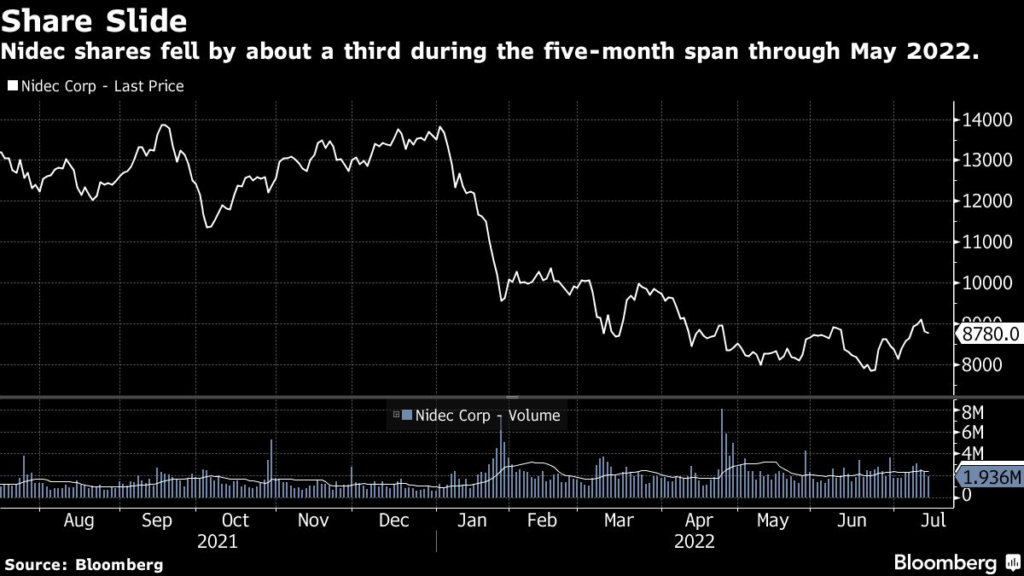
When Nagamori handed over his company to Seki in June 2021, the founder was beginning to think about his next phase of life — writing books and managing a university. But Nidec’s shares, over a five-month span through May, were in the midst of losing roughly a third of their value and over the last year “every day I was in agony,” Nagamori said in an interview. “The company’s performance was getting worse and worse.” 

In April, Nidec announced that Nagamori would return to his post as CEO, leaving Seki in the role of chief operating officer, to look after the company’s automotive business. Nidec’s unit supplying motor systems for electric vehicles has continued to struggle, according to Nagamori, but over the recent quarter through June, he’s “tidied up” other businesses. “You’ll see that in the earnings,” he said.

Nidec is set to announce results for the period on July 20. Analysts, on average, are forecasting a 43.5 billion yen ($313 million) operating profit, which would be down slightly from 44.6 billion yen the previous year.

Longer term, Nagamori said his goal is to see Nidec’s share price rise to a level that would beat its 2021 record of 15,175 yen. In two years, at the latest, Nidec’s shares will trade at around 20,000 yen, Nagamori said, “I’m full of confidence.” 

Nagamori acknowledges that the performance boost he sees stemming from his return will be temporary. After a record share price is achieved, Nagamori said he’ll look to pass on the CEO post and eventually transition into the role of Nidec’s honorary chairman.

Physical Wound

But at the same time, Nagamori says as long as he’s living, he can’t accept handing off Nidec and seeing it stumble. “I built this company from the ground up and Nidec is like a part of my body,” he said. “If the company were to become a failure it’d be like a physical wound for me.”

Indeed, what comes after Nagamori steps down is of key interest to investors in the company. For years, analysts have been warning that if a transition of power wasn’t smooth, Nidec could lose its “Nagamori premium.”

Nagamori said he’s given up on finding any one individual capable of filling his shoes. He intends to break up his responsibilities between a number of individuals, he said. “At this level, there isn’t a person in Japan who can operate this company as CEO alone,” Nagamori said, “it needs to be managed by a group.” 

Recently, Nidec has moved to significantly bolster its recruiting activities, poaching prominent executives including Mitsuya Kishida, the former head of Sony Group Corp.’s mobile communications business, and Shinya Yoshida an executive vice president at Mitsubishi Corp. 

Nagamori said those individuals, along with other internal and external hires are all contenders for the top job — a position in which they’ll be tasked with reaching Nidec’s long-standing goal of reaching 10 trillion yen in annual net sales by fiscal 2030.

With regard to Seki, Nagamori said the former CEO has not done enough to learn and embody his methods of management since joining the company. Seki remains the top candidate for next CEO, but unless the businesses he’s in charge of turns around there’s “zero chance” of his return to the top job, Nagamori said.

Seki didn’t immediately respond to a request for comment.

Nidec has a basic policy outlining that the person who contributes most to the company’s profit will claim the top job, Nagamori said. “You may think this is an unsparing company but it’s really the proper way,” he said. “It’s a meritocracy.”

More stories like this are available on bloomberg.com

©2022 Bloomberg L.P.
Crypto Deal Delay Casts Doubts Over Oldest Thai Bank’s Makeover

(Bloomberg) — A delayed deal between Thailand’s oldest bank and its largest cryptocurrency exchange is raising doubts about the 115-year-old financial group’s ambition to become a regional fintech powerhouse. 

Bangkok-listed SCB X Pcl agreed to acquire a majority stake in Bitkub Online Co. for 17.9 billion baht ($490 million) at the peak of crypto craze in November, with a target to wrap up the deal earlier this year. But SCB last week said there’s still due diligence to be carried out amid discussions with regulators. 

Thailand’s cryptocurrency industry is facing heightened regulatory scrutiny just as SCB attempts a push to become a market leader in digital assets. Falling fees and rising competition within traditional banking businesses are forcing lenders to develop new markets within Southeast Asia’s second-biggest economy and further afield. 

“Bitkub is a key step for SCB to achieve its expansion into digital asset and fintech businesses,” said Therdsak Thaveeteeratham, an analyst at Asia Plus Securities Pcl. “The delay further raises doubt about the deal completion. This would be a significant blow to SCB’s regional tech ambition.”

Bitkub and its chief executive officer last month were fined by the Securities & Exchange Commission for creating “artificial trading volume” on its platform. In May, the company and five officials were also fined by the regulator for breaching guidelines in listing the company’s own digital coins. 

Meantime, the global crypto market is contending with a $2 trillion crash and a slew of high-profile bankruptcy filings. Bitcoin, the world’s biggest token, is down more than 70% from its peak in November. Crypto lender Celsius Network and broker Voyager Digital Ltd. filed for Chapter 11 bankruptcy, while liquidators have been called in for bankrupt crypto hedge fund Three Arrows Capital.

“The biggest concern now is the depressed cryptocurrency trading worldwide,’ said Nares Laopannarai, the secretary general of the Thai Digital Asset Association. “Coupled with some tax and regulation issues, this has made most investors and participants more cautious about the crypto market.”

No Deadline

SCB hasn’t given a new completion deadline for the proposed takeover of Bitkub. 

Still, for SCB, which counts Thailand’s King Maha Vajiralongkorn as its biggest shareholder, the setback to the pending Bitkub deal is unlikely to derail the group’s expansion into fintech, according to Bloomberg Intelligence. The group saw broad-based digital adoption in the first quarter for users, loans and revenue, a recent Bloomberg Intelligence report showed. 

“SCB may continue to focus on high-growth fintech business,” said Rena Kwok, a Bloomberg Intelligence analyst. “Its peer-leading digital transformation and foray into high-growth fintech space could offer medium-term earnings drivers.”

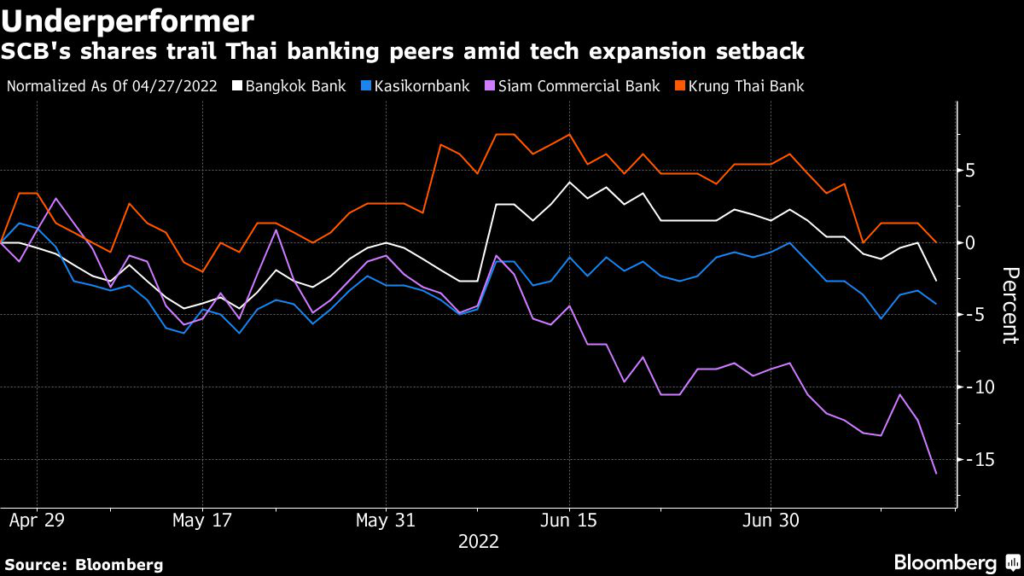
SCB shares are down about 16% since they began trading in April after a successful stock-swap offer for the previously-listed entity called Siam Commercial Bank Pcl. They have trailed peers such as Bangkok Bank Pcl, Kasikornbank Pcl and Krung Thai Bank Pcl. 

More stories like this are available on bloomberg.com

©2022 Bloomberg L.P.

Coinbase May Drop From Ranks of Top Crypto Exchanges as Volume Falls

(Bloomberg) — Coinbase Global Inc. is falling out of the coveted list of the world’s top 10 digital-asset exchanges by volume as the markets battle crypto winter.

The latest data for this month so far shows the firm is now the 14th largest exchange, down from the fourth-biggest in late 2021, according to Mizuho Securities USA LLC. 

The main exchange for digital tokens in the US only had a 2.9% average market share among the top 30 exchanges globally so far this month, Mizuho said. That’s down from 3.6% average in the second quarter of this year and 5.3% in the first quarter, the report said.

It’s the latest sign that Coinbase’s profit trajectory looks problematic, Mizuho said. 

“We worry that the competitive nature of the industry is likely to require further increases in sales & marketing spend over time, and can also weigh on COIN’s take rates,” Mizuho analysts said in the report. “All this, coupled with subdued volume trends, is likely to weigh on profitability moving forward, in our view.”

Coinbase didn’t immediately return a request for comment.

As crypto prices collapsed in the last eight months, erasing about $2 trillion in market value, most large exchanges’ trading volume dwindled as retail traders remained on the sidelines. Coinbase is suffering “because their business model is seeing structural issues: suffering from a perfect storm of more competition in a declining market while take rates are perceived to be too high and unsustainable,” Mizuho analyst Dan Dolev said in an email.

In June, Coinbase said it will lay off 18% of staff after a streak of aggressive hiring. Other exchanges, such as Gemini Trust Co., have laid off workers as well.

After crypto prices began to decline, Coinbase’s shares have collapsed 84% from the $357 all-time high on Nov. 9 to $53.42 currently.

More stories like this are available on bloomberg.com

©2022 Bloomberg L.P.
Stocks Bounce Off Lows as Traders Temper Fed Bets: Markets Wrap

(Bloomberg) — Stocks closed well off session lows as comments from Federal Reserve officials brought some relief to investors worried that a more aggressive pace of rate hikes could trigger a recession.

The S&P 500 almost erased a slide that topped 2% as Fed Governor Christopher Waller and Fed Bank of St. Louis President James Bullard said they would back a 75-basis-point hike in July after a hot inflation print. The tech-heavy Nasdaq 100 climbed amid gains in giants like Apple Inc. and Intel Corp.

About $1.9 trillion of options are set to expire Friday, obliging investors to either roll over existing positions or start new ones. The monthly event includes $925 billion of S&P 500-linked contracts and $395 billion of derivatives across single stocks scheduled to run out, Goldman Sachs Group Inc. estimates. 

Treasury two-year yields fell as traders shifted their bets away from a full-point hike by the Fed this month. Markets may have gotten a little ahead of themselves in betting on a move of that magnitude, Waller said. The Bloomberg Dollar Spot Index pared gains, but still traded at an all-time high.

Investors got a reality check from the corporate side Thursday, with JPMorgan Chase & Co. temporarily halting buybacks as earnings fell short of estimates, and Morgan Stanley announcing a plunge in investment-banking revenues. Still, the chiefs of both banks said they aren’t steering their firms toward shelter even as they see global events denting the economy.

“People are confused as to where the economy is actually heading,” said Victoria Fernandez, chief market strategist at Crossmark Global Investments. “Are we going into recession? Are we not? Is it going to be a short recession? Is it going to be a deep recession? That’s why we’re seeing so much volatility in the market. People just don’t have a clear direction right now.”

Read: Fed Watchdog Clears Powell, Clarida in Trading Scandal Probe

Shrinking the Fed’s $8.9 trillion balance sheet will have an effect over time equivalent to no more than three quarter-point interest-rate hikes, according to a new study by a Fed Bank of Atlanta economist. That suggests the asset reductions will have a relatively modest effect compared to rate hikes to counter inflation.

“We remain skeptical that the Fed can pull off simultaneously normalizing its balance sheet, controlling inflation, and avoiding severe market disruptions,” said Richard Saperstein, chief investment officer at Treasury Partners. “We’re increasingly concerned that investors may be forced to endure more downside volatility in this tricky environment.”

In other corporate news, US-listed China stocks tumbled as a report that Alibaba Group Holding Ltd. faces an inquiry in China in connection with a data-theft case renewed regulatory concerns broadly. 

Elsewhere, Bitcoin broke above $20,000, joining gains in tech stocks while investors got more clarity on the bankruptcy of a major digital-assets lender. 

Wall Street’s top regulator may use its authority to exempt crypto companies from certain securities laws to help the industry come into compliance, said Securities and Exchange Commission Chair Gary Gensler

What to watch this week:

  • China GDP, Friday
  • US business inventories, industrial production, University of Michigan consumer sentiment, Empire manufacturing, retail sales, Friday
  • G-20 finance ministers, central bankers meet in Bali, from Friday
  • Atlanta Fed President Raphael Bostic speaks, Friday

Will the eurozone avoid a recession or a debt crisis? How will the euro and stocks perform in the next six months? Share your views and participate in the latest MLIV Pulse survey. It only takes a minute, so please click here anonymously.

Some of the main moves in markets:

Stocks

  • The S&P 500 fell 0.3% as of 4 p.m. New York time
  • The Nasdaq 100 rose 0.3%
  • The Dow Jones Industrial Average fell 0.5%
  • The MSCI World index fell 0.8%

Currencies

  • The Bloomberg Dollar Spot Index rose 0.6%
  • The euro fell 0.4% to $1.0016
  • The British pound fell 0.6% to $1.1823
  • The Japanese yen fell 1.1% to 138.94 per dollar

Bonds

  • The yield on 10-year Treasuries advanced four basis points to 2.97%
  • Germany’s 10-year yield advanced three basis points to 1.18%
  • Britain’s 10-year yield advanced four basis points to 2.10%

Commodities

  • West Texas Intermediate crude fell 0.1% to $96.19 a barrel
  • Gold futures fell 1.6% to $1,707.50 an ounce

More stories like this are available on bloomberg.com

©2022 Bloomberg L.P.
Google Parent Alphabet Names Goldman Sachs Veteran to Board

(Bloomberg) — Wall Street veteran Marty Chavez is joining the board of Google parent Alphabet Inc., adding significant finance muscle to the technology giant.

Chavez, a vice chairman and partner with Sixth Street Partners, has worked as an investor and software executive but is best known for his 20-year tenure at Goldman Sachs Group Inc. John Hennessy, Alphabet’s chairman, welcomed Chavez in a statement as “an accomplished technologist, entrepreneur and investor.”

His appointment marks the first change to the Alphabet board since 2020, when former Google Chief Executive Officer Eric Schmidt departed.

Chavez, 58, originally joined Goldman Sachs in the J. Aron trading unit. He then held various other roles at the firm, including chief financial officer, chief information officer, and head of its trading division, the bank’s largest unit.

After stepping away to found a technology startup, Chavez, an openly gay executive, returned to the firm and helped with Goldman Sachs’s efforts to remake itself as a tech company. After leaving the bank again, he joined Sixth Street Partners, a boutique investment firm run by former Goldman colleague Alan Waxman.

Chavez also chairs the board of biotech firm Recursion Pharmaceuticals Inc. and was briefly on the board of Banco Santander SA.

To date, Google’s most prominent Wall Street appointment has been Chief Financial Officer Ruth Porat, who came from Morgan Stanley. Shortly after Porat joined, in 2015, Google formed the holding company Alphabet, giving investors more insight into its expensive, futuristic ventures and the profitability of its advertising business.  

Wall Street has long eyed the internet giant as a potential finance disruptor. But aside from a few investments and products, like Google Finance, the tech company has largely stayed out of the sector. It recently shelved a project to provide checking accounts with major banks.

In 2019, Alphabet added the biotechnology veterans Robin L. Washington and Frances Arnold to the board. Its directors also include CEO Sundar Pichai and founders Larry Page and Sergey Brin, who stepped away from major roles at the company in 2019.

More stories like this are available on bloomberg.com

©2022 Bloomberg L.P.

Alibaba, US-listed China Stocks Drop Amid Probe Report

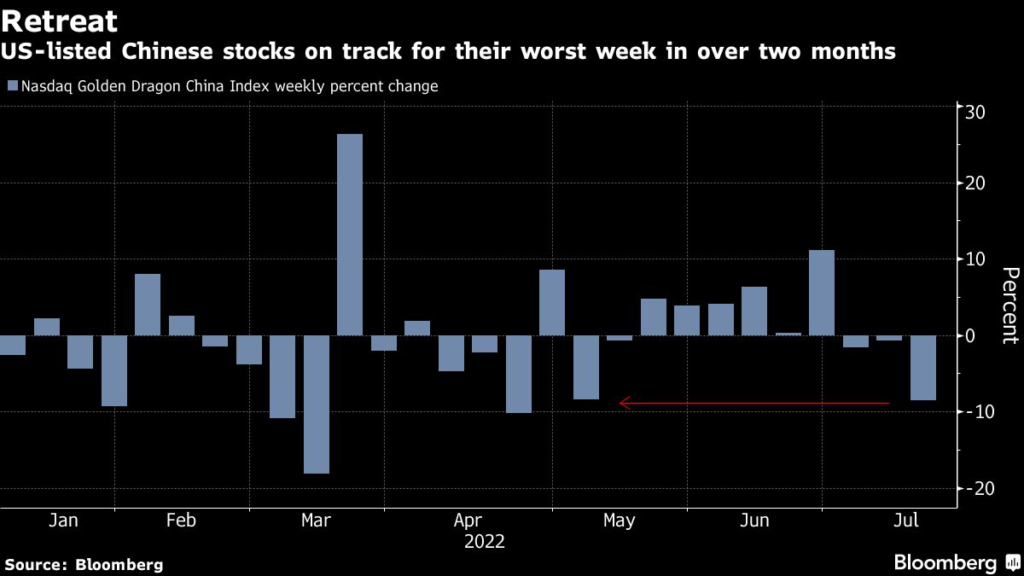
(Bloomberg) — US-listed China stocks tumbled on Thursday, leaving them poised for their steepest weekly losses since May, as a report that Alibaba Group Holding Ltd. faces an inquiry in China in connection with a data theft case renewed regulatory concerns broadly. 

The Nasdaq Golden Dragon China Index fell about 2%, led by Alibaba, which dropped as much as 7.7% in a five-day losing streak. Technology peers Baidu Inc. and JD.com Inc. declined 2.5% and 0.5%, respectively, while electric vehicle stock Nio Inc. lost 0.3%.

Executives from Alibaba Group’s cloud division have been summoned for talks by authorities in Shanghai in connection with the theft of a vast police database, one of the nation’s largest cybersecurity breaches, according to the Wall Street Journal.

The news, coupled with reports Monday that China hit tech giants with regulatory fines, is denting investors sentiment on the group after a rally in June. 

Alibaba, China Stocks in US Tumble Amid Fines, Covid Risks

In June, the Golden Dragon Index soared 16%, its best month since 2019, with a string of analysts calling a bottom in the group, as the government appeared to step back from regulatory crackdowns on the tech industry and continued to roll out supportive measures. The rally then paused amid jitters over regulatory uncertainty and fresh Covid-19 lockdown risks. The Golden Dragon Index is still about 17% lower this year.

This week, the Hang Seng Tech Index entered a technical correction, with analysts questioning if fresh probes on internet giants would trigger another downturn in the sector. 

(Corrects first paragraph to say steepest weekly loss since May)

More stories like this are available on bloomberg.com

©2022 Bloomberg L.P.

Close Bitnami banner
Bitnami