

Bloomberg

Stocks Well Off Lows as Traders Dial Back Fed Bets: Markets Wrap

(Bloomberg) — Stocks pared losses as comments from Federal Reserve officials brought some relief to investors worried about a more aggressive pace of rate hikes sinking the economy into a recession.

The S&P 500 almost erased a slide that topped 2% as Fed Governor Christopher Waller and Fed Bank of St. Louis President James Bullard said they would back a 75-basis-point hike in July after a hot inflation print. The tech-heavy Nasdaq 100 climbed amid gains in giants like Apple Inc. and Intel Corp.

Read: A Mark of Capitulation as Retail Starts to Mean What It Says

Treasury two-year yields fell as traders shifted their bets away from a full-point hike by the Fed this month. Markets may have gotten a little ahead of themselves in betting on a move of that magnitude, Waller said. The Bloomberg Dollar Spot Index pared gains, but still headed toward its all-time high.

Investors got a reality check from the corporate side Thursday, with JPMorgan Chase & Co. temporarily halting buybacks as earnings fell short of estimates, and Morgan Stanley announcing a plunge in investment-banking revenues. Still, the chiefs of both banks said they aren’t steering their firms toward shelter even as they see global events denting the economy.

“People are confused as to where the economy is actually heading,” said Victoria Fernandez, chief market strategist at Crossmark Global Investments. “Are we going into recession? Are we not? Is it going to be a short recession? Is it going to be a deep recession? That’s why we’re seeing so much volatility in the market. People just don’t have a clear direction right now.”

Read: Fed Watchdog Clears Powell, Clarida in Trading Scandal Probe

Shrinking the Fed’s $8.9 trillion balance sheet will have an effect over time equivalent to no more than three quarter-point interest-rate hikes, according to a new study by a Fed Bank of Atlanta economist. That suggests the asset reductions will have a relative modest effect compared to rate hikes to counter inflation.

“We remain skeptical that the Fed can pull off simultaneously normalizing its balance sheet, controlling inflation, and avoiding severe market disruptions,” said Richard Saperstein, chief investment officer at Treasury Partners. “We’re increasingly concerned that investors may be forced to endure more downside volatility in this tricky environment.”

Elsewhere, Bitcoin broke above $20,000, joining gains in tech stocks while investors got more clarity on the bankruptcy of a major digital-assets lender. 

Read: SEC Weighs Waiving Some Rules to Regulate Crypto, Gensler Says

What to watch this week:

  • China GDP, Friday
  • US business inventories, industrial production, University of Michigan consumer sentiment, Empire manufacturing, retail sales, Friday
  • G-20 finance ministers, central bankers meet in Bali, from Friday
  • Atlanta Fed President Raphael Bostic speaks, Friday

Will the eurozone avoid a recession or a debt crisis? How will the euro and stocks perform in the next six months? Share your views and participate in the latest MLIV Pulse survey. It only takes a minute, so please click here anonymously.

Some of the main moves in markets:

Stocks

  • The S&P 500 fell 0.5% as of 3:48 p.m. New York time
  • The Nasdaq 100 rose 0.1%
  • The Dow Jones Industrial Average fell 0.5%
  • The MSCI World index fell 0.9%

Currencies

  • The Bloomberg Dollar Spot Index rose 0.6%
  • The euro fell 0.3% to $1.0024
  • The British pound fell 0.6% to $1.1821
  • The Japanese yen fell 1.1% to 138.86 per dollar

Bonds

  • The yield on 10-year Treasuries advanced one basis point to 2.94%
  • Germany’s 10-year yield advanced three basis points to 1.18%
  • Britain’s 10-year yield advanced four basis points to 2.10%

Commodities

  • West Texas Intermediate crude was little changed
  • Gold futures fell 1.6% to $1,708.20 an ounce

More stories like this are available on bloomberg.com

©2022 Bloomberg L.P.
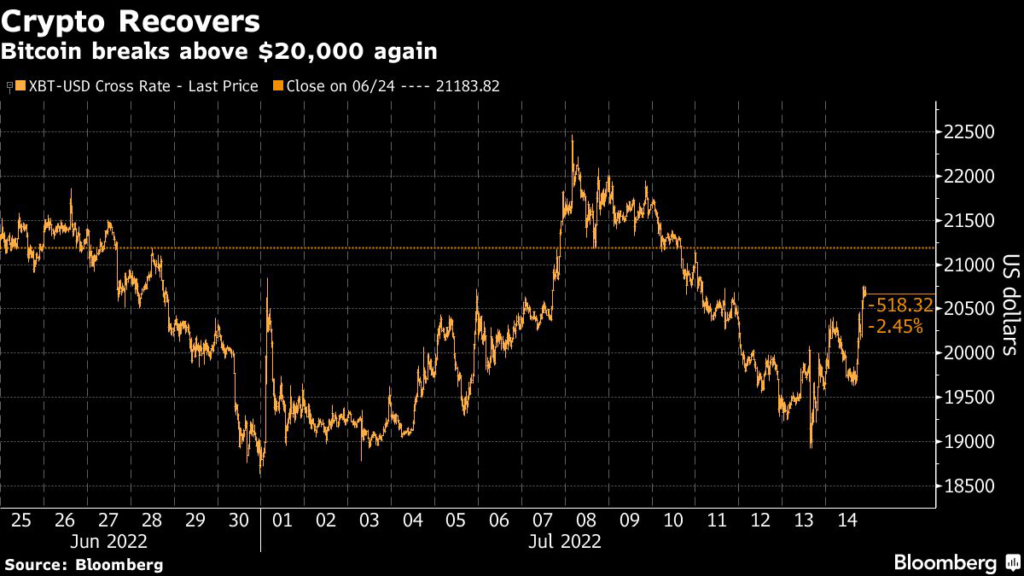
Bitcoin Breaks Above $20,000 Again; Celsius Removes Uncertainty

(Bloomberg) — Cryptocurrencies rose for the second day as US tech stocks also posted an advance and investors got more clarity on the bankruptcy of a major digital-assets lender. 

Bitcoin, the largest digital coin by market value, rose as much as 5.6% on Thursday to once again trade above the closely watched $20,000 level. Ether, the second-biggest, surged 12% at one point to above $1,200. The rallies were broad-based, with an index of 100 of the most-tracked coins rising roughly 6%, and happened as the market digested Celsius Network Ltd.’s filing for bankruptcy, which cleared a major overhang. 

Meanwhile, the Nasdaq 100 index of technology stocks — which Bitcoin and other cryptos tend to mimic on a day-to-day basis — also gained as comments from Federal Reserve officials brought relief to investors concerned about the central bank’s aggressive pace of rate hikes potentially sinking the US economy into a recession. Fed Governor Christopher Waller and Fed Bank of St. Louis President James Bullard both said they would back a 75-basis-point hike in July after a hot inflation print, whereas some market participants had been anticipating the central bank could institute a 100-basis point increase. 

“This is the time for medium and long-term investors (1+ year) to consider allocating to Bitcoin more aggressively,” wrote Sean Farrell, head of digital asset strategy at FSInsight, wrote in a note. 

Crypto investors have been hurt all year as the Fed hikes interest rates to fight inflation. Trading volumes have plummeted amid the dreadful first half, with spot and derivatives volumes declining across major exchanges. 

But much of the news around the Fed’s aggressiveness has already been priced in, according to StoneX’s Youwei Yang. 

“Interest rate hikes are priced in so that’s why it’s holding in here,” Yang said in an interview. 

More stories like this are available on bloomberg.com

©2022 Bloomberg L.P.

Crypto Lender Celsius Files for Bankruptcy After Cash Crunch

(Bloomberg) — Cryptocurrency lender Celsius Network Ltd. filed for Chapter 11 bankruptcy, the latest casualty of a $2 trillion crash that has wiped out some of the industry’s biggest names and exposed hundreds of thousands of individual investors to steep losses.

Celsius, which has more than 100,000 creditors, said it took the step to stabilize its business and work out a restructuring for all stakeholders. The filing was made in the Southern District of New York and listed Alameda Research, the trading firm co-founded by crypto billionaire Sam Bankman-Fried, among major creditors.

The platform held about $4.3 billion of assets against $5.5 billion of liabilities as of Wednesday, according to court papers. The company has been trying to obtain new financing from third parties, but those talks made clear that a bankruptcy filing was necessary, Chief Executive Officer Alex Mashinsky said in a sworn declaration.

“The amount of digital assets on the company’s platform grew faster than the company was prepared to deploy,” Mashinsky said, detailing the path that led Celsius to bankruptcy. “As a result, the company made what, in hindsight, proved to be certain poor asset deployment decisions.”

The company, one of the largest cryptocurrency lenders, had amassed more than $20 billion in assets by offering interest rates as high as 18% to depositors before it halted all withdrawals in June amid a panic run by clients. 

Celsius’s troubles are emblematic of the problems plaguing the digital asset space, where rising US interest rates have sent investors fleeing and triggered the collapse of lenders and hedge funds. Crypto broker Voyager Digital Ltd. filed for Chapter 11 bankruptcy protection this month while liquidators have been called in for bankrupt crypto hedge fund Three Arrows Capital.

Doubts about the sky-high yields backing products such as those Celsius offers intensified after the collapse of the TerraUSD algorithmic stablecoin in May. Another centralized lender Babel has also halted withdrawals and crypto prices have slumped, with Bitcoin and Ether losing half their value since end-December.

For Celsius, its business was built on loaning crypto borrowed from its customers to institutional investors. It was also a participant in a slew of decentralized-finance applications.

Read: How Billions in TerraUSD Went Up in Algorithmic Smoke: QuickTake

In a statement Wednesday, Celsius said it needed to halt withdrawals as without it, an acceleration of the pullouts “would have allowed certain customers —- those who were first to act — to be paid in full while leaving others behind to wait for Celsius to harvest value from illiquid or longer-term asset deployment activities before they receive a recovery.”

Celsius didn’t respond to a request for comment. Co-Founder and Chief Executive Officer Alex Mashinsky said in the statement that the move would strengthen the future of the company.

The firm has petitioned to continue to operate. It isn’t requesting authority to allow customer withdrawals right now, saying that claims would be handled through the Chapter 11 process. 

Bankruptcy Processes

Kirkland & Ellis is serving as legal counsel, with Centerview Partners as financial adviser and Alvarez & Marsal the restructuring adviser to Celsius.

Bankruptcy processes can take a while to resolve. Creditors of Mt. Gox, at one time the world’s biggest Bitcoin exchange that closed doors in 2014 and began liquidation proceedings, have yet to be paid. 

How much and what Celsius’s users will recover is unclear. Under its terms of service, treatment of its customers’ digital assets in case of insolvency is “unsettled” and “not guaranteed,” which may result in customers being treated as unsecured creditors.

Read: Celsius Paydowns Take Crypto Lender Into ‘Uncharted Territory’

When the TerraUSD (UST) stablecoin and related Luna token collapsed in May, Celsius scrambled to pull its funds out of Terra’s Anchor Protocol, which offered 20% returns on UST deposits. More recently, it suffered as another large holding — a token known as staked ETH, or stETH, which is tied to the value of Ether — became largely illiquid and more widely discounted to Ether.

In the past month, Celsius paid back all — more than $900 million — of its debt in decentralized applications Aave, Compound and MakerDAO, according to blockchain data and tracker Zapper. The paydowns have raised the specter of a legal debate on how and in what order should distressed crypto companies pay back creditors — whether they are actual people or platforms governed by computer code referred to as smart contracts.

(Updates with details from CEO court filing begining in paragraph three.)

More stories like this are available on bloomberg.com

©2022 Bloomberg L.P.

Facebook Users Will Be Able to Have Up to Five Profiles

(Bloomberg) — Meta Platforms Inc. will start letting more users create multiple profiles with their Facebook accounts, the company’s latest attempt to encourage posting and sharing on its social network. 

As part of a test, certain Facebook members will be able to create as many as four additional profiles, and each one won’t need to include a person’s real name or identity. Users could have one for friends and another for co-workers, for example, each with its own feed. But they will only be able to comment or like another post with one profile.

Meta is stepping up efforts to drive engagement on the world’s biggest social network, which has seen growth slow — especially among younger users. Facebook has previously offered multiple profiles but in a more limited fashion. Public figures, for example, have been able to manage multiple profiles for years, and the company has also let users create different identities for dating or college.

Additional profiles are still required to adhere to Facebook’s content policies and will tie back to a user’s core account, meaning rule violations on one profile will affect the others, the company said. 

When launching student profiles, Meta executives said that users were looking to interact around interests that were more specific than the things they might find with their main social experience. With multiple profiles, Facebook hopes users will create separate identies for their different interests, like gaming, travel or food, according to the spokesperson. 

The test won’t change how Meta calculates its monthly or daily active user totals, which are reported during earnings. The multiple-profile effort is just a test for now, and includes some US users and those in a handful of other countries.

More stories like this are available on bloomberg.com

©2022 Bloomberg L.P.

VW Risks Flurry of Consumer Claims After EU Top Court Ruling

(Bloomberg) — Volkswagen AG and other car markers risk potentially costly consumer claims after the bloc’s top court said the use of IT meant to protect car components from damage at certain temperatures could be illegal.

In a dispute stemming from the aftermath of the diesel scandal that roiled the German car giant, the EU Court of Justice on Thursday said there’s no exemption from regulations for the use of software that changes pollutant gas emissions in cars based on the outside temperature. 

While VW insists its use of so-called thermal windows is in line with the law, the ruling may open the door to lawsuits for compensation over sales contracts for affected cars. 

“Software in diesel vehicles which reduces the effectiveness of the emission control system at normal temperatures during most of the year constitutes a prohibited ‘defeat device,’” the EU court said. “Since such a vehicle default is not minor, rescission of the sale contract in respect of the vehicle is not, in principle, precluded.”

The EU’s top court in 2020 issued a key ruling in a dispute following from the diesel scandal that had engulfed VW, which said the use of defeat devices, which helped the automaker bypass diesel engine pollution tests, can’t be justified under the bloc’s rules. The ruling raised questions for car makers more broadly about the use of other software, because engine functions known as thermal windows — that lower pollution controls when temperatures are low to protect components — are used across the industry.

‘Minor’ Effects

Despite Thursday’s ruling, VW continues to argue that its software remains legal in the way it’s used in its vehicles. 

Following the criteria laid out by the EU court, “the thermal windows used in cars by VW remain permissible,” VW said in a statement. “The effects of the ruling on VW are therefore minor” and civil damages claims “will continue to be unsuccessful.”

The company argues that the exhaust gas re-circulation in its EA189 vehicles is active “most of the year,” because it is only switched off if the outside temperature falls below 10 degrees Celsius. However, the court said that the device at issue in Thursday’s case switches off the cleaning mechanism at temperatures below 15 degrees Celsius, making it illegal because it doesn’t work “most of the year.”  

“Even if the cars were considered roadworthy because of a retrofit, they do not correspond to what consumers were promised and paid good money for,” said European consumer campaign group BEUC. “Consumer organizations across the EU are still in court against Volkswagen, and this judgment should help consumers to get compensation.”

EU Justice Commissioner Didier Reynders on Thursday also weighed in, tweeting that the judgment is “good news for consumers affected by #Dieselgate” and urging VW to “to end litigation & compensate all consumers.”

A number of consumer claims in Austria by people seeking to cancel their sales contracts led to three courts deciding to ask EU judges for more clarity on whether such software also qualified as a defeat device, or whether there were exceptions for its use. 

“This puts a stop to arguments by diesel producers and also the German authorities that these thermal windows serve to protect engines and are legal,” said Peter Kolba, chairman of Austrian consumer association VSV. The group will continue to encourage “risk-free claims for damages against the diesel manufacturers in German courts,” he said.

The Austrian association says it has some 600 lawsuits pending in Germany and has supported Austrian car owners to join a group action of the German consumer organization against Mercedes-Benz Group AG.

The cases are: Cases C‑128/20, C‑134/20 and C‑145/20, GSMB Invest GmbH & Co. KG v. Auto Krainer Gesellschaft mbH, IR v. Volkswagen AG, DS v. Porsche Inter Auto GmbH & Co. KG, Volkswagen AG.

More stories like this are available on bloomberg.com

©2022 Bloomberg L.P.
Celsius Bankruptcy Filing Shows Long Reach of FTX’s Sam Bankman-Fried

(Bloomberg) — Among the more than 100,000 creditors of Celsius Network Ltd., the crypto lender that filed for bankruptcy on Wednesday, one entity stands out: Pharos USD Fund SP. 

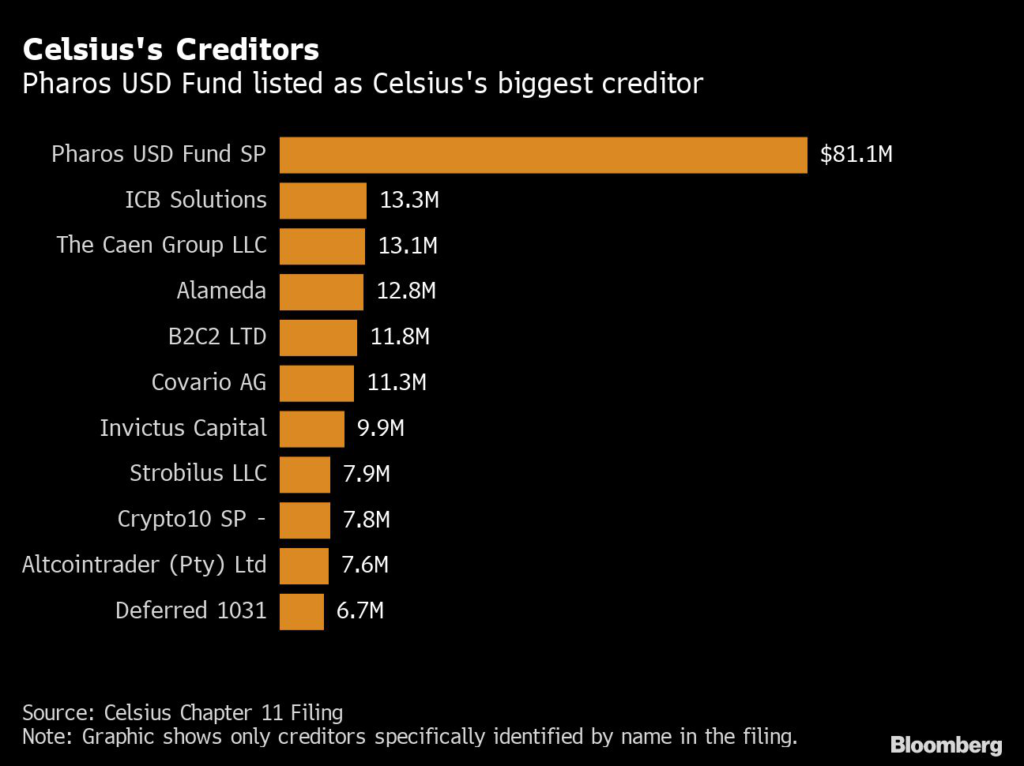
Celsius’s Chapter 11 filing shows that it owes Pharos $81 million, a claim twice as large as that of the second-biggest creditor. The document lists a Cayman Islands address for Pharos, along with an email: admin@lanternventures.com.

A Google search for Pharos USD Fund SP doesn’t yield any results. A job posting on an otherwise bare-bones website of Lantern Ventures describes it as a London-based proprietary trading firm focused on cryptocurrencies. The website — and Lantern’s LinkedIn page — make no mention of Pharos, but an SEC filing from April lists Pharos as an affiliate of Lantern. 

The firm has about $400 million under management, more than half of which is owned by investors outside the US, the SEC filing shows. 

Lantern also has several employees whose career histories listed on LinkedIn intersect with that of a prominent crypto billionaire whose firm also is a major creditor to Celsius: Sam Bankman-Fried. 

The firm’s Chief Executive Officer Tara Mac Aulay is a co-founder of Alameda Research, Bankman-Fried’s crypto trading firm, she said during a panel at a conference in London in November. She also worked at the Oxford, UK-based Centre for Effective Altruism, a charity where Bankman-Fried was formerly a director of development, according to her LinkedIn profile.

BlockFi Deal

Bankman-Fried has emerged as a central player in the recent crypto market tumult, showing up as a major borrower and creditor in this month’s bankruptcy of cryptocurrency lender Voyager Digtal Ltd. His crypto exchange, FTX US, is injecting capital into BlockFi Inc., another distressed crypto lender, and has an option to acquire it. 

Read more: Bankman-Fried’s Crypto Firm Alameda Is All Things to Voyager

Celsius owes Alameda $12.8 million, the bankruptcy filing shows. Bankman-Fried turned down a bailout request from Celsius as the crypto lender was teetering, Bloomberg News reported earlier. The billionaire did not immediately respond to a request for comment.

Mac Aulay’s LinkedIn page, which describes her as a pharmacist by training, doesn’t mention her former role at Alameda. A spokesperson at Alameda confirmed in an emailed response to Bloomberg that Mac Aulay is an early employee there, adding that the trading shop now “has no relationship with Lantern Ventures.”

Lantern Shareholders

At least three other Lantern employees have worked for either the charity or its affiliate Giving What We Can, of which Bankman-Fried is listed as a member, according to the employees’ biographies on LinkedIn. 

Another Lantern employee, Victor Xu, was head trader at Alameda for nine months in 2018 according to his LinkedIn profile. 

Mac Aulay and Xu didn’t respond to requests for comment. An email to the Lantern address listed in the filing went unanswered. 

Mac Aulay is listed as Lantern’s largest shareholder as of May 2021, according to a Companies House filing. Other investors include Luke Ding, a former partner at Brevan Howard Asset Management, Libertus Capital’s Pamir Gelenbe, and Estonia-based Metaplanet Holdings.

A filing with the UK’s Companies House shows Lantern Ventures had £3.1 million ($3.7 million) in net assets as of May 2021. A year earlier, the company listed £508,000 ($600,050) in net liabilities.

(Adds updated comment from Alameda in seventh paragraph and Metaplanet Holdings investment in eleventh paragraph)

More stories like this are available on bloomberg.com

©2022 Bloomberg L.P.
Crypto Trading Volume Tumbled in June to the Lowest Since 2020

(Bloomberg) — Cryptocurrency trading volumes have plummeted amid a dreadful first half of the year for the industry.

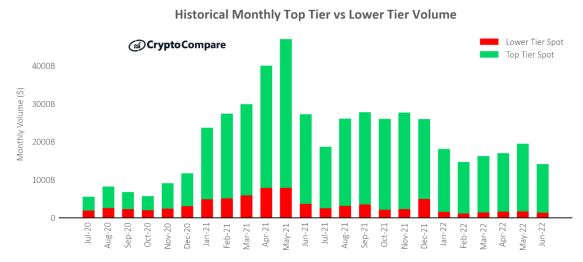
Spot and derivatives volumes have declined across exchanges, falling more than 15% since May to around $4.2 trillion and reaching the lowest since January of last year. The month of June alone saw spot volumes drop nearly 28% to $1.41 trillion as Bitcoin tumbled, the lowest since December 2020, according to data compiled by CryptoCompare.

Meantime, derivatives trading volumes were off by 7% during the month, the lowest since July 2021. Derivatives are hugely important in the crypto space, making up more than half of the market. 

To market-watchers, the trend makes sense considering declines in Bitcoin and Ether, both of which have fallen over 70% from last year’s all-time highs. Bitcoin tumbled 15% on June 18 to $17,599, the lowest price since late 2020. It reflects investors turning cautious. 

“Volume has declined given the reduced excitement from investors in a cyclical bear market,” Katie Stockton, co-founder of Fairlead Strategies, said in a message. “Until crypto prices break out of their bear-market cycle, which could take months, we can expect volume to be below average.”

Cryptocurrencies have, along with other riskier assets, had a hard time this year amid a higher-rate environment, whereby central banks around the world are trying to tamp down red-hot inflation. The MVIS CryptoCompare Digital Assets 100 Index of some of the largest coins is down 60% this year. Bitcoin rose 2.8% to $20,208 on Thursday.

Bitcoin futures contracts last month at the CME, with volume of $29 billion, reached their lowest volume traded since July of 2021, while Ether’s fell over 20%, indicating a “fall in speculative activity,” according to CryptoCompare. The drop-off in trading volume has taken place across many platforms, including Binance, OKX and FTX. 

The trend marks a reversal from the past two years, when retail investors, stuck at home during lockdowns or looking to capitalize on rising prices, swarmed into cryptos and other risky bets. 

“For moms and pops, when you see something sell off that much, they probably aren’t as interested,” Chris Gaffney, president of world markets at TIAA Bank, said in an interview. “They hate buying something that’s in a free-fall or even something that has fallen and stabilized. They want to see that first leg up.”

More stories like this are available on bloomberg.com

©2022 Bloomberg L.P.

Apax Weighs Sale of $1 Billion Device Maker Candela

(Bloomberg) — Apax Partners is weighing a sale of Candela Medical in a deal that could value the aesthetic device maker at more than $1 billion, people with knowledge of the matter said. 

The private equity firm is sounding out potential suitors, including other buyout firms, the people said, asking not to be identified discussing confidential information. Candela filed for a Nasdaq listing in October that was later postponed. 

Deliberations are ongoing and there’s no guarantee they’ll result in Apax selling the business. A representative for Apax declined to comment, while a spokesperson for Candela couldn’t immediately be reached for comment.

Headquartered in Marlborough, Massachusetts, Candela makes devices used for everything from reducing wrinkles to tattoo, hair and scar removal. Its products are available in nearly 100 countries, according to its website. 

Candela was founded as an industrial laser firm in 1970 and Apax agreed to acquire the company in 2017 for about $400 million.

More stories like this are available on bloomberg.com

©2022 Bloomberg L.P.

Stocks Drop Amid Recession Fears as Dollar Rallies: Markets Wrap

(Bloomberg) — Stocks slumped as disappointing results from two Wall Street heavyweights added to recession worries, while bets the Federal Reserve will intensify its fight against inflation pushed a dollar gauge to a record.

Equities pushed lower after briefly paring losses when Fed Governor Christopher Waller said he supports a 75-basis-point hike in July, but could vote for more if data show further inflation risks. Traders reduced bets slightly on a 100-basis-point move.

“We do not believe investors should start to get overly bullish if the Fed becomes less hawkish at some point this summer or early fall,” wrote Matt Maley, chief market strategist at Miller Tabak. “Yes, if they completely pivot,” he added, “THAT will be a time to become much more constructive on the stock market.”

Traders got another reality check Thursday, with JPMorgan Chase & Co. temporarily halting buybacks as earnings fell short of estimates, and Morgan Stanley announcing a plunge in investment-banking revenues.

JPMorgan’s boss Jamie Dimon, who has told investors to brace for an economic “hurricane,” noted he sees a “serious set of issues” clouding the economic outlook. Meantime, Morgan Stanley’s chief James Gorman said a deep or dramatic recession in the US is unlikely, and the bank is “long the US” in most of its businesses.

Read: Fed’s Collins Says Addressing Too-High Inflation Is Key Priority

A key measure of US wholesale and business prices jumped by more than forecast, though some signs of cooling inflationary pressures began to emerge. Over the last several weeks, measures of food, raw industrial materials and oil fell sharply. Nonetheless, it may take months before inflation moderates at the household level. 

Mortgage rates in the US rose, resuming an upward climb that threatens to further cool the housing market. The average for a 30-year loan jumped to 5.51% from 5.3% last week, Freddie Mac said in a statement Thursday. It’s up from 3.11% at the end of last year.

Shrinking the Fed’s $8.9 trillion balance sheet will have an effect over time equivalent to no more than three quarter-point interest-rate hikes, according to a new study by a Fed Bank of Atlanta economist. That suggests the asset reductions will have a relative modest effect compared to rate hikes to counter inflation.

“We remain skeptical that the Fed can pull off simultaneously normalizing its balance sheet, controlling inflation, and avoiding severe market disruptions,” said Richard Saperstein, chief investment officer at Treasury Partners. “We’re increasingly concerned that investors may be forced to endure more downside volatility in this tricky environment.”

Elsewhere, cryptocurrency lender Celsius Network Ltd. filed for Chapter 11 bankruptcy, but Bitcoin took the news in stride. The digital token may be regaining its long-touted appeal as an inflation hedge.

Read: SEC Weighs Waiving Some Rules to Regulate Crypto, Gensler Says

What to watch this week:

  • China GDP, Friday
  • US business inventories, industrial production, University of Michigan consumer sentiment, Empire manufacturing, retail sales, Friday
  • G-20 finance ministers, central bankers meet in Bali, from Friday
  • Atlanta Fed President Raphael Bostic speaks, Friday

Will the eurozone avoid a recession or a debt crisis? How will the euro and stocks perform in the next six months? Share your views and participate in the latest MLIV Pulse survey. It only takes a minute, so please click here anonymously.

Some of the main moves in markets:

Stocks

  • The S&P 500 fell 1.5% as of 12:50 p.m. New York time
  • The Nasdaq 100 fell 1.1%
  • The Dow Jones Industrial Average fell 1.6%
  • The MSCI World index fell 1.6%

Currencies

  • The Bloomberg Dollar Spot Index rose 0.8%
  • The euro fell 0.6% to $0.9994
  • The British pound fell 0.8% to $1.1788
  • The Japanese yen fell 1.1% to 138.96 per dollar

Bonds

  • The yield on 10-year Treasuries advanced four basis points to 2.98%
  • Germany’s 10-year yield advanced three basis points to 1.18%
  • Britain’s 10-year yield advanced four basis points to 2.10%

Commodities

  • West Texas Intermediate crude fell 1.8% to $94.57 a barrel
  • Gold futures fell 1.8% to $1,704.60 an ounce

More stories like this are available on bloomberg.com

©2022 Bloomberg L.P.

Alibaba Faces China Inquiry Over Data Theft, WSJ Says

(Bloomberg) — Executives from Alibaba Group Holding Ltd.’s cloud division have been summoned for talks by authorities in Shanghai in connection with the theft of a vast police database, the Wall Street Journal reported, citing people familiar with the matter. 

China has been rocked in recent weeks by one of the largest cybersecurity breaches in the country’s history. Hackers claimed to have stolen data on as many as a billion Chinese residents after penetrating a police database. The person or group claiming the attack offered to sell the information online for the equivalent of about $200,000. 

According to the Journal, cybersecurity researchers said a dashboard for managing the database had been left open without a password for more than a year, making it easy to steal and erase its contents.

Based on scans of the database, the researchers concluded that it was hosted on Alibaba’s cloud platform, according to the Journal. Company employees also confirmed the relationship, the paper said. The Chinese tech giant has been conducting an internal investigation into how the heist was allowed to happen, the newspaper reported. 

Executives called in for meetings with the Shanghai authorities include Alibaba Cloud Vice President Chen Xuesong, who was recently hired to lead the unit’s digital public-security business, the Journal said, citing people familiar with the matter.

An Alibaba representative in the US didn’t immediately respond to a request for comment. Alibaba’s American depositary receipts fell 5.1% in New York.


(Updates with no immediate response from Alibaba)

More stories like this are available on bloomberg.com

©2022 Bloomberg L.P.

Close Bitnami banner
Bitnami