Bloomberg

India Accuses Chinese Phone Maker of Tax Evasion as Probes Grow

(Bloomberg) — India is seeking 43.89 billion rupees ($551 million) from smartphone maker Oppo for allegedly evading customs duties, the latest in a flurry of accusations by Delhi against Chinese tech giants.

The anti-smuggling agency has searched the offices of Guangdong Oppo Mobile Telecommunications Corp.’s local unit and questioned management, India’s Finance Ministry said on Wednesday. It found “incriminating evidence indicating willful mis-declaration” of imported tools and components used to make phones, according to a statement. The Oppo unit also failed to include licensing fees paid to overseas companies when calculating the value of goods imported, the ministry added.

Senior managers and Oppo suppliers have issued statements acknowledging errors, while the Chinese company has made a pre-payment of 4.5 billion rupees, the ministry said. A spokesperson for Oppo’s India unit could not be reached for comment.

The latest move underlines heightened scrutiny of Chinese companies, following a Himalayan border clash between the two nuclear-armed neighbors in 2020 that left 20 Indian and four Chinese soldiers dead. 

Oppo’s woes follow accusations that bigger rival Xiaomi Corp. moved money out of the country by falsely claiming patent-fee payments. Last week, India’s anti-money laundering agency seized bank accounts, cash and gold bars belonging to Vivo Mobile Communications Co.’s local unit and related companies. An Indian court lifted a freeze on Vivo’s accounts on Wednesday after the company made a guarantee of payment.

Authorities had been investigating the local units of ZTE Corp. and Vivo for alleged financial improprieties, Bloomberg News reported previously.

Read more: India Said to Probe ZTE, Vivo as More China Firms Under Scrutiny

More stories like this are available on bloomberg.com

©2022 Bloomberg L.P.

Futures, Stocks Mixed Before Key US Inflation Data: Markets Wrap

(Bloomberg) — American equity futures edged higher Wednesday in cautious trading dominated by a dimming economic outlook and an anxious wait for data that may show US inflation at a fresh four-decade high.

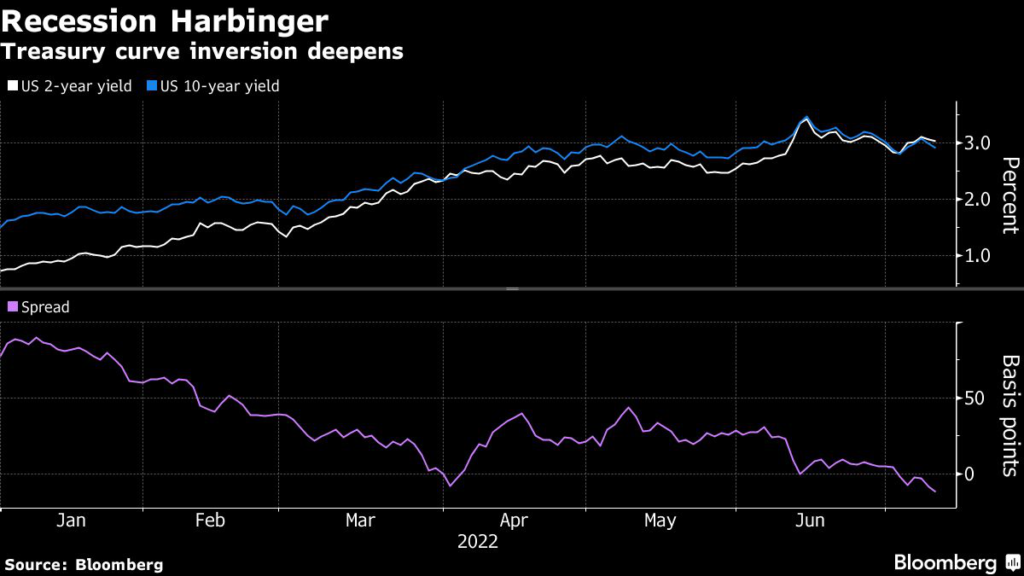
S&P 500 and Nasdaq 100 futures posted modest gains after yet another volatile session Tuesday that ended with both gauges solidly in the red. Treasuries were steady and a key part of the yield curve remains inverted, a potential signal of recession ahead. The 10-year yield at one point Tuesday was 12.4 basis points below the 2-year rate, a level unseen since 2007.

Insurance, healthcare and travel shares led a decline in the Stoxx Europe 600 index. The UK benchmark underperformed after Bank of England Governor Andrew Bailey said policy makers are prepared to move borrowing costs higher in bigger steps to control inflation. MSCI Inc.’s Asia-Pacific share gauge added less than 0.5%, bolstered by a rebound in Chinese technology shares. Most European bonds fell.

WTI crude oil stabilized at about $96 a barrel after a tumble. The dollar hovered near the highest levels since March 2020. The euro remained in sight of parity with the greenback. Bitcoin held below $20,000.

Rapidly tightening monetary policy in the US and elsewhere to fight price pressures is fueling worries about growth and leaving markets nervous. South Korea and New Zealand became the latest to hike interest rates further.

Economists project US inflation likely hit a fresh pandemic peak in June, keeping the Federal Reserve geared for another big rate increase. The consumer-price index probably rose 8.8% from a year earlier, the largest jump since 1981, according to a Bloomberg survey ahead of the release Wednesday.

“This is widely expected to be a really strong print,” Lauren Goodwin, economist and portfolio strategist at New York Life Investments, said on Bloomberg Television. “Even if it is not, I don’t think that changes the Fed’s perspective in a couple of weeks. We won’t have enough evidence that inflation is convincingly turning over.”

The International Monetary Fund cut its growth projections for the US economy and warned that a broad-based surge in inflation poses “systemic risks” to both the country and the global economy.

Traders are also on tenterhooks for the latest corporate earnings getting underway this week and monitoring for a brewing energy crisis in Europe if Russia cuts off gas supplies in the fallout from its invasion of Ukraine. 

What to watch this week:

  • Earnings due from JPMorgan, Morgan Stanley, Citigroup, Wells Fargo
  • US CPI data, Wednesday
  • Federal Reserve Beige Book, Wednesday
  • US PPI, jobless claims, Thursday
  • China GDP, Friday
  • US business inventories, industrial production, University of Michigan consumer sentiment, Empire manufacturing, retail sales, Friday
  • G-20 finance ministers, central bankers meet in Bali, from Friday
  • Atlanta Fed President Raphael Bostic speaks, Friday

Will the eurozone avoid a recession or a debt crisis? How will the euro and stocks perform in the next six months? Share your views and participate in the latest MLIV Pulse survey. It only takes a minute, so please click here anonymously.

Some of the main moves in markets:

Stocks

  • Futures on the S&P 500 rose 0.2% as of 6:03 a.m. New York time
  • Futures on the Nasdaq 100 rose 0.3%
  • Futures on the Dow Jones Industrial Average rose 0.2%
  • The Stoxx Europe 600 fell 0.7%
  • The MSCI World index was little changed

Currencies

  • The Bloomberg Dollar Spot Index was little changed
  • The euro was little changed at $1.0038
  • The British pound was little changed at $1.1897
  • The Japanese yen fell 0.2% to 137.09 per dollar

Bonds

  • The yield on 10-year Treasuries declined one basis point to 2.96%
  • Germany’s 10-year yield advanced two basis points to 1.15%
  • Britain’s 10-year yield advanced two basis points to 2.09%

Commodities

  • West Texas Intermediate crude rose 0.8% to $96.57 a barrel
  • Gold futures rose 0.1% to $1,726.70 an ounce

More stories like this are available on bloomberg.com

©2022 Bloomberg L.P.

Rogers to Face Financial Hit After Canada-Wide Network Failure

(Bloomberg) — Cable and wireless firm Rogers Communications Inc. said it will give customers a credit worth five days of service as compensation for last week’s network failure, which knocked more than 10 million people offline and temporarily choked Canada’s payments system. 

The move is “a first step” to regain the trust of consumers, Rogers spokesperson Chloe Luciani-Girouard said in an emailed statement. “We have been listening to our customers and Canadians from across the country who have told us how significant the impacts of the outage were for them,” she said. 

The company didn’t disclose the financial cost. In the first quarter, Rogers earned C$2.75 billion ($2.1 billion) in service revenue from divisions that provide wireless, cable television and internet service — about C$31 million a day. 

BMO Capital Markets analyst Tim Casey estimated Sunday that the “unprecedented” network collapse, which began Friday morning and stretched into the weekend, would cost the company C$70 million in the third quarter. But that calculation was based on Rogers giving customers a refund for two days of service, not five. 

Industry Minister Francois-Philippe Champagne has called the network problem “unacceptable” and ordered telecommunications companies including Rogers, BCE Inc. and Telus Corp. to reach agreements on emergency roaming and mutual assistance during future outages. There will also be an investigation by Canada’s telecom regulator, the Canadian Radio-television and Telecommunications Commission. 


More stories like this are available on bloomberg.com

©2022 Bloomberg L.P.

Taiwanese iPhone Maker Arm Backs Top China Chipmaker After $9 Billion Rescue

(Bloomberg) — A Shanghai-listed arm of Foxconn Technology Group acquired a stake in China’s top chipmaker during its $9 billion bailout, people familiar with the matter said, the latest in a series of investments the Taiwanese-run firm has made in the mainland’s semiconductor industry.

Foxconn Industrial Internet Co. invested in state-backed Tsinghua Unigroup through a fund it set up with investment house Wise Road Capital, according to people familiar with the deal. The fund paid about 5.3 billion yuan ($788 million) for a minority stake in Unigroup, one of the people said, asking not to be identified discussing a private deal.

The investment by the unit of Apple Inc.’s main iPhone assembler, known also as Hon Hai Precision Industry Co., could raise eyebrows as tensions rise between Beijing and Taipei over issues including technology and supply chain security. The deal requires a green light from Taiwan’s investment commission, which oversees sensitive deals, but Foxconn hasn’t submitted an application for approval, an official with Taiwan’s Ministry of Economic Affairs told Bloomberg News by phone.

“FII has invested in private equity funds in China to look for investment targets that can help FII’s future development,” the company said in a statement.

Unigroup, owned by a consortium led by state-backed JAC Capital following the bailout, is considered one of a handful of chipmakers crucial to realizing Beijing’s ambition of self-reliance in semiconductors. Foxconn has been expanding its chip investments in recent months partly to satisfy its own growing demand as it pushes into the electric vehicle sector. The Taiwanese company began assembling chips at a plant in eastern China in 2021 and acquired a modest chip plant in Taiwan the same year.

A JAC representative declined to comment on the investment, which was first reported by the Securities Times. The newspaper later removed the article.

Read more: Apple Said to Weigh More Chip Suppliers, Including in China

Taiwan’s Economic Daily cited officials from the island’s investment commission as saying Foxconn will need to apply for approval to close its investment. Calls to a commission spokesman went unanswered Wednesday.

Apple is considering new sources for the memory chips that go into iPhones, including its first Chinese producer of the critical component, to limit supply disruptions, Bloomberg News has reported. This year, it tested sample NAND flash storage made by Hubei-based Yangtze Memory Technologies Co., which is owned by Unigroup.

Memory is typically a gateway to more complex chipmaking because it requires production capabilities and heavy investment rather than the intricate designs needed for advanced processors and other logic chips. Washington is now considering leveling sanctions on Yangtze Memory, The Information has reported.

On Wednesday, Unigroup’s new chairman, Li Bin, said the company intended to eventually expand beyond chips and into sectors like genetics and artificial intelligence.

“History has proven that all scientific development and national prosperity depends, among other things, on realizing where one is ignorant,” Li wrote in a memo to his staff. “And then it’s the ability to remain curious, endless explore and learn, and seek progress.”

(Updates with Taiwan government’s comment from the third paragraph. A previous version corrected a newspaper’s official name.)

More stories like this are available on bloomberg.com

©2022 Bloomberg L.P.

Tianqi Lithium Ends Flat in Biggest Hong Kong Debut of 2022

(Bloomberg) — Tianqi Lithium Corp. ended flat in its debut in Hong Kong, following the largest share sale in the Asian financial hub this year.

The shares trimmed a decline of as much as 11% to finish at HK$82, the same price they were sold in an offering that raised about HK$13.5 billion ($1.7 billion). They did not trade above the listing price at any point during the session. The supplier of the key material used in batteries is also listed in Shenzhen. 

The performance suggests investors remain wary of putting money into newly listed stocks in Hong Kong. Three other companies that debuted in the city on Wednesday finished lower. The weak starts cast a shadow over a pipeline of large offerings in the city, including that of China Tourism Group Duty Free Corp., the world’s largest travel retailer that is planning a share sale of as much as $3 billion.

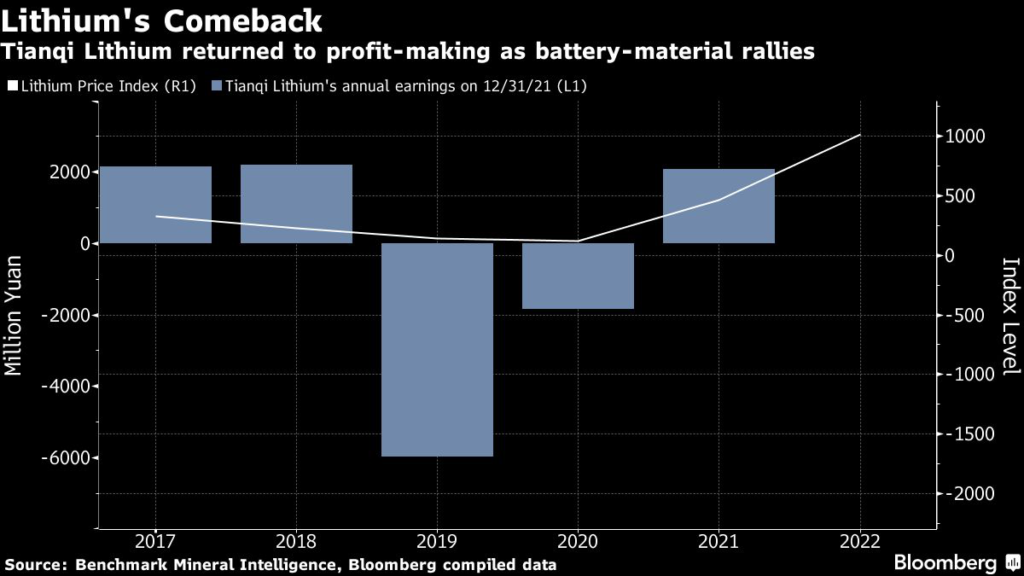
Tianqi’s Hong Kong listing, nevertheless, caps a major turnaround for the firm after a debt crisis just two years ago forced it to sell stakes in prize assets, and raised questions for management. The company’s revival was aided by an eye-popping gain of more than 1,000% for lithium prices since mid-2020.

Tianqi mines lithium in Australia and produces compounds and derivatives in China. The Chinese producer first brought up a secondary listing in 2018, but shelved the plan amid falling lithium prices and liquidity problems. In 2020, the Chinese company sold a stake in Australia’s Greenbushes, one of the world’s most coveted lithium mines, to Perth-based IGO Ltd. for $1.4 billion to help repay debt.

A fresh global push for electrified transport is fueling a demand boom for lithium — a key material used in EV batteries. According to BloombergNEF, lithium prices could stay elevated amid a tight market this year. 

Tianqi is planning to more than double its lithium refining capacity in the next three years to about 110,000 tons, from about 45,000 tons now, Chief Executive Officer Frank Ha said in an interview with Bloomberg Television on Wednesday. “The continued ramp-up of revenues and prices is something that we can foresee,” Ha said.

Tianqi’s Hong Kong share sale has attracted seven cornerstone investors including LG Chem Ltd. and battery maker CALB Co., the prospectus shows. In another sign of a brighter outlook for Tianqi, its lithium refinery in Australia’s Kwinana — a venture between the company and IGO — delivered its first batch of battery-grade lithium hydroxide in May.

Most companies that debuted in Hong Kong this year fell on their first day of trade, data compiled by Bloomberg show. Retailer Miniso Group Holding, wealth management company Noah Holdings Ltd. and piped natural gas distributor Huzhou Gas Co. fell 3%, 4.5% and 7.9%, respectively, on their first day of trade on Wednesday. 

Big offerings have dwindled this year amid rising inflation, hawkish central banks and a jump in volatility that has led the Hang Seng Index to retreat more than 11% this year.

Strong appetite for listings in the city has yet to return, according to Ke Yan, head of research at DZT Research. “Everyone is still working hard to find a deal to profit from,” he said.

Tianqi’s shares plunged in Shenzhen on Monday after the wife of one prominent investor raised concerns about the firm’s valuation ahead of the secondary listing. The shares on the mainland touched an all-time high last week. 

Morgan Stanley, China International Capital Corp. and CMB International Capital Ltd. are joint sponsors of the Hong Kong offering. 

(Updates with closing price and adds intraday chart)

More stories like this are available on bloomberg.com

©2022 Bloomberg L.P.

Buyer Beware: The Hunt For Zombie Crypto Tokens Goes On

  • Listen to Bloomberg Crypto on the iHeartRadio App
  • Listen to Bloomberg Crypto on Apple Podcasts
  • Listen to Bloomberg Crypto on Spotify 

(Bloomberg) — If you want an example of the cryptosphere’s unrelenting optimism, here’s one: Some investors are still buying the token known as Luna Classic, which has flatlined at near zero in the aftermath of the collapse of the TerraUSD stablecoin, to which it was linked. Why are some people so willing to buy zombie coins? Bloomberg  senior editor Mike Regan and Bloomberg reporter Misyrlena Egkolfopoulou drop in to this episode of Bloomberg Crypto to discuss the motivations of these risk-takers. 

Follow us on Twitter @crypto, and subscribe to the Bloomberg Crypto Newsletter at https://bloom.bg/cryptonewsletter


More stories like this are available on bloomberg.com

©2022 Bloomberg L.P.

An Abu Dhabi Fund Deploys Its Billions Defying Tech Decline

(Bloomberg) — An Abu Dhabi sovereign wealth fund is fast emerging as a white knight for tech firms seeking funds in a volatile market.

Mubadala Investment Co., the $284 billion state-owned fund, is defying a rout in technology valuations and becoming a go-to investor in a sector where fortunes have turned overnight. The investor backed raises this week for both Klarna Bank AB and Wefox.

Mubadala is committing its capital at a time its owner, the Abu Dhabi government, benefits from a surge in oil prices driven mainly by the war in Ukraine. The Gulf fund is stepping in to invest in technology-focused businesses just as other investors turn away from what they see as risky and potentially overpriced assets. 

“As a long-term investor, Mubadala continues to deploy capital opportunistically across a range of key sectors,” a spokesperson for the fund said.

It led the latest funding round for German insurance-technology firm Wefox, which raised $400 million at a valuation of $4.5 billion this month. The fund also came in as a new investor in the $800 million raise by Klarna, the buy-now-pay-later giant, that saw its valuation plunge to $6.7 billion from the $45.6 billion achieved last year. 

Mubadala’s first major foray into technology was when it emerged as one of the key backers to SoftBank Group Corp.’s $100 billion Vision Fund a few years back. Mubadala is now exploring whether to back Rajeev Misra, the main architect of the Vision Fund, as he seeks to start his own fund, the spokesperson said. 

More recently, Mubadala led an $768 million funding round for Turkish grocery delivery app Getir in March at a valuation of $11.8 billion. The fund also participated in a $300 million raise for payments business SpotOn, which valued the company at about $3.6 billion. It also led a $100 million round for Swedish fintech firm Juni last month. 

Mubadala is also splashing out in other areas, from health care to financial services. It’s in talks to acquire Fortress Investment Group from SoftBank in a potential deal valuing the asset manager at more than $1 billion, Bloomberg News reported this week. 

Buyout firm EQT AB and Mubadala agreed to buy Swedish medical freight company Envirotainer AB for an enterprise value of about 2.8 billion euros last month. Mubadala teamed up with another investment firm, Warburg Pincus, on a more than $2 billion deal for Informa Plc’s pharma analytics unit reached in February. 

(Updates with talks on Fortress deal in penultimate paragraph.)

More stories like this are available on bloomberg.com

©2022 Bloomberg L.P.

Italian Cruise Billionaire Mired in Feud Over Family Fortune

(Bloomberg) — A luxury cruise firm, a disputed family inheritance, and a Monaco-based tycoon fighting to protect his fortune.

It sounds like the summary of the latest must-watch streaming drama, but it’s in fact a clash that’s been playing out for real over more than two decades. It’s centered on two Italian brothers, billionaire Manfredi Lefebvre d’Ovidio and his history professor brother Francesco, over the ownership of the business their father founded.

Francesco, a university professor, claims he’s the rightful owner of 52% of a family holding company, according to court documents. That company owned Silversea Cruises, which under Manfredi’s watch became a leading brand in ultra-luxury cruises. Royal Caribbean Cruises Ltd. bought a majority stake in 2018, valuing it at $2 billion.

Read more: Royal Caribbean Bets on Luxury With Silversea Stake

After years of court hearings and rulings, the case may finally be moving toward its endgame. It’s due to go to an appeal trial in Bologna, which should mark the final decision under Italian law.

A decision in Francesco’s favor might not just threaten Manfredi’s fortune, but also an investment strategy that’s seen him pump money into multiple businesses.

Since the sale of Silversea, Manfredi took over travel group Abercrombie & Kent with its founder, backed firms including a software encryption company, and funded companies controlled by controversial German financier Lars Windhorst. Last month, A&K bought two ships in a sale resulting from the collapse of Crystal Cruises.

The brothers declined to comment for this story, as did Francesco’s legal team. Manfredi’s lawyers say the case is “groundless.”

Roman Brothers

The siblings grew up in Rome, but while Francesco, born in 1951, pursued an academic career to become a professor of international history, Manfredi, two year his junior, dropped out of university to work with their father Antonio, who died in 2011, at the growing family shipping businesses. 

The dispute between the brothers began more than 20 years ago when, according to claims made in court documents, Antonio decided to put the siblings’ holdings into a family trust. 

The brothers were in disagreement, but in 2001 they found a compromise: Francesco would get properties in Rome and receive a holding company controlling some shipping assets, while Manfredi would keep the cruise business — with a stake held by their sister Elvira. 

Seven years later, however, Francesco went to court against the rest of the family arguing that the delivery of the shares of the holding company didn’t go through as planned. Manfredi claims the deal was completed as agreed. 

Francesco has previously failed in his bid to seize Silversea assets in Greece and Germany, but the main effort has been through Italian courts. He’s claiming half of the Silversea shares, or damages equivalent to 52% of the value of the company, estimated at about 800 million euros ($803 million), according to court documents. 

French Family

The Lefebvres have a storied history, coming from a French family that settled in Naples at the time of the Napoleonic wars. Their ancestor Charles Lefebvre became one of the most notable entrepreneurs and bankers in Southern Italy, partnering up with the Rothschilds. He even joined the ranks of the local nobility before the unification of the country in 1860. 

The family fortunes dwindled in the years before the second world war until Antonio, a lawyer specializing in maritime law, set up a shipping company that helped European migrants to move to Australia. Gradually, the firm shifted away from the passenger sector to focus on the cruise industry, leading to the founding of Silversea in the 1990s.

The 2018 sale, and the transfer of the remaining stake to Royal Caribbean in 2020, turned Manfredi Lefebvre into a billionaire with a pile of cash ready for investment through the family holding, Heritage Group. 

Heritage Group

Heritage, chaired by Manfredi, took over UK travel agency Abercrombie & Kent, which specializes in luxury vacations such as $20,000 safari trips. It’s also participating in a new blank check company to buy renewable energy companies with a former Barclays Plc banker and Telecom Italia chief executive officer. 

Read more: Italian Billionaire-Backed Firm Buys Crystal Cruises Ships 

Some investments have run into trouble: Arqit Quantum Inc., the UK encryption company Heritage bought via a SPAC launched with Centricus Asset Management, fell more than 80% from its peak in November.

Heritage also sued Windhorst in a London court last year as the German financier failed to pay obligations on transactions linked to the shares of his companies, even after they had reached a settlement. Heritage still owns stakes in Windhorst-controlled firms, including lingerie brand La Perla Fashion Holding and medical technology company Avatera Medical GmbH, according to a portfolio listing on the firm’s website.

‘Totally Groundless’

The Italian part of the brothers’ legal battle has gone through several stages over the last decade, but it just entered its final chapter after the Supreme Court found issues with a decision in favor of Manfredi in 2018.

A preliminary hearing for the new trial was held on June 14 and adjourned to December.

Francesco’s lawyer in the Italian appeal trial, Salvatore Patti, declined to comment on the case. 

“The Court of Appeal will have to reject Francesco’s demands because Manfredi fully complied with the terms of the deal with his brother,” according to Manfredi’s Italian lawyers, Giovanni Frau, Elena Lucertini and Francesca Poiatti of law firm Frau Ruffino Verna. “The request to transfer shares and assets against legal entities, which aren’t part of the ongoing trial, and the request for damages are totally groundless.”

Meanwhile, Francesco also sued Royal Caribbean in Miami in May as he seeks to get back the Silversea shares. In the filing, he accuses the cruise company of “unjust enrichment, conversion, and aiding and abetting conversion.” He claims the 2018 sale, agreed shortly after the Supreme Court ruling, hindered his ability to recover Silversea’s stock and assets.

In June, Royal Caribbean asked the judge to dismiss the case, claiming the suit is “an attempt to circumvent the Italian legal system.” The company didn’t respond to a request for comment.

(Updates with details of investments in Windhorst businesses)

More stories like this are available on bloomberg.com

©2022 Bloomberg L.P.

Stocks, Futures Mixed Before Key US Inflation Data: Markets Wrap

(Bloomberg) — American equity futures edged higher Wednesday while stocks in Europe dipped in cautious trading dominated by a dimming economic outlook and an anxious wait for data that may show US inflation at a fresh four-decade high.

S&P 500 and Nasdaq 100 futures posted modest gains after yet another volatile day that ended with both gauges solidly in the red on Monday. The Stoxx Europe 600 index dropped about 0.6%, with declines for carmakers and insurers offsetting gains for retailers. MSCI Inc.’s Asia-Pacific share gauge added less than 0.5%, bolstered by a rebound in Chinese technology shares. 

Treasuries were steady and a key part of the yield curve remains inverted, a potential signal of recession ahead. The 10-year yield at one point Tuesday was 12.4 basis points below the 2-year rate, a level unseen since 2007. Most European bonds gained.

Brent crude oil stabilized at about $100 a barrel after a tumble. The dollar hovered near the highest levels since March 2020. The euro remained in sight of parity with the greenback. The British pound gained after Bank of England Governor Andrew Bailey said policy makers are prepared to move borrowing costs higher in bigger steps to control inflation. Bitcoin hovered above $19,000.

Rapidly tightening monetary policy in the US and elsewhere to fight price pressures is fueling worries about growth and leaving markets nervous. South Korea and New Zealand became the latest to hike interest rates further.

Economists project US inflation likely hit a pandemic peak in June that will keep the Federal Reserve geared for another big rate increase. The consumer-price index probably rose 8.8% from a year earlier, the largest jump since 1981, according to a Bloomberg survey ahead of the release Wednesday.

“This is widely expected to be a really strong print,” Lauren Goodwin, economist and portfolio strategist at New York Life Investments, said on Bloomberg Television. “Even if it is not, I don’t think that changes the Fed’s perspective in a couple of weeks. We won’t have enough evidence that inflation is convincingly turning over.”

The International Monetary Fund cut its growth projections for the US economy and warned that a broad-based surge in inflation poses “systemic risks” to both the country and the global economy.

Traders are also on tenterhooks for the latest corporate earnings getting underway this week and monitoring for a brewing energy crisis in Europe if Russia cuts off gas supplies in the fallout from its invasion of Ukraine. 

What to watch this week:

  • Earnings due from JPMorgan, Morgan Stanley, Citigroup, Wells Fargo
  • US CPI data, Wednesday
  • Federal Reserve Beige Book, Wednesday
  • US PPI, jobless claims, Thursday
  • China GDP, Friday
  • US business inventories, industrial production, University of Michigan consumer sentiment, Empire manufacturing, retail sales, Friday
  • G-20 finance ministers, central bankers meet in Bali, from Friday
  • Atlanta Fed President Raphael Bostic speaks, Friday

Will the eurozone avoid a recession or a debt crisis? How will the euro and stocks perform in the next six months? Share your views and participate in the latest MLIV Pulse survey. It only takes a minute, so please click here anonymously.

Some of the main moves in markets:

Stocks

  • The Stoxx Europe 600 fell 0.6% as of 8:20 a.m. London time
  • Futures on the S&P 500 rose 0.1%
  • Futures on the Nasdaq 100 rose 0.3%
  • Futures on the Dow Jones Industrial Average were little changed
  • The MSCI Asia Pacific Index rose 0.3%
  • The MSCI Emerging Markets Index rose 0.5%

Currencies

  • The Bloomberg Dollar Spot Index was little changed
  • The euro fell 0.1% to $1.0026
  • The Japanese yen fell 0.2% to 137.14 per dollar
  • The offshore yuan rose 0.1% to 6.7259 per dollar
  • The British pound rose 0.2% to $1.1916

Bonds

  • The yield on 10-year Treasuries was little changed at 2.96%
  • Germany’s 10-year yield advanced two basis points to 1.15%
  • Britain’s 10-year yield advanced four basis points to 2.12%

Commodities

  • Brent crude rose 1.2% to $100.68 a barrel
  • Spot gold was little changed

More stories like this are available on bloomberg.com

©2022 Bloomberg L.P.
Japanese Software Maker Promises Workers Inflation Relief Pay

(Bloomberg) — Cybozu Inc., a Japanese provider of enterprise software, will pay out a special allowance to employees around the world to help them deal with sustained inflation.

Rapid price rises in countries where Cybozu operates, including Japan, the US and Australia, have been severe enough to make annual salary increases insufficient, the company said on Wednesday. Employees will receive a special lump sum payment, which will be anywhere from about $440 to $1,100 in Japan and adjusted for locality elsewhere.

Inflation pressure has manifested even in Japan, a nation famous for its stubbornly anemic growth rate. The unusual measure from Cybozu comes in the wake of major retailers increasing their prices in the country, accounting for a weaker yen as well as higher costs of production and shipping. Apple Inc. recently hiked local iPhone prices by as much as 25% and Calbee Inc., Japan’s answer to Frito-Lay, plans major price bumps in September.

Read more: Japan’s Economic Recovery Seen Weaker With Sticky Inflation

Cybozu has close to 1,000 employees worldwide and develops a collaborative business platform known as Cybozu Office. The company had sales of 18.5 billion yen ($135 million) in the prior fiscal year, according to its filings.

More stories like this are available on bloomberg.com

©2022 Bloomberg L.P.
Close Bitnami banner
Bitnami