
Bloomberg

Kishida’s Win Creates Space to Pursue ‘New Capitalism’ for Japan

(Bloomberg) — Japanese Prime Minister Fumio Kishida’s strong election victory presents him with a three-year time frame to pursue his own agenda of making capitalism fairer and greener, with no need to quickly change course on economic policy including central bank stimulus.

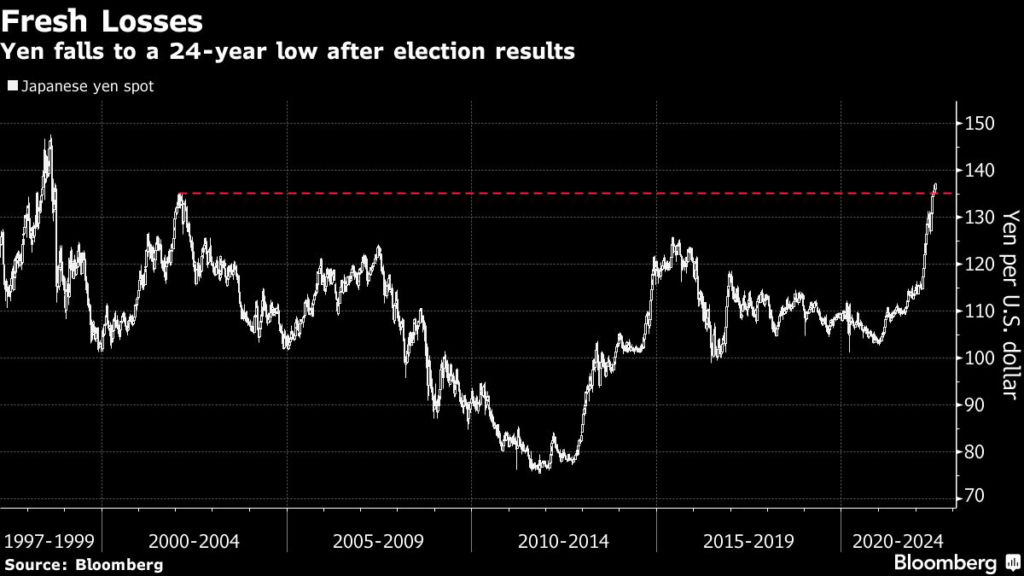
That view was largely backed up by market moves on Monday, with the yen falling to a fresh 24-year low against the dollar as investors appeared to conclude that the easing stance of Bank of Japan Governor Haruhiko Kuroda is set to continue for now.

The next key gauge of whether Kishida intends to move away from policy settings largely based on those of murdered former Prime Minister Shinzo Abe will come when the premier unveils a new aid package to relieve the pain of soaring food and energy prices. That could come as soon as next month.

Legacy of Abenomics to Live Beyond Its Tragically Shot Architect

“The election outcome reflects public support for Prime Minister Fumio Kishida, and makes it clear that rising inflation in Japan isn’t as critical for the public as overseas,” said Juntaro Morimoto, analyst at Sony Financial Group Inc. “It may make it easier for him to maintain current easy monetary policy during Kuroda’s term, a view that lends to yen selling on receding expectations for a policy tweak.”

The scale of the aid measures will indicate how committed Kishida is to sticking with Abenomics or forging his own path. For now economists and strategists expect that any changes would come at a slow pace, with Kuroda seeing out his term with the current monetary policy framework largely in place and no rush on deciding his replacement. 

A smaller, targeted spending package will revive the impression that Kishida is more cautious on spending than Abe and former premier Yoshihide Suga. Another big package will show Kishida is likely intending to follow closely in the footsteps of Abenomics. 

“I don’t expect a big spending round to deal with the current inflation even though some ruling party members are calling for it. Kishida will probably stick with his approach of putting a band-aid where inflation hits hard,” said Atsushi Takeda, chief economist at Itochu Research Institute. “Kishida is likely to gradually shift toward restoring fiscal health with the election victory to reflect his own views.”  

An announcement may come as Kishida reshuffles his cabinet, according to analysts.

The government’s existing price relief measures already include fuel subsidies that are reducing gasoline prices by around 20%. Through these steps, the government has essentially enabled the BOJ to continue with rock-bottom interest rate settings that are contributing to yen weakness by easing some of the pain it causes.

The yen was at 136.95 against the dollar at lunchtime in Tokyo having reached 137.28 earlier in the day. It has sunk over 16% against the greenback this year.

Any changes for monetary policy would likely come after the government has had time to see the new package implemented and digest developments in markets, economists said. While political pressure for change has eased for now, market pressure could resume, with another two large interest rate hikes expected from the Federal Reserve this quarter.

The Big Japan Short Is Back for Hedge Funds Betting Against BOJ

It’s risky to change monetary policy when the economy has yet to recover to its pre-pandemic levels and global economies are facing the growing risks of a recession, according to Goldman Sachs Japan’s chief economist Naohiko Baba and his colleague Yuriko Tanaka.

Kishida has called for a fairer distribution of incomes as a way of making economic growth more sustainable, but his call for higher wage hikes has yet to trigger a major shift in pay gains. His vision of “New Capitalism” still requires fleshing out in more detail but will include more measures to help the economy become greener and reach its emissions goals.

BOJ’s Rock-Bottom Rates Are Crucial for Kishida’s Spending Plans

Investors are more closely watching to see if the premier intends to change the shape of monetary policy. Kishida will pick a new BOJ governor and two deputies when their tenures end in less than a year. 

Like Abe orchestrated a policy accord in 2013 with former BOJ governor Masaaki Shirakawa, Kishida may first overhaul a joint policy statement with the central bank before Kuroda leaves office in April, said Hideo Kumano, executive economist at Dai-Ichi Life Research Institute. 

“I’m not sure if they will change the 2% inflation target, but Kishida can show his own clout by giving more flexibility on the target rather than absolutely defending it,” Kumano said. “If that happens, you can then say Abenomics has switched to Kishidanomics.”

More stories like this are available on bloomberg.com

©2022 Bloomberg L.P.
ByteDance-Backer Snags $3.2 Billion as China Startup Hopes Grow

(Bloomberg) — Qiming Venture Partners raised $3.2 billion across two new funds, joining Sequoia China and IDG in securing fresh capital as investors grow more sanguine about the country’s startup arena.

Qiming, known for early bets on tech giants from ByteDance Ltd. to Meituan and Xiaomi Corp., becomes at least the third venture house in recent weeks to home in on significant new capital. The firm closed its oversubscribed USD Fund VIII at $2.5 billion and also raised roughly $700 million in the first closing of a yuan-denominated fund, both aimed at the technology, consumer and health-care sectors. Qiming now manages $9.4 billion across 18 funds, it said in a statement on Monday.

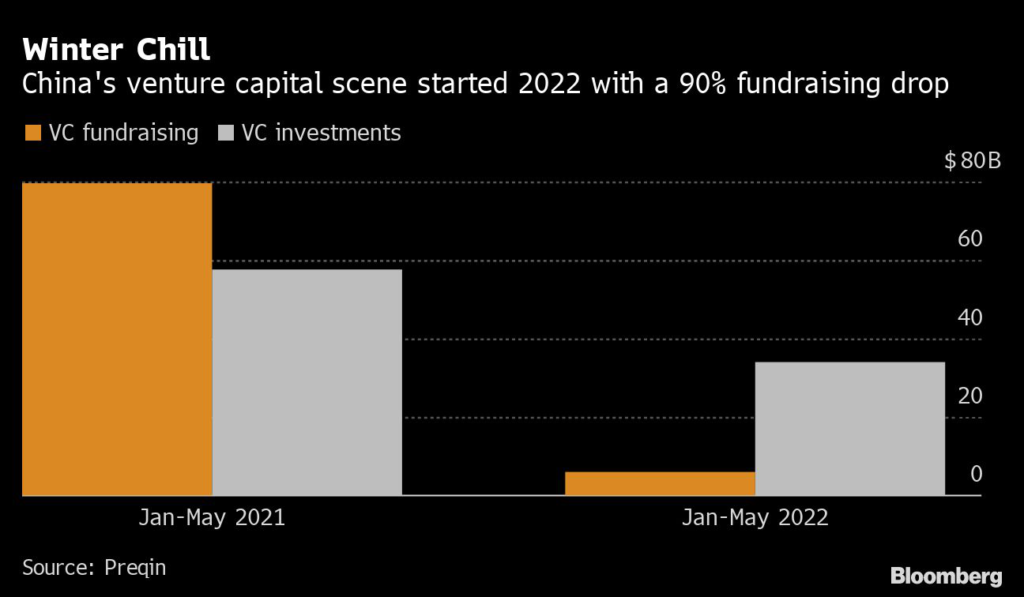
Venture funding in China plummeted at the start of this year as the government’s far-reaching crackdown on consumer internet, gaming and fintech hit valuations across public and private markets. VC and private equity funds raised only $6.2 billion in the first five months of 2022, a 90% drop from the previous year, while startup investments slowed 40% to $34 billion, according to data from research firm Preqin.

Read more: Top Tech Dealmaker Warns China’s VC Winter Is Far From Over

Read more: China Tech Investor Defies Skeptics With $900 Million Fundraise

Investors remain cautious about regulatory uncertainty but recent weeks have shown signs of improving sentiment, as Sequoia China secured about $9 billion for investments in tech and consumer firms. IDG Capital is poised to raise about $900 million for a new China-focused fund backed mostly by existing investors. Early-stage investor BlueRun Ventures China also reached the final close of a second dual-currency fund of more than 5.5 billion yuan ($817 million) in May, according to a company statement.

Founded in 2006, Qiming has backed over 480 companies. The company has made over 180 exits, it said in the statement. Managing Partners Duane Kuang, Nisa Leung, William Hu and Gary Rieschel will lead Fund VIII, the firm said.

Read more: Sequoia China Raises $9 Billion as Investors Flock to Big Funds

More stories like this are available on bloomberg.com

©2022 Bloomberg L.P.
China Tech Stocks Sink as Alibaba, Tencent Suffer Fresh Fines

(Bloomberg) — Chinese tech stocks fell sharply Monday, weighed by a selloff in Alibaba Group Holding Ltd. and Tencent Holdings Ltd. after the two firms received a regulatory fine on past transactions. 

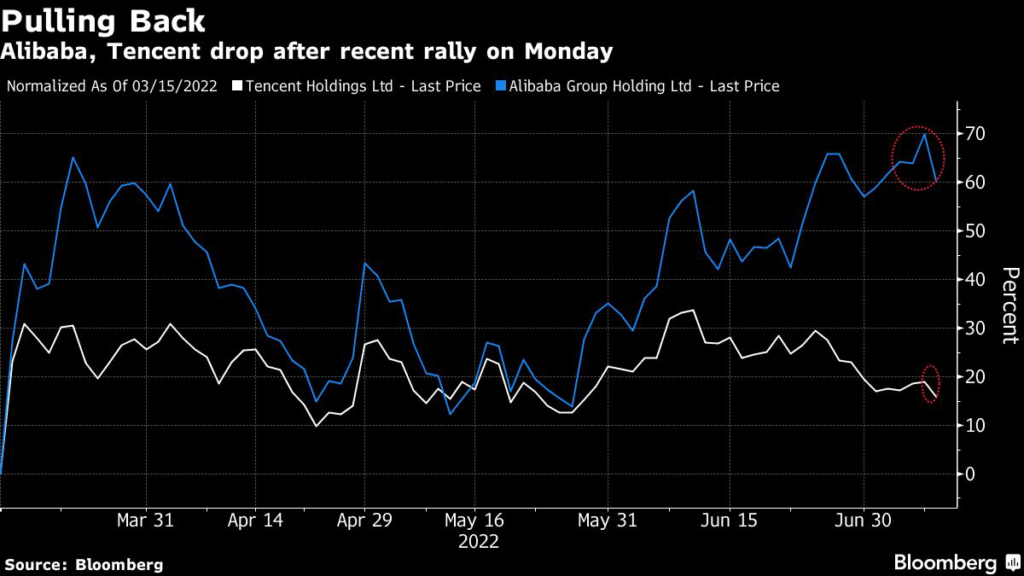
The Hang Seng Tech Index dropped as much as 3.7%, with Alibaba among the top losers after plunging 6%. Tencent fell a maximum of 3.2%. 

The losses came after China’s State Administration for Market Regulation fined the two tech giants for not properly reporting past deals, indicating how fragile investor mood remains toward the sector despite signs of easing regulatory headwinds. The declines also formed part of the broader weakness in Chinese shares as a fresh Covid outbreak in Shanghai renewed concerns about more lockdowns. 

“The latest selloff is triggered by the news of fresh fines on anti-monopolistic practices in the sector,” said Justin Tang, head of Asian research at United First Partners. “The world is not out of the woods yet and we will continue to see volatile movement in stocks as a general rule of thumb.”

The latest penalties on Alibaba and Tencent followed fines imposed on a live-streamer for tax evasion in February, while both Alibaba and Tencent were penalized for violations of antitrust rules in November.

Before Monday, Alibaba and Tencent shares had rallied 70% and more than 18% from their mid-March lows in Hong Kong, respectively.

More stories like this are available on bloomberg.com

©2022 Bloomberg L.P.
Musk’s About-Face on Twitter Shifts Takeover Saga to Delaware

(Bloomberg) — Now that Elon Musk has decided that he doesn’t want to buy Twitter Inc. after all, he can’t just walk away from the $44 billion contract. The billionaire co-founder of Tesla Inc. will need to make his case before a judge in Delaware that Twitter failed to uphold its side of a merger deal reached in April. If history is a guide, his job won’t be easy.

Twitter Chairman Bret Taylor vowed Friday that the social media platform will fight in the Delaware Court of Chancery to compel Musk to follow through on his agreement, and the company has lawyered up in a race to sue. A filing could come as soon as early this week, people familiar with the matter told Bloomberg.

If the judge rules against Musk, he could be forced to pay Twitter shareholders $54.20 a share, as he said he would in the accord announced April 25. A ruling in his favor would let Musk walk, though he’d probably have to pay a break-up fee, initially set at $1 billion. There’s also the prospect that both sides reach a settlement whereby Musk still makes the acquisition, potentially at a lower price.

The judge in this case will zero in closely on the densely worded intricacies of the 73-page purchase agreement, and the court has rarely sided with parties who, like Musk, are attempting to bail on acquisition commitments.

Musk’s rationale centers on automated user accounts known as bots and how Twitter accounts for them. He alleges that the social media platform is teeming with spam bots, disputing Twitter’s contention that they make up less than 5% of total users. Musk said in his Friday filing with the US Securities and Exchange Commission that Twitter’s failure to properly hand over specifics on the number of bots amounts to what’s known as a “company material adverse effect [MAE]” A judge must decide whether such an event has occurred and whether it justifies Musk’s cancellation.

Larry Hamermesh, a University of Pennsylvania law professor who specializes in Delaware corporate law disputes, describes an MAE as an “unexpected, fundamental, permanent” negative development — akin to blowing a hole in the transaction that can’t be fixed.

So far, Delaware courts have found only one case in which a clear MAE emerged — Fresenius SE’s $4.3 billion buyout bid in 2018 for rival drugmaker Akorn Inc. A judge blessed Fresenius’ decision to walk away from the deal after finding Akorn executives hid an array of problems that cast doubt on the validity of data backing up approval for some drugs and profitability of its operations.

Forcing Musk’s Hand

The agreement also gives Twitter officials so-called specific-performance rights, which means that if the judge finds Musk’s complaints about the bots data don’t rise to the level of an MAE, the platform can demand that the judge force Musk to consummate the buyout.

Musk’s decision to sign the deal without doing due diligence could work against him, said Robert Profusek, head of the mergers and acquisitions department at law firm Jones Day. “His lawyers’ argument that you don’t do diligence and test things out later simply isn’t the way things work in big ticket M&A and, if accepted, would put shareholders at risk,” he said in an interview.

Delaware chancery court judges are known for their expertise in interpreting what may look and sound to the layperson as a maze of legal jargon that seeks to delineate both sides’ rights and responsibilities in a merger and acquisition accord.

In the Twitter deal, the platform’s executives are obligated to promptly furnish Musk with “all information concerning the business, properties and personnel of the company and its subsidiaries as may reasonably be requested.” Musk contends management hasn’t met those duties in connection with the details of spam and bot accounts.

Twitter said it has handed over extensive data on its user base. Executives told media Thursday that the company manually reviews thousands of accounts each quarter to determine the 5% spam bot tally, and estimates that the actual number is well below the threshold disclosed in filings. The company uses internal data, such as examining phone numbers or Internet Protocol addresses, the unique set of characters associated with a computer or other device, to help determine whether an account is run by a human.

The agreement also defines a “company material adverse effect,” as “any change, event, effect or circumstance which, individually or in the aggregate, has resulted in or would reasonably be expected to result in a material adverse effect on the business, financial condition or results of operations of the company and its subsidiaries.”

A probable outcome is that the parties reach an out-of-court settlement. Musk’s effort to pull the plug on the deal is probably nothing more than a negotiating ploy, said Charles Elson, a retired University of Delaware professor and former head of the school’s Weinberg Center for Corporate Governance.

“This is not a material adverse change,” Elson said. “That’s just a negotiating position. He knows the Delaware courts are extremely reluctant to find something like that in these deals.”

To press its case, Twitter has hired merger law heavyweight Wachtell, Lipton, Rosen & Katz, according to people familiar with the matter. The social media company aims to file suit early this week, said the people, who declined to be identified because the matter is private. By hiring Wachtell, it gains access to lawyers including Bill Savitt and Leo Strine, who served as Chancellor of the Delaware Chancery Court.

Musk has brought in Quinn Emanuel Urquhart & Sullivan LLP. The firm led his successful defense against a defamation claim in 2019 and is representing him as part of an ongoing shareholder lawsuit over his failed attempt to take Tesla private in 2018.

Twitter Morale Sinks

Whatever the outcome of legal wrangling, the mood among many employees of San Francisco-based Twitter is dour, people at or close to the company have told Bloomberg. Amid the uncertainty surrounding a possible sale, several employees have lamented what they consider a lack of leadership and vision-setting from the top, including Chief Executive Officer Parag Agrawal, said the people, who requested anonymity discussing internal matters. 

For many Twitter staffers, neither of the likely outcomes is palatable. If Twitter prevails in court, the company will be run by an unpredictable and reluctant owner, while still struggling to meet ambitious growth targets. And should Musk succeed in ending the deal, Twitter stock will likely plummet, and a staff already dejected by Musk’s months-long public criticism of the site will suffer another emotional blow.

Several people have left or are planning to leave because they simply don’t want to work for Musk, the people said. For some, the decision to depart was cemented after a June question-and-answer session during which Musk, who showed up late, told employees that only those who were “exceptional” would be allowed to continue working from home. 

More stories like this are available on bloomberg.com

©2022 Bloomberg L.P.
Rogers CEO Faces Grilling as Network Woes Cast Shadow Over Deal

(Bloomberg) — Rogers Communications Inc.’s chief executive officer will face Canada’s industry minister to account for a nationwide network failure that left millions of households and businesses without wireless and internet service. 

Industry Minister Francois-Philippe Champagne’s office said he will meet Rogers CEO Tony Staffieri on Monday, along with executives from other major telecom companies, “to discuss how important it is to improve the reliability of the networks across Canada.”

Champagne’s department has the final call on whether to approve Rogers’ proposed C$20-billion ($15.4 billion) acquisition of Shaw Communications Inc., a major internet and wireless provider based in Canada’s west. The country’s antitrust body, known as the Competition Bureau, has opposed the deal and Friday’s outage could provide the regulator with more ammunition in its battle to stop the merger.

Champagne said the network failure was “unacceptable.” It started Friday morning, stretched into Saturday and affected access to emergency services for some customers as well as bank payment systems including Interac. It even caused postponements of events like The Weeknd’s scheduled concert in Toronto. 

“These services are vitally important for Canadians in their day-to-day life and we expect our telecom industry to meet the highest standards that Canadians rightly deserve,” Champagne said in an emailed statement from his office. 

“If I was working for the Competition Bureau, I would be thinking about ways to quantify the harm that results from an outage like this,” said Benjamin Klass, who researches Canadian telecom policy at Ottawa’s Carleton University and has presented arguments objecting to the deal at hearings.

Klass said Rogers can use a so-called “efficiencies defense” in Canadian merger law to argue that its takeover of Shaw creates a more efficient system with economic benefits for the country, and therefore should be approved. 

Still, Friday’s network collapse demonstrates that there are problems with “over-reliance on these large firms,” Klass said. “In this particular case, more smaller providers would have contained the impact of something like this.”

Staffieri apologized in a Saturday statement and said the Toronto-based company would compensate customers with a credit, but didn’t quantify the extent of the financial impact on the company.

He also offered an explanation on what happened, blaming the issue on a maintenance update that caused its routers to fail within its core network. The disruption was so wide-ranging that even Canada’s telecom regulator lost phone service on Friday. 

More stories like this are available on bloomberg.com

©2022 Bloomberg L.P.

Klarna May Get Backing From Canada Pension Fund, Sky Reports

(Bloomberg) — The Swedish buy-now, pay-later giant Klarna Bank AB has secured funding from investors that could include the Canada Pension Plan Investment Board, Sky News said.

Klarna is close to announcing a $800 million funding round at a valuation of less than $6 billion, according to the report. It’s been in talks with CPPIB, the largest Canadian pension fund, as well as the Abu Dhabi state investment fund Mubadala, Sky said.

The reported valuation marks a sharp drop from the $15 billion that was under negotiation last month and a fraction of the $45.6 billion Klarna commanded last summer that made it Europe’s most valuable startup. Bloomberg News reported earlier this month on the talks with investors.

Existing shareholders Sequoia Capital and Silver Lake are planning to participate in the latest fundraising round, Sky reported. A Klarna spokeswoman declined to comment to the news outlet.

More stories like this are available on bloomberg.com

©2022 Bloomberg L.P.
Twitter Assembles Legal Team to Sue Musk Over Dropped Takeover

(Bloomberg) — Twitter Inc. has hired merger law heavyweight Wachtell, Lipton, Rosen & Katz as it races to sue Elon Musk for moving to dump his $44 billion takeover of the company, according to people familiar with the matter.

The social media company aims to file suit early this week, according to the people, who declined to be identified because the matter is private. By hiring Wachtell, it gains access to lawyers including Bill Savitt and Leo Strine, who served as Chancellor of the Delaware Chancery Court, where the case will be heard.

Musk has brought in Quinn Emanuel Urquhart & Sullivan LLP. The firm led his successful defense against a defamation claim in 2019 and is representing him as part of an ongoing shareholder lawsuit over his failed attempt to take Tesla Inc. private in 2018.

An official for Wachtell Lipton declined to comment, and officials for Quinn Emanuel couldn’t be reached. A Twitter spokesperson declined to comment. Musk and Jared Birchall, the head of his family office, did not respond to a request for comment. 

Delaware is the corporate home to more than half of US public companies, including Twitter, and more than 60% of Fortune 500 firms. There, chancery judges — business law experts — hear cases without juries and can’t award punitive damages. Based on previous merger fights, efforts to terminate a deal can play out within a few months, often ending with settlements to avoid further wrangling.

Top Names

Savitt, a Wachtell partner, is at the top of select group of A-list chancery court litigators. Companies such as health-insurer Anthem Inc., real-estate giant Sotheby’s and financial titan KKR & Co. have lined up outside his door when deals turn sour or buyouts get challenged in Delaware.

Strine, who spent over 20 years working in the Delaware courts, most recently as Chief Justice of that state’s Supreme Court, helped shape the legal norms that Musk will seek to test by terminating his agreement to acquire Twitter. Strine joined Wachtell in 2020.  

Before becoming the Chief Justice, he served on the Delaware Court of Chancery as Chancellor from 2011, and as a Vice Chancellor from 1998.

Delaware Chancery Court typically frowns on efforts to back out of merger agreements. It’s possible that one of Strine’s most influential decisions will determine how Musk makes his case for ditching his Twitter takeover.

In 2000, Tyson Foods Inc. agreed to acquire rival IPB Corp. Soon after agreeing to the deal, the meat market suffered a precipitous downturn, impacting both companies financially. Tyson argued it had been given misleading information about IBP’s business and was thus no longer obliged to complete the $3.2 billion merger.

In court, Strine disagreed that there had been a Material Adverse Change and ruled that Tyson must follow through with the deal. The ruling became a landmark and the Tyson-IBP case is still the basis for the way courts and corporations interpret the ability of a buyer to terminate a merger agreement.

The judges also have a say over whether breakup fees must be paid. In the Musk-Twitter deal, that fee is $1 billion.

In a regulatory filing after the official market closed Friday, Musk announced plans to walk away from his $54.20-a-share offer to buy Twitter, alleging that the company misrepresented user data. Twitter Chairman Bret Taylor responded by vowing to enforce the deal in what promises to be an arduous court brawl.

Twitter shares closed 5.1% lower at $36.81 in official trading, and dropped another 4.8% to about $35 in post-market activity.

More stories like this are available on bloomberg.com

©2022 Bloomberg L.P.
Uber Lobbied Politicians, Broke Laws in Global Push, Reports Say

(Bloomberg) — Uber Technologies Inc. attempted to lobby politicians and flouted laws as part of efforts to expand globally from 2013 to 2017, according to newspaper reports based on leaked documents.

The company allegedly received assistance in its efforts from politicians including French President Emmanuel Macron, reports from outlets including the Guardian and Le Monde said. The so-called “Uber Files” — based on more than 124,000 documents shared with the non-profit International Consortium of Investigative Journalists — cover a period of time when co-founder Travis Kalanick was chief executive officer and detail the lengths to which the company sought to expand into key cities like Paris.

In a statement released shortly after the reports were published, Uber didn’t deny any of the allegations and instead focused on the changes that have been made since Dara Khosrowshahi was named CEO in 2017.   

“There has been no shortage of reporting on Uber’s mistakes prior to 2017,” the San Francisco-based company said in a statement. “Thousands of stories have been published, multiple books have been written—there’s even been a TV series.”

Uber said that Khosrowshahi has transformed the company, making safety a top priority. 

“When we say Uber is a different company today, we mean it literally: 90% of current Uber employees joined after Dara became CEO,” according to the statement.  

Uber’s aggressive tactics as it took on the taxi industry have been reported on for years. Bloomberg News reported in 2018 that the company had deployed a remote system to prevent police from obtaining internal data during raids.    

Uber Used Secret Tool for Keeping the Authorities in the Dark 

Macron’s Role

French newspaper Le Monde reported on text messages between Kalanick and Macron while he was finance minister. There were a total of four meetings between the two and a secret “deal” was put in place between Uber executives and French politicians, it said. Macron’s office didn’t immediately respond to a request for comment Sunday. 

According to the documents, Uber withdrew its person-to-person UberPop service in France in 2015 and a few months later, a law making it difficult to become a licensed Uber driver was modified in favor of the ride-hailing company, infuriating taxi drivers.

During anti-Uber protests in Paris and other European cities in 2016, Kalanick had dismissed internal concerns about potential violence against Uber drivers, according to the leaked documents. The company instead sought to use the violent attacks against its drivers at the time to win public sympathy, the reports said.

A spokesperson for Kalanick disputed the allegations in a detailed statement to the Washington Post, one of several news organizations that wrote about the documents.

“Mr. Kalanick never suggested that Uber should take advantage of violence at the expense of driver safety,” according to the statement. “Any accusation that Mr. Kalanick directed, engaged in, or was involved in any of these activities is completely false.” 

More stories like this are available on bloomberg.com

©2022 Bloomberg L.P.
‘Thor’ Tops Box Office, Improving Disney’s Uneven 2022 Record

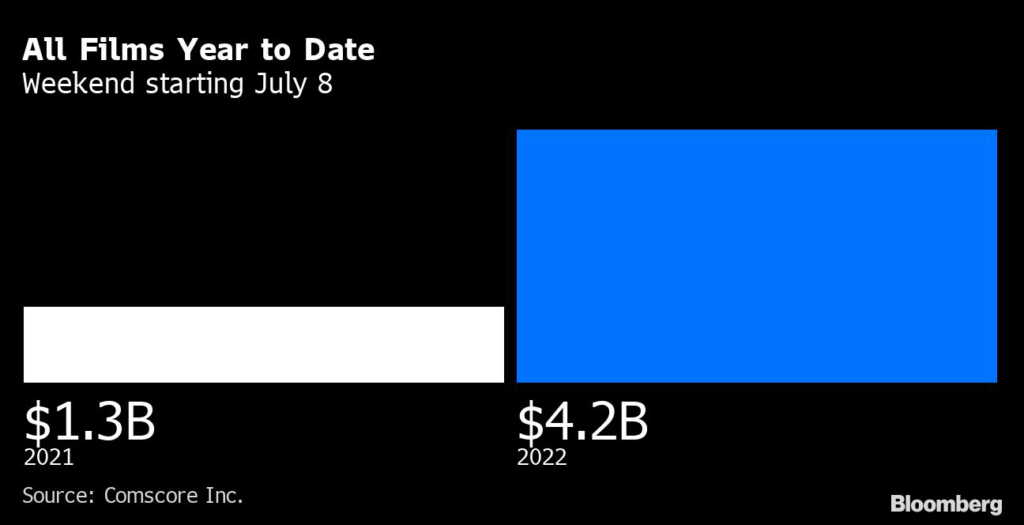
(Bloomberg) — “Thor: Love and Thunder,” the second major Marvel movie to debut in 2022, topped the domestic box office in its first weekend in theaters, bolstering Walt Disney Co.’s return to the big screen two years into the Covid-19 pandemic.

  • “Love and Thunder” generated $143 million in ticket sales over the weekend, researcher Comscore Inc. estimated Sunday. That’s Disney’s second-best domestic debut this year and in line with the $135 million to $165 million researcher Boxoffice Pro had forecast. The studio also projected ticket sales within that range.
  • The movie helped Disney shake off the poor performance of its last theatrical debut, Pixar’s “Lightyear,” which slid to seventh place over the weekend.

Key Insights

  • “Love and Thunder” tells the story of the comic-book character, a superhero based off the Norse mythology. It’s the fourth film in a series that began with “Thor” in 2011. Chris Hemsworth returns as the title role, while the movie also stars Tessa Thompson, Natalie Portman and Christian Bale.
  • The movie was a middle-of-the-road debut for a Marvel project. It had a smaller domestic opening than “Doctor Strange in the Multiverse of Madness,” which took in $187 million in May. But it did better than the last film focused on the character, “Thor: Ragnarok,” which opened to $123 million in November 2017. “Love and Thunder” has a 68% approval rating from critics on Rotten Tomatoes, on a par with “Ragnarok.”
  • Disney has had a patchy return to theaters, after sending many of its new movies straight to its Disney+ streaming service during the pandemic. Last month its animated film “Lightyear,” opened in second place with $51 million in ticket sales, a far weaker debut than analysts expected.
  • “Minions: Rise of Gru,” which broke a Fourth of July record in its opening last weekend, fell to second place. It made $45.6 million, Comscore estimated. The movie has become popular on TikTok, helping drive ticket sales.

Get More

  • Read how “Minions” became a TikTok star.
  • See the schedule for upcoming releases.
  • See Boxoffice Pro’s long-range forecast.

More stories like this are available on bloomberg.com

©2022 Bloomberg L.P.

China Watchdog Fined Alibaba, Tencent Over Reporting Past Deals

(Bloomberg) — China’s antitrust watchdog fined companies including Alibaba Group Holding Ltd. and Tencent Holdings Ltd. for not properly reporting past transactions, according to a statement Sunday from the State Administration for Market Regulation. 

Tencent was fined a combined 6 million yuan ($896,245) over 12 acquisitions, while Alibaba’s subsidiaries were fined 2.5 million yuan for not reporting five deals, the statement showed. SAMR issued penalties related to 28 deals in total.

The regulator said it was accelerating the disposal of existing anti-monopoly cases and will fully support the involved companies’ development. 

More stories like this are available on bloomberg.com

©2022 Bloomberg L.P.

Close Bitnami banner
Bitnami
