Bloomberg

UK Tech Firm Says It Lost Factory After Chinese Firm’s Buyout

(Bloomberg) — Rockley Photonics has been forced to find an alternative manufacturer for its products after a subsidiary of China’s Wingtech Technology Co. took over the British factory it had been using.

The UK-based company planned to keep making its components for sensors, which it aims to sell to the healthcare market, at Nexperia NV’s Newport Wafer Fab, Rockley Chief Executive Officer Andrew Rickman told British lawmakers on Tuesday. That relationship was shuttered after Nexperia bought the plant, he said.

“The current owner, for business reasons known to themselves, don’t want us to manufacture there,” Rickman told the Business, Energy and Industrial Strategy Committee. “It is frustrating. We will ramp up not only the alternative foundry that we have in the US, but we’ll find a replacement for Newport Wafer Fab in due course.” 

The Newport takeover was completed a year ago but is the subject of a probe under the UK’s new National Security and Investment Act, which could lead to ministers challenging the deal retrospectively.

China has been aggressively trying to acquire foreign semiconductor technologies to aid the development of a chip industry at home and reduce its reliance on imports. While Newport is not a major player in the global chipmaking space, it has received funding to make silicon carbide-based chips, also called “third-generation” chips that China is racing to develop.

“As discussed with Rockley prior to acquiring Newport Wafer Fab, Nexperia had to focus on meeting commitments to its customers to ensure that, amongst others, the automotive industry could continue manufacturing,” a spokesman for Nexperia said in a statement.

More stories like this are available on bloomberg.com

©2022 Bloomberg L.P.

Morgan Stanley Hires Deutsche Bank’s Buennemeyer for German Tech

(Bloomberg) — Morgan Stanley has hired Tammo Buennemeyer from Deutsche Bank AG to help expand coverage of Germany’s growing technology scene.

The 45-year-old managing director started his new role in Frankfurt with the European tech team in July, according to a spokesperson for the US bank. Before joining Morgan Stanley, Buennemeyer worked at Deutsche Bank for almost two years after stints at Greenhill & Co. and JPMorgan Chase & Co.

Buennemeyer last year worked on deals including the $4.3 billion take-private of German online pet-food retailer Zooplus AG; the listing of e-commerce company About You Holding AG in Frankfurt; and the launch of tech-focused investment firm Lakestar SPAC I SE and its acquisition of online travel company HomeToGo SE.

In his new role, he’ll focus on software, Internet and fintech companies, including bringing Germany’s growing number of startup unicorns to the market and further consolidation.

Morgan Stanley earlier this year made several promotions to its technology banking and tech mergers and acquisitions business, one of its most important groups. Enrique Perez-Hernandez, a London-based banker, became a head of global tech banking, and Patrick Standaert was put in charge of the European tech business.

More stories like this are available on bloomberg.com

©2022 Bloomberg L.P.

Traders Looking to Get Ahead of Fed Again Now Foresee Rate Cuts

(Bloomberg) — Signs of a rapidly deteriorating US economic outlook have spurred bond traders to pencil in a complete policy turnaround by the Federal Reserve in the coming year, with interest-rate cuts in the middle of 2023.

Fed Chair Jerome Powell — who is widely expected to keep lifting the central bank’s benchmark rate for some time to come — has pledged he and his colleagues will be “nimble” in setting policy as they assess incoming data. But they would need to be remarkably nimble to keep up with markets.

Less than a month ago, traders were pricing in a cycle that took the benchmark federal funds rate target to more than 4% — a level last seen in early 2008 — up from the current range of 1.5% to 1.75%.

But traders have rapidly unwound those expectations, and now foresee a peak around 3.3% in the first quarter of 2023. That’s after a slew of indicators, including a drop in inflation-adjusted spending for May and a slide in US manufacturing activity in June, prompted economists at banks including JPMorgan Chase & Co. and Morgan Stanley to cut US growth estimates.

By contrast, the latest median projections from Fed officials, released last month, show the key policy rate climbing into 2023, reaching 3.75%. 

“Markets are saying recession is coming, inflation will slow down, commodities will fall and the Fed will cut rates in 2023,” said Gang Hu, managing partner at Winshore Capital Partners LP, which specializes in inflation-protected investments. “It’s hard to fade it because this story line is consistent. It can be a self-fulling process.”

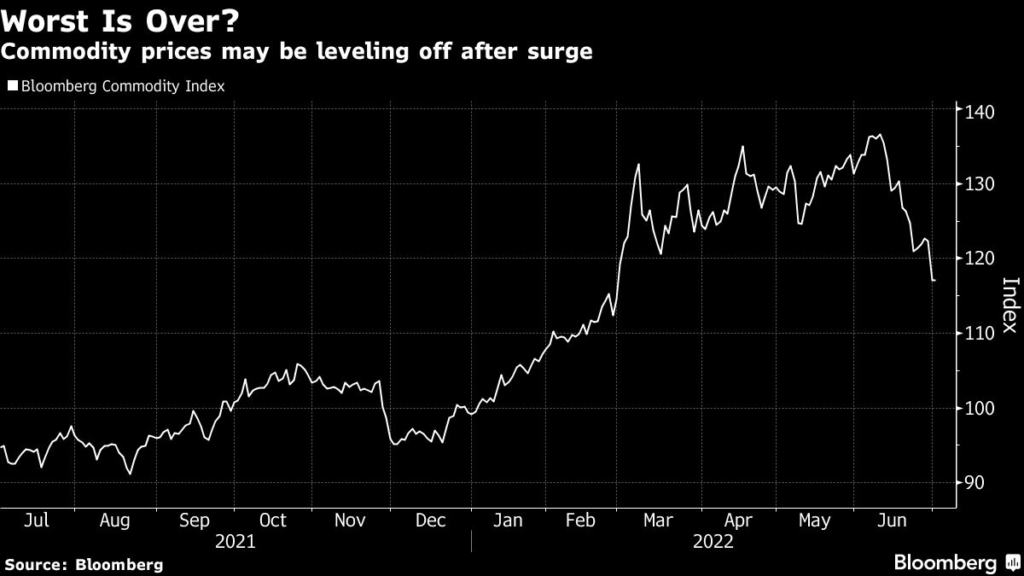
Commodity prices such as oil are leveling off, easing one major source of inflationary pressure. A key gauge of inflation expectations in the bond market, known as the five-year, five-year forward breakeven rate, tumbled to about 2% on Friday from the eight-year high of 2.6% reached in mid-April.

Economists have pointed to signs that the doubling of US mortgage rates since the start of 2022 has damped the housing market, and to corporate anecdotes of diminishing demand and rising inventories. Micron Technology Inc., the largest US maker of memory semiconductors, warned last week that appetite for chips used in computers and smartphones is cooling.

The economic turnaround has seen some analysts warning that a recession is possible even this year. 

Bond investors are betting the Fed will need to cut rates by at least 50 basis points next year, futures trading shows. As of late last week, futures had the benchmark rate peaking at about 3.4% by February. That’s about 60 basis points lower than the peak as of the middle of last month.

By December 2023, traders predict the rate will drop to 2.7%, below the lowest dot on the Fed’s so-called dot plot of projections by policy makers released at the June policy meeting.

That dot plot had the Fed hiking to around 3.4% by the end of this year and 3.8% by the end of 2023, before coming back down in 2024, the median projections showed.

As to whether the market or the Fed will prove more accurate, bond traders can point to a recent victory. They were ahead of Powell and his colleagues in recent months in anticipating the central bank would have to get a lot more aggressive than it expected to take on the highest inflation in decades. Futures started pricing in the Fed’s May half-point rate hike and June three-quarter-point increase before policy makers’ signals.

Futures don’t explain whether markets see an outright US recession, or whether they simply expect inflation to subside and the Fed to lower rates in response. But history suggests that when investors are as convinced about future rate cuts as they are now, recessions tend to follow.

Since the 1980s, when expectations of cuts of at least 40 basis points persisted, an economic downturn followed within the next 18 months, according to data compiled by Bloomberg.

Policy makers have said they will keep raising rates until they see clear evidence that inflation is coming down. Investors could be anticipating that the Fed’s sharp rate increases may cause demand and the economy to slow so much that the central bank will need to cut rates next year to stimulate growth, said Krishna Guha, a vice chairman at Evercore ISI.

“The odds are that by the time that clear evidence comes through, you have overshot where interest rates need to be,” Guha said.

But it remains to be seen whether the softness in economic data is pointing to an impending recession or just economic bumpiness that could eventually smooth out, he said.

More stories like this are available on bloomberg.com

©2022 Bloomberg L.P.

Tesla Pauses Plants After Ending Shaky Quarter With a Production Milestone

(Bloomberg) — Tesla Inc. investors have a lot to parse after the July 4 holiday: a disappointing quarter of deliveries, a record month of production, and now several weeks of downtime at multiple plants.

The electric-car maker will halt most production on its Model Y assembly line in Shanghai for the first two weeks of July, then stop the Model 3 line for a 20-day stretch starting July 18, Bloomberg reported last month. Upgrade work at the factory to boost output of both vehicles is expected to be completed by early August, people familiar with the matter said.

On Monday, TeslaMag said the carmaker’s plant near Berlin will take a two-week break starting July 11. The German site reported that Tesla aims to roughly double its production rate in August, citing an unidentified source. The company built 1,000 Model Ys at the factory during at least one week last month.

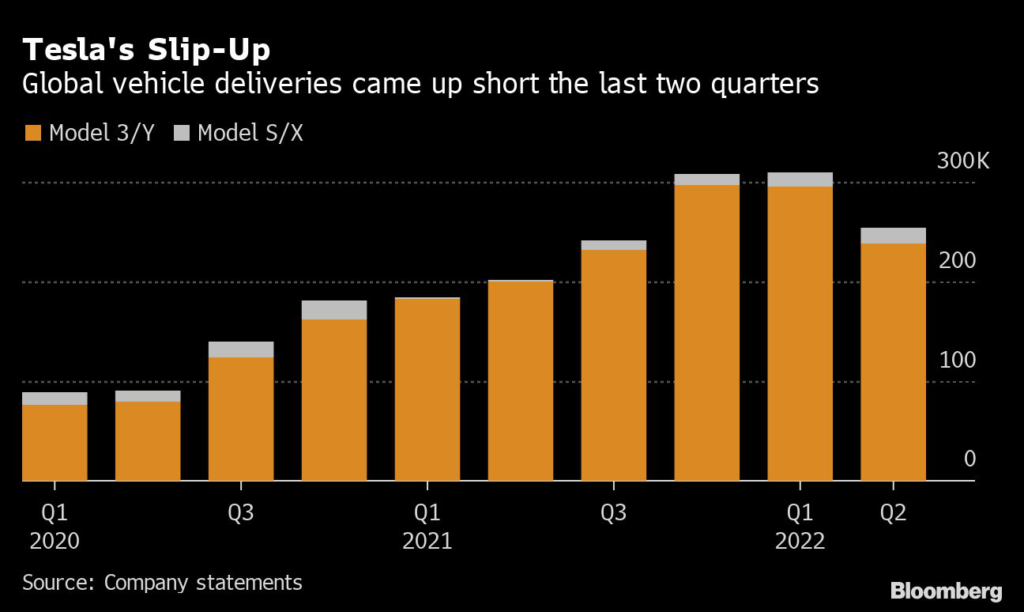
Tesla didn’t mention these plans in its July 2 production and deliveries statement. The carmaker offered an upbeat line — it made more vehicles in June than any month in its history — while disclosing 254,695 deliveries for the quarter, short of analysts’ estimates.

The “relative weakness” of the quarter was expected, Philippe Houchois, a Jefferies analyst with a buy rating on Tesla shares, said in a July 3 note. He wrote that Chief Executive Officer Elon Musk’s comments referring to the company’s new plants as “money furnaces” suggest Tesla’s free cash flow may have been affected by significant working capital disruptions.

Tesla shares fell as much as 4.2% to $653.18 shortly after the start of regular trading Tuesday and have declined about 38% this year.

The biggest blow to Tesla’s performance last quarter came from Shanghai’s weeks-long lockdown in response to a Covid outbreak. The company went to extraordinary lengths to reopen its factory there and keep it running, with thousands of workers sleeping on site to maintain partial production.

Whereas Shanghai is Tesla’s most productive plant, its factories near Berlin and Austin, Texas, are only just getting going. Musk staged an opening party at the former on March 22 and at the latter on April 7.

While those were jovial affairs — Musk danced in Germany and donned a cowboy hat and shades in Texas — the CEO sounded much more subdued a few weeks later.

“Berlin and Austin are losing billions of dollars right now because there’s a ton of expense and hardly any output,” Musk told the Tesla Owners of Silicon Valley on May 31. “Getting Berlin and Austin functional and getting Shanghai back in the saddle fully are overwhelmingly our concern.”

The Shanghai shutdown and struggles ramping up new plants contributed to Tesla shares plunging 38% in the three months that ended in June, a record quarterly drop. The S&P 500 slumped 16%, the biggest decline for the benchmark US stock index since the first quarter of 2020.

Tesla scheduled its quarterly earnings report for July 20.

(Updates with share trading in the sixth paragraph.)

More stories like this are available on bloomberg.com

©2022 Bloomberg L.P.

Chips Look Cheap But Demand Woes Keep Bulls Away

(Bloomberg) — Semiconductor stocks are trading at bargain prices, but investors are still staying away as signs of cooling demand pile up.

Things don’t look good for the sector: Micron Technology Inc. gave a disappointing forecast, while Intel Corp. said the macroeconomic environment is weakening. Prices have dropped for memory chips, as well as for Nvidia Corp.’s graphics cards. Research firm Gartner Inc. expects PC shipments to fall 9.5% in 2022.

Chips are the worst-performing S&P 500 group this year, down almost 40%. While that’s left stocks looking cheap, most investors expect things to get worse — especially if weakness spills over from consumer products into areas like enterprise spending and cloud computing.

“We’re in the first innings of this, and the last few could come pretty quickly and be pretty brutal,” said Rohan Kumar, a portfolio manager at Hood River Capital.

Kumar is positive on chips in the long-term, but concerns about the sector in the near-term have led him to reduce his exposure to some of the lowest levels of his decade-plus career.

The Philadelphia Stock Exchange Semiconductor Index fell 2.9% on Tuesday, on track for a sixth straight negative session. It is trading at its lowest since November 2020.

Falling demand marks a shift from 2020-2021, when the industry was struggling with a Covid-driven global supply crunch, and is also an ominous sign for the health of the broader economy, given the prevalence of chips in everything from cars to appliances, gaming and artificial intelligence.

“Semi downturns happen every 3-4 years, and we could be due for another one,” Bank of America analyst Vivek Arya wrote last week, saying that tighter monetary policy, geopolitical turmoil and consumer weakness will pressure demand into 2023. He downgraded several stocks including Texas Instruments Inc.

The rout has left the Philadelphia Stock Exchange Semiconductor Index, or SOX, trading at less than 13 times forward earnings, below its 10-year average of 16 times, and lower than the Nasdaq’s multiple.

Wall Street analysts expect profits at semiconductor companies to rise 19% in 2022, more than they expected at the start of the year, according to data compiled by Bloomberg Intelligence.

However, estimates aren’t yet reflecting the challenges ahead, and many think the consensus view will soon be slashed. B Riley Securities analyst Craig Ellis last month downgraded a number of chip and chip equipment stocks, saying consensus numbers don’t reflect uncertainty ahead for consumer or enterprise demand.

While chipmakers have gotten cheaper, estimates need to come down more for them to look attractive, according to Jordan Klein, a managing director and tech analyst at Mizuho Securities.

“We don’t have any visibility into how soft 2023 could be, and while numbers could start improving soon, I don’t want to make that bet when the Fed is getting more hawkish and we have the downside risk of a recession.”

Low valuations could limit the group’s downside potential, “but you need a bigger catalyst than stocks just looking cheap,” he said.

Tech Chart of the Day

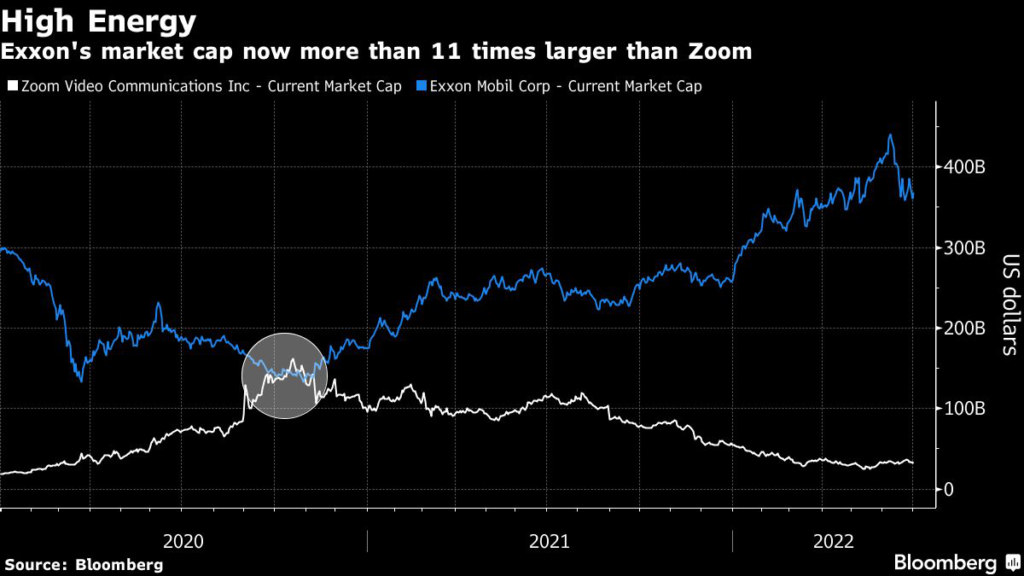
The pandemic-induced rally in shares of Zoom Video Communications Inc. and the decline in Exxon Corp. after the oil price slump resulted in the video-conferencing firm’s market value briefly overtaking that of the energy giant. Two years later and the tables have turned. Exxon is more than 11 times larger than the lockdown darling as oil prices have surged, while growth stocks like Zoom are suffering as the Federal Reserve raises interest rates.

Top Tech Stories

  • Tesla Inc. investors have a lot to parse after the July 4 holiday: a disappointing quarter of deliveries, a record month of production, and now several weeks of downtime at multiple plants.
  • Japanese chemicals supplier Showa Denko K.K. expects to further raise prices and cut back unprofitable product lines as it grapples with a barrage of economic challenges confronting the $550 billion semiconductor industry.
  • A consortium backed by KKR & Co. is emerging as the frontrunner to buy a stake in Deutsche Telekom AG’s sprawling wireless tower portfolio, people with knowledge of the matter said.
  • The European Union wants to increase the number of deep tech startups in Europe by attracting 45 billion euros ($47 billion) in private money and making it easier for founders to keep control of a firm once it goes public.
  • Unknown hackers claimed to have stolen data on as many as a billion Chinese residents after breaching a Shanghai police database, in what industry experts are calling the largest cybersecurity breach in the country’s history.

(Updates with market open.)

More stories like this are available on bloomberg.com

©2022 Bloomberg L.P.

Nothing on Horizon to Rival Dollar’s Status, Fed Study Finds

(Bloomberg) — The dollar’s prime international status remains unchallenged, according a study by Federal Reserve Bank of New York staff, despite challenges from sources including geopolitics and technologies like digital currencies.

“The dollar’s international role, whether for trade, investment or use as a global reserve currency, remains quite strong, with nothing on the horizon likely to rival it,” authors Linda Goldberg, Robert Lerman, and Dan Reichgott wrote in a blog posted Tuesday.

Even so, the study cites some factors that could erode the international use of the dollar over time.

Financial sanctions on Russia following its invasion of Ukraine could encourage de-dollarization by other countries anxious to avoid similar moves against them. And that could fragment the U.S. currency’s global role, the authors wrote.

Cryptocurrencies and central bank digital currencies could eventually supplant the dollar’s cross-border role in payments and investments — though the authors raise several reasons why this may not happen.

Efforts to peg stablecoins to the dollar could actually reinforce its international status. Likewise, CBDCs so far have been aimed at domestic retail markets, something that doesn’t challenge the dollar’s international role. They are also not as attractive as the dollar as a store of value, being mostly backed by local currencies that lack the widespread global acceptance of the greenback. 

“No currency replicates the characteristics of the US dollar as a store of value, unit of account and medium of exchange,” the authors wrote. “Moreover, US assets are viewed to be safe and liquid and have withstood the effects of global shocks.”

More stories like this are available on bloomberg.com

©2022 Bloomberg L.P.

Bitcoin’s First African Adopter Plans Its Own Digital Currency

(Bloomberg) — The Central African Republic, which adopted Bitcoin as legal tender in April, is poised to roll out its own digital currency as part of a plan to develop its financial industry, according to the nation’s leader.

“Sango Coin will be the currency for the next generation,” President Faustin-Archange Touadera said in a virtual briefing. The digital money may be rolled out in the third quarter.

The CAR’s plan is, however, as scanty on detail as its announcement on becoming the second country to adopt Bitcoin after El Salvador. Like then, Touadera’s administration caught key stakeholders, including the regional Bank of Central African States, unaware. The World Bank and the International Monetary Fund raised concern, citing a lack of transparency and the potential effect on financial inclusion.

The central bank didn’t immediately comment when contacted on Tuesday.

CAR’s crypto ambitions have raised concerns, given it’s one of the world’s poorest countries with significant infrastructure gaps. CAR’s government said it wants to make the transfer of money easier for its citizens, but just 557,000 of its 4.8 million people have access to the Internet and electricity coverage remains low.

The plan comes as the market capitalization of digital assets has dropped by about $2 trillion since late 2021, with Bitcoin down more than 55% since the beginning of year.

The CAR’s nation’s treasury will hold 20% of the Sango Coin, according to a concept note on the project’s website. The Sango Coin’s use may also be tied to the marketing of the country’s resources and government services on citizenship, residency and land ownership.

“The Central African Republic sits on a mountain of resources — gold, diamonds, rare minerals, unexploited resources. Sango Coin will enable the direct access to our resources for the whole world,” Touadera said.

CAR, which relies on donors for more than half of its budget, is rich in diamonds and gold, but decades of conflict has prevented the country from benefitting from its mineral resources. The African Development Bank forecasts the $2.3 billion economy to expand 5.1% this year.

  • Take our survey: MLIV Pulse: What Is the Future for All Things Crypto?

More stories like this are available on bloomberg.com

©2022 Bloomberg L.P.

Startup Zapper Plans to Raise Funds at $1 Billion Value

(Bloomberg) — Zapper is considering options to raise capital, including a stake sale, that could value the South African startup at nearly $1 billion, according to people familiar with the matter. 

The Cape Town-based mobile payments business hired Ernst & Young as advisers on a potential deal, the people said, asking not to be identified because the information is still private. Zapper may also consider a combination with a strategic bidder, they said.

“Management is excited by future opportunities, underpinned by an innovative technology roadmap,” a Zapper spokesperson said in response to questions about a potential deal. Interested parties place “us in excellent standing for ongoing and future discussions,” the person said, declining to comment further. 

African startups attracted a record $5 billion in fundraising rounds last year as investors backed firms trying to fix the continent’s thorniest problems, such as insufficient banking infrastructure. Fintech companies have expanded rapidly over the past few years, with several attaining “unicorn” status with valuations of more than $1 billion. 

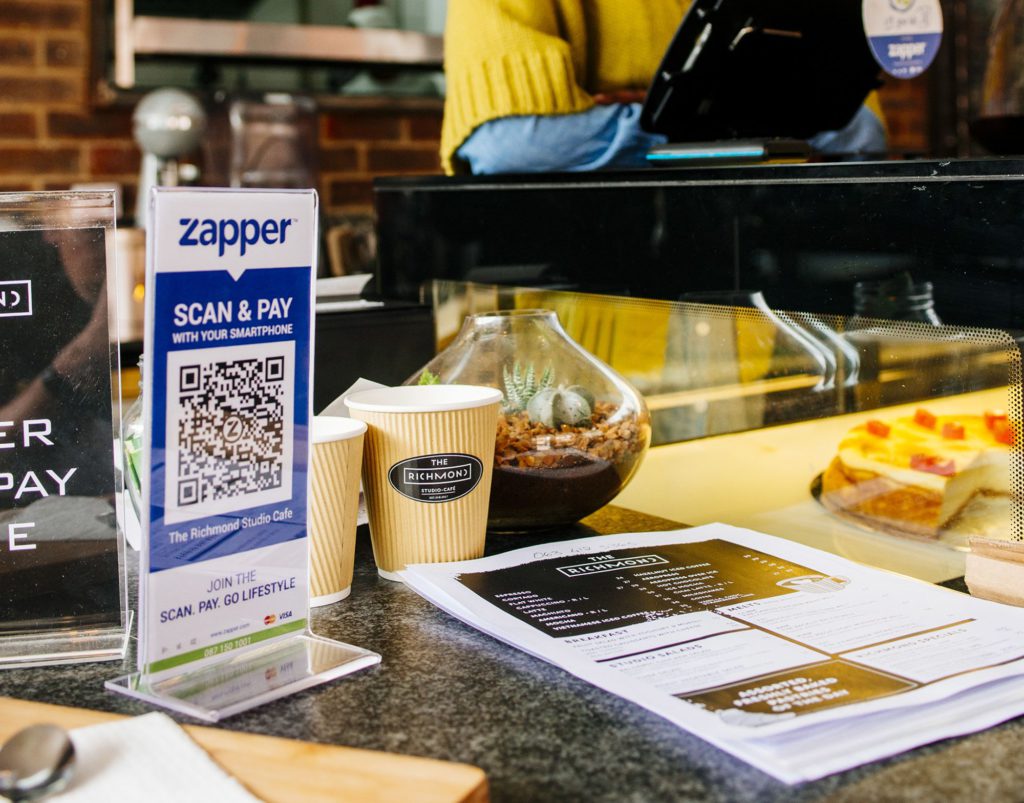
Zapper, started in 2014, operates a mobile payments platform with about 250,000 customers and 65,000 merchants. It’s solution enables quick settlements use QR code and URL technology and the use of data insights to award discounts. 

More stories like this are available on bloomberg.com

©2022 Bloomberg L.P.

Troubled Crypto Lender Vauld Says It May Get Bought by Nexo

(Bloomberg) — Vauld, the Singapore-based crypto lender that announced a freeze on withdrawals on Monday, said it has signed a tentative agreement to be acquired by rival Nexo. 

“We are working tirelessly to ensure your financials are protected,” Vauld Chief Executive Officer Darshan Bathija said in a tweet on Tuesday. “To that end, we’ve signed an indicative term sheet with @Nexo to acquire up to 100% of Vauld.”

Vauld became the latest among several crypto lenders to resort to emergency measures to stay afloat after a $2 trillion digital-asset market rout sapped their finances. The turmoil has produced an opportunity for better-capitalized companies like billionaire Sam Bankman-Fried’s FTX to swoop in and buy assets on the cheap. 

Read more: FTX US Signs Option to Buy BlockFi in Crypto Sector Shakeup

Bathija didn’t immediately return calls seeking comment. The Block earlier reported that Nexo was in the process of potentially acquiring Vauld, citing Nexo co-founder Antoni Trenchev. A spokesperson for Nexo confirmed the discussions. 

Nexo in June said it was preparing an offer for assets of Celsius Network Ltd., shortly after Celsius announced a freeze on withdrawals. That offer was open for a week and lapsed after Celsius didn’t want to make a deal, the Block said. Celsius on June 30 said it’s exploring options such as “strategic transactions” as well as restructuring its debt. 

The speed of the market meltdown has ensnared crypto lenders large and small — with some, like Vauld, freezing withdrawals just weeks after ensuring customers that their business was sound. On June 16, Bathija said on Vauld’s blog that “Over the last few days, all withdrawals were processed as usual and this will continue to be the case in the future.”

Regulators are taking note of the crypto industry’s trouble and say they’re moving to bolster guardrails. Hours after Vauld’s announcement on Monday, Singapore’s central bank said it was considering new crypto rules to protect consumers. 

“These may include placing limits on retail participation, and rules on the use of leverage when transacting in cryptocurrencies,” Monetary Authority of Singapore Chairman Tharman Shanmugaratnam said in a written response to a question from parliament.

Read more: Singapore Evaluates More Crypto Safeguards After Blowups (2)

More stories like this are available on bloomberg.com

©2022 Bloomberg L.P.

American Factories Are Making Stuff Again as CEOs Take Production Out of China

(Bloomberg) — There has been a sense in financial circles that the fever among American executives to shorten supply lines and bring production back home would prove short-lived. As soon as the pandemic started to fade, so too would the fad, the thinking went.

And yet, two years in, not only is the trend still alive, it appears to be rapidly accelerating.

Rattled by the most recent wave of strict Covid lockdowns in China, the long-time manufacturing hub of choice for multinationals, CEOs have been highlighting plans to relocate production — using the buzzwords onshoring, reshoring or nearshoring — at a greater clip this year than they even did in the first six months of the pandemic, according to a review of earnings call and conference presentations transcribed by Bloomberg. (Compared to pre-pandemic periods, these references are up over 1,000%.) 

More importantly, there are concrete signs that many of them are acting on these plans.

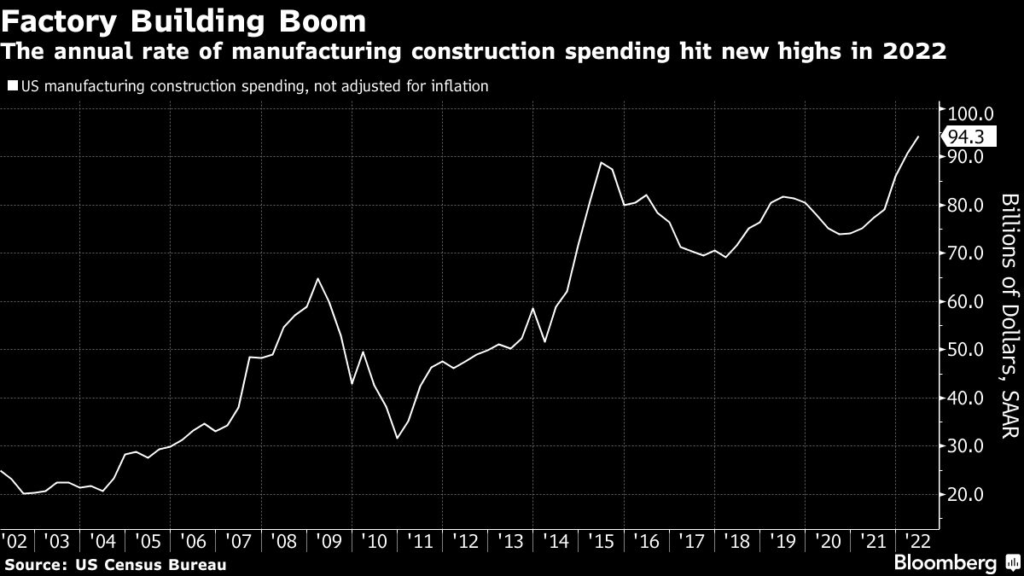
The construction of new manufacturing facilities in the US has soared 116% over the past year, dwarfing the 10% gain on all building projects combined, according to Dodge Construction Network. There are massive chip factories going up in Phoenix: Intel is building two just outside the city; Taiwan Semiconductor Manufacturing is constructing one in it. And aluminum and steel plants that are being erected all across the south: in Bay Minette, Alabama (Novelis); in Osceola, Arkansas (US Steel); and in Brandenburg, Kentucky (Nucor). Up near Buffalo, all this new semiconductor and steel output is fueling orders for air compressors that will be cranked out at an Ingersoll Rand plant that had been shuttered for years.

Scores of smaller companies are making similar moves, according to Richard Branch, the chief economist at Dodge. Not all are examples of reshoring. Some are designed to expand capacity. But they all point to the same thing — a major re-assessment of supply chains in the wake of port bottlenecks, parts shortages and skyrocketing shipping costs that have wreaked havoc on corporate budgets in the US and across the globe.

In the past, says Chris Snyder, an industrials analyst at UBS, it was as simple as “if we need a new facility, it’s going in China.” Now, he says, “this is being thought through in a way that has never been done before.”

In January, a UBS survey of C-suite executives revealed the magnitude of this shift. More than 90% of those surveyed said they either were in the process of moving production out of China or had plans to do so. And about 80% said they were considering bringing some of it back to the US. (Mexico has also become a popular choice.)

This is, of course, a nascent trend. And so many manufacturing jobs were lost here over so many decades — about 8 million from peak to trough — that almost no one would argue that the current trend marks a return to those halcyon times. The rise of automation, which has eliminated many low-skilled, low-paid jobs, means US factories today require a much smaller group of workers.

What’s more, the soaring US dollar threatens to curtail the whole thing just as it’s beginning. As the dollar surges against the yuan, yen, pound and euro, it becomes costlier to make goods in the US rather than in those countries.

‘Better and Cheaper’

To Kevin Nolan, the CEO at GE Appliances, all this fretting about high costs in the US is overdone.

It has been for years, he says. Around 2008, he came to realize that on large items — like, say, dishwasher size and up — the savings earned by eliminating overseas shipping could outweigh the extra money spent on labor here. The key, he determined, was to wring maximum efficiency out of the factory floor to keep those labor costs down. A year later, he decided to test the thesis out and moved some of GE’s water-heater production to Louisville. Other product lines followed.

It’s all been such a success for the company — which is now, ironically, owned by China’s Haier Smart Home — that Nolan has been waiting for other CEOs to follow his move. It took a pandemic to convince them to do it.

“I’ve always said, this is just economics, people are going to realize that the savings they thought they had aren’t real,” Nolan said in an interview, “and it’s going to be better and cheaper to make them here.”

For some companies, the first nudge they got to revamp their supply-chain lines came two years before Covid, when then-President Donald Trump began slapping tariffs on Chinese products again and again.

Generac Holdings, a maker of power generators, started mapping out plans to shift some production from China, and when the pandemic hit, those plans got supercharged. The company now gets more of its parts from suppliers in the US and Mexico, produces more generators near its headquarters outside Milwaukee and runs a brand new plant in a small town just north of Augusta, Georgia.

“We wanted to be closer to our customers in the southeast,” said Chief Operations Officer Tom Pettit. Low shipping costs and quick delivery times are proving a hit with clients and paving the way for the company to keep growing, he said. Opened just a year ago, expansion work on the plant is already underway.

Russia’s invasion of Ukraine also got Pettit’s attention.

Not just because the war further snarled global trade and added to the surge in freight costs but because it reminded him that China could try something similar in Taiwan. And in the same way that business ended for most Western companies in Russia, so too it could end in China. Suddenly, that benign geopolitical backdrop that had helped encourage so many executives to globalize their operations over the past few decades was vanishing. And this, Pettit said, added to his sense of urgency to change things up.

“President Xi Jinping has not been shy about wanting to reunify China and Taiwan,” Pettit said. “We still think China is incredibly competitive. However, we need to have dual sources outside of China.”

More stories like this are available on bloomberg.com

©2022 Bloomberg L.P.

Close Bitnami banner
Bitnami