
Bloomberg

Northvolt Is Said to Keep $12 Billion Valuation After New Round

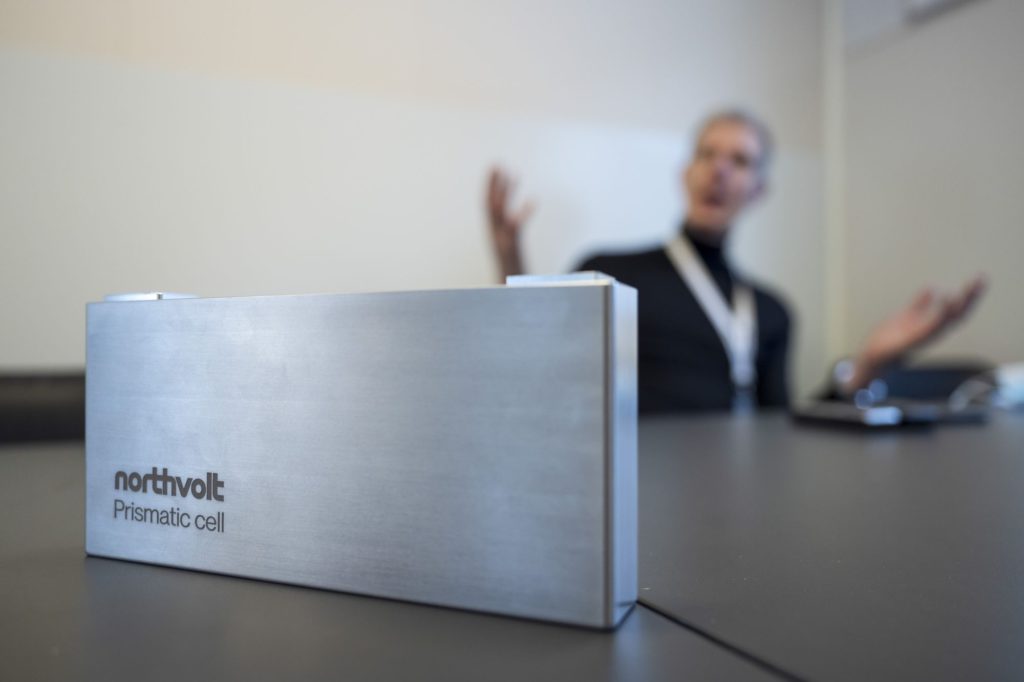
(Bloomberg) — Swedish battery-maker Northvolt AB has defied the market gloom surrounding startups by securing new funds at last year’s valuation of $12 billion, according to a person familiar with matter who asked not to be identified because the details are private.

The company said in a separate statement that it had signed a $1.1 billion convertible note to finance an expansion of its production capabilities in Europe. The new funds arrive as other high profile private companies in Sweden, such as Klarna Bank AB, have seen their valuations plummet amid a cooler climate for raising capital.

Investors participating in Northvolt’s latest round included Goldman Sachs Asset Management, Volkswagen AG, Baillie Gifford & Co. and Sweden’s AP Funds, according to the statement. The latest capital raise takes the battery-maker’s total equity and debt financing to nearly $8 billion since 2017, it said.

“The market is incredibly strong,” Northvolt Chief Executive Officer Peter Carlsson said Tuesday when asked about demand for electric-car components in an interview with Bloomberg Television. “While we see all these challenges around us, the green energy transition is continuing with full force.”

Production Rampup

Part of the proceeds will help Northvolt develop cathode material production, which the company says is a key component of its strategy to establish operations throughout the battery value chain. In May, the battery-maker became the first European firm to start commercial shipments to a carmaker. 

“Our biggest challenge short-term is to keep focus on executing and getting products out, and show our customers we can deliver on time,” Carlsson said. Northvolt is also looking at opportunities that may arise in the US, the CEO added.

Goldman Sachs Group Inc., JPMorgan Chase & Co. and Morgan Stanley & Co. acted as joint placement agents on the convertible note offering.

Representatives for Northvolt did not immediately respond when asked about the valuation.

Read More: BMW-Backed Northvolt Advances on $12 Billion Battery IPO Plan

(Updates with CEO comment in fourth paragraph.)

More stories like this are available on bloomberg.com

©2022 Bloomberg L.P.
Sequoia China Raises $9 Billion as Investors Flock to Big Funds

(Bloomberg) — Sequoia China, led by investment guru Neil Shen, has raised about $9 billion for investments in technology and healthcare, according to people familiar with the matter, overcoming the fundraising challenges that have beset the venture capital sector.

The firm, which operates largely separate from Silicon Valley-based Sequoia Capital, raised the money from pensions, endowment funds and family offices from the US, Europe, the Middle East and Southeast Asia, the people said, asking not to be named because the matter is private.

Sequoia China is long-term positive on the country’s growth despite concerns around increased regulation and an economic slowdown, and plans to invest in cutting-edge technology that can help advance industries including pharmaceutical and healthcare, the people added.

The investment firm stands out as venture capital peers in China struggle to raise cash during a crackdown on private enterprise and an economic slowdown brought on by the pandemic. As investors reassess their China exposure, the more established funds like Sequoia and IDG Capital are attracting the bulk of funds, leaving smaller and newer ones struggling to find backers. 

The money will be allocated to four funds: Sequoia Capital China Expansion Fund I, Sequoia Capital China Seed Fund III, Sequoia Capital China Venture Fund IX and Sequoia Capital China Growth Fund VII, the people said. Investors oversubscribed by about 50%, but the firm decided to stick to its original goal range, they added. 

Sequoia China declined to comment in an emailed statement. The Information reported the fundraising plan earlier. 

Sequoia Capital and its Beijing affiliate have spent over a decade scattering more than $10 billion across China’s multitude of startups, backing the likes of ByteDance Ltd. and JD.com Inc. while becoming a powerhouse brand among the venture firms aiming to strike it rich there.

The prospects for investments in China are mired in uncertainty, as regulatory actions on both sides of the Pacific squeeze the nation’s technology industry and create unpredictability for its financial backers.

Putting aside a stock rally that began on the mainland last quarter, China is still weathering a decline in venture capital investments, despite once being touted as a primary rival to Silicon Valley.

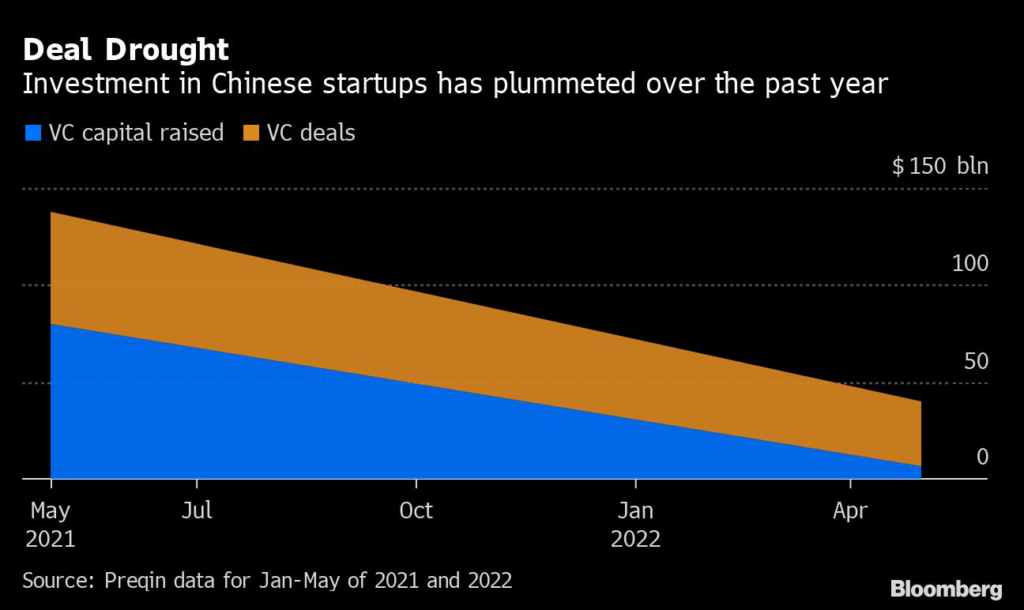
The value of deals in the country fell roughly 40% from a year ago to $34 billion in the first five months of 2022, according to data from research firm Preqin. Meanwhile, venture capital and private equity funds raised $6.2 billion, a drop of more than 90% compared to the first five months of last year.

Chinese tech stocks have taken a beating in the past year, driving down valuations in the industry and spurring investors to allocate money into the country’s top investment outlets instead of less established ones. 

The healthcare industry, which hasn’t yet been a focus of Beijing’s recent crackdowns, represents about a third of Sequoia China’s portfolio companies, the people said. Technology and consumer startups also account for one third each, they added. 

More stories like this are available on bloomberg.com

©2022 Bloomberg L.P.
KKR-Backed Group Leads Bidding for $20 Billion Deutsche Telekom Arm

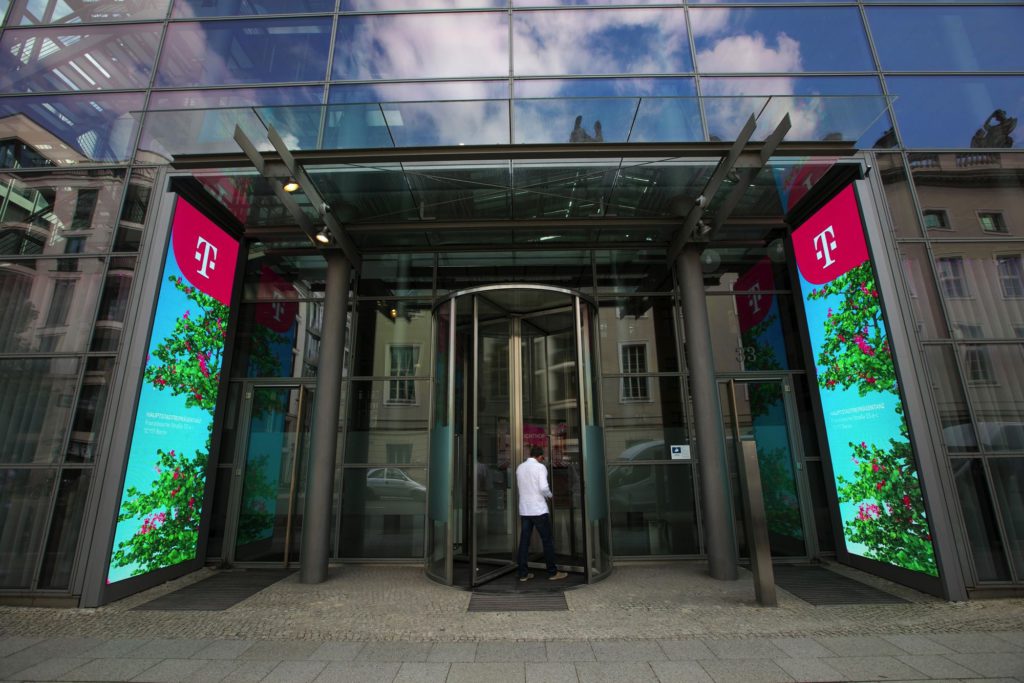
(Bloomberg) — A consortium backed by KKR & Co. is emerging as the frontrunner to buy a stake in Deutsche Telekom AG’s sprawling wireless tower portfolio, people with knowledge of the matter said.

KKR has made an offer in conjunction with Global Infrastructure Partners and Stonepeak, the people said. Their bid is seen as more attractive than a rival proposal from Brookfield Asset Management Inc. and Spain’s Cellnex Telecom SA, the people said, asking not to be identified because the information is private. 

Deutsche Telekom plans to formally choose a winner as soon as this week, according to the people. The unit could be valued at around $20 billion in any deal, the people said. 

While negotiations are at an advanced stage, no final decisions have been made and the talks could still fall apart, the people said. Deutsche Telekom could still decide to retain the asset or other bidders could emerge, the people said.

Vodafone Group Plc’s listed infrastructure arm Vantage Towers AG was also among suitors studying the business earlier, Bloomberg News has reported.  

Representatives for Deutsche Telekom, Brookfield, Cellnex, GIP and KKR declined to comment. Queries sent to Stonepeak weren’t immediately answered during a US holiday. 

A spokesperson for Vodafone said the company is exploring its own options to achieve the objectives set out for its tower business in May, referring to statements by Vodafone Chief Executive Officer Nick Read on the carrier’s hunt for value-creating deals.

The sale of stake in Deutsche Telekom’s tower business could be one of the largest infrastructure deals in Europe this year, according to data compiled by Bloomberg. KKR, GIP and Stonepeak jointly made a binding offer for a controlling stake in the unit, Bloomberg News reported last month. 

For Cellnex, missing out on a deal for Deutsche Telekom’s towers unit may end up boosting its stock — which has fallen by about a quarter this year — according to analysts at Bernstein.

“Reports of competing bids from private equity and the lack of clear synergies — Cellnex is not present in Germany — has fueled investor concern that Cellnex might end up overpaying for the asset,” wrote Stan Noel in a Tuesday note to clients. “We believe this explains in large part the stock’s underperformance in recent months.”

Europe’s struggling phone carriers once saw ownership of these infrastructure assets as a vital part of their business models. Now, under pressure to raise cash and cut the bill for new network investments, they’ve begun to spin off their wireless masts into separate units or sell them outright.

Institutional investors are drawn to such assets because of their ability to generate steady, long-term returns. KKR raised $17 billion for its latest global infrastructure fund earlier this year, while GIP is targeting $25 billion for what would be the world’s biggest pool of capital dedicated to infrastructure investments. 

(Adds analyst comments from ninth paragraph.)

More stories like this are available on bloomberg.com

©2022 Bloomberg L.P.

Franklin Templeton-Backed Digital Lender Zand Gets UAE License

(Bloomberg) — Sign up for our Middle East newsletter and follow us @middleeast for news on the region.

Zand, a digital bank helmed by Dubai property tycoon Mohamed Alabbar and backed by investors including Franklin Templeton, has been granted a banking license by the United Arab Emirates.

“We got our banking license on June 30, and we celebrated by welcoming our first corporate customers,” co-founder and Chief Executive Officer Olivier Crespin said. “Zand’s corporate offerings will be made available to our customers incrementally.”

Zand Bank PJSC, as the firm will be known, will be the first digital bank to provide retail and corporate services in the UAE. 

The UAE is attempting to broaden access to financial services by opening up its banking system to digital banks, which have taken off with the spread of finance technology in Middle East — a region with high internet penetration and a largely young population.

Zand will compete with other digital platforms including Wio, backed by Abu Dhabi wealth fund ADQ, and units of traditional banks including Dubai’s Emirates NBD. The firm’s other investors include Aditya Birla Group, Abu Dhabi’s Al Hail Holding, Al Sayyah & Sons Investments, Global Development Group, Yusuff Ali of Lulu Group, and Crespin.

More stories like this are available on bloomberg.com

©2022 Bloomberg L.P.
Bitcoin Hints at a Bottom, But It May Be Different This Time

(Bloomberg) — It’s a perennial exercise whenever an asset is mired in a prolonged and deep drawdown: People look at the charts, they go over this or that indicator and they get their checklists out to try to figure out when it might find a floor. For Bitcoin, there’s plenty of such action happening right now, with technical signals that in the past have suggested just such a formation. 

Analysts at Glassnode track a number of gauges — from instances when Bitcoin dips below a moving average to when it closes below the so-called balance price measure, which reflects a market price that matches the value paid for coins minus the value ultimately realized. What they’re seeing now is that many of these measures are all flashing in similar fashion, something that rarely happens. 

Over the last five years, the analysts say, there have only been six other similar stretches, some of which have coincided with bear-market bottoms, such as in November 2018 and March 2020. But might this time prove otherwise?

“The case for Bitcoin bottom formation is one grounded in observable dominance of strong-hand investors, historically significant lows in numerous macro oscillators, and a strong confluence with prices hovering in striking distance of several bear-market pricing models,” Glassnode’s analysts wrote. “However, can these HODLers hold the line?” 

Bitcoin on Thursday closed out one of its worst quarters on record, giving up 60% in the April-June stretch. The coin had through Friday lost 70% in value since its November high. In this environment, Bitcoin spot trading activity has dropped “substantially,” according to Arcane Research. Meanwhile, assets under management for crypto investment products in June reached a record low, with ETFs experiencing the largest drop – that category saw declines of more than 50% to $1.3 billion, according to CryptoCompare. 

Bitcoin advanced 2.9% on Tuesday morning in Europe to break above the $20,000 level. 

The usual culprits were to blame: a Federal Reserve bent on raising interest rates to tamp down inflation, even if it injures the economy; a selloff across multiple asset classes and souring sentiment; and a growing list of crypto firms, lenders and hedge funds maimed by the downturn. Pantera Capital’s Dan Morehead said recently that there are likely to be more “major meltdowns” in the coming months. 

Ross Mayfield, investment-strategy analyst at Baird, says that a lot of the pain so far has already been priced into crypto — or at the very least Bitcoin. But, “that’s not to say it can’t go much lower in the near term because the Fed will continue to raise interest rates, and if we enter a recession, there will be even less appetite for highly risky and speculative assets,” he said by phone. “It’s definitely facing a challenging environment going forward,” Mayfield added.

On-chain activity tends to be high during bull markets and further increases during market crashes as participants scramble to offload their positions, according to Arcane Research. When its price stabilizes at a low level, such activity then also tends to drop. “It looks like we are in such a period right now,” wrote the firm’s Jaran Mellerud in a note. “The Bitcoin blockchain has gone into hibernation mode as the crypto winter marks its presence.”

One positive sign: Brett Munster at Blockforce Capital points out that typically during bear markets, coins get taken out of cold storage and deposited back onto exchanges, which can indicate an intent to sell. Right now, that’s not the case. 

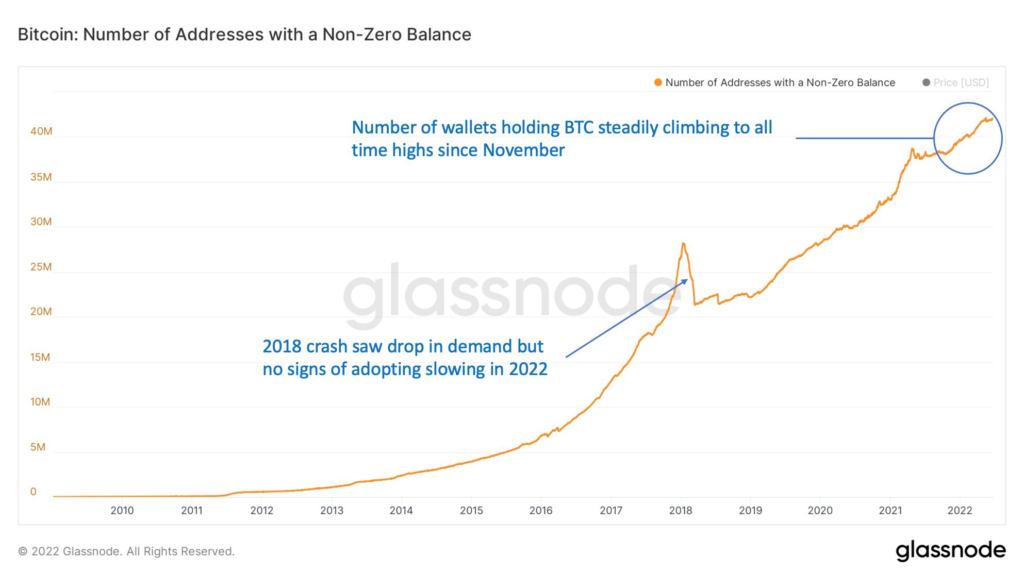
“Other than the ~80,000 coins that were dumped on the market by the Luna foundation in a failed attempt to defend the peg of UST, we have continued to see a steady flow of Bitcoin out of exchanges and put away for long-term accumulation,” Munster wrote. In addition, the number of wallets with a non-zero amount of Bitcoin in them has been growing, among other developments. 

“Unlike in 2018, when the demand for Bitcoin did drop during that price crash, there are no signs of adoption slowing today,” he said. “Despite the recent price crash, Bitcoin’s fundamentals are arguably stronger now than any time in its history.”

(Updates Bitcoin price in paragraph 6.)

More stories like this are available on bloomberg.com

©2022 Bloomberg L.P.
Temenos, Retailers Picked as Top Takeover Targets in Europe

(Bloomberg) — Banking-software specialist Temenos AG topped mergers and acquisitions watchlists in Europe, along with retail firms bruised by sinking consumer confidence, roaring inflation and the risk of recession.

The Swiss company was picked as the region’s top takeover candidate in an informal Bloomberg News survey of 18 traders, fund managers and analysts. Temenos, which is said to have attracted interest from buyout groups and sovereign wealth funds, has lost more than a third of its value this year, making it all the more attractive for bargain hunters.

The value of dealmaking in Europe fell 27% year on year to $666 billion in the first half, its worst such showing since 2020, according to data compiled by Bloomberg. While still running high against historical averages for the period, the drop has been more severe than in other major regions.

Read More: Dealmakers Buckle Up as Records Give Way to Ruptures in M&A

Rising interest rates, a selloff in growth assets, a grim economic growth picture and runaway inflation have all undermined confidence, while tightening lending conditions contributed to deals worth tens of billions of dollars falling apart in recent weeks. 

“We’ve seen a significant slowdown in M&A so far this year compared to last year with private equity buyers in particular much less active,” said John O’Mara, an event-driven analyst at Avalon Capital Partners. “Both financial and strategic buyers are likely to remain cautious until equity and credit markets stabilize.”

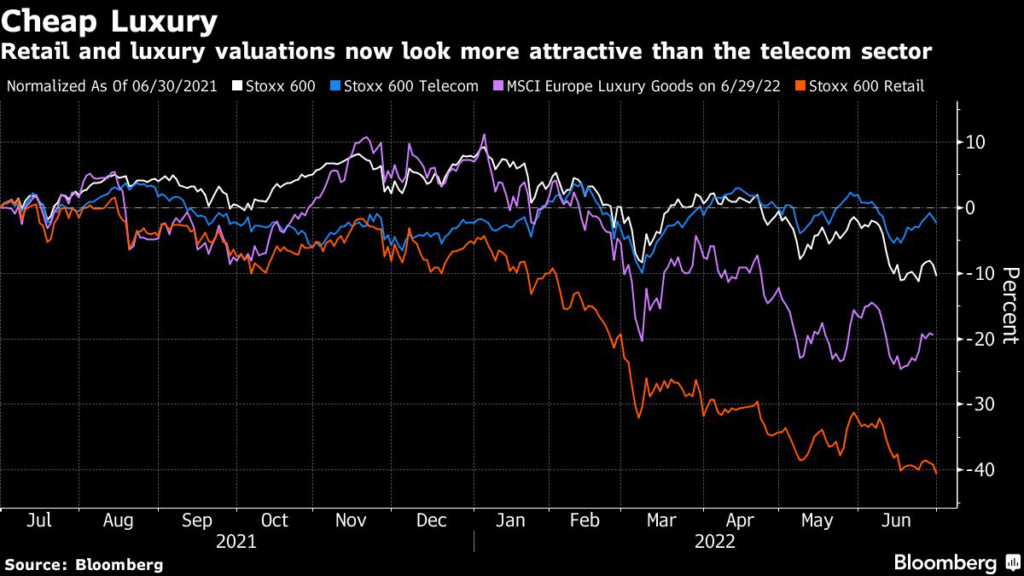
Still, this year’s selloff has also created opportunities as valuations become more attractive. Consumer-facing businesses that have been at the wrong end of the stock market rotation proved popular in the poll, including luxury companies Moncler SpA and Burberry Group Plc, UK grocers J Sainsbury Plc and Marks & Spencer Group Plc and online shopping emporium THG Plc.

Representatives for Temenos, Moncler, Burberry, Marks & Spencer, Ubisoft, THG and Sainsbury either declined to comment or did not respond to requests for comment.

They’ve crowded out the telecom carriers that dominated the rankings at the end of the first quarter. Consumer stocks have been hammered as a surge in the cost of living weighs on sales, while investors have piled into more defensive areas of the market, driving up their share prices.

“Buyers will start to look opportunistically,” said Roger Jones, head of equities at London & Capital. “There’s a lot more longer-term value opportunities arising in luxury and retail, as opposed to the sectors that haven’t sold off much.”

Consumer Woes

To be sure, bargain hunters making what is perceived as an opportunistic bid on down-and-out businesses have met with little success so far. Retailer Ted Baker Plc rejected several offers from Sycamore Partners LLC, while Pearson Plc rebuffed Apollo Global Management Inc.’s advances.

“In this volatile market, although suitors may be circling, they will be wanting to snap up targets at a bargain price,” said Susannah Streeter, a senior analyst at Hargreaves Lansdown Plc. “Boards are likely to be reluctant to accept offers based on current valuations as they believe they don’t truly reflect future opportunities for growth.”

Recent takeover attempts for THG have also failed, after both Nick Candy and Belerion Capital walked away from the beleaguered e-commerce firm. But the worsening climate for retailers means some may be left with few alternatives. 

“The cost-of-living crisis is taking a big bite out of many retailers’ sales and margins,” said Danni Hewson, a financial analyst at AJ Bell Plc. “If the current crisis lingers, some businesses will become vulnerable and takeover offers might become lifelines, rather than an irritation to be swatted away.”

More stories like this are available on bloomberg.com

©2022 Bloomberg L.P.

Nordic VC Firm Starts First Impact Fund Backed by Skype Founder

(Bloomberg) — Skype’s co-founder is among investors backing a new impact fund focused on managers from underrepresented demographics. 

Nordic venture capital firm Unconventional Ventures closed the initial round for its first European impact fund, raising 30 million euros, General Partner and co-founder Nora Bavey said in a phone interview. It is the first fund in Europe to invest exclusively in impact companies founded by women, people of color, immigrants or LGTBQ+ persons, she said. 

“These founders have been overlooked because of the market being so homogeneous, but their companies offer fantastic potential,” Bavey said.

In addition to Niklas Zennstrom’s Atomico vehicle, early investors also include Vaekstfonden, the Danish state’s investment fund, as well as Norway’s Investinor. 

Discussions regarding a second round of financing are already underway, and should close “fairly quickly,” Bavey said. 

The new fund will mainly invest in tech-companies focusing on climate, health, education, and inclusive fin-tech. Patience is key, as impact companies tend to grow slower than others, she said. “The investment horizon is about five to seven years. We are convinced that greater impact and diversity brings greater returns.”

Unconventional Ventures was founded in Denmark in 2018 by Thea Messel. Prior to the fund, the firm worked on small-scale funding of nine impact driven companies.


More stories like this are available on bloomberg.com

©2022 Bloomberg L.P.
Singapore Evaluates More Crypto Safeguards After Blowups

(Bloomberg) — Singapore is considering new rules to protect consumers after plunging digital-asset prices triggered a series of high-profile crypto blowups, including firms based in the city-state. 

The Monetary Authority of Singapore “has been carefully considering the introduction of additional consumer protection safeguards,” its Chairman Tharman Shanmugaratnam said in a written response to a question from parliament. “These may include placing limits on retail participation, and rules on the use of leverage when transacting in cryptocurrencies.”

The central bank has repeatedly said this year that cryptocurrencies aren’t for retail investors, as a $2 trillion market selloff engulfed a growing list of players. Terraform Labs, whose TerraUSD stablecoin imploded in May, is based in Singapore, as was Three Arrows Capital, the crypto hedge fund ordered into liquidation last month after failing to repay creditors. 

Frozen Withdrawals

Vauld, a Singapore-based crypto lender, on Monday said it froze withdrawals and hired advisers to pursue a potential restructuring after a surge in withdrawals sapped liquidity. 

The MAS last week reprimanded Three Arrows for providing false information and exceeding the limit on assets under management. It’s continuing to investigate the fund for more rule breaches.

Authorities in the city-state have long maintained a wary embrace of crypto, granting just 14 firms the regulatory nod to provide digital token payment services locally, a fraction of almost 200 applicants.

Fine Line

Singapore has clamped down on crypto marketing and requires virtual asset providers to be licensed locally even if they only do business overseas. 

The MAS’s Chief Fintech Officer Sopnendu Mohanty recently said the regulator is “brutal and unrelentingly hard” on any bad behavior in the crypto market.

But he has also commended major players in the industry like Binance and Crypto.com for efforts to create a responsible and compliant industry.

Governments across the world are increasing their scrutiny of the industry amid a major meltdown in crypto markets. 

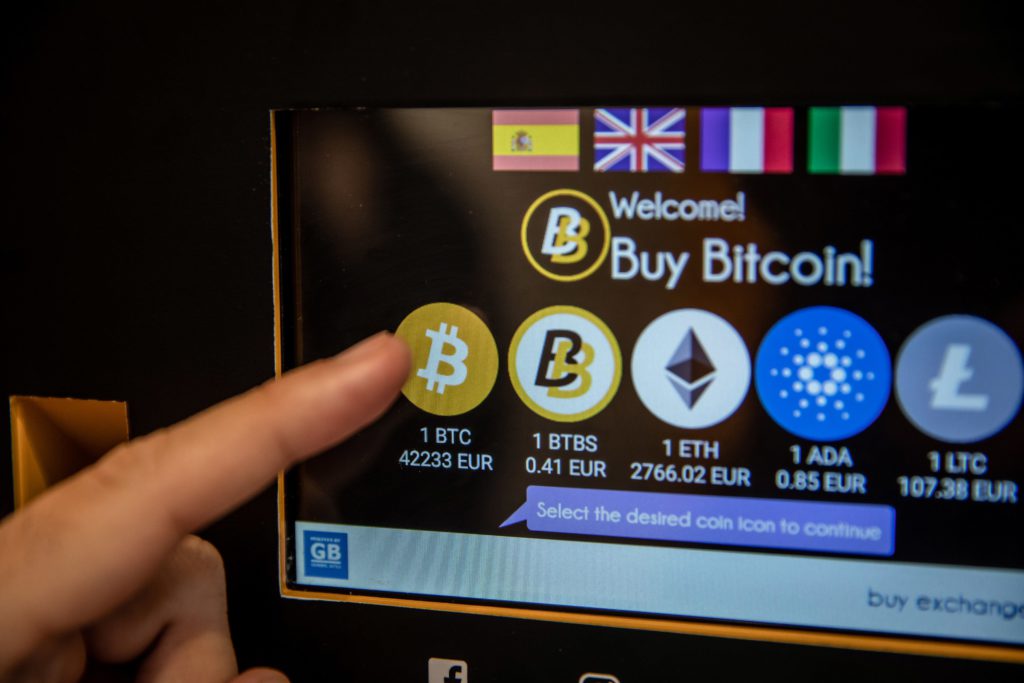
Bitcoin, the largest virtual token, has plunged about 56% this year, part of a broader retreat in riskier investments as tightening monetary policy drains liquidity from markets. It was trading at about $20,200 as of 11:08 a.m. on Tuesday in Singapore.

(Updates Bitcoin pricing in the final paragraph.)

More stories like this are available on bloomberg.com

©2022 Bloomberg L.P.
EU Set to Ease IPO Rules to Lure $47 Billion Deep Tech Funding

(Bloomberg) — The European Union wants to increase the number of deep tech startups in Europe by attracting 45 billion euros ($47 billion) in private money and making it easier for founders to keep control of a firm once it goes public.

The EU Listing Act, which is set to be put forward in the second half of this year, will allow “founders and families to retain control post-listing, while raising a larger amount of funds and enjoying the benefits associated to listing,” according to a draft of a new digital innovation strategy seen by Bloomberg News.

The EU has far fewer deep-tech firms than the US and China. The commission attributed this to the “fragmented and risk-averse nature” of venture capital markets in Europe, while traditional bank products like loans play a bigger role in financing startups than alternative resources like equity funding.

“Europe needs to draw in institutional investors to invest in deep-tech innovations,” Mariya Gabriel, the commissioner in charge of research and innovation said last week at a European Innovation Area Summit. “Increasing the proportion of European capital invested in innovative companies and startups is one of our main objectives. This can result in companies relocating their corporate headquarters to Europe.”

The commission’s strategy to be unveiled Tuesday includes:

  • A Listing Act to simplify listing requirements for companies, which may also propose countries across the EU match their regulation regarding dual-class share structures. At present, every stock exchange in Europe sets its own rules
  • Allowing countries to use state aid for testing and experimentation infrastructure
  • “Regulatory sandboxes,” so startups can experiment with more flexible regulations, with a specific test bed focused on renewable hydrogen and commission-backed AI experimentation facilities
  • Creating a working group to help startups offer stock options to new employees

The EU is also “losing the global race for talent,” the commission wrote in the draft, with researchers and academics moving to the US. The commission will launch a talent initiative to find 1 million people to work in deep tech, backed by 20 million euros from the EU budget to be topped up with more money from public and private organizations. The commission will also launch talks with EU countries to attract talent from third countries, especially by making it easier to obtain startup visas.

There’s also a “gap” in the amount of innovation in larger, wealthier regions compared to their smaller, poorer European counterparts. The commission wants to create “deep-tech innovation valleys” to ensure regions across the bloc benefit from the commission’s innovation plans. The bulk of the funds, approximately 10 billion euros, will come from the European Regional Development Fund. Another 170 million euros will come from the the EU budget’s research and cohesion funds.

Few women are represented in deep-tech startups, the commission wrote. Female-led tech startups raised only 1.7% of capital in European VC markets in 2020, citing Atomico’s 2021 State of European Tech report. The commission will launch a number of initiatives to address this including a gender and diversity index to collect data on women and underrepresented groups.

More stories like this are available on bloomberg.com

©2022 Bloomberg L.P.
Trading Dries Up on India Crypto Exchanges as New Tax Kicks In

(Bloomberg) — Warnings from Indian crypto exchanges that a controversial new transaction tax would erode trading are coming true, with volumes evaporating since the levy took effect. 

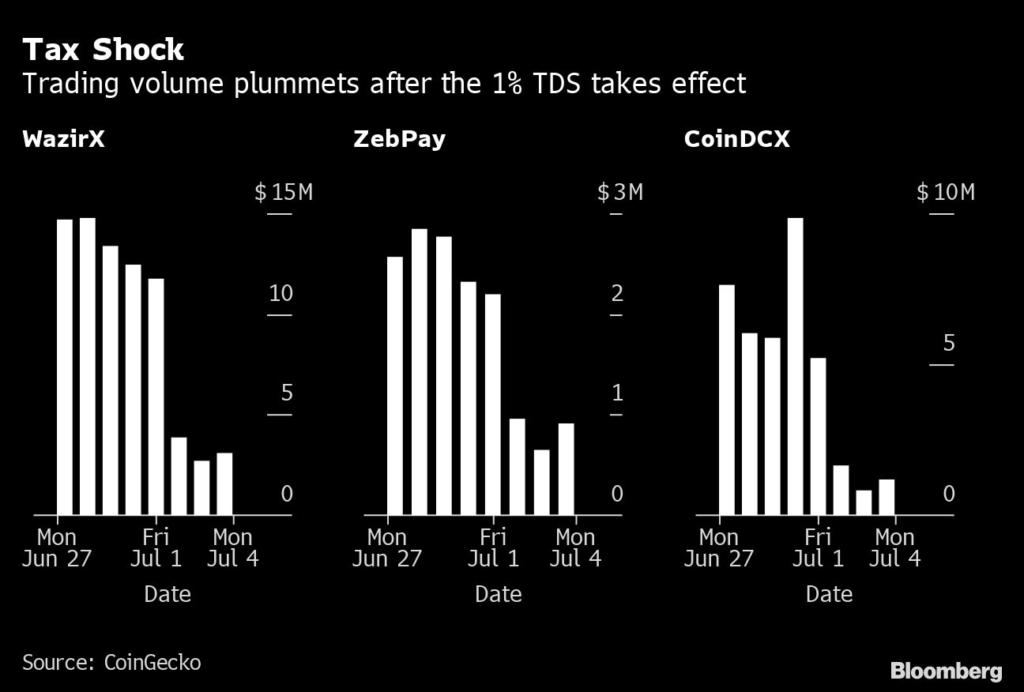
Three exchanges — ZebPay, WazirX and CoinDCX  — suffered declines of between 60% and 87% in the value of daily trading immediately after the 1% tax deductible at source became effective on July 1, data from CoinGecko show. A fourth, Giottus, saw trading sink 70%, its chief executive said.

Those steep declines came from already depressed trading levels, as a combination of plunging prices, unfavorable tax treatment and difficulty getting cash onto exchanges combined to depress the once-hot market. 

Binance-backed WazirX, for example, did $3.8 million worth of trading on July 2, the day after the tax known by the acronym TDS took effect, CoinGecko data show. In early July last year, it would have taken less than two hours of trading to reach that mark. (Crypto exchanges trade 24 hours a day, seven days a week).  

While long-term crypto holders are still buying and selling, market makers and high-frequency traders are “gone,” said WazirX Vice President Rajagopal Menon. Traders are also doing more peer-to-peer trading and migrating to so-called decentralized exchanges, he said. 

The government introduced a tax regime for digital assets in February, consisting of the TDS and a flat 30% tax on income from crypto investments. It also banned offsetting of losses on such assets, treating them differently from stocks and bonds. 

More stories like this are available on bloomberg.com

©2022 Bloomberg L.P.

Close Bitnami banner
Bitnami
