Bloomberg

Giant UK Electric-Car Charging Station Also Will Supply the Grid

(Bloomberg) — An electric-vehicle charging station that can juice hundreds of cars a day and set up with two batteries that can send power to the UK grid is opening in Oxford.

The project, known as the Energy Superhub Oxford, will include 42 rapid chargers at the Redbridge Park and Ride. Britain will need to rapidly scale up charging infrastructure and battery storage to achieve its goals for cutting carbon emissions.

The  £41 million ($50 million) facility was developed by Pivot Power, a division of Electricite de France SA, with the Oxford City Council. The system includes 12 Tesla Superchargers, a 2-megawatt vanadium flow battery from Invinity Energy Systems Plc and a 50-megawatt lithium-ion battery from Wartsila Oyj. It’s the largest pairing of those two battery technologies and could serve as an example for building storage capacity to help reach climate goals.

“We really need to accelerate this whole plan,” said Matt Allen, chief executive officer of Pivot Power. “Our superhub model will be a key part of that acceleration.”

Electric vehicles made up 14% of UK car registrations in the first five months of the year, nearly double the percentage from a year earlier, according to industry data. Some of the chargers will be able to add 300 miles (483 kilometers) of range to an electric car in 20 minutes, potentially providing extra juice for hundreds of cars a day.

The charging station plugs directly into the grid via a four-mile underground cable. There’s enough capacity to add more chargers in the future, potentially to electrify Oxford’s buses. 

One key barrier to large-scale electric vehicle charging is having the access to power. Local distribution networks are carefully balanced and can’t always accommodate a huge source of unpredictable demand like an EV charging facility. The Oxford charging station will connect directly into National Grid’s larger network that stretches across the country.

Batteries can help boost the amount of power coming from renewables by recharging when solar and wind are plentiful and then discharging when there’s high demand.

More stories like this are available on bloomberg.com

©2022 Bloomberg L.P.

UK to Force Internet Companies to Curb Foreign ‘Disinformation’

(Bloomberg) — The UK will force owners of apps such as social media and search engines to curb “state-linked disinformation” or face fines with an amendment to its sweeping new upcoming online safety law.

Owners of platforms where people can post their own content will have a legal duty to pro-actively curtail posts backed by overseas governments aimed at “interfering with the UK,” the Department for Digital, Culture, Media and Sport said in a statement Monday. 

If they don’t, regulator Ofcom will have the power to impose fines of as much as 10% of their annual global sales, in powers granted by the forthcoming Online Safety Bill. 

Following Russia’s invasion of Ukraine, companies including Alphabet Inc.’s Google blocked Kremlin-linked outlets such as news network RT, formerly known as Russia Today. 

“Disinformation is often seeded by multiple fake personas, with the aim of getting real users, unwittingly, then to ‘share’ it,” Security Minister Damian Hinds said in the statement. “We need the big online platforms to do more to identify and disrupt this sort of co-ordinated inauthentic behavior.”

More stories like this are available on bloomberg.com

©2022 Bloomberg L.P.

Vital TSMC Supplier Warns of Chip Material Price Hikes Into 2023

(Bloomberg) — Japanese chemicals supplier Showa Denko K.K. expects to further raise prices and cut back unprofitable product lines as it grapples with a barrage of economic challenges confronting the $550 billion semiconductor industry.

That’s on top of at least a dozen hikes already this year, reflecting Covid-19 supply snarls, surging energy costs from the war in Ukraine and the yen’s dramatic weakening, Chief Financial Officer Hideki Somemiya told Bloomberg News in an interview. The situation is unlikely to significantly improve until at least 2023, he added.

Tokyo-based Showa Denko, which supplies essential chip fabrication materials to the likes of Taiwan Semiconductor Manufacturing Co. and Infineon Technologies AG, has been forced to drastically increase the cost it passes on to customers, Somemiya said. Because it’s a key supplier of the chemicals used early in the production chain by chipmakers and other manufacturers like Toyota Motor Corp., its price hikes could potentially squeeze margins or pressure customers to follow suit.

“A big theme this year common to all the players in the materials industry is how much cost burden we’d be able to convince customers to share with us,” Somemiya said. “The current market moves require us to ask twice the amount we had previously calculated.”

Showa Denko is far from alone in raising prices, as other component makers and materials suppliers have been making similar moves to cope with the tough market, Toyo Securities analyst Hideki Yasuda said. Consumers of durable goods like electronics won’t be spared higher price tags further down the road, he added. Chipmakers like TSMC and Samsung Electronics Co. have notified their own customers they intend to raise prices, Bloomberg News has reported.

Samsung in Talks to Increase Prices of Chip Manufacturing by Up to 20%

Somemiya’s company has started terminating the sale of certain commodity products and contracts with customers where it doesn’t see the potential to carry on business profitably. The company, whose share price has fallen 31% over the past 12 months, will spend the rest of this year sorting out which areas to retreat from, he said.

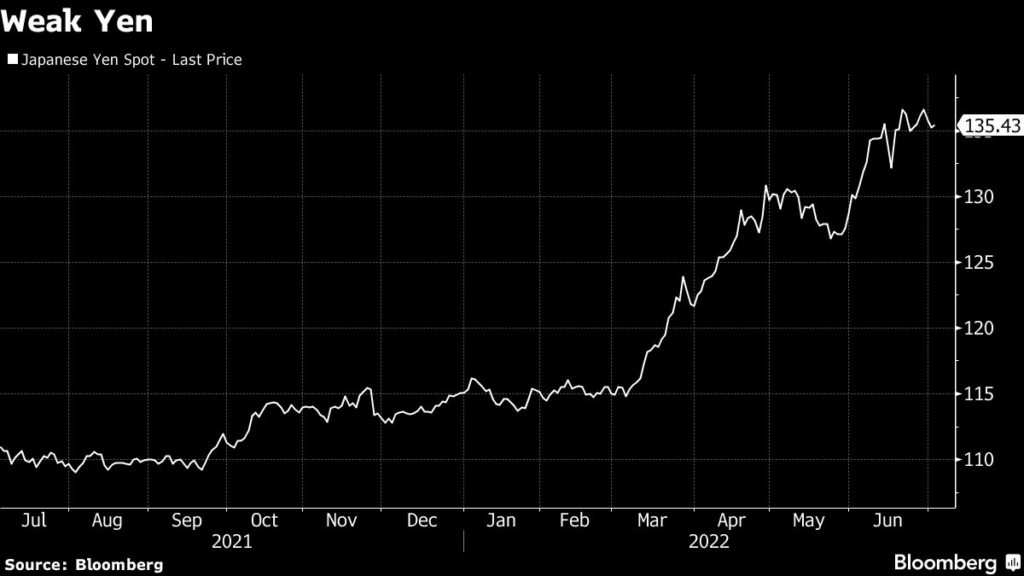
In addition to rising prices of raw materials and natural resources, Showa Denko’s Somemiya said the weakened yen poses another challenge. The Bank of Japan has grown increasingly isolated in its commitment to an ultra-easy monetary policy, pushing the yen to its lowest level against the US dollar in 24 years.

“The current yen moves are not desirable for us at all because the weak yen is further pushing up the cost of raw materials,” Somemiya said. “Measures to deal with the yen that we as a company can undertake are very limited.”

Somemiya, a former banker at JPMorgan Chase & Co., moved from Sony Group Corp. last year to take the CFO’s position at Showa Denko and serve as Chief Executive Officer Hidehito Takahashi’s right-hand man in overhauling the company. At that time, Somemiya criticized the chemicals supplier for being naive in negotiating prices and leaving profit on the table. 

Read more: Shakeup at Showa Denko Bets on Chipmakers’ Next Design Challenge

Employees have since become more assertive in their negotiations, in part because they have no other option — a positive change that the market turmoil might have brought.

“There’s nothing positive about the current rising material costs, but employees, who were used to simply accepting customer demands to cut prices, have become stronger in arguing that appropriate pricing will be best for us and customers over the long term,” Somemiya said.

More stories like this are available on bloomberg.com

©2022 Bloomberg L.P.

Singapore’s Tiny Second Airport Eyes Future as a Flying Taxi Hub

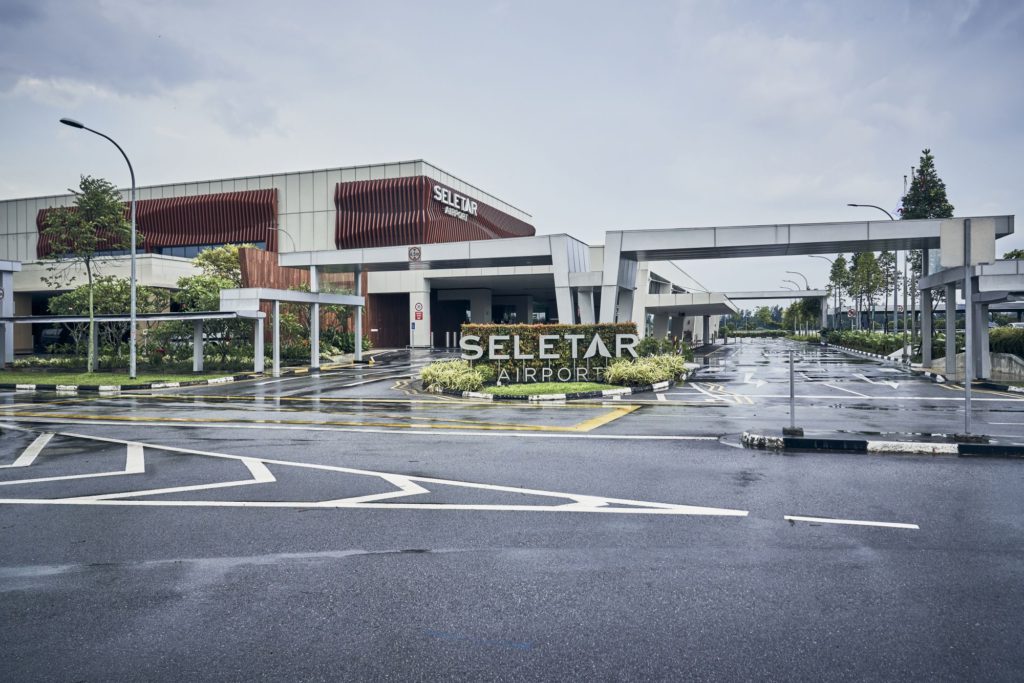
(Bloomberg) — Just 20 minutes north-west of Singapore’s Changi Airport — regularly voted the world’s best — is Seletar Airport, the city-state’s second, and far well less known, airfield. It’s predominantly where the super rich land in their private jets. It’s also where the future of aviation could be taking off.

The neighborhood, more known for its laid-back cafes in restored British-era colonial buildings and sleepy fishing villages, is positioning itself as a hub for flying taxis. Singapore has already signed two agreements with advanced air mobility startups Skyports Ltd. and Volocopter GmbH that may convert the aging aerodrome into a vertiport, or an airport where the aerial devices take off and land vertically, Jetsons-style.

It isn’t some way off dream, either. Plans for flying taxis to be operational at Seletar are pretty immediate — as soon as 2024 — and the airport, or vertiport, could serve as a global model for what the future of mobility may look like.

Recent interest in so-called eVTOLs (electric vertical take-off and landing vehicles) has been immense. Electric cabs stole the limelight at this year’s Singapore Air Show in February with Malaysian tycoon Tony Fernandes of AirAsia fame placing an order to rent at least 100 of them from Vertical Aerospace Ltd. Carriers including American Airlines Inc. and Virgin Atlantic Airways Ltd. have also ordered scores of eVTOLs. 

“Singapore is, and continues to strive to be, the world leader in mobility, and this development is another brick in that wall,” said Sunny Xi, a principal at consultancy Oliver Wyman’s transportation and services practice. “This is more than simply solving traffic on roads. Singapore has all the right ingredients to test, learn and scale both the mobility adoption and the business to then export it across the world.” 

But flying taxis — until recently the stuff of science fiction — have one big and crucial hurdle to clear. Not one has been approved by regulators anywhere to actually take to the skies with passengers onboard. Authorities can take years to approve new technology and it’s only recently that flying taxis have a taken the giant leap from being a concept to a reality. Regulators are now examining the safety of such vehicles before green lighting them for commercial operations.

Companies like Volocopter say it’s just a matter of time, and Asia will play a large role in eVTOL adoption.

Read more: No, Really, Flying Taxis Are Getting Closer to Giving You Rides

“In Asia, you have a high concentration of mega cities that you don’t have in any other region,” Christian Bauer, Volocopter’s chief commercial officer, said in an interview. “This new industry is innovative, it’s good for inhabitants, for tourists, and also for cross-border connections to relieve the pain of congestion.”

Volocopter, which predicts S$4.2 billion ($3 billion) of cumulative economic benefits to Singapore and as many as 1,300 local jobs by 2030 from the industry, is showcasing its aircraft in the city-state later this month to increase public awareness. It’s also talked up the “political benefits” including reduced car ownership and the ability of Singapore to position itself as a torchbearer for the rest of Asia.

Fares for passengers are expected to start at about 40% of the cost of a helicopter, according to Bauer. That could drop to around the price of a premium taxi within five to six years, he said.

“This makes it interesting for anyone who can afford a taxi to take a Volocopter instead,” Bauer said, adding that the company’s service will be “very silent compared to a helicopter. You will not hear it at all.”

Volocopter’s backers include Chinese automaking powerhouse Zhejiang Geely Holding Group Co. as well as German logistics firm DB Schenker and the venture capital arm of chipmaker Intel Corp. Skyports is supported by Japan’s Kanematsu Corp. and Goodman Group in Australia, and counts Ken Allen, the CEO of DHL eCommerce, as a board member.

For all the behind-the-scenes work, the burgeoning revolution underway at Seletar isn’t visible yet.

On a recent visit, the airfield was littered with private and small trainer planes, with a few bigger jets in hangars undergoing repairs. Patrons at an aviation-themed bistro overlooking the runway were mostly expats or locals with jobs at nearby plane-maintenance companies. Inside the terminal, staff were busy guiding a handful of passengers onto a flight to Subang Jaya in Malaysia — one of the only two commercial services operating from the airport.

Read more: Flying Cabs Steal Thunder at Airshow as Clean Future Beckons

Singapore’s Jurong Town Corporation , commonly known at JTC and a primary state-run developer of real estate, is bullish on Seletar’s scope. The broader area surrounding the airstrip, called Seletar Aerospace Park, is the centerpiece of Singapore’s aerospace industry cluster and home to around 60 companies spanning businesses from engine makers, repairs, research and training. 

“The future of urban air mobility is exciting and presents far-reaching possibilities for Seletar Aerospace Park,” Lim Ai Ting, JTC’s director of aerospace and marine cluster, said. “We’re currently in discussions with various parties on new partnerships. This will add to the park’s vibrancy and also benefit the aerospace industry ecosystem.”

With about 82,500 passenger eVTOLs expected to be operational in Asia Pacific by 2050, the region will account for around half the global market, according to a study by Rolls-Royce Holdings Plc and consultancy Roland Berger released earlier this year. The flying devices could be used as airport shuttles, for tourist flights or inter-city travel, flying as far as 250 kilometers (155 miles) on a single charge, according to the study. 

“With its high-rise and high-density landscape, and highly efficient domestic transport systems, the vision in Singapore is focused first on tourist flights, and ultimately, regional connectivity,” said Yun Yuan Tay, Skyports’ head of APAC. Seletar, with its integrated cluster of aerospace-related facilities, is “the perfect setting for the holistic development of an industry as new as advanced air mobility,” he said.

More broadly, eVTOLs’ advancement isn’t limited to just Singapore, or Asia.

A unit of Kenya Airways Plc agreed last month to buy as many as 40 flying taxis starting in 2026 from EVE UAM, part of US-headquartered Eve Holding Inc. And England’s Coventry, once known as Britain’s motor city, is gearing up to host what’s being billed as the first-ever fully functional hub for flying taxis this spring. The site, on a car parking lot at a busy junction across the road from Coventry’s main railway station, is being developed by Urban-Air Port Ltd., a London-based startup that competes with Skyports.

“The good thing is, a couple of years back, we were approaching cities,” said Volocopter’s Bauer. “Now cities are approaching Volocopter because they see the demand, they see this revolutionary change, and they want to be there. Singapore is high on the list.”

Outside of regulatory approval, another hurdle is range, with eVTOLs’ flying time relatively limited. Potential electrification of popular passenger planes like Airbus SE’s A320s series or Boeing Co.’s 737 family has been largely ruled out due to the immense weight of the batteries that would be required to fly hundreds of miles. 

The fact the aerial devices are electric isn’t going to put much of a dent in aviation’s huge carbon footprint, either. 

About 80% of the industry’s carbon emissions come from flights longer than 1,500 kilometers, which is why flying taxis won’t be a solution in the near term, the International Air Transport Association’s Director General Willie Walsh said in May. The biggest lobby group for airlines is “conservative” about the impact the technology will have on the industry’s path to net zero, Walsh said.

Read more: Why Electric-Powered Airplanes Are Headed for Takeoff: QuickTake

Oliver Wyman’s Xi agrees. He sees all-electric propulsion restricted to short-haul aircraft applications for mainly commuter, or between nine to 19 seat, applications.

“Without significant improvements in the specific energy density of batteries compared to kerosene, it’s unlikely that electric planes will threaten modern commercial aviation.”

More stories like this are available on bloomberg.com

©2022 Bloomberg L.P.

Keeping Phones Running in Wartime Pushes Kyivstar to the Limit

(Bloomberg) — Employees killed and displaced, infrastructure seized by force and relentless cyberattacks are only a few of the challenges that Ukraine’s largest mobile phone operator is struggling to overcome as the country tries to fight off Russia’s invasion.

Alexander Komarov, the chief executive officer of Kyivstar, said about 10% of the company’s network can’t function because Russian officials have switched off base stations and captured hardware. But that’s only part of the problem.  

Since Russian President Vladimir Putin launched his attack against Ukraine, Kyivstar has been subject to a “tremendous increase in DDos and an even bigger jump in phishing attacks,” Komarov said Monday in a video interview from Lugano, Switzerland, where he’s attending a conference on rebuilding Ukraine.

The company’s staff has also suffered fatalities, with one employee killed in the Kyiv suburb of Bucha, where Ukraine has accused Russian forces of committing war crimes. Another of Kyivstar’s 3,700 employees has been missing since May and a third has been detained by the Russian forces, he said. More than 100 were drafted into the army.

“Around 10% of our employees right now are in a dangerous proximity to the combat line, but they are doing essential jobs there,” Komarov said.

Billions of Hryvnia

Kyivstar has halted operations in Russian-occupied territory and converted offices into shelters, where roughly a quarter of its workforce have temporarily moved for safety.

Komarov said it’s difficult to quantify the damage the company has suffered because it doesn’t have access to territory not held by Kyiv’s forces. But he estimated losses of billions of hryvnia, citing “ruined offices, sales centers, base stations.”

One upside of the war has been solidarity between Ukraine’s mobile operators, according to Komarov, who said competition in the industry has “almost evaporated” as former rivals have joined forces to help provide service continuity.

Complicated Parent

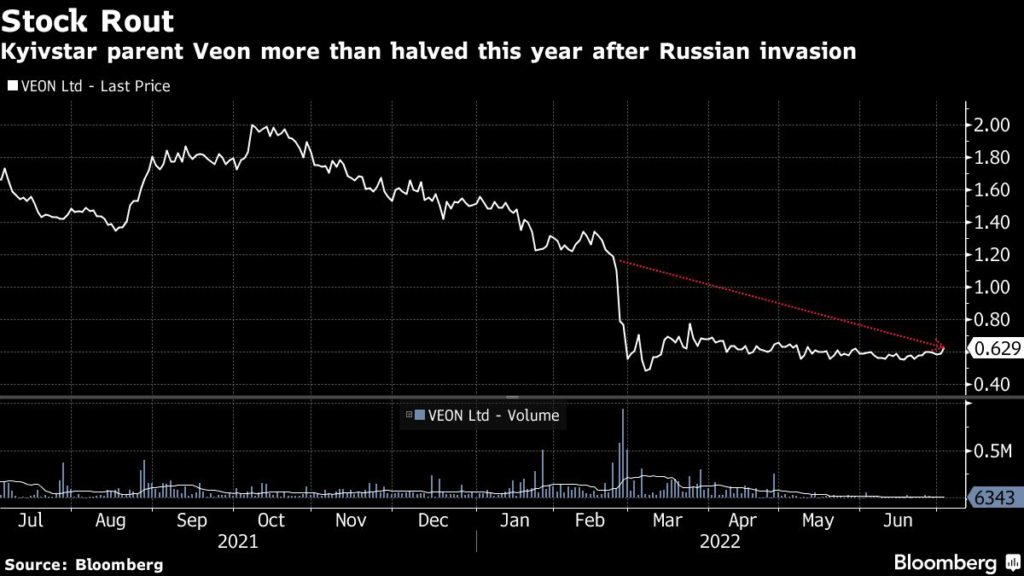
Kyivstar is a subsidiary of Veon Ltd., which was founded in Moscow in 1992 as VimpelCom, one of Russia’s first cellular-phone providers. Today Veon is a Dutch-domiciled telecommunications giant serving over 217 million customers in nine countries. 

It’s still the third-largest mobile-phone provider in Russia with its Beeline brand, which Kyivstar has no contact, Komarov said.

“We’re decentralized, it’s an independent operation,” he said, adding that the Kremlin has sanctioned two of the Ukrainian operator’s board members.

At the same time, LetterOne Investment Holdings, founded by Russian billionaire Mikhail Fridman, owns 47.9% of Veon. Fridman, who’s under sanctions from both the European Union and the UK, stepped down from the boards of Veon and LetterOne after the war began. 

Chinese Presence

Kyivstar depends on technical support from the four leading global telecoms equipment vendors Ericson, Nokia, ZTE and Huawei, Komarov said.

But Ukraine’s bid to join the EU could complicate future ties with Huawei, because the EU’s Investment Screening Mechanism curtails non-EU investment into strategic sectors.

When asked whether Kyivstar and the Ukrainian government are equipped to manage tensions stemming from the Chinese presence, Komarov said it would be taken into account and that he was “absolutely sure that Ukraine’s future is very much related to our ability to move toward the European Union.”

He also refused to give details of Kyivstar’s financial position because of the cloud of uncertainty created by the war. 

“From my perspective, we will not upstream any dividends from Ukraine for a while,” he said. “All the resources should stay in the country.”

More stories like this are available on bloomberg.com

©2022 Bloomberg L.P.

Singapore Weighs New Crypto Safeguards as Industry Stumbles

(Bloomberg) — Singapore is considering new rules to protect consumers after plunging digital asset prices triggered a series of high-profile crypto blowups, including firms based in the city-state. 

The Monetary Authority of Singapore “has been carefully considering the introduction of additional consumer protection safeguards,” Tharman Shanmugaratnam, the central bank’s chairman, said in a written response to a question from parliament. “These may include placing limits on retail participation, and rules on the use of leverage when transacting in cryptocurrencies.”

The central bank has repeatedly said this year that cryptocurrencies aren’t for retail investors, as a $2 trillion market selloff engulfed a growing list of players. Terraform Labs, whose TerraUSD stablecoin imploded in May, is based in Singapore, as was Three Arrows Capital, the crypto hedge fund ordered into liquidation last month after failing to repay creditors. 

Vauld, a Singapore-based crypto lender, on Monday said it froze withdrawals and hired advisers to pursue a potential restructuring after a surge in withdrawals sapped liquidity. 

Read more: Crypto Lender Vauld Freezes Withdrawals, Eyes Restructuring (1)

More stories like this are available on bloomberg.com

©2022 Bloomberg L.P.

This Electric Three-Wheeler Brings Greener Delivery Options

(Bloomberg) —

In June, the electric bike startup Joco, which rents e-bikes to food delivery workers and other couriers in New York City and Chicago, began testing a new vehicle called the Deliverator. Made in Eugene, Oregon by Arcimoto Inc., the Deliverator is an electric three-wheeler with a “reverse-tricycle” configuration—two wheels in the front and one in the back—that makes it look like a giant lobster.

It has a 20 cubic-foot enclosed storage compartment behind the driver, a top speed of 75 miles per hour, a range of about 100 miles and costs $25,000. Joco is testing four as part of a pilot program with Arcimoto and has begun giving demos to ghost kitchens, grocery chains and other potential customers in need of delivery fleets.

“They’ve loved it,” said Joco co-founder Jonny Cohen.

I met with Cohen in the parking lot of a self-storage center on the far West Side of Manhattan on a weekday at the end of June so that I could take one of the Deliverators for a spin. After a brief tutorial, I pulled into the midday traffic on Eleventh Avenue. (Thanks to a recent change in New York state law, I didn’t need a motorcycle license to operate it on city streets, no helmet required.) The motorcycle-style handlebars felt strange at first, but after a few blocks I started to get the hang of it. When a car in front of me stopped to double park, I squeezed around it on the left and, on one open stretch, throttled up to 30 miles-per-hour. It was, far and away, more enjoyable than covering the same blocks in a van. 

The fun-factor, though, is not the point. The Deliverator is a modified version of the Arcimoto’s flagship product, the FUV, or Fun Utility Vehicle. The Deliverator’s storage compartment takes the place of the FUV’s single passenger seat. While the original aims at retail customers willing to plunk down $17,900 to enjoy the breeze and turn heads as they drive, the Deliverator is for fleet customers looking to lower operating costs and maximize deliveries per hour. Founded in 2007, Arcimoto spent more than a decade developing the retail FUV, which shipped to its first customers in 2019. Work on the Deliverator began that same year. 

In addition to Joco, Arcimoto has small pilot programs for the Deliverator in Los Angeles; Key West, Florida; and Eugene, Oregon. The goal is for electric three-wheelers to gain a foothold in the US as urban delivery vehicles, a role they already play in cities across China, India, and Southeast Asia. “What we’re aiming to do is radically widen the market opportunity for three-wheeled vehicles,” said Arcimoto co-founder and CEO Mark Frohnmayer.

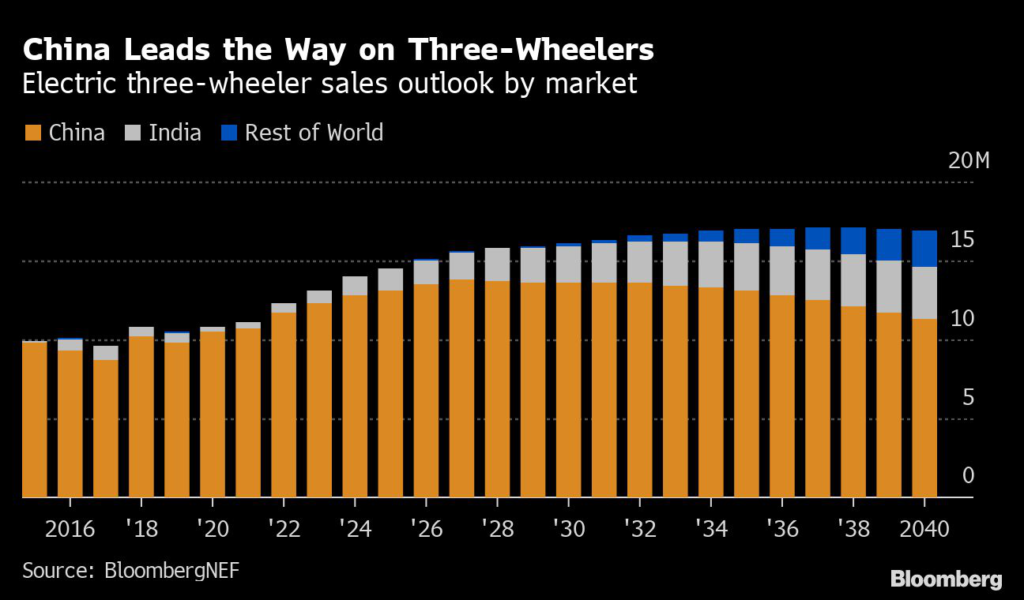
Of the 117 million three-wheelers on the road globally last year, according to BloombergNEF’s Electric Vehicle Outlook, more than 90% were in China and India. China alone has a fleet of roughly 100 million, primarily used for hauling passengers and cargo on short trips. Nearly 70% of the global fleet is electric, mostly using lead-acid batteries, though a swift transition to lithium-ion is underway. BNEF expects global sales of electric three-wheelers to pass 12 million units this year, with fewer than 10,000 outside of China and India. 

In the US, the three-wheeler remains a niche product, with combustion engine models such as the Polaris Slingshot sold to retail buyers as flashy weekend rides. Arcimoto is attempting to use that recreational appeal to get US drivers to opt for light electric vehicles for some of the many, many short trips they take alone in cars. “We compete very well on the joy factor with all kinds of toys in the market,” said Frohnmayer, “but the utility thesis very quickly shines through for our customer base.”

For the moment, that base is small. The company built about 300 vehicles last year, including the two-seater retail FUV, the Deliverator, and other variations built for first responders, landscapers and movie sets. It’s targeting 1,000 this year. ElectraMeccanica, a rival electric three-wheeler maker founded in 2015, has so far produced more than 400 of its flagship vehicle, the SOLO, which seats only the driver, and sells for $18,500. 

Vehicles like the FUV and SOLO occupy an in-between space in the personal transportation market—more than a bicycle, but less than a car. “It’s been a hard sell in the US to convince people to buy expensive, small electric vehicles,” said Reilly Brennan, a founding partner at the San Francisco venture capital fund Trucks, which specializes in transportation. Most people, he said, would sooner buy a used Toyota Corolla.

For fleet customers, three-wheelers can be a happy medium. They are smaller, nimbler, and cheaper to operate than vans and trucks, while moving faster than most cargo bikes and without pedaling by the driver. As cities increasingly restrict access for cars and trucks in central districts, said Brennan, three-wheelers provide future-proofing: “In certain corridors around the world, small, lightweight electric vehicles will likely be the only way you can do delivery without paying a penalty.”

  • Want to lead a more climate-conscious life? Bloomberg Green wants to answer your questions. Take our brief survey and tell us what you’d like to know.

ElectraMeccanica is also testing the waters for delivery and other commercial uses, with a cargo version of the SOLO with 12 cubic feet of storage space and price tag of $24,500 set to begin shipping soon. In February, the company announced that it had delivered 20 SOLOs to customers including sandwich shops, diners, and a frozen yogurt stand. While these pilot programs are as much about publicity as they are logistics, they suggest that the US market for three-wheelers is moving in a new direction. Delivery buyers, said Brennan, are likely to outnumber retail customers over the next ten years.  

Joco’s Cohen said if all goes well, he aims to place an order for a couple dozen units when the pilot ends later this summer. Joco’s main business is renting bikes to delivery workers, who pick them up and drop them off at private parking lots scattered throughout New York, but the Deliverator will not be available to them.  It’s offering the three-wheelers only to fleet customers who contract with Joco for access to multiple vehicles.

“We think the next trillion-dollar opportunity in the transportation space is going to be in light electric vehicles—e-bikes, cargo bikes, this beautiful Deliverator,” he said, “You don’t need a two-ton vehicle to do to do the deliveries that we do.”

More stories like this are available on bloomberg.com

©2022 Bloomberg L.P.
Crypto Lender Vauld Freezes Withdrawals, Eyes Restructuring

(Bloomberg) —

Vauld, a crypto lender backed by Coinbase Inc., said it froze withdrawals and hired advisers to explore a potential restructuring, joining rivals from Celsius Network to Babel Finance in resorting to last-ditch measures to survive the market rout. 

The Singapore-based company hired Kroll as financial adviser and Cyril Amarchand Mangaldas and Rajah & Tann Singapore LLP as legal advisers, Chief Executive Officer Darshan Bathija said in a blog post on Monday. All withdrawals, trading and deposits on the platform have been suspended. 

Vauld’s move came less than three weeks after the company said it was processing withdrawals “as usual and this will continue to be the case in the future.” The about-face hints at the speed with which plunging prices are rippling through the sector, bringing firms ranging from Celsius to hedge fund Three Arrows Capital to their knees. 

Shortly after that attempt to reassure customers, Vauld announced plans to cut 30% of its workforce. 

Crypto markets showed muted reaction to Vauld’s latest announcement, with Bitcoin trading 1.3% lower at $19,180 at 10:30 a.m. in London on Monday. The largest cryptocurrency has tumbled more than 70% from its peak in November. 

Founded in 2018 by Bathija and Sanju Kurian, Vauld provides crypto lending and deposit products. It raised $25 million in a Series A funding round led by Peter Thiel’s Valar Ventures in July last year. Coinbase Ventures also participated in the financing. 

Bathija said in Monday’s blog post that Vauld had seen “in excess of” $197.7 million of customer withdrawals since June 12 as market conditions deteriorated. The CEO told the BusinessLine newspaper in May that he was targeting boosting assets under management to $5 billion from $1 billion. 

The company is also in talks with potential investors, according to the post. It plans to apply for a moratorium with Singapore courts “so as to give us breathing space to carry out the proposed restructuring exercise,” Bathija said.

Vauld will make “specific arrangements” for deposits by customers who need to meet margin calls related to collateralized loans, according to the statement. 

(Updates with Bitcoin price in fifth paragraph.)

More stories like this are available on bloomberg.com

©2022 Bloomberg L.P.
Foreign Investors Drained $40 Billion From Emerging Asia Last Quarter, and It Could Get Worse

(Bloomberg) — Some of Asia’s biggest stock and bond markets outside China are seeing greater outflows than in previous market crises, and the process may just be getting underway.

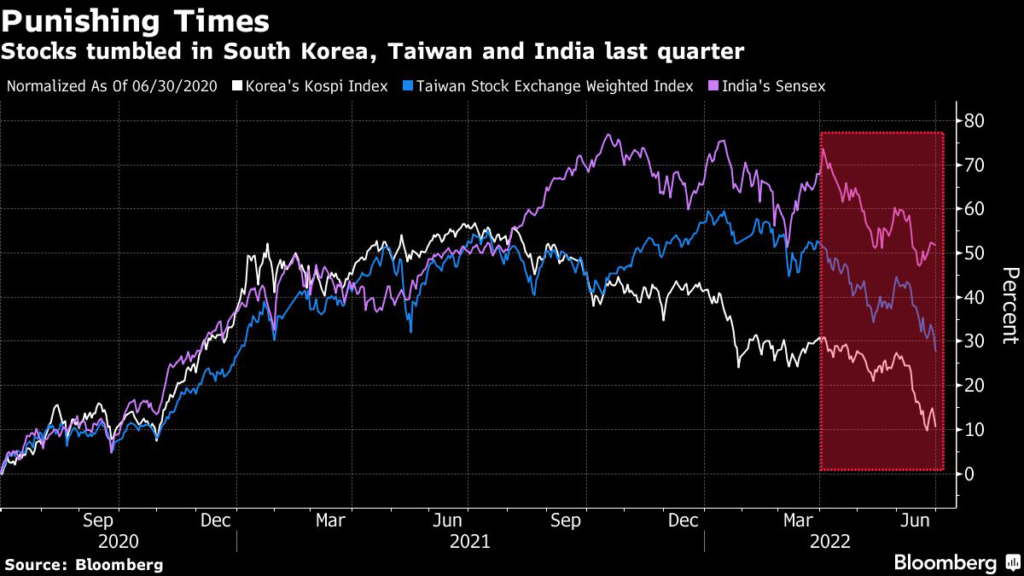
Global funds offloaded a net $40 billion of equities across seven regional markets last quarter, exceeding any three-month period characterized by systemic stresses since 2007. The steepest selling was in tech-heavy Taiwan and South Korea and energy-importing India, while foreign investors also made supersized outflows from Indonesian bonds. 

Money managers are pulling out of higher-risk markets as rampant inflation and aggressive central bank interest-rate hikes sap the outlook for global growth. Fears of a US recession and supply-chain disruptions in Europe and China in a global economy still recovering from Covid-19 lockdowns are providing additional reasons to sell.

“We would expect investors to remain cautious toward export-oriented economies and markets with high valuation under the current backdrop,” said Pruksa Iamthongthong, senior investment director for Asia equities at abrdn plc in Singapore. “We expect the outlook to remain uncertain for the technology sector globally on rising recession risks.”

The total amount of equity outflows for the quarter is an aggregate of those from India, Indonesia, Korea, Malaysia, the Philippines, Taiwan and Thailand. The sum for the past three months was then compared with three previous episodes: the global financial crisis of 2008, the 2013 taper tantrum, and the peak of the Federal Reserve’s last rate-hike cycle in 2018.

Foreigners withdrew a net $17 billion from Taiwan stocks, easily surpassing the outflows seen in any of the three previous periods. Indian shares saw $15 billion of sales, and Korea reported $9.6 billion, also exceeding the earlier periods. 

Hawkish Fed

The Fed’s aggressive tightening, which is pushing up US yields, is expected to keep drawing money away from the region. Swaps are pricing in a further 150 basis points of rate hikes from the US central bank this year.

“The reason foreign investors are selling shares in those markets is not because something has gone wrong in them, instead, it’s because the Federal Reserve and other central banks are tightening their monetary policy,” said Mark Matthews, head of research for Asia Pacific at Bank Julius Baer in Singapore.

One of the main themes thrown up by the data is selling of technology shares, which account for more than half of Taiwan’s equity benchmark and about a third of Korea’s. Tech stocks have slumped around the world this year due to concern over slowing global growth, and their lofty valuations following gains they made during the Covid pandemic.

The weakening yen is also hurting the economy and equities in Taiwan and Korea given the two countries have similar export products to Japan, said Calvin Zhang, a fund manager at Federated Hermes in Pepper Pike, Ohio. This is leading to the fear that they will lose market share, he said.

Indian stocks meanwhile have come under pressure as the economy has suffered from surging oil prices, while the central bank has been rapidly raising interest rates to try and bring inflation under control.

‘Double Whammy’

“The double whammy for Asia –- rapidly tightening liquidity in developed markets and high fuel prices -– could continue to weigh on Asian currencies and depress flows into Asian financial markets for the time being,” Manishi Raychaudhuri, head of Asia Pacific equity research at BNP Paribas SA in Hong Kong, wrote in a research note last week.

There were bright spots too. Indonesia and Thailand saw inflows into their equity markets last quarter, while outflows in two other near neighbors Malaysia and the Philippines were relatively small. 

Part of that may be down to the more dovish approach of central banks in Southeast Asia, which are seeking to slow-walk increases in borrowing costs as they nurture fragile post-Covid recoveries.

Bond Outflows

Bond markets were more mixed with Indonesia seeing outflows of about $3.1 billion, while Korea and Thailand saw money coming in.

Indonesian debt fell from favor as its high-beta bonds were sold more heavily than its regional peers amid fears of a global recession.

Moderate bond outflows from emerging Asia “should persist in the second half alongside the narrowing trend of Asia-US policy rate differentials and subdued outlook for Asian growth,” said Duncan Tan, a rates strategist at DBS Group Holdings Ltd. in Singapore.

The outlook for dollar-denominated corporate bonds in the region is also challenging given that spreads offered over Treasuries are becoming less attractive compared with their US peers. Yield premiums on investment-grade Asian bonds fell below those of US debt in late June for the first time in more than two years.

“Diminishing relative value versus the US will slow down fund inflows from developed markets or even lead to outflows,” said Joyce Liang, head of Asia Pacific credit research at BofA Securities in Hong Kong. “Risks are to the downside for spreads.”

(Updates to add comment from analyst in 12th paragraph)

More stories like this are available on bloomberg.com

©2022 Bloomberg L.P.
Top Thai Mobile Operator Buys Internet Firm to Widen Network

(Bloomberg) — Advanced Info Service Pcl, Thailand’s biggest mobile phone operator, plans to expand its network by acquiring Triple T Broadband Pcl and an infrastructure fund for a total of 32.4 billion baht ($908 million).

The Bangkok-based company will buy internet provider Triple T from Jasmine International Pcl for 19.5 billion baht, Chief Financial Officer Tee Seeumpornroj said in an exchange filing. It will also acquire 1.52 billion units, or a 19% stake, in Jasmine Broadband Internet Infrastructure Fund for 12.9 billion baht. At 8.5 baht a unit, that is a 7.6% discount to the fund’s latest unit price of 9.2 baht. 

“This acquisition will enhance consumer access to broader and better quality of service by improving broadband inclusion in new areas targeting the upcountry and non-city areas,” Tee said. “This aligns with our business direction to grow the broadband business and effectively develop the nation’s fiber infrastructure.”

Shares of Advanced Info rose as much as 2.8% Monday, the biggest gain since June 24. Jasmine International, a technology company that is expanding into Bitcoin mining, dropped as much as 7.2%, while Jasmine Broadband slid 7.4% before paring the loss to 3.2%. 

“Advanced Info is the biggest beneficiary from this deal as the acquisition cost is much lower than we previously expected,” said Wasu Mattanapotchanart, an analyst at Maybank Securities (Thailand) Pcl. “The cheap price and additional subscribers will benefit Advanced Info’s operations and outlook significantly. In contrast, Jasmine has a negative outlook from this deal because it is selling almost all of its businesses at a cheap price.”

Advanced Info, whose major shareholders include Singapore Telecommunications Ltd., said it will finance the acquisitions with borrowings, given its “sufficient debt headroom.” The company pledged to maintain a dividend payout of at least 70% of its net income.

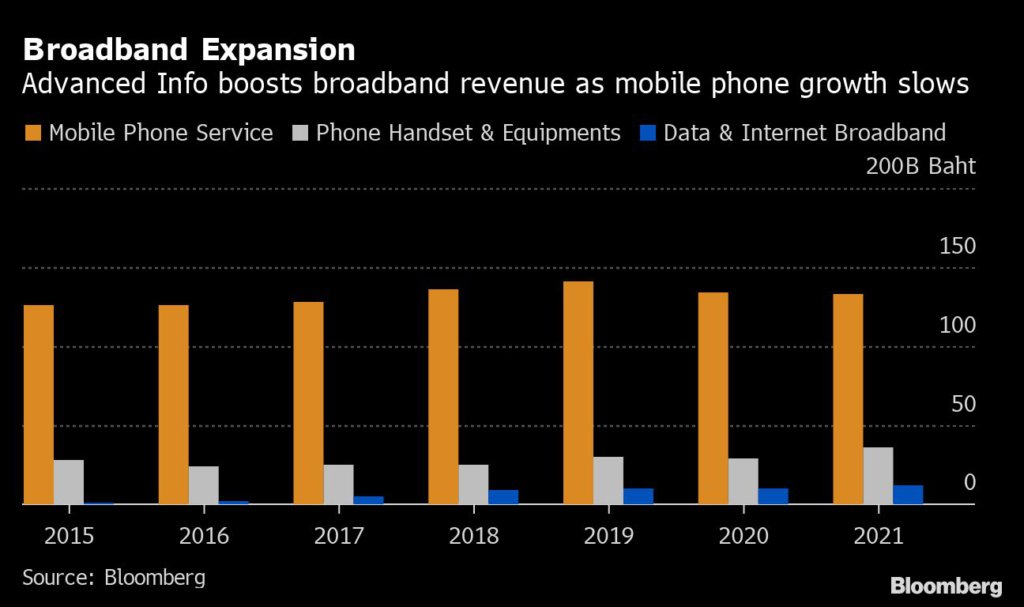
The company entered the broadband business in 2015 to tap rising demand for high-speed internet in Thailand. Its broadband service subscribers rose to 1.87 million as of March 31 from 1.77 million at the end of 2021, the company said in May, while its mobile phone business had 44.6 million customers. 

The move comes as Telenor ASA bids to merge its Thai telecommunications unit with True Corp. and potentially topple Advanced Info as the country’s biggest mobile operator. Advanced Info’s backers include Thai billionaire Sarath Ratanavadi, while True is backed by billionaire Dhanin Chearavanont’s Charoen Pokphand Group and China Mobile Ltd.

Advanced Info will request regulatory approvals before entering a formal contract and expects to complete the acquisitions in the first quarter of 2023, it said in a separate statement.

The new acquisitions will complement Advanced Info’s existing businesses and deliver returns to shareholders in the long term, according to Chief Executive Officer Somchai Lertsutiwong.

Jasmine International said it will use the sale proceeds to partly repay debt and liabilities and some as working capital. The company is also in the process of reviewing its business operations and additional investments, it said in an exchange filing. 

(Updates with comments from Jasmine in final paragraph. An earlier version of this story corrected reference to Temasek as a shareholder in sixth paragraph.)

More stories like this are available on bloomberg.com

©2022 Bloomberg L.P.

Close Bitnami banner
Bitnami