Bloomberg

Chinese Professor Loses $2.4 Billion After SenseTime Slumps

(Bloomberg) — A co-founder of SenseTime Group Inc. lost almost half of his fortune after shares of the artificial intelligence giant plummeted 47% on Thursday.

Tang Xiao’ou, a Massachusetts Institute of Technology graduate and information engineering professor at the Chinese University of Hong Kong, has a 21% stake in the company. His net worth plunged by about $2.4 billion to $2.8 billion, based on the closing share price, dropping him off a list of the world’s 500 richest people, according to the Bloomberg Billionaires Index.

The fall of SenseTime occurred after the lock-up period on a portion of shares held by cornerstone investors and stakeholders expired a day earlier. Some executives, including Chief Executive Officer Xu Li, pledged to extend the lock-up of their shares until Dec. 29.

The tech company completed a Hong Kong listing in December despite US sanctions, and surged as much as 23% on debut. Thursday’s slump dragged the stock below the initial public offering price for the first time.

Read more about SenseTime’s stock decline

SenseTime’s technology has been deployed in a range of areas, including assisting police in China, providing product placements in films and creating an augmented reality scene in a mobile game by Tencent Holdings Ltd.

SenseTime reported revenue of 4.7 billion yuan ($702 million) and a loss of 6.9 billion yuan last year.

(Updates shares, loss and net worth in first two paragraphs)

More stories like this are available on bloomberg.com

©2022 Bloomberg L.P.

Crypto Becomes a Major Political Donor as Americans Head to the Polls

  • Listen to Bloomberg Crypto on the iHeartRadio App
  • Listen to Bloomberg Crypto on Apple Podcasts
  • Listen to Bloomberg Crypto on Spotify 

(Bloomberg) — It might feel like there’s always some kind of election happening in the US – and that’s because there is. State and local elections can happen every year, while ​​Congressional midterms occur every other year, allowing US voters to decide who will represent them. These elections really matter, and crypto executives are spending significant amounts of money to influence them. In 2022, for the very first time, political spending by major figures in the crypto industry has eclipsed the dollars being spent by traditional donors in Big Tech and pharma. Today, Bloomberg reporter Allyson Versprille joins this episode to share her reporting on why crypto is emerging as a significant financial force in US politics.  

Follow us on Twitter @crypto, and subscribe to the Bloomberg Crypto Newsletter at https://bloom.bg/cryptonewsletter

More stories like this are available on bloomberg.com

©2022 Bloomberg L.P.

Nvidia Game Card Prices Plunge Along With Crypto Mining Demand

(Bloomberg) — The turmoil in the cryptocurrency industry has ravaged portfolios and left large and small investors struggling to adapt. It’s also taken a toll on a corner of the tech world that once benefited from crypto’s rise: Nvidia Corp. graphics cards. 

Long popular with computer gaming nerds, these cards enjoyed a second life during the crypto boom as an essential component of the systems that generate digital coins. Even as Nvidia tried to limit its exposure to the industry, the crypto rally had helped send prices of the company’s products soaring on secondary markets like EBay. 

Now that’s changed. With the value of currencies plummeting, miners see less of a need for expensive computer hardware. Their interest is expected to dwindle further as the popular Ethereum blockchain network shifts to a new method called “proof of stake” that won’t require the same heavy-duty computer processing.

By one estimate, more than a third of the consumer graphics-card market could vanish as crypto enthusiasts abandon the technology. And the products are piling up on EBay’s site and other marketplaces. Though Nvidia’s suggested retail price for the cards hasn’t changed, they’re selling for 50% less on secondary markets than they did in recent months.

“People don’t want to buy GPUs knowing it’s potentially going to be obsolete in two quarters,” said Tristan Gerra, an analyst at Robert W. Baird & Co. “We believe that crypto-related purchases have steadily declined.”

A graphics card is a component that fits into a personal computer and converts code into images that can be displayed on a monitor. It’s outfitted with chips known as graphics processing units, or GPUs, which can improve how a PC renders a game. 

Crypto miners discovered that gaming gear designed to play Assassin’s Creed or Red Dead Redemption in high resolution could also be harnessed to create new crypto tokens, and that set off a stampede to acquire the equipment.

An Nvidia graphics card with a list price of $1,499 was fetching twice that amount from frenzied buyers. Pierre Ferragu, an analyst at New Street Research, reports that $3 billion worth of graphics cards were bought by miners since the beginning of 2021 and “they are now flushing into the secondhand market.” 

The question is how this turnabout will affect Nvidia, which is the biggest provider of GPUs and the most valuable chipmaker in the US. The company has acknowledged that the crypto slowdown has affected demand for some products, and it’s not alone in facing a potential hangover. Advanced Micro Devices Inc., best known for its personal-computer processors, also sells GPUs.

“The reduced pace of increase in Ethereum network cash rate likely reflects lower mining activity on GPUs,” Nvidia Chief Financial Officer Colette Kress said during the company’s quarterly conference call last month. “We expect a diminishing contribution going forward.”

The Santa Clara, California-based company declined to comment further. 

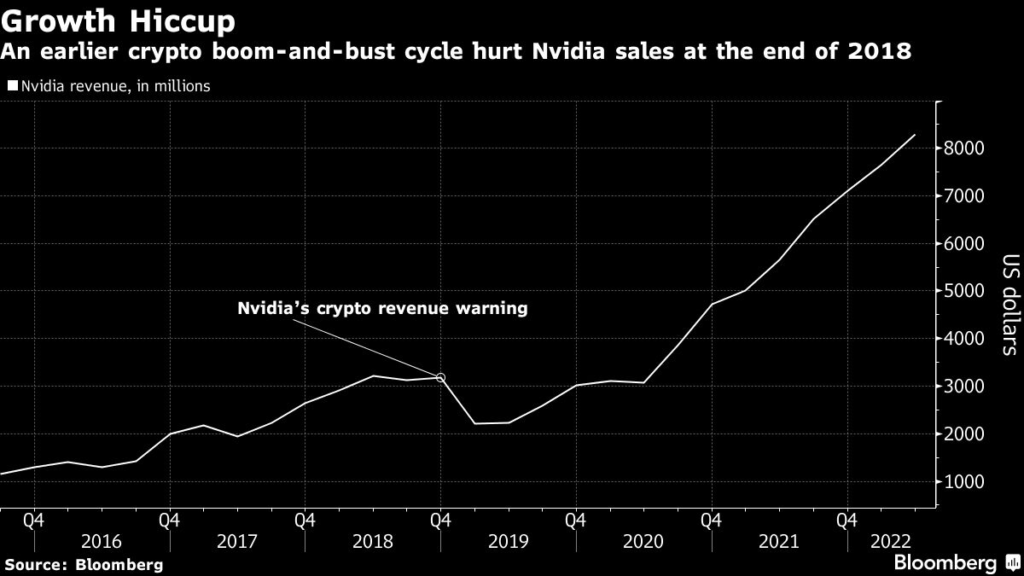
Nvidia has already spent years struggling with how to handle the crypto industry. Though demand from miners has helped fuel sales, the vagaries of the market suddenly made results harder to predict. That came to a head in late 2018 when the company blamed a crypto retreat for a weak forecast. Nvidia warned that revenue would be hundreds of millions of dollars lower than Wall Street projected, sending its shares down 20% in just two days.

The company didn’t want a repeat of that scenario, so it made its gamer GPUs — sold under the GeForce brand — less effective at mining. It also released a card designed for the crypto market that can’t be used for gaming. The product lacks the hardware needed to connect to monitors.

Even so, the Securities and Exchange Commission criticized Nvidia for not making its revenue sources clear enough to investors in previous quarters. In May, the agency fined the company $5.5 million for failing to adequately disclose the impact of crypto mining on its GPU sales. 

Meanwhile, sales of Nvidia’s new more-targeted crypto products have declined. In February, Nvidia said it had sold just $24 million of them in the fourth quarter, less about 1% of its total gaming-related sales in the period.

That suggests Nvidia’s days as a crypto supplier are already waning. Chief Executive Officer Jensen Huang has said that demand remains strong from gamers, as well as from data-center customers, which use its chips to power artificial intelligence. Nvidia’s total revenue has grown more than 50% in each of the past two years.

“The underlying dynamics of the gaming industry is really solid,” Huang said during the company’s latest quarterly conference call last month. 

That still leaves the company with the aftereffects of the crypto boom. Baird’s Gerra estimates that as much as 35% of consumer graphics cards were bought by miners during the run-up. And many of them are hitting secondary markets — and potentially eating into Nvidia’s sales. 

In the past two months, the price of Nvidia’s GeForce 3080 model fell from $1,100 in late April to $793 on EBay, according to data from MarkSight. That’s good news for gamers, who can now get their hands on the hardware without paying a massive premium or waiting in long lines outside electronics stores.

“With less crypto demand, speculators have also withdrawn from the market,” industry researcher Jon Peddie said.

And the mining market is unlikely to stage a comeback soon. Instead of using computers to generate Ethereum tokens, the technology is shifting to a bidding process. New allotments will be given to those who put up some of their existing holdings as collateral.

On the plus side, the loss of crypto customers will make it easier to gauge demand from Nvidia’s traditional buyers, Baird’s Gerra said.

“Once that’s gone, it’s a black hole that’s gone away,” he said.

More stories like this are available on bloomberg.com

©2022 Bloomberg L.P.

Russian Hackers Target Norway in Latest Volley of Cyber Attacks

(Bloomberg) — Russian hacker group Killnet targeted a string of Norwegian public service websites in the latest digital salvo against NATO member countries.

Norway’s National Security Authority has been assisting a series of organizations in dealing with targeted cyber attacks from an alleged pro-Russian group, Director General Sofie Nystrom told reporters on Wednesday. Some websites experienced instability or disruption, but there are currently no indications that any sensitive or personal information has been compromised. 

The public administration portal, the corporate page of an online banking identification service and the Norwegian Labor Inspection Authority were among those affected by so-called distributed denial-of-service attacks. The website of Norway’s largest newspaper was also down for 25 minutes, it reported on Wednesday.

Other NATO members have faced similar attacks, with Lithuania’s defense chief saying on Wednesday that the Baltic nation has come under an unprecedented cyber attack this week after the government announced it would start blocking the transit of sanctioned goods to the Russian exclave of Kaliningrad.

Norway has itself also refused the transit of sanctioned Russian goods bound for the archipelago of Svalbard via its mainland ports as part of the measures implemented after the invasion of Ukraine. A shipment of two containers that was blocked last week included spare parts for ships and vehicles, TV2 reported. 

Norway has sovereignty over Svalbard, according to a 1920 treaty, but signatories have equal rights to carry out commercial activities there.

More stories like this are available on bloomberg.com

©2022 Bloomberg L.P.

China Tech Investor Defies Skeptics With $900 Million Fundraise

(Bloomberg) — Venture firm IDG Capital is poised to raise about $900 million for a new fund focusing on investment in China, a rare feat amid skepticism about the political and market risks of Asia’s largest economy. 

Most investors are existing backers of IDG, which has been putting money into Chinese technology firms for nearly three decades, according to people familiar with the matter, who asked not to be named because the matter is private. The new fund will focus on technology startups, the people added.

The fundraising stands out as venture capital firms in China are struggling to raise cash amid the nation’s regulatory crackdown on private enterprise and an economic slowdown brought on by the pandemic. Putting aside this year’s stock rally, China is still weathering a decline in venture capital investments, despite once being touted as a primary rival to Silicon Valley.

IDG declined to comment in an emailed statement.

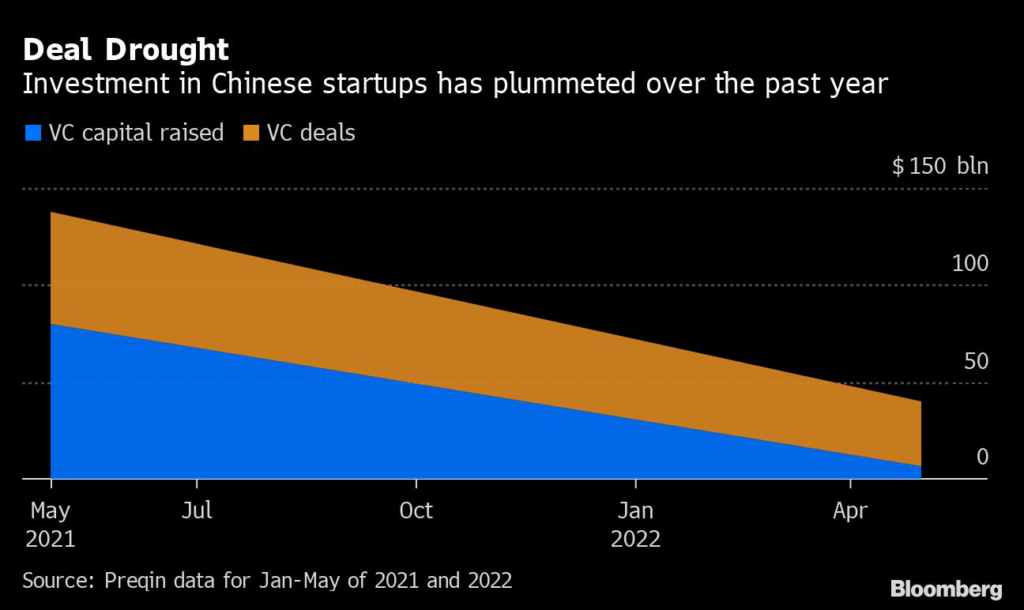
The value of deals in the country fell roughly 40% from a year ago to $34 billion in the first five months of 2022, according to data from the research firm Preqin. Meanwhile, venture capital and private equity funds raised $6.2 billion, a fall of more than 90% compared to the first five months of last year.

Chinese tech stocks have taken a beating in the past year, driving down valuations in the industry, and spurring risk averse investors who still want the exposure to allocate money into the country’s top investment outlets instead of less established ones. 

IDG Capital has been investing in China since 1993, making bets on companies including Baidu Inc., SenseTime Group Inc., Xiaomi Corp and Tencent Holdings Ltd. It’s invested in more than 1,300 companies, with 400 successful exits, according to the company’s website.  

More stories like this are available on bloomberg.com

©2022 Bloomberg L.P.

Real Incomes Fall For Fourth Quarter in a Row: The London Rush

(Bloomberg) — Here’s the key business news from London-listed companies this morning.

UK House Prices:  House prices growth in the UK has slowed more than was expected this month, following a series of rate hikes from the Bank of England 

  • Meanwhile, UK Real Household Incomes fell for a fourth consecutive quarter at the start of 2022, the longest run of declines since records began in 1955

Bunzl Plc: The distribution business upgraded its guidance for the full year, saying strong revenue growth and contribution from its recent acquisitions will lead to higher margins.

  • While they’ve seen a decline in sales for some of the products related to the coronavirus pandemic, that will only partially offset growth in its core business 

Thames Water Utilities Limited: The UK’s largest water provider has approved a plan to spend £2 billion more than previously agreed to “accelerate delivery” of its turnaround.

  • Shareholders will subscribe to about £500 million of new equity, with plans to provide a further £1 billion of equity funding

Virgin Money UK Plc: The bank will buy £75 million worth of shares in its first-ever share buyback, in a bid to boost capital returns.


Outside The City

The UK will almost double the military support it is giving to Ukraine, with an extra £1 billion to help the country move beyond defense towards offensive operations against Russia.

EU’s chief Brexit negotiator Maros Sefcovic said he won’t consider a hard border on the island of Ireland and suggested the UK’s plan to override the part of the Brexit deal governing trade in Northern Ireland may harm European cooperation on financial services. 

Meanwhile, Europe’s travel chaos is extending further into the summer with London Heathrow and Paris Charles de Gaulle airports are cutting more flights. 

In Case You Missed It 

Yesterday the UK sanctioned Vladimir Potanin, Russia’s richest man and the president of  MMC Norilsk Nickel PJSC, in a measure that has sparked fears over the supply of metal.

Unilever Plc said it would sell its Israeli arm of Ben & Jerry’s following a storm of criticism when the ice cream brand said it would halt sales in Jewish West Bank settlements.

If you’re planning a trip to South Korea, the United Arab Emirates or Ireland, you’re in luck. They’re the three best places to be as the world enters the next phase of Covid era, according to Bloomberg’s Covid Resilience Ranking. The UK fell eight places to 22nd in June, but it is still ahead of Germany and the US.

Looking Ahead

UK mortgage approvals data could reveal further signs of a property market slowdown tomorrow amid higher borrowing costs.

Company earnings are in a quieter period until they heat up again towards the middle of next month. 

For a news fix when the day is done, sign up to The Readout with Allegra Stratton, to make sense of the day’s events.

More stories like this are available on bloomberg.com

©2022 Bloomberg L.P.
Bear Market Looms for Taiwan Stocks After a Chipmaker-Led Slump

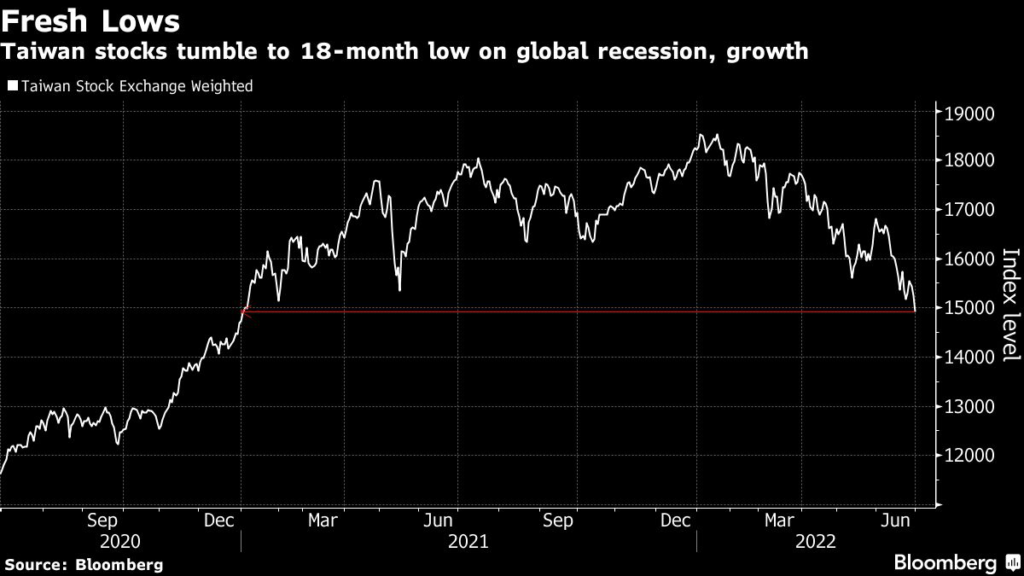
(Bloomberg) — Taiwan’s stock benchmark index slumped on Thursday, taking its decline from a January high to over 19% and just points away from a so-called bear market.  

The Taiex gauge closed 2.7% lower in Taipei, the worst performer in Asia. It was dragged by chipmakers after Bank of America took a cautious view on the industry’s growth prospects. Taiwan Semiconductor Manufacturing Co., which accounts for more than a quarter of the index’s weighting, dropped 3.1%.

Facing headwinds of rate hikes by global central banks, tech-heavy stock markets in Taiwan and Korea have been the worst performers in Asia this quarter, both down over 15%. Foreign investors have net sold about $16 billion of Taiwan stocks during the three-month period, the most among emerging Asia countries outside China. 

Taiwan’s deputy finance minister said the National Financial Stabilization Fund will continue to closely monitor the stock market to see if it needs to step in. Taiwan Stock Exchange also said in statement that it will adopt stabilizing measures if needed when there are “irrational” declines in the stock market.

Societe Generale SA Thursday downgraded Taiwan stocks to underweight from neutral, citing external risks including tighter financial conditions and global growth slowdown fears. 

“Global tech stocks are facing P/E re-rating, mainly due to recession and inflation concerns,” said Diana Wu, senior manager at Capital Securities Corp. “It’s a global issue as rate hikes normally hit tech stocks. Investors are withdrawing cash from TSMC and other Taiwan tech stocks.”


(Updates with closing prices throughout and analyst downgrade in the sixth paragraph)

More stories like this are available on bloomberg.com

©2022 Bloomberg L.P.

UAE Agritech Startup Raises $180 Million for Asia Expansion

(Bloomberg) — Sign up for our Middle East newsletter and follow us @middleeast for news on the region.

United Arab Emirates-based Pure Harvest Smart Farms raised $180.5 million in its biggest ever fundraising, from backers including the billionaire Olayan family, which runs one of Saudi Arabia’s largest conglomerates.

The firm, which already has farms in the UAE and Saudi Arabia, will use the funds to expand in the Middle East and enter new markets in Asia. It grows produce including tomatoes and strawberries in controlled environments to protect crops from harsh outdoor conditions while also limiting water use.

Other investors include Britain’s Metric Capital Partners and South Korea’s IMM Investment Corp., the company said in a statement. The latest round, structured as a convertible financing, brings the total amount raised by Pure Harvest to $387.1 million.

Mostly dependent on imported food, governments in the Middle East have put increasing focus on food security in the wake of the coronavirus pandemic and Russia’s invasion of Ukraine. The war has sharply reduced exports from Ukraine, while the blockade of key Black Sea ports has exacerbated supply-chain turmoil, sending global food prices soaring.

Read More: Templeton Joins Funding for Agritech Firm Trying to Tame Desert

“While climate change is threatening traditional food systems, we’ve seen an opportunity in import-reliant regions experiencing massive population growth to offer a sustainable product, with tangible food security benefits at a new price point,” Pure Harvest founder and Chief Executive Officer Sky Kurtz said in an interview.

The company is looking to use additional debt and project financing to more than double the capital raised in the latest round and is aiming to expand in Singapore, Korea, Indonesia, Malaysia and the Philippines.

“Eventually we see the business as getting to the stage where an IPO on a major international exchange and potentially a dual listing in the Middle East or Asia, as a way for our investors to get an exit,” Kurtz said.

Pure Harvest already has four farms operational in the UAE and one in Saudi Arabia, covering about 22 hectares. Over the next 18 months, the company will more than double the area of land its farms cover with expansions in Kuwait and Saudi Arabia, he said.

More stories like this are available on bloomberg.com

©2022 Bloomberg L.P.
Lenskart in $400 Million Deal to Create Asian Eyewear Giant

(Bloomberg) — Lenskart is buying a majority stake in Japan’s Owndays Inc. in a deal that will create one of Asia’s biggest online retailers of eyewear.

The Indian startup backed by SoftBank Group Corp. has agreed to buy Owndays shares held by L Catterton Asia and Mitsui & Co. Principal Investments, the companies said in a statement. The deal values the Japanese chain at about $400 million, a person familiar with the transaction said, asking to remain anonymous discussing an undisclosed detail. Owndays will operate as a separate brand led by co-founders Shuji Tanaka and Take Umiyama, but target the premium segment, while Lenskart focuses on the middle and mass market segments, they said.

Lenskart will own a majority stake in Owndays but the deal is designed as a merger, the Indian company said. A spokesman declined to comment on the size of the deal.

The move will create a retail giant with operations in more than a dozen markets from India and Japan to Southeast Asia. Lenskart, which uses technology and supply chain automation to directly sell eyewear to consumers, will lean on Owndays to expand its presence in physical retail.

“About 4.5 billion people globe-wide need to wear prescription glasses but only half of them do,” said Peyush Bansal, Lenskart’s 38-year-old co-founder and chief executive officer.  “We are seeing a $50 billion to $100 billion opportunity and a real chance to build an Amazon for eyewear.” 

Lenskart should reach profitability when it hits $400 million in sales in the year ending March 2023, Bansal estimated. The two companies project combined sales of $650 million in that period, he said. His startup, which was founded in 2010 and backed by Falcon Edge Capital, KKR & Co., Temasek Holdings Pte and PremjiInvest, grew 65% last year and is projected to surpass that this year, Bansal said on a video call.

Read more: SoftBank-Backed Lenskart Raises $220 Million as India Tech Booms

Bansal graduated in engineering from McGill University in Montreal and worked at Microsoft Corp.’s headquarters before returning to India. He co-founded Lenskart Solutions Pvt in 2010 in the dusty, industrial town of Faridabad outside New Delhi with three others he met on LinkedIn.

It’s since grown into the country’s largest optical brand, shipping over 10 million pairs of eyewear annually, offering facial analysis-driven recommendations on its mobile app and home vision tests.

Tokyo-headquartered Owndays was founded in 1989 and opened its first overseas stores in 2013.  It currently operates 460 stores in a dozen countries besides Japan, selling over 2.5 million pairs of glasses annually. L Catterton and Mitsui acquired Owndays in November 2018 for an undisclosed sum. 

Read more: Longreach, Navis Capital Said In Talks for Eyewear Chain Owndays

L Catterton was formed as a partnership between Catterton, luxury goods brand LVMH and Groupe Arnault. Its Asian arm had been mulling a sale of the Japanese chain for more than a year. At one point, Owndays’s owners were in exclusive negotiations with private equity firms Longreach Group and Navis Capital, Bloomberg News has reported. 

In June, it sold $360 million worth of minority interests to accounts managed by Hamilton Lane and other institutional investors, a move that raised capital for the Asia unit to be redeployed in new investments.

A public listing for the newly enlarged Lenskart is at least 36 months away, Bansal said. The company is now building what it says is the world’s largest eyewear manufacturing plant northwest of Delhi. The $150 million factory will ship 50 million pairs of eyewear annually, Bansal said.

“Digital transformation is the key to our next phase of growth in the post-pandemic operating environment,” Owndays co-founder Tanaka said in the joint statement.

(Adds Owndays valuation in second paragraph)

More stories like this are available on bloomberg.com

©2022 Bloomberg L.P.
Samsung Is First to Start Mass Production of 3-Nanometer Chips

(Bloomberg) — Samsung Electronics Co. kicked off mass production of 3-nanometer chips that are more powerful and efficient than predecessors, beating rival Taiwan Semiconductor Manufacturing Co. to a key milestone in the race to build the most advanced chips in the world.

South Korea’s largest company will begin with 3nm semiconductors for high-performance and specialized low-power computing applications before expanding to mobile processors, it said in a statement on Thursday. By applying so-called Gate-All-Around transistor architecture, Samsung’s 3nm products reduce power consumption by up to 45% and improve performance by 23% compared to 5nm chips, it said.

Samsung shares were down about 1% in Seoul on Thursday, in line with the KOSPI benchmark.

Samsung’s push to be first to market with the latest technology is essential in its uphill climb to match TSMC, which remains dominant in the contract chipmaking, or foundry, market. The Taiwanese firm accounts for more than half of the global foundry business by revenue and is the exclusive supplier of Apple Inc.’s Silicon processors for iPhones, iPads, MacBooks and desktop Mac PCs.

TSMC and Samsung are competing for large multiyear orders from the likes of Apple and Qualcomm Inc. 3nm mass production from the Taiwanese chipmaker will commence in the second half of the year, TSMC has said. Samsung will produce 3nm chips at its Hwaseong facilities and is expected to extend that production to its newest Pyeongtaek fab.

“We will continue active innovation in competitive technology development and build processes that help expedite achieving maturity of technology,” said Siyoung Choi, president and head of Samsung’s foundry business.

What Bloomberg Intelligence Says

Samsung’s launch of 3nm node chip production, based on a new-generation transistor architecture, shouldn’t affect TSMC’s market share and sales growth in the next 12 months. Despite stronger performance, Samsung’s 3nm chip needs to demonstrate it can be produced at the same cost-efficiency level as TSMC’s most advanced N3 process before it can gain new orders from Apple, Qualcomm and other large chip designers.

— Charles Shum, BI analyst

Click here for the full research

Samsung’s advance comes at a sensitive time for the semiconductor industry, whose place in the global geopolitical order is currently under scrutiny by leading governments. The US and China have both taken steps to bring more chipmaking capacity and expertise within their borders — arguing it’s a matter of national security — and Samsung is in the process of setting up a new fabrication facility in Texas.

President Joe Biden took a tour of Samsung’s plant in Pyeongtaek last month and underscored semiconductor alliances as part of his agenda to strengthen international supply chains and stem chip shortages while also reducing reliance on China. 

Eric Schmidt Urges US to Lean on TSMC, Samsung for Chip Security

(Updates with share price and analyst comment)

More stories like this are available on bloomberg.com

©2022 Bloomberg L.P.

Close Bitnami banner
Bitnami