Bloomberg

Three Arrows Reprimanded by Singapore Over False Information

(Bloomberg) — Three Arrows Capital, the crypto hedge fund ordered to liquidate after failing to repay creditors, was reprimanded by the Monetary Authority of Singapore for providing false information and exceeding the maximum amount of money it was allowed to manage. 

The central bank said in a statement on Thursday that Three Arrows had obtained a local registration in 2013 that allowed it to manage up to S$250 million ($180 million). Three Arrows breached the limit on assets under management from July 2020 to September 2020, and from November 2020 to August 2021, MAS said.  

A British Virgin Islands court this week ordered Three Arrows into liquidation, after the fund failed to repay borrowings it amassed to fuel investments in everything from Bitcoin to the ill-fated Luna token. Three Arrows became the latest casualty of a selloff that’s wiped about $2 trillion from the value of digital assets since late last year. 

Crypto Hedge Fund Three Arrows Set for Liquidation (1)

Three Arrows also told MAS that it had “novated” management of its fund to an “unrelated offshore entity” in the BVI effective Sept. 1, 2021. That was misleading as Three Arrows co-founder Su Zhu was a shareholder of both entities and is a director of Three Arrows, according to the statement. 

“In light of recent developments which call into question the solvency of the fund managed by TAC, MAS is assessing if there were further breaches by TAC of MAS’ regulations,” the regulator said.

Zhu and Solitaire, a law firm representing Three Arrows, didn’t immediately respond to messages seeking comment.


(Updates with efforts to reach Zhu and Three Arrows law firm in final paragraph.)

More stories like this are available on bloomberg.com

©2022 Bloomberg L.P.

China’s Tech Stocks Are Most Attractive in World, Invesco Says

(Bloomberg) — China is the best place to buy tech stocks as valuations in the US remain too high to be attractive, according to Invesco Ltd.

Beijing’s crackdown on everything — from tech to property and online education — sparked a year of heavy selling that wiped out almost $2 trillion from the Hang Seng Tech Index at the height of the rout. That’s now reversing as loose monetary policy and an improving growth outlook outweighs concerns about the country’s Covid Zero policy, the firm’s Global Head of Asset Allocation Research Paul Jackson said in an interview.

The slump “opened up a valuation point where the market is trading in a low range historically and, in absolute terms, at almost half compared to the US,” said Jackson at Invesco, which oversees about $1.45 trillion in assets. “If you’re going to buy tech stocks, it’s best to do so in China.”

Read More: JPMorgan Sees China as Equity ‘Safe Haven’ Due to Policy Easing

Equities in the world’s second-largest economy have outperformed the US and Europe in recent weeks as pandemic restrictions are relaxed, while the Hang Seng index of Chinese tech shares has surged 12% this month as authorities signaled a more lenient stance toward the sector. Invesco’s optimism adds to bullish calls on China tech from JPMorgan Asset Management, Morgan Stanley and Jefferies Financial Group.

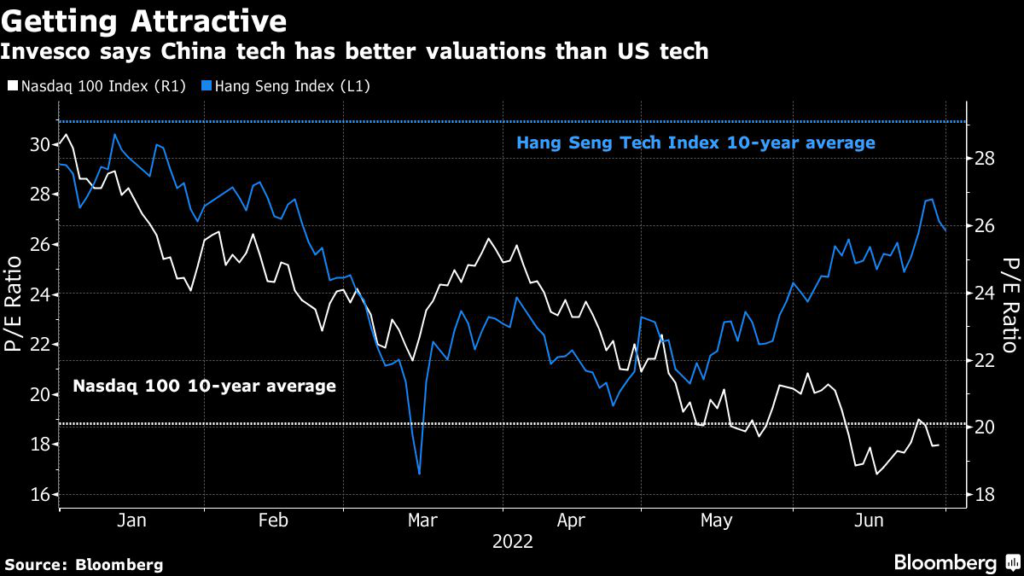
Even after recent gains, China’s tech stocks are still cheap compared to historical averages, with the Hang Seng Tech index trading at 27 times its forward price-to-earnings ratio compared with a 10-year average of 32 times, according to data compiled by Bloomberg. The Nasdaq 100 is trading at nearly 20 times on the same basis, about in line with its historical average.

The outlook for stocks in Europe and the US is less rosy, according to Invesco. “Usually when markets dip it’s time to buy, but that feels uncomfortable now that we are getting so close to a recession,” Jackson said. As a result, he is slightly underweight equities and overweight sovereign debt for the first time since 2016.

Central banks from the US to Australia are struggling to curb soaring inflation even with aggressive interest rate hikes. That’s left tech stocks particularly battered and most major economies facing potential recessions. Equity markets in general are buckling under the weight of these worries, with the S&P 500 on course to post its worst first half since 1970. 

Though Jackson is impressed by how well earnings have held up so far, rising commodities costs and wages are pressuring margins. “I’ll be surprised if we continue to see the corporate sector sailing through,” he said.

While the wider technology industry in the US appears overpriced, profitability at Big Tech firms including Alphabet Inc. looks more secure because they are less labor-intensive and have fewer costs as a result, Jackson added. The same applies to health care firms, he said.

Jackson isn’t keen on businesses with thin margins like retailers, airlines, food-delivery and car companies. 

More stories like this are available on bloomberg.com

©2022 Bloomberg L.P.

Will Big Tech Protect Abortion Seekers? Investors Want to Know

(Bloomberg) — In a post-Roe world, the privacy of people seeking abortions is shaping up to be the next battleground for big technology companies. 

Some investors who support reproductive rights want to know what steps — if any — technology and telecommunication companies will take to protect the data of those looking to terminate pregnancies in states where abortion is now illegal or highly restricted, after the US Supreme Court overturned a 50-year-old case that offered federal protection. 

As a result of the decision, companies like Alphabet Inc.’s Google could face increased pressure from authorities to provide data on anyone suspected of attempting to get an abortion in another state, according to Rhia Ventures, a group that advocates for corporate support for reproductive rights. The quest for data could even extend to women who have miscarried, since they would experience similar medical outcomes to those who have taken an abortion pill, said Shelley Alpern, director of corporate engagement at Rhia. 

“Prosecutors are going to want to come after their search histories, location data, all that sort of thing,” Alpern said. 

Technology companies already respond to thousands of requests for data from law enforcement officials each year and reject very few of them. In the first half of last year, Google received almost 70,000 requests from subpoenas, search warrants and other government queries. Requests covered more than 115,000 accounts, according to the company’s transparency report.

Verizon Communications Inc. and AT&T Inc. said they each received more than 100,000 requests for information in the second half of last year. Google, Verizon and AT&T declined to comment on whether that policy might change for abortion law enforcement requests.

States where abortion remains legal have been taking their own steps to bolster support for women from areas where it is not, including a focus on data sharing. Washington Governor Jay Inslee pledged over the weekend to block hardline anti-abortion jurisdictions from learning who travels to the state for the procedure.

Abortion Support

JPMorgan Chase & Co., Facebook owner Meta Platforms Inc. and Starbucks Corp. are among the companies that have pledged to cover costs for employees seeking out-of-state abortions, yet that may not be the case for a majority of American firms.

Of the 350 human resources executives surveyed in late May by consultancy Gartner, 60% said their companies wouldn’t add any new policies in response to changing laws. Fewer than 10% said they would pay for some or all of employee travel costs for an abortion. Meanwhile, Texas lawmakers have warned companies may violate state law if they assist employees in traveling to another state to terminate a pregnancy. 

Earlier this month, Rhia convinced about a third of investors at Lowe’s Cos. and those at TJX Cos. to support a request for the companies to report on the risks to their workforces if abortion were made illegal. At Walmart Inc., where the Walton family controls about 47% of shares, only 13% of investors indicated their support for the proxy proposal. TJX and Lowe’s declined to comment on whether they will engage with shareholders on the topic. 

Beyond responding to pro-choice investors, companies also face growing backlash from some conservative shareholders who see them as going too far in addressing concerns over environmental, social and governance issues. 

At annual meetings in April and May, the National Center for Public Policy Research — a conservative group that pushes for free-market solutions to policy issues — asked shareholders at a half dozen companies including AT&T, Citigroup and Twitter Inc. to support reports on the risks of diversity policies for employees who are not a member of a minority group. 

While the proposals failed to attract more than 4% support from any company, the center will likely continue to focus the broader corporate foray into taking positions on social issues, according to Scott Shepard director of the center’s Free Enterprise Project.

“We’re going to work with C-suites in the context of metaphorically shaking them by the ears and waking them up to all the unnecessary litigation risk, legislative risk, reputational risk, and activism risk that they’re opening themselves up to,” Shepard said.

Rhia is similarly redoubling its efforts. It has asked several companies to disclose their political and election spending related to access to reproductive health care, a proposal that garnered support from 44% of investors at AT&T Inc.

The company spent at least $16.4 million on politicians and organizations “working to weaken women’s access to reproductive health care” in the 2016 to 2018 election cycle, Rhia said in a regulatory filing in March ahead of the May meeting. AT&T said its donations are bi-partisan and are the result of its broad participation in the political process, according to the filing. 

“For companies, there’s no escaping they’re at a crossroads,” Rhia’s Alpern said. “They either take the moment to upgrade their policies and benefits or risk being seen by some portion of the talent pool as relics.”

More stories like this are available on bloomberg.com

©2022 Bloomberg L.P.

Grayscale Suing SEC After Its Bitcoin ETF Is Rejected

(Bloomberg) — Grayscale Investments said it had sued the US Securities and Exchange Commission after the agency rejected a bid to convert its Bitcoin trust into an exchange-traded fund. 

Chief Executive Officer Michael Sonnenshein tweeted late Wednesday that Grayscale was suing the regulator and the company said it had filed a lawsuit in US Court of Appeals for the D.C. Circuit.

The SEC on Wednesday denied the company’s application to convert its Grayscale Bitcoin Trust into the first ETF based on the world’s biggest cryptocurrency. The regulator found that the plan by NYSE Arca to list the product didn’t do enough to prevent fraud and manipulation. 

The SEC didn’t immediately respond to an emailed request for comment sent after normal business hours.

Grayscale, which filed its plan in October, had been hinting for months that it would sue if the application was rejected. 

Flipping GBTC into an ETF would have solved a persistent issue for Grayscale: the trust’s deep discount to its underlying holdings. Unlike an ETF, GBTC shares can’t be created and redeemed to keep pace with shifting demand. That’s effectively turned GBTC into a closed-end fund, with GBTC’s price trading 28% below its net-asset value. 

In a May meeting with US regulators, Grayscale argued that converting into an ETF would unlock as much as $8 billion in value for investors. 

In a statement, Donald Verrilli, a law partner at Munger, Tolles & Olson representing Grayscale, said that in rejecting the application the SEC was “failing to apply consistent treatment to similar investment vehicles” in violation of federal law. 

“We are deeply disappointed by and vehemently disagree with the SEC’s decision to continue to deny spot Bitcoin ETFs from coming to the U.S. market,” Sonnenshein, Grayscale’s CEO, said in the statement.

Bitcoin is on pace for its biggest quarterly decline in more than a decade. The largest cryptocurrency by market value fell about 6% to $18.985 as of 6:55 a.m. in New York, and is down around 58% since March, the biggest drop since the third quarter of 2011, when the digital asset was still in its infancy. 


(Updates to include quarterly returns for Bitcoin in the final paragraph.)

More stories like this are available on bloomberg.com

©2022 Bloomberg L.P.

Crypto Lender Genesis May Be Facing Loss of Hundreds of Millions: Report

(Bloomberg) — Crypto lender Genesis Trading is looking at a potential loss running into the “hundreds of millions” of dollars, CoinDesk reported, citing people it didn’t identify.

The losses at the top digital-asset lender are at least partially due to its exposure to Three Arrows Capital and Babel Finance, CoinDesk said in its report on Thursday.

Three Arrows is facing a liquidation case ordered by a British Virgin Islands court as the crypto-focused fund succumbed to a $2 trillion wipeout of the digital-asset market. The contagion that started with the collapse of the TerraUSD stablecoin last month is spreading fast, creating liquidity stress across the crypto complex — affecting lenders like Celsius Network and Babel Finance, crypto brokers including Voyager Digital and investors like Three Arrows.

Genesis didn’t immediately return an email seeking comment on the report.  

The precise amount of losses at Genesis, which is owned by Digital Currency Group, also the owner of CoinDesk, isn’t yet known as the company tries to salvage some of its losses by seeking partial repayments from counterparties. Some losses may have been offset through hedging, according to the report.

Genesis has been pulling credit lines from some counterparties, CoinDesk reported, citing another unidentified person.

(Updates with effort to reach Genesis in fourth paragraph.)

More stories like this are available on bloomberg.com

©2022 Bloomberg L.P.

Volkswagen Pulls Out All the Stops to Address China Challenges

(Bloomberg) —

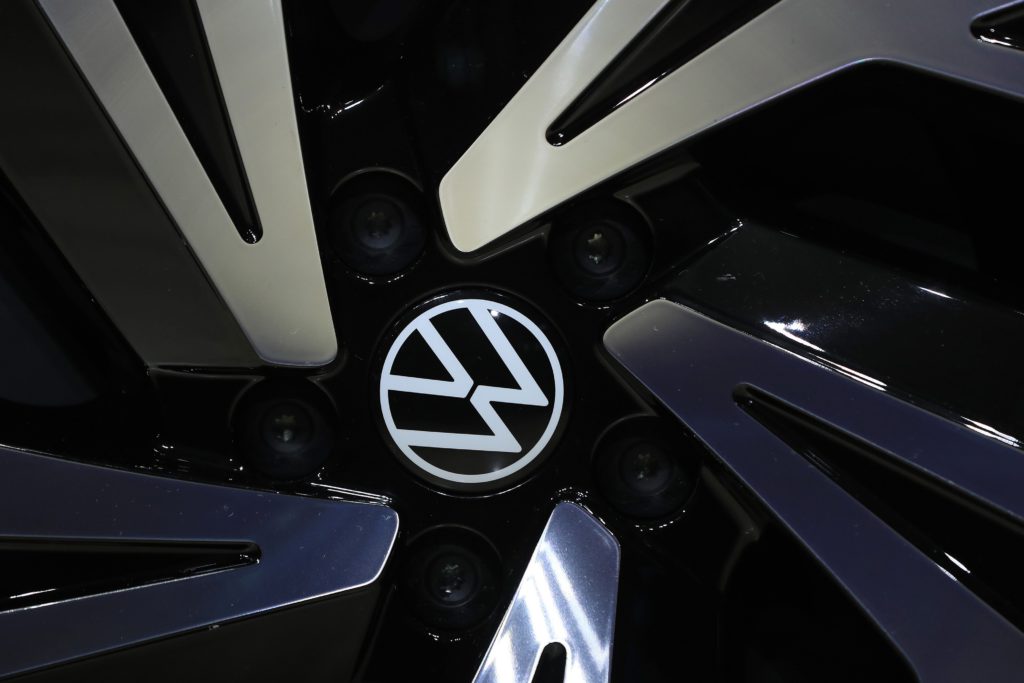
On April 11, 1983 in Shanghai, Volkswagen and its local partner assembled their first car in China, a boxy sedan called Santana. The model proved wildly popular, becoming a symbol of China’s rising middle class and cementing VW’s role as the country’s most prominent carmaker.

While Santana sales have since tapered off, it’s hard to overstate how important China still is for the VW group. The manufacturer delivered roughly 40% of its vehicles to the world’s biggest auto market in the first quarter. It employs more than 90,000 people in the country and operates over 40 vehicle and components factories along with partners.

Chief Executive Officer Herbert Diess called China the company’s “second home market” this week, telling workers VW’s business there generates more than 4 billion euros ($4.2 billion) in profit every year.

“A large part of our bonus is created in China,” Diess said in a speech to staff in Wolfsburg, Germany. “We are doing everything to defend our position there as market leader.”

Keeping that top spot looks increasingly challenging. Volkswagen’s sales in China have fallen from a peak of 4.2 million cars in 2018 to 3.3 million last year. Its premium brands like Porsche and Audi are still doing fine, but the VW marque has been giving up market share.

Local manufacturers including Li Auto, Nio and Xpeng are catching up fast, and they’re all-in on battery-powered cars. When Bloomberg Editor-in-Chief John Micklethwait asked Elon Musk about Tesla’s rivalry with Volkswagen last week, the CEO instead pointed to increasingly competitive Chinese EV makers.

The top domestic rival looks to be BYD, the Shenzen-based manufacturer backed by Warren Buffett’s Berkshire Hathaway. It’s on the cusp of entering the trillion-yuan market cap club after handling lockdowns, chip shortages and price increases better than many of its peers.

BYD may supply batteries to Tesla and is becoming more directly involved in lithium mining as it hopes to gain a long-term advantage in securing the key battery resource. BYD sold more than 320,000 EVs last year, while VW sold around 70,000 of its ID family of electric cars in China, well short of its internal target.

  • Do you own an electric car? US residents, Bloomberg Green wants to learn more about your experience with EVs. Take our brief survey.

VW is changing tack in the US to gain market share, mainly by focusing on cars made in America catered to local buyers instead of shipping over European-designed models. It will have to do more of that as well in China, where some buyers put more emphasis on connectivity and entertainment than pure driving performance.

“Who of you here would spend 200 euros on a karaoke function?” Diess asked his workers Tuesday. “For many Chinese, it’s standard — so we must deliver on that.”

VW is setting up a regional China board to make better and faster decisions for its brands. Diess is dispatching Ralf Brandstaetter, the head of the VW passenger-car brand, to oversee the board, while former Huawei adviser Marcus Hafkemeyer will lead technology and VW Russia executive Stefan Mecha will head up sales.

There’s one more issue that won’t easily be solved with personnel changes. In return for allowing VW to expand its Shanghai factory, the Chinese government asked the carmaker to also set up shop in Xinjiang to bolster economic development in the northern province.

VW faces mounting pressure to address allegations that ethnic Uyghurs are suffering from coercive labor practices in the region. Two board members have recently voiced concerns. VW’s local partner in charge of its Xinjiang factory, SAIC, has said no workers are mistreated. Diess’s view is that VW’s presence in the region can be a force for good.

But the automaker is now facing pushback from the German government. Berlin recently declined a VW request to renew risk insurance for the company’s Chinese operations over human rights concerns, according to a person familiar with the matter. The rejection reflects a shift in tone on China, which became Germany’s biggest trading partner outside the European Union over the past two decades.

Diess is under pressure to address the issue himself. On Tuesday, he vowed to visit the Xinjiang plant as soon as Covid conditions allow. Just don’t expect VW to scale back its ambitions in the country.

“We’ll continue to invest heavily in China,” Diess said. “We’ll keep benefiting from its know-how and speed.”

More stories like this are available on bloomberg.com

©2022 Bloomberg L.P.

China AI Giant SenseTime Dives as Much as 51% as Lockup Expires

(Bloomberg) — Chinese artificial intelligence software maker SenseTime Group Inc. slumped as much as 51% in Hong Kong on Thursday, after a lock-up of its shares expired following its December initial public offering.

The shares ended the day down 47% at HK$3.13, their lowest ever, and below their IPO price of HK$3.85. A lock-up on a portion of the stock owned by cornerstone investors and shareholders — amounting to 23.4 billion of shares — expired on Wednesday.

“SenseTime’s average liquidity looks very low, and it’s also subject to US sanctions. That means its investor base is probably more concentrated, so the impact of lockup expiry is higher,” said Vey-Sern Ling, senior analyst with Union Bancaire Privée.

SenseTime joins a list of technology companies that have seen insiders selling their shares after a strong rebound since mid-March. This week, Tencent Holdings Ltd.’s major backer announced it will further cut its stake in the company. In May, JD Health International Inc.’s controller Richard Liu sold his stake in the company. 

Selling pressure is not removed for SenseTime as another block of shares owned by its shareholders is set to expire near the end of this year, Bloomberg-compiled data show. 

The selloff shows that stakeholders are not optimistic on SenseTime’s outlook, said Marvin Chen, a strategist at Bloomberg Intelligence. “There were concerns on growth outlook and earnings potential during the IPO. Also, early IPO investors in SenseTime should have been well aware of the potential risks and volatility due to potential US blacklists and bans.” 

Chen does not think SenseTime’s move has broad implications on China tech. 

SenseTime, China’s most valuable private AI firm, was one of the highest-profile targets of sanctions from Washington aimed at containing China’s tech rise. Like Huawei Technologies Co. and Semiconductor Manufacturing International Corp., the company was regarded as a national champions, a leader in a burgeoning field considered key to establishing China’s tech credentials globally. 

SenseTime’s plummet takes the on-paper loss for SoftBank’s Vision Fund, which holds about 4.7 billion shares, to about $1.5 billion in a single day, Redex Research analyst Kirk Boodry estimated.

Bloomberg reported in December that SenseTime secured funding from nine cornerstone investors including state-backed Mixed-Ownership Reform Fund and Shanghai Xuhui Capital Investment Co. When it raised about HK$6.6 billion ($851 million) in the IPO, SenseTime allocated about 60% of the offering to cornerstone investors, who were subject to lockup periods.

SenseTime went public at the end of December after the original share-sale schedule was derailed after a move by the US Treasury Department to sanction the company for its alleged role in creating facial-recognition software used in the oppression of Uyghur Muslims in the Xinjiang autonomous region of western China.

READ: How Huawei Landed at the Center of Global Tech Tussle: QuickTake

(Updates with closing price and adds more details in the penultimate paragraph. An earlier version of the story corrected number of shares in second paragraph.)

More stories like this are available on bloomberg.com

©2022 Bloomberg L.P.

Former Amazon Logistics Executive to Lead Digital Pharmacy Alto

(Bloomberg) — Former Amazon.com Inc. executive Alicia Boler Davis will take over as chief executive officer of Alto Pharmacy Inc., the company said Thursday. 

Boler Davis will start on Sept. 1, Alto said in a statement. She takes over from co-founders Matt Gamache-Asselin and Jamie Karraker, who were leading the company after the previous CEO Kevin Burns exited less than a year after his appointment to rejoin yogurt maker Chobani LLC.

“Alto is in the business of improving health, not just fulfilling and delivering prescriptions,” Boler Davis said in a statement. “I am proud to join Matt and Jamie and lead Alto on its mission to improve the pharmacy experience for everyone.”

San Francisco-based Alto is one of numerous upstarts trying to take on bricks-and-mortar pharmacies. The companies offer slick mobile apps and home delivery services, which they say are a better option than the traditional model of going to a store. Incumbents Walgreens Boots Alliance Inc. and CVS Health Corp. also bolstered their digital offerings during the pandemic. 

Boler Davis will bring Amazon’s logistics prowess to Alto. She most recently served as Amazon’s senior vice president of global customer fulfillment, overseeing the e-commerce behemoth’s logistics warehouses. She was one of two top Black executives who exited Amazon this month. 

Gamache-Asselin and Karraker will no longer hold titles within Alto, but will remain on its board of directors. 

Privately-held Alto has raised more than $550 million since it was founded in 2015, according to data from PitchBook. The company counts SoftBank Group Corp. among its investors.

More stories like this are available on bloomberg.com

©2022 Bloomberg L.P.

Hedge Funds Spawned by Hillhouse Burned in China Rout

(Bloomberg) — For years, it’s been one of the best calling cards that hedge fund startups in Asia could ask for: getting support from billionaire Zhang Lei or gaining experience at his Hillhouse Capital Group.

After leveraging that Hillhouse pedigree to raise a combined $20 billion, the offshoot funds are losing some of their luster. Most have posted double-digit declines this year on the same Chinese tech, consumer and health-care sectors that Hillhouse itself backed to mint so many millionaires.

None of the nine Hillhouse next-generation funds Bloomberg tracked has been spared. Franchise Capital Management lost two-thirds of its value in the 14 months to April, according to a newsletter sent to investors. Brilliance Asset Management’s flagship fund dropped 27% in the first four months of 2022, according to people familiar with the matter, while a retail version dropped 47% from a February 2021 peak to June 2. CoreView Capital Management and Snow Lake Capital also had losses.

While most funds with sizable China exposure have suffered, the Hillhouse offshoots have been particularly hard hit. Several of them easily exceeded the 9% drop in a Eurekahedge index for the first four months of the year. That same gauge that tracks Asia stock hedge funds eked out a gain in 2021, unlike half of the Hillhouse progeny.

“Some hedge funds were early to grasp the opportunities in tech stocks — unfortunately, many held on for far too long when fortunes turned against them,” said Andrew Beer, founder of New York-based Dynamic Beta Investments, which seeks to replicate hedge fund returns. “The shocking magnitude of drawdowns among some stock-picking hedge funds calls into question whether they were ever hedged at all.”

The losses are a painful reversal for the funds, which have had success in recent years in part by focusing on some of the same industries as Hillhouse, the investment giant Zhang founded 17 years ago with $30 million from Yale University’s endowment fund. 

Thanks to winning bets on firms like JD.com Inc., Meituan, Sea Ltd., Tencent Holdings Ltd.  and Zoom Video Communications Inc., Hillhouse — named after a street on the Yale campus — became an investment behemoth with $106 billion in assets at the end of 2021. That makes it one of the biggest asset managers in Asia.

Given Zhang’s track record, a Hillhouse connection helped hedge fund entrepreneurs start their own firms, much like the Tiger Cubs in the US, whose founders cut their teeth at Julian Robertson’s Tiger Management. (The Tiger Cubs are also getting whacked this year by the tech plunge.)

Like Hillhouse, the funds know their industries inside-out, according to an investor with knowledge of most of them. When confronted with corrections in core positions, they have tended to dig in or double down rather than cut losses and flee like more active-trading rivals.

The funds often share Hillhouse’s fondness for long-term, gutsy bets, and it’s not unusual for them to select stocks like JD.com and GDS Holdings Ltd. that have counted Hillhouse as a top shareholder, according to regulatory filings since June 2021. Until recently, that’s been a winning formula, with some of the acolyte funds posting returns as high as 203% in better years.

That strategy is now being put to the test by policy shifts. Chinese stocks in industries from e-commerce to tutoring have been hammered by regulatory tightening, while the US has threatened to delist Chinese companies over access to audits. These moves, combined with a global tech rout, have contributed to a 67% drop in the Nasdaq Golden Dragon China Index since February 2021. The index has rebounded from a nine-year low in March, providing potential relief to the funds.

China Bets

The Hillhouse offsprings’ bets such as TAL Education Group, New Oriental Education & Technology Group Inc. and Chinese cosmetics company Yatsen Holding Ltd. have lost more than 90% of their value in the past 16 months, among the biggest decliners of the Golden Dragon gauge. 

“Hedge fund managers are paid a ton precisely because investors expect them to step off the tracks before the train hits,” said Beer. “Here, it looks like a whole group of funds was convinced trains were obsolete.”

Firms across the region are feeling the pinch. Net outflows for Asia hedge funds excluding Japan were about $3.6 billion in the first four months of the year, compared with net inflows of $8.1 billion for all of 2021, according to figures from Eurekahedge.

While not immune to the carnage, Hillhouse has invested in a wider array of countries and industries than its progeny, backing global firms like Salesforce Inc. and Mondelez International Inc. The fund has posted annualized returns of 28% before fees from 2005 to the end of 2021, according to a person familiar with the matter. 

Still, assets at its $62.7 billion HHLR Advisors Ltd. unit — the public investment arm — declined 9% last year, in part due to investment losses. And some of its biggest holdings have seen steep declines this year. Health-care firm BeiGene Ltd. is down 46%, while Doordash Inc. has dropped 58% to June 10. Hillhouse began investing in BeiGene before it went public, and the shares are still well above the IPO price.

Here are details on returns and snapshots of some of the bigger funds:

Franchise

Founder Simon Wang, a former Hillhouse analyst specializing in finance and real estate, has focused his $900 million hedge fund on technology, consumer and healthcare, according to an April newsletter seen by Bloomberg News. 

Franchise has been one of the top holders of Chinese education company Gaotu Techedu Inc. Even after the July clampdown by Beijing, Franchise added to its Gaotu position into the fourth quarter, before starting to cut it early in 2022, according to Bloomberg data based on regulatory filings.

More than half of Franchise’s 24 US-listed stocks as of March 31 have lost 40% or more of their value this year, according to a regulatory filing. They included e-commerce giants Sea, Shopify Inc., and Bilibili Inc., the live-streaming platform.

Wang blamed the deep losses on the “huge” correction in growth stocks, especially the fund’s key US-listed positions, poor “exposure control” and “lack of attention to business, organization and valuation,” according to the newsletter.

Still, investors who have stayed with Franchise from inception in 2015 have more than doubled their money even after the recent hemorrhage.

Brilliance

Former Hillhouse analyst Shi Lin struck out on his own in 2013 with $5 million and three analysts, eventually becoming a $6.1 billion firm with offices in Hong Kong and Beijing, according to a profile for a UBS Group AG event this year. 

Brilliance’s flagship fund plunged last July, prompting an apology from Shi for failing to quickly grasp the impact of Beijing’s education reform. While he remained bullish on New Oriental and TAL Education at that time, Brilliance no longer held those stocks by the third quarter, based on filings. 

The Brilliance China Core Long Short Fund, a retail version of its hedge fund, dropped 26% this year through June 2, according to Bloomberg data. Assets tumbled to less than $120 million from a high of $676 million.

Brilliance pivoted last year to domestic stocks, which accounted for 80% of its bullish holdings. Still, the majority of the shares held at year end by a vehicle that includes the Brilliance retail fund have declined more than 20% in 2022. China’s main equity gauge is off 15% as of June 13.

Snow Lake

Sean Ma set up Snow Lake in 2009 with backing from Zhang, and oversaw $2 billion in hedge and long-only Asia and China funds as of August. It announced in November it was shuttering its Asia fund that lost 31% in the first nine months of the year after two managers left.

A wrong bet on MGM China Holdings Ltd. was the key driver. The firm built an 8% stake early last year, hoping to push the Macau casino’s parent to sell shares to a Chinese company. Instead, the government’s proposal to increase oversight of the industry sent the stock into a tailspin. It’s down about 70% from a March 2021 high.

A strong fourth-quarter rebound helped its China hedge fund narrow the annual loss to about 25%. This year, the fund is down mid-single-digits through early June, said a person with knowledge of the matter. Zhang no longer has a stake in Snow Lake.

CoreView

Founder Vincent Gao spent more than 10 years at Hillhouse, specializing in consumer technology companies. As one of the nearly dozen Hillhouse investment partners at the time of his departure, Gao’s hedge fund was one of the most anticipated startups last year, attracting some $3 billion in gross assets. That’s no small feat considering the average hedge fund in Asia runs $142 million, according to Bloomberg data.

CoreView began trading in February 2021 amid a perfect storm for Chinese technology companies. The firm lost money last year and this year, said a person with knowledge of the matter. CoreView doubled down on Chinese online property platform KE Holdings Inc., which by March represented nearly 43% of its reported US holdings. The stock has tumbled 28% this year.

Aspex

Gravity finally caught up with Aspex Management. The Zhang-backed firm led by Hermes Li, the former head of Asia equities at Och-Ziff Capital Management, lost 15% in the first four months of 2022, people familiar said. That followed returns ranging from 31% to more than 100% in each of its first three years, as assets swelled to $8 billion. 

Its US holdings — worth $2.3 billion at the end of March — were much to blame. Aspex is a top shareholder of GDS, with a stake worth more than $300 million. GDS is down about 70% from its February 2021 high to Monday. 

Aspex has fared better than some of the other funds given its more balanced investments across Asia and in a broader set of industries.

Brilliance, Franchise and Octagon Capital representatives didn’t reply to several emails seeking comment. Hillhouse, AIHC Capital Management, Aspex, AnglePoint Asset Management, CoreView, Snow Lake and Toroa Management declined to comment. 


(Corrects start date of Hillhouse performance record in 15th paragraph in story originally published on June 14, 2022)

More stories like this are available on bloomberg.com

©2022 Bloomberg L.P.

China Stocks Get Reopening Boost After Some Travel Rules Eased

(Bloomberg) — Chinese stocks rallied again as the easing of some domestic travel rules further boosted prospects for the nation’s economic reopening.

Shares of hotel operators, airlines and airport operators were among the big gainers in the market on Thursday. The optimism, along with data showing an improvement in the official manufacturing purchasing managers index for May, saw the benchmark CSI 300 Index climb 1.4%. It has risen in five of the last six sessions.

China’s industry ministry scrapped putting an asterisk on people’s travel-history cards if their records in the previous 14 days included cities designated as medium or high Covid-risk areas. Some local governments used to impose curbs on visitors with the asterisk. Separately, a report said Shanghai will gradually open museums, art galleries and tourist attractions starting July 1.

“We expect the pace of activity normalization will gain more strength in coming months, thus stabilizing the growth momentum,” said Banny Lam, head of research at CEB International Investment Corp. “Positive growth outlook enhances investors’ optimism, thus leading to upswing of equity market.”

The latest developments follow China’s decision earlier this week to reduce quarantine times for inbound travelers by half, the biggest shift yet in its Covid-Zero policy. Optimism is thus rising that the nation is moving away from the strict stance that has weighed on growth and consumption, and also clouded the outlook for equity investors.

Huatian Hotel Group Co. surged 10% while China Tourism Group Duty Free Corp. ended with a 6.3% gain. China Eastern Airlines Corp. rose 3.6% and Guangzhou Baiyun International Airport Co. jumped 5.4%.

A sub-gauge of consumer staples stocks climbed 2.1% to close at its highest since Jan. 10.

Bull Market

The CSI 300 jumped 9.6% in June to cap its best monthly gain since July 2020. Up about 19% from an April 26 low, the gauge is close to entering a technical bull market.

The rally has come against the backdrop of a slump in global stocks, as the Chinese central bank’s loose monetary settings set it apart from the Federal Reserve and many other major peers that are rapidly raising interest rates to curb inflation. Beijing’s dialing back of a crackdown on the key technology sector has also lifted sentiment.

READ: China Rally Stands Out as Global Stocks Fret Over Fed Hikes

“Chinese regulators have been consistent in their messaging: first announcing that the crackdown on tech was largely done, and then relaxing Covid measures,” said Manish Bhargava, a fund manager at Straits Investment Holdings Pte. “If the new guidelines prove to perform well in containing Covid, removing extra restrictions could follow, which could reduce the economic costs of a Covid Zero regime.”

To be sure, President Xi Jinping declared Covid Zero the most “economic and effective” policy for China earlier this week during a symbolic visit to Wuhan. China would rather endure some temporary impact on economic development than let the virus hurt people’s safety and health, he said, in remarks reported Wednesday by state media.

“The longer-term market performance will be heavily dependent on economic fundamentals and whether there will be further adjustment to policies on Covid measures.” said Rebecca Lim, founder of AutoML Capital Ltd. in Hong Kong.

READ: China’s Shock Covid Shift Adds Fuel to World-Beating Stock Rally

More stories like this are available on bloomberg.com

©2022 Bloomberg L.P.
Close Bitnami banner
Bitnami