Bloomberg

Hedge Fund Viking Global Seeks to Raise $1 Billion to Back Cash-Hungry Startups

(Bloomberg) — Viking Global Investors is raising a structured equity fund, joining the likes of Coatue Management in seeking to provide capital to cash-hungry startups, a move that may help private companies delay raising money at lower valuations amid tumultuous public markets. 

Viking has begun conversations with prospective investors about the vehicle, which will be led by its head of credit, Patrick Dowd, according to people familiar with the matter. 

The Greenwich, Connecticut-based firm is targeting at least $1 billion for the fund, which will provide cash to both public and private companies, the people said. A spokesman for the firm declined to comment. 

Meanwhile, Coatue is seeking to raise $2 billion for its effort and has already gathered $1.2 billion from anchor investors. Its fund will mostly back publicly traded companies, with about 20% earmarked for private startups. JPMorgan Chase & Co. is also considering raising a fund with a similar strategy.  

Structured equity generally includes convertible debt, senior equity or debt plus warrants. It differs from traditional growth equity funding, which tends to take the form of common equity, and enables companies to raise financing without solidifying a new valuation.

Viking’s hedge fund lost about 9% this year through May. The firm, led by co-founder and Chief Executive Officer Andreas Halvorsen, had more than $47 billion of capital under management as of Dec. 31, its website shows. 

More stories like this are available on bloomberg.com

©2022 Bloomberg L.P.

Mandiant Finds Possible Link Between Kremlin, Pro-Russian ‘Hacktivists’

(Bloomberg) — A pro-Russian “hacktivist” outfit that targeted Ukraine and its allies may be tied to the Kremlin, according to preliminary research from a US-based cybersecurity firm.

Mandiant Inc. told Bloomberg News that Russian intelligence operatives were likely behind a recent breach of an unnamed organization, resulting in the theft of data. Information stolen in that breach wound up in the hands of  XakNet, a pro-Russian “hacktivist” group that’s previously denied it’s government-affiliated. Mandiant declined to identify the victim organization. 

Cybersecurity experts have worried for months about the prospect of cyberattacks from Russia against Western countries, concerns that haven’t fully materialized. Mandiant’s findings suggest that the Kremlin is nonetheless carrying out cyber operations in service of propaganda efforts, apparently using a state-sponsored hackers to provide data to a group that masquerades as independent activists. 

“It’s important we scrutinize the actors who claim to be Russian hacktivists because the intelligence services regularly use that façade to carry out their operations,” said John Hultquist, Mandiant’s vice president of intelligence analysis. “If we wait until after a major attack to ask who is really behind these personas, it may be too late.”

XakNet, which US officials say have been active since March, has claimed credit for several cyber incidents targeting Ukraine. Those include the defacement of a news ticker during a live March broadcast on Ukraine 24 TV — which falsely reported that President Volodymyr Zelenskiy surrendered to the Russians — and the defacement of a Ukrainian bank. 

The US government and private sector have meanwhile expressed warning about groups like XakNet and the use of propaganda as Russia wages its war in Ukraine. Microsoft Corp. recently said propaganda efforts are part of a three-pronged strategy by the Russian government, in addition to military and cyber attacks.

Mandiant believes XakNet and a similar group, known as Killnet, have directly coordinated some of their activity, although it’s unclear whether Killnet is backed by Russian authorities. Hacktivists are often motivated by political or social causes, rather than financial gain or personal interest. 

Mandiant’s research also harkens back to an incident that seemingly involved an innocuous hacker, but ultimately turned out to be the work of state-sponsored attacker, such as when US officials determined that Russia’s military intelligence service, or GRU, fabricated a Twitter persona, known as Guccifer 2.0, to leak documents stolen from the Democratic National Committee in 2016. Those disclosures led to acrimony within the party during the final months of the presidential campaign.

XakNet has threatened to target Ukrainian organizations in response to perceived attacks on Russia. The US and its intelligence allies said recently that XakNet and others pose cyber threats to critical infrastructure “as a response to the unprecedented economic costs imposed on Russia as well as materiel support provided by the United States, and US allies and partners.” 

On Monday, Killnet claimed responsibility for a distributed denial-of-service attack against Lithuania after the country blocked goods to the remote Russian region of Kaliningrad, with government agencies reporting an “intense” wave of cyberattacks.

A representative for the Russian embassy in Washington didn’t immediately respond to an email seeking comment. 

US officials have repeatedly urged companies to update their software and increase threat detection capabilities in the face of Russian aggression in cyberspace. Nearly two-thirds of Russian cyber espionage targets outside Ukraine were NATO countries, Microsoft’s report found. 

More stories like this are available on bloomberg.com

©2022 Bloomberg L.P.

NFTs Have ‘Fallen Off the Cliff’ as Sales Sink to Lowest Levels in a Year

(Bloomberg) — The market for nonfungible tokens — such as artwork of bored apes and pudgy penguins — has been spiraling downward after sales sank sharply and the prices of popular NFTs plummeted over the last few weeks. 

The crypto niche is on course to record its first month with under $1 billion in sales since June 2021, according to data tracker DappRadar. On the world’s biggest NFT marketplace, OpenSea, sales volume has fallen 75% since May, and looks set to scrape the lowest levels since July 2021, Dune data shows. 

The prices of top-selling NFTs have also slipped. Some Otherdeed NFTs, which were in such high demand at their May launch that they clogged up the Ethereum network, have seen their price floors fall by about 30% in the last 30 days, while the price floor on Bored Ape Yacht Club’s (BAYC’s) blue-chip NFT collection has also fallen nearly 33% in the same time, data from NFT Price Floor shows. 

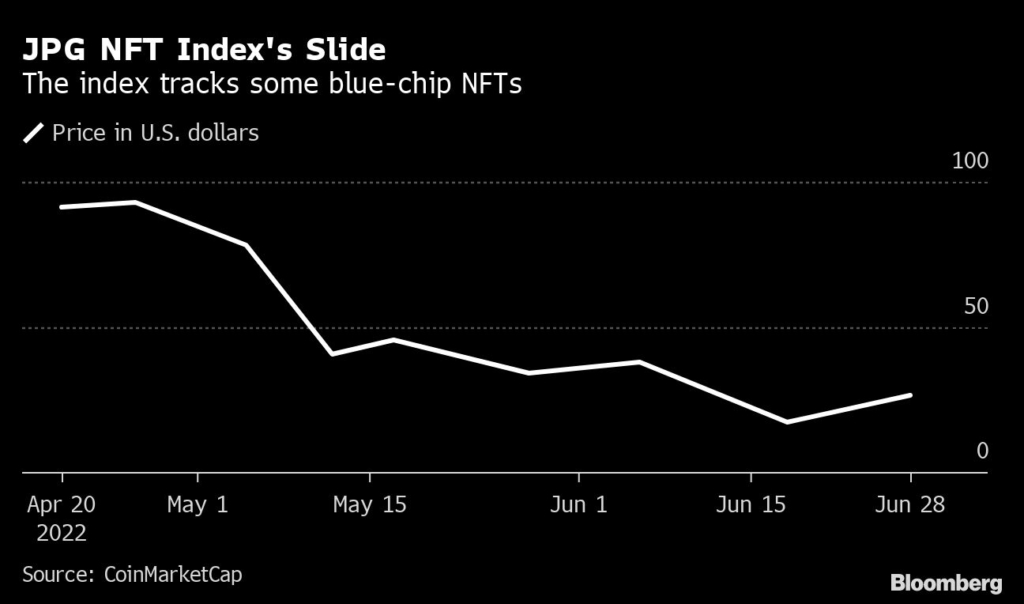
Meanwhile, the JPG NFT Index, which tracks a handful of blue-chip NFT projects, is down by more than 70% since its inception in April. 

With all crypto coins tanking in the aftermath of Terra blockchain’s collapsed stablecoin and possible insolvency at lenders Celsius Network and Babel Finance, as well as at hedge fund Three Arrows Capital, investors have been shunning many crypto-related projects. They have also been dumping Ether, which is used to buy much of the world’s most valuable NFTs. 

“Without question, the NFT market has fallen off the cliff this June,” said Pedro Herrera, head of research at DappRadar. “While the market is way more mature, it is fair to say that in recent weeks, investors were looking for safer places to put their money amid the Terra collapse and the rumors surrounding potential liquidations.” 

Even high-profile acquisitions of NFT platforms — such as eBay’s deal to buy NFT marketplace KnownOrigin and Uniswap Labs’ purchase of NFT marketplace aggregator Genie — and recent events like the NFT.NYC conference and Bored Apes’ ApeFest 2022 in New York, have failed to revive investors’ enthusiasm. 

The news that Yuga Labs Inc., the creator of BAYC’s NFTs, has filed a trademark infringement lawsuit in Los Angeles claiming that conceptual artist Ryder Ripps scammed people into buying fake Bored Ape NFTs is unlikely to help shift sentiment either.  

“Much of the craziness was bled out of NFTs and they are going through a period of consolidation,” said Aaron Brown, a crypto investor and writer for Bloomberg Opinion. “I suspect they will survive, but on a much more sensible basis than at the height of the mania.”

What’s an NFT? It’s What Makes GIFs Worth Big Bucks: QuickTake

More stories like this are available on bloomberg.com

©2022 Bloomberg L.P.

Billionaire Kellner Family Shifts Focus Back to Europe From Asia

(Bloomberg) — The Czech billionaire Kellner family is shifting investment focus back to Europe as it plans to exit its consumer-lending operations in China and trim its presence in other Asian markets.

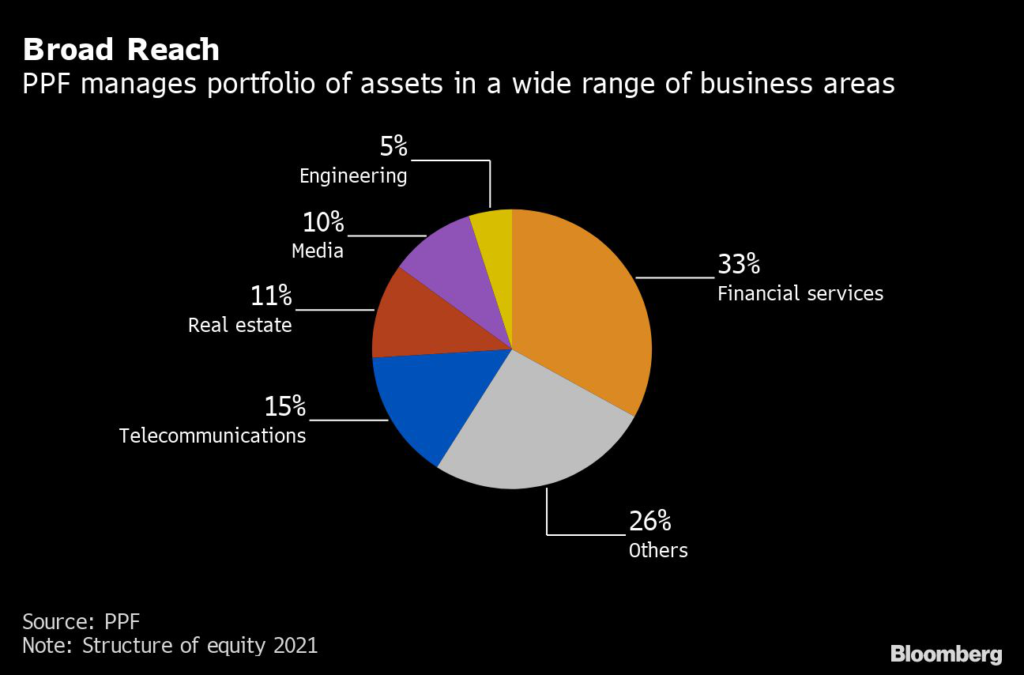
The Kellner’s investment company PPF Group NV is revamping strategy following last year’s death of its founder Petr Kellner. The family, which has a net worth of $12.3 billion according to the Bloomberg Billionaire Index, has picked the founder’s long-time investment partner Jiri Smejc to run the business that operates in 25 countries and in industries including financial services, telecommunications, media, biotech and real estate.

Following the coronavirus pandemic and regulatory changes, PPF is looking for a strategic partner that would buy a majority stake and eventually acquire full ownership of the Chinese operations of its consumer lending arm Home Credit, Smejc told reporters on Tuesday. He expects more clarity within about six months on whether such a plan is feasible.

PPF is also overhauling Home Credit’s activities in other previously fast-growing markets in southeast Asia and India because of difficulties in obtaining banking licenses, which prevent access to deposits and are putting the company at a competitive disadvantage. 

Closer to Home

That’s why PPF is looking for partners that can provide cheap funding and is ready to negotiate sales of majority stakes in Home Credit’s operations in those countries, with the buyers providing funding for further development of the business. 

“We’re negotiating in all of those markets. The talks are in various stages,” Smejc said, without elaborating further. 

PPF wants its core activities to be closer to its home region and the Chief Executive Officer said that at some point he’d like to make a bigger investment — worth at least 1 billion euros ($1.1 billion) — in western Europe, if the company finds the right opportunity. 

“We have several industries where we have the strategic know-how, and that’s where we’ll be looking,” Smejc said. PPF will consider other sectors if it finds an attractive deal, he added.

One potential area of expansion is financial services and Smejc mentioned retail banking in Germany as a potential example. Any such investment would most likely be via a joint-venture rather than an outright acquisition, according to the CEO. 

PPF’s media business is showing good results and “it’s certainly one of the areas where we’ll be looking” for potential acquisitions, Smejc said. “We think there will be interesting opportunities there, including in western Europe.”

The current downturn in global asset prices is creating investment opportunities, but it’s not yet attractive enough because the decline still probably hasn’t reached the bottom, he said. 

Smejc said he can imagine cooperation with other investors for larger transactions in Europe, saying that private-equity firms have a “similar mentality” and could be natural partners.

More stories like this are available on bloomberg.com

©2022 Bloomberg L.P.

Lithuania Faces ‘Intense’ Cyber Attack Amid Kaliningrad Standoff

(Bloomberg) — Lithuania’s defense chief said the Baltic nation has come under an unprecedented cyber attack this week after the government announced it would start blocking the transit of sanctioned goods to the Russian exclave of Kaliningrad.

“This cyber war has been ongoing non-stop for many years,” Defense Minister Arvydas Anusauskas told LRT radio on Tuesday. “But this scale and intensity, which is perhaps not yet the highest but medium, is taking place for the first time.” 

The ministry pointed to the Russian hacker group Killnet as the source of a wave of so-called distributed denial-of-service attacks against state institutions and businesses in the nation of 2.8 million. Anusauskas said the group, which he said has ties with the Russian government, had taken responsibility and called on others to join the campaign. 

The Kremlin, which has repeatedly denied that it conducts such campaigns, had no immediate response to the Lithuanian cyber attack. 

Killnet has been blamed for similar DDoS attacks, which attempt to overload systems by flooding the target with superfluous requests from multiple sources, on institutions in the US, Estonia, Poland, the Czech Republic and other NATO countries. 

Russian President Vladimir Putin’s government has said it will retaliate against the EU member state for blocking rail transport of goods such as steel in accordance with the bloc’s sanction measures. Lithuania has accused the Kremlin of waging a propaganda campaign over the issue, saying the restrictions tied to EU measures that came into force this month involve only 1% of total transit.


Lithuania has been able to successfully fend off the attacks, the ministry said. The cyber assault is likely to continue over the coming days, particularly in the communications, energy and finance sectors, the authorities said, warning of an increased risk of ransomware and defacement attacks. 

More stories like this are available on bloomberg.com

©2022 Bloomberg L.P.

Napster, Former Music Industry Nemesis, Plans Crypto Comeback

(Bloomberg) — Napster, the brand that became synonymous with free music to a generation of consumers, plans to rebuild its business around cryptocurrencies and nonfungible tokens, even as demand for such assets has slumped. 

The streaming platform’s revamp is part of a take-private acquisition by Hivemind Capital Partners, former Citigroup Inc. executive Matt Zhang’s crypto venture. The UK-based company plans to launch its own token, $NAPSTER, which music fans can use to buy tickets and experiences from artists on its new platform, said Zhang and Napster’s Chief Executive Officer Emmy Lovell. 

Napster’s move follows a similar rebirth by LimeWire and potentially pits it against crypto-native platforms such as OpenSea that are seeking new ways to expand in the digital area. NFTs, a form of digital collectible, soared in popularity last year — but demand has since faltered, with one in three such projects recording little to no trading activity after their initial launch. NFTs have also been a hotbed for copyright infringement fights, with high-profile lawsuits already emerging between music figures and speculators. 

That hasn’t deterred Napster, which has gone through several guises and owners since it was first shut down in 2001 after being sued for copyright infringement. The company re-adopted the Napster name in 2016.

“Obviously it was completely illegitimate and there was a big backlash,” Lovell said about Napster’s early days in an interview. “But it does still continue to have the reputation of a disruptor and an industry innovator.” 

Previously listed on London’s Alternative Investment Market since late 2020, Napster shifted almost all of its assets to a new private company in January, a process that valued the loss-making business at $45.6 million. Napster reported revenue of £32.4 million ($39.5 million) for the first half of 2021 in its most recent publicly available filing. Spotify Inc. pulled in roughly 4.5 billion euros ($4.75 billion) in the same period. 

Read More: Crypto’s $2 Trillion Shakeout Portends Lehman Moment

The new Napster platform will operate on blockchain provider Algorand’s network, Zhang and Lovell said, declining to provide a timeline for a full launch. Algorand and Brevan Howard Digital Assets, the crypto fund of British billionaire Alan Howard, were among the consortium of buyers involved in Hivemind’s acquisition of Napster, which closed in the first quarter for an undisclosed amount.

Use Case

With its new token, Napster plans to cater to music listeners, rights holders and artists, hinting at future services including live music experiences and merchandise sales in a so-called “lite paper” published on Wednesday. Products will be limited at launch because the project is still in an early stage, Zhang said. 

While the supply of $NAPSTER tokens is set to be capped at 10 billion coins, Zhang said the figure was “meaningless” until further decisions are made on how the token will operate. The coin will be managed by the Napster Innovation Foundation and will offer rewards to stakeholders, denominated in $NAPSTER. Eventually, holders of $NAPSTER may also be given a say over how the business is run.

Zhang acknowledged that while launching a token is easy, some coins are brought to the market without much thought about what’s next, whether they’re sustainable or add any real value. A bout of selling fueled by monetary tightening by central banks and a string of high-profile crypto blowups saw Bitcoin plunge almost 70% from its record high. 

“Despite the short term volatility in the market, personally, I remain very, very optimistic about how this actually will bring a real use case and enduring value, and actually bring a paradigm shift to many sectors,” he said. “Music is going to be one of them.”

More stories like this are available on bloomberg.com

©2022 Bloomberg L.P.

Uber Hikes UAE Fares as Petrol Prices Surge in Key Oil Producer

(Bloomberg) — Uber Technologies Inc. raised fares in the United Arab Emirates amid a surge in gasoline prices that have outpaced increases in neighboring oil-rich states.

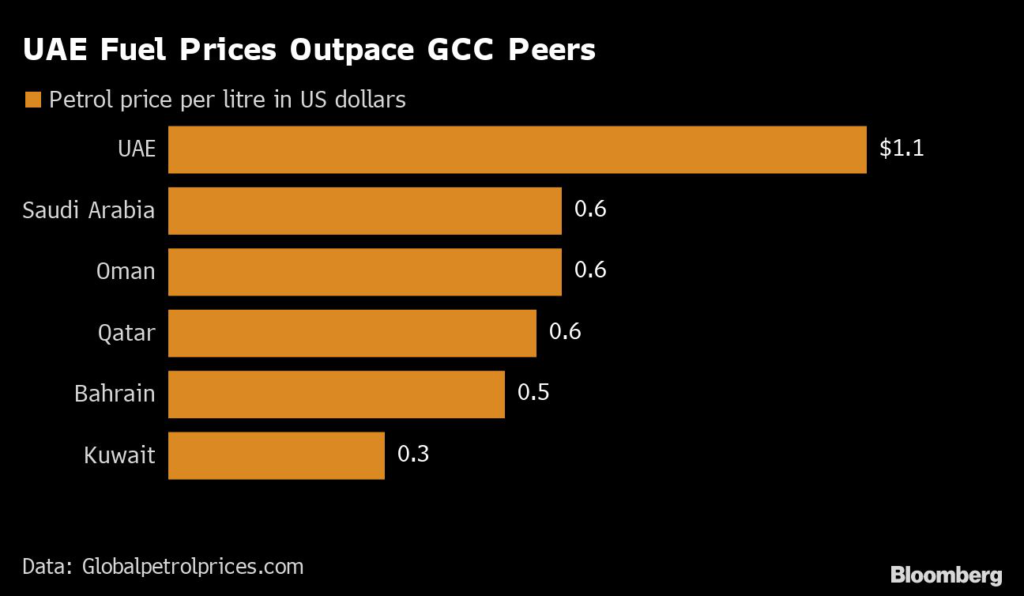
The ride-hailing company will charge as much as 11% more for some trips, it said in an email to customers. The hike is Uber’s second this year in the UAE, where petrol is three times more expensive than in Kuwait and almost double the average cost per liter in the six-member Gulf Cooperation Council. 

Prices in the UAE, which are adjusted based on market costs, have surged 56% since the start of the year. Other countries in the key oil-producing region subsidize fuel to varying degrees. Saudi Arabia is the biggest OPEC producer and UAE is third, followed by Kuwait.  

Still, while UAE prices are higher relative to the region, they’re well below the global average of $1.47 a liter, according to data from globalpetrolprices.com. Petrol costs $1.37 a liter on average in the US, and $2.32 in the UK. 

Read More: 

  • Uber, Lyft Drivers Switch to Teslas as Gas Prices Squeeze Profit 
  • In 2015; U.A.E. Raises Gasoline Prices as OPEC Member Halts Subsidies

More stories like this are available on bloomberg.com

©2022 Bloomberg L.P.

BT Asks UK for More Time to Remove Huawei Core as Ban Approaches

(Bloomberg) — BT Group Plc has asked the UK government for more time to remove the Huawei Technologies Co. core of its network after supply chain concerns led to an impending ban on the equipment. 

“At the end of the day, not interrupting service for customers is the critical requirement here,” BT Chief Technology Officer Howard Watson said in an interview in London with Bloomberg on Tuesday, blaming Covid-19 lockdowns for slowing the transition. 

The core is the most sensitive part of a broadband network, akin to a sorting office for mail. Following a ban announced after the the US sanctioned the Shenzhen-based company, operators are obliged to remove Huawei from network cores by Jan. 28, 2023 or face fines of as much as £100,000 ($122,000) per day. 

The request underscores the British telecommunications industry’s previous reliance on the Chinese technology giant even in sensitive parts of its biggest systems, and the challenges of implementing the politically fraught order to replace its gear. 

UK Prime Minister Boris Johnson banned Huawei from next-generation 5G wireless networks in 2020 and limited its presence in fixed networks, citing supply-chain concerns after the US imposed sanctions due to spying concerns.

The industry has already received a six-month reprieve for non-core components such as cell transmitters. A BT spokesman in the room said despite the request, the former state phone monopoly is working to the existing deadline.

BT is moving the core of its mobile network from Huawei to Sweden’s Ericsson AB and it has already started migrating customers, according to Watson. Its request was submitted to the Department for Digital, Culture, Media and Sport, he said.

“We’re considering all the responses received and will publish our decision in due course,” a spokeswoman for DCMS said by email. 

More stories like this are available on bloomberg.com

©2022 Bloomberg L.P.
Moonpig Sales Slump as People Cut Back on Greeting Cards

(Bloomberg) — Moonpig Group Plc revenue plunged as UK consumers released from lockdowns sent fewer cards to friends and family online.  

Revenue dropped 17% to £304 million ($371 million) in the year to April, although the decline was smaller than expected and the company said it expects shoppers to keep buying cards despite soaring inflation. Over two years, revenues are up 76% as Moonpig continues to expand its customer base, the company said in a statement Wednesday. 

Moonpig shares fell more than 6% in early trading London.

Moonpig has seen no impact from inflation in the last few months “when I know a lot of businesses are starting to see those signs,” said Chief Executive Officer Nickyl Raithatha in a phone interview. “For the price of a cup of coffee you can put a bigger smile on your mum’s face.”

Average order value increased to £7.70 in the year, with more expensive shipping rates offset by higher stamp prices, which have been passed on to consumers.

If Moonpig does start to see any changes in consumer behavior “we have the ability to invest more in certain price points or categories that appeal to the customer more very easily,” said Raithatha.


More stories like this are available on bloomberg.com

©2022 Bloomberg L.P.
Byju’s Said to Offer Over $1 Billion for 2U to Expand in US

(Bloomberg) — Indian online-education provider Byju’s has offered to buy 2U Inc. in a cash deal that values the US-listed edtech company at more than $1 billion, a person familiar with the matter said.

Byju’s made the offer of about $15 a share to 2U’s board last week, said the person, who asked not to be named as the bid isn’t yet public. The offer represents a 61% premium to 2U’s closing price of $9.30 on the Nasdaq on Tuesday and gives the Lanham, Maryland-based company an enterprise value of about $2 billion.

Byju’s, one of the world’s most valuable startups with backing from Tiger Global Management and Mark Zuckerberg’s Chan Zuckerberg Initiative, is accelerating its expansion globally through acquisitions. Bloomberg reported in May that Byju’s was likely to bid for either 2U or Chegg Inc. Talks with Santa Clara, California-based Chegg haven’t progressed, the person said. 2U surged more than 17% in pre-market trading in New York.

The talks with 2U could still fall apart and a deal may not materialize if its board rejects the offer. 2U has a current market value of $717 million and about $1 billion in debt and other liabilities. A representative for 2U declined to comment. Byju’s and Chegg didn’t respond to requests for comment.

Byju’s has secured financing of more than $2.4 billion for whichever deal it finally pursues as it looks to step up its growth and global expansion, said the person. While debt financing is more expensive than just three months ago, assets are cheaper and deals are still looking attractive, the person said. Shares of 2U have declined more than 80% since a peak of $55.55 in early 2021.

Meanwhile, Byju’s is pushing back payments for an approximately $1 billion acquisition of test-preparation provider Aakash Educational Services struck last year, according to people familiar with the matter. Byju’s asked to postpone the payments until late August because regulators have yet to clear the acquisition, said one of the people, adding that it had nothing to do with cash shortages. Aakash’s shareholders agreed to the extension, the person said.

Byju’s is India’s most valuable startup, with a valuation of $22 billion, according to the market researcher CB Insights. The edtech pioneer, formally known as Think & Learn Pvt, has about 115 million students using its online learning platform, with 7 million of them paying annual subscriptions. Its backers also include Silver Lake Management, Naspers Ltd., and Mary Meeker’s Bond Capital.

(Updates with share action from the third paragraph)

More stories like this are available on bloomberg.com

©2022 Bloomberg L.P.

Close Bitnami banner
Bitnami