Bloomberg

Crypto Tax Cheats Likely to Get Relief as US Crackdown Hits Snag

(Bloomberg) — The US government’s bid to collect billions of dollars in taxes is hitting a snag, with the Biden administration poised to delay when crypto brokers and exchanges must start gathering detailed information on their clients’ trading.

The Treasury Department and the Internal Revenue Service are likely to push off a January date for the firms to begin tracking data such as customers’ capital gains and losses, according to people familiar with the matter who asked not to be named because a final decision hasn’t been made. The move would mean the tax agency waits longer to get the kind of data it gets for stocks or bonds. 

Crypto tax evasion remains a major issue for Washington policy makers even amid the recent downturn. Treasury and the IRS have struggled to quickly draft rules, which firms will use in collecting and reporting the information on their clients’ trades.

Under a law passed by Congress last November, crypto firms are supposed to begin recording their clients’ detailed transaction data in 2023, with reports to be sent to the IRS and investors the following year. From the beginning, industry executives have pushed back, complaining that the legislation was drafted too broadly. 

Treasury and the IRS declined to comment on the possible delay. While their efforts around crypto are relatively new, officials have in the past pushed off start dates for information-reporting rules in other areas. 

Once rules are in place, exchanges and brokerages will have to send the detailed transaction data to the IRS and their clients who made the trades, who could then use the information to file their taxes. The data would include customer names and addresses, gross proceeds from sales, and any capital gains or losses. Last year, Treasury said that such information can significantly increase compliance rates. 

The data would not only help the IRS catch tax cheats but also make filing easier for those who want to pay their bills. “It could be very helpful just to standardize the reporting and put it in a way that makes it easier to digest and put on a tax return,” said Michael Desmond, former chief counsel for the IRS who now works as a partner at the law firm Gibson, Dunn & Crutcher.

Charles Rettig, the head of the IRS, told lawmakers last year that unpaid crypto liabilities are a key contributor to the nation’s growing tax gap — the difference between what’s owed and actually collected. 

Facing the looming requirements, industry executives say they need more time to prepare and update their software programs. Coinbase Global Inc., the biggest US exchange, said in a statement that the industry may need as long as two years to comply. 

“Given the broad scope of the tax provisions, uncertainty around implementation, and the short time line before these new rules are set to take effect, we encourage the Treasury Department to extend the deadline for compliance,” added Jake Chervinsky, head of policy at the Blockchain Association trade group. 

In addition to the rules, Treasury and the IRS are working on a new form for crypto firms to use called the 1099-DA, which will be different than the 1099-B used by stock and bond brokers. The government is planning to release a draft of it in the coming months, according to one of the people familiar with the matter. 

More stories like this are available on bloomberg.com

©2022 Bloomberg L.P.

Export Controls ‘Matter More Than Ever,’ US Commerce Chief Raimondo Says

(Bloomberg) — US restrictions on exports “are at the red-hot center of how we best protect our democracies” because they cut off supply of crucial technologies tocountries that threaten American national security, Commerce Secretary Gina Raimondo said. 

Export controls “matter more than ever,” she said at a conference hosted by the Commerce Department’s Bureau of Industry and Security Wednesday, giving the example of restrictions on exports to Russia that may force the nation to ground as much as two-thirds of its commercial aircraft in the next four years to cannibalize them for spare parts. 

US shipments of all goods to the nation that invaded Ukraine have plunged about 95% by value, while American sales in the aviation and aerospace industry have tumbled 99.9%, Alan Estevez, under secretary of Commerce for Industry and Security, said earlier this month. 

Export controls by the US and 37 other nations are working, Raimondo said, adding “we have to do it over a sustained period of time because, unfortunately, I don’t think this is going to end anytime soon.” 

The BIS spent months prior to Russia’s invasion in late February coordinating potential export controls with global allies to make sure that Moscow wouldn’t simply substitute technology exports from another nation for those that were blocked by the US. The rules are being used to deny Russia access to products used in the defense, aerospace, and maritime sectors.

More stories like this are available on bloomberg.com

©2022 Bloomberg L.P.

Tesla Cuts 200 Autopilot Workers as California Site Closes

(Bloomberg) — Tesla Inc. laid off hundreds of workers on its Autopilot team as the electric-vehicle maker shuttered a California facility, according to people familiar with the matter.

Most of the roughly 200 people let go were hourly workers, the people said late Tuesday, a surprise given that Tesla previously disclosed headcount reductions targeted at salaried positions. As recently as last week, Chief Executive Officer Elon Musk outlined a plan to boost hourly jobs.

Tesla’s shares fell 3.8% at 9:41 a.m. Wednesday in New York. The stock tumbled 34% this year through Tuesday’s close, compared with a 20% decline in the SP 500 Index.

Teams at the San Mateo office were tasked with evaluating customer vehicle data related to the Autopilot driver-assistance features and performing so-called data labeling. Many of the staff were data annotation specialists, all of which are hourly positions, said one of the people, who asked not to be identified discussing private information.

See also: Elon Musk Sounds Off on Recession Risk, Twitter Deal and Trump

Prior to the cuts, the office had about 350 employees, some of whom were already transferred to a nearby facility in recent weeks, the people said.

Tesla didn’t respond to a request for comment.

The latest moves mark a shift after a surge in hiring in recent years to fortify Tesla’s position as the EV market leader. The company, now based in Austin, Texas, had grown to about 100,000 employees globally as it built new factories in Austin and Berlin.

Musk caught workers by surprise earlier this month when he said layoffs would be necessary in an increasingly shaky economic environment. He clarified in a subsequent interview with Bloomberg that about 10% of salaried employees would lose their jobs over the next three months, though the overall headcount could be higher in a year.

Like many competitors, Tesla is grappling with strained supply chains and the other challenges that come with ramping production in a growing EV market. Musk said recently that the company’s new plants are losing billions of dollars.

Targeted Cuts

The automaker’s downsizing efforts have focused on areas that grew too quickly. Some human resources workers and software engineers are among those who have been laid off, and in some cases, the cuts have hit employees who had worked at the company for just a few weeks.

Those affected by the latest move worked on one of the higher-profile features in Tesla vehicles. In job postings, Tesla has said that labeled data is the “critical ingredient for training powerful Deep Neural Networks, which help drive the Tesla vehicles autonomously.” Staffers in Buffalo, New York, and San Mateo spent hours labeling images for cars and the environment they navigate, such as street signs and traffic lanes.

In Buffalo, Tesla has continued to expand its Autopilot data-labeling teams, a person familiar with the matter said. But staff at that location, who are doing the same role, are paid a lower hourly rate than in San Mateo, the person said.

(Updates with share trading in third paragraph)

More stories like this are available on bloomberg.com

©2022 Bloomberg L.P.

JPMorgan Piles On With Estimate Cuts Before Earnings: Tech Watch

(Bloomberg) — Wall Street analysts are starting to cut earnings estimates for some of the world’s biggest technology companies, undermining the argument that their stocks look cheap after this year’s market rout. 

Amazon.com Inc., Nvidia Corp. and Alphabet Inc. are among those that have seen earnings estimates fall over the past month amid growing speculation that the Federal Reserve’s aggressive path of interest-rate hikes will trigger a recession. JPMorgan Chase & Co. on Wednesday lowered estimates on 26 internet companies, including Twitter Inc. and Spotify Technology SA.

For months, estimates for many megacaps held firm even as soaring costs and surging interest rates torched trillions of dollars from market values. With angst over the risk of a recession building, analysts are starting to step back from their rosy assessments before the second-quarter earnings season starting next month. That has them edging closer to the many investors who have been anticipating weaker profits.

“Corporate America has done an amazing job at passing on pricing pressure but I’m not sure that continues,” said Bob Doll, chief investment officer at Crossmark Global Investments. “The earnings picture is going to get a little darker.” 

Tech stocks dipped on Wednesday, with the Nasdaq 100 Index down 0.3%. 

Estimates for the vast majority of companies in the S&P 500 Index have remained steady. In fact, profits from companies in the benchmark are projected to expand more than 10% this year, up from a forecast of 8.7% at the start of the year, according to Bloomberg Intelligence.

The aggregate forecast for 2022 earnings per share for the tech-heavy Nasdaq 100 Index, though, peaked in February and has since fallen almost 3%, according to Bloomberg data. 

For battered tech stocks, falling estimates raise the prospect of more selling pressure as the denominator in the price-to-earnings ratio sinks, making the equities look more expensive. That throws up a hurdle to a sustained rally in the S&P 500, considering the sector has the biggest weighting in the index.

Shrinking Valuations

After dropping 29% in 2022, the Nasdaq 100 is priced at about 19 times projected profits, close to the lowest since the start of the pandemic, and down from a peak of 31 after the Fed unleashed a flood of stimulus in 2020. 

If profits do in fact start to shrink, that would erode the argument that many stocks are in bargain territory, says Michael Arone, chief investment strategist at State Street Global Advisors’ U.S. SPDR business. He estimates that earnings projections could fall as much as 40% to accurately reflect slowing growth and the persistent inflation that’s threatening margins.

“Stocks look deceptively cheaper because estimates haven’t fallen,” Arone said. “Current estimates suggest growth north of 10%, but they need to be reduced to reflect a cyclical slowdown, if not something worse.”

Read more: Morgan Stanley’s Shalett Says Analysts Are ‘Deer in Headlights’

Of course, not all megacap estimates are dropping. Projections for Apple Inc. and Microsoft Corp., the two most valuable American companies, have barely budged, although their stocks have tumbled more than 20% this year.

Earnings Season

There have been signs that this earnings season may bring more gloom for technology investors. In May, Snapchat owner Snap Inc. blamed a sudden slowdown in its advertising business on a weakening economic outlook, sending jitters through the ranks of companies that rely on digital ads as their main source of revenue. A week later, Microsoft cut forecasts as a result of the surging dollar, which reduces the value of American companies’ overseas earnings.

The five companies with the greatest weighting in the S&P 500 — Apple, Microsoft, Alphabet, Amazon and Tesla Inc. — are projected to see second-quarter profits drop by more than 20% from the same period a year ago, when their earnings jumped 88%, according to Bloomberg Intelligence. 

For Citigroup Inc.’s Scott Chronert, all of the bearish expectations could set stocks up for a strong second half of the year if earnings aren’t as bad as feared. He expects profits to hold up and projects the S&P 500 to rally about 10% by year-end, the strategist wrote in a research note Monday. 

Earnings releases in the weeks ahead are going to be crucial for investors in deciding whether that bullishness is warranted.

“Given what we know of slower economic conditions, the dollar’s strength and the impact that has on multinational profits, and margins coming under pressure, I think consensus estimates seem rather ambitious,” said Mark Luschini, chief investment strategist at Janney Montgomery Scott. 

Tech Chart of the Day

Top Tech Stories

  • Tesla Inc. laid off hundreds of workers on its Autopilot team as the electric-vehicle maker shuttered a California facility, according to people familiar with the matter.
  • Indian online-education provider Byju’s has offered to buy 2U Inc. in a cash deal that values the US-listed edtech company at more than $1 billion, a person familiar with the matter said.
  • Nio Inc. slumped 11% in Hong Kong trading after a short seller said the electric-car maker has inflated revenue. The company rejected the claim, saying the report from Grizzly Research contains “numerous errors.”
  • Samsung Display Co. has purchased display company Cynora GmbH for about $300 million, according to people with knowledge of the matter, gaining technology for so-called OLED screens.
  • BT Group Plc has asked the UK government for more time to remove the Huawei Technologies Co. core of its network after supply-chain concerns led to an impending ban on the equipment.
  • Sony Group Corp. is launching a new gaming gear brand called Inzone, trotting out headphones and displays for the PC to try and expand its reach beyond the PlayStation.

(Updates to market open.)

More stories like this are available on bloomberg.com

©2022 Bloomberg L.P.

Amazon Cloud Unit on Course for $3 Trillion Value, Redburn Says

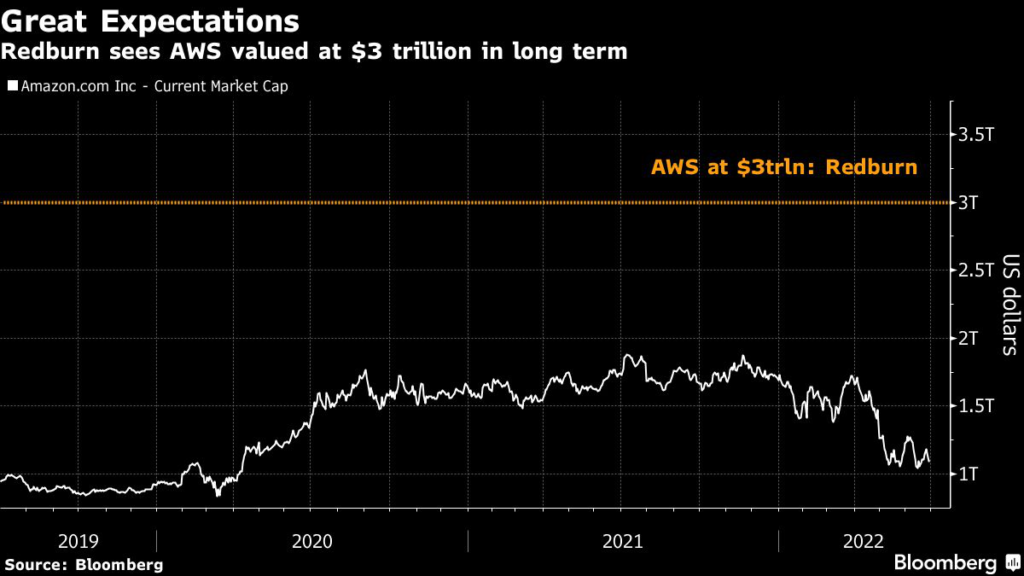
(Bloomberg) — Amazon.com Inc.’s cloud-storage business is on a clear path toward a $3 trillion value, almost triple what the whole company is worth now in the stock market, according to a Redburn Ltd. analyst. 

The unit, Amazon Web Services, is so powerful that the company may decide at some point to split it off from the massive, slower-growing online retail operation, analyst Alex Haissl wrote in a 128-page report initiating coverage of the cloud-computing industry. He didn’t say when the $3 trillion value may be achieved.

“Separating AWS may not be on the table for now, but if the performance gap versus the non-AWS parts continues to widen, it could be on the table further down the road,” wrote Haissl, a former head of automotive research at Berenberg and Credit Suisse Group AG who began his career as a police officer in Vienna.

Haissl recommends buying Amazon shares and sees the stock reaching $270 in the next year, the highest target on Wall Street and 150% above Tuesday’s closing price. He also rated Microsoft Corp. a buy, Snowflake Inc. as neutral and has a sell on MongoDB Inc.

Amazon Web Services’ revenue jumped 37% to $18.4 billion in the first quarter even as the company’s core e-commerce business saw a decline in sales. “There is no sugar-coating the weak performance” of online retail, he said, adding that “we do not think the business is structurally broken.” 

The Amazon cloud unit is better positioned than rivals run by Microsoft and Alphabet Inc. because it has lower costs and better technology, Haissl wrote. Amazon Web Services accounts for less than 20% of Amazon’s revenue but will contribute all of its earnings this year, he wrote. 

However, Bloomberg Intelligence analyst Anurag Rana, who estimates the value of AWS at $1.5 trillion to $2 trillion, said “Microsoft could be better positioned than Amazon Web Services and Alphabet’s Google as enterprises accelerate their shift to a hybrid-cloud model, given its strong footprint in on-premise IT infrastructure.”

“Amazon is highly unlikely to spin off its cloud segment, since it’s the source of many funds for the company’s other businesses units,” Rana said. 

(Adds more analyst commentary in the penultimate paragraph.)

More stories like this are available on bloomberg.com

©2022 Bloomberg L.P.

‘Altcoins’ Lead Crypto Slide as Bitcoin Bounces Around $20,000

(Bloomberg) —

Cryptocurrency losses deepened, with popular Defi tokens such as Solana and Avalanche falling more than sector bellwether Bitcoin, as contagion concern mounts in the wake of the collapse of hedge fund Three Arrows Capital. 

Bitcoin dipped below $20,000 for the first time in almost a week, as the token’s lack of sustained upward momentum caused some technical analysts to raise the prospect of further declines.

The largest cryptocurrency dropped as much as 2% before recovering slightly to trade at $20,068 at 9:09 a.m. in New York. The MVIS CryptoCompare Digital Assets 100 index, which measures 100 of the top tokens, fell as much as 4.1%. Solana slipped as much as 6.2% and Avalanche fell by as much as 7.2%.

“Most short-term technicals point to an above-average chance of a final ‘washout’-style decline before this bottoms,” said Mark Newton, technical strategist at Fundstrat, in a note Tuesday. Bitcoin has room to drop as low as $12,500 to $13,000, “which I expect should be an excellent place for intermediate-term buyers to add to longs,” he wrote. 

Bitcoin’s relatively steady trading since crashing to a low of $17,560 on June 18 had fueled optimism that the battered crypto market was setting the stage for a rebound. Yet the sector remains under pressure from central banks’ efforts to drain liquidity, as well as a series of high-profile crypto blowups that have dented investor confidence.


Read more: Crypto’s $2 Trillion Shakeout Portends Lehman Moment

More stable crypto prices recently have probably sparked some relief “given the stream of negative headlines over the last couple of months,” said Craig Erlam, senior market analyst at Oanda. “I fear more may follow in the weeks ahead and I wonder whether the community does too, given its inability to get any traction above $20,000.”

More stories like this are available on bloomberg.com

©2022 Bloomberg L.P.

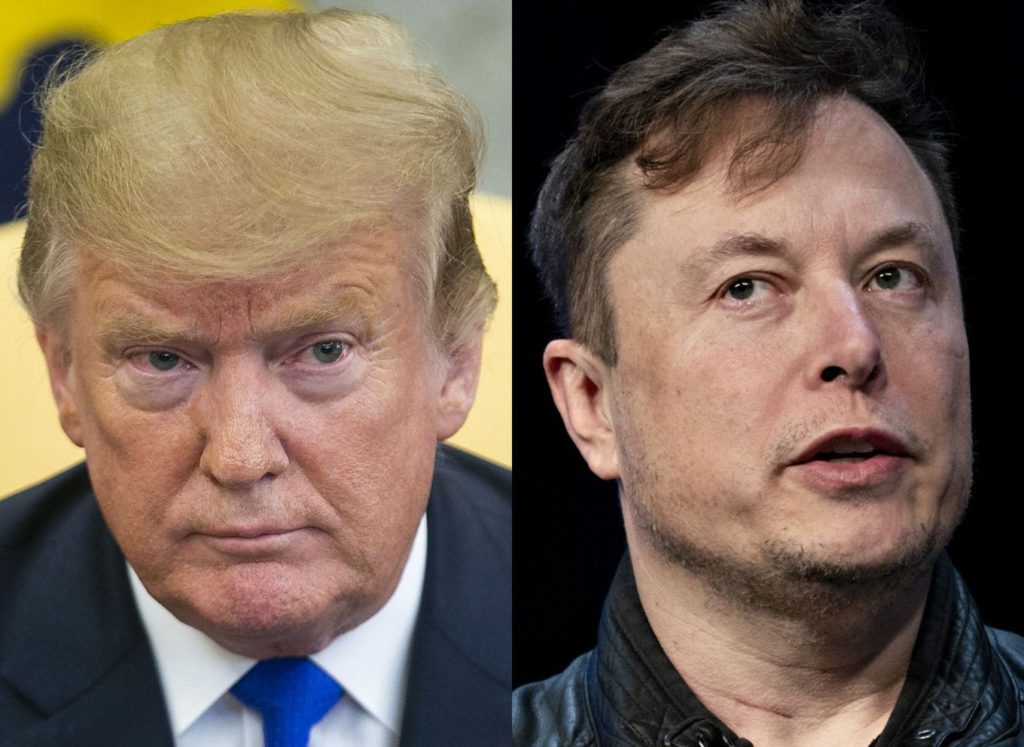
Elon Musk’s Tweets Echo Tactics Used to Great Effect by Donald Trump

(Bloomberg) — Using repetition, deflection and schoolyard taunts, Elon Musk can move markets, confound, distract and offend with a single tweet — heavily evoking the tactics of former President Donald Trump.

Their shared approach to online communication and mercurial personalities invite obvious comparison, with the similarities coming into even sharper relief as the Tesla Inc. chief and world’s richest person has swerved into politics and cast his first vote for a Republican.

Musk’s infatuation with Twitter Inc. inspired him to make a $44 billion bid for the company, a deal that would give him even greater influence over a digital ecosystem where he commands outsized power. That could be especially useful as federal bureaucrats pose a growing challenge to his empire.

Read More: Musk Hoists GOP Banner, Tears Into Biden

Musk has indicated he would welcome Trump back to the social platform, lifting a suspension that began when the former president violated the site’s policies with tweets surrounding the Jan. 6, 2021, attacks on the US Capitol. But that permissive treatment — and Musk’s recent right-leaning political epiphany — aren’t an indication he’ll back Trump in the 2024 US presidential race.

“I’m undecided at this point,” he said last week at the Qatar Economic Forum in an interview with Bloomberg News Editor-in-Chief John Micklethwait. That demurral came several days after he tweeted he was leaning toward supporting Florida Governor Ron DeSantis. The careful answer for a public audience of investors demonstrates he can switch off the freewheeling, provocative online persona when needed — a restraint that Trump could never quite muster.

‘Flooding the Zone’

As much as Twitter has worked to improve what it calls the “health” of conversation on its site — by down-ranking harassing voices and offering prompts to nudge users to reconsider offensive replies, for instance — the platform still rewards incendiary behavior through re-tweets, likes, replies and follows. Banning those who cross the line in their use of the service, including Trump, has done little to calm those dynamics, and has left room for Musk to become the center of attention.

Musk’s presence on Twitter is so forceful that even his absence is noticed: He hasn’t tweeted since June 21, leaving his admirers resorting to online speculation about the billionaire’s whereabouts. Typically, though, Musk serves up what his audience wants, emulating and fine-tuning Trump’s strategy to build his fan base and brands. 

Musk and Trump are both effective at “flooding the zone,” said Inga Kristina Trauthig, a senior research fellow at The University of Texas at Austin. They hammer straightforward opinions repeatedly, she said, whether it’s Musk’s recent fixation with decreases in global birth rates or Trump’s frequent claims of a deep-state conspiracy working against his agenda.

Flooding the zone is an approach popularized by Steve Bannon, Trump’s onetime political strategist. In 2018, Bannon told author Michael Lewis that “the real opposition is the media. And the way to deal with them is to flood the zone with shit.”

With this kind of onslaught, accuracy is less important than persistence. 

“Their narratives are not nuanced. They’re not complicated,” said Trauthig, whose research focuses on how emerging technologies are used in political communication.

Those simple stories often frame the men as victims of politically motivated attacks, often timed to unflattering news stories. Musk, for example, speculated in May that Democrats would unleash a “dirty tricks campaign” against him because of his support of Republicans — and the next day, Insider reported allegations of sexual misconduct against him, which he dismissed as a “hit piece” designed to “interfere with the Twitter acquisition.”

Trump’s social media habit had singularly high-stakes consequences, with his tweets used to disseminate misinformation and to attempt to overturn his failed re-election bid. Still, Musk’s missives have a certain importance, shaping the investment decisions and world view of his acolytes.

Both found massive online reach, with Trump notching 88.9 million Twitter followers before he was kicked off the platform, and Musk counting some 100.3 million followers. 

Read More: Elon Musk Sounds Off on Twitter Deal and Trump

Musk’s Twitter acumen evokes Trump’s in another pointed way: He has a penchant for seizing the daily news cycle and reframing it. For Trump, tweets were often simple media commentary — he watched cable news voraciously, and delighted in mocking the ratings of the Oscars and the NBA. Others, though, were huge news: He fired his secretary of state by Twitter and even tweeted his own Covid-19 case.

“I call Twitter a ‘typewriter,’” Trump said in 2019. He recalled one tweet declaring that Israel has sovereignty over the Golan Heights, a post that bucked a longstanding US position. “I go: ‘Watch this.’ Boom, I press it, and within two seconds, ‘We have breaking news.’”

Musk’s tweets can blot out chatter about Tesla’s plunging stock price and his Twitter deal — or any effort to wriggle out of it. One Sunday in June, for example, he tweeted Father’s Day wishes, said he was still buying Dogecoin and that he feels “swindled” every time he drinks LaCroix sparkling water. 

Sowing Distrust

Both men use the platform instinctively and gravitate to topics will thrive there. Trump amplified conservative media to stoke feuds that underpin the US culture war. Musk, in between announcements about his companies, has weighed in on remote work, video games and the media, which he accuses of skewing too negative. He and Trump have sought to cultivate followings that trust them and distrust mainstream news outlets.

Followers closely hang on every word. Musk tweets cryptically, such as in April when he tweeted a blank space for a word followed by “is the Night” — spurring a flurry of speculation and sleuthing about whether the first word was “tender,” indicating he planned to make a tender offer for Twitter. Trump was less coy, but his tweets were still heavily dissected, such as his infamous unfinished one about “negative press covfefe.”

Musk, Tesla and a representative for Trump didn’t respond to requests for comment. 

Notorious Tweets

Still, their impulsivity online has sometimes blown up spectacularly. Trump lost his Twitter megaphone in January 2021 in the aftermath of the fatal swarming of the Capitol, when the company determined his tweets violated its policies around glorifying violence. The scope of Trump’s involvement in the rally is still coming to light. A former aide testified Tuesday that Trump urged security to let armed people into the protest, demanded he join them at the Capitol and grabbed at the wheel of the presidential SUV to redirect it.

Musk landed himself in trouble with a 2018 tweet in which he falsely claimed to have lined up financing to take Tesla private. That led to an agreement with the Securities & Exchange Commission in which he and Tesla each agreed to pay $20 million in civil fines over the tweet.

More recently, Musk’s own workforce has chafed at his online theatrics. On June 16, SpaceX fired employees who were behind an open letter condemning the behavior of Musk, their CEO, as “a frequent source of distraction and embarrassment for us, particularly in recent weeks.”

Should Musk’s acquisition of Twitter close, Trump has said he won’t return to the site, pledging to stick with issuing proclamations on Truth Social, his own platform. 

The lure of regaining the reach and cache of his Twitter account, however, may prove too difficult to resist. 

More stories like this are available on bloomberg.com

©2022 Bloomberg L.P.

Tesla’s Technoking of Tumult Caps a Wild Quarter With Silence

(Bloomberg) —

The man who dominates discussion about the future of transportation has gone uncharacteristically quiet at the close of a manic quarter.

Even by Elon Musk’s high bar for bedlam, the last three months have been wild. Considering all that happened — Shanghai’s shutdown, another factory opening, the chaotic Twitter deal and job cuts at Tesla — it’s no wonder the technoking has hunkered down (he fired off his last tweet on June 21).

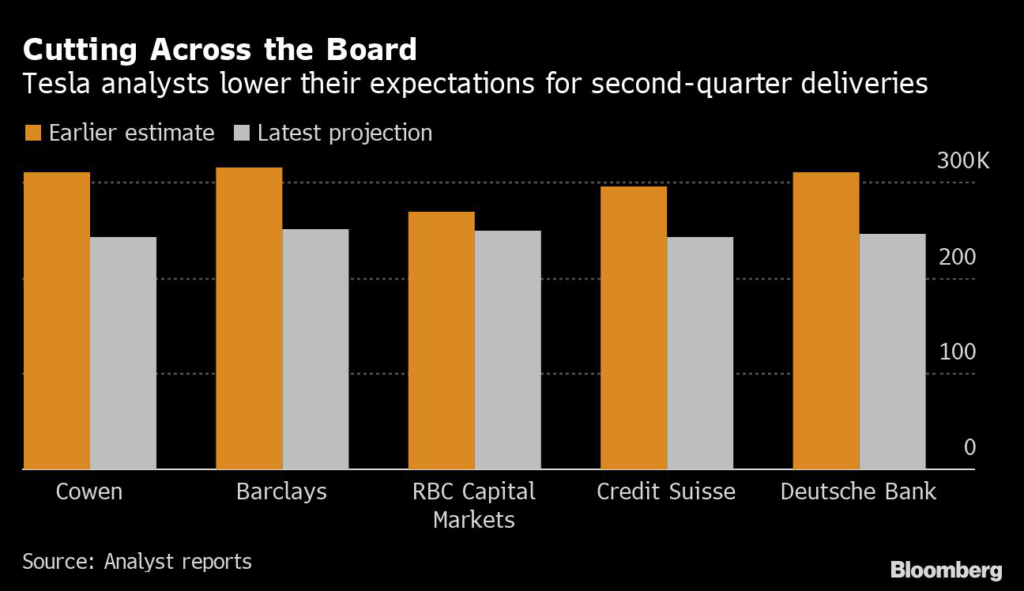
Tesla started this quarter with a bang, reporting deliveries of more than 310,000 cars in the prior three months. The company is expected to come up well short of that mark for the period ending in June, with several analysts calling for fewer than 250,000 units.

When Musk disclosed the supposedly passive stake he’d taken in Twitter in early April and soon thereafter bid $44 billion for the company, it signaled Tesla was on stable footing. Surely, the carmaker’s chief executive officer — who already had his hands full also running SpaceX, Neuralink and The Boring Company — wouldn’t add more to his plate if all was not well at his most valuable venture.

But Tesla was already in the midst of a work stoppage at its top-producing plant, which is all but certain to have brought an end to its impressive run of record-setting deliveries. This was, of course, out of Musk’s control, and the supply chain challenges bedeviling the global auto industry have spared no one.

  • Do you own an electric car? US residents, Bloomberg Green wants to learn more about your experience with EVs. Take our brief survey.

While Musk’s commentary during the quarter wasn’t exclusively positive — he said the “insane” price of lithium might force Tesla to get into mining and refining, for instance — his pursuit of Twitter wasn’t the only indication he gave that Tesla was maintaining momentum. He staged a splashy “Cyber Rodeo” in Austin and told fans the highly anticipated Cybertruck, Roadster and Semi will all be manufactured starting next year. During Tesla’s April 20 earnings call, Musk said the company may “pull a rabbit out of the hat” in Shanghai. Tweets about Taylor Swift and the merits of an edit button also suggested Tesla was far from production hell.

If Musk, who just turned 51 on Tuesday, was thinking about his life, legacy and empire-building when he decided to acquire Twitter, much like his rival Jeff Bezos seemed to be when buying the Washington Post, here-and-now fear of recession has begun to take precedent. He said in mid May the US was probably in one and made similar comments to Bloomberg Editor-in-Chief John Micklethwait last week.

In between, we learned Tesla will be doing another round of job cuts. Musk has said the company will dismiss about 10% of its salaried workforce over three months and put an end to remote work in most cases. Several people — including some who were just hired in May — shared on LinkedIn that they were terminated in June.

Tesla still hasn’t filed a WARN notice, which triggered a lawsuit on behalf of two workers at the company’s battery plant in Nevada. Layoffs are still in process, the latest of which include about 200 members of the Autopilot team at a Silicon Valley facility the carmaker is shuttering. Even so, Tesla is actively hiring for on-site recruiters in Austin, according to this LinkedIn post.

Deutsche Bank analysts wrote yesterday that they expect this quarter to be the trough for Tesla this year. We’ll get a better sense of just how rough it was when the company announces production and delivery figures in the coming days.

More stories like this are available on bloomberg.com

©2022 Bloomberg L.P.
Stripe’s Carbon-Removal Effort Announces First Funding Recipients

(Bloomberg) — The nascent $925 million carbon-removal effort funded by major technology firms has started writing checks to fledgling companies aiming to remove CO₂ from the air.

The Frontier fund said Wednesday that it had selected six startups to receive grants or pre-purchase agreements — essentially, advance payments for carbon removal in the future — from the fund. It’s the first set of commitments from the fund, which has raised money from Stripe Inc., Meta Platforms Inc., Alphabet Inc., Shopify Inc. and McKinsey & Co. The fund debuted earlier this year and grew out of similar carbon-removal purchase programs at Stripe and Shopify. 

Many climate efforts are focused on reducing emissions, but in order to combat climate change, carbon also must be removed from the air and stored in a long-lasting way, such as capturing atmospheric carbon and burying it deep in the earth. The technology to do so is still in its infancy, and the processes are prohibitively expensive. Over time, improvements could bring volume and cost-efficiency, but in order for that to happen, the companies trying to develop carbon removal need a jumpstart.

The goal of the effort is to create a market for carbon-removal technology at scale. The bulk of the $925 million is intended to pay for the carbon removal after it’s completed — so-called offtake agreements. To start, however, the fund is paying smaller companies before they’ve even begun. So far, only Stripe is paying for those pre-purchase agreements, while the other participants in the fund can choose whether they want to do so or wait for the companies to mature.

For this first round, a group of 19 experts looked at a pool of 26 applicants and selected six companies, which hail from the US, the UK, Australia and Israel, and which focus on direct-air capture, enhanced rock weathering and synthetic biology. Stripe will be the first customer for each of them. The payments processor has committed to spend $2.4 million buying carbon removal from those six companies, and has set aside another $5.4 million for future purchases from the same set. 

The fund’s overseers  said they were heartened by the diversity and creativity among the applicants, but they also recognized just how minuscule the current capacity for carbon removal is compared with the eventual scale needed to meet climate goals. Experts predict that by 2050, 6 billion tons of carbon must be removed from the atmosphere each year; so far, only about 10,000 tons have been removed in all. The pre-purchase agreements are buying  hundreds of tons each.

“On the one hand, there’s been a huge amount of momentum, and at the same time, there’s not enough momentum,” said Nan Ransohoff, head of climate at Stripe. “There’s a very big gap between those two numbers.”

Three of the companies — AspiraDAC, Calcite-Origen, and RepAir — are developing direct-air capture technology, which uses machinery to filter CO₂ out of the air. These new methods include some options to use electricity rather than heat during the process, which would allow for eventually powering the capture using renewable sources. Two others — Travertine and Lithos Carbon — are finding ways to speed up the natural process by which mineral weathering captures carbon dioxide from the air. And a final company, Living Carbon, is receiving a research and development grant to synthesize a component of algae to sequester CO₂.

The fund will select another round of companies to buy from in the fall. The hope is to send a clear message to anyone considering founding a startup to attack this problem: If you build something promising, you’ll have buyers. Ransohoff hopes that the missive will be received quickly, even if the technology takes several years to develop before it can remove significant amounts of carbon from the air. “I think it’s unrealistic for everybody to start to see huge volume in the next few years,” she said. “We have to be both patient and impatient at the same time.” 

More stories like this are available on bloomberg.com

©2022 Bloomberg L.P.

Private Lenders Are Offering Cheaper Debt Than Wall Street Banks

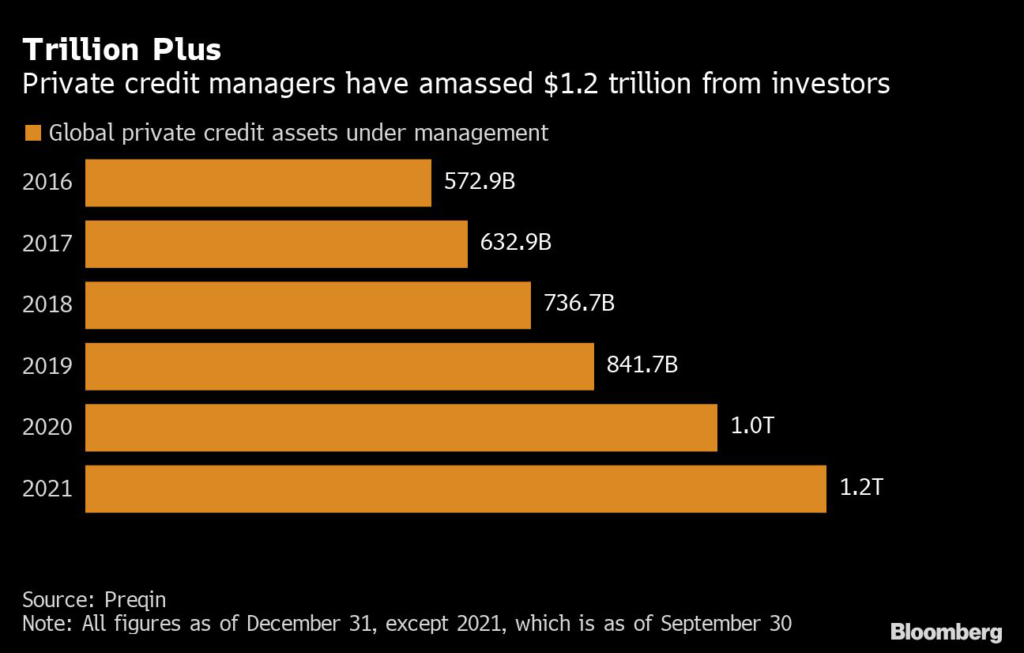
(Bloomberg) — A dirty little secret in a $1.2 trillion world of credit is getting exposed as the Wall Street rout deepens: Private debt is now the cheaper financing option for big-ticket leveraged borrowers than the ailing public market — upending industry norms.

As banks get pummeled by risk aversion and sinking asset values, direct lenders are lavishing risky companies and private-equity firms with capital at rates below what’s available in the volatility-lashed high yield and syndicated loan market.

These asset managers are so desperate to unleash all the billions amassed in the low-yield era that they’re increasingly putting up with lower returns than their risk-averse peers in other parts of the credit world are willing to stomach. As traditional lenders beat a retreat, the bonanza is helping power leveraged buyouts with deals including The Access Group, Davies Group, Ivirma Group and Zendesk. 

“We have seen a few cases in which private credit firms swooped in and participated heavily in deals that otherwise would have been distributed — or even were in the process of being distributed — solely to the public markets at the same contractual terms and even tighter pricing than the syndicated markets were willing to provide,” said Scott Macklin, director of leveraged loans at AllianceBernstein.

With the Federal Reserve rushing to tighten policy in a bid to tame inflation at four-decade highs, the average yield on US junk bonds has roughly doubled this year in an historic selloff as the primary market has been all but frozen. 

While unsecured debt for the riskiest part of LBOs can come with double-digit yields, sponsors have been able tap into the private-lending boom to secure all-in yields below 9%.

Likewise in Europe, premiums for direct loans remain low and have defied the broader repricing in global markets, according to four of the region’s biggest private credit providers and advisers, who declined to be identified because they weren’t authorized to speak publicly. 

All this is potentially bad news for private investors who were promised higher returns than bank loans offer, in exchange for tying up capital for as long as 10 years — known as the illiquidity premium. 

Shadow lenders include the likes of Blackstone Inc., Apollo Global Management Inc., Blue Owl Capital and HPS Investment Partners. Industry players say they are making good on a promise to provide financing in volatile economic climates, at rates that are both affordable for borrowers and attractive for its investors. In this view, premiums in the public market look dislocated relative to fundamentals, with strong issuers getting punished by an indiscriminate selloff.

Meanwhile banks are struggling to sell the buyout debt on their books — and they’re charging so much for new deals that they are effectively undercutting new business opportunities. Just this week Walgreens Boots Alliance Inc. scrapped its potential sale of the Boots drugstore chain in the UK, in part because of the rising cost of raising capital.

Read more: Banks Charge So Much for Buyout Funding That Bidders Are Balking

In their zeal to win market share over the long haul — something investment bankers may struggle to win back — private lenders have been willing to undercut traditional players. 

While AllianceBernstein last year touted a more than 3% premium over the public market for mid-market private lending, increased competition between direct lenders saw that dwindle to an estimated 1.7% in March 2022, according to the US-focused Cliffwater Direct Lending Index.

Since then, high-yield bond financing has hit an implied cost of around 9% in the US and 8.7% in Europe, per Bloomberg gauges measuring the cost of new single B rated debt. At the same time, US leveraged loans are now yielding around 8.8% in the secondary market, according to a JP Morgan index tracking single B loans. 

“For the best credits, we have seen pricing as low as 5%, where people are killing themselves to get this deal done,” said Norbert Schmitz, a managing director in Houlihan Lokey’s debt advisory practice. “For the normal deals, you may see 650 or 675 basis points.” 

Pricing on so-called unitranche loans — a blend of senior and subordinated debt and a structure beloved by non-banks — is typically in the region of 575 to 650 basis points over the interbank rate. That’s not budged much even as broader credit markets are roiled by recession fears, the people familiar said. 

At 5% or even anywhere under 7%, direct lenders are also undercutting the floating rate syndicated loan market. Recent public loan deals done include Kofax, which priced at a yield of 8.2% while Gaming1’s 300 million euro ($316 million) term loan B is seen with a 7.4% yield, according to Bloomberg calculations. 

By contrast, Europe’s largest-ever direct lending deal for UK software business The Access Group saw lenders charge a floating-rate margin of just 575 basis points for the 3.5 billion pound ($4.3 billion) financing, according to people familiar with the transaction.

Comparisons with the junk bond market are far from perfect of course, given private deals tend to come with floating-rate obligations and stronger lender protections. The financing for Norgine BV show how the industry is looking for tighter covenants than is standard in the public market. And the asset class is no magic financing solution for all borrowers. 

Yet for all that, evidence keeps piling up that the private market is offering big firms a competitive capital-raising solution. In Europe for example, the junk bonds backing Lone Star Funds’ acquisition of Manuchar NV were sold at the largest discount for investors in a decade. 

By contrast, when BC Partners-controlled Davies Group tapped its direct lender for an extra £350 million ($426 million) of debt on top of its outstanding unitranche loan, the insurance services firm managed to secure tighter pricing, according to a person close to the transaction, who declined to be identified because the details are private.

To Daniel Lamy, JPMorgan Chase & Co.’s head of European credit strategy, this dynamic can’t continue as the monetary backdrop darkens.

“Private credit funds will re-adjust the level at which they are willing to do deals,” he said. “Pricing in that market was slower to react to the changing macro environment, and we don’t think it’s sustainable for private creditors to lend inside public market levels.”

(Updates with more industry context in ninth paragraph)

More stories like this are available on bloomberg.com

©2022 Bloomberg L.P.

Close Bitnami banner
Bitnami