Bloomberg

Roe Ruling Discussions Turn Contentious Inside Tech Giants

(Bloomberg) — Inside some technology industry bellwethers, discussion of the Supreme Court decision overturning abortion rights turned contentious Friday, prompting managers to take steps to quell discord.

At Amazon.com Inc., employees clashed on company message boards, debating the meaning of passages from the Old Testament, according to exchanges reviewed by Bloomberg. One person accused colleagues of harassment. Amazon Senior Vice President Beth Galetti sent a memo acknowledging “strong emotions” felt by some of its 1.6 million employees and saying “we work to be respectful of everyone’s perspectives while also taking care of and supporting our employees’ personal medical needs.”

Inside Apple Inc., the issue turned divisive as well. Some employees took to internal Slack channels Friday to celebrate the decision, while others bemoaned it. Posts reflected differing religious beliefs. The company’s brief statement on the matter — pointing to a decade-old policy of allowing employees to travel out of their home state for medical care — didn’t take a stance on the court’s ruling. Like other companies, Apple has offices in locations like Texas that are expected to take a particularly strong stance on enforcing the Supreme Court’s opinion.

Discussion of abortion can be contentious in any environment, but conversations about such matters take on added resonance in the technology industry, where many staffers have grown accustomed to open and sometimes free-wheeling conversations in internal communications channels, such as Slack.

Some tech companies that discourage debate have ended up demoralizing staffers. More than a dozen employees of Basecamp quit last year after of the developer of productivity software banned political discussion at work. Coinbase Inc. rattled workers in 2020 after it clamped down on political activism and conversation just months after the murder of George Floyd prompted a nationwide reckoning over race and police brutality.

At Facebook parent Meta Platforms Inc., managers were reminded on Friday that the company does not allow discussion of important social and political issues in large internal forums, according to a person with knowledge of the matter. Employees are discouraged from discussing those topics at work, or asked to do so in smaller groups.

The policy even applies to Meta’s senior leaders. Chief Operating Officer Sheryl Sandberg published a public post Friday calling the Supreme Court’s decision a “huge setback,” but that post would not be allowed to be shared on Meta’s internal channels, according to a person familiar with the matter.

According to the New York Times, managers pointed to a May 12 memo, issued after the leak of a draft of the Supreme Court’s decision on Roe v. Wade. “Discussing abortion openly at work has a heightened risk of creating a hostile work environment,” according to the memo, cited by the newspaper. As a result, Meta had taken “the position that we would not allow open discussion.” The policy has led to internal “frustration and anger,” the Times reported, citing people with knowledge of the situation it didn’t identify.

Meta had previously tightened rules around internal conversations in 2020 in the wake of Floyd’s death.

(Updates with details about Sheryl Sandberg’s comments on the ruling in seventh paragraph.)

More stories like this are available on bloomberg.com

©2022 Bloomberg L.P.

China Electric-Vehicle Stocks Are All the Rage, Trouncing Tesla

(Bloomberg) — Shares of China’s electric-vehicle makers are trouncing global industry leader Tesla Inc., bolstered by Beijing’s consumption incentives and heavy dip-buying from investors.

American depository receipts of Nio Inc., XPeng Inc. and Li Auto Inc. have surged at least 64% each over the past month to be among the top gainers in Chinese stocks traded in the US. The sharp rally reflects improving sentiment following a monthslong slump due to worries over high valuation and supply bottlenecks.

Their gains easily beat Tesla’s 17% advance, with the divergence in China and US policy outlooks and investor jitters over how Elon Musk will fund a potential Twitter Inc. deal weighing on the EV giant’s share price.

China’s EV industry hit a trough during Shanghai’s lockdown — when not even one car was sold in the city in April and factories were forced to shut down or operate under heavy restrictions. Authorities have since unveiled a slew of stimulus measures to revive the sector, including subsidies, higher quota for car ownership in Shanghai and Guangdong, and a possible extension of purchase tax exemption for new energy vehicles.

READ: Tesla Cut, Chinese Rivals Added by Oldest EV Fund in Korea

“There are fund flows buying the dip and capturing the sector’s bounce,” said Andy Wong, fund manager at LW Asset Management Advisors Ltd. in Hong Kong. However, short-term upside potential has narrowed following the recent surge, he noted.

Meanwhile, Tesla’s shares have seen huge swings and are down about 36% from this quarter’s high in April, even though the firm has staged a remarkable comeback in terms of its production in China. The US automaker’s looming job cuts, uncertainty over Musk’s Twitter deal, and his latest comments about new factories in Germany and Texas losing money are keeping the stock in check.

Priced In

The market performance is also emblematic of the diverging growth and policy outlooks in China and the US. Year to date, the Nasdaq Golden Dragon China Index has fared better than the broader Nasdaq gauge by almost 18 percentage points, as Chinese firms are expected to ride on policy stimulus while US peers languish under aggressive monetary tightening and fears of a recession.

READ: JPMorgan China Fund Ramps Up Bets on Tech as Bullish Calls Grow

Yet after such heady gains in China’s EV stocks, investors are in search for further catalysts that can sustain the momentum. Li Auto’s 14-day relative strength index is at 84, well past the 70 level that signals to some investors that the stock is overbought. Readings for XPeng and Nio are also around 70.

Improving delivery figures offer some comfort as China’s economy gradually heals from the damage inflicted by Covid-19 lockdowns. Li Auto, the largest by market cap among the Chinese trio, delivered 11,496 units in May, up 176% from April and more than double last year’s level. 

“Looking forward, we think catalysts would need to come from earnings and the economy improving” as most of good news for the Chinese auto sector has been priced in, Eason Cui, an analyst with Sunwah Kingsway Capital Holdings Ltd., wrote in a note earlier this month.

READ: Li Auto Unveils New Luxury SUV to Compete With Mercedes, BMW

More stories like this are available on bloomberg.com

©2022 Bloomberg L.P.

Jana Partners Pulls Zendesk Proxy Fight After $9.5 Billion Deal

(Bloomberg) — Activist investor Jana Partners withdrew its plan to nominate four directors for Zendesk Inc.’s board after the software maker agreed to be acquired by a group of buyout firms led by Hellman & Friedman and Permira for about $9.5 billion.

Jana said in a filing Friday that it was withdrawing its proxy materials in connection with the company’s annual meeting. The investment firm previously said that, in the absence of that board changes it was seeking, Zendesk should be sold.

The private equity-led group buying Zendesk is paying $77.50 a share in an all-cash transaction announced earlier Friday. That represents a 34% premium over Zendesk’s closing stock price on Thursday, the company said in a statement. Including debt, the deal is valued at about $10.2 billion.

Zendesk’s shares rose 30% to close at $74.17 Friday, giving the company a market value of almost $9.1 billion.

The announcement came after Zendesk said earlier this month that it would remain independent after failing to find a potential buyer.

Financing Difficulties

The San Francisco-based company said June 9 that it would no longer seek to sell itself after a strategic review that reached out to 16 potential strategic partners and 10 financial sponsors. Ultimately, “no actionable proposals were submitted,” Zendesk said in a statement at the time, and final bidders cited “adverse market conditions and financing difficulties at the end of the process.”

In February, Zendesk received an unsolicited takeover offer from buyout firms that valued the company at $127 to $132 a share. Those firms included Hellman & Friedman, Advent International and Permira, Bloomberg reported. That offer came a few weeks before Zendesk dropped its effort to buy SurveyMonkey’s parent, Momentive Global Inc., saying it failed to garner the necessary support from its shareholders to go through with the acquisition.

The lower price Zendesk ultimately accepted reflects how the company’s business momentum and long-term outlook has changed since February, according to people familiar with the matter, who asked to not be identified because the details are private. 

The buyout firms also didn’t have as good a grasp on Zendesk’s prospects when they made their offer in February, as the bid was based on publicly available information, the people said. They only got to look at Zendesk’s books after the Momentive deal died and it began talking with other suitors, they said.

New Offer

The new offer started coming together about a week ago, when Hellman & Friedman and Permira came back with a fully financed bid and the parties hammered out the latest price, the people added. 

Representatives for Zendesk and Hellman & Friedman declined to comment on how the deal came together.

Zendesk had agreed to buy Momentive in October in an all-stock transaction valued at roughly $4 billion at the time. The transaction was met with a dramatic sell-off in both companies as investors balked at the tie-up. Zendesk shareholder Janus Henderson Group Plc came out against the acquisition, as did Jana Partners.

Zendesk, which makes customer service software, had said it would gain from Momentive’s market research products. The shares had declined 51% since the deal was announced Oct. 28 through Thursday.

More stories like this are available on bloomberg.com

©2022 Bloomberg L.P.

Blackstone-Led Group Provides $5 Billion of Debt for Zendesk

(Bloomberg) — A group of direct lenders led by Blackstone Inc. is providing about $5 billion of debt to help fund the leveraged buyout of software maker Zendesk Inc., according to people with knowledge of the matter.

The financing for the acquisition of the company led by Hellman & Friedman and Permira includes a $3.75 billion term loan and a $350 million revolving credit facility, according to a filing Friday. It also includes a loan of $750 million to $1 billion that can be drawn at a later date, according to the people, who asked not to be identified discussing a private transaction. 

The lender group also includes Apollo Global Management Inc., Blue Owl Capital and HPS Investment Partners, the people said. Blue Owl is acting as administrative agent on the loan, one of the people said.

Representatives for Blackstone, Hellman & Friedman, Permira, Apollo, Blue Owl and HPS declined to comment. A spokesperson for Zendesk didn’t immediately respond to a request for comment.

The financing for the acquisition also includes $6.32 billion of common equity, as well as $500 million of preferred equity, according to the filing. 

Direct lenders, flush with cash after a record year for fundraising and somewhat insulated from the selloff in financial markets, have swept in to provide loans for buyouts as credit markets seize up. 

Some sponsors are even bypassing the public markets altogether as banks struggle to offload debt they’ve committed to provide for acquisitions, selling loans and junk bonds at steep discounts and risking billions of dollars of losses on an $80 billion backlog of debt sitting on their balance sheets.

A few buyout firms have turned to cash-rich private lenders to place the riskiest piece of their buyout financings.

A group of lenders led by Ares Management Corp. bought the unsecured portion of the $11.15 billion debt financing supporting Elliott Investment Management and Brookfield Asset Management’s acquisition of U.S. TV ratings business Nielsen Holdings Plc. 

Goldman Sachs Group Inc.’s asset management division stepped in with a $865 million second-lien loan to help fund Brookfield Asset Management’s acquisition of auto-dealership software company CDK Global Inc. 

Direct lenders also provided $2.5 billion to fund private equity firm Thoma Bravo’s $10.7 billion purchase of software company Anaplan Inc. earlier this year.

San-Francisco based Zendesk is being acquired for about $9.5 billion. Including debt, the deal is valued at about $10.2 billion, and shareholders will receive $77.50 per share.

The deal followed an announcement by Zendesk earlier this month that it would remain independent after failing to find a potential buyer. Zendesk said in a statement at the time that, even though it had extended the process to allow would-be buyers to secure financing, “no actionable proposals were submitted.”

More stories like this are available on bloomberg.com

©2022 Bloomberg L.P.

Chevron to Sell California Campus, Move Some Staff to Texas

(Bloomberg) — Chevron Corp. plans to sell its campus in the San Francisco Bay area and give employees the option of moving to Houston in the latest business migration to Texas. 

The second-largest US oil explorer will lease new office space in San Ramon, California, and maintain its corporate headquarters in the Golden State where it’s been located for more than 140 years, according to a statement Friday. 

Chevron already has its biggest US presence in downtown Houston, where it occupies the former Enron building, and follows in the footsteps of Caterpillar Inc., Tesla Inc. and Oracle Corp. in shifting significant numbers of employees to the Lone Star state. Earlier this year, Exxon Mobil Corp. announced plans to move its corporate headquarters from suburban Dallas to the Houston area. 

The announcement is a blow to California’s Democratic Governor Gavin Newsom, who’s been contending with a string of high-profile business departures, and a boost to Republican Texas Governor Greg Abbott, who is seeking re-election in November.

READ: Tesla’s Texas Move Is Latest Sign of California Losing Tech Grip

Bay Area real estate prices and the cost of living have surged amid the tech boom. The median house price in the Diablo Valley that includes San Ramon was more than $2 million during the first five months of 2022, according to Compass. Houston is a much cheaper housing market and Texas has no state income tax. 

“The current real estate market provides the opportunity to right-size our office space to meet the requirements of our headquarters-based employee population,” Chevron said. 

Chevron expects the move to take place during the third quarter of 2023. The Wall Street Journal earlier reported the announcement.

(Updates with other Texas relocations in third paragraph.)

More stories like this are available on bloomberg.com

©2022 Bloomberg L.P.

Software Maker Zendesk to Be Bought by Investor Group in $9.5 Billion Cash Deal

(Bloomberg) — Software maker Zendesk Inc agreed to be acquired by a group of buyout firms led by Hellman & Friedman and Permira for about $9.5 billion.

The all-cash transaction offers shareholders $77.50 a share, a premium of 34% over Zendesk’s closing stock price on Thursday, the company said in a statement on Friday. The stock jumped about 29% to $74.75 on the news. Including debt, the deal is valued at about $10.2 billion. The announcement comes after Zendesk said earlier this month that it would remain independent after failing to find a potential buyer.

The San Francisco-based company said June 9 that it would no longer seek to sell itself after a strategic review that reached out to 16 potential strategic partners and 10 financial sponsors. Ultimately, “no actionable proposals were submitted,” Zendesk said in a statement, and final bidders cited “adverse market conditions and financing difficulties at the end of the process.”

In February, Zendesk received an unsolicited takeover offer from buyout firms that valued the company at $127 to $132 a share. Those firms included Hellman & Friedman, Advent International and Permira, Bloomberg reported. That offer came a few weeks before Zendesk dropped its effort to buy SurveyMonkey’s parent, Momentive Global Inc., saying it failed to garner the necessary support from its shareholders to go through with the acquisition.

Outlook Changed

The lower price Zendesk ultimately accepted reflects how the company’s business momentum and long-term outlook has changed since February, according to people familiar with the matter, who asked to not be identified because the details are private. 

The buyout firms also didn’t have as good a grasp on Zendesk’s prospects when they made their offer in February, as the bid was based on publicly available information, the people said. They only got to look at Zendesk’s books after the Momentive deal died and it began talking with other suitors, they said. 

The new offer started coming together about a week ago, when Hellman & Friedman and Permira came back with a fully financed bid and the parties hammered out the latest price, the people added. 

Representatives for Zendesk and Hellman & Friedman declined to comment on how the deal came together. Representatives for Permira didn’t respond to requests for comment. 

Zendesk had agreed to buy Momentive in October in an all-stock transaction valued at roughly $4 billion at the time. The transaction was met with a dramatic sell-off in both companies as investors balked at the tie-up. Zendesk shareholder Janus Henderson Group Plc came out against the acquisition and Jana Partners, an activist investor, also urged shareholders to reject the deal. 

Zendesk, which makes customer service software, had said it would gain from Momentive’s market research products. The shares have declined 51% since the deal was announced Oct. 28 through Thursday.

(Adds additional background in fifth paragraph)

More stories like this are available on bloomberg.com

©2022 Bloomberg L.P.

AT&T Joins Texas Employers Reimbursing Travel After Abortion Ruling

(Bloomberg) — AT&T Inc., one of the largest employers in Texas, said it is reimbursing travel expenses for medical procedures after the state banned abortions following a landmark US Supreme Court ruling.

The policy applies to medical services that employees can’t access within 100 miles of where they live, Dallas-based AT&T said in a statement that didn’t specifically mention abortion. “The health of our employees and their families is important to our company,” the telecommunications provider said. 

The company joins JPMorgan Chase & Co., Walt Disney Co. and others in disclosing travel reimbursement policies in the wake of a US Supreme Court decision that ended the constitutional right for an abortion, allowing states to restrict the procedure. AT&T rival T-Mobile expanded its health coverage for women needing to travel for health care in May in response to a potential change in the abortion law.

AT&T had 203,000 employees at the end of last year, though it doesn’t break out how many are in Texas or other states were abortion is restricted. 

More stories like this are available on bloomberg.com

©2022 Bloomberg L.P.

Wall Street Banks Quietly Test Cyber Defenses at Treasury’s Direction

(Bloomberg) — With global tensions rising over Ukraine, the cutthroat competitiveness of the US financial sector is yielding to partnership over the conviction that a cyberattack against even a group of minor banks — or a third-party service provider — could imperil everyone in a highly connected system.

Some of the nation’s largest banks are now working with the Treasury Department, engaging in role play and sharing information they would have guarded closely in the past.

“You’re only as good as your weakest link,” said Ron O’Hanley, chief executive officer of State Street Corp., one of the largest US money managers and custody banks. “Networks are put together not just by what you’re doing, but the vendors you’re relying on, the counter-parties you’re dealing with, even regulators you’re dealing with,” he said in an interview.

As part of a broader move aimed at strengthening defenses, Treasury officials late last month gathered executives of several top banks and practiced how they would reach one another and work together across a range of cyber-attack scenarios.

That simulation exercise, which hasn’t been reported before, included JPMorgan Chase & Co., Bank of America Corp. and Morgan Stanley. It ran through five hypothetical threat levels, ranging from minor assaults to a full-scale onslaught on multiple banks and critical payment systems.

“You can invest in defenses, but that aspect of practicing over and over again, and continuous improvement, is the critical element in responding to the next threat,” said J. F. Legault, global head of cybersecurity at JPMorgan Chase in a phone interview.

Treasury officials have also moved to declassify more intelligence to get it in front of financial executives, and to extend security clearance to more employees within the big banks.

Russia’s invasion of Ukraine and the subsequent sanctions against Moscow have upset a fragile equilibrium in financial security. Governments adept at cyber warfare such as China and Russia used to be considered stakeholders in the market for global dollar assets — in effect giving them an incentive to leave financial infrastructure alone.

World’s Best

“What was different about Russia-Ukraine was the potential threats were not only obvious, but you had a player that was reputed to be the best in the world at it in terms of cyber threats,” said State Street’s O’Hanley. “We take all cyber threats serious, but you start to think about it differently when it’s a nation-state and, particularly in connection with an armed conflict.”

The Treasury also knew the threat landscape was shifting late last year. As they mapped out the sanctions to be unleashed in the event of an invasion of Ukraine, officials concluded that cyberattack preparation needed to step up.

“Once we knew where we were going to land with some of the initial sanctions packages by the end of 2021 and how severe they were going to be, we knew we had to update our incident-response playbooks and work with the sector to increase intel sharing,” said Todd Conklin, a counselor to the Treasury’s No. 2 official, Deputy Secretary Wally Adeyemo, in an interview.

It’s part of a steady expansion of a public-private partnership around cyberattack response.

The Cybersecurity Infrastructure Security Agency, CISA, part of the Department of Homeland Security, was founded in 2018 as the lead agency for cyber protection. That year, Fed Chair Jerome Powell, when asked in a congressional hearing in 2018 what kept him up at night, responded, “the clear answer to me from that would be cyber risk.”

Nevertheless, Adeyemo said Treasury Secretary Janet Yellen instructed him on his first day to make cybersecurity a priority.

Adeyemo has drawn from past financial crises, which made clear how the banks’ inter-connectedness makes them vulnerable.

“Telling them ‘shields-up’ without providing additional support and intel sharing isn’t that helpful,” Conklin said. “It’s making sure, if something does happen, we have a plan in place for a collective response.” 

When any point in the financial system comes under attack, information about the event must get sent out across the network of firms, regulators and intelligence agencies as quickly as possible, officials say. Instead of hoarding information for competitive advantage and hushing up any unhappy development, firms must think cooperatively, sharing intelligence.

“It’s sharing information as soon as possible to ensure that if there’s an attack somewhere, you’re protecting the rest of the system,” Adeyemo said.

The largest banks have known that for some years, but are going further than they have in the past.

In 2016, the eight biggest players, led by JPMorgan and Bank of America, formed the Analysis and Resilience Center for Systemic Risk (ARC), aimed at ramping up collaboration in monitoring and protecting critical systems exposed to the internet, with a focus on early-warning capabilities. It’s since grown to include exchanges and clearing houses as well as several big energy companies.

Government Cooperation

The group set up its headquarters just outside Washington because bank executives wanted ARC to work closely with the government, according to Scott DePasquale, ARC’s president and chief executive officer. A Treasury official co-chairs the group’s risk committee.

There’s also a wider counterpart to the ARC, the Financial Services Information Sharing and Analysis Center, whose members include a broad array of firms ranging from banks and insurers to fintechs, from more than 70 countries.

Worries remain, especially over third-party service providers.

In the 2020 SolarWinds attack, according to US officials, a compromised piece of software was used by Russian hackers to target 100 companies and nine federal government agencies, including the Treasury, Homeland Security and the State Department.

‘Constantly’ Probed

But the targets need not be so high-profile to cause damage. In 2021, Kaseya, a US firm that provides IT management and security software services — with a customer base that included many small banks — found itself the target of a ransomware attack.

The issue, later blamed on the Russia-based group REvil, was resolved within days and without a ransom payment. But it forced officials to ponder what would happen if thousands of small banks across the country were paralyzed, and to ask how extensive an attack needed to be before it might provoke a larger run on bank deposits and a wider liquidity crisis across the financial system.

“One of the reasons this community is ahead of others is that they are constantly being probed by cyber criminals,” said James Andrew Lewis, director of the strategic technologies program at the Center for Strategic and International Studies in Washington.

“The top 20 banks — I am pretty comfortable they are a really hard target,” he added. “If you were to pick the bottom 20 financial institutions and even some of the service providers in the plumbing, I don’t know if I would be as confident.” 

Accelerated Timeline

There are also concerns about the government itself. The Treasury and other agencies aren’t just regulatory supervisors. The Treasury issues US government debt and the Fed is an interbank payments provider, and their systems can be subject to attack.

After SolarWinds, the Treasury began shoring up its own defenses. It has since invested significantly to modernize its IT, advance encryption technology and rebuild its entire email system, officials said. Russia’s preparation for invading Ukraine kicked the project into a higher gear, turning a three-year timeline into a six-month sprint.

For the upcoming fiscal year, the Treasury has asked for an increase of $135 million for department-wide investments in cybersecurity.

Staff fatigue has emerged as a challenge. Like other employers, the Treasury has struggled somewhat to find and hire as many skilled IT professionals as it would like, and the strain is only growing.

So far, Russia has not responded to sanctions with a concerted attack on the US, opting instead to focus on firms and government operations in Ukraine.

Adeyemo warns that risks are always present.

“There are, every day, actors of all kinds who are trying to penetrate or trying to take advantage of our financial system, or the regulatory system,” he said. “Regardless of what happened yesterday, we have to be equally as vigilant as we were the day before.”

(Updates with comment from Powell.)

More stories like this are available on bloomberg.com

©2022 Bloomberg L.P.

Pinterest Must Face Woman’s Suit Saying She Helped Create It

(Bloomberg) — Pinterest Inc. must face a lawsuit from a digital marketing strategist who says she helped conceive the social media platform, a California judge ruled.

Late on Thursday, Alameda County Superior Court Judge Richard Seabolt denied the company’s motion to dismiss the suit, but he eliminated co-founder Paul Sciarra as a defendant because he left Pinterest a decade ago.

Christine Martinez sued the company in September, saying she contributed key ideas to the platform but was never compensated by founders Ben Silbermann and Sciarra. According to her complaint, Oakland resident Martinez was friends with Silbermann when he asked her to “salvage a failed shopping app” that later became Pinterest. 

She says she developed some of the main concepts for the platform, including features that allowed users to create “pinboards” reflecting their cultural tastes and created a marketing plan to enlist bloggers to recruit users. Martinez claims she was so integral to the site’s creation that Silbermann and Sciarra embedded her name in the platform’s source code.

‘Transformative Event’

Pinterest moved to dismiss the case in December, saying Martinez’s claims were too old and therefore barred by statute of limitations. But Seabolt said Martinez “sufficiently alleges” that the parties agreed to deferred compensation and that her claims stem from the company’s 2019 initial public offering. The judge called the IPO a “transformative event” that would trigger the obligation to pay her, while dismissing claims of conversion and unfair business practices.

Pinterest said in a statement that it was pleased the judge had thrown out some of Martinez’s claims. “As the facts come out, we are confident the evidence will confirm that Plaintiff’s claims are meritless and that the rest of this baseless lawsuit should be dismissed,” LeMia Jenkins Thompson, the company’s chief communications officer, said.

Courtney Devon Taylor, Martinez’s lawyer, said, “Pinterest and Silbermann tried to dismiss Ms. Martinez’s claims on a technicality rather than acknowledging her crucial role in Pinterest’s creation. We are pleased that the Court rejected their arguments and allowed the case to proceed, where we look forward to proving Ms. Martinez’s claims.”

But the judge said Sciarra’s early departure from Pinterest meant Martinez’s claims against him were time-barred.

“To the extent plaintiff alleges that defendants touted plaintiff’s contributions in the IPO, it is clear that these allegations do not include Sciarra who ‘left the company in 2012, just a few years after it was formed,” the judge said.

The case is Martinez v. Pinterest, RG21112456, California Superior Court, Alameda County (Oakland).  

(Updates with comment from Martinez’s lawyer.)

More stories like this are available on bloomberg.com

©2022 Bloomberg L.P.

Meme-Stock Probe Finds Robinhood Woes Were Worse Than It Let On

(Bloomberg) — Robinhood Markets Inc. faced a more dire situation during the height of last year’s meme-stock frenzy than executives at the online brokerage let on publicly, according to a report from top Democrats on a key congressional committee. 

A more-than-yearlong investigation by staff on the House Financial Services Committee concluded Friday that the frenzied trading in GameStop Corp. and AMC Entertainment Holdings Inc. posed a significant threat to the online brokerage. Robinhood avoided defaulting on its regulatory collateral obligations in late January 2021 only because it received a waiver from its clearinghouse, according to the findings.

Robinhood drew the ire of lawmakers on Capitol Hill last year after the surge in demand for meme stocks prompted the firm and some of its competitors to temporarily prevent clients from buying shares of some companies. The episode led to congressional hearings, threats of new regulations and added scrutiny for some of the biggest names in stock trading. 

“The company was only saved from defaulting on its daily collateral deposit requirement by a discretionary and unexplained waiver,” according to the report. “Robinhood’s risk-management processes did not work well to predict and avert the risk of default that materialized.”

As stock-trade orders surged in late January 2021, Robinhood’s collateral obligations at its clearinghouse increased 10-fold. Ultimately, the demands forced the company to seek a $3.4 billion cash infusion from its venture-capital investors.

The 138-page document released on Friday provides the most detailed look yet at how alarmed Robinhood executives grew over the situation in late January 2021. According to the findings, those actions didn’t match the firm’s public assertions.

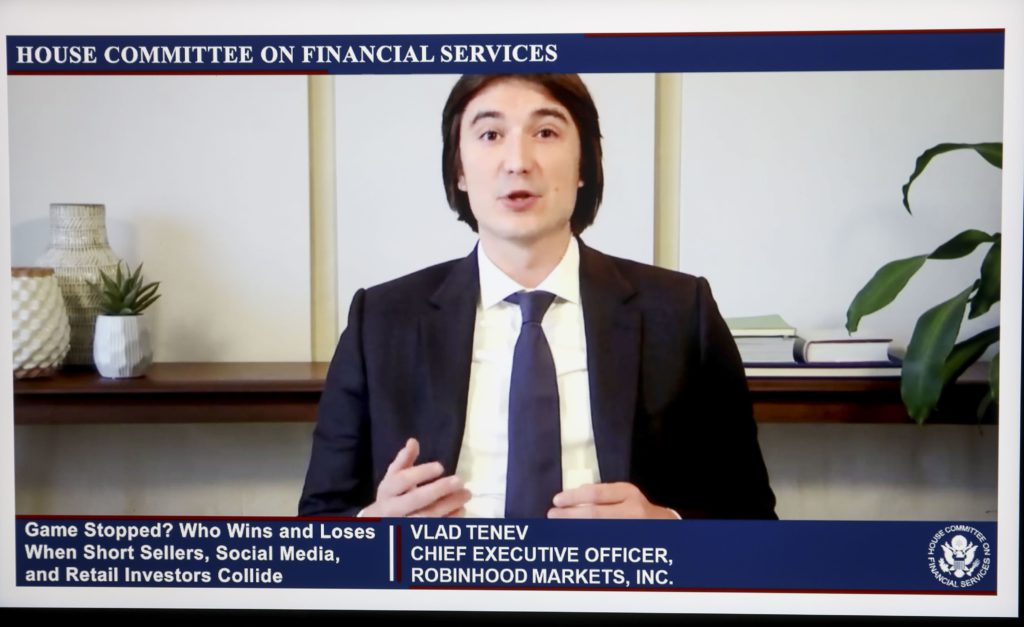
For example, Robinhood Chief Executive Officer Vlad Tenev said during a February 2021 hearing before the committee that the company was “always comfortable with our liquidity.” 

But just weeks earlier, on Jan. 27, 2021, Tenev wrote the firm’s chief financial officer, Jason Warnick, about ensuring the company’s liquidity “stays green,” according to the report. The following morning, Jim Swartwout, president of the company’s Robinhood Securities unit, texted “Huge liquidity issue” to the company’s chief operating officer, Gretchen Howard.

Howard then quickly notified Tenev about the concern and sparked what Friday’s report called “extensive crisis management.” Robinhood had been facing these operational concerns “all week” internally, and was worried that the issue could become public, according to the report.

Lucas Moskowitz, deputy general counsel and head of government affairs for Robinhood, said in a statement that the report was “nothing new” and showed how the events of January 2021 were unique. 

“The report corroborates that the decisions and requests Robinhood made and waivers granted were generally the same decisions, requests and waivers made and granted by others in the industry,” Moskowitz said. Robinhood remains confident that it “took the appropriate and responsible steps necessary to protect and support our customers” and has made improvements since, he said.

Beyond Robinhood, the committee’s investigation was billed as an attempt to get to the bottom of one of the wildest periods for the US stock market in recent memory. A confluence of events — retail investors banding together on Reddit message boards to drive stocks to astronomical levels, hedge fund short-sellers getting hammered with losses and Robinhood and other brokerages temporarily halting the rally — gripped Wall Street and Washington for months early last year.

Meanwhile, Republicans on the committee pushed back on the probe’s findings, which were released by Democrats including Chairwoman Maxine Waters.

Patrick McHenry, the top GOP member of the panel, said that the investigation used the public outrage to push for new regulations, and that it was a missed opportunity to “level the playing field” for retail investors.

More stories like this are available on bloomberg.com

©2022 Bloomberg L.P.
Close Bitnami banner
Bitnami