

Bloomberg

Amazon Staff Demand Ban of Books Calling Transgender People Mentally Ill

(Bloomberg) — A group of Amazon.com Inc. employees plans to march in Seattle’s Pride Parade on Sunday to protest the online retailer’s sale of books they consider anti-transgender—an action that threatens to erode the company’s image as an inclusive employer.

In recent months, several hundred staffers have been pushing the e-commerce giant to ban books like “Irreversible Damage: The Transgender Craze Seducing Our Daughters.” They say such titles dehumanize trans people and dismiss their identities as mental disorders, which runs counter to the recommendations of almost every major medical group. Employees say the books could confuse vulnerable teens and their parents who turn to Amazon seeking information.

“It’s pretty jarring to see books that are promoting that trans people should not transition in the LGBT book section,” said Lina Jodoin, who transitioned two years ago and quit her engineering job at Amazon last month in protest. “It just hurts on a personal level.”

The internal backlash began more than a year ago via employee chat rooms, then spilled into public in March when more than 400 workers signed a petition demanding that senior management stop selling certain books and convene a panel to determine whether the titles violate Amazon’s policies against hate speech. The activism ratcheted up earlier this month when about 30 workers belonging to a group called No Hate at Amazon participated in a “die-in” during a Pride celebration at Amazon’s Seattle headquarters.

To date more than 600 employees have signed the petition and about 20 workers have quit the company due to the sale of titles they say misrepresent what it means to be transgender, according to a member of the group. Several other transgender employees are also planning to quit after they complete certain gender-affirming treatments, a complex and personal process that can take years and could be disrupted by switching jobs and insurance plans, said the person, who requested anonymity for fear of retaliation.

The planned demonstration during the Seattle Pride Parade, which is expected to attract as many as 500,000 observers, will be No Hate at Amazon’s most visible protest to date. Three months ago, Seattle Pride organizers also dropped Amazon as a corporate sponsor, citing its support of lawmakers and organizations that support anti-LGBTQ legislation.

“We respect that many people care deeply about this topic, and we remain committed to providing an inclusive work environment for all of our 1.6 million employees,” Amazon spokesperson Maggie Sivon said in an emailed statement. “As a company, we believe strongly in diversity, equity, and inclusion. As a bookseller, we’ve chosen to offer a very broad range of viewpoints, including books that conflict with our company’s stated positions. We believe that it’s possible to do both—to offer a broad range of viewpoints in our bookstore, and to stand behind our values as a company. When reviewing a book against our content guidelines, we consider the specific content of that book and we invest significant time and resources to ensure our guidelines are applied as consistently as possible.”

Deciding what items to ban is a constant challenge for Amazon, which typically declines to yank products until public pressure threatens to dent its reputation. In 2015, the company pulled Confederate flag merchandise from its web store but only after Walmart Inc. and EBay Inc. banned them first. Amazon is frequently called out for selling Nazi memorabilia and other merchandise deemed anti-Semitic, such as Christmas ornaments celebrating Auschwitz, the infamous Nazi death camp. More than half the goods sold on Amazon come from independent merchants, who post their own merchandise on the site through online portals, making the sprawling online marketplace difficult to police.

For example, Amazon last year stopped selling the book “When Harry Became Sally,” saying it dismissed transgender people as having mental disorders. But a Bloomberg reporter found the book on the web store this week while reporting this story. It was removed after the reporter asked Amazon about it.

Employees are struggling to understand why Amazon banned that book but continues to carry other titles with similar themes. They suspect a backlash from Republican lawmakers may have given the company pause. Senator Marco Rubio of Florida, for one, accused Amazon of censorship after it stopped selling “When Harry Became Sally.”

Of particular concern to the employee activists is “Irreversible Damage,” which appears at the top of search results when an Amazon shopper types in “transgender.” Written by Abgail Shrier, the 2020 book uses anecdotal evidence to suggest that teens identifying as trans is a passing “trend” that can be traced back to mental health issues. It has a 4.7-star rating and more than 6,000 Amazon reviews.

Shrier and Regnery Publishing didn’t respond to requests for comment. On its website, the publisher said “Abigail Shrier’s essential book will help you understand what the trans craze is and how you can inoculate your child against it—or how to retrieve her from this dangerous path.”

Another target is “Johnny the Walrus,” a children’s book by conservative commentator Matt Walsh about a boy who thinks he’s a marine mammal. The boy’s mother, caving to pressure from “the internet people,” feeds him worms and takes him to a saw-wielding doctor who suggests turning his hands and feet into fins.

A spokesperson for the title’s publisher, the Daily Wire-owned DW Books, applauded Amazon for “dismissing demands by its woke employees,” adding that “with nearly 100,000 copies sold on Amazon alone, it’s clear there is a huge demand for “Johnny the Walrus” by Amazon customers, and we are thrilled with the book’s massive success.”

Some Amazon employees express frustration that their employer is willing to take a position on some issues—supporting the Black Lives Matter movement, say, or providing relief to Ukrainians fending off the Russian invasion—but is unwilling to ban all books they consider anti-transgender.

GLAAD, a LGBTQ media watchdog group, says the company has failed to honor the pledge it made last year not to sell books misrepresenting LGBTQ people as mentally ill. “Amazon should keep that promise, adhere to its own content guidelines that forbid hate speech and stop misrepresenting these titles as anything other than what they are: harmful anti-LGBTQ misinformation and propaganda,” a spokesperson for the advocacy group said.

Jodoin, who knew she was transgender when she was 18, is particularly concerned that parents reading books like “Irreversible Damage” could deny their children’s transgender identity, with potentially devastating consequences. Transgender and nonbinary teens were more likely than their cisgender peers to consider or attempt suicide in the past year, according to a survey of LGBTQ youth conducted by the mental-health advocacy group The Trevor Project. Respondents who were threatened with or subjected to harmful and discredited practices known as conversion therapy were also more likely to report suicidal ideation than those who had not. At least 20 states have banned the use of conversion therapy on children.

“It’s especially dangerous when it’s this marketplace as big as Amazon,” Jodoin said. “If we bill ourselves as the world’s biggest bookstore, that comes with a lot of responsibility.”

More stories like this are available on bloomberg.com

©2022 Bloomberg L.P.
Bitcoin Options Point to Positive Signs After Rout, Traders Say

(Bloomberg) — Crypto is undergoing a historic bout of volatility, but options traders are seeing positive signs within the market in the wake of the ruckus and controversy that overtook digital-asset lenders and others in the sector.

Chris Bae, chief executive and co-founder at structured-derivative-solutions provider EDG and a former trader at UBS and Goldman Sachs, is looking at open interest and is tracking global exchanges that offer options trading. 

“It doesn’t suggest that liquidity has thinned dramatically,” Bae said in an interview. “There’s a lot of data that suggests the maturity of the market has progressed and that in the options market in particular, it’s business as normal, to a large degree, when taking into context the environment that we’re in.” Bae added that bid-ask spreads seem reasonable.

The environment, of course, has been strained by a number of hacks, as well as combustions of stablecoin projects and foldings of big-name crypto hedge funds. Over the past few weeks, lenders, in particular, have shown instability, with Celsius Network and Babel Finance freezing withdrawals, and Three Arrows Capital, a major crypto hedge fund, facing liquidity troubles. And it’s all coming amid a less-accommodative monetary-policy background, where the Federal Reserve and other global central banks are furiously raising rates to combat price increases. 

To be sure, the market is much different than during last year’s bull run. Open interest, or the total number of outstanding contracts, has come way down from its highs. OI is down a little more than $7 billion from a record of about $15 billion in October 2021, according to data from Skew. Volume is currently slightly below $600 million, compared with an all-time high of more than $8 billion also in October. 

Patrick Chu, head of institutional coverage APAC at Paradigm, a liquidity provider for crypto derivatives, says that the drop in OI is reflective of market sentiment. During bear markets, interest tends to wane. 

Options can serve two functions, he says. One is hedging, and the second is speculation. “For one, the amount of assets deployed shrinks so there is less to hedge. For two, speculations, people have a very strong long-only bias in crypto, so when the market goes bear, people get rekt,” a reference to the word “wrecked” that is often used in the crypto community.

Still, Chu says, his firm has been seeing “more and more TradFi players” — or traditional-finance participants — showing interest in options. And they are entering the market, he says. That could help explain why OI levels have remained stable, despite all the turmoil within the crypto industry. 

That institutions are playing a bigger role bears out in other data, too. A report from the Amber Group, a digital-asset company, showed that its desk saw an increase in put-option buying demand in the wake of the liquidations seen over the past few weeks. “Risk mitigation is especially worthy of consideration under current market environments,” the note said. 

Meanwhile, Luke Farrell, a trader at crypto market-maker GSR, says he’s noticed a huge change in the options space over the past two years relative to prior cycles. Institutions, he says, have been coming in, whereas crypto, prior to 2017, was heavily influenced by retail participations. Today, institutions are using options for tailor risk-management solutions or to hedge portfolios or positions. In addition, he says, investors can play with options on an expanded number of coins, a trend that spurs holders to want to use them for risk-management solutions. 

Finally, Farrell says, Bitcoin miners, many of whom have found themselves in hot water amid price slumps for digital tokens, are hedging their future production, a change from last year when, amid a bull market, they weren’t buying protective options. “They are willing to pay a little bit to protect on the downside of turning below their cost productions,” he said. “That’s been an interesting shift.”

More stories like this are available on bloomberg.com

©2022 Bloomberg L.P.

Social Media Buzz: Gun Legislation, Abortion, Norway

(Bloomberg) — What’s buzzing on social media this morning:

BUZZING HEADLINES:

President Joe Biden signed gun-safety legislation into a law that he called the most significant of its kind in decades, restricting firearms access for the youngest buyers and offering incentives for states to set up “red flag” laws. “While this bill doesn’t do everything I want, it does include actions I’ve long called for that are going to save lives,” he said at the White House on Saturday. Congress passed the bill in the same week that gun rights were expanded by the Supreme Court, which knocked down a century-old gun safety law in New York. 

The Supreme Court’s ruling Friday to overturn Roe v. Wade, allowing states to outlaw abortion, led to a spike in searches of the term “ectopic pregnancy,” a condition in which an embryo implants outside the uterus. The fetus almost never survives beyond the first trimester and if not treated, the condition can be deadly for the woman. 

Thousands of demonstrators across the US protested against the Supreme Court’s decision. Most protests were peaceful, though the driver of a pickup truck in Cedar Rapids, Iowa, struck a group of people protesting against the decision, the Huffington Post reported. In Phoenix, SWAT team members fired tear gas on thousands of abortion rights protesters at the Arizona Capitol late Friday, where lawmakers were finishing their 2022 session, AP reported.

Norway raised its terror alert after a gunman opened fire in Oslo, killing two people during annual Pride week celebrations, the Associated Press reported. The acting chief of the Norwegian security service PST called the shootings an “extreme Islamist terror attack.” Police arrested a suspect, a 42-year-old Norwegian citizen originally from Iran, saying he had opened fire in three parts of the capital. Oslo’s Pride parade, scheduled for Saturday, was canceled.

More stories like this are available on bloomberg.com

©2022 Bloomberg L.P.
Singapore Regulator Praises Leaders of Crypto Firms Like Binance

(Bloomberg) — Just days after saying Singapore is “brutal and unrelentingly hard” on bad behavior in the crypto industry, Sopnendu Mohanty, chief fintech officer at the city’s regulator, struck a cordial tone.

Mohanty, in a LinkedIn post summarizing his thoughts from the Point Zero Forum in Switzerland, commended the leadership of some of the biggest firms in the sector.

“Leaders from the Crypto/Token space (Binance, Crypto.com, Ripple and others) are fully committed to building a secure and sustainable innovation solving real problems, and identifying real-economy opportunities,” said Mohanty of the Monetary Authority of Singapore. “It is heartening to see the clarity among CEOs on the need to create a responsible and compliant industry. The future is on the right path.”

Mohanty’s praise comes as the digital currency market continues to spiral downward following a broad-based selloff in digital assets and the collapse of high-profile tokens TerraUSD and Luna. Major lenders Celsius Network and Babel Finance have frozen withdrawals, and Three Arrows Capital, a major crypto hedge fund, is facing liquidity troubles that rattled investors. 

The total market value of cryptocurrencies, which topped $3 trillion in November, has dropped to $991 billion, according to data from CoinGecko. Bitcoin has fallen precipitously from a high near $69,000 in November, trading Saturday around $21,000. 

Singapore was an early proponent of blockchain technology and officials have expressed ambitions to be a global crypto hub, but the relationship with the industry soured amid issues including a slow regulatory process for license approvals and a ban on crypto advertising that surprised the sector. 

Binance, the largest crypto exchange, had a strong presence in Singapore and Chief Executive Officer Changpeng “CZ” Zhao resided on the island before the firm largely decamped in recent months to Dubai. The company is currently the target of investigations by almost every major US financial regulator — the Department of Justice, the Commodity Futures Trading Commission, the Internal Revenue Service, and the Securities and Exchange Commission — and others around the world. 


The MAS may be picking up the pace on licenses, at least, with three in-principle approvals issued recently including to digital currency exchange Crypto.com.

Ripple — engaged in a tussle with US regulators about the XRP token but which has a sizable international footprint — and Binance have said they plan to expand even as other entities in the sector downsize. Crypto.com, which is headquartered in Singapore, announced layoffs of about 260 staff, or 5% of its workforce earlier this month. Chief Executive Officer Kris Marszalek said the company made the “difficult and necessary decisions” to optimize for profitability and sustainable growth during a market downturn.

“While others may have hit the brakes on hiring, we’re doubling down,” said Brooks Entwistle, Ripple’s managing director for APAC and MENA, in a recent email interview. “In the next 12 months, we’re leaning into our first mover advantage and taking opportunities to be more aggressive in our hiring, growth, investments and strategic opportunities. Just this year alone, we’re looking to hire 300 employees, nearly half of which will be based outside the US.”

Still, Mohanty’s post wasn’t entirely effusive, offering some of the caution that has also been a signature of Singapore’s approach to crypto.

“Web 3.0/Crypto is a very nascent industry, but the promises have run ahead of the technology maturity, the industry is filled with speculators and scammers, and magical soundbites with clickbait headlines are filling the space,” Mohanty said. “So let’s not create a forced error and throw the baby out with the bathwater.”

More stories like this are available on bloomberg.com

©2022 Bloomberg L.P.

Sorry Elon Musk. Hyundai Is Quietly Dominating the EV Race

(Bloomberg) — Pipe down for a second Elon, the hottest things in the auto industry — the most electric electrics — now come from Hyundai Motor Co. and Kia Corp.

Earlier this year, the South Korean carmakers rolled out two new battery-powered cars — the Hyundai Ioniq 5 and its sibling, the Kia EV6 — which promptly tore up the sales charts, passing the Nissan Leaf, Chevrolet Bolt and every other electric vehicle on the market not made by Tesla. In the US this year through May, Hyundai and Kia sold 21,467 of these two machines, besting even the white-hot Ford Mustang Mach-E, which was snapped up by 15,718 drivers.

“From an EV perspective, they’re really just kind of cleaning the floor,” said Edmunds analyst Joseph Yoon. “I honestly don’t know if any dealers around me have any in stock.”

Tesla still sells far more cars, but it took the company a decade to deliver as many electric vehicles as Hyundai and Kia have managed in a few short months. Even Musk has been impressed.

  • Do you own an electric car? US residents, Bloomberg Green wants to learn more about your experience with EVs. Take our brief survey.

Granted, Hyundai is no startup. And the design of the current hits started about six years ago, according to Steve Kosowski, manager of long range strategy at Kia America. At the time, the Chevrolet Bolt had just hit the market and Kia considered a car similar in size and scope. Ultimately, Kosowski and company green lit something far larger, sportier and swankier — at a slightly higher price.  

“The thinking was, with the platform we have and the market understanding we have, let’s put together a really bold, breakthrough proposition,” he recalls. “We’re going to make a statement that Kia is here.”

The timing was favorable. EV adoption is picking up in the US, thanks to a surge in both climate concern and gasoline prices. And though there’s a run on battery-powered vehicles, there still aren’t many to choose from. Of the 30 or so models for sale on the US market, only a handful can be had for less than $45,000 and most of those are relatively small, dated cars like the Nissan Leaf. 

The Ioniq 5 and EV6 both offer the cargo space of a small SUV, the size and shape of vehicle that has taken over US garages of late. Both cars ride on the same modular platform, incorporate the same motors and batteries and post similar speed specifications. They are tricked out with screens and  charge at some of the fastest rates in the industry, adding almost 16 miles of range in a minute under ideal conditions. They also offer a couple features that are novel in the space: pedals to adjust regenerative braking and bi-directional power (yes, you can run power tools or charge another EV with one of these machines).

Starting around $40,000, they are drawing buyers with smaller budgets who otherwise may have bought a starter sedan, says Yoon at Edmunds. And yet, they are plush enough inside to pull from the top of the market as well, as drivers trade in luxury cars with internal combustion engines.

“These two cars have come in kind of at the right price and the right size for a lot of buyers,” Yoon said. “And I think there’s a level of inherent trust with a big manufacturer getting in the game with a mainstream.”

Emad Zia and his wife had only been planning to “dip our toes” in the EV market when Hyundai’s new cars launched this winter. The two are fond of sporty cars — preferably with a stick shift — but wanted something bigger than the Volkswagen Golf R and Mazda Miata in their Dallas garage. They settled on the Ioniq 5 purely based on photos and speed specs, then ordered an EV6 when they couldn’t find the Hyundai anywhere close to the sticker price.

“We’re used to having — I don’t want to say underdogs — but unique cars,” Emad Zia explained. “And the looks and uniqueness of this car just doesn’t get old.”

So far, roughly three in four EV6 buyers were previously driving a car from another brand, according to Kia, and only one in 10 has previously owned a plug-in vehicle. The current waitlist for the EV6 is about six months long and the average transaction price is a few thousand dollars above the sticker price, according to Bloomberg Intelligence, which suggests most buyers are willing to pay a premium. 

“Our dealers are reporting that these cars are sold within hours,” said Eric Watson, vice president of sales at Kia America Inc.

Kosowski said the new Hyundai products are capitalizing, in part, on “Tesla fatigue,” as the first-mover sedans and SUVs become ubiquitous even beyond coastal states. Also, Hyundai owners are sticking with what they know — of those trading in a Hyundai or Kia recently, about 60% stayed with the brand, according to Edmunds.

Hyundai plans to launch a new battery-powered car every year for the rest of the decade and is spending $16.5 billion to boost EV production in South Korea. By 2030, the automaker wants to claim 12% of the global EV market, some 3.2 million cars and trucks.

“They definitely have a leg up,” Yoon says. “Toyota and Subaru will have to see if they can catch them.”

(Updates references to Edmunds, Hyundai and Kia corporate names throughout.)

More stories like this are available on bloomberg.com

©2022 Bloomberg L.P.
Hyundai Quietly Climbs the EV Sales Charts and Elon Musk Notices

(Bloomberg) — Pipe down for a second Elon, the hottest things in the auto industry — the most electric electrics — now come from Hyundai Motor Co. and Kia Corp.

Earlier this year, the South Korean carmakers rolled out two new battery-powered cars — the Hyundai Ioniq 5 and its sibling, the Kia EV6 — which promptly tore up the sales charts, passing the Nissan Leaf, Chevrolet Bolt and every other electric vehicle on the market not made by Tesla. In the US this year through May, Hyundai and Kia sold 21,467 of these two machines, besting even the white-hot Ford Mustang Mach-E, which was snapped up by 15,718 drivers.

“From an EV perspective, they’re really just kind of cleaning the floor,” said Edmunds analyst Joseph Yoon. “I honestly don’t know if any dealers around me have any in stock.”

Tesla still sells far more cars, but it took the company a decade to deliver as many electric vehicles as Hyundai and Kia have managed in a few short months. Even Musk has been impressed.

  • Do you own an electric car? US residents, Bloomberg Green wants to learn more about your experience with EVs. Take our brief survey.

Granted, Hyundai is no startup. And the design of the current hits started about six years ago, according to Steve Kosowski, manager of long range strategy at Kia America. At the time, the Chevrolet Bolt had just hit the market and Kia considered a car similar in size and scope. Ultimately, Kosowski and company green lit something far larger, sportier and swankier — at a slightly higher price.  

“The thinking was, with the platform we have and the market understanding we have, let’s put together a really bold, breakthrough proposition,” he recalls. “We’re going to make a statement that Kia is here.”

The timing was favorable. EV adoption is picking up in the US, thanks to a surge in both climate concern and gasoline prices. And though there’s a run on battery-powered vehicles, there still aren’t many to choose from. Of the 30 or so models for sale on the US market, only a handful can be had for less than $45,000 and most of those are relatively small, dated cars like the Nissan Leaf. 

The Ioniq 5 and EV6 both offer the cargo space of a small SUV, the size and shape of vehicle that has taken over US garages of late. Both cars ride on the same modular platform, incorporate the same motors and batteries and post similar speed specifications. They are tricked out with screens and  charge at some of the fastest rates in the industry, adding almost 16 miles of range in a minute under ideal conditions. They also offer a couple features that are novel in the space: pedals to adjust regenerative braking and bi-directional power (yes, you can run power tools or charge another EV with one of these machines).

Starting around $40,000, they are drawing buyers with smaller budgets who otherwise may have bought a starter sedan, says Yoon at Edmunds. And yet, they are plush enough inside to pull from the top of the market as well, as drivers trade in luxury cars with internal combustion engines.

“These two cars have come in kind of at the right price and the right size for a lot of buyers,” Yoon said. “And I think there’s a level of inherent trust with a big manufacturer getting in the game with a mainstream.”

Emad Zia and his wife had only been planning to “dip our toes” in the EV market when Hyundai’s new cars launched this winter. The two are fond of sporty cars — preferably with a stick shift — but wanted something bigger than the Volkswagen Golf R and Mazda Miata in their Dallas garage. They settled on the Ioniq 5 purely based on photos and speed specs, then ordered an EV6 when they couldn’t find the Hyundai anywhere close to the sticker price.

“We’re used to having — I don’t want to say underdogs — but unique cars,” Emad Zia explained. “And the looks and uniqueness of this car just doesn’t get old.”

So far, roughly three in four EV6 buyers were previously driving a car from another brand, according to Kia, and only one in 10 has previously owned a plug-in vehicle. The current waitlist for the EV6 is about six months long and the average transaction price is a few thousand dollars above the sticker price, according to Bloomberg Intelligence, which suggests most buyers are willing to pay a premium. 

“Our dealers are reporting that these cars are sold within hours,” said Eric Watson, vice president of sales at Kia America Inc.

Kosowski said the new Hyundai products are capitalizing, in part, on “Tesla fatigue,” as the first-mover sedans and SUVs become ubiquitous even beyond coastal states. Also, Hyundai owners are sticking with what they know — of those trading in a Hyundai or Kia recently, about 60% stayed with the brand, according to Edmunds.

Hyundai plans to launch a new battery-powered car every year for the rest of the decade and is spending $16.5 billion to boost EV production in South Korea. By 2030, the automaker wants to claim 12% of the global EV market, some 3.2 million cars and trucks.

“They definitely have a leg up,” Yoon says. “Toyota and Subaru will have to see if they can catch them.”

More stories like this are available on bloomberg.com

©2022 Bloomberg L.P.
JPMorgan Says Bitcoin Miner Sales May Keep Pressuring Price

(Bloomberg) — Bitcoin miners needing to sell could weigh on the token’s price for some time, according to JPMorgan Chase & Co.

Public-listed miners — which account for about 20% of the total — have already reported Bitcoin sales in May and June to increase liquidity, meet costs and possibly deleverage, JPMorgan strategists led by Nikolaos Panigirtzoglou wrote in a note Friday. Privately-held miners may have sold a larger share of their block rewards from mining activity to meet ongoing costs and could be less levered given their more limited access to capital markets, they said.

“Offloading of Bitcoins by miners, in order to meet ongoing costs or to delever, could continue into Q3 if their profitability fails to improve,” the strategists wrote. That offloading “has likely already weighed on prices in May and June, though there is a risk that this pressure could continue.”

The largest cryptocurrency is down more than 50% year-to-date as the Federal Reserve begins to hike interest rates and inflation remains high. The troubles for the asset class deepened with the meltdown of the Terra/Luna ecosystem as well as concerns about hedge fund Three Arrows Capital. Now the trouble is spreading — decentralized finance projects are admitting exposure to losses, and billions of dollars in Bitcoin miner loans are coming under stress.

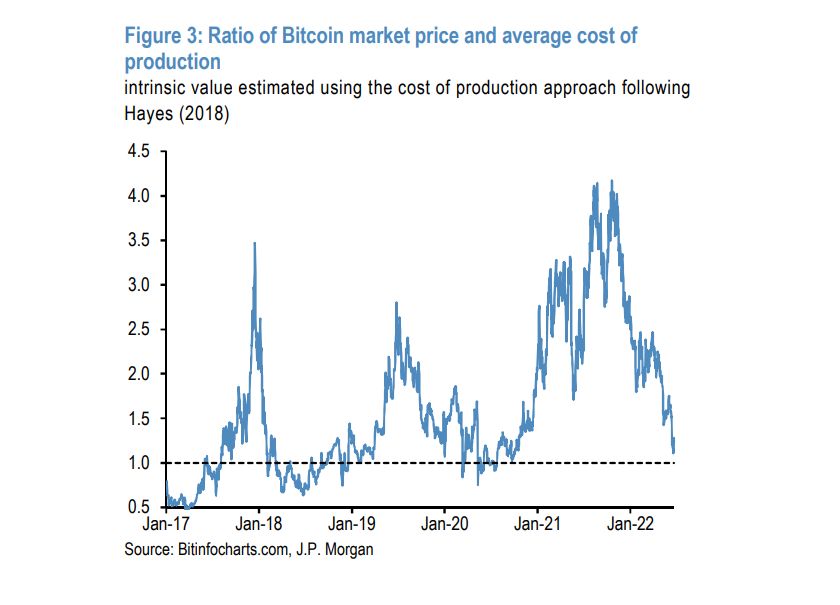
One thing that could mitigate price pressures, according to JPMorgan: a drop in the cost of production from a range of around $18,000 to $20,000 earlier in the year, to this month settling around $15,000. That seems to be related to an improvement in the implied energy efficiency of mining hardware, and could cushion profitability, the firm said.

Estimates of the cost to mine Bitcoin can vary. The cost of production for a large mining company is around $8,000 per token, assuming average electricity prices and fairly new mining machines, according to Arcane Crypto. However, Securitize Capital says that factoring in overhead costs for infrastructure and interest rates, the total costs for some miners may already be above $20,000.

Bitcoin was trading around $21,500 as of 8:30 a.m. in London.

More stories like this are available on bloomberg.com

©2022 Bloomberg L.P.
Miner Capitulation Means Bitcoin Bottom Is Near: CryptoQuant

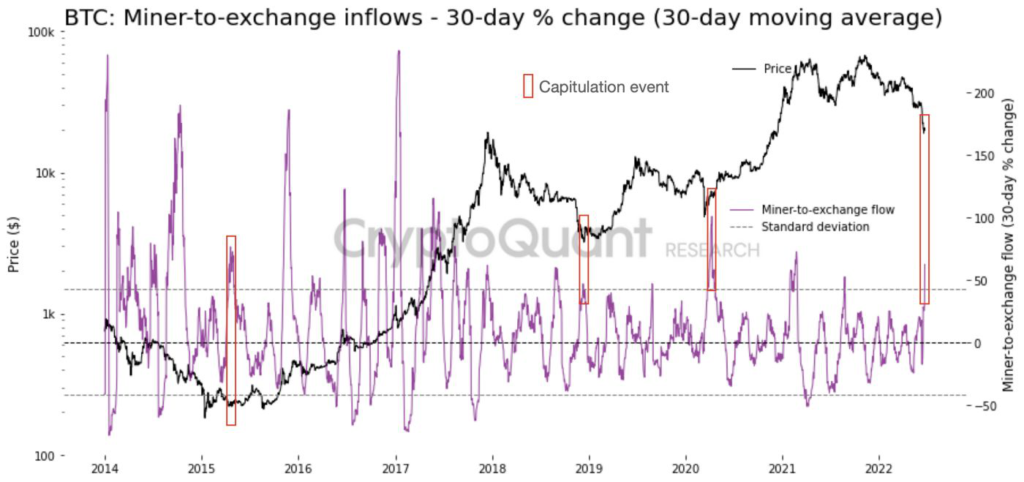
(Bloomberg) — A major “capitulation event” in which Bitcoin miners funnel thousands of tokens to exchanges could signal an approaching bottom for the world’s largest cryptocurrency, if history is any guide.

In an effort to salvage plunging profits, Bitcoin miners are turning sellers after seeing the price of the bellwether token more than halve in 2022. This past month, miners moved 23,000 Bitcoin to exchanges, representing the highest monthly flow since May 2021, when China initiated a crackdown on its domestic crypto industry, data from tracker CryptoQuant shows. Earlier this week, Canadian mining firm Bitfarms Ltd. sold 3,000 Bitcoin for $62 million, following in the footsteps of Riot Blockchain Inc., which started selling off holdings in April. 

Market watchers have said that the slew of selloffs is only likely to continue, driving coin prices down further. But some, like CryptoQuant senior analyst Julio Moreno, say they’re a sign of an approaching market bottom. 

CryptoQuant has dubbed the phenomenon a “capitulation event” or the start of a “capitulation period” for miners. Moreno says this typically comes right before a bottom, in line with past market cycle patterns.

“With miners’ revenue dropping and mining difficulty still at high levels, miners are now in the “extremely underpaid” territory,” he wrote in a note dated June 23. “Some miners’ revenue can’t meet the break-even point, so they have to cash out to cover expenses/loans,” he wrote. 

At the moment, Bitcoin is trading at around $21,500 and seems to be resting on a crutch of at least $20,000 after falling as low as about $17,600 on June 18. Between June 13 and 17, miners offloaded about 9,769 Bitcoin to exchanges, according to CryptoQuant data, after crypto lending platform Celsius halted withdrawals and news broke that hedge fund Three Arrows Capital may face insolvency.

The selloff in coins was initially triggered by the collapse of Terra’s algorithmic stablecoin amid unfavorable macro conditions across the cryptosphere. Total crypto market capitalization has sunk by more than $800 billion since May, according to CoinGecko. 

More stories like this are available on bloomberg.com

©2022 Bloomberg L.P.

London’s Prime Shopping Street Has a Case of Long Covid

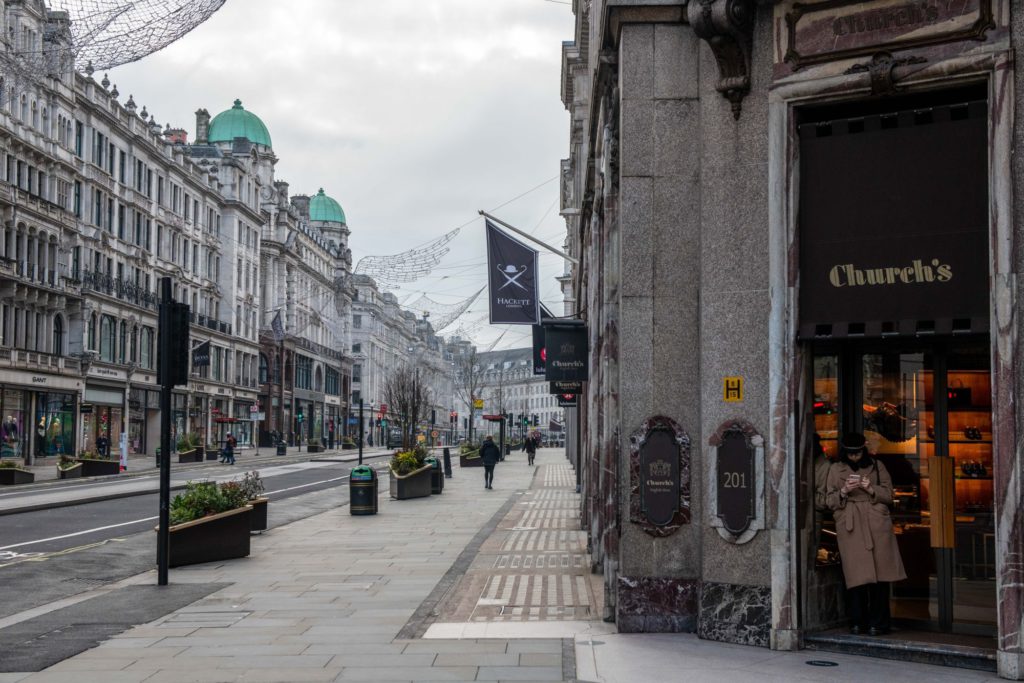
(Bloomberg) — Regent Street, London’s premier shopping thoroughfare, is struggling to shake off the lingering effects of Covid-19. 

Store vacancy levels, at a record 12%, are almost twice what they were at the end of 2019, while asking rents for the best space on the street have fallen by more than 30% during the pandemic, according to Savills Plc. 

Shoppers who stroll along the curving avenue, passing through Oxford Circus and Piccadilly in London’s West End, may notice the absence of familiar brands. J Crew, Brooks Brothers, Desigual and Zara Home all closed stores during the two years of on-again off-again lockdowns that battered brick-and-mortar retailers and accelerated a shift to online shopping.

“We aren’t out of the woods by any means,” said Simon Harding-Roots, managing director for London at The Crown Estate, which counts Regent Street among its £7.7 billion ($9.5 billion) of holdings in the capital. 

“There’s work to be done to get vacancies back to pre-pandemic levels,” he said in an interview. “We’re well aware we’ve got some tough times ahead.”

The Crown Estate — which traces its roots to the Norman conquest in 1066 — owns a range of assets, from shops, offices and rural lands to the seabed around England. Now an independent company established by an Act of Parliament, its proceeds go to the UK treasury, which in turn sets aside a portion of the profits to fund the monarchy. It owns most of Regent Street along with Norway’s Sovereign Wealth Fund, which has a 25% stake.

‘Stubbornly Down’

The number of visitors to the West End collapsed during the pandemic as shoppers stayed away. Now people are returning, but with many still working part of the week at home, real wages falling and tourism not yet recovered, the shopping district hasn’t bounced all the way back.

“Footfall is stubbornly down,” said Harding-Roots. “We’ve got to entice people back into London.”

Britain’s biggest rail strike in a generation — and the prospect of more labor unrest this summer — aren’t helpful. Nor is the exponential growth of e-commerce companies, like China’s Shein. Even Primark, which has steadfastly resisted moving online, said Monday it will start a trial selling children’s products through its website for in-store collection. 

Purveyors of luxury goods have been hit as the government’s decision to abolish tax-free shopping in the UK sends the well-heeled to boutiques in cities like Paris, Madrid and Milan. Those hubs are gaining £5 million a week from high-earning British spenders who can make cheaper purchases on the continent, said Helen Brocklebank, chief executive officer at Walpole, which represents the UK luxury industry.

“Has Regent Street lost its iconic status? No not at all,” Brocklebank said. “But is there a fight for wallet share post pandemic? Yes absolutely.”

It’s not just Regent Street where the shine seems to have come off. Vacancies have been rising on neighboring Oxford Street too, and rents have also fallen. More broadly, the problems affecting London’s prime shopping district are similar to those facing high streets across the UK. Chief among them: surging inflation, a shift to internet shopping and staffing shortages. 

Retail leaders need to consider where best to invest money and many will think the digital world is a safer bet, said Peter Williams, the chairman of Mister Spex SE and former chair of Boohoo Group Plc. “Many will ask ‘do I really need to invest in a store on Regent Street, when the West End is not looking as good as it once did? Probably not.”’

Mixing It Up

That said, churn is hardly new in Britain’s dynamic retail industry. As some brands have left the area, others — like Uniqlo — have moved in. The Japanese clothing seller opened a new Regent Street store in April. 

The Crown Estate is reviewing its retail properties to mix flagship stores with smaller shops and pop-ups. Its ownership of Regent Street as a whole gives it the flexibility to break up large retail spaces and vary the type of tenants, said Harding-Roots.

“It’s been around 300 years, it’ll be around another 300 years,” he said. “Global success stories want to be on Regent Street, still.”

Gymshark, the workout-wear brand, plans to open its first permanent store there. Skincare brand Aesop, apparel maker Armani Exchange and fashion label Marc Jacobs also have new shops in the offing. 

Footfall has grown to 88% of pre-pandemic levels, higher than the West End’s average of 81%, according to the New West End company, which represents businesses in the area. The opening of the new Elizabeth Line at Bond Street station in the autumn may bring in more visitors. 

Gymshark likens Regent Street to New York’s Fifth Avenue or the Champs-Elysees in Paris. It has a history of attracting the most exciting new brands, said Mitch Healey, who heads physical retailing and events at the company. Gymshark customers want to “hang out” and touch and feel products in real life, he said. 

The sportswear brand had a pop-up store in Covent Garden in 2020 and the “data we gleaned from those 11 days of trading showed we were onto a good thing,” he said.  

But for Superdry Plc, Regent Street has lost its appeal. The fashion brand closed its store last year in favor of a newly fitted-out flagship across three floors on Oxford Street. 

While the tech gadgets of Apple Inc. and colorful toys of Hamleys of London Ltd. pull in customers at the upper end of Regent Street, there isn’t an anchor store at the bottom end to keep shoppers interested, Julian Dunkerton, CEO and co-founder of Superdry, said by phone. Department store Selfridges & Co. provides that attraction on Oxford Street, he said.

“You’ve got a real determined shopper on Oxford Street and you’ve got a sort of lost tourist at the bottom end of Regent Street,” he said. “You need a really strong flagship that is going to give people a reason to go.”

More stories like this are available on bloomberg.com

©2022 Bloomberg L.P.

Why Margin Calls and Bot Liquidations Are Roiling Crypto

(Bloomberg) — It’s a vicious circle long familiar to those in traditional finance: trades made with borrowed money coming apart when the value of their collateral put up against the loans drops, forcing liquidations that in turn push prices down further. That pattern, driven by so-called margin calls, has come to cryptocurrency markets in a big way since prices began to slump broadly — with some additional crypto-only twists. 

1. What’s a margin call? 

In traditional markets, trading with borrowed money is called borrowing on the margin. The lenders, usually brokers, require that collateral, usually in the form of other stocks, be posted to offset the risk of the trade going sour. The collateral requirement is defined as a percentage of the loan. That means that if the value of the collateral drops, the broker will call for the investor to either post more collateral or close the position and repay the loan. 

2. How can margin calls disrupt markets? 

The system usually works well enough when markets are going up or are roughly steady, though individual investors who make bad bets or get in over their heads can suffer. Bigger troubles can come when there’s a broad fall in values that triggers widespread margin calls. When investors sell holdings to meet a margin, they drive prices down further, prompting further margin calls. 

3. How is this different in crypto? 

For one thing, the DeFi (decentralized finance) apps on which much crypto trading takes places tend to be interconnected, meaning troubles in one can have cascading effects on another. For another, most DeFi apps require overcollateralization — that an amount of crypto greater than the loan be posted, to account for the normal volatility seen in this market. But perhaps most important is that liquidation of positions when margin calls aren’t met usually happens automatically: The so-called smart contracts used to execute trades will turn the positions over to bots designed for this purpose. There’s no chance to convince a broker that you will be able to cover your position if given another day, hour or minute. 

4. What happens when liquidations are triggered? 

Many DeFi apps offer a liquidation bonus to the bots, which are run by third-party programmers and traders. That incentive can lead to swarms of them competing to carry out the liquidations, a situation that can clog up the blockchain ledgers used to process and record crypto transactions. And as with any other kind of margin call, a large number of liquidations — or the liquidation of a large holding — can drive down token prices, leading to more liquidations. 

5. How bad is the situation? 

The pain now buffeting DeFi apps was triggered after centralized crypto lenders Celsius Network and Babel froze deposits and the rumored collapse of fund Three Arrows Capital sent crypto prices down by double digits over the course of a week. Celsius had worked with many DeFi apps to earn the high returns it offered. Much of the market turmoil focused on stETH, a token that represents staked Ether on the Ethereum blockchain and counts Celsius as a major holder. Since its launch by decentralized app Lido Finance, stETH has become one of the most popular collateral assets for lending and borrowing in DeFi. But stETH began trading at a deepening discount to Ether’s price, which has led both to liquidations and illiquidity in its trading. About 30% of all stEth stuck on Aave, for example, was from Celsius, according to researcher Novum Insights. Three Arrows Capital, meanwhile, was an investor in Lido, which issued stETh. As tracked by DeFi Llama, the total value locked in DeFi, the amount of crypto in use on apps, plunged to $76 billion on June 24 from $205.7 billion on May 5, just before the Terra blockchain’s implosion set off the year’s biggest crypto crisis so far. 

6. What has been the response? 

Some unprecedented steps were taken, though some of them were rescinded. On June 19, token holders of Solend, a lending app on the Solana blockchain, voted to temporarily take over a large user’s account that faced the threat of a large liquidation, an extreme move for DeFi that appeared to be a first. That decision, which was meant to provide an orderly over-the-counter liquidation rather than a bot-driven firesale, was reversed in a follow-up vote. A slew of other apps moved to adjust their practices and policies to stave off large-scale liquidations and consequent losses.

7. What’s the significance of all this? 

During the bull market, many crypto traders appeared to have forgotten just how risky crypto and DeFi loans in particular can be. The wave of liquidations that washed over the industry seemed to prompt more people to become more cautious with borrowing. On decentralized exchange dYdX, for example, traders have dramatically reduced their leverage since Terra’s crash.

  • Bloomberg QuickTakes on DeFi, crypto lending, Terra’s implosion, yield farming and stablecoins.
  • An article by CoinDesk on $1 billion in crypto liquidations.
  • A Bloomberg article on the Solend votes and other moves by DeFi apps on liquidations.
  • A primer on DeFi liquidations from the Ledger Academy.


More stories like this are available on bloomberg.com

©2022 Bloomberg L.P.

Close Bitnami banner
Bitnami