Bloomberg

Hackers Steal $100 Million by Exploiting Crypto’s Weak Link

(Bloomberg) — Hackers looted about $100 million from a so-called cryptocurrency bridge, again exposing a key vulnerability in the digital-asset ecosystem. 

Blockchain Harmony said in a tweet that the hack of its Horizon bridge, which lets people swap coins between different blockchains, took place Thursday morning. It has “begun working with national authorities and forensic specialists to identify the culprit and retrieve the stolen funds.”

Most of the crypto world is divided into silos: The Bitcoin and Ethereum networks, for example, can only operate using Bitcoin and Ethereum tokens. As more cryptocurrencies gain adoption and traders demand the ability to interact seamlessly with one another, projects like Harmony are developing platforms known as bridges that can accept a variety of tokens and move them fluidly between blockchains. 

But bridges are particularly vulnerable to hacks, as their technology is complex and they are often run by anonymous teams. The way they safeguard funds is often unclear. Sophisticated hackers have repeatedly targeted them.  

Harmony’s native ONE token, used to pay transaction fees, earn rewards or vote on changes to the platform, dropped 12% over the past 24 hours, according to CoinGecko. The underlying Harmony blockchain has more than $1 billion in total value locked to the project, according to its website.

It wasn’t immediately clear whether any user funds had been stolen. 

‘Private Key Compromise’

The attack on Horizon, which offers cross-chain transfers between Ethereum and Binance’s Smart Chain, marks the third major bridge hack this year. In February, hackers stole more than $300 million from the Wormhole bridge, followed by a $620 million theft from the Ronin bridge a month later. 

Even before to the Horizon hack, more than $1 billion had been stolen from bridges, researcher Chainalysis has estimated.

In Horizon’s case, “the theft seems to have happened due to a private key compromise,” said Xuxian Jiang, chief executive officer of security firm PeckShield, which has been contacted by Harmony for support. Harmony did not immediately respond to requests for comment.

The Horizon bridge is managed and secured by four wallets, Jiang said, and an authentication from at least two of the wallets — each supported by multiple signatures — is required to validate and execute a transaction. On this occasion, an attacker was able to compromise the private information required to access these wallets, and then trigger transactions that withdrew assets from the Horizon bridge to an external wallet, Jiang said.

The hackers made off with cryprocurrencies including Ether and BNB as well as stablecoins Tether, USDC and DAI, researcher Elliptic said in a tweet. Those tokens were then swapped for Ether using so-called decentralized exchanges in what Elliptic called “a commonly-seen technique with these hacks.”

Ronin Hack

Horizon uses a security mechanism similar to the one employed by the Ronin bridge, linked to the popular blockchain game Axie Infinity, which required five out of nine validators required to sign off at the time it was hacked. Harmony is popular for blockchain games like Mars Colony and DeFi Kingdoms, according to its website. 

After the Ronin attack, which was attributed to a North Korean hacker group, owner Sky Mavis sharply increased the number of validators required to sign off on transactions — pledging to eventually boost it to over 100.  

Thursday’s attack on the Horizon bridge followed an exploit related to five user wallets on Harmony’s network in January, in which the company said a thief had siphoned 19,314,598 ONE tokens, worth roughly $5.8 million at the time.

The amount of money locked on bridges connected to the Ethereum blockchain declined 60% in the last 30 days to less than $12 billion, per tracker Dune, triggered by a wider crypto market slump and liquidity concerns surrounding several large crypto players including Celsius Network, Babel Finance, Three Arrows Capital and Voyager Digital.

(Updates to add context from third paragraph and throughout)

More stories like this are available on bloomberg.com

©2022 Bloomberg L.P.

Tech Companies Want More Eyes in the Sky for Wildfire Season

(Bloomberg) —

Dan Nuñez pulls up a video feed on his computer.

“Can you see that?” he asks, pointing to some rolling, foggy hills in rural Oregon. The footage was captured seven minutes before Nuñez opened up his browser. Barely perceptible on the screen is a rising plume of smoke.

“I would not have caught that,” Nuñez said after hitting replay. “But the AI does.” The artificial intelligence Nuñez is referring to comes from Pano AI, a California startup that makes high-definition cameras to detect, track and manage flames. As the manager of wildfire planning and analytics at Portland General Electric, Nuñez is responsible for doing everything possible, as early as possible, to find and put out fires.

A cottage industry in fire detection technology has taken root, especially in the western US, as fires have become more frequent, larger and financially ruinous.

PGE so far has installed five Pano cameras, with plans to add 17 more across Oregon this summer. The hardware offers minute-by-minute snapshots of the surroundings. According to Sonia Kastner, the startup’s founder and chief executive officer, Pano’s software can distinguish benign clouds from troubling smoke. The artificial intelligence that makes that possible has become the main selling point. For firefighters, government agencies and utilities, spotting wildfires early is critical to limiting the damage.

“Minutes matter here,” said Mark Miller, chief commercial officer for AEM, an environmental technology company owned by Union Park Capital. AEM sells weather stations and panoramic cameras for weather detection, along with satellite data. Like Pano, AEM says it relies on advanced AI that has learned to identify what a wildfire looks like and when it arrives.

  • Do you own an electric car? US residents, Bloomberg Green wants to learn more about your experience with EVs. Take our brief survey.

False alarms do occur, but less than some might expect. Pano operates a call center where staff analyze the video footage before alerting local customers or authorities. Kastner said Pano’s 32 active camera systems have  spotted actual wildfires with 90% accuracy.

Cameras aren’t particularly novel solutions. Marin County, north of San Francisco, installed a fleet of remote security cameras to replace volunteer fire lookouts in 2014, after a record drought. The county had to swap them out within four years because they couldn’t properly distinguish smoke from fog. Now Marin uses a statewide camera system that multiple utilities finance.

Nuñez believes additional use cases for the devices will emerge. “From a safety and environmental risk perspective, it’s probably one of the most important projects in our portfolio,” he said. PGE has spent $4.5 million on Pano’s systems so far.

Certainly, utilities and state governments are spending more to combat the problem. PGE has budgeted $32 million for wildfire operations this year. In 2021, the agency reported incremental costs of $45 million from wildfire responses, up threefold from the year before.

The sums are miniscule compared with what Pano and other consumer or enterprise tech companies can earn in revenue. (Pano declined to disclose that figure.) Pano’s Kastner used to work on smart-home devices for Google’s Nest. She founded the company in 2019, then recruited other alums from Google, Apple and Tesla.

The startup estimated that California would only need 1,800 of its cameras to have fully equipped statewide detection, if the money arrives. “We’re a team that’s used to shipping millions of products a month,” said Kastner. 

Pano also markets its cameras to private businesses, including a timber company in Australia, where the startup will install six cameras this summer. It is working with two resorts in Big Sky, Montana. AEM, according to Miller, has more than 6,500 customers, primarily in government; there are some prospective deals AEM is exploring with insurance companies.

Chris Martinelli, the fire captain for Marin County, has seen waves of demos from companies pitching AI for fire detection. “Some of them are really expensive,” he said. He’s mostly interested in adding the software to the county’s existing cameras. And he’s yet to see any product that helps with detection at night. For that, the AI tech might not offer any advantage. “It’s not as beneficial as just getting a visual,” he said.

More stories like this are available on bloomberg.com

©2022 Bloomberg L.P.

SoftBank-Backed Ride Startup Seeks at Least $119 Million in IPO

(Bloomberg) — SoftBank Group Corp.-backed car-sharing startup Socar Inc. filed for an initial public offering of at least 154.7 billion won ($119 million), testing investor appetite for new tech stocks in an adverse market.

South Korea’s biggest car-sharing service provider plans to sell 4.55 million new shares at an indicative price range of 34,000 won to 45,000 won apiece, it said in a filing on Friday. The company, which will list on the Korea Exchange on Aug. 18, plans to use the proceeds mainly for acquisitions and to cover operational costs.

The IPO will put the startup’s market capitalization at about 1.2 trillion won to 1.6 trillion won, a company spokesman said. This compares with a 2.4 trillion won valuation calculated based on its 12-month revenue through March and peer comparison, the company said. The discount highlights a growing challenge for startups trying to raise funds as stock markets tumble. The benchmark Kospi is down more than 20% so far this year, heading for its worst year since the 2008 global financial crisis.

But the discount may do little to appease SoftBank shareholders who are desperately looking for signs of recovery in a portfolio awash with red. Anxiety remains high that big write-offs might yet be ahead. A number of SoftBank’s portfolio companies have been forced to restructure or raise funds at lower valuations.

SoftBank Cuts Back Spending, Leaving Startups Desperate for Cash

South Korea was one of the hottest markets for IPOs during the pandemic, but sentiment has deteriorated as markets plunge on worries over global economic growth. Investors are scaling back their investments in startups and showing tepid demand for IPOs, forcing companies including SK Group affiliates to delay or withdraw their listing plans.

SoftBank Ventures Asia, the Japanese technology conglomerate’s investment arm with about $1.9 billion assets under management, bought a minority stake in Socar in 2020. Socar’s major shareholders include SK Inc., SK Group’s holdings company, and Lotte Rental Co. 

Socar, which started its business in Jeju Island with about 200 cars in 2011, now boasts a market share of more than 70% in South Korea’s car-sharing market. It has a total of 7.5 million users, which is equivalent to one-fourth of the country’s population with a driver’s license, according to the company’s website.

The IPO will be priced on Aug. 4. 

More stories like this are available on bloomberg.com

©2022 Bloomberg L.P.

Ukraine Is Fighting the First War Funded by Crypto Philanthropy

  • Listen to Bloomberg Crypto on the iHeartRadio App
  • Listen to Bloomberg Crypto on Apple Podcasts
  • Listen to Bloomberg Crypto on Spotify 

(Bloomberg) — Prior to the Russian invasion of Ukraine in February, the Ukrainian government and the country’s crypto community would not have been described as allies. There was skepticism, distrust and even a few police raids on unlicensed crypto exchanges. That shifted with the war: Digital asset leaders in Ukraine are now hailed, by some, as heroes because of their work with the Ukrainian government to finance the war effort. Ukraine’s deputy minister for digital transformation said crypto donations have enabled the army to buy military equipment, and medicine. In this episode, Bloomberg reporter Alastair Marsh discusses his reporting on how Ukraine has been using crypto during the war to support its armies and its population.

Follow us on Twitter @crypto, and subscribe to the Bloomberg Crypto Newsletter at https://bloom.bg/cryptonewsletter

More stories like this are available on bloomberg.com

©2022 Bloomberg L.P.

Crypto Hackers Steal $100 Million With Horizon Bridge Attack

(Bloomberg) — Hackers looted about $100 million from a so-called cryptocurrency bridge, targeting a key vulnerability in the digital-asset ecosystem. 

Harmony said in a tweet the hack of its Horizon bridge, which lets people swap coins between blockchains, took place Thursday morning. It has “begun working with national authorities and forensic specialists to identify the culprit and retrieve the stolen funds.”

Horizon, which offers cross-chain transfers between Ethereum and Binance, marks the third major bridge hack this year. In February, hackers stole more than $300 million from the Wormhole bridge. In late March, Ronin Bridge lost about $620 million to hackers. Even before the Horizon hack, money stolen from bridges exceeded $1 billion, researcher Chainalysis has estimated.

Harmony’s native ONE token dropped 13% over the past 24 hours, according to CoinGecko. 

“The theft seems to have happened due to a private key compromise,” said Xuxian Jiang, chief executive officer of security firm PeckShield, which has been contacted by Harmony for support. 

Harmony’s bridge is managed and secured by four multi-signature wallets and an authentication from at least two of them is required to validate and execute a transaction, Jiang said. The Ronin Bridge, linked to the popular play-to-earn video game Axie Infinity, employed a similar mechanism, with five out of nine validators required to sign off. 

Read more: Crypto Bridge Heists Swiping $1 Billion Spur Race for Options

Bridges are particularly vulnerable to hacks, as their technology is complex and they are often run by anonymous teams. The way they safeguard funds is often unclear. The amount of money locked on bridges connected to the Ethereum blockchain declined 60% in the last 30 days, to less than $12 billion, per tracker Dune. 

The drop was triggered by a wider crypto market slump and liquidity concerns surrounding lender Celsius Network and crypto-focused hedge fund Three Arrows Capital.

(Updates to add paragraphs 4, 5 and 6)

More stories like this are available on bloomberg.com

©2022 Bloomberg L.P.

Zalando Plunges After Cutting Guidance on Worsening Economy

(Bloomberg) — Zalando SE shares tumbled the most in more than three years after Europe’s largest online retailer slashed its profit forecast, blaming worse-than-anticipated macroeconomic conditions.

The stock dropped as much as 17% in early German trading. It’s fallen about 70% this year.

The retailer said late Thursday that it expects full-year adjusted earnings of 180 million euros ($190 million) to 260 million euros, well below previous guidance in May of 430 million euros to 510 million euros. The second quarter is still profitable, but weaker than expected, Zalando said. 

While sales for online retailers boomed during lockdowns, when people were forced to shop online, that growth has since cooled as normal shopping patterns return. Record euro-zone inflation is also hitting consumer confidence. 

“After some promising signs of improving consumer demand between the end of April and May things seem to have deteriorated significantly in June,” said Guido Lucarelli, an analyst at Citigroup, adding that he didn’t see much hope for a recovery in the second half, “and possibly neither in the first half of 2023.”

Asos Plc and Boohoo Group Plc, two of Britain’s biggest e-commerce chains, last week also reported slowing sales in a fresh sign of consumer distress. Asos slashed its profit and sales guidance while Boohoo recorded the first UK sales decline in its history as shoppers bought less online and returned more goods.

Zalando has been expanding aggressively. Last year, when online sales were booming, it set out a plan to corner a 10th of Europe’s fashion market — estimated to be worth 450 billion euros in the long term. 

More stories like this are available on bloomberg.com

©2022 Bloomberg L.P.

Stock Funds See Exodus as Recession Fears Grip Investors

(Bloomberg) — Global equity funds saw their biggest outflows in nine weeks as investors piled into cash amid fears that the US economy could be headed for a recession.

About $16.8 billion exited global stock funds in the week through June 22, with US equities seeing their first outflow in seven weeks at $17.4 billion, Bank of America Corp. said, citing EPFR Global data. Bonds saw redemptions of $23.5 billion, while investors moved $10.8 billion to cash and $0.6 billion to gold, the data show.

Bank of America’s custom bull and bear indicator remains at “maximum bearish,” strategists led by Michael Hartnett wrote in a note, which is a buy signal for stocks. For the year, investors have bought $195 billion of stocks and sold $193 billion of bonds, meaning capitulation has not been reached for equities, they said.

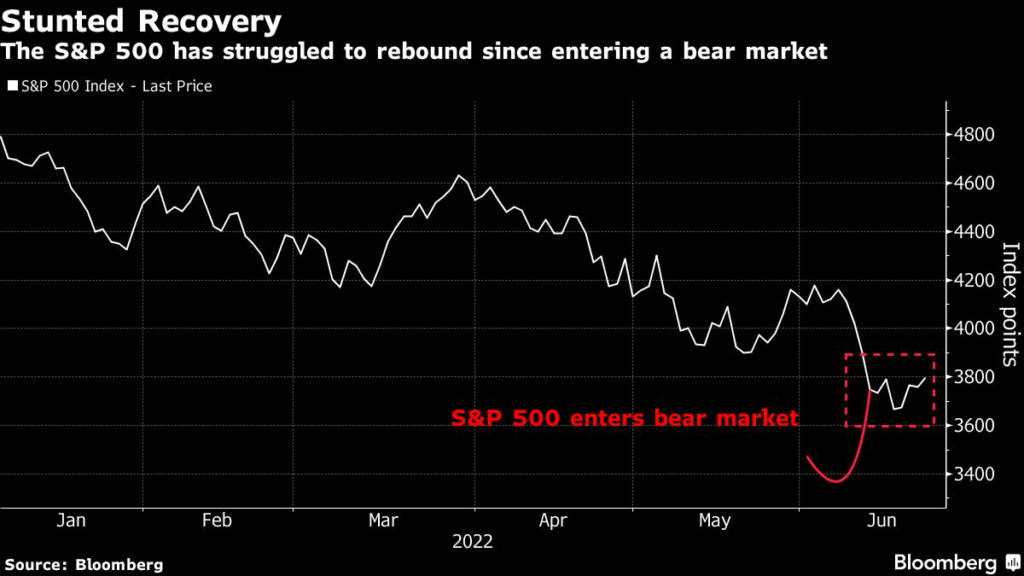
The US stock market has struggled to meaningfully recover after it sank into a bear market last week, and the S&P 500 Index is still on track for its worst first half since 1970 amid fears of economic slowdown. Federal Reserve Chair Jerome Powell acknowledged this week that a soft economic landing was “very challenging.”

Despite the selloff, strategists broadly believe equity markets haven’t seen a bottom. Hartnett said last week that based on past bear markets — defined as a 20% drop for the index from recent highs — the current one for the S&P 500 would end in October with the index at 3,000 points. That’s 21% below current levels. 

Morgan Stanley strategist Michael J. Wilson also sees the index dropping to 3,000 to fully reflect the scale of economic contraction. And Societe Generale SA’s Manish Kabra said this week that a 1970’s style shock amid stagnation with higher inflation could send the index crashing more than 30% from current levels.

By trading style, US small cap and large cap stocks led outflows. By sector, materials and energy saw the biggest redemptions. Technology, communication services and real estate had inflows.

More stories like this are available on bloomberg.com

©2022 Bloomberg L.P.

Ukraine Latest: US to Send More Arms; EU Backs Kyiv’s Candidacy

(Bloomberg) — The US plans to provide Ukraine with an additional $450 million in aid and advanced weaponry that includes rocket systems. European Union leaders granted the country candidate status, which moves the war-torn nation closer to its long-sought goal of joining the Western bloc. 

The Kremlin said a peace deal with Ukraine isn’t possible until Kyiv accepts all its demands — leaving conditions at a stalemate as Russia’s invasion nears the four-month mark.

German Economy Minister Robert Habeck triggered the second stage of the country’s three-phase gas-emergency plan and warned of the potential for Lehman-like contagion. 

(See RSAN on the Bloomberg Terminal for the Russian Sanctions Dashboard.)

Key Developments

  • How One Woman’s Hardball Tactics Opened the EU Door for Ukraine
  • Biden Limps to G-7 as Allies Fret Over His Troubles at Home
  • US Sends Cannon Shells, Patrol Boats in $450 Million Ukraine Aid
  • Russia Faces Fresh Bond Deadline With Possible Default Days Away
  • Cold Winter Could Push Europe Toward Gas Supply Shortages
  • Ukraine Wins Symbolic Step on Long Path to EU Membership

On the Ground

Ukrainian air defense downed two cruise missiles targeting Odesa on Thursday, the city council said on Telegram. Three cruise missiles launched from occupied Kherson targeted the city of Mykolayiv, hitting industrial and social infrastructure and injuring one person.“Heavy explosions” were heard in the southern seaport, its mayor said. A day earlier Mykolayiv faced a large-scale rocket attack. “A threat of artillery shelling has been announced in the city,” the mayor wrote on his Telegram account, urging residents to go to shelters “immediately.” Russian troops seized two more villages south of Lysychansk, in Luhansk, a stronghold Kyiv relies on in its defense in that area. 

(All times CET)

US Adds Another $450 Million in Weapons, Aid (10:06 p.m.)

The US announcement of another $450 million in advanced weaponry and aid to Ukraine is the latest tranche in what has become a multibillion-dollar effort to push back Russia’s invasion. 

The new package includes patrol boats, rocket systems and additional ammunition, National Security Council spokesman John Kirby said. 

The move comes just weeks after President Joe Biden announced $1 billion in new weapons and support, including high-technology rocket systems meant to allow Ukraine to hit Russian targets from as far as 80 kilometers (50 miles) away. After required training for Ukraine’s military, some of those weapons are now flowing into the country. 

Zelenskiy Looking to Replace Top Spy, Politico Says (9:51 p.m.)

President Volodymyr Zelenskiy is looking to replace top intelligence official Ivan Bakanov over perceived failures on the job, Politico reported citing four unidentified officials close to the Ukrainian leader and a Western diplomat who has advised Kyiv. Zelenskiy is looking for someone more suitable to serve as the wartime chief of the Security Service of Ukraine, Politico reported them as saying.

Politico said Zelenskiy’s office and Bakanov didn’t respond to its requests for comment. Bakanov has been close to Zelenskiy since his days as an entertainer.

Leaders Hail Move on Ukraine’s EU Candidacy as Historic (9:40 p.m.)

Leaders including Zelenskiy and France’s Emmanuel Macron applauded the decision by EU heads to grant Kyiv candidate status on the path to membership of the bloc.

Zelenskiy hailed the move as “a unique and historical moment.” Macron said the decision mirrors the EU’s response since Russia invaded Ukraine, “which means reacting in a fast, historic and united way through sanctions, macroeconomic, military and financial support.”

Ursula von der Leyen, head of the European Commission, said she was convinced Ukraine would move ahead as swiftly as possible with reform needed to join the EU. Kyiv, which applied for membership shortly after the Russian invasion in February, will have to meet conditions in the future on issues related to the rule of law, justice and anti-corruption.

Lithuania Says EU to Clarify Kaliningrad Advice (9:30 p.m.)

The EU is “is working on a document” that will clarify the bloc’s guidance on how to handle Russian goods transiting to the exclave of Kaliningrad without violating sanctions, according to Lithuania’s leader.

“I don’t know if they’ll publish it tonight, but this may also happen sometime early next week,” Lithuanian President Gitanas Nauseda told reporters. “This will answer all the questions that may occur to people today.”

EU Grants Ukraine Candidate Status for Membership (8:26 p.m.)

European Union government leaders holding a two-day summit in Brussels approved a recommendation from the European Commission to grant candidate status to Ukraine, according to Luxembourg Prime Minister Xavier Bettel. Kyiv, which applied for membership shortly after the Russian invasion in February, will have to meet conditions on issues related to the rule of law, justice and anti-corruption.

Zelenskiy has spent the past few months pressing for recognition that the country is on a path to a closer relationship with Europe as he seeks moral support in countering Russian aggression. But the membership process can last more than a decade.

US Senate Panel Backs Measure Calling Russia Terror Sponsor (7:04 p.m)

The US Senate’s Foreign Relations Committee advanced a measure that would direct the secretary of state to designate Russia as a state sponsor of terrorism for its invasion of Ukraine, putting it in the same category as Iran, Syria, North Korea and Cuba. Both chambers of Congress would have to pass the measure for it to be sent to President Joe Biden’s desk to be signed into law.

Earlier in the day, Senator Jim Risch, the top Republican on the committee, told an audience that included Ukrainian Ambassador to the US Oksana Markarova that Russia’s actions make it a “bully” and a state sponsor of terrorism because it invaded a country that was smaller in size, population and military capability.

Ukraine Takes Russia to Human Rights Court Over War Crimes (6:58 p.m.)

Ukraine is seeking $80 billion in compensation from Russia over alleged war crimes inflicted during its invasion, kick-starting its legal battle at Europe’s human rights court. 

The country’s justice ministry filed the first round of submissions against Russia at the European Court of Human Rights in Strasbourg, according to a Thursday statement from its lawyers, Quinn Emanuel Urquhart & Sullivan. 

Envoy Presses Canada to Hold on to Gazprom Turbine (6:51 p.m.)

Ukraine’s ambassador to Canada encouraged Prime Minister Justin Trudeau’s government to keep a gas turbine sent to the country for repairs and not return it to Europe where it would be used on the Nord Stream pipeline. The turbine was sent to Canada, where it was manufactured, for repairs just before sanctions were imposed on Russia over its invasion of Ukraine.

Ambassador Yulia Kovaliv said Russian energy giant Gazprom is holding Europe hostage by blaming the missing turbine for a reduction in gas flows. She argued that the company could deliver additional gas to Europe through Ukrainian infrastructure.

“Instead of blackmailing, instead of threatening European consumers, there is a way to deliver this gas to the market,” Kovaliv said in an interview. 

Germany Warns of Lehman-Like Contagion From Russian Gas Cuts (5:37 a.m.)

Germany warned that Russia’s moves to slash Europe’s natural gas supplies risked sparking a collapse in energy markets, drawing a parallel to the role of Lehman Brothers in triggering the global financial crisis.

With energy suppliers piling up losses by being forced to cover volumes at high prices, there’s a danger of a spillover effect for local utilities and their customers, including consumers and businesses, Economy Minister Robert Habeck said after raising the country’s gas risk level to the second-highest “alarm” phase.

Europe’s largest economy faces the unprecedented prospect of businesses and consumers running out of power. 

Lithuania Accuses Moscow of Propaganda Battle (3:55 p.m.)

Lithuania accused Moscow of waging a propaganda battle and taking a threatening stance in a standoff over Vilnius restricting the transit of sanctioned goods to the Russia’s exclave of Kaliningrad.

Food Crisis Could Last Two Years, Western Officials Say (4:08 p.m.)

Even if Russia’s war on Ukraine ended tomorrow, the current food crisis could last another two years or more, Western officials said in a briefing. It’s possible an agreement on shipping grain from Ukraine’s ports could be reached within the next month, though if that happens, it will still take time to de-mine ports and get them back up and running. 

Officials are working with the UN Food and Agriculture Organization and the International Grains Council to look at having an investigation into allegations that Russia is stealing grain from occupied areas of Ukraine, though they said it’s hard to track because reports are coming from the country’s east, where there’s no international presence.

Italy Won’t Trigger Emergency Gas Alert Yet (3:29 p.m.)

Italy is “much better off than other countries” on gas reserves and sees no need to copy Germany’s move to increase the alert on supplies, Energy Minister Roberto Cingolani told reporters in remarks quoted by Radiocor. 

His comments follow Germany’s decision to raise the country’s gas risk level to the second-highest “alarm” phase. Still, Italy’s approach could shift, Cingolani said, adding, “The impact of the war is unpredictable, what Russia is doing is unpredictable.”

Italy’s gas storage is 55% full, he said. Italy has mandates from energy companies including Snam Spa to stock up as soon as possible to reach a 85% to 90% level by the end of the year. Most EU members have more gas in storage now than is normal at this time of year, Josep Borrell, the EU’s foreign policy chief, said in Brussels.  

US Long-Range Rocket Launchers Arrive in Ukraine (2:47 p.m.) 

US high mobility artillery rocket systems, or HIMARS, have arrived in Ukraine, Defense Minister Oleksii Reznikov said in a tweet. 

The delivery is part of an effort to provide heavy weapons to Ukraine to counter Russia’s firepower. President Joe Biden promised the HIMARS as part of an announcement of new military aid this month. 

HIMARS have a “recognized and proven range up to 300 kilometers” (186 miles) according to their manufacturer, Lockheed Martin. 

Zelenskiy Calls on Israel to Do More (13:30 p.m.)

The Ukrainian president said he regretted Israel’s reluctance to join sanctions against Russia in a video address to The Hebrew University of Jerusalem community. While thanking Israel for medical aid, Zelenskiy said there was a lack of support to help Ukraine defend itself. Israel has significant ties with both Russia and Ukraine, and its government has been adopting a neutral stance since Putin’s invasion.

Kremlin Says Peace Possible if Kyiv Accepts Demands (12:40 p.m.)

Russia is ready to agree to a peace deal with Ukraine if it accepts all of Moscow’s demands, President Vladimir Putin’s spokesman said. “As far as the peace plan is concerned, it’s only possible after Ukraine fulfills all the conditions of the Russian side,” Dmitry Peskov told reporters on a conference call on Thursday, Interfax reported.

Negotiations between Russia and Ukraine on a cease-fire and peace deal have been effectively frozen since April. In addition to demanding that Kyiv give up its ambitions to join NATO and declare its neutrality, Russia wants to keep territory it’s captured since its February invasion of the neighboring state.

Europe’s Offshore Wind Industry in Major Ramp-Up (9:44 a.m.) 

Dutch power grid operator TenneT Holding BV has launched a tender to build the infrastructure that will speed the construction of North Sea wind farms as Europe looks to cut its dependence on Russian energy imports.

The company plans to enter agreements worth as much as 30 billion euros ($31.7 billion), a sign that Europe is following through on plans to rapidly ramp up renewable power. 

Europe’s Top Economies Slow Significantly (9:40 a.m.)

Growth in Germany and France slowed sharply as manufacturers suffered from a dearth of demand, increasingly strained supply chains and surging prices.

Reports on Thursday signaled that, for now, economic activity is still being supported to some extent by workloads built up earlier in the year. But the range of challenges confronting the world economy has led to worries that a recession is on the horizon.

European stocks fell on Thursday, with miners and energy firms leading the decliners in the Stoxx Europe 600 Index. 

Germany’s a Step Closer to Gas Rationing (9:35 a.m.) 

German Economy Minister Robert Habeck will trigger the second stage of the country’s three-phase gas-emergency plan later on Thursday, moving Europe’s biggest economy to the “alarm” level following steep cuts in supplies from Russia, according to a person familiar with the plan.

The heightened alert gives the government the option of enacting legislation to allow energy companies to pass on cost increases to homes and businesses, while some coal-fired power plants could also be reactivated to help minimize gas consumption. The third and highest “emergency” level would involve state control over distribution. 

Ukraine’s EU Membership Timeline Depends on War, Reform (9:00 a.m.)

Kyiv sees “positive trends” for Ukraine to get EU candidate status, Zelenskiy’s deputy chief of staff, Ihor Zhovkva, said in an interview on Bloomberg Television as the bloc’s summit kicks off. 

“Ukraine should become a candidate country for EU membership and then move further on the path to the integration with the European Union,” Zhovkva said. He warned that negotiations might be tough and difficult. While much depends on the course of the war, the pace of reforms will also be critical, he said. 

Zhovkva said Moscow would need to withdraw its troops to the lines of Feb. 23 to resume diplomatic talks. There are no talks planned between Ukraine’s Zelenskiy and Russian President Vladimir Putin.


More stories like this are available on bloomberg.com

©2022 Bloomberg L.P.

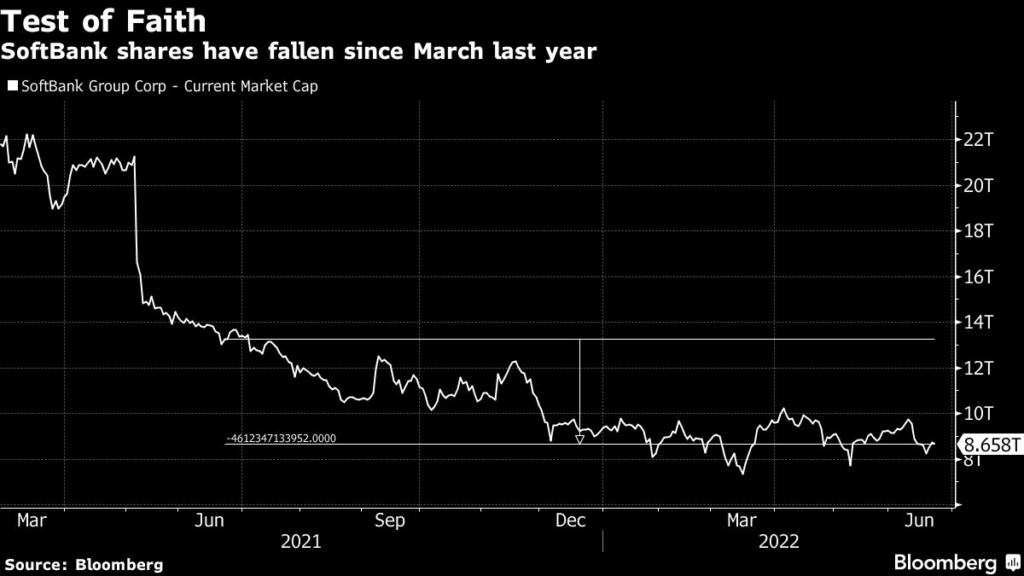
SoftBank Faces Shareholders After $34 Billion Loss

(Bloomberg) — SoftBank Group Corp. founder Masayoshi Son is used to praise and encouragement from shareholders. But the company’s loss of $34 billion in market value over the last year is a test for even his most faithful admirers when they gather for the annual shareholders’ meeting on Friday.

Investors stuck by Son when SoftBank announced a holding company strategy in 2015 to hive out its staid but profitable domestic telecom business to become the world’s largest investor in volatile tech startups. When the Vision Fund booked an $18 billion loss on investments like WeWork and Uber Technologies Inc. in 2020, they pointed to Son’s ability to win thousands-fold returns on Alibaba Group Holding Ltd. When Son preached patience as the stock began a downward trajectory from a March peak last year, they listened and hung on.

But five years of deploying $142 billion has now resulted in a record 2.1 trillion yen ($15.4 billion) loss for the company in the quarter ended in March. Much of that can be pinned on the recent global selloff in tech and a crackdown on China’s biggest technology companies, but much can also be attributed to SoftBank’s pressure on companies to make big, aggressive bets. 

With SoftBank’s own financial health on the line, shareholder confidence is near a breaking point, said Mio Kato of LightStream Research. Son needs to show how SoftBank adds value as an investor and chart steps — such as further share buybacks financed by sales of Alibaba stocks — for the stock price to recover, he said.

“Investors remain loyal as long as they believe in your dream, but once they realize things aren’t working, trust crumbles in an instant,” Kato said. 

Shareholders looking for signs of recovery see a portfolio awash with red instead. SoftBank bet more than $12 billion on Chinese ride-hailing firm Didi Global Inc., but Didi delisted from the New York Stock Exchange less than a year after its IPO and that stake is now worth less than $3 billion. South Korean ecommerce company Coupang Inc.’s shares are down close to 70% from a year earlier, and other publicly listed companies — which represent only a fraction of its portfolio companies — have similarly tumbled in value.

Anxiety remains high that big write-offs might yet be ahead. A number of portfolio companies have been forced to restructure or raise funds at lower valuations. SoftBank-backed firms that have recently announced headcount reductions include Swedish payments firm Klarna Bank AB and privacy management company OneTrust, while Bloomberg News has reported staff cuts at chip unit Arm Ltd.

Questions also linger on whether anyone on SoftBank’s board is able to provide proper oversight. SoftBank’s board has lost its most independent voices in recent years, including outgoing outside director Lip-Bu Tan who cautioned that Son “needs people to provide safeguards, give him advice and make him even more successful” in an open departure letter. “Poor choices made too quickly can have negative consequences for the company.” 

A key item on Friday’s agenda is SoftBank’s appointment of David Chao to replace Tan as an external director. Chao — a co-founder and general partner at venture capital firm DCM — had previously invested in companies such as vertical farming startup Plenty Inc. and personal finance startup SoFi Technologies Inc., in which the Vision Fund also invested. SoFi in 2017 was embroiled in a sexual harassment investigation that led to the ouster of its CEO.

“This feels like a continuation of the degradation of the strength of board oversight,” Kato said about Chao. “Given some of the scandals at SoFi which he had invested in, it is not a ringing endorsement of his ability to contribute to better governance at SoftBank.” 

SoftBank this year will conduct fewer and smaller deals, Son has said. The average size of SoftBank’s Vision Fund 2 investments stood at about $100 million to $200 million, compared with around $900 million for Vision Fund 1. In January-March, the Vision Fund doled out $2.5 billion, or less than one-fourth of the $10.4 billion it spent the previous quarter.

SoftBank’s emphasis on breakneck speed remains the same, however. It reached a decision to invest in Japan’s AI Medical Service Inc. within two months of a 30-minute Zoom meeting in February between founder Tomohiro Tada and Son. After Tada’s presentation of the company — which uses artificial intelligence to help clinicians identify potential cancers of the stomach and intestines — Son spent 15 to 20 minutes asking for numbers to back up the accuracy of AIM’s technology, Tada said.

Several minutes into the call, Son suggested Tada should seek as much as $74 million, double the sum Tada proposed. The two also brainstormed possible business models for when AIM would scale up, Tada said. Following an intense two weeks of some 150 email exchanges, SoftBank in April led an $59 million funding round into AIM.

Due to Covid-related precautions, only 150 shareholders will attend Friday’s meeting at SoftBank’s headquarters in Tokyo, which will be broadcast via a web portal. Son will take questions selected from those submitted in writing online, SoftBank said.

(Updates with chart; an earlier version corrected timeframe for investments in the 11th paragraph)

More stories like this are available on bloomberg.com

©2022 Bloomberg L.P.

Crypto Bridge Horizon Is Hacked for $100 Million

(Bloomberg) — Another cryptocurrency bridge — an app that lets people swap coins between blockchains — got hacked today, this one for $100 million.

Harmony said in a tweet the hack of its Horizon bridge took place Thursday morning, and that it has “begun working with national authorities and forensic specialists to identify the culprit and retrieve the stolen funds.”

This is the third major bridge hack this year. In February, hackers stole more than $300 million from the Wormhole bridge. In late March, Ronin Bridge lost about $620 million to hackers. Even before the Harmony hack, money stolen from bridges exceeded $1 billion, per researcher Chainalysis.

Read more: Crypto Bridge Heists Swiping $1 Billion Spur Race for Options

Bridges are particularly vulnerable to hacks, as their technology is complex and they are often run by anonymous teams. The way they safeguard funds is often unclear. The amount of money locked on bridges connected to the Ethereum blockchain declined 60% in the last 30 days, to less than $12 billion, per tracker Dune. This has been triggered by a wider crypto market slump and liquidity concerns surrounding lender Celsius Network and crypto-focused hedge fund Three Arrows Capital.

More stories like this are available on bloomberg.com

©2022 Bloomberg L.P.

Close Bitnami banner
Bitnami