
Bloomberg

Bitcoin Sinks Further 70% in Standard Chartered List of Possible 2023 Upsets

(Bloomberg) — Speculators cleaving to the view that the crypto rout is mostly over are at risk of a rude awakening in 2023, according to Standard Chartered.

A further Bitcoin plunge of about 70% to $5,000 next year is among the “surprise” scenarios that markets may be “under-pricing,” the bank’s Global Head of Research Eric Robertsen wrote in a note on Sunday.

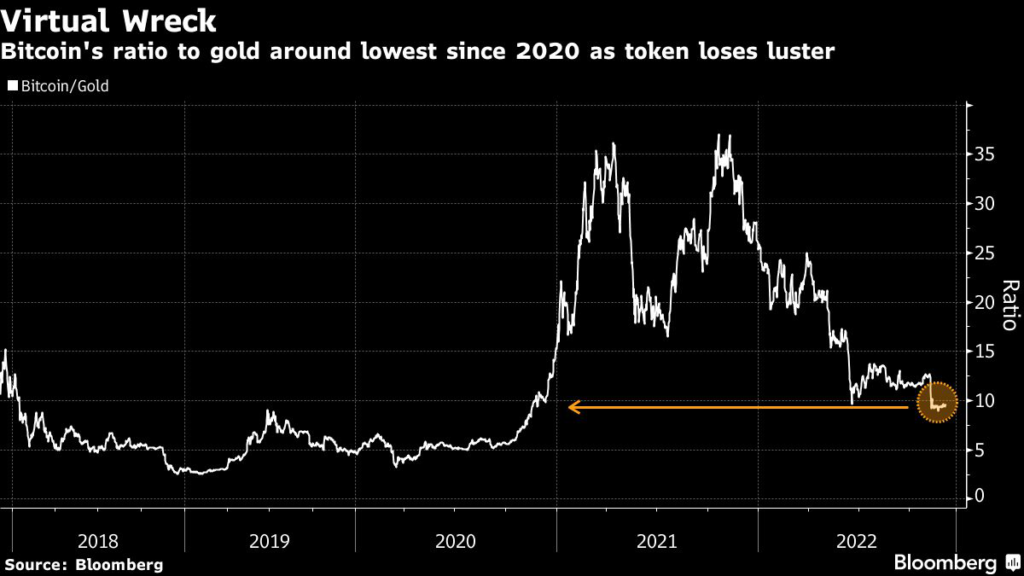
Demand could switch from Bitcoin as a digital version of gold to the real thing, spurring to a 30% rally in the yellow metal, Robertsen also said.

This possible outcome involves a reversal in interest-rate hikes as economies struggle and more crypto “bankruptcies and a collapse in investor confidence in digital assets,” Robertsen added. 

He stressed that he wasn’t making predictions but instead adumbrating scenarios that are materially outside of current market consensus.

The question of just what lies ahead for digital assets has arguably never been harder to answer following the collapse of Sam Bankman-Fried’s FTX exchange and sister trading house Alameda Research. The tremors spreading from the blowup threaten to topple more crypto companies and buffet token prices.

For some, much of the bad news may already be reflected in a more than 60% plunge in Bitcoin and a gauge of the top 100 tokens over the past year.

“Our base case is that most forced selling is over, but investors might not be compensated for the market risk incurred in the immediate term,” Sean Farrell, head of digital asset strategy at Fundstrat, wrote in a note Friday. 

Farrell pointed to ongoing uncertainty surrounding Digital Currency Group, parent company of embattled crypto brokerage Genesis. Creditors to Genesis are seeking options to try to keep the brokerage from falling into bankruptcy. 

Gold Outlook

Robertsen of Standard Chartered said the surprise market scenario of gold surging as crypto retreats could see the precious metal scale $2,250 an ounce.

“Gold will benefit going forward from the problems in crypto, with the sudden decline in confidence in the crypto ecosystem,” said Nicholas Frappell, global head of institutional markets at ABC Refinery in Sydney.

The crypto sector continues to retrench. For example, digital-asset exchange Bybit is planning to cut its workforce by 30%, the latest in a slew of layoffs to hit the industry.

More pain may lie ahead: some 94% of respondents to Bloomberg’s MLIV Pulse survey think that further blowups will follow the bankruptcy of FTX as years of easy credit give way to a tougher business and market environment. 

Bitcoin for the moment is fairly steady. The largest virtual coin rose as much as 1.8% on Monday and was trading at a three-week high of about $17,340 as of 2:35 p.m. in Tokyo. Tokens such as Ether, Solana and Polkadot also gained.

For crypto market prices: CRYP; for top crypto news: TOP CRYPTO.

–With assistance from Sing Yee Ong.

More stories like this are available on bloomberg.com

©2022 Bloomberg L.P.

Chinese Students Protest Over Wuhan University’s Covid Rules

(Bloomberg) — Students in China have held a peaceful protest over a university’s Covid Zero rules, a sign of the simmering discontent with the Asian nation’s zero-tolerance approach to the coronavirus.

A video on Twitter showed a group of students gathered on Sunday outside an administrative building at Wuhan University, where they chanted for “an open process and information transparency.”

Weibo posts apparently written by students at the university in the city where the virus first emerged about three years ago said they were unhappy about confusing rules for leaving campus to head for their hometowns and about an exam schedule. Students also said they were upset about continued virus testing and that shops on campus selling food were closed.

Read: China’s Covid Pivot Accelerates as Cities Ease Testing Rules

The students seemed to avoid crossing any of the ruling Communist Party’s red lines. A message that appeared to be from a protest organizer asked them not to bring blank sheets of paper to the demonstration and to stay away from political topics.

Wuhan University said in a statement on Sunday night that students could choose to stay on campus or go home, and that classes would be resumed in an orderly manner.

Bloomberg News hasn’t been able to independently verify the footage in the clip or the social media posts. The university didn’t respond to requests for comment on Monday. 

More: China Protesters Exploit Gaps in Great Firewall to Pressure Xi

Protesters took to the streets in cities across China late last month in a rare outpouring of public anger directed at a government that has little tolerance for dissent. Some of them called for President Xi Jinping to step down over the stringent Covid Zero rules.

Protesters also held up blank pieces of paper as a symbol of discontent, mimicking a tactic used in Hong Kong during demonstrations against the national security law passed in 2020.

Several Chinese cities have taken steps to ease Covid Zero rules since the most widespread protests in decades. Police have also been deployed to demonstration sites in Beijing and Shanghai, deterring any further displays of anger.

–With assistance from Lucille Liu.

More stories like this are available on bloomberg.com

©2022 Bloomberg L.P.

World Cup Interest Is so High in Japan That a Streamer Can’t Cope

(Bloomberg) — CyberAgent Inc.’s Abema TV may have to restrict access to Japan’s World Cup game at midnight Monday local time, as runaway demand is pushing the streaming service to its limits.

Viewers were advised over the weekend that admission to watch the Japan-Croatia match may be restricted in order to ensure a stable service.

Abema holds the streaming rights to the Qatar tournament in Japan, and the national team’s unexpected progress out of the group stage has triggered a wave of interest and support. The youth-oriented streaming network hit a new usage high on Friday after Japan’s game against Spain, which was broadcast at 4 a.m. locally, CyberAgent President Susumu Fujita said on Twitter. 

CyberAgent surged 4% on the news, which augured well for its investment in the loss-making service. Shares fell about 1% on Monday.

“CyberAgent’s stock is rising on expectations that Abema will see its revenue from ads increase over the long-term,” said Hideki Yasuda, an analyst at Toyo Securities. 

Tokyo-based CyberAgent is better known for its portfolio of video games, such as Uma Musume, which helped drive the stock to a record high amid the pandemic. It may have spent as much as 20 billion yen ($150 million) on securing the World Cup streaming rights for Abema, according to Jefferies analyst Hiroko Sato. Its broadcasts also feature former national footballer Keisuke Honda as a commentator. Its service can be watched on phones, PCs and connected TVs. Japanese fans also have the option to watch via a regular broadcast on Fuji TV.

Though overwhelmingly popular, the Abema live streams are free to watch and analysts question how much of the current surge the company will be able to convert into paying users. Abema registered more than 17 million viewers on Friday, CyberAgent said. CyberAgent has added extra servers to handle World Cup demand and anticipates making a loss on the tournament, a spokesperson said.

“I expect most viewers who installed the app for the soccer games will delete it after the tournament’s over and return to other TV and streaming services, such as Netflix and YouTube,” Yasuda said.

More stories like this are available on bloomberg.com

©2022 Bloomberg L.P.
China Carmakers Are Ordering Their Own Ships to Get Export Ready

(Bloomberg) — Two of China’s biggest automakers are so determined to ensure their cars make it from factories on the mainland to anyone who wants to drive them they’ve bought their own ships.

BYD Co., which only makes electric and hybrid cars, is going the extra length to avoid any last mile supply chain snarls, ordering at least six ships in October, each with the capacity to carry 7,700 cars, for 5 billion yuan ($710 million). State-owned SAIC Motor Corp., which already operates the world’s fifth-largest shipping fleet via transport arm SAIC Anji Logistics Co., has a tender out for seven new carriers that can each hold 8,900 vehicles.

Representatives for SAIC and BYD declined to comment.

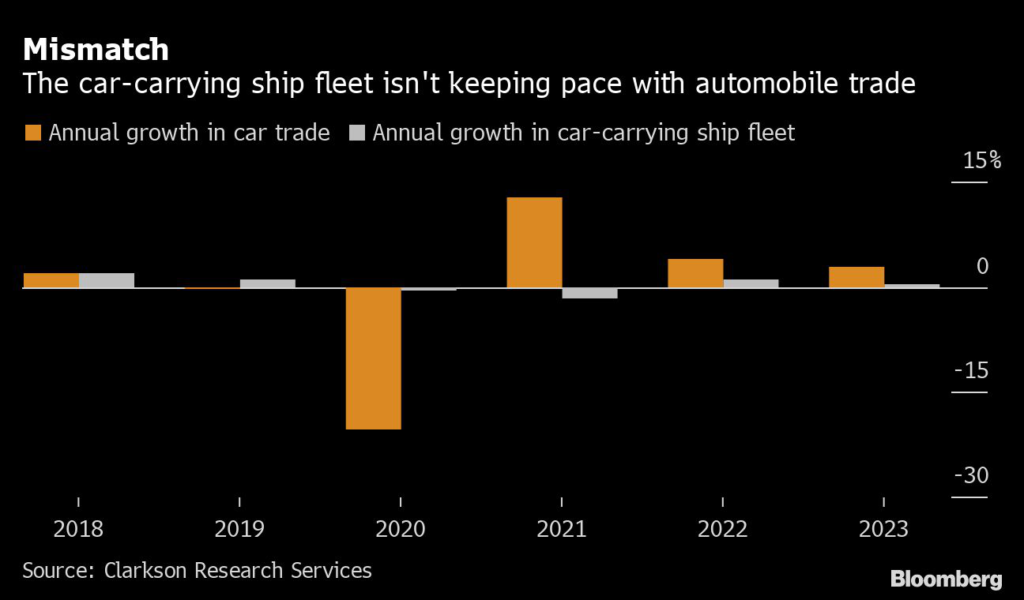
With the vessels in question not expected to come online for several years yet, it’s a bold bet on lasting global consumer demand for Chinese cars. China recently overtook Germany as the world’s second-largest auto exporter, sending almost 2.6 million vehicles abroad in the first 10 months of 2022, eclipsing 2021’s volumes. Even October’s unexpected drop in demand for Chinese goods didn’t derail that upward trajectory with car and chassis exports growing 60% from a year earlier to 352,000 units in the period, or a record high $7.1 billion.

But while auto exports have surged, “the number of car carriers globally has barely increased,” said Xing Yue, the head of Clarksons Research Services in Shanghai, a unit of the world’s largest shipbroker. Shipping costs have skyrocketed and there’s now “lots of investment pouring into building new ships for vehicle transport because of this demand-supply mismatch.” 

The lack of vessels is stretching an auto supply chain already worn thin by a scarcity of semiconductors, pandemic-related labor shortages and months of port congestion intensified by China’s Covid-19 lockdowns. Daily rates for vessels that can carry up to 6,500 cars (commonly known as roll-on/roll-off ships, or ro-ros) have surged to about $100,000 a day as of October, more than tenfold 2020 levels and the highest on record since at least 2000, according to Clarksons.

With all the last leg supply chain disruptions it makes sense for Chinese automakers to strike out on their own, according to Tobias Bartz, chairman and chief executive officer of Rhenus Logistics. Ships have become “such a scarcity,” he said on the sidelines of a conference in Singapore last month.

The shortage has meant that some vessels almost 30 years’ old are still operating instead of being scrapped, raising the risk of accidents. Trying to extinguish any lithium-ion battery fires that occur may also be harder.

Chinese automakers aren’t alone in their desire for more freighters. Tesla Inc., which uses Anji Logistics’ car carriers, has also had trouble transporting vehicles from its factories.

“There weren’t enough boats, there weren’t enough trains, there weren’t enough car carriers to actually support the wave” of vehicle deliveries at the end of the last quarter, CEO Elon Musk said during Tesla’s third-quarter earnings call. “Whether we like it or not, we actually have to smooth out the delivery of cars intra-quarter, because there just aren’t enough transportation objects to move them around.”

This latest pinch point may be new but BYD and SAIC aren’t the first automakers to run their own shipping fleets. Toyota Motor Corp. owns shipping company Toyofuji Shipping Co., while South Korea’s Hyundai Motor Co. has logistics group Hyundai Glovis Co.

It’s also a telling sign of how far Chinese automakers’ export ambitions go.

Just a few years ago, China was mainly selling cars to developing nations in Africa and the Middle East. But the rise in electric-vehicle production has boosted made-in-China cars in Europe, which is now the biggest market for Chinese auto exports. China exported over 852,000 EVs in the first 10 months of this year, up from almost nothing a short while back. Over a fifth of those were Tesla electric cars produced in the US automaker’s Shanghai gigafactory.

To be sure, some aren’t entirely confident that buying ships now is the right decision. 

“Car shipping costs are set to come down as the risks shift from backlogs to a glut in the car market,” said Craig Fuller, founder and CEO of supply chain market intelligence provider FreightWaves. With supply chain bottlenecks easing, “the risk is more on the demand side of the equation,” he said.

Until that inflexion point, Chinese automakers appear keen to control as much of the process as they can. Electric vehicle maker Nio Inc. and Chery Automobile Co. are also eying ship orders, local media reported last week.

Among Chinese brands, SAIC is the furthest along overseas. It sold 697,000 vehicles abroad in 2021 — bolstered by the success of MG Motor, the British brand it acquired — and is aiming for 800,000 this year. That’s a way off from meeting its annual shipping capacity, which stands at around 10 million vehicles, but meanwhile SAIC’s ships can and do serve other carmakers too, including Nio.

–With assistance from Ann Koh.

More stories like this are available on bloomberg.com

©2022 Bloomberg L.P.
SBF Says He Will Testify Before House, Without Committing to Date

(Bloomberg) — Sam Bankman-Fried says he will testify before the House Financial Services Committee after he’s finished “learning and reviewing” the events that led to the implosion of FTX.   

Representative Maxine Waters, the committee’s chair, last week invited Bankman-Fried to join the panel’s Dec. 13 hearing on his crypto exchange’s collapse. The FTX founder, also known as SBF, didn’t commit to appearing at the meeting this month. 

“Once I have finished learning and reviewing what happened, I would feel like it was my duty to appear before the committee and explain,” he said in a tweet Sunday. “I’m not sure that will happen by the 13th.” 

Bankman-Fried, the former CEO of FTX, did not indicate if he would be physically present for the meeting.

To view the source of this information click here

More stories like this are available on bloomberg.com

©2022 Bloomberg L.P.
Elon Musk Says Apple Is ‘Fully’ Advertising on Twitter Again

(Bloomberg) — Elon Musk said Apple Inc. has “fully resumed” advertising on Twitter Inc., further de-escalating a brewing war between two of the world’s most influential tech companies. 

Musk made the comments during a Twitter Spaces conversation on Saturday, adding that Apple is the largest advertiser on the social media network. The billionaire, who didn’t elaborate further on Apple, spoke for more than two hours from his private plane during the chat, which had more than 90,000 listeners. 

Apple didn’t immediately respond to requests for comment sent outside normal working hours. 

Musk blasted Apple last week, saying the maker of iPhones and Mac computers had mostly stopped advertising on Twitter and had threatened to withhold the site from its App Store. In taking aim at Apple, Musk risked a war with the world’s most valuable company and a top advertiser at a time when other companies were pulling their advertising from Twitter.

Read more: Musk’s Threats Toward Apple Jeopardize Ties With Top Advertiser

Musk subsequently met with Apple Chief Executive Officer Tim Cook and said the two had a “good conversation” and “resolved the misunderstanding about Twitter potentially being removed from the App Store.” Musk said Cook was “clear that Apple never considered doing so.”

Since Musk’s takeover, a string of companies have suspended advertising on Twitter, including General Mills Inc. and Pfizer Inc. On Saturday, Musk posted a tweet thanking advertisers for returning to Twitter.

In clarification of an earlier post, Platformer News said in a tweet on Sunday afternoon that Amazon.com Inc. had paused various campaigns on Twitter recently but did continue some level of advertising “throughout the recent turmoil.” Platformer News cited a source familiar with the matter it didn’t identify and also said the retailer is considering increasing its annual ad spending to $100 million. An Amazon spokesperson declined to comment.

Twitter’s new approach for verifying accounts had also allowed trolls to impersonate major brands. Musk said that he hopes to revive the company’s verification program in the next week after it had been paused to deal with imposers.

–With assistance from Mark Gurman and Mark Bergen.

(Updates with additional detail on Amazon per Platformer in seventh paragraph.)

More stories like this are available on bloomberg.com

©2022 Bloomberg L.P.

FTX Should Rattle Crypto Backers in Congress, Top Democrat Says

(Bloomberg) — FTX’s spectacular collapse should be a wakeup call for Congress to address risks posed by the largely unregulated crypto industry, Senate Banking Committee Chair Sherrod Brown said.

The Ohio Democrat said he and colleagues are “trying every day” to get new regulations in place and working with federal agencies to “crack down on crypto.”

“It’s not like we snap our fingers and get a crypto bill through the Senate and through the House,” Brown said on CNN’s “State of the Union” on Sunday. “Half the Senate, the Republicans and a handful of Democrats, still think crypto is legitimate and that it is something that should be a significant part of our economy.”

The collapse of Sam Bankman-Fried’s FTX crypto trading empire has put more pressure on Congress to establish guardrails for the industry, and US financial watchdogs are pressing for more oversight.  

Rostin Behnam, chairman of the Commodity Futures Trading Commission, last week testified at the first congressional oversight hearing on FTX’s demise, where he pushed to make his agency the main Bitcoin regulator and give it oversight of crypto exchanges. The Securities and Exchange Commission maintains most crypto tokens are securities that fall under its jurisdiction.

Read more: Missing Billions Remain Mystery After Bankman-Fried Grilling

While the fiasco at FTX — and the $8 billion hole in its balance sheet —  has rippled across the crypto world, Brown said on Sunday the regulatory push does not stem from “one crypto company.”

“This is about everything about national security. From Russian oligarchs to North Korean cyber criminals to gun runners to drug traffickers that love the thought of using unregulated, unrestricted cyber,” he said.

Senator Pat Toomey, the top Republican on the Senate Banking Committee, told Bloomberg News last week that he sees an opening for Congress to pass a narrow digital asset regulation bill before the end of the year. 

Toomey said he’s working with Democrats to get some measures, including a regulatory framework for stablecoins, attached to a possible spending deal after months of inaction in Congress, where Republicans will have a House majority starting in January. 

Read More: Senator Who ‘Bought the Hype’ on FTX Aims to Pass Crypto Law

Brown urged Treasury Secretary Janet Yellen last month to work with lawmakers to craft crypto legislation to ensure its risks “do not spillover into traditional financial markets and institutions.”

Top US financial officials, including Yellen and Federal Reserve Chair Jerome Powell, have said the government has limited ability to regulate crypto assets that aren’t covered by securities laws.

More stories like this are available on bloomberg.com

©2022 Bloomberg L.P.
How Two Crypto Hedge Funds Dodged the Market Collapse

(Bloomberg) —

The cryptocurrency space is undergoing one of its roughest stretches in memory, with trouble brewing at exchanges and lenders, and token prices collapsing. But one company has been able to ride out the volatility. 

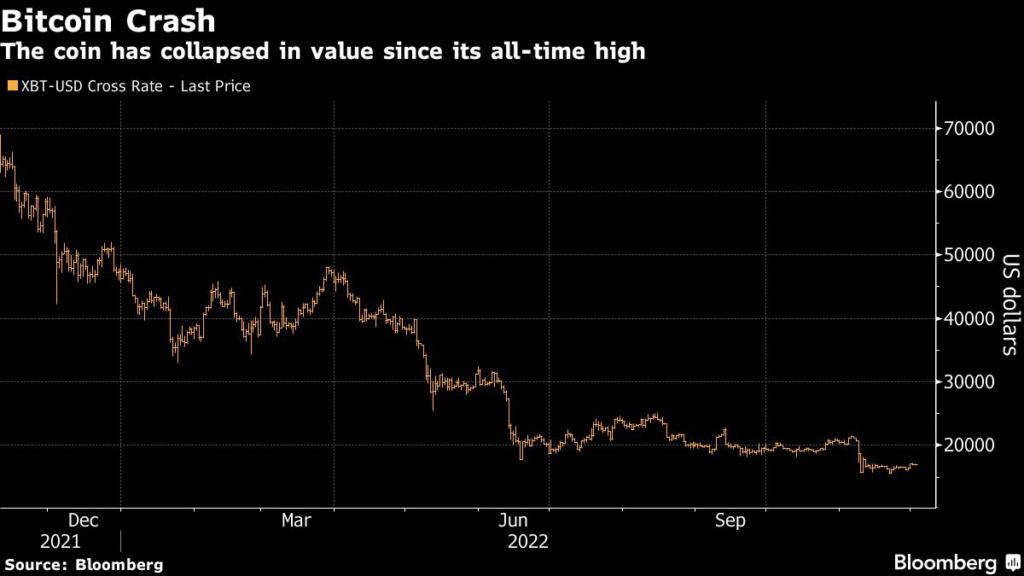
Pythagoras Investment Management LLC has two funds that have been rare bright spots in a market that’s been eviscerated by a number of scandals. Both its Market Neutral Fund — a strategy that doesn’t have exposure to the price of any crypto at any time — and its trend-following Pythagoras Token Fund have each gained about 8% this year, according to the company. Meanwhile, the world’s largest digital token Bitcoin is down around 60% this year. 

“We particularly outperform in bear markets,” Mitchell Dong, chief executive officer of Pythagoras, said. “Our absolute-return funds are positive whether the market’s up or down — whether it’s a bull market, a bear market, we’re going to have positive returns.”

Pythagoras’s market-neutral fund utilizes arbitrage, meaning it is simultaneously buying the same crypto at different places and different prices, therefore buying low and selling high. Meanwhile, its trend-following fund uses technical indicators to detect short-term trends in the crypto market, Dong said.  

The crypto market has been engulfed in scandals in recent weeks as Sam Bankman-Fried’s once-high-flying crypto exchange FTX filed for bankruptcy, reminding investors of the implosions of other digital-asset firms earlier this year. FTX’s collapse also dragged down other companies.

Pythagoras’s arbitrage fund had a 10% exposure to FTX before the exchange’s collapse. The company says it requested a full withdrawal of funds and received about 7%, which spurred it to hedge by shorting the FTX’s native token FTT. 

The FTX collapse spurred a plunge in cryptocurrency prices, with Bitcoin at one point dropping below $16,000 — way off its highs of near $69,000 just a year ago. The coin is now hovering around $17,000. 

Pythagoras’s fund strategies play off the fact that crypto, which is global and traded on numerous exchanges, is driven by retail investors, said Dong. 

“The idea is to use quantitative, technical indicators to try to detect trends, either up or down,” he said. “When you detect an upward trend, you go long when you think the psychology of people is that they think it’s going up. And when the trend is going down and everybody’s selling, you go short.”

Dong, whose prior roles included running hedge funds for more than 25 years and trading uranium and electric-power contracts, among other things, founded Pythagoras in 2014 after Bitcoin caught his eye. “Buying and holding Bitcoin comes with 90% drawdowns. That’s not my risk-return profile,” he said. “I want steady returns of 1-2% per month, with no losing months. That’s the target.”  

Pythagoras is not alone, other market-neutral shops have also recorded positive returns this year. The strategy doesn’t look as attractive during bull markets, when coins tend to see big upward surges, but in a bear market, they can stand out, traders say. 

Earlier: Once-Dull Crypto Strategies Are Now Shining in the Bear Market

“The reason we can continuously produce returns is that crypto is a young and a very rapidly changing market,” Dong said. “In crypto, every day is drama, and every week is an adventure. Every quarter there’s a paradigm shift and every year is a decade in traditional finance.”

More stories like this are available on bloomberg.com

©2022 Bloomberg L.P.

French Birth Rate Plummets to Lowest in Decades on Pandemic

(Bloomberg) — Pandemic lockdowns may have encouraged home baking and online shopping, but baby-making not so much — at least in France.

The number of French births dropped to the lowest level in almost three decades in October, intensifying a downward trend in one of Europe’s most fertile countries.

There were 1,940 births in the month, a 10% drop from a year ago, according to the latest figures published by national statistics agency Insee. That’s the lowest level since 1994, Isabelle Robert-Bobée, head of demography studies, told Le Parisien newspaper, citing a backdrop of uncertainty that often affects fertility.

France has long enjoyed comparatively high fertility levels among developed countries, but the latest numbers suggest even it may have lost ground during the Covid-19 crisis. 

While the rate has declined dramatically across the Organisation for Economic Cooperation and Development over the past decades, France ranked just behind Ireland as the most fertile European country, according to the latest study on social trends within the group of rich countries.

Yet the most recent French figures show a decline that has intensified in recent months and highlights the effects on baby-making during and after pandemic-related lockdowns. 

According to Insee, the country’s first Covid confinement in the spring of 2020 caused couples to delay plans for babies and led to a record drop in the number of births nine months later. While conception increased at the end of that lockdown and each one after that, the upward bump in the number of births was less marked each time and has now given way to a decline since July.

The number of births in September and October this year were below the levels during the same months in 2020, which hadn’t yet been affected by the pandemic, Insee said.

“The levels are really low,” Robert-Bobée was quoted as saying, adding that the effects of the war in Ukraine, which got underway in February may start to emerge in the France’s November numbers.

More stories like this are available on bloomberg.com

©2022 Bloomberg L.P.
Crypto Exchange Bybit to Cut 30% of Jobs in ‘Deepening Bear Market’

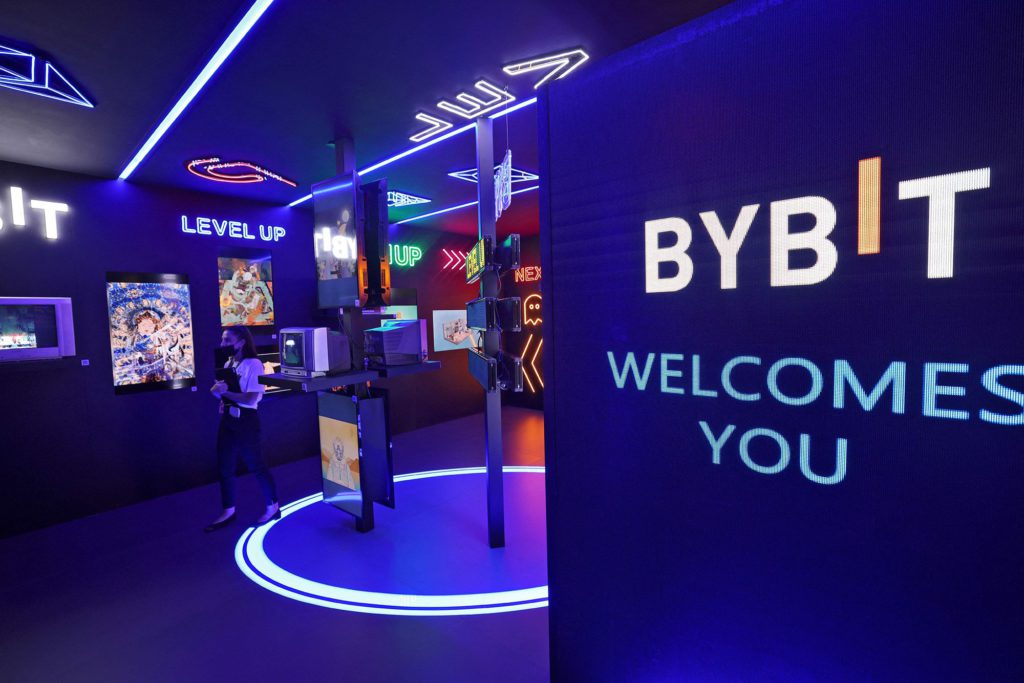
(Bloomberg) — Cryptocurrency exchange Bybit is planning to cut its workforce by 30% amid a continued bear market in the asset class, co-founder and Chief Executive Officer Ben Zhou said.

The moves are part of an ongoing reorganization aimed at refocusing efforts, and reductions will be across the board, Zhou said Sunday, adding the priority is to ensure business operations are unaffected and client assets remain safe. 

He cited crypto prices trending lower and the struggles of companies such as bankrupt crypto lender BlockFi and embattled crypto brokerage Genesis as signals “to tell us that we are entering into an even colder winter than we had anticipated from both industry and market perspectives.”

Bybit, which is ranked in the top 10 crypto exchanges by both CoinMarketCap and CoinGecko using measures including volume and confidence in the reported volumes, is the latest in a string of exchanges to announce job cuts. Peers like Crypto.com and Kraken have also reduced their workforce as the industry contends with depressed prices and lower volumes.

“It’s important to ensure Bybit has the right structure and resources in place to navigate the market slowdown and is nimble enough to seize the many opportunities ahead,” Zhou said. “Tough times demand tough decisions.”

In a blog post dated Thursday, Zhou had said that “Bybit is here for the long run,” and noted the exchange secured the largest-ever crypto sponsorship with the Formula One 2021 and 2022 world champions, Oracle Red Bull Racing. 

“We ended the season on a high, with the first blue-chip NFT on a F1 race car,” and launched a $100 million institution support fund, he added. 

More stories like this are available on bloomberg.com

©2022 Bloomberg L.P.

Close Bitnami banner
Bitnami
