Bloomberg

What Does Political Giving Look Like for Crypto After the Downfall of FTX? (Podcast)

(Bloomberg) — Listen to Bloomberg Crypto on the iHeartRadio App, Apple Podcasts or  Spotify.

The interplay of money and politics in the US is real, and well established. And that includes when that money is either in the form of crypto, or comes from people who made their fortunes in digital assets. 

The recently concluded US Midterm Elections featured several candidates whose campaigns were financed in part by crypto-related donors and donations. Among the donors: Sam Bankman-Fried and Ryan Salame of FTX, who supported candidates on opposite ends of the political spectrum. The collapse of FTX has led to some politicians and lawmakers who received funds now attempting to distance themselves entirely from their benefactors. 

To talk more on the relationship between crypto and politics in the US, Bloomberg reporters Bill Allison and Allyson Versprille join this episode. 

Subscribe to the Bloomberg Crypto Newsletter at https://bloom.bg/cryptonewsletter 

This podcast is produced by the Bloomberg Crypto Podcast team: Supervising producer: Vicki Vergolina, Senior Producer: Janet Babin, Producers: Sharon Beriro and Muhammad Farouk, Associate Producers: Mo Andam and Ty Butler. Sound Design/Engineer:  Desta Wondirad.


More stories like this are available on bloomberg.com

©2022 Bloomberg L.P.

Venezuela’s Soaring Migration Creates Need for Remittance Firms

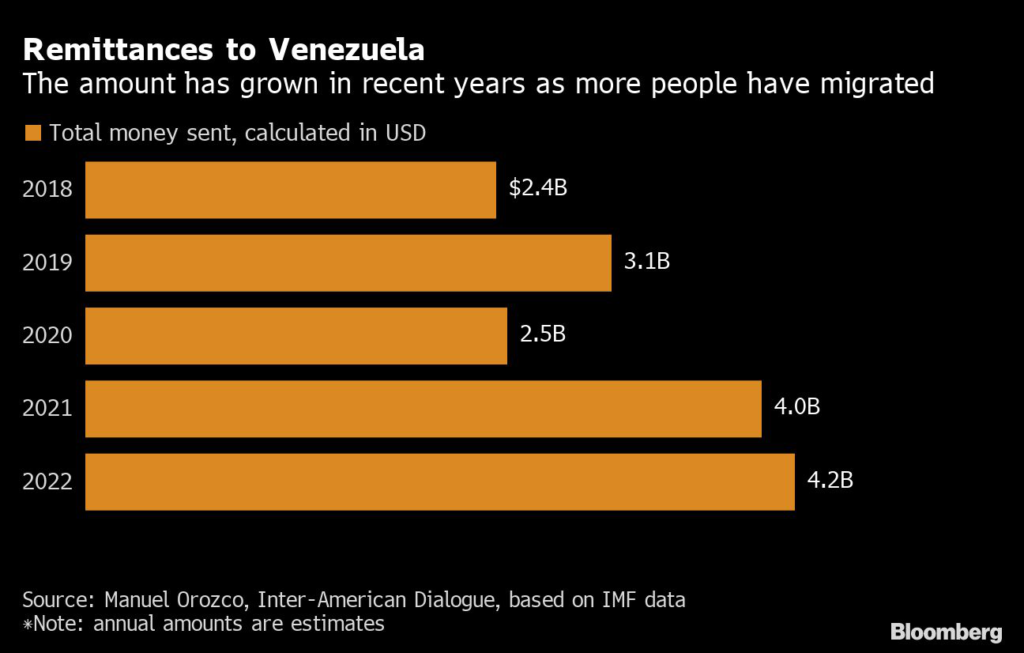
(Bloomberg) — Venezuela’s growing migrant community in the US and its lack of formal money transfer services are an incentive for remittance companies to operate in the country, according to the Inter-American Dialogue.

Transfers from the U.S. account for 38% of the approximately $4.2 billion in remittances this year, but only 3% of the money is being sent through formal remittance channels, a new report by the Washington-based think tank shows.

In just four years Venezuela has become a major remittance-depending country, according to the report seen by Bloomberg News. About 29% of Venezuelan households receive money from abroad as over 7 million people have left the country.

The remittance marketplace has remained informal after Venezuela severed relationships with foreign banks and because of prior currency controls. But conversations around easing US sanctions and the government’s embrace of the US dollar for everyday transactions represent an opportunity for businesses, even if these changes take some time, IAD analyst Manuel Orozco told Bloomberg News. 

“As long as there is a signaling of sanctions easing in the context of political negotiations, the incentives for the business sector to do business will increase,” Orozco said. “That’s basically what you’re looking at in 2023.”

Venezuela’s financial inclusion is among the highest in the region, with 80% holding bank accounts, and yet most migrants turn to unlicensed routes to send money. 

The tech savvy depend on cryptocurrency, and a limited number of people turn to third parties with access to payment apps such as Zelle or Airtm, or even depend on bringing physical cash into the country. Others find go-betweens willing to trade dollars in a foreign account for cash or bolivars.

Read More: Venezuela Embraces U.S. Dollar With Unexpected Help from Zelle

–With assistance from Nicolle Yapur.

More stories like this are available on bloomberg.com

©2022 Bloomberg L.P.

China’s Covid Pivot Accelerates as Cities Ease Testing Rules

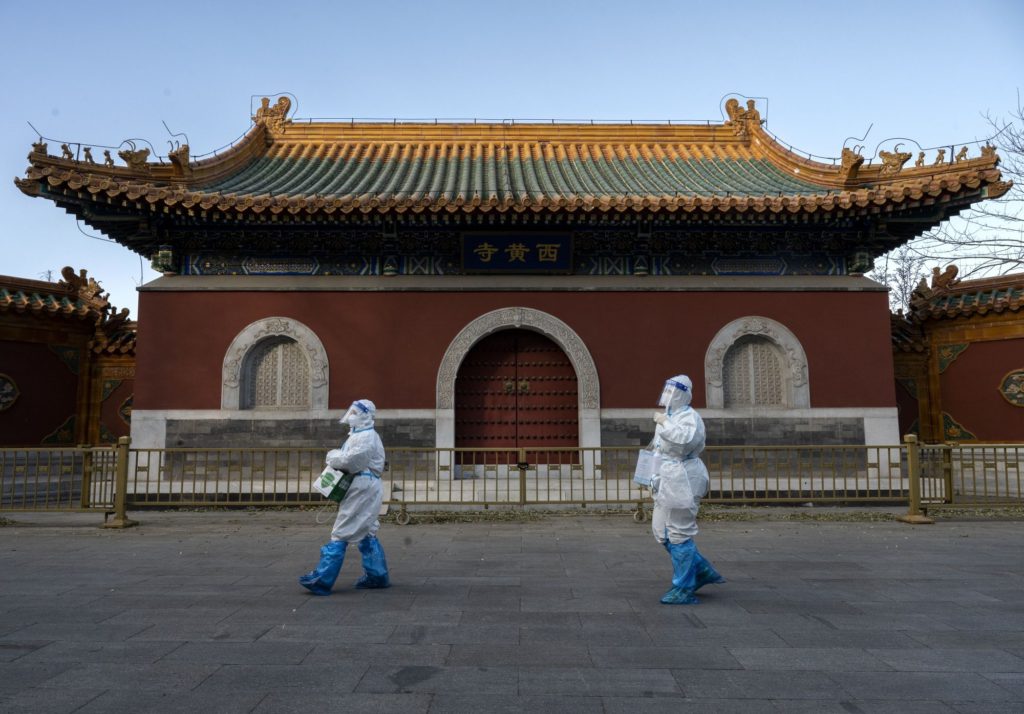
(Bloomberg) — Chinese authorities eased Covid testing requirements across major cities over the weekend as Beijing appears to be engineering a gradual shift away from its strict Covid Zero policy amid elevated cases and public protests.

The financial hub of Shanghai, which saw a grueling two-month lockdown earlier in the year, scrapped PCR testing requirements to enter all public venues except some like restaurants, bars and nursing homes, city authorities said. Measures will “continue to be optimized and adjusted” in line with national policy and the local situation, according to the statement.

Hangzhou, home to tech giant Alibaba Group Holding Ltd., also dropped testing requirements to enter most public venues including offices and supermarkets and to take public transportation. Tests will no longer be required to purchase certain medicines, city authorities said in a statement. 

Also read: The Dangerous Wisdom of Chinese Crowds: Niall Ferguson

By Monday afternoon, cities including Shenzhen and Dalian, and provinces like Shandong and Jiangxi had largely followed suit in reining in testing demands. 

The string of announcements comes after government officials over the past week signaled a transition away from the harshest Covid containment measures, which have weighed on the economy and prompted thousands of demonstrators to take to the streets to voice their anger. Chinese Vice Premier Sun Chunlan said last week that the country’s pandemic control has entered a new phase. Confronted with evolving challenges and tasks, the government will take small, consistent steps to optimize Covid measures, she said.

China may announce 10 additional Covid measures as early as Wednesday, Reuters reported, without elaborating on what they might be. The country may downgrade its management of Covid-19 as a top-level Category A infectious disease to Category B as early as January, the report added.  

The country is in a downswing in its infection curve, with 29,171 Covid cases reported for Sunday, the lowest in nearly two weeks. Infection spread has come off a peak of nearly 40,000 at the end of November, which may partly be due to the scaling down in mass testing as some asymptomatic cases remain undetected. 

Nevertheless, China’s easing starts from a high bar: substantial testing rules remain in place, with cities requiring negative results for people to enter indoors areas like offices. Cities battling outbreaks, like Beijing, Guangzhou and Chongqing, are also still largely at standstill with schools and leisure venues shuttered.


Restrictions are also being rolled back in Zhengzhou city, home to Apple Inc.’s largest manufacturing site in China. Authorities announced on Sunday the immediate end of mandatory Covid testing to enter buses, subway, taxis and other public venues besides for those who depart from the city or go to karaoke bars and internet cafes.

Foxconn Technology Group, which manages the world’s biggest iPhone manufacturing facility, is continuing with closed loop operations, restricting workers’ movements to their dormitories and the factory, according to a notice posted on WeChat.

The city of Wuhan, where the virus first emerged about three years ago, said it would end testing requirements to ride the subway while Lhasa city will resume previously halted bus operations.

Chinese stocks have rallied recently, fueled by rising optimism that China is softening its pursuit of Zero Covid. In Hong Kong, the Hang Seng China Enterprises Index surged 29% in November, capping its best month since 2003, while the benchmark Hang Seng Index posted its biggest monthly gain since 1998. 

The rally was mainly driven by the gains in airlines, casinos, restaurant operators and other stocks expected to benefit from a reopening of the world’s second-largest economy. Investors are increasingly seen shifting their bets to longer-term plays such as consumer and health-care equities, from travel and catering firms whose shares have jumped sharply.

Restrictions were also eased in a number of provincial capital cities over the weekend. Kunming, in the southwestern province of Yunnan, will as of Sunday allow people to ride public transport without showing a PCR test, while Nanning in the neighboring Guangxi region scrapped such testing requirements for all public venues except hotels and tourist destinations. 

In Harbin, the capital of Heilongjiang in the northeast, test results are no longer required to enter public places, while people leaving the city only need to take one PCR test within 48 hours instead of two, the local government said late Saturday. 

Urumqi, where a fire that killed more than 10 people last month triggered anti-lockdown protests, reopened skiing venues and a pedestrian street on Sunday, according to state broadcaster CCTV. Hotels, restaurants, supermarkets and entertainment businesses such gyms will also resume normal operations Monday as conditions are now ripe for “normalized” containment measures, CCTV reported, citing a local government briefing Sunday. The city is also reopening a previously closed subway line. 

Suspicions that Covid restrictions hampered rescue efforts in the fire a high-rise building in the capital city of the Xinjiang region fueled public anger, helping spread protests across the country as people gathered to commemorate the victims and request an end to Covid curbs.

While the easing measures in cities can’t be interpreted as China abandoning its Covid Zero policy yet, “we see them as clear evidence of the Chinese government preparing for an exit, and trying to minimize the economic and social cost of Covid control in the meantime,” Goldman Sachs Group Inc.’s chief China economist Hui Shan and colleagues wrote in a note Sunday. 

Experiences in Hong Kong and Taiwan showed that new cases will skyrocket upon reopening, with mobility declining sharply, they wrote. Goldman Sachs’ base case scenario suggests China’s Covid Zero policy will stay until April to allow for preparations, according to the note. 

The unwinding of requirements has led to a sharp drop in the number of testing booths in some cities, causing unusually-long queues. Authorities in Beijing’s Chaoyang District, one of the Chinese capital’s worst-hit areas in the current outbreak, on Saturday said they were “deeply sorry” for inadequate coordination that led to excessively long waiting times and restored some sites. Some sites have reopened or extended operating hours following widespread complaints. 

–With assistance from Low De Wei, Youkyung Lee, Jacob Gu, Debby Wu and Phila Siu.

(Updates with Reuters report on new measures in sixth paragraph.)

More stories like this are available on bloomberg.com

©2022 Bloomberg L.P.

Trafigura Signs $3 Billion German-Backed Loan for Gas Supply

(Bloomberg) — Commodities trader Trafigura Group signed a $3 billion German government-backed loan for gas supply, as Berlin steps up efforts to secure natural resources following Russia’s invasion of Ukraine.

Trafigura, which will primarily tap its global gas and liquefied natural gas portfolio, made the first delivery on Nov. 1, the trading house said Monday in a statement. The loan deal confirms an earlier report by Bloomberg News.

It’s the second such deal in recent months, after Trafigura in October announced it had secured an $800 million loan to supply metals to Germany. Increasingly, trading companies that have historically been major off-takers of Russian energy, grains and metals are now being tapped by governments to find alternatives from international markets.

Germany has had to retool its energy policy since the war in Ukraine forced it to end a longstanding dependence on cheap Russian gas. Chancellor Olaf Scholz has traveled to Saudi Arabia and Qatar seeking energy deals, and last week Qatar announced a long-term agreement to supply Germany with LNG starting in 2026. The nation used to get more than a half of its gas via pipelines from Russia.

The country is becoming increasingly concerned about supplies of other critical materials like metals that underpin technologies needed for the transition away from fossil fuels. The government is considering a state-backed fund to help find alternative suppliers to China, an initiative spearheaded by Economy Minister Robert Habeck.

Germany is offering backing for commodity traders through a program known as untied loan guarantees, managed via Euler Hermes AG — an export-credit unit that’s now part of Allianz SE. The guarantees insure the majority but not all of the loans and were originally for encouraging Germany’s manufacturing exports.

The four-year loan with Trafigura for gas supplies was jointly arranged and underwritten by Deutsche Bank AG and another bank, and syndicated to more than 25 other lenders.

For trading houses like Trafigura, the deals represent a key means of obtaining financing at a time when high commodity prices and extreme volatility have increased their need for credit and have left some banks reluctant to add exposure to the sector. 

The loan means Trafigura has committed to delivering “substantial volumes of gas into the European gas grid, and ultimately into Germany, over the next four years,” according to the statement. Trafigura will supply the gas to SEFE Securing Energy for Europe GmbH, a former unit of Gazprom PJSC that was recently nationalized by the German government. 

We are supplying a “significant volume of gas to Germany backed by our extensive portfolio and long term US LNG contracts,” said Richard Holtum, head of gas and power trading for Trafigura.

Read: Germany Backstops Commodity Traders as War Drives Resource Dash

(Updates with Trafigura gas commitment in penultimate paragraph)

More stories like this are available on bloomberg.com

©2022 Bloomberg L.P.
Tesla China Shipments Top 100,000 in November in Record Month

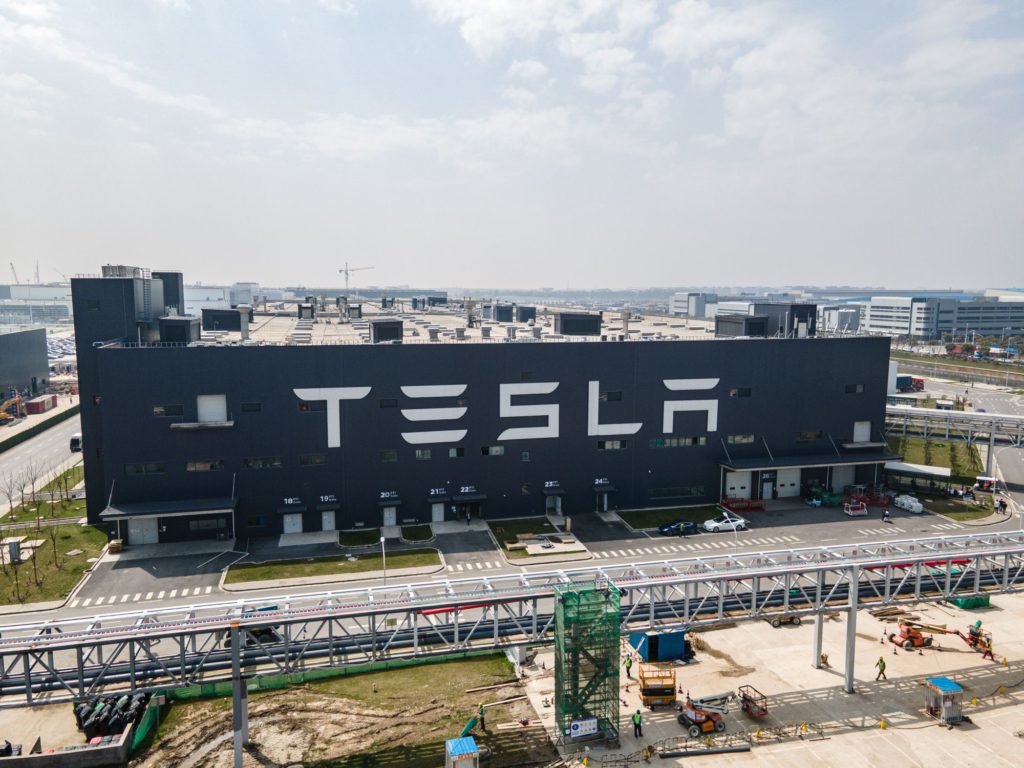
(Bloomberg) — Electric car deliveries from Tesla Inc.’s factory in Shanghai rose to a record in November after the US automaker deployed aggressive marketing tactics and promotions in China’s increasingly competitive market. 

Tesla shipped 100,291 cars in Asia’s biggest economy last month, versus 71,704 in October and almost double the 52,859 vehicles the EV pioneer delivered in the same month of 2021, Cui Dongshu, secretary general of China’s Passenger Car Association, said on Monday. Exact figures for domestic shipments and cars for export weren’t specified.

Annual deliveries from Tesla’s Shanghai plant could possibly hit 750,000 units in 2022, Cui said.

Tesla is facing intensifying competition in the world’s largest EV market, where recent outbreaks and lockdowns have prevented potential customers in major cities like Guangzhou and Chengdu from entering showrooms.

But the Texas-headquartered group, which has long proudly eschewed traditional advertising avenues, has turned on the charm, offering extended insurance subsidies, reinstating a user-referral program and even advertising on TV. 

There have also been price cuts, leading some analysts to speculate about waning demand after the Shanghai factory was upgraded to increase output. People familiar with the matter said earlier Monday that Tesla plans to lower production in Shanghai as soon as this week.

Read more: Tesla to Fix Rear Lighting Issue on Over 435,000 China-Made Cars

Tesla has also conducted two recalls in China in the past month, requiring both over-the-air software fixes and some vehicles to be returned for maintenance. A recent fatal crash in the southern part of the country involving a Model Y that killed two people has meanwhile again sparked discussion over Tesla’s product safety. 

Chinese rival BYD Co., which makes both pure EVs and hybrid cars, shipped 230,427 vehicles in November, including about 114,000 battery-electric models. Its overall new-energy vehicle sales are expected to exceeded 5.7 million in the first 11 months of the year, Cui said.

State media outlet Xinhua reported Tesla’s November figures earlier on Monday.

More stories like this are available on bloomberg.com

©2022 Bloomberg L.P.
China Stocks Climb, Yuan Jumps Past Key Level on Reopening Shift

(Bloomberg) — Chinese equities rallied and the yuan strengthened past a key level, as the authorities accelerated a shift toward reopening the economy and more investors turned bullish. 

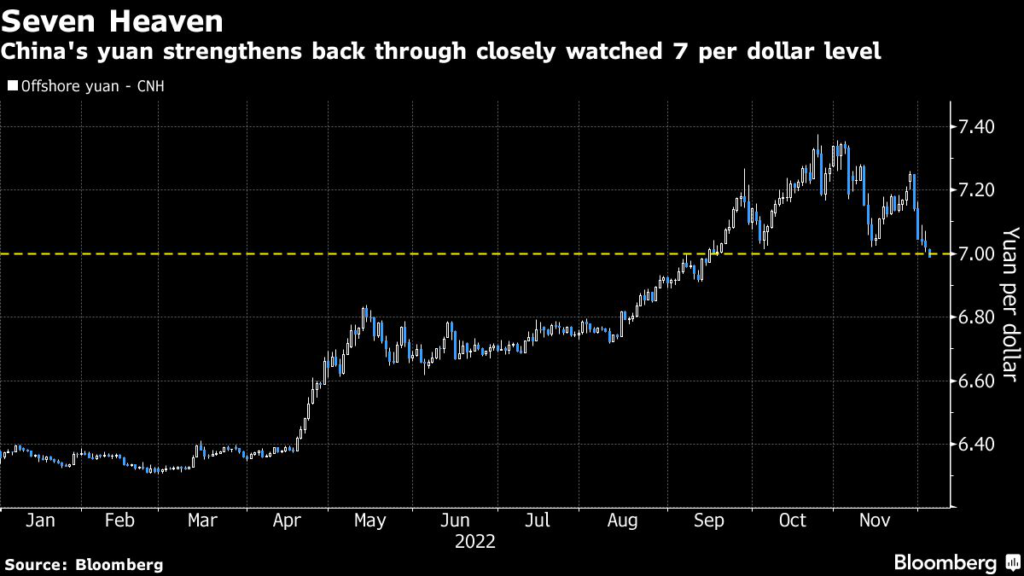
The yuan breached the 7-per-dollar level, while a gauge of Chinese tech stocks in Hong Kong surged 9.3% in a fifth day of gains. The dollar bonds of developers also rose as financial hub Shanghai and neighboring Hangzhou joined other cities in easing Covid-Zero curbs. 

Months of volatility in Chinese assets have given way to a buying spree as money managers grow increasingly convinced that the tide has finally turned on a market brought low by Beijing’s regulatory crackdown and Covid policy. But even as the bullish calls pile up, analysts such as Grow Investment Group’s Hao Hong caution that rising infections may induce more price swings in the near term.

Read: Morgan Stanley Upgrades China Stocks on Reopening Bullishness

For now, a steady rollback of restrictions in the past weeks is generating a buzz not seen in a while. The Hang Seng China Enterprises Index surged 29% last month, the best performance since late 2003, while the onshore yuan gained by the most since 2018. 

“There are more signs of relaxation of Covid curbs, and the positive factors have not been fully priced in by the market,” said Kenny Wen, head of investment strategy at KGI Asia in Hong Kong. “I expect more funds to continue to hold long positions in the remainder of the month for year-end window dressing purposes.”

The loosening of restrictions, coupled with a property rescue package, has resuscitated Chinese equities after a $6 trillion rout that culminated in the Communist Party congress in October. Investors are expected to zero in on longer-term plays such as consumer and health-care shares as the economy recovers.

Morgan Stanley on Sunday lifted Chinese equities to overweight from an equal-weight position it had held since January 2021. Goldman Sachs Group Inc. predicted that China’s stocks will outperform in 2023, while Bank of America Corp. said it has turned tactically positive. 

Other Chinese benchmark stock gauges also advanced on Monday, with the CSI 300 Index and Shanghai Stock Exchange Composite Index rising almost 2%. A gauge of Macau gaming shares rallied 11% while the onshore yuan jumped as much as 1.5% to 6.9473 a dollar, the strongest since Sept. 13. 

The rally spilled over into the credit market, with traders saying that property firms’ dollar bonds rose at least 3 cents on Monday. Country Garden’s 8% dollar bond due 2024 rose 7.4 cents to 70.7 cents as of 4:23 p.m. in Hong Kong, according to Bloomberg-compiled prices. It’s poised for its highest close since June.

China junk dollar notes, dominated by the property sector, rose to an average 65 cents on Friday, the highest in three months, a Bloomberg index showed.

Read: China’s Biggest Builder Posts 404% Bond Return on Policy Shifts

Shanghai Shift

Shanghai joined Beijing, Shenzhen, Guangzhou, Zhengzhou, and other Chinese cities in shifting toward reopening after recent protests. Most places will no longer require PCR results for access to local public transit and many shared spaces. The easing comes after Chinese Vice Premier Sun Chunlan said last week that the country’s pandemic control has entered a new phase.

Covid Zero will probably formally remain in place until April, though the risk of an earlier but managed exit has increased, according to strategists at Goldman Sachs. 

“We judge recent public protests against the tight Covid curbs have put pressure on the government to hasten its reopening plans,” Commonwealth Bank of Australia strategists led by head of international economics Joseph Capurso wrote in a note. “Dollar-yuan can extend its losses this week if there are further signs China is readying to exit its strict Covid policies.”

China’s Covid stance aside, investors are also weighing the impact of a robust US jobs report as well as a slowing of aggressive Federal Reserve rate hikes, which have hurt global markets this year.

Some analysts remain wary, warning that the yuan will only sustain gains if Beijing manages to ensure a solid economic recovery next year. The upcoming December Politburo meeting, which provides high-level guidelines for economic policy making, is the next key focus.

“It’ll take time for China to exit from their Zero Covid policy,” said Ho Woei Chen, an economist at United Overseas Bank Ltd. in Singapore. “In the near term, China’s economy continues to face headwinds from the prolonged property market slump and high Covid infections weigh on consumption recovery. These factors may limit the gains in the yuan.”

–With assistance from Chester Yung, Matthew Burgess, Lorretta Chen and Dorothy Ma.

(Updates prices throughout and adds Macau gaming shares index in eighth paragraph)

More stories like this are available on bloomberg.com

©2022 Bloomberg L.P.
Women-Led Startup Headed by Ex-JPMorgan Banker Raises Funding

(Bloomberg) — Visa Foundation and Mastercard Foundation Africa Growth Fund invested in the first institutional fund raising by Nigerian equity and gender-focused firm Aruwa Capital Management.

The two firms helped raise more than $20 million for the Nigerian company to invest in women-led enterprises facing capital challenges on the continent, Lagos-based Aruwa said in an emailed statement. Others who contributed to the funding include closely held Nyala Venture and family businesses from Africa, Europe and the US, it said.

Founded in 2019 by Adesuwa Okunbo, an ex-investment banker at JPMorgan Chase Co., Aruwa plans to invest $500,000 to $2.5 million “in women-focused small and growing businesses in Nigeria and Ghana,” in sectors including healthcare, renewable energy and financial technology, it said.

Africa’s female entrepreneurs and startups have been under-represented in access to capital in Africa. Out of 300 companies that raised $3.5 billion in venture capital in the six months through June, only 27% were led by female founders or have at least one female founder, according to a report by the African Private Equity and Venture Capital Association.

Aruwa has made six investments and committed more than 45% of its capital to firms that met its investment criteria, the company said. “The fund aims to create more sustainable and scalable pathways for economic growth and inclusion in the region,” it said.

Read: Female Startups Fight ‘Tomato Seller’ Cliche for Funds in Africa


More stories like this are available on bloomberg.com

©2022 Bloomberg L.P.

Vodafone CEO Nick Read Exits as Shares Lag: The London Rush

(Bloomberg) — The week has kicked off with a bang as Vodafone’s CEO announced his sudden exit from the company. Meanwhile, spare a thought for England fans in Qatar who will have had to dig deep to celebrate last night’s victory over Senegal due to the resilience of the Gulf nation’s currency. 

Here’s the key business news from London this morning:

In The City

Vodafone Group Plc: The firm’s Chief Executive Officer Nick Read will step down at the end of 2022 following a year when the telecommunications company’s share price sank. 

  • Chief Financial Officer Margherita Della Valle will become interim CEO, in addition to her current role, while a replacement is found
  • Vodafone’s market value dropped 42% to €24.9 billion during the four years Read has been in the role

Glencore Plc: The commodities trading giant will pay $180 million to the Democratic Republic of Congo, after reaching an agreement on claims alleging acts of corruption between 2007 and 2018. 

  • The firm was last month hit with a £276 million penalty by a London judge after pleading guilty to coordinating a sprawling effort to bribe government officials for access to oil cargoes across Africa

National Grid Plc: The company said all conditions for Macquarie Group Ltd.’s £9.6 billion purchase of a 60% stake in its gas transmission business have been fully met.

In Westminster

Keir Starmer will today promise the “biggest ever transfer of power” from the parliament to the British people, as his Labour Party begins to flesh out its priorities if it wins the next general election in about two years.

Meanwhile, the RMT union rejected an offer from the Rail Delivery Group aimed at ending a strike action planned before Christmas. The news comes as Conservative Party Chairman Nadhim Zahawi said Sunday the government could use the military to help ease any disruption caused by public sector strikes. 

In Case You Missed It 

The UK economy faces a decade of lost growth unless the government takes action on investment tax reliefs, the Northern Ireland protocol and the shrinking workforce, the Confederation of British Industry has warned.

Britain may be more ethnically and racially diverse than ever, but minorities working in the financial services industry continue to face discrimination, according to a new study.

Elsewhere, football fans who traveled to Qatar knew the World Cup experience wouldn’t be cheap, but the resilience of the Gulf nation’s currency is making the trip particularly painful for travelers from South Korea, Japan and England.

Looking Ahead

Heating and ventilation firm Ferguson Plc and industrial equipment rental company Ashtead Group Plc are among the companies expected to publish results tomorrow. 

A strong rental market buoyed by tight equipment availability and skilled-labour shortages is seen driving revenue growth for Ashtead, while strong pricing power is key for Ferguson to resist cost inflation, according to Bloomberg Intelligence.

For a news fix when the day is done, sign up to The Readout with Allegra Stratton, to make sense of the day’s events.

–With assistance from Kwaku Gyasi.

More stories like this are available on bloomberg.com

©2022 Bloomberg L.P.
FTX Tremors Spur Australian Crypto Exchange Swyftx to Lay Off 35% of Staff

(Bloomberg) — Australian crypto exchange Swyftx laid off 35% of employees as the crisis sparked by FTX’s implosion further dims the sector’s outlook.

The firm let go 90 of 259 people, a step taken “in expectation of a potentially sharp fall in global trade volumes in the first half of 2023 and further aftershocks from FTX’s collapse,” a Swyftx spokesperson said Monday.  

Chief Executive Officer Alex Harper flagged the potential for more “black swan-type events” in a message to staff seen by Bloomberg News. Swyftx had already laid off about a fifth of its workforce in August. 

Investors have fled the crypto sector after a yearlong rout and a series of blowups, most recently the wipeout of Sam Bankman-Fried’s FTX crypto empire. Platforms around the world such as Crypto.com, Kraken and Bybit have cut staffing levels in response to the downturn.

For crypto market prices: CRYP; for top crypto news: TOP CRYPTO.

More stories like this are available on bloomberg.com

©2022 Bloomberg L.P.
Trafigura Nears Multibillion-Dollar German-Backed Loan for LNG

(Bloomberg) — Commodities trader Trafigura Group is close to agreeing on a German government-backed loan for gas supplies, as Berlin steps up efforts to secure natural resources following Russia’s invasion of Ukraine.

The loan of around $3 billion to $4 billion would be linked to Trafigura supplying Germany with liquefied natural gas, according to people familiar with the matter, who asked not to be identified because the discussions are private. It would be the second such deal in recent months, after Trafigura in October announced it had secured an $800 million loan to supply metals to Germany.

Germany is offering backing for commodity traders through a program known as untied loan guarantees, managed via Euler Hermes AG — an export-credit unit that’s now part of Allianz SE.

A Trafigura spokesperson did not respond to a request for comment outside of regular business hours.

A Euler Hermes spokeswoman declined to comment and referred questions to the economy ministry. A spokesperson for the economy ministry declined to comment.

Read: Germany Backstops Commodity Traders as War Drives Resource Dash

Germany has had to retool its energy policy since the war in Ukraine forced it to end a longstanding dependence on cheap Russian gas. Chancellor Olaf Scholz has traveled to Saudi Arabia and Qatar seeking energy deals, and last week Qatar announced a long-term agreement to supply Germany with LNG starting in 2026.

For trading houses like Trafigura, the deals represent relatively cheap financing at a time when high commodity prices and extreme volatility have increased their need for credit and have left some banks reluctant to add exposure to the sector. 

–With assistance from Archie Hunter.

More stories like this are available on bloomberg.com

©2022 Bloomberg L.P.

Close Bitnami banner
Bitnami