Bloomberg

UK Targets Pension Funds to Keep Startup Funding Boom Going

(Bloomberg) — The UK is planning to update its digital strategy for the first time since 2017, in a bid to attract tech talent to the country, and encourage pension funds to invest in tech startups.

Post-Brexit, the British government wants to “capitalize on the freedoms we now have to set our own rules and regulations,” said Nadine Dorries, the Secretary of State for Digital, Culture, Media and Sport, at the opening of London Tech Week.

The new strategy comes at a time when tech startups are cutting jobs after facing pressure to focus on profits rather than growth. Getir, Gorillas, and Klarna, some of the largest European startups with a significant presence in London, are cutting jobs, while UK rapid grocery startup Zapp is also planning cuts of up to 10% of staff. 

The UK will also publish a semiconductor strategy and will work with pension funds to get them to invest in tech startups before the firms make their initial public offering, part of a digital strategy to “produce more for less and tame inflationary demons,” Chris Philp, Minister for Tech and the Digital Economy, said at the event.

Chancellor Rishi Sunak’s announced in October the UK would look into allowing pension funds to allocate more to early-stage tech companies. UK pension funds are currently hamstrung in investing into risker investments, unlike their US counterparts.

The UK government “will do everything to enable” the sector’s success in a bid to avoid a low growth, high inflation environment, Philp said. The UK tech sector has grown three times faster than any other area of the economy since 2015, he added.

The digital strategy, launched also has six visa routes to help highly-skilled people travel to the UK to join tech businesses. 

“The Home Office is promising a three week turnaround in those visa applications,” Philp said.

(Updates with additional context throughout.)

More stories like this are available on bloomberg.com

©2022 Bloomberg L.P.

China’s Chipmaking Power Grows Despite US Effort to Counter It

(Bloomberg) — China’s semiconductor industry is showing signs of flourishing even in the face of Biden administration efforts to counter its growth, raising alarm bells in Washington.

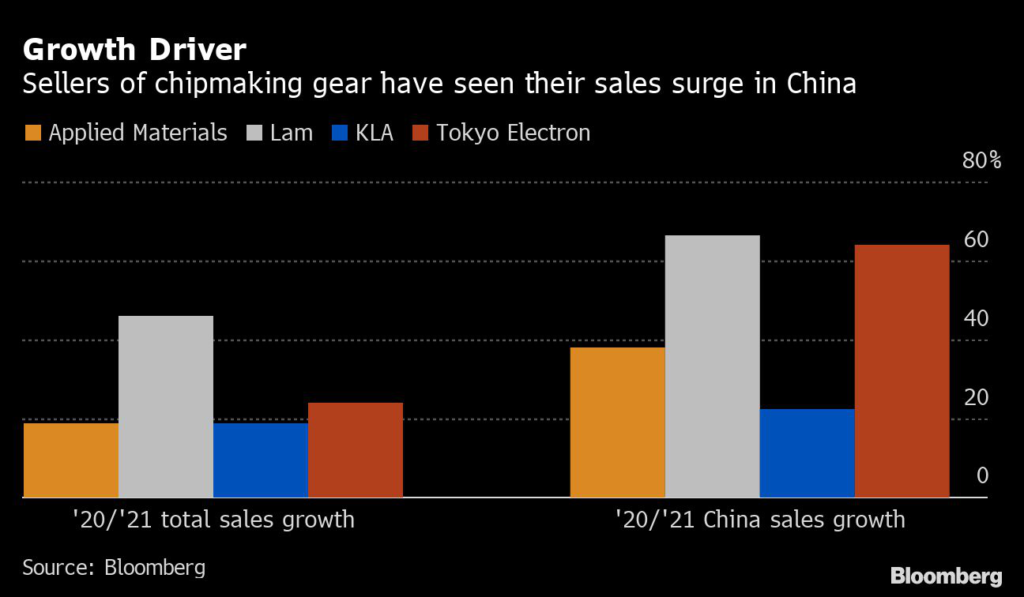
Chinese orders for chip-manufacturing equipment from overseas suppliers rose 58% in 2021, making it the biggest market for those products for a second year running, according to data provided by industry body Semi.

While those figures appeared in April, the flood of machinery headed to China is now drawing more attention — especially as a legislative push to bolster the US chip industry with investments and incentives falters. The US Commerce Department, meanwhile, appears unwilling to crack down harder on Beijing, irking critics.

“If the Biden administration is serious about securing the semiconductor supply chain in the United States and allied and partner countries, it’s absurd to let the Chinese Communist Party buy up and stockpile the global supply of tools and equipment to make semiconductors,” said US House Representative Michael McCaul, a Republican from Texas.

The semiconductor industry became a key battleground during the Trump administration’s trade war with China. President Joe Biden then inherited a set of rules aimed at restricting some Chinese companies’ access to technology. While some parts of the US government want to extend that into a more blanket ban, others are resisting what they see as an unnecessary escalation.

The global chip shortage, which disrupted supplies of everything from cars to smartphones, further inflamed tensions. Biden ordered a review of supply-chain vulnerabilities last year and found that — while the US maintains a healthy share of chip design and manufacturing equipment — the industry is “highly dependent” on overseas sales, notably in China.

That dilemma is evident in the latest industry figures for 2021. Even in a year when worldwide bookings for equipment from the likes of US-based Applied Materials Inc. and Japan’s Tokyo Electron Ltd. climbed 44% — fueled by a global surge in chip demand — the growth of China’s chipmaking industry far outpaced other regions.

Some US chipmakers have expressed concerns that Chinese companies are paying above-market rates to obtain the machinery. They say that’s made it harder for US companies to get the equipment they need to expand domestic production, undercutting a core goal of the Biden administration. But the US government isn’t convinced intervention is needed.

At the center of the growing debate, the US Department of Commerce said it’s so far found nothing other than normal market forces at play. The department has enforced bans on some supply to Chinese companies listed as a threat to national security, including Semiconductor Manufacturing International Corp. But it’s avoiding dabbling in industrial policy beyond that. 

“I hear a lot of concerns within the chip industry — and when I heard this, I looked into it,” Secretary of Commerce Gina Raimondo said in an interview. “Selling a commodity product to a Chinese company is in and of itself not problematic. If at any point we found evidence of preferencing Chinese companies, then we would take action to address it immediately.”

Raimondo in April summoned the CEOs of Applied Materials, Lam Research Corp. and KLA Corp. to explain the supply-chain data presented to her and answer accusations of favoring Chinese customers, people familiar with the matter said. National Security Advisor Jake Sullivan and National Economic Council Director Brian Deese were also present at the meeting. The executives provided data in follow-up meetings and appear to have convinced the Commerce chief that there’s no foul play.

“I don’t think anyone would want the US government to dip into the private sector supply chain and try to micromanage it if nothing wrong is happening,” Raimondo said.

That stance is too passive for many China critics, possibly including some within the Biden administration. 

Saif Khan, technology director of the National Security Council, argued before joining the administration in favor of stringent export controls on semiconductor manufacturing equipment. The idea, he said at the time, was to make it difficult for China to make advanced chips, “largely preempting China’s development and use of many dangerous or destabilizing technologies.”

Khan didn’t respond to a request seeking comment. 

McCaul and others have advocated for tighter controls on equipment exports to China, either unilaterally or by working with allies such as Japan and the Netherlands — countries that together with the US control some 90% of the market for the most advanced chipmaking gear.

That’s not gone unnoticed in China and may be spurring the run-up in ordering, particularly at a time of shortages and increasing demand. Beijing is willing to provide the financing for many of the purchases, said Guarav Gupta, an analyst at Gartner Inc.

“They’re encouraging the domestic chipmakers to buy more, to get whatever you can right now because you never know when the US may place more restrictions,” he said. “Even if they require one tool, they will order three or four. Money doesn’t seem to be a problem.” 

The beneficiaries include Applied Materials, Lam and KLA in the US, as well as Tokyo Electron and Netherlands-based ASML Holding NV. ASML is hiring more than 200 workers in China this year to keep up with growth there.

China is the largest consumer of semiconductors because of the size of its domestic electronics market and its status as production base for entire industries. Yet it is dependent on foreign companies for equipment, and the overwhelming majority of its output is several generations behind the most leading-edge chips.

“Keep in mind that more than 40% of the equipment spending in China is by multinational corporation operating facilities there to produce closer to the large contract assembly base,” said SEMI head Ajit Manocha. “Furthermore, the great majority of the installed base capacity for foundries in China is for lagging-edge technologies.”

Yet during the height of the global chip shortages, it’s exactly semiconductors made with lagging technologies that were in the most severe short supply. Carmakers and many other companies were scrambling to get enough of power management chips, display drivers and microcontrollers. 

Even Apple Inc., the largest corporate buyer of semiconductors, was not immune. China’s increasing capability of making those could mean the world will come to rely on the country’s supply even more.

Gartner’s Gupta sees it as unlikely that equipment makers would prioritize shipments to China over their main sources of income: the world’s three largest chipmakers. Those companies — Taiwan Semiconductor Manufacturing Co., Samsung Electronics Co. and Intel Corp. — together account for more than 40% of gear purchases and are planning or building new plants in the US. Smaller companies may have to wait longer to get what they’ve ordered, Gupta said.

All the same, apart from ASML — whose extreme ultraviolet lithography machines are necessary to make the most advanced chips — all of the equipment makers saw sales in China outpace overall growth in 2021. Tokyo Electron reported the strongest China expansion, with sales from that market increasing more than twice as fast as its overall rate. 

The Japanese company has fewer restrictions on what it can sell to China. US equipment makers are prevented from selling some cutting-edge tools to China’s top chipmaker, SMIC, because of its ties to the Chinese military. The Dutch government has yet to renew an export license for ASML to sell its EUV machines to China. 

Even with the limitations, China has helped fuel booming sales for the industry over the past five years: ASML’s China revenue tripled, while KLA’s grew fourfold. 

While the Commerce Department has received complaints from some chipmakers that Chinese companies are paying premiums to jump the line for gear, investigations have shown no evidence that’s the case, according to a person familiar with the process. 

The major US chip-equipment makers, which may receive federal chip funding, are still unlikely to give up the Chinese market willingly. All have indicated they have the capability to avoid US sanctions by building capacity outside of America.

More stories like this are available on bloomberg.com

©2022 Bloomberg L.P.

America’s Inventory Glut Might Be Great for Overstock

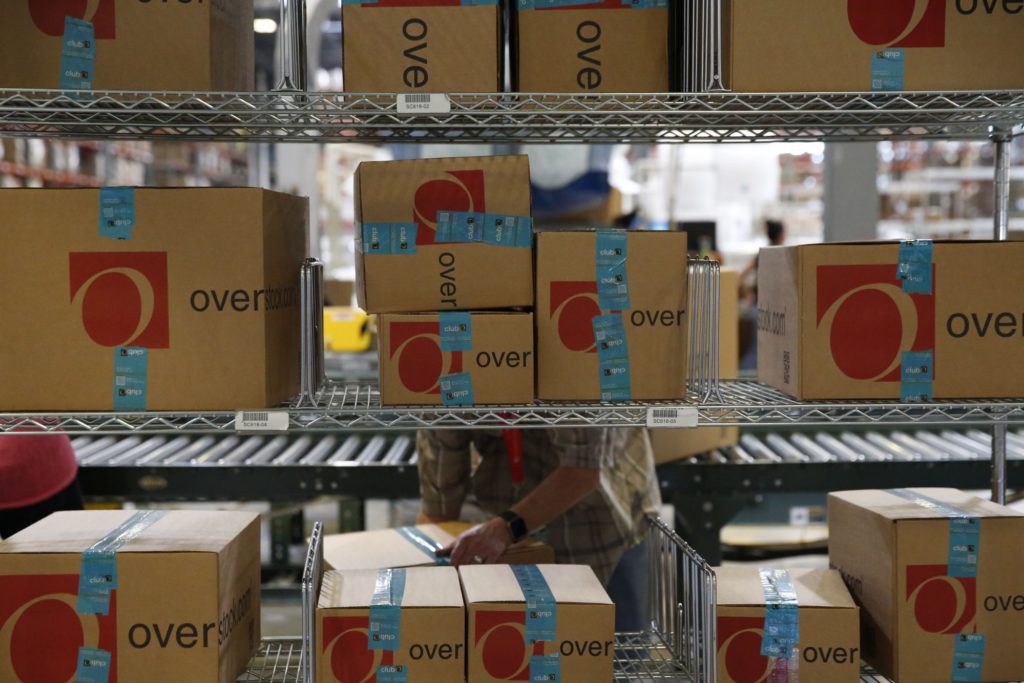
(Bloomberg) — Overstock.com Inc. is poised to take advantage of the inventory glut plaguing retailers like Target Corp. and Walmart Inc.

The e-commerce company specializes in helping chains liquidate slow-moving merchandise, and now it will have more opportunities than usual. US retailers racked up excess goods to ensure shelves stayed full during the pandemic. But now shoppers have shifted spending to categories like services and travel, leaving warehouses overflowing.

That may help Overstock rebound from a rough stretch. Its shares have fallen 48% this year, while sales have declined for three straight quarters.

Under Chief Executive Officer Jonathan Johnson, the company also shifted to selling mostly home goods, which traditionally have better margins and been growing faster than other categories. And surging US inflation is likely to push shoppers to the deals found on Overstock, according to Michael Pachter, managing director at Wedbush, who feels Overstock’s extensive selection at a range of prices offers a competitive advantage.

“In an inflationary environment, consumers tend to look for the lower-cost solution,” said Pachter, who estimates Overstock will end this year with its sales little changed. That would come after revenue fell 19% in the first quarter.

Overstock was founded in 1999 to help retailers sell off inventories during the dot-com bust. Johnson, who joined a few years later and succeeded founder Patrick Byrne as CEO in 2019, decided to move the company away from what he called a “liquidator of all things” into a “retailer of home furnishings.” That evolution paid off during the pandemic when Americans splurged on their properties. Overstock’s shares surged by 580% in 2020 and kept rising last year.

“They’re well suited to be the best house on the bad block in either a period of an all-out recession, or just slowing interest in the home category,” said Tom Forte, an analyst at D.A. Davidson. Overstock will benefit from all this excess inventory, he said. 

For his part, Johnson expects supply-chain disruptions and the retail industry’s inventory woes to continue into next year. The latest Covid-related port closures in China have provided a much-needed reset, he said. They gave US ports time to catch up, but China ramping back up could create more bottlenecks.

“The supply chains are still not normalized,” Johnson said. “The ports are slow. Trucks are slow. Delivery is expensive because of oil prices.”

More stories like this are available on bloomberg.com

©2022 Bloomberg L.P.

Crypto Lender Celsius Stops Withdrawals, Fuels Market Slump

(Bloomberg) — Celsius Network Ltd. paused withdrawals, swaps and transfers after weeks of speculation over the sustainability of the outsized returns being offered by the DeFi lending platform, fueling a broad cryptocurrency selloff. 

Crypto markets tumbled after the Celsius announcement, with Bitcoin dropping as much as 14% to the lowest level since December 2020 and other major tokens like Ether also falling sharply. Celsius’s CEL token was down about 50% to 19 cents as of 7:16 a.m. in New York Kong, according to pricing data site CoinGecko.

The meltdown is the latest blow to DeFi, or decentralized finance, crypto’s answer to traditional finance, with more control and less costs for users but also less oversight and more risk. 

Doubts about the sky-high yields backing products such as those Celsius offers have intensified after the collapse of the Terra ecosystem in May, and as tighter monetary policy across the world curbs demand for riskier assets. The CEL token promises “actual financial rewards,” including as much as 30% extra returns weekly, according to its website.

While the collapse of the TerraUSD (UST) stablecoin captured most of the market’s attention, one of the project’s main attractions for investors had been its promised interest rate, set as high as 20% for UST deposits in the Terra blockchain-based lending project Anchor. Celsius was an investor in the project. Both revolve around the promise of super-high yields to keep up demand, which itself depended on a steady flow of new entrants feeding the system, or borrowing to pay the high rates.      

Nexo, a London-based competitor, announced on Twitter that it’s ready to buy any “remaining qualifying assets” of Celsius, which it defined as “mainly their collateralized loan portfolio.” Nexo later published a letter of intent outlining the offer on Twitter. A Nexo spokeswoman confirmed the tweets. 

Nexo also said it had reached out to Celsius to offer support, “but our help was refused.” The firm has a “strong liquidity and equity position,” a spokeswoman said by email without giving details. Celsius didn’t immediately respond to requests for comment on Nexo’s statement.  

A little over a day before announcing the halt, Celsius Chief Executive Officer Alex Mashinsky appeared to counter speculation about a freeze on withdrawals, tweeting “Mike do you even know one person who has a problem withdrawing from Celsius?” in response to a post by Mike Dudas, a crypto investor and co-founder of The Block.

In announcing the move, Celsius said: “We are taking this action today to put Celsius in a better position to honor, over time, its withdrawal obligations.” It added that users will continue to accrue rewards during the pause.

The announcement landed in the midst of turmoil in crypto markets, with worse-than-expected US inflation data on Friday stoking expectations of faster interest rate increases, hitting riskier assets like digital tokens. Bitcoin has tumbled 47% this year, while Ether has lost about two-thirds of its value. 

There’s No Hiding From the Bad News This Time: John Authers

“The Celsius news added fuel to the fire, adding to the uncertainty in the market,” said Vijay Ayyar, vice president of corporate development and international at crypto platform Luno. “There is a lot of pressure on prices as we go into the week of Fed decision coupled with concerns on the protocols offering high-yield products.”

Tokens linked to lending and borrowing protocols underperformed on Monday, with their overall value down 10% compared with a 6.4% drop in the broader crypto universe, according to CoinGecko. Celsius peers Aave, Maple and Compound slumped 12%, 15% and 13%, respectively.

Ethereum blockchain data shows that the largest single digital wallet holding CEL tokens is a wallet that belongs to Celsius itself, with more than 184 million CEL tokens, or 26.6% of the total supply in circulation. Mashinsky clarified in a weekend tweet that Celsius hadn’t been selling the token. 

The collapse of the TerraUSD stablecoin and its sister token Luna in early May spawned widespread skepticism of the juicy returns crypto lenders like Celsius and decentralized-finance platforms have been promising investors. Anchor, a project linked to the Terra ecosystem, had offered yields of roughly 20% before TerraUSD, or UST, crashed.

“The plunge of Celsius’s token $CEL seems to be a realization of the contagion risk of UST/LUNA into similar financial tools,” said Burak Tamac, senior analyst for regulatory and on-chain at CryptoQuant.

(Updates with added comment from Nexo in fourth paragraph.)

More stories like this are available on bloomberg.com

©2022 Bloomberg L.P.
UK Plans Update to Digital Strategy Amid Lack of Tech Staff

(Bloomberg) — The UK is planning to update its digital strategy for the first time since 2017, in an attempt to address the “skills deficit” in the tech sector.

Post Brexit, the British government wants to “capitalize on the freedoms we now have to set our own rules and regulations,” said Nadine Dorries, the Secretary of State for Digital, Culture, Media and Sport, at the opening of London Tech Week.

The new strategy, which has yet to be revealed in any detail, comes at a time when tech startups are cutting jobs after facing pressure to focus on profits rather than growth. Getir, Gorillas, and Klarna, some of the largest European startups with a significant presence in London, are cutting jobs, while UK rapid grocery startup Zapp is also planning cuts of up to 10% of staff. 

Despite the recent cuts, venture capital funding into London rose at the start of 2022 to $11.3 billion through the end of May, a rare increase that makes it an outlier among top competitors, which saw their levels drop amid a broader slowdown.

The UK capital ranked as the third-highest city globally for attracting venture financing through the start of this year, according to a report from the capital’s promotional company London & Partners and data provider Dealroom.co. However, it was the only city in the top four to post an increase this year over first-half 2021, when tech markets surged.

London’s $11.3 billion in venture capital investment this year through May topped the $10.5 billion in the first half of last year. That figure trailed only the San Francisco Bay Area and New York, according to the report. 

Private technology investment is playing an increasingly prominent role in London’s financial sector, while venture capital firms have become an attractive place to work.

Read more: Venture Capital’s Billions Are Taking Over London Finance

(Updates with additional context.)

More stories like this are available on bloomberg.com

©2022 Bloomberg L.P.
YouTube Videos Are Targeting Muslims, Women in India, Study Says

(Bloomberg) — Influencers backing India’s ruling Hindu nationalist party have used YouTube videos to spread conspiracy theories and hateful content targeting Muslims and women in the biggest market for the platform by user base, according to a report by the NYU Stern Center for Business and Human Rights.

The NYU Stern Center report highlighted the case of India to press Alphabet Inc.’s Google-owned video platform to look at its recommendations to boost content moderation and disclose information on how algorithms recommend and remove content. 

India has more than 450 million YouTube users, nearly double the size of the platform’s US base. The videos have helped fuel a conspiracy theory that Muslims spread Covid as a form of “jihad’, or holy war, according to the report titled “A Platform ‘Weaponized’: How YouTube Spreads Harmful Content – And What Can Be Done About It.”

The report also cited examples of rivalries between street rival vendors turning violent after a YouTube video campaign that singled out Muslims as well as anti-Muslim rhetoric often blending with at online attacks on women. 

“A spate of misogynistic rants by nationalistic Indian YouTube influencers have made such invective popular on the platform,” the report said. “The diatribes, many of which include physical threats, are often delivered as selfie videos.”

A YouTube spokesperson said the recommendations detailed by the report were priorities for the platform though greater algorithmic transparency makes it harder to protect its systems. 

“We work to provide ongoing insights into how recommendations work, through blog posts, videos, interviews and more,” the spokesperson said. 

Requests for comments from Prime Minister Narendra Modi’s Bharatiya Janata Party and India’s Interior Ministry also remained unanswered.

Intensified Hostility

With over 1.3 billion people and growing Internet use, India is an important and profitable jurisdiction for social media companies. However popular support for the Hindu nationalist agenda of Modi’s BJP puts big tech companies in a spot when it comes to balancing free speech with curbs on hateful content.  

While the report noted that religious divides existed in India long before YouTube came to the picture, “widespread social media use has intensified the hostility.” 

The report comes amid an ongoing controversy in India where two ex-BJP officials made derogatory remarks against Islam and Prophet Muhammad on a news channel and on social media, dragging New Delhi into a diplomatic spat with several Middle Eastern trading partners. It has also led to sporadic religious clashes in several parts of India.

The police have arrested a YouTuber from insurgency-prone northern region of Kashmir for allegedly uploading a video that showed beheading an effigy of one of the suspended officials, local media reported, reflecting the challenges of curbing hate messages on the platform. 

Speaking at World Economic Forum in Davos last month, YouTube’s Chief Executive Officer Susan Wojcicki said the platform faced a test in keeping ahead of people creating misinformation and making sure it understood what they are. She said YouTube missed only about 10 to 12 content-violating videos per 100,000 views of videos on the platform, citing the company’s latest research. 

More stories like this are available on bloomberg.com

©2022 Bloomberg L.P.

Japan Starting to Crack as Yen Tumbles With Stocks and Bonds

(Bloomberg) — With the yen at a 24-year low, Tokyo stocks down the most since March and bond yields hitting its ceiling, the Bank of Japan is under duress having to defend a policy the rest of the world is quickly moving on from.

In his clearest warning yet on the yen’s weakness, BOJ Governor Haruhiko Kuroda, 77, said Monday that the recent abrupt slide of the currency is bad for the economy, while the central bank reinforced efforts to keep a lid on yields. Still, the yen fell 0.6% to 135.19 per dollar, the lowest since 1998.

The downward pressure on the yen and slide in Japanese government bonds was triggered by a new wave of selling in global debt markets, led by Treasuries, as investors shocked by Friday’s US inflation data priced in aggressive policy tightening by the Federal Reserve and sought refuge in the dollar. 

“While Japanese authorities have stepped up warnings, there are few tools available to stop this momentum,” said Akira Moroga, manager of currency products at Aozora Bank in Tokyo. “The environment remains ripe for speculators to drive dollar-yen higher.”

The yen fell almost 15% this year — the worst-performing major currency — as the BOJ keeps rates low to boost a sluggish economy while US yields surge on bets for continued Federal Reserve hikes. 

Why the Yen Is So Weak and What That Means for Japan: QuickTake

Bond Buying

Kuroda’s statement to parliament ahead of a policy meeting Friday also included a reminder that monetary easing needed to continue. Earlier, the BOJ stepped up efforts to defend its easy stance, saying it would buy another 500 billion yen ($3.7 billion) worth of bonds on Tuesday to keep rates low. That’s after the 10-year bond yield rose above 0.25% — the upper end of its accepted range — for first time since January 2016.

“The BOJ will now need to explain clearly what is the logic behind the 0.25% cap and whether that level is appropriate under the current environment,” said Mari Iwashita, chief market economist at Daiwa Securities Co.

While Kuroda’s currency comments gave some support to the yen, stocks still lost the most since March 7, with the Topix Index down 2.2%. Even traditional weak-yen beneficiaries including electronics and automakers ended the day in the red.

“It’s crystal clear that stocks that are sensitive to the global economy are being sold off today,” said Mamoru Shimode, chief strategist at Resona Asset Management Co.

Senior Japanese officials already delivered a ramped-up warning on the yen’s decline Friday, putting their concern in a written statement for the first time as they seek to keep a floor under the currency.

Japan Spells Out Warning on Forex With Yen Near 1998 Low

Economic Impact

Kuroda underlined that message Monday, pledging to work closely with the government.

While a recent survey of economists by Bloomberg showed that the BOJ is unlikely to adjust policy until the yen breaches the 140 level, the talk of close cooperation has prompted some BOJ watchers to flag the chance of adjustments or tweaks to policy guidance at the conclusion of Friday’s meeting.

With the Fed expected to deliver at least a half-percentage point rate hike before the BOJ meets, the downward pressure on the yen is set to continue.

The weakening yen is expected to have a mixed impact on the domestic economy, hurting household budgets but providing a boost to exports. A further slide would increase pressure on neighboring Asian economies such as China and South Korea which are losing out in export competitiveness. 

Yen’s Slump Reaches Levels That Put Asia’s Rebound in Danger

The US Treasury’s semiannual report on foreign exchange released Friday may have added to the yen selling pressure, said Yuji Saito, executive director at Credit Agricole CIB’s foreign-exchange department in Tokyo. It suggested currency intervention should only be reserved for exceptional circumstances with prior consultation.

“It essentially rejected Japan intervening for yen weakness that came as a result of widening interest rate differentials because Japan is pursuing an easy monetary policy on its own decision,” Saito said. “Dollar-yen’s uptrend is unlikely to stop until US economy slows down or inflation peaks.”

(Updates with story links.)

More stories like this are available on bloomberg.com

©2022 Bloomberg L.P.

Walmart Seeks UK Sellers for Third-Party Online Marketplace

(Bloomberg) — Walmart Inc. is seeking UK retailers to join its online marketplace in an attempt to give British businesses another e-commerce alternative to Amazon and EBay Inc.

Approved British sellers will be able to sell their goods on Walmart.com, which is visited by more than 120 million people every month, the US shopping giant said in a statement Monday. In a bid to attract sellers, Walmart is offering a guaranteed two-day shipping service to the US for much of the year and access to other services to help them generate sales across the Atlantic.

Walmart is hosting a UK Sellers Summit in London on Friday and said manufacturers and exporters from an array of sectors, including fashion, sporting goods, beauty and entertainment, have been invited. 

UK companies already on Walmart’s marketplace include wearable technology firm Statsports, home and garden products seller BuyBox, sporting equipment company Nodor and generalist retailer Pertemba.

Walmart has a long history with UK retail and for years owned Asda, Britain’s third-largest grocer, before selling most of its holding to a consortium led by the Issa brothers over a year ago. The latest move to target British exporters comes as the UK government seeks to help businesses reach £1 trillion ($1.22 trillion) in exports by 2030 by focusing on non-EU markets such as the US, Australia, Canada or Japan. 


More stories like this are available on bloomberg.com

©2022 Bloomberg L.P.

Electrifying Fleets One Solution to World’s Car Obesity Problem

(Bloomberg) — Companies in the transport sector, and automakers in particular, are among the most-visible pioneers of the inevitable shift to cleaner fuel. Electric cars are becoming a household concept, regardless of their prohibitive cost for most of humanity — another classic case where modern technology is largely unaffordable for the poor.

That’s where large fleet operators come in, according to New York-based RedBlue Capital, an early-stage investor in clean mobility startups. Companies like Amazon and food-delivery services such as DoorDash and Instacart will drive a faster adoption to EVs, RedBlue partners Olaf Sakkers and Prescott Watson say. Ride-hailing outfits, taxis, transit buses and corporate shuttles will also play a part, considering such operators are cautious about the total cost of ownership and use the vehicles a great deal more, making the economics of EVs attractive to them.

In 2019, RedBlue invested in Zoomo, an Australian e-bike startup that supplies to food-delivery services. Through bulk sales, Zoomo has already become one of the fastest-growing e-bike companies in the world, according to Watson. More recently, RedBlue invested $28 million in EVage, a supplier of light electric trucks in India.

“We should measure the success of the transition to EVs against how many miles they run, not by how many vehicles are sold to the general public,” Sakkers said in an interview in Singapore last week. “For many people, EVs are just a second or third car that they hardly drive, which doesn’t move the needle. But fleet operators use them many times every day.”

That’s particularly true for a country like India — a nation of 1.4 billion people or one-sixth of the world’s population. There, very cheap, no-frills cars made by the local units of Suzuki and Hyundai dominate. Price elasticity is so tough that Ford and GM ended up exiting, unable to sell enough cars to justify the billions of dollars in investment over many years.

In India, fleet operators are already leading the way to electrification. BigBasket, which delivers everything from groceries to cooking utensils, is on a mission to electrify 90% of its fleet. In New Delhi, people often tweet about their rides with BluSmart, a 100% electric taxi startup with almost half a million app downloads. It estimates the market will grow more than four times to $90 billion by 2030 across several Indian mega cities. Amazon and Walmart-owned retailer Flipkart are also pushing for more EVs, but the problem is they can’t get enough supply.

“India has traditionally waited to localize wealthy countries’ auto products once prices fall,” Watson says. “But the ‘wait ten years’ approach doesn’t work with climate timelines today and so India in particular will have to develop indigenous technologies to make EVs cheap enough for near term mass adoption. That’s the opportunity we’re investing in.”

That’s different from larger, more developed nations where cars tend to grow bigger even as utilization remains limited. Call it a car obesity problem. In America, a typical vehicle sits in the garage 96% of the time, Sakkers wrote in his book Mobility Disruption Framework, citing research by McKinsey.

But in emerging economies like India, newer concepts are gaining ground. E-scooters are selling like hot cakes and the South Asian nation is now mulling battery swapping as opposed to charging stations to ensure faster adoption of cleaner fuels.

According to BloombergNEF, the market for light-duty trucks and vans in India is growing at two to three times that of Europe or the US, and almost 40% of the nation’s three-wheeler fleet is already electric.

More stories like this are available on bloomberg.com

©2022 Bloomberg L.P.

Global Rout Deepens as Outsized Rate Hike in Play: Markets Wrap

(Bloomberg) — A global selloff intensified following a surprise American inflation print that heaped pressure on the Federal Reserve to step up monetary tightening. Treasury yields traded at a multi-year high.

S&P 500 futures sank 2.5% and Nasdaq 100 contracts slid 3.1%. The S&P 500 is flirting with a bear market after Friday’s shock consumer prices report ignited a more than $1 trillion selloff. The Stoxx 600 traded at its lowest level since early March.

Yields on 10-year US Treasuries reached 3.24%, the highest since October 2018, and a selloff in European government bonds also gathered pace, with the yield on German’s two-year government debt rising above 1% for the first time in more than a decade.

The exodus from stocks and bonds is gaining momentum on fears that central banks’ battle against inflation will end up killing economic growth. Inversions along the Treasury yield curve point to fears that sharp Fed interest-rate hikes will spark a hard landing.

“The Fed will not be able to pause tightening let alone start easing,” said James Athey, investment director at abrdn. “If all global central banks deliver what’s priced there are going to be some significant negative shocks to economies.”

Traders are now pricing in 175 basis points of Fed tightening by September, implying two half-point and one 75 basis points hike. If that comes to pass it would be the first time since 1994 the Fed resorted to such a draconian measure.

Read more: US Bond Market Flashes Recession Warning as Yield Curve Inverts

Meanwile, the dollar climbed while the yen weakened to a 24-year low. Oil and iron ore paced declines among growth-sensitive commodities.

Poor sentiment was also evident in a cryptocurrency slide that took Bitcoin below $25,000 to the lowest in 18 months.


What to watch this week:

  • First WTO ministerial meeting in nearly five years. Through June 15.
  • ECB’s Luis De Guindos due to speak, Monday.
  • US PPI, Tuesday.
  • China key economic activity data, liquidity operations, medium-term lending facility, Wednesday.
  • FOMC rate decision, Chair Jerome Powell briefing, US business inventories, empire manufacturing, retail sales, Wednesday.
  • ECB President Christine Lagarde due to speak, Wednesday.
  • Bank of England rate decision, Thursday.
  • US housing starts, initial jobless claims, Thursday.
  • Bank of Japan policy decision, Friday.
  • Eurozone CPI, Friday.
  • US Conference Board leading index, industrial production, Friday

Some of the main moves in markets:

Stocks

  • Futures on the S&P 500 fell 2.5% as of 5:51 a.m. New York time
  • Futures on the Nasdaq 100 fell 3.1%
  • Futures on the Dow Jones Industrial Average fell 2%
  • The Stoxx Europe 600 fell 2.2%
  • The MSCI World index fell 1%

Currencies

  • The Bloomberg Dollar Spot Index rose 0.7%
  • The euro fell 0.5% to $1.0464
  • The British pound fell 0.9% to $1.2208
  • The Japanese yen was little changed at 134.49 per dollar

Bonds

  • The yield on 10-year Treasuries advanced eight basis points to 3.23%
  • Germany’s 10-year yield advanced five basis points to 1.56%
  • Britain’s 10-year yield advanced three basis points to 2.48%

Commodities

  • West Texas Intermediate crude fell 1.4% to $119 a barrel
  • Gold futures fell 0.9% to $1,859.20 an ounce

More stories like this are available on bloomberg.com

©2022 Bloomberg L.P.

Close Bitnami banner
Bitnami