Bloomberg

Prologis Shares Tumble After Firm Seals $26 Billion Duke Bid

(Bloomberg) — Prologis Inc. boosted its bid for US warehouse landlord Duke Realty Corp. to an all-stock offer of about $26 billion including debt, securing a deal after months of negotiations.

Prologis plans to hold about 94% of Duke Realty’s assets and exit one market, the companies said in a statement Monday. Both firms’ boards have approved the transaction.

Prologis, which owns industrial warehouses across the US and other countries, went public with a $24 billion acquisition offer in early May after months of private pushback from Duke. That initial bid was rejected by Duke, which called the offer “insufficient.” 

Prologis shares fell 8.9% to $106.77 at 11:08 a.m. in New York Monday. Duke stock declined less than 1%.

“Whatever macro environment, good or bad, that we have, the new company will perform even better than the old company,” Prologis Chief Executive Officer Hamid Moghadam said on a conference call. “We’ve really seen no let-up in demand and trajectory of rent in most markets.”

What Bloomberg Intelligence Says

“Prologis’ planned purchase of Duke Realty for $26 billion, after the prior $24 billion offer was met with resistance, demonstrates the strength and longevity of warehouse rent growth.”

–Lindsay Dutch, industry analyst

The deal shows how the ongoing shift to e-commerce is creating strong demand for industrial space, giving landlords ample room to raise rents. The vacancy rate for US warehouses fell to 3.4% in the first three months of this year even as developers rushed to build new logistics properties, according to Jones Lang LaSalle Inc. 

Prologis sees that demand holding up even after Amazon.com Inc. made waves in the commercial real estate world by telling investors that it had overbuilt its logistics network. The retail giant followed that disclosure by seeking to sublease millions of square feet of industrial real estate. 

Duke has more exposure to Amazon leases than Prologis has in its existing portfolio, Moghadam said on the call. 

“I’m not at all concerned about Amazon, because I know that e-commerce is a big driver,” Moghadam said. “It’s not the only driver, but it’s a big driver, and if anything, it’s getting broader today.”

With the Duke transaction, Prologis will gain properties in areas including Southern California, New Jersey, South Florida, and Dallas. The deal will also give the company 11 million square feet (1 million square meters) of real estate that’s under development.

Duke investors will receive 0.475 Prologis shares for each Duke share they own. The companies expect to close the deal in the fourth quarter, according to the statement. Prologis plans to retain some Duke employees to manage real estate assets and fill open positions at the combined company. 

“We have always respected Prologis, and after a deliberate and comprehensive evaluation of the transaction and the improved offer, we are excited to bring together our two complementary businesses,” Duke CEO Jim Connor said. 

(Updates with quotes from conference call beginning in fourth paragraph.)

More stories like this are available on bloomberg.com

©2022 Bloomberg L.P.

Outsourcer iEnergizer Starts Sale Process Amid Takeover Interest

(Bloomberg) — iEnergizer Ltd., the digital content and business process outsourcing company, said it’s launching a formal sale process after receiving private equity takeover interest. 

The London-listed company, which has been exploring strategic options, concluded it would be “appropriate” to investigate a sale of the company, it said in a statement Monday. iEnergizer plans to review potential buyers who will enable the company to prosper long-term while maximizing value for all stakeholders, according to the statement. 

Barclays Plc, JPMorgan Chase & Co. and Arden Partners are advising iEnergizer on the sale, it said. The company announced last week it had received an approach from Baring Private Equity Asia and was conducting a strategic review, following a Bloomberg News report that it was gauging interest from potential buyers. 

The buyout firm plans to participate in the formal sale process and will no longer be bound by a regulatory deadline to announce firm plans for a bid by July 7, iEnergizer said in Monday’s statement. Shares of Guernsey-based iEnergizer have risen 27% this year, giving the company a market value of about £780 million ($946 billion). 

iEnergizer offers customer management and custom content development services. Anil Aggarwal, the firm’s founder and chief executive officer, is the controlling shareholder, according to its annual report. 

Founded in 2000 in India, iEnergizer employs more than 22,000 people across nine delivery centers worldwide. Its customers are based primarily in the US and India, the annual report shows. iEnergizer acquired content production and digital media firm Aptara Inc. in 2012 for $150 million.

Outsourcing firms have benefited from the digitization that accelerated during the Covid-19 pandemic, driving a wave of deals. Mindtree Ltd. and Larsen & Toubro Infotech Ltd., two software firms controlled by Larsen & Toubro Ltd., agreed to merge last month at a combined $18 billion market value. 

More stories like this are available on bloomberg.com

©2022 Bloomberg L.P.

Historic Hudson Valley Estate Hits Market for $25 Million

(Bloomberg) — One of the most expensive homes ever listed in the Hudson Valley is for sale for $25 million.

When Suzy Welch bought her Red Hook, N.Y., mansion in March 2020, it was, she says, “a complicated time.”

For most people, she continues, the dominant preoccupation was Covid-19, which was just making its way into the global consciousness. Welch’s husband Jack Welch, the influential former chief executive officer of General Electric Co., had just died, “and I was looking for a place to go and process that,” says Welch, an author, TV commentator, and business journalist.

As the pandemic dragged on, the mansion became the primary residence for Welch and her family. Welch slowly updated and renovated the 16,600 square-foot structure, set on 290 acres overlooking the Hudson River, with the help of interior decorator Bunny Williams.

Now, with the Covid-era behind her and a teaching job at NYU on the horizon, Welch is putting the house back on the market, listing it with Compass’s Candy Anderson and Byron Anderson for $25 million. “Life changed in a way that I didn’t expect, and I’m back in New York City all the time,” Welch says. “I poured my heart and soul and all my creativity into the house, and I’m just hoping the owner loves it as much as I do. It’s a house that’s easy to love.”

The History

The estate, known as Steen Valetje, was built in 1851 and became a centerpiece in the sprawling, interconnected history of American wealth and power. The house was a gift from William Backhouse Astor Sr. to his daughter Laura, who married Franklin Hughes Delano, a businessman and great uncle to President Franklin Delano Roosevelt. 

Franklin and Laura, who were childless, left the house to Franklin ‘s nephew Warren Delano, who lived there with his wife Jenny until he was killed in an accident involving a spooked horse and an oncoming train. He, in turn, left the house to his son Lyman, who would often entertain First Lady Eleanor Roosevelt.

In 1949, Roosevelt mentioned the house in her “My Day” column, writing that “in spite of being built in the Victorian era, [Steen Valetje] has more charm and sense of being a house where people have lived and really understood and loved their possessions than some houses where you have a feeling that perfectly impersonal decorator was called in to hang the curtains and lay the rugs and choose and place the furniture.”

The property remained in the Roosevelt family until 1966. It went through several owners before Welch purchased it in 2020 for what Anderson, the broker, says was $16.5 million.

What’s Inside

The main house has 10 bedrooms, two designed as primary suites with their own dressing and sitting rooms. The property also has two four-bedroom guest cottages; a carriage house with four apartments used by staff; an additional two-bedroom gatehouse; an eight-stall stable with its own office, tack room, and viewing lounge; indoor and outdoor riding rings; and a pool house with dressing rooms and showers.

When she bought the property, “the owners directly before me had it for several decades,” says Welch. “And nobody hurt the house. All the original tile was there, the ceilings and beautiful floors were there. Really, they just had different decorating taste than I did.”

Apart from refurnishing and repainting many rooms, Welch made some significant upgrades. She redid the bathrooms in the main house and in the guest houses, installed fiber optic cable for the property, updated plumbing and electric in most of the buildings, added new HVAC to the main house and both guest cottages, and built a new kitchen in the main house. (The house has two: a “family” kitchen and a catering kitchen.)

“I love to cook,” Welch explains. “Maybe someone else would have said, ‘It’s fine for me,’ but I wanted one to my specifications.” Overall, “it wasn’t like you had to peel things back to find the historic house,” she says. “I had to sand and rebuff them back up, but it’s not like a bomb dropped.”

The other major addition she made was to put in electric systems to automate the house. All of its major functions can be controlled by phone. 

“On many levels, the history was in the background for me,” she says. “It was functioning as a family home. I wasn’t thinking about the history as I was decorating it. I didn’t want to make it a museum.”

Were she to return it to its original style, “that would mean the house would have to look Victorian, which is not my personal style—and pretty much not anyone’s,” she explains. “So my vision, and Bunny’s, was to do a beautiful blend of historic and modern that made it a livable home.” 

The Property

During Welch’s tenure, the stables remained empty. “I’m not a horse person,” she says. “But I’m told by all my horse friends that the facilities are absolutely state of the art.” The historic barns on the property, she says, “are really just so beautiful and even predate the house.” Currently, they’re used to store lawn mowers.

The lawnmowers have a lot of work to do.

The sprawling grounds include a tennis court, pool, and a lawn that slopes down to a half-mile of river frontage. “It has all of these places where you can take a lot of walks and play a lot of tennis,” Welch says. “And it’s the greatest house for sledding in the history of humankind.”

The Market

The house is in turnkey mode, massive, and historic. It’s also much more expensive than anything on the Hudson Valley marketplace. (The only area property that’s more expensive is a $45 million contemporary house at the river’s edge in Hyde Park.) This makes it difficult for potential buyers to reckon an accurate valuation. “The highest price to date has been about $18 million” for the area, says broker Anderson. “But there are numerous properties up here that have far more than that into them. They’re just not available for purchase.”

The problem, Anderson continues, is that such estates—particularly in this condition—come to market so seldom that it’s nearly impossible to find comparable properties. “We priced it to sell,” she says. “When I saw it and saw the improvements that have been made to it, I thought of a much higher price, but the owner wants to sell so it’s a terrific opportunity.”

The furniture in the house isn’t included in the asking price. “You buy the furniture of the home, and the house has a certain scale,” says Welch. “I could be wrong, but my feeling is, someone who really appreciates the house is going to want to purchase some or all of the furniture, and we can have that conversation.”

Welch is selling “with very complicated emotions and mixed feelings about it,” she says. “But I understand you have to go where your life takes you.”

More stories like this are available on bloomberg.com

©2022 Bloomberg L.P.

EV-Truck Startup Electric Last Mile Says It Plans to Liquidate

(Bloomberg) — Electric Last Mile Solutions Inc. plans to liquidate its operations about a year after the electric-vehicle startup went public and just four months after both its chief executive officer and chairman resigned.

The Troy, Michigan-based company said in a statement late Sunday that its board and interim CEO, Shauna McIntyre, decided to liquidate through a Chapter 7 bankruptcy process. The decision comes after a review of Electric Last Mile’s products and plans turned up no better option for stockholders, creditors and other interested parties, it said.

Electric Last Mile’s stock plunged 56% to 22 cents a share at 9:49 a.m. in New York. It was down 93% so far this year, to 51 cents, as of the close of trading last week.

The filing will make Electric Last Mile the first of the EV startups that merged with special purpose acquisition companies to go out of business amid the recent market slump. On May 27, the company had warned it might run out of cash this month. 

Founders James Taylor and Jason Luo had planned to import electric delivery vans from China and assemble them at a former General Motors Hummer factory in Mishawaka, Indiana. Both men resigned in early February after Electric Last Mile accused them of making improper stock purchases just before the company announced the SPAC merger in December 2020. The company listed on the Nasdaq in late June 2021 in a SPAC transaction that netted it about $379 million. 

“I’m very disappointed by this outcome because our ELMS team demonstrated incredible determination to get our electric vans ready to meet the critical need for clean, connected vehicles that reduce carbon emissions from ground transportation,” McIntyre said in the statement. “Unfortunately, there were too many obstacles for us to overcome in the short amount of time available to us.”

Taylor, a former GM executive who once ran the Hummer brand, had served as CEO while Luo, a former CEO of Ford China, was chairman. The company’s market value had been as high as $1.4 billion shortly after it started trading, based on closing prices.

Electric Last Mile has struggled since the shakeup. Just one week after Taylor and Luo resigned, the startup’s auditor — BDO LLP — also quit. Electric Last Mile has operated without an auditor ever since and has yet to file its annual report for the year 2021 and its financial results for the first quarter of 2022, leaving it out of compliance with Nasdaq listing rules. 

The company cut 24% of its workforce in March and disclosed that it was under investigation by the US Securities and Exchange Commission. All of these troubles combined “made it extremely challenging to secure a new auditor and attract additional funding,” the company said late Sunday.

More stories like this are available on bloomberg.com

©2022 Bloomberg L.P.

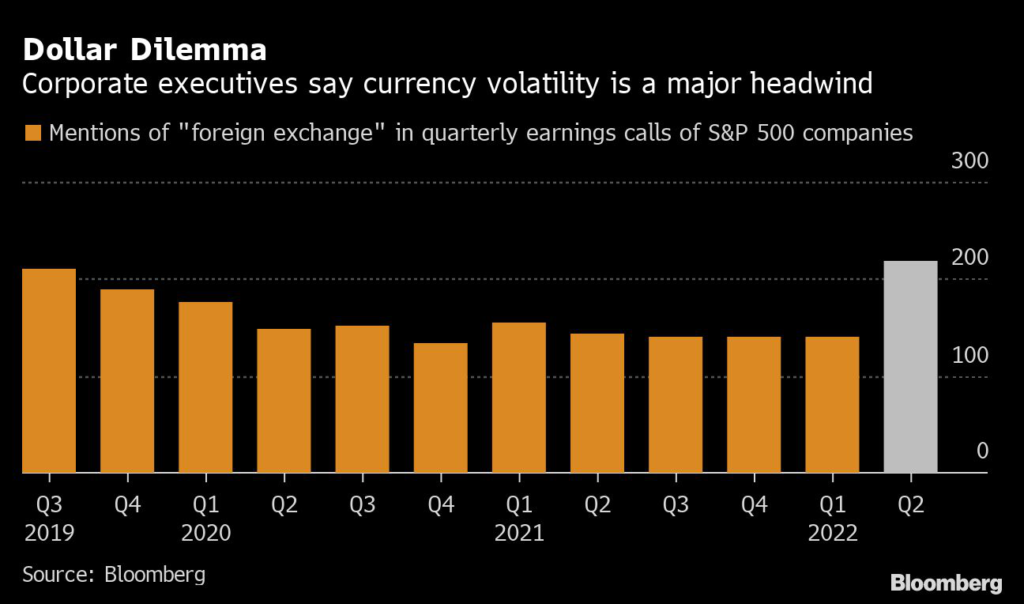
‘Dollar Ate My Profit’ Is Corporate America’s Lament Once Again

(Bloomberg) — Among the cavalcade of challenges facing corporate America, from historically high inflation to the lingering effects of the pandemic, a familiar lament is beginning to dominate C-suite conversations once again: the meteoric ascent of the dollar.

Microsoft Corp. became the latest US firm to make headlines for pointing a finger at the surging greenback, accusing it of eating away at its profits in a rare mid-season earnings forecast revision. It follows similar comments from the likes of Biogen Inc., Costco Wholesale Corp., Hewlett Packard Enterprise Co. and Salesforce Inc., all of which have bemoaned the stronger dollar in recent weeks.

After years of relatively serene global currency markets, foreign-exchange volatility has come roaring back as central banks around the world look to rein in runaway inflation by raising interest rates. With the Federal Reserve leading the charge, the dollar is off to its best start to a year since 2010, extending its gains over the past 12 months to more than 22% versus the yen and 15% against the euro.

For many companies dependent on overseas sales, it’s set to be a gut punch to their bottom lines. That’s because a stronger greenback lessens the value of their foreign revenue when translated back into dollars. It also makes their products less competitive as prices rise in local currency terms, reducing demand. 

“There’s concern about the dollar pricing US companies out of the global marketplace, which is very significant when you consider some of our largest cap companies have the greatest bulk of their businesses overseas, or at least sizable amounts,” said Jim Paulsen, chief investment strategist at Leuthold Weeden Capital Management in Minneapolis.

The US currency soared on Monday to the highest since April 2020 on expectations the Fed will be forced to raise rates even more aggressively this year.

Still, earnings revisions based on foreign-exchange fluctuations are often brushed off by investors more concerned with operational performance. In fact some market watchers say currency volatility is too often used as a convenient veil for a poor quarter. 

Yet it’s clear that this go around, the stronger dollar is having a tangible impact on corporate results.

About 35% of US firms have enough exposure overseas that a stronger greenback materially hurts their earnings per share, according to Gina Martin Adams, director of equity strategy at Bloomberg Intelligence.

These include many of the country’s largest technology companies, which have complex global operations and can generate more than a third of their sales outside the US.

Salesforce, the leader in cloud-based customer management software, recently doubled its expected revenue hit for the fiscal year to $600 million on account of the stronger dollar, while still predicting growth of about 20%. 

“The dollar might have even had a stronger quarter than we did, which is kind of amazing,” co-Chief Executive Officer Marc Benioff said on the company’s May 31 earnings call. “This is great to be a tourist in Japan, but it’s going to have implications as we roll this revenue up from the Japanese market.”

In fact, references to “foreign exchange” are popping up in earnings calls at the fastest clip in three years, according to a Bloomberg analysis. And “hedging” has been mentioned more than in any quarter since 2016.

A representative for Microsoft directed Bloomberg to the company’s June 2 earnings forecast revision, in which the company predicted a $460 million hit to fourth-quarter revenue from currency fluctuations. A spokesperson for Biogen declined to comment beyond the firm’s May earnings call, in which executives noted that the stronger dollar would result in a revenue hit of about $120 million after hedging.

Costco, which last month said that foreign currency weakness versus the dollar dented third quarter sales by more than 1%, hasn’t made any operational changes despite the increased volatility, Chief Financial Officer Richard Galanti said. A spokesperson for HPE noted that in addition to currency movements, the company’s downward profit forecast earlier this month was also impacted by Russia’s invasion of Ukraine and Covid-19 related disruptions in China.

Credit Pain

The surge has been particularly acute versus the yen and euro, but also versus the British pound and South Korean won, both of which are off more than 12% versus the greenback over the past year.

Every 8% to 10% jump in the dollar triggers, on average, a roughly 1% hit to US company profits, according to Credit Suisse Group AG.

“The strong dollar is an issue for companies because it makes US products less attractive to foreign buyers,” said Jonathan Golub, chief US equity strategist at Credit Suisse Securities. And “when you translate those earnings back to dollars, you get lower numbers.”

On the flip side, a Credit Suisse basket of US companies that stand to benefit from dollar appreciation — those with domestic sales and foreign currency costs — has outperformed a gauge of firms that tend to suffer by about 5.7% this year through mid May.

While the surging greenback’s toll on stock prices has garnered the lion’s share of attention recently, market watchers are starting to warn of impacts on corporate debt as well.

“We view lower-quality credits with high non-US dollar revenue exposure as vulnerable given unfavorable valuation and demand drivers created by the strong US dollar,” Dominique Toublan, head of US credit strategy at Barclays Plc, wrote in a June 3 report.

Barclays advises reducing exposure to BBB rated corporate bonds of firms such as Leidos Holdings Inc., which gets about 87% of its revenue abroad, and automotive supplier BorgWarner Inc.

“Along with inflation, strength in the dollar has been a notable market dynamic that has shown few signs of abatement,” Toublan said.

(Updates with Monday’s dollar move in sixth paragraph)

More stories like this are available on bloomberg.com

©2022 Bloomberg L.P.

Amazon Builds Property Empire, Quietly Buying Land Across the US

(Bloomberg) — The 193 acres just outside Round Rock, Texas, were coveted by some of the biggest developers in the US. Located a few miles north of the booming city of Austin, the raw parcel could be used for virtually anything given the state’s lenient land-use laws. So when the prominent Robinson family put the property on the market last year, there was strong interest from a range of real estate players, including home builders, private equity giant Blackstone Inc. and Prologis Inc., an industrial landlord that rents out warehouses across the country. But when the successful bidder emerged in October, it wasn’t a real estate firm. It was the world’s largest e-commerce company: Amazon.com Inc.

Starting about three years ago, the Seattle-based colossus quietly began searching for property in key US markets such as Southern California, Texas, Illinois, Florida and the Bay Area. Between 2020 and 2022, Amazon tripled the amount of built industrial space it owns in North America, according to company filings. Sometimes Amazon buys existing buildings, such as defunct call centers, but it also purchases bare land, of which the company acquired about 4,000 acres in the same period, says real estate researcher CoStar Group Inc. Amazon plans to use much of the real estate for a new generation of towering fulfillment centers that can store a wide variety of products close to customers in populous areas, according to people familiar with the strategy.

Buying land is a major shift for Amazon, which historically relied on a handful of developers to find property, build fairly simple warehouses and rent them back to the company. Now Amazon is increasingly taking parts of the development process in-house, often bidding against long-time partners for the best space.

It’s a potentially risky strategy that exposes Amazon to the vagaries of the industrial real estate market. The company also overbuilt during the pandemic and is saddled with too much warehouse space now that the surge in online shopping has decelerated. As a result, Amazon is looking to sublease space it doesn’t need and has slowed its warehouse expansion. “Like all companies, we’re adapting to the availability of real estate and location of our customer demand, and we’re also constantly evaluating our approach based on our financials,” spokesperson Kelly Nantel said in a statement.

But the company said there is no change in its long-term real estate strategy. Executives remain committed to securing land in the right locations to fulfill founder Jeff Bezos’ vision of making an online purchase as instantly gratifying as a trip to the store. If Amazon doesn’t keep marching closer to customers now, it could permanently surrender that proximity to retail competitors like Walmart Inc. that are just a short drive away.

“There’s going to be something on the other side of all of this investment for the consumer,” said John Blackledge, an analyst at Cowen and Company LLC. “People will buy more on Amazon when they see they can get it in five hours instead of in two days.”

Amazon has spent at least $2.2 billion acquiring land or properties slated for redevelopment in the past two years, according to CoStar, which says the estimate is conservative because some states, including Texas, don’t disclose purchase prices.

In March 2020, the company shelled out $30 million for 63 acres in a bustling industrial area between San Diego and the US border with Mexico. Then it built a 130-foot (40-meter) tall, state-of-the-art facility that can process a large assortment of products for same-day shipping. The company was opening new logistics facilities at the rate of about one every 24 hours at the time, so few realized the transaction represented a departure from standard practice.

Amazon had historically preferred not to tie up money in real estate. Bezos, keen to run the business like a startup for as long as possible, always had other plans for the cash, the people said. He liked to invest in potentially transformative, long-term bets—cloud-computing, the Alexa voice-activated platform, building a movie studio.

Bezos’ aversion to buying property confounded some Amazon real estate executives, especially as the company matured and its needs shifted, according to people familiar with the matter, who requested anonymity to discuss an internal matter. Retail competitors like Walmart own most of their US stores, giving them more control and assets that appreciate. A real estate portfolio can be sold and leased back to help a company get through lean periods without giving up the use of the land. There were also concerns that Amazon sometimes left money on the table in its dealings with developers. Once Amazon signs a long-term lease, the property typically surges in value; the company often gets none of the upside despite paying rent for 20 years.

Amazon’s push to get deliveries to customers the same day was an ideal moment to rethink Bezos’ strategy. The company needed industrial space close to customers where land is scarce and competition is fierce. Erecting boxes on vacant land in the rural outskirts no longer worked. Amazon had to cram more products into smaller urban lots, requiring it to build more specialized and expensive taller buildings. Industrial property in the shadow of big cities is increasingly scarce and desired by a jostling pack of players, from distribution companies like United Parcel Service Inc. and FedEx Corp. to grocers, restaurant chains and car dealerships. The vacancy rate for industrial space is at an all-time low of 3.4% despite a construction spree fueled by pandemic-related demand.

Buying land is risky. Developing it is even more so because Amazon itself must negotiate the local bureaucracy and politics. But executives feel they have no choice, according to people familiar with the strategy, because the new generation of fulfillment centers are several orders of magnitude more complicated than the 40-foot boxes currently dotted around the country.

The new facilities can be 100 feet tall or more, are packed with state-of-the-art automation and require lots of electricity. Warehouse developers typically avoid projects that are too expensive and specialized, especially when space in 100-year-old brick warehouses can still fetch a premium in the right location. It’s easy enough to find a new tenant for a simple warehouse but much harder to re-lease a facility purpose-built to Amazon’s exacting specifications.

The new facilities can cost twice as much to build as typical warehouses, which currently run about $200 per square foot. So Amazon is courting a new class of investor to help finance the expansion besides developers narrowly focused on building for profits. USAA Real Estate Co., Softbank Group Corp.’s Fortress Investment Group LLC and GLP Capital Partners LP are among the investment firms interested in financing Amazon’s expansion with transactions that more closely resemble corporate bonds than lease agreements.

Unlike developers who worry whether the building will appeal to the next tenant, these investors focus more on the credit-worthiness of the borrower. They’re also often willing to accept a lower return—paid by Amazon over approximately 20 years—since the real estate can shelter profit from other investments from taxes, according to Eric Frankel, a commercial real estate consultant and director at Validus Capital. “These new warehouses are so specialized they’re more like manufacturing facilities,” he said. “So Amazon needs to find different financing partners.”

Amazon doesn’t win every bidding war. The company lost the suburban Chicago headquarters for Allstate Corp. and a 100-acre parcel near Miami to industrial real estate firms, according to people familiar with the matter. But Amazon is prevailing often enough to upend longstanding relationships with companies that suddenly find themselves competing for the best land with a deep-pocketed rival. Amazon will still pay developers to oversee warehouse construction, but for a paltry fee in the $5 million range compared with profits of up to $50 million they made by converting vacant land into a brand new facility with Amazon as a tenant, according to people familiar with the matter.

For developers, the new strategy makes dealing with Amazon more complicated. Many are hesitant to show the company land they’re hoping to acquire and then lease to the e-commerce giant, fearing that Amazon will decide to try and buy it, according to people familiar with the situation, who requested anonymity because they continue to deal with the company. As Amazon considers other strategies, including buying and developing parcels itself, says a person familiar with its strategy, the company has been abruptly scuttling deals. Over the last year, Amazon has backed out of dozens of proposed delivery centers, according to developers and brokers.

“People are pissed off,” said one real estate developer who has done business with Amazon and had a recent deal fall through. “They’re just cutting their partners out who helped them get to where they are right now.” The company denied relations with developers have soured and said it needs them as partners as much as developers need Amazon.

The question now is how Amazon will adapt a boom-era strategy to current economic conditions. Online sales growth is slowing, interest rates are rising, and some analysts expect a recession in the coming months. The company has already reduced the number of new multistory warehouses it plans to build in the coming years to about 10 from as many as 40, according to people familiar with the matter. “Our plans continue to evolve, and we’re unable to confirm future builds or launches,” spokesperson Nantel said.

Executives also are debating whether to unload some of the real estate they don’t immediately need or hang on to it for the day that demand picks up again, the people said. Those who favor keeping all of the properties say it would be even more expensive and potentially impossible to secure the same space in the future. How the debate is resolved will depend in part on who Chief Executive Officer Andy Jassy chooses to replace retail and logistics chief Dave Clark, who recently announced he was leaving to run logistics startup Flexport Inc. Clark’s successor will have to weigh the pitfalls of investing in faster delivery at a time consumers are starting to pull back.

The 193-acre property Amazon bought last fall in Round Rock captures the potential promise and peril. On the one hand, building a next-generation warehouse near Austin would position the company to meet the needs of a fast-growing region for years to come. On the other, if a recession materializes and online sales growth continues to slow, Amazon could find itself stuck with a pricey piece of land.

Already the company seems to be hedging its bets. Amazon was moving expeditiously toward building the new facility, hosting community meetings to win over local residents, and was slated to begin the permit application process this summer. Then, on May 19, an Amazon economic development manager told city officials the company was putting the project on hold indefinitely.

“As mentioned in our recent earnings report, customer demand patterns have stabilized and this provides an opportunity to better match our capacity and demand,” Jessica Breaux wrote in an email. “We will re-engage with the city and neighboring community when the timeline for this site is more defined.”


More stories like this are available on bloomberg.com

©2022 Bloomberg L.P.

Bitcoin Tumbles to 18-Month Low After Latest DeFi Lender Blowup

(Bloomberg) — Bitcoin plunged to the lowest in about 18 months after the freezing of withdrawals by the Celsius lending platform added to concern that systemic risk in the crypto ecosystem will accelerate the digital-asset market meltdown. 

The world’s largest digital token tumbled as much as 15% to $23,336 — its lowest since December 2020. Other cryptocurrencies also declined as a broader sell-off continued. The MVIS CryptoCompare Digital Assets 100 Index, which measures 100 of the top tokens, dropped as much as 15%. And the total market value, which topped $3 trillion in November, was $1.02 trillion as of 9:48 a.m. New York time on Monday, according to CoinGecko.

“The fundamentals to support stabilization and recovery just aren’t there,” said Steven McClurg, co-founder and CIO at crypto fund manager Valkyrie Investments. “Things can and likely will get worse before they get better.”  

The selloff comes as traders are boosting bets for a more aggressive pace of Federal Reserve tightening after data Friday showed US inflation jumped to a fresh 40-year high in May. Cryptocurrencies, which have struggled amid the Fed’s policy in recent months, have been hit particularly hard. The collapse of the Terra/Luna ecosystem last month, and lender Celsius pausing withdrawals Monday morning Asia time, have further eroded confidence in the space.

“If you do get long, perhaps think about doing so with either a long call spread or short put spread to limit risk” on Bitcoin futures, said Rick Bensignor, president of Bensignor Investment Strategies and a former strategist at Morgan Stanley. “If this dives, there’s no reliable support nearby.”

Crypto long liquidations hit about $437 million on Monday, according to CoinGlass, the most since May 11. This is the fourth day the tally has been above $250 million.

Altcoins were suffering more than Bitcoin. Ether declined as much as 20% to its lowest level since January 2021. Avalanche dropped as much as 20%, Solana up to 19% and Dogecoin as much as 20%.

“If Ethereum continues to bleed toward $1,200 (the 200-week moving average) the outlook for other altcoins becomes even bleaker,” said Antoni Trenchev, co-founder and managing partner of crypto lender Nexo.

More stories like this are available on bloomberg.com

©2022 Bloomberg L.P.
Traders on Edge Send S&P Tumbling 20% From Peak: Markets Wrap

(Bloomberg) — The selloff in global stocks sent the S&P 500 careening more than 20% from its January record as speculation that a more aggressive Federal Reserve policy to combat hot inflation could sink the economy into a recession. Treasury yields surged to multi-year highs and the dollar strengthened versus major peers.

Another ugly session for equities left the US benchmark again on the brink of a bear market. The Cboe Volatility Index, known as Wall Street’s fear gauge, is pricing in more uncertainty in the here-and-now than it is in three months after a rare inversion of the futures curve. Bitcoin plummeted below $24,000 as crypto assets sank. Treasury 10-year Treasury yields climbed to the highest since 2011 while two-year rates jumped to levels last seen before the 2008 crisis. The greenback had its biggest four-day rally since the onset of the pandemic.

The exodus from stocks and bonds is gaining momentum, with inversions across the Treasury curve pointing to fears the Fed won’t be able to stave off a hard landing. Traders are now pricing in 175 basis points of Fed tightening by September — implying two half-point and one 75 basis points hike. If that comes to pass, it would be the first time since 1994 the Fed resorted to such a draconian measure. All eyes will be on Wednesday’s Fed decision and Chair Jerome Powell’s conference, where policy makers’ characterization of inflation and long-term forecasts for the fed funds target — the so-called dot plot — will be critical.

Read: Powell Facing Choice Between Elevated US Inflation and Recession

Comments:

  • “It’s going to get a little uglier,” said Victoria Greene, chief investment officer at G Squared Private Wealth. “It’s going to be very hard for stocks to rally when the Fed continues to put hawkish pressure. There’s no way they can slam on the brakes with inflation without slamming on the brakes economically speaking. It’s funny we still have recession deniers.”
  • “The idea that there is some Goldilocks outcome in the cards or soft landing is a mockery,” wrote Danielle DiMartino Booth, chief strategist of Quill Intelligence. “While tightening into a recession is no easy task, the Federal Reserve must indicate a willingness to raise interest rates by more than a half-percentage point at upcoming meetings if inflation continues to surprise to the upside.”
  • “Overall, there has been no follow-through by the bulls,” wrote JC O’Hara, chief market technician at MKM Partners. “Until they have a data point to celebrate, investors will continue to shed risk assets. The largest risk now is that interest rate expectations are still too low and earnings expectations are still too high.”

What to watch this week:

  • US PPI, Tuesday.
  • China key economic activity data, liquidity operations, medium-term lending facility, Wednesday.
  • FOMC rate decision, Chair Jerome Powell briefing, US business inventories, empire manufacturing, retail sales, Wednesday.
  • ECB President Christine Lagarde due to speak, Wednesday.
  • Bank of England rate decision, Thursday.
  • US housing starts, initial jobless claims, Thursday.
  • Bank of Japan policy decision, Friday.
  • Eurozone CPI, Friday.
  • US Conference Board leading index, industrial production, Friday

Some of the main moves in markets:

Stocks

  • The S&P 500 fell 2.6% as of 9:54 a.m. New York time
  • The Nasdaq 100 fell 2.9%
  • The Dow Jones Industrial Average fell 2%
  • The Stoxx Europe 600 fell 2.2%
  • The MSCI World index fell 2.8%

Currencies

  • The Bloomberg Dollar Spot Index rose 0.8%
  • The euro fell 0.7% to $1.0441
  • The British pound fell 1.1% to $1.2179
  • The Japanese yen rose 0.5% to 133.69 per dollar

Bonds

  • The yield on 10-year Treasuries advanced 13 basis points to 3.28%
  • Germany’s 10-year yield advanced seven basis points to 1.59%
  • Britain’s 10-year yield advanced one basis point to 2.46%

Commodities

  • West Texas Intermediate crude fell 0.7% to $119.78 a barrel
  • Gold futures fell 2.2% to $1,834.60 an ounce

More stories like this are available on bloomberg.com

©2022 Bloomberg L.P.

Etsy Investors Risk More Pain After Record Selloff

(Bloomberg) — Etsy Inc.’s bad news for investors goes beyond the 66% plunge that’s the second-biggest in the S&P 500 Index this year: The unraveling of the platform for craft sales may have further to go, especially with the fastest inflation in 40 years crimping consumer budgets.

With Etsy shares already near their cheapest on record, UBS Group AG slashed its price target by 50% this month, while Morgan Stanley said Wall Street’s earnings estimates for the second half might still be too high. The boost in online sales from the pandemic is fading, said Ken Leon, director of equity research at CFRA.

“Etsy is facing a behavioral shift away from sheltering at home and having abundant time at home to buy personal items,” he said.

Etsy is heading for the biggest annual stock decline in its seven years as a listed company. Yet the shares are still more than 60% higher than their 2019 closing level, while other e-commerce companies like Shopify Inc. are back to their pre-Covid prices as shoppers, who were already returning to their pre-pandemic habits, tighten their purse strings amid higher prices.

After years of double-digit revenue increases, Etsy’s sales growth is forecast to slow to 9.7% in 2022, according to data compiled by Bloomberg. That data point alone could spark an exit at a time when investors stand ready to punish companies that don’t deliver blowout results and strong forecasts.

“Earnings revisions for a large portion of our e-commerce coverage may have just started,” said Morgan Stanley analysts led by Lauren Schenk. “Thus most stocks likely have not bottomed.” Schenk said in a report last week she remains cautious on Etsy, which helps merchants sell handmade crafts and vintage items, and furniture retailer Wayfair Inc., and questioned the durability of their growth given the weak economic environment.

Etsy’s shares are relatively cheap at about 3.5 times projected sales, versus a five-year average of 7.7 and the 2016 record low of 2, and analysts are still bullish, giving it 15 buy recommendations and 6 holds. That may not be enough to lure investors given the slowdown in online commerce. 

E-commerce stocks have slumped this year as the most recent earnings season laid bare the quickly fading pandemic-driven boom because of surging inflation and concerns of a recession that are weighing on consumers. Amazon.com Inc. triggered a historic rout after reporting a weaker-than-expected revenue forecast in April, Shopify’s merchandise volume and revenue for the first quarter failed to meet analyst expectations, Wayfair’s loss was wider than projections and EBay Inc. gave lackluster sales and profit outlooks. 

Shopify’s U.S.-listed shares and Wayfair have plunged more than 75% in 2022, and EBay and Amazon are each more than 30% lower.

While analysts have begun chopping away at their profit estimates and price objectives for Etsy, the stock has been falling even faster: Their targets now imply a 95% rally over the next 12 months — or another round of price target and ratings reductions.

Tech Chart of the Day

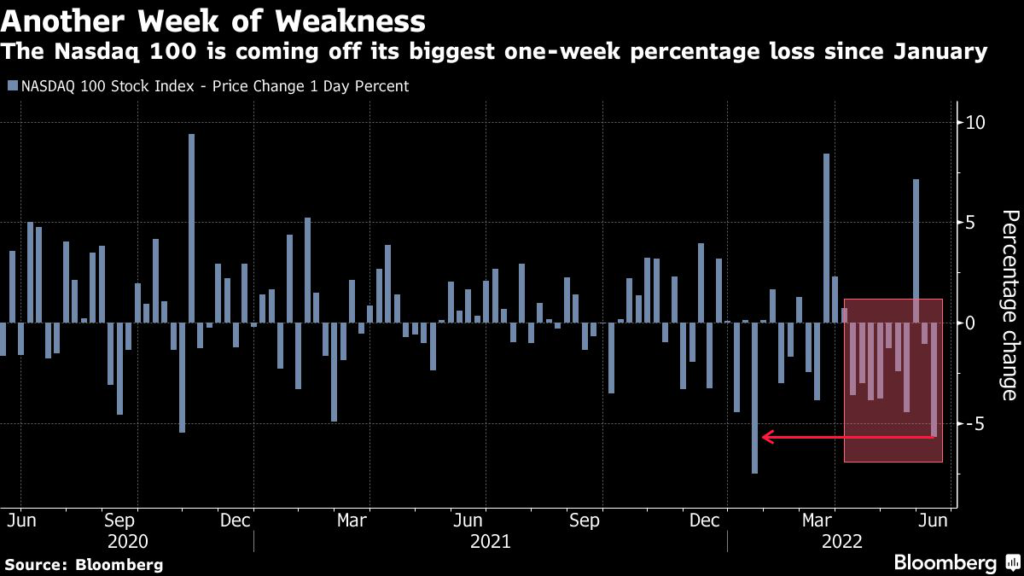
The weakness in big tech is showing no signs of stopping. The tech-heavy Nasdaq 100 Index fell 5.7% last week, its biggest one-week drop since January, as well as its ninth negative week of the past 10. Much of the slump came in Friday’s session, when a higher-than-expected reading on inflation sparked a broad-based decline, taking the index down more than 3.5%.

Top Tech Stories

  • Crypto lender Celsius Network Ltd. paused withdrawals, swaps and transfers on its platform, fueling a broad cryptocurrency selloff and prompting a competitor to announce a potential bid for its assets.
  • When Shutterfly decided recently to move the database where it clusters reams of customer photos to the cloud, one name was noticeably absent from its list of potential providers: Oracle Corp. Businesses are opting to align with newer providers such as MongoDB Inc., Databricks Inc. and Snowflake Inc. instead of Oracle, the sector stalwart, as a result of changes across the enterprise technology landscape.
  • For the past quarter century, the meteoric rise of the digital economy has been exempt from the kind of tariffs that apply to trade in physical goods. That era may come to a screeching halt this week as a handful of nations threaten to scrap an international ban on digital duties in a game-changing bid to draw more revenue from the global e-commerce market.
  • Contemporary Amperex Technology Co. Ltd., the world’s biggest maker of batteries for electric cars, has kicked off an A-share private placement that could raise about 45 billion yuan ($6.7 billion), according to terms of the deal seen by Bloomberg News.
  • Changpeng Zhao, co-founder and chief executive officer of the world’s biggest crypto exchange, thinks the crypto winter is a great time to increase investment in talent and acquisitions.
  • Blake Lemoine, a software engineer on Google’s artificial intelligence development team, has gone public with claims of encountering “sentient” AI on the company’s servers after he was suspended for sharing confidential information about the project with third parties.
  • A Chinese education company staged a meteoric stock-market rally of as much as 100% Monday as the company’s endeavors into livestreaming e-commerce went viral.
  • French billionaire Patrick Drahi is mulling his next steps with BT Group Plc as UK rules that prevent him from launching a takeover offer expire on Tuesday.

(Updates to market open.)

More stories like this are available on bloomberg.com

©2022 Bloomberg L.P.

Video Game Studios Embrace Transparent Pay to Battle Wage Discrimination

(Bloomberg) — Siobhan Beeman, a video game programmer, was recently preparing to leave a job when she mentioned to a co-worker what she had been getting paid. “Wow,” the co-worker said, by Beeman’s recollection. “You’re making less money than me.”

The colleague, who didn’t have as much experience as Beeman and whose title was one notch lower, was getting paid $15,000 more a year, Beeman said. So when she was interviewing for a new job earlier this year at an independent game developer called Gardens, Beeman was thrilled to hear that the company had a transparent salary policy.

Gardens was founded last year by experienced developers who had worked previously on high-profile games such as Marvel’s Spider-Man and The Elder Scrolls V: Skyrim, with the mission to create a more humane, healthier work environment than many other game companies. While it may not be able to compete with bigger studios in prestige or job security, Gardens is betting that its approach, including fair and transparent pay, will be a draw for talent. It was for Beeman. 

“There’s that security of knowing you’re not leaving money on the table,” she said. “You’re not getting undervalued compared to other people doing the same job.”

Wage discrepancy has become a major issue among video game workers in recent years, part of a broader reckoning over working conditions throughout an industry notorious for long hours and allegations of sexism and discrimination against women. In the UK, which requires companies to report their gender pay gaps, men at game companies were making 17.1% more than women in 2021, according to Gamesindustry.biz. That’s more than double the median pay gap across all professions in the country.

In the US, California’s Department of Fair Employment and Housing sued the video game publisher Activision Blizzard Inc. last year for sexual misconduct and discrimination, including unfair pay. League of Legends developer Riot Games agreed to a $100 million settlement in a similar case, and a former PlayStation employee sued the company alleging gender pay discrimination and wrongful termination after she spoke up about the issue. Activision says it’s working to make its workplace culture more inclusive, and has recently named more women to the board, and Riot said at the time of the settlement that it has improved its culture in recent years. Sony Group Corp. denied the allegations in the case. Read more about how pay transparency in tech could reduce racial and gender inequities

For decades, sharing or talking about salaries was considered taboo, and for many workers it can still feel uncomfortable. But in the last few years, 17 states and municipalities have enacted some form of salary transparency laws, including New York, which will mandate later this year that job listings include salary ranges. David Turetsky, vice president of consulting at Salary.com, said those regulations have encouraged more companies to be open about pay, which he said will help them recruit and retain staff. “The market is best run when everybody has full information,” he said.

Stephen Bell, a co-founder of Gardens, said employees have been very receptive to having open wages. “Not only was a push for pay equity right and fair,” he said, “it really helped attract amazing talent that had wanted to see this kind of change happen, and it helped us stand out a bit.”

It’s unlikely that big video game companies such as Activision — whose Chief Executive Officer, Bobby Kotick, took home almost $300 million of stock last year from a set of old equity awards — and Electronic Arts Inc. will be quick to adopt similar policies. But pay transparency is becoming popular among smaller game companies that are often founded by former workers of the gaming giants who say they want to do things better.

Lightforge Games, an independent game studio launched in 2020 by former Blizzard and Epic Games Inc. employees, implemented a transparent salary policy during its early days. Every role and level at the company is now standardized, with a specific number attached to it, and an internal spreadsheet with everyone’s salaries is accessible to anyone who works there.

“I think it helps crowdsource accountability to the whole company,” said CEO Matt Schembari. “It definitely makes some conversations harder, but that’s kind of the point.”

Schembari said he thinks most, if not all, of his employees feel good about working for a company where salaries are open and fair. He said that even those who have taken pay cuts to join Lightforge “express relief to know that we’re doing the right thing, that they’re part of an equitable organization.”

Disbelief, an outsourcing company that provides technical support for big video game franchises like Borderlands and Gears of War, was one of the first gaming studios to offer transparent salaries. When it announced in 2018 that every title would correspond to one specific, open salary, the firm saw a huge jump in applications. Steve Anichini, co-founder and chief technology officer, said that in four years of following the practice, he hasn’t seen any downside. “Honestly, I can’t think of a single time anyone’s brought it up as a problem,” he said.

Anichini said other gaming companies have begun to show interest in following a similar model. “Any time studio heads are curious about it, I set aside some time to talk to them,” he said. “I think the industry would be better if more people did this.”

If there’s a potential negative to the practice, it’s that companies may find it more difficult to be competitive in luring top talent. Some companies use bonuses or flexible pay tiers to account for that. Others don’t think it will be a significant hindrance. “My personal feeling is that if you’re trying to maximize personal income at all cost, I don’t know that you’re in the games industry to begin with,” said Anichini.

At first, some employees say it can be uncomfortable for everyone to see one another’s salaries, but soon it begins feeling like the norm. Chris Wood, founder of the UK-based video game outsourcing firm Tanglewood Games, said his company began implementing the practice in March. Although they’re still tweaking the numbers and figuring out what kind of salary tiers make the most sense, so far the experiment has been successful, he said.

“Our company is run by programmers,” Wood said. “We’ve worked for places where these things are very much not talked about, and we’ve worked for places where they’re a little bit more open. We definitely favor the openness.”

More stories like this are available on bloomberg.com

©2022 Bloomberg L.P.
Close Bitnami banner
Bitnami