

Bloomberg

China Approves More Games in a Step Toward Normalization

(Bloomberg) — China approved its second batch of games this year following a months-long freeze, in a step toward normalization in the world’s largest mobile entertainment arena.

The approval of 60 new titles by the National Press and Publication Administration marks an acceleration from April’s 45 and include entries from studios like Genshin Impact creator MiHoYo Co. China’s two powerhouse games publishers, Tencent Holdings Ltd. and NetEase Inc., were absent from both lists, but analysts see their prospects for approval improving as well.

Shares of Tencent and Netease rose more than 3% on Wednesday, amid a broader surge in Chinese tech stocks. Live-streaming platform Kuaishou Technology jumped 5.8%.

“We are delighted to see established studios such as Perfect World, Shengqu Games, MiHoYo, and Changyou obtained approval titles this time, which we believe could indicate higher possibilities for Tencent’s and NetEase’s titles to be approved in coming batches,” Citi analysts wrote in a note to investors. “The approval announcement will also send positive signal of policy support to the overall China Internet sector.”

Jefferies analysts including Thomas Chong also list China’s big two among the likely beneficiaries from the latest approval, along with live-streaming platforms like Kuaishou and Tencent-backed Huya and Douyu. The gap between the two batches of approved games came after an upsurge in Covid-19 infections and lockdowns in the country over the past few weeks.

China Ends Game Freeze by Approving First Titles Since July

Beijing’s tech crackdown — which has ensnared sectors from e-commerce to fintech and even online education — spread to online gaming in August, when regulators introduced stringent measures capping play time for minors and imposed new requirements aimed at curbing addiction. The media watchdog has also been reviewing new titles to determine whether they meet stricter criteria on content and child protection, slowing rollouts, Bloomberg News has reported.

The faster pace in game approvals comes on the heels of a report this week that said China was preparing to allow Didi Global Inc.’s apps back on domestic app stores after concluding a probe into the ride-hailing giant’s operations. The news bolstered Chinese tech stocks on broader hopes of easing in regulatory oversight.

(Updates with share price in graph 3)

More stories like this are available on bloomberg.com

©2022 Bloomberg L.P.
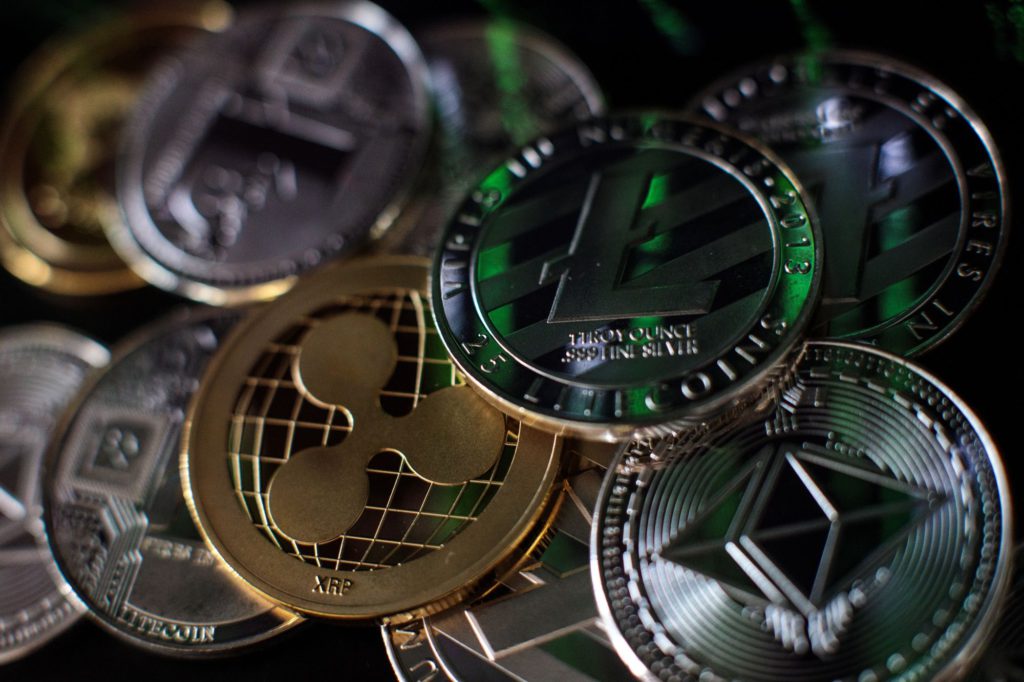
Japan Crypto Exchanges May Scrap System for Screening Tokens

(Bloomberg) — The body that governs Japan’s cryptocurrency exchanges is in talks to abolish strict rules for listing digital tokens after Prime Minister Fumio Kishida’s administration expressed discontent with the existing system.

The Japan Virtual and Crypto assets Exchange Association, which oversees digital coin listings, has held discussions about letting local exchanges list cryptocurrencies without going through its screening process, according to people with knowledge of the matter. 

In a shift from its current stance, the self-regulatory body would focus on policing the assets once they are listed instead of being involved in the listing process, the people said, asking not to be identified because the talks are private. It’s also looking at whether member exchanges should be forced to delist digital tokens should problems arise after they start trading, they said.

An easing of the rules would mark a dramatic liberalization for Japan’s market for cryptocurrency trading and could be a potential boost for foreign newcomers like Coinbase Global Inc. that have broader knowledge of tokens than local firms. The US company offers more than 100 coins at home, compared with GMO Coin Inc. — one of Japan’s largest crypto firms — which has 21 cryptocurrencies listed.

The new measures wouldn’t apply to initial coin offerings, the people said. The JVCEA aims to make a final decision on whether to change the rules by the end of the year, they said. 

‘Protecting Users’

In May, a government panel on which Kishida sits criticized the listing process for coins, saying “the certified self-regulatory organization tends to spend a long-time pre-screening” crypto assets and that it would “ease the criteria while being mindful of the need to protect users.”

An FSA official who asked not to be identified due to the agency’s policy said the regulator is aware the JVCEA is discussing a response to Kishida administration’s call for a simpler screening process, but that it’s not clear what recommendations it will come up with and whether the FSA will approve them. A representative for JVCEA wasn’t immediately available to comment.

A legal requirement for crypto exchanges to report any plans to list new tokens to the regulator will likely remain even if the screening process gets dropped, a person with knowledge of the matter said.

Earlier this year, the JVCEA introduced a greenlist of cryptocurrencies that member exchanges could list in one go. Before then, a token listing often had to go through a screening process that could take six months or longer, causing some companies to complain that it was hurting growth, the people said.

The current process for approving new listings applies to coins that are not on the JVCEA’s greenlist, large or small, although the organization has been working to shorten the time it spends on screenings, according to the people. 

More stories like this are available on bloomberg.com

©2022 Bloomberg L.P.
SGX-Backed ADDX Allows Investors to Use Crypto to Gain Access

(Bloomberg) — Private-market exchange ADDX will now recognize some cryptocurrency holdings from investors seeking to gain access to its platform, amid what it sees as record levels of crypto ownership around the world.  

ADDX will start acknowledging three coins — Bitcoin and Ether at a 50% discount rate, as well as USDC at a 10% discount rate — as part of its process for verifying so-called accredited investors, according to a statement from the firm on Wednesday. The coins and discount rates will be reviewed at regular intervals and may be revised as conditions change, said ADDX, that counts the likes of the Singapore Exchange Ltd. and United Overseas Bank Ltd. as shareholders.

“Cryptocurrencies are here to stay. They no longer exist only on the fringes of wealth and investment conversations,” ADDX’s Chief Executive Officer Oi-Yee Choo said. “It is reasonable for these digital assets to be recognized as a part of one’s portfolio — not unlike any other assets that can be valued in the marketplace, such as real estate or equity.” 

Cryptocurrency adoption has grown worldwide, though prices of Bitcoin, Ether and many altcoins have struggled in the past few months as the Federal Reserve hikes rates and riskier assets have tumbled. ADDX’s move within Singapore also comes as top officials in the country repeatedly warn retail investors they should avoid trading digital assets. 

Under the city-state’s regulatory regime, individuals have to meet one of three criteria to qualify as accredited investors. For example, they must have more than S$300,000 ($218,181) of income over the past 12 months, net financial assets over S$1 million, or net personal assets topping S$2 million. Crypto assets can be recognized under the third category of net personal assets.  

In future, “we are likely to enable customers to fund their investment wallets with cryptocurrencies and to convert their assets between fiat currencies and crypto,” Choo said.

More stories like this are available on bloomberg.com

©2022 Bloomberg L.P.

Solana Ventures Raises Fund to Help Battered Korean Crypto Scene

(Bloomberg) — Solana Ventures and the Solana Foundation said Tuesday that they’ve launched a $100 million investment and grant fund to support crypto projects in South Korea, a country whose digital-currency scene has been ravaged by the collapse of the Terra blockchain that had operations there.

The fund is mainly meant to help projects in the country based on Solana. But it will also support crypto projects based on Terra that were stranded by the blockchain’s collapse, according to Johnny B. Lee, general manager of games for the Solana Foundation. Some platforms once based on Terra are now migrating over to different blockchains like Solana.

“The developers did nothing really wrong, but they’re left in the lurch,” he said in an interview.

South Korea is also a hotbed for virtual gaming, an area of focus for the new fund, which will invest in nonfungible token and decentralized finance projects as well.

The fund could also help attract startups and developers to the struggling Solana blockchain, which has suffered a series of outages, include a more than four-hour incident earlier this month. Solana’s SOL token has been one of the hardest-hit cryptocurrencies during a market downturn for the industry, with its price falling 46% in May, according to a report from digital asset data firm CryptoCompare. 

These issues could weaken Solana’s pitch as a faster, cheaper alternative to Ethereum, which has been the blockchain of choice for many DeFi platforms. The Solana blockchain can handle up to 65,000 transactions per second, compared to Ethereum’s rate of about 15, according to blockchain analytics provider Nansen.

Solana has also been positioning itself as an ideal blockchain for gaming. Solana Ventures launched a $100 million gaming fund with crypto exchange FTX and Lightspeed Venture Partners in November, and a $150 million fund with gaming-focused firms Forte and Griffin Gaming Partners in December. Specialized marketplaces for gaming NFTs like Magic Eden and Fractal have also cropped up on Solana. 

But there’s been pushback against the use of blockchains and NFTs in gaming, with developers and players questioning whether these technologies actually improve their in-game experiences. Lee said this kind of hesitation is typical when it comes to changes in gaming, citing previous resistance to developments like mobile applications. 

“This is how the cycle of adoption and innovation works in the gaming industry,” Lee said. 

More stories like this are available on bloomberg.com

©2022 Bloomberg L.P.
BlockFi Looks to Raise New Cash at Reduced $1 Billion Valuation

(Bloomberg) — Crypto lending platform BlockFi Inc. is looking to raise new funding that would value the company at about $1 billion, according to people with knowledge of the plan. 

The firm may raise around $100 million, though the amount is still being finalized, said the people, who asked not to be identified because the transaction is private. BlockFi previously raised $350 million at a $3 billion valuation in March of last year. The company’s fundraising plans were first reported by crypto news outlet The Block.

The depressed valuation comes as crypto firms struggle to navigate a broad-based selloff in digital assets that’s spurring an industry-wide chill. Other crypto businesses like Gemini Trust Co. have laid off staff, while companies like Coinbase Global Inc., have frozen hiring and rescinded job offers. 

Bain Capital Ventures, DST Global, Castle Island Ventures and Peter Thiel’s Valar Ventures are expected to participate in the round, according to the people, who noted that investors remain upbeat about BlockFi’s prospects.

Still, it’s been a rocky road as of late for the company, which agreed to pay $100 million to the US Securities and Exchange Commission over allegations that it was selling its crypto lending product as an unregistered security.

A representative for BlockFi said that the company doesn’t comment on market rumors when reached for comment. Bain Capital Ventures, DST Global and Valar Ventures did not immediately respond to requests seeking comment, while Castle Island Ventures declined to comment.

The Information last year reported that BlockFi was seeking to raise funds at a valuation of $5 billion.

More stories like this are available on bloomberg.com

©2022 Bloomberg L.P.
Food-Delivery Billionaires See Fortunes Swoon as Pandemic Ebbs

(Bloomberg) — Early in the pandemic, as locked-down diners turned to ordering online, a new type of billionaire emerged: the food-delivery magnate. 

The three co-founders of San Francisco-based DoorDash Inc. each amassed fortunes of $2.5 billion or more. Jitse Groen, who started European rival Just Eat Takeaway.com, racked up a $1.5 billion fortune. 

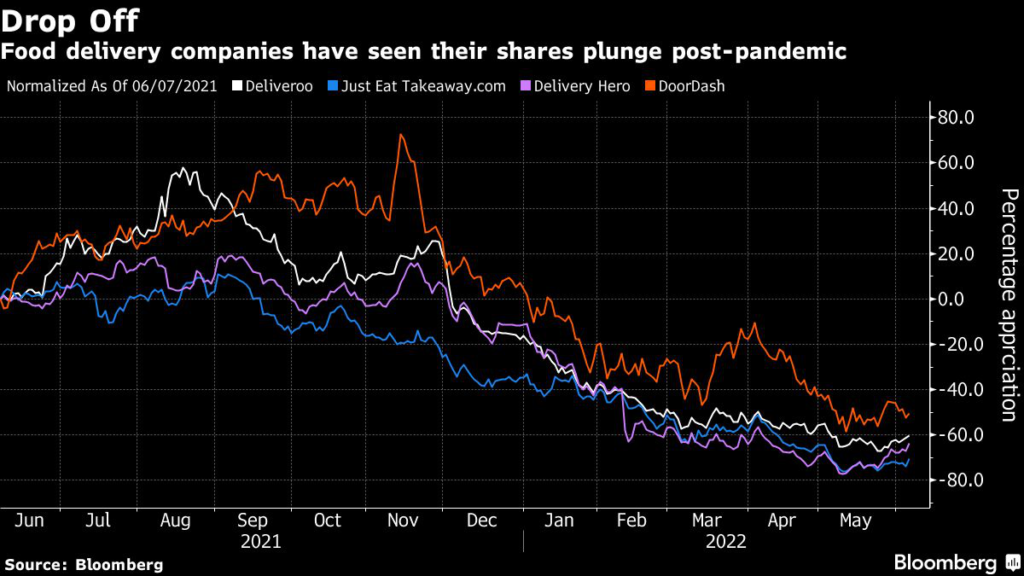
Those riches now seem like a mirage as the world returns to eating in restaurants rather than just ordering takeout, while technology stocks fall out of favor with investors amid a shifting macro environment. Groen’s stake has dropped to $350 million, while DoorDash’s Andy Fang and Stanley Tang are no longer billionaires, and Chief Executive Officer Tony Xu’s net worth has fallen to $1.1 billion, according to the Bloomberg Billionaires Index. Others also suffered massive wealth reversals, including Deliveroo Plc’s Will Shu, whose holdings in the company have declined to about $150 million from $620 million in August.

“The end of lockdowns has shown us the limits of food delivery,” said Mott Smith, the CEO of Amped Kitchens, which rents kitchen space. 

After notching huge gains in 2020 and much of last year, the slump in share prices of large food delivery firms has been swift and relentless, wiping out more than $100 billion of market value. And while most are still managing to increase revenue, that growth has leveled off sharply from the 2020 surge.

A recent market downturn as well as persistent inflation are also eroding consumers’ savings, cutting into the amount of money that people can afford to spend on ordering in. Fast-growing technology stocks have widely plummeted, with growth expectations dropping amid rising interest rates and fears of a prolonged slowdown.

“The bottom is too tough to call,” said Diana Gomes, an analyst at Bloomberg Intelligence. “The sector never experienced such a combination of high inflation and uncertainty on what level of demand constitutes the new normal.”

The focus has now shifted to cost-cutting for some, with investors pressing companies to generate cash rather than spending to grow market share. Just Eat’s shares rose 12% following a report this week that Grubhub founder Matt Maloney had considered buying back the US business just a year after selling it to Just Eat for $7.3 billion. 

To be sure, the scale-back is not across the board as lockdown ordering habits show signs of sticking. DoorDash is hiring employees at “still very aggressive rates,” Xu said on a May conference call.

Read more: Pressure Builds on Just Eat’s Board After $16 Million Ski Trip

Representatives for DoorDash, Just Eat and Deliveroo declined to comment. 

The founders’ wealth was years in the making and then exploded seemingly overnight. Xu and his two partners came up with the inspiration for DoorDash while they were students at Stanford University. Groen was also a student — at the University of Twente in the Netherlands — when he created Just Eat’s predecessor in 2000. And Shu had recently finished business school at Wharton before founding Deliveroo in London in 2013, though he did have some experience as a banker. 

Before the pandemic, the growth of food delivery firms seemed limitless. When DoorDash went public in December 2020, its shares rocketed 92% in one of the biggest first-day jumps of the year.

DoorDash’s co-founders have started moving some of that wealth into the bank. Xu, Fang and Tang have sold more than $356 million in stock combined in the past 17 months, using pre-arranged trading programs, according to Bloomberg calculations.

Many of the food delivery companies that enjoyed the biggest run-up in prices — and subsequently the biggest collapses — are based in Europe, which isn’t known for its culture of food delivery. It now risks a more precipitous return to normal. 

“This was a uniquely American phenomenon that spread to the whole world for a moment in time,” said Usha Haley, a business professor at Wichita State University.

These founders have now experienced another aspect of American life: Not all get-rich-quick billionaires manage to hang onto their fortunes.

(Updates throughout with more context.)

More stories like this are available on bloomberg.com

©2022 Bloomberg L.P.
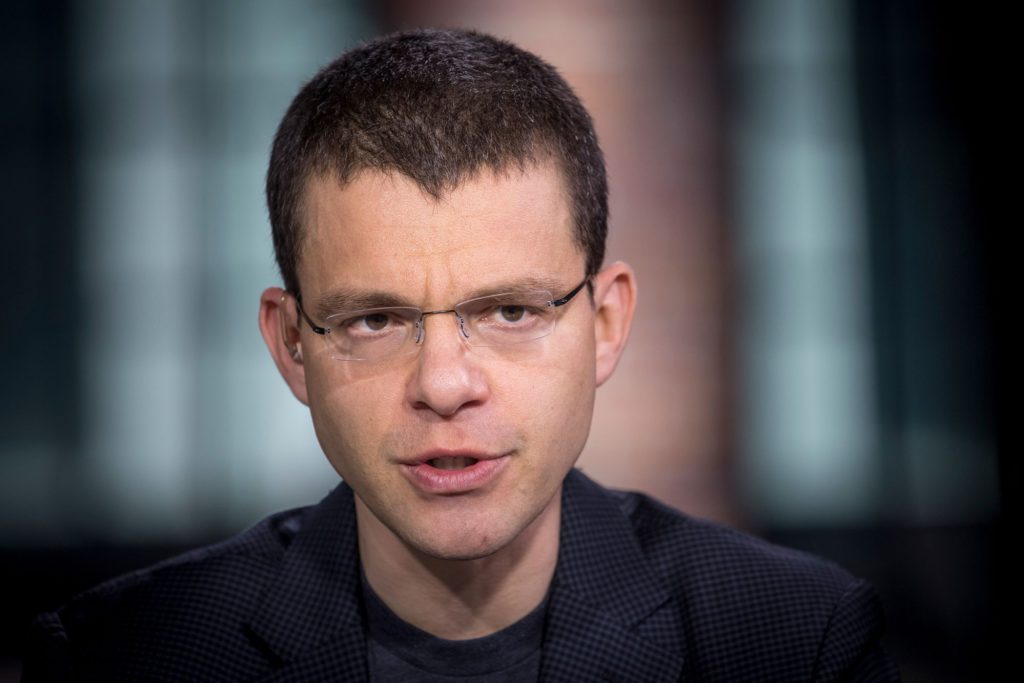
Affirm CEO Says He’s Not Worried About Apple’s Pay Later Rival

(Bloomberg) — Affirm Holdings Inc. Chief Executive Officer Max Levchin said he’s not worried about Apple Inc.’s upcoming buy now, pay later service, because his company offers more extensive and longer-term plans.

“I don’t think there’s much concern,” Levchin said Tuesday in an interview on Bloomberg Television. “There’s a lot of room for growth for all involved.” Buy now, pay later is used for fewer than 5% of US transactions, he said. 

Affirm offers lending plans from six weeks to 60 months, compared with Apple’s plan to split up Apple Pay purchases over four payments across six weeks, Levchin said. The Apple service “creates a really nice tailwind for us” by informing more people about buy now, pay later services, he said.

Apple Pay Later was unveiled Monday at the company’s annual Worldwide Developers Conference. Unlike other buy now, pay later platforms, the service is integrated directly into the iPhone’s Wallet app, which comes installed on every new iPhone.

Another Affirm competitor, Klarna, recently announced plans to eliminate 10% of its staff. By contrast, Levchin says Affirm is continuing to hire engineers. “We’re gearing up for time to shine for growth,” he said.

Apple’s plans could present a challenge for competitors focused on short-term lending, Levchin said. 

While Apple has announced only the short-term plan, it is also working on additional financial products, including long-term plans called Apple Pay Monthly Installments that could eventually rival Affirm. 

More stories like this are available on bloomberg.com

©2022 Bloomberg L.P.

Chinese Carmaker Joins SpaceX in Low-Earth-Orbit Satellite Race

(Bloomberg) — A company controlled by one of China’s top carmakers just put its first satellites into space. But Geespace, a unit of China’s Geely automotive empire, says its ambitions are more modest than Elon Musk’s plans for Space Exploration Technologies Corp.

Nine of the Zhejiang Geely Holding Group Co. subsidiary’s satellites began circling the planet last week after being placed in orbit by a Chinese government rocket. That makes it one of the first Chinese companies to begin assembling the sort of satellite constellations pioneered by Musk’s SpaceX, which already has more than 2,000 in orbit.

“Both of us have a car-manufacturing background and we hope aerospace technology and satellites can feed back to car manufacturing and travel,” Geespace Chief Executive Officer Tony Wang said in an interview Tuesday. “The difference is our goals in making satellites.”

SpaceX is sending its Starlink satellites into orbit to build an internet-service constellation to work as a low-cost alternative to remote land-based systems that are vulnerable to interruption. The Hawthorne, California-based company also launches rockets for global satellite operators, the U.S. military and NASA. 

Headquartered in Shanghai, Geespace has more modest ambitions, with plans to deploy a much smaller network to help Geely and other companies access and transmit data for autonomous driving. Geespace expects to have 72 satellites by the end of 2025, Wang said, and 168 by the end of the decade.

“We want to provide users with the ultimate travel experience while SpaceX focuses more on access to low-latency broadband to provide high-speed broadband access for 7 billion people in the world,” he said. 

Geely owns several car brands in China as well as Sweden-based Volvo Car AB, electric-vehicle maker Polestar and British carmaker Group Lotus Plc. The group’s billionaire founder and chairman Li Shufu also owns nearly 10% of Mercedes-Benz Group AG.

The Geespace launch comes at a time when China is ramping up efforts to compete with the US to be a space power.  

China’s space agency has several missions planned this year to complete work on Tiangong, a space station that Beijing first started after the US prevented it from taking part in the International Space Station. A Chinese spacecraft carrying three astronauts took off for a mission to work on Tiangong on June 5.

Geespace is following the lead of Chinese rival GalaxySpace, which had six satellites enter orbit in March. Weighing an average of 190 kilograms (420 pounds), those were China’s first entrants in efforts to develop constellations in low-Earth orbit, state media reported. 

“China’s constellation is small compared with Starlink,” the Global Times newspaper said in a report on the launch, adding that the country “is ramping up efforts to promote the application and transfer of space technology in the next five years.”

Geespace intends on doing its part, making its network open to other brands, about which more information will be revealed within three months, Wang said.

“Geely’s future collaboration partners will not be limited to Geely’s ecosystems and car brands,” he said. “We are also building up partnerships with other industries.”

More stories like this are available on bloomberg.com

©2022 Bloomberg L.P.
Citadel Securities, Virtu Build Crypto Plan With Brokerages

(Bloomberg) — Citadel Securities and Virtu Financial Inc. are building a cryptocurrency trading platform along with retail brokerages Fidelity Investments and Charles Schwab Corp. 

The market makers are developing a crypto offering with help from Fidelity and Schwab that would increase access to digital assets, according to people familiar with the matter, who asked not to be identified discussing the private plans. The product, still in its early development, could be available late this year or early next, the people said. 

Representatives for Citadel Securities and Virtu declined to comment. 

This would be the first big crypto push from Citadel Securities and Virtu, dominant trading firms in traditional markets like equities and exchange traded funds. Other market makers like Jump Trading and Jane Street are already active in crypto with venture investments and trading capabilities. 

Susan Coburn, a spokeswoman for Fidelity, said the brokerage firm “supports efforts within the industry that provide optionality to source liquidity for our clients.” 

Schwab “has made a minority, passive strategic investment in a new digital asset venture,” spokeswoman Mayura Hooper said in an emailed statement. “We know there is significant interest in this cryptocurrency space and we will look to invest in firms and technologies working to offer access with a strong regulatory focus and in a secure environment.” 

The brokerage firm doesn’t have plans to offer direct crypto trading at this point, but “will consider introducing direct access to cryptocurrencies when there is further regulatory clarity,” Hooper said. 

Plans could change based on the regulatory landscape and future market conditions, the people said. Aspects of Citadel Securities and Virtu’s efforts were earlier reported by CoinDesk. 

Investors buying crypto typically use crypto exchanges such as FTX Trading Ltd., Coinbase Global Inc. or brokerage apps like Robinhood Markets Inc. Citadel Securities founder Ken Griffin has said the company plans to make markets in crypto, without providing a specific timeline. 

Earlier this year, Fidelity said it will have a product ready in the coming months to allow 401(k) plan participants to direct a portion of their savings into bitcoin. The brokerage firm first entered crypto in 2018, with its subsidiary Fidelity Digital Assets, which allows customers like hedge funds, family offices and other institutions to trade and store virtual currencies.

Schwab Chief Executive Officer Walt Bettinger has also expressed interest in crypto. In a January interview, he called crypto “hard to ignore,” saying “there’s a tremendous void in that space today for a firm like Schwab.”

(Updates with context, Schwab CEO starting in fourth paragraph.)

More stories like this are available on bloomberg.com

©2022 Bloomberg L.P.
Cybersecurity Groups Push US to Boost Collaboration on Hacks

(Bloomberg) — Business leaders and cybersecurity experts are pushing the Biden administration to step up efforts to quell big hacks against US companies. 

In a joint statement to be issued Tuesday, several of the groups said a public-private initiative created by the US Cybersecurity and Infrastructure Security Agency, known as CISA, 10 months ago needs to grow and increase its “reach and impact.” That initiative, called the Joint Cyber Defense Collaborative, is intended to lead cybersecurity defense and crisis planning, as well as information sharing between the government and private sector.

The groups are calling on the JCDC, whose government members include the National Security Agency and FBI, to help anticipate and plan for the top five potential digital attacks in the wake of Russia’s invasion of Ukraine. The groups also want to increase “collective understanding” of cyber threats and work with lawmakers to improve regulations they say hamper effective cyber defense.

“We don’t have sufficiently thoughtful game plans for dealing with national security-grade attacks against our critical infrastructure and economic functioning,” said Greg Rattray, a former director for cybersecurity in the White House. He is now executive director of the Multilateral Cyber Action Committee, which was formed by former government officials and business leaders last year after a spate of egregious breaches in the energy, health and communications sector. The committee is spearheading the push to increase collaboration between government and business to improve the nation’s cyber readiness.

Eric Goldstein, executive assistant director for cybersecurity at CISA, said the JCDC “looked forward to working with an expanding breadth of partners,” and he added that it had “pioneered” a new model of collaboration between government and business.

The JCDC partnership model was “evolving,” he said, adding that it was helping to reduce the nation’s cyber risk.

Michael Daniel, a former Obama administration cyber official who now leads the Cyber Threat Alliance, which is signing onto Tuesday’s joint statement, said the JCDC was a good initiative that needed to “double down” so it could work at scale. He suggested hubs for specific sectors could be helpful, arranged in “concentric, overlapping circles.” 

Art Coviello, former executive chairman at RSA Security, who helped create the Multilateral Cyber Action Committee, said the JCDC should expand from about 25 businesses, mostly cybersecurity and tech companies, to 2,500. 

Avril Haines, the top US intelligence official, said at a conference on Monday that cybersecurity “is getting harder.” She said the government must find better ways to collaborate with business, including real-time information sharing about threats, saying that despite improvement there was “enormous work to be done.”


More stories like this are available on bloomberg.com

©2022 Bloomberg L.P.

Close Bitnami banner
Bitnami
