Bloomberg

China Tech Shares Rally as Game Approvals Raise Hope of Recovery

(Bloomberg) — A slew of China video game approvals is giving stock bulls renewed hope that a nascent rebound in tech shares could become a sustainable rally.

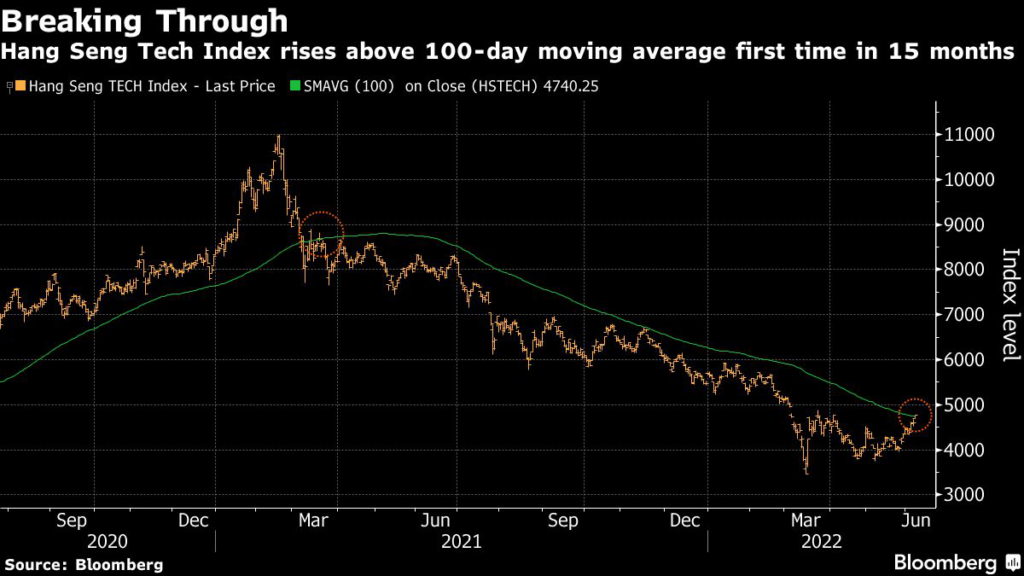
The Hang Seng Tech Index jumped more than 4% Wednesday after the government approved 60 licenses, bolstering bets that a year-long crackdown that wiped out $2 trillion in market value from the sector was nearing its end. The gauge pushed further away from its recent downtrend and climbed above a key moving average for the first time in 15 months.

The gaming approvals come on the heels of a report this week that China is wrapping up its investigation into Didi Global Inc. — a major flashpoint in Beijing’s move to curb the power and influence of the nation’s largest companies. To some investors that suggests a marked turnaround in a sector that until recently had been considered uninvestable. 

Alibaba Group Holding Ltd. and Bilibili Inc. led the rally, surging by as much as 11% and 19%, respectively. The buying frenzy also lifted shares of Tencent Holdings Ltd. and NetEase Inc., despite the companies being absent from the approval list.

“I think the market is still excited about the potential restore of Didi on Apps stores and feels a bit risk-on sentiment,” said Willer Chen, an analyst at Forsyth Barr Asia Ltd. “The newest batch of gaming license approval, though Tencent and NetEase are not on the list, is also good news.”  

Beijing’s wide-ranging tech crackdown spread to online gaming last summer when regulators introduced stringent measures to curb addiction. China’s entertainment regulator on Tuesday approved licenses for 60 new games in what is seen as a step towards policy normalization. 

China Approves More Games in a Step Toward Normalization 

All Encompassing

From the sudden scuttling of Ant Group’s IPO in late 2020 to sweeping reforms for online tutoring firms last summer to a shake up of Macau casinos, Beijing’s hallmark crackdown on the private sector has forced a rethink of not just where but whether investors should put their money in the world’s second-largest economy. 

Reforms have landed most heavily on tech companies, with nearly $2 trillion of market value wiped out since a 2021 peak. While the Hang Seng Tech gauge has risen almost 40% from its mid-March low, it remains more than 50% below its 2021 high.

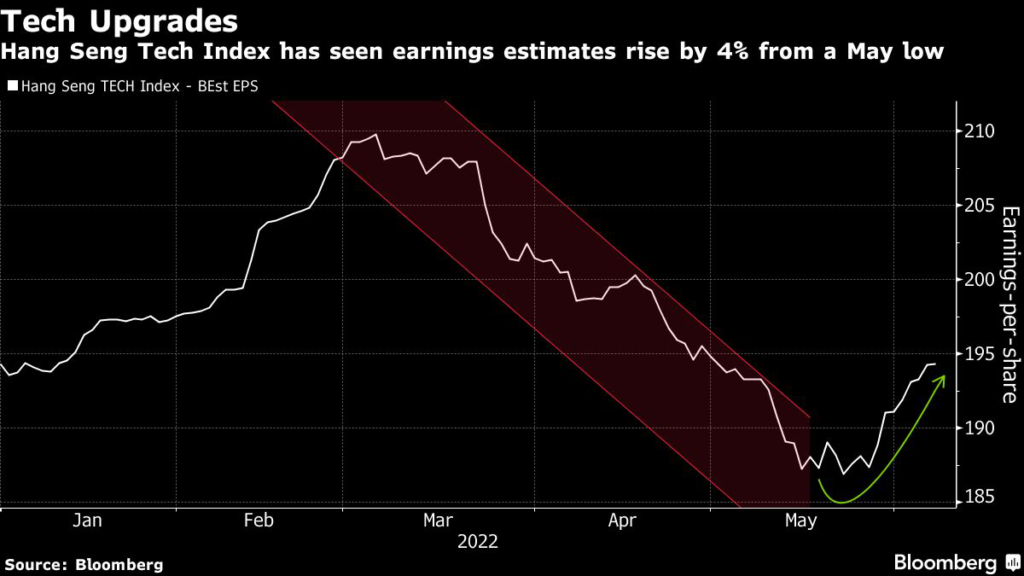
The outlook looks a bit brighter this time around. Forward earnings estimates for companies on the sector benchmark have risen by about 4% from a low in May after slumping nearly 11% from a peak in March, according to data compiled by Bloomberg.

Still, much will depend on the path of the economy, with China’s strict Covid Zero policy leaving the specter of future lockdowns hanging. Investors that have repeatedly been burned by buy tech shares on the dip are still waiting for more actions from Beijing after a March promise from China’s top economic official — Vice Premier Liu He — that a sweeping crackdown on internet companies was nearing an end. 

“When the economy is struggling, the tightenings will take a break and the policy will become more pro-growth,” Winnie Wu, China equity strategist at BofA Securities, said in a Bloomberg TV interview. “So during those times we could see a strong trading rally of the internet sector in general, because they remain to be some of the largest, most liquid stocks that investors are familiar with.”

(Updates throughout)

More stories like this are available on bloomberg.com

©2022 Bloomberg L.P.

Australian Chinese News Site Hit by Cyber Attack, Media Reports

(Bloomberg) — One of Australia’s largest Chinese-language media platforms came under cyber attack early in the hours of June 4, potentially putting users’ information at risk, The Australian newspaper reported Wednesday.

On Saturday morning, users of the news organization Media Today received authentication texts to their mobile phones after more than 20 million attempts were made to reset user passwords, the paper reported, citing a statement from the company. It was expected that 110,000 users would receive the verification codes, it said.

The company said the cyber attack took place between 1 a.m. and 8 a.m. on June 4, according to The Australian.

“The attack originated from IP addresses in the US, Canada and Hong Kong and was executed against the platform’s registration system, attempting to use SMS verification codes to obtain user passwords and steal their accounts,” the firm was reported as saying.

Media Today claims to have more than 2000,000 daily users in Australia, through its website and its application Australia Today. It said that no users’ personal information was leaked as a result of the attack, which had been reported to the police, The Australian reported.

June 4 is a significant date for the Chinese diaspora, marking the anniversary of the 1989 massacre of pro-democracy protesters in Beijing and other cities across China by the country’s military. Commemorations of the June 4 killings are heavily censored in China, including on state-run media and social media applications.

More stories like this are available on bloomberg.com

©2022 Bloomberg L.P.

South Korea Eyes Guidelines for Crypto Bourses After Terra Crash

(Bloomberg) — South Korean policymakers are pushing the country’s cryptocurrency exchanges to come up with industry guidelines for listing and delisting digital tokens, in a bid to protect the public after the collapse of the TerraUSD stablecoin.

Yun Chang-hyun, a lawmaker who heads the ruling party’s virtual assets committee, has called a second meeting with bourses Upbit, Bithumb, Coinone, Korbit and Gopax for next week, he said in an interview. The aim is to agree on a draft of the non-binding guidelines, he said. The country would employ a self-regulatory system, like Japan does. 

“There are a lot of shortcomings compared with traditional finance,” Yun said by phone. Crypto “was neglected for too long without order and discipline.”

The move comes after the high-profile implosion of algorithmic stablecoin TerraUSD last month. Around $40 billion in market value was erased globally for holders of TerraUSD and its sister coin Luna when TerraUSD plunged far below its $1 peg. An estimated 280,000 South Koreans had invested in Luna, according to the Financial Services Commission, the country’s financial regulator.

Do Kwon and Daniel Shin, the co-founders of Terraform Labs, the company behind the two cryptocurrencies, were both born in South Korea. Terraform Labs was founded in 2018, according to its LinkedIn page. 

Global Push

South Korea joins governments around the world in pushing for more crypto oversight in the wake of the TerraUSD collapse. Much of the recent efforts have centered on ensuring that investors in stablecoins, a vital part of the cryptocurrency ecosystem, are better protected. 

Such tokens, which are typically pegged to an asset like the US dollar, have a combined market value of about $160 billion, according to CoinGecko. Yun said the TerraUSD failure underscores the need for better investor protections in crypto. 

Yun didn’t elaborate on the details of the draft guidelines. They’re likely to include stricter reporting requirements to provide transparency rather than a tightening of trading procedures, according to people familiar with the matter, who asked not to be identified discussing private information. 

Representatives for four of the five exchanges — which together account for almost 99% of cryptocurrency trading in South Korea — confirmed the meeting but said they weren’t aware of its agenda. The FSC said it knows about the gathering but was unable to comment on the plan. The exchanges would make the announcement if any guidelines were established, it said.

The ruling party held a first meeting with the five exchanges on May 24. 

Apart from the planned self-regulatory guidelines, the Korea Blockchain Association, an industry body, has been drawing up a draft manual on behalf of its 19 members setting out comprehensive guidelines for how to operate, said Yun Sung Han, its director. The association’s members include the five crypto exchanges, he said.

More stories like this are available on bloomberg.com

©2022 Bloomberg L.P.

China Tech Earnings Outlook Improves as Regulatory Tone Softens

(Bloomberg) — Earnings upgrades are adding to an improved outlook for China’s beaten-down technology stocks amid optimism that Beijing’s sweeping crackdown on the sector is finally beginning to ease.

The 12-month forward earnings estimate for companies on Hong Kong’s Hang Seng Tech Index, which carries bellwethers such as Tencent Holdings Ltd. and Alibaba Group Holding Ltd., has risen by about 4% from a low in May after dropping nearly 11% from a peak in March, according to data compiled by Bloomberg. 

The turnaround is notable for the sector, which has seen trillions of dollars in market value globally wiped out in the wake of Beijing’s more than yearlong crackdown on private enterprises in pursuit of “common prosperity”. 

A report that regulators are looking to end a probe on Didi Global Inc., which became the poster child of China’s regulatory wrath, and approvals of new video games show that policymakers are matching words with actions to support the sector. 

The outlook is also improving amid a string of better-than-expected results by internet giants including Alibaba, Baidu Inc. and Meituan.

More stories like this are available on bloomberg.com

©2022 Bloomberg L.P.

WTO Dysfunction Marks Turning Point to New Era of Trade Tensions

(Bloomberg) —

If you’re not seated at the table, you’re on the menu. 

That old saying about the cutthroat nature of trade negotiations will be put to the test next week when officials gather in Geneva for the first meeting of the World Trade Organization’s highest decision-making body in nearly five years.

The goal of the WTO’s 12th ministerial conference is to conclude small but symbolically important deals to show that the headquarters of rules-based globalization is still capable of rallying countries to act together to solve problems.

The WTO’s leader, Ngozi Okonjo-Iweala, has urged nations to conclude a handful of deliverables at the meeting, namely:

  • an agreement to curb harmful fishery subsidies
  • a framework to expand global access to vaccines
  • a package to help address the global food crisis
  • a renewal of the WTO’s ban on e-commerce duties and
  • a work program to improve the WTO’s functioning.

But the backdrop of these talks is marked with division and urgency. It will take place amid the simultaneous crises of surging inflation, war, disease and potential famine — when the need for collective action couldn’t be higher. 

“The current geopolitical situation shows that the WTO is needed, and provides the WTO with an important opportunity,” European Trade Commissioner Valdis Dombrovskis told parliamentarians last month. 

Global Fragmentation

While the WTO is no stranger to disappointment, any failure to reach agreements aimed at increasing vaccine production, averting a food crisis, or curbing overfishing will further cement the view that the WTO is no longer a viable forum to address the shortcomings of international commerce.

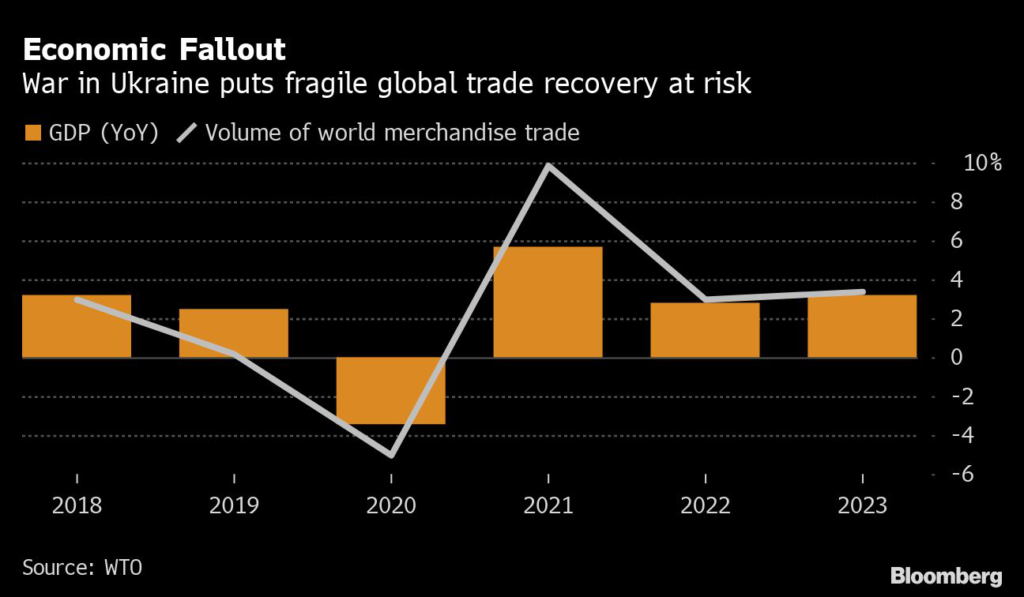
To be sure, a busted conference won’t be fatal to the WTO’s system of rules that govern more than $17 trillion worth of trade flows each year. But it could be the clearest sign yet that the world’s trading partners are redrawing allegiances along geopolitical lines — a new phase where might equals right and weak nations get trampled.

For some observers, this era began when the Trump administration raised tariffs on billions of dollars worth of goods shipped between America and its largest trade partners — namely China and the European Union. 

Then, during the pandemic, many nations pursued their own nationalistic tendencies, like prioritizing the sourcing of critical health products, food supplies and vaccines for their own citizens instead of sharing them for the greater good.

The latest turn came when Russian President Vladimir Putin’s military started a war in Ukraine, marking a paradigm shift: For the first time, one WTO member invaded another. 

Russia’s assault and the West’s sanctions have further disrupted the global economy by increasing the costs of doing business, pushing up the cost of living, and adding pressure to the world’s historically stressed supply chains. 

‘Friend-Shoring’

“Fragmentation is going to stay,” said Robert Koopman, the WTO’s chief economist. “What we’re going to see is this reorganized globalization, with this recognition that there are these additional costs around uncertainty.”

The trend isn’t entirely new, but events of the past few years have accelerated the move away from multilateralism toward regional blocs of influence.

Key examples in the trade world include the 11-nation Comprehensive and Progressive Agreement for a Trans-Pacific Partnership, the 15-nation Regional Comprehensive Economic Partnership, and the 54-nation African Continental Free Trade Area.

The US and others are pursuing an agenda of “friend-shoring,” which aims to shift manufacturing and trade flows away from authoritarian regimes like China and Russia, to countries that share the same economic and security concerns. 

WTO Irrelevance

In the face of all these sweeping changes, the WTO — an organization founded on the premise that trading nations don’t go to war with each other — is practically helpless.

Under Trump, the US paralyzed a key component of the WTO’s dispute settlement system, which has prevented nations from obtaining final trade justice and increased the risk of tit-for-tat trade wars. 

And the WTO’s consensus principle — whereby multilateral agreements must be approved by all 164 WTO members — is simply not working. 

“It is very difficult to agree to things multilaterally and that has been plaguing the WTO,” Okonjo-Iweala acknowledged during this year’s World Economic Forum. 

Many nations, India in particular, have found it to be more advantageous to block consensus WTO agreements in order to subsidize and protect their domestic industries. 

But India isn’t entirely to blame. The US, which was the original architect of the global trading system, “has not demonstrated a willingness to make the necessary investment in the WTO to revive it as a negotiating forum,” former WTO Deputy Director-General Alan Wolff wrote last month.

More stories like this are available on bloomberg.com

©2022 Bloomberg L.P.

Oatly-Backer Felix Capital Doubles Funds With $600 Million Raise

(Bloomberg) — Venture investor Felix Capital has raised its fourth fund of $600 million, giving it additional capital to deploy at a time when plunging technology valuations have some firms seeing attractive opportunities for deal-making. 

The closure of the latest fund doubles Felix’s total committed capital to more than $1.2 billion, and will be used to back companies across Europe and North America, according to a statement. London-based Felix Capital also plans to increase its investments in startups developing technologies around crypto-currencies and blockchains.

“As a firm focused around shifts in consumer behavior, we expect communities will evolve naturally on Web3 platforms to communicate and transact,” said Antoine Nussenbaum, a partner at Felix. “We want to play an early role in this journey.”

After launching in 2015, Felix Capital has backed companies including Oatly Group AB, Peloton Interactive Inc. and Deliveroo Plc. More recently it has invested in firms including former Meta Platforms Inc. executive David Marcus’s bitcoin payments startup Lightspark, and “Cocomelon” studio Moonbug Entertainment Ltd — which was acquired for $3 billion last November. 

Read more: ‘Cocomelon’ Studio Fetches $3 Billion in Blackstone-Backed Deal

“This environment — frankly, we welcome it,” said Felix Capital Managing Partner Frederic Court in an interview. “When we enter a cycle like this, typically things are slower but the vintage tends to be better.”

Felix Capital is also expanding its team to 13 staffers. In December, Felix appointed former Meta executive Julien Codorniou as a partner. 

More stories like this are available on bloomberg.com

©2022 Bloomberg L.P.

Vodafone’s Mobile Phones Were the Future Once. Now What Happens?

(Bloomberg) — At Vodafone Group Plc headquarters in west London, a sign hangs near the office of Chief Executive Officer Nick Read, telling passers-by: “It’s OK to make mistakes.”

Three-and-a-half years into his tenure as CEO, with activist investors and hedge funds on alert, 57-year-old Read deflects media reports of “pressure” and doesn’t actually admit to making any big mistakes himself. “My view is every FTSE CEO has pressure,” Read said in an interview with Bloomberg. “It just comes with the job.”

Read has worked at Vodafone for 21 of the company’s 38-year existence. Nevertheless, the middle-aged CEO of a middle-aged company says he wants to embrace tech-style risk, eschewing traditional telecoms caution in a bid to boost returns on capital.

Vodafone’s challenges are different, though, from those faced by Silicon Valley tech giants. Instead of pivoting to the metaverse, Read has been busy cutting costs, standardizing internal information technology systems and selling off units in New Zealand and Malta. He has also carved out and listed the group’s mobile masts operation, aiming to tap into high valuations for infrastructure and to pay down debt.

Vodafone was founded in 1984 and sees itself as a pioneer. Yet as it approaches its fifth decade, many of its stellar achievements are now reminders of a distant past. Its network carried the first cellular telephone call in the UK, on Jan. 1, 1985. The company then led the rollout of out text-message technology, and was quick to expand globally.

Its shares peaked during the dotcom boom, giving it a market capitalization of £214 billion in March 2000. Today they languish near 20-year lows, down 20% even since Read started as CEO in Oct. 2018. 

Vodafone spent the last decade retrenching and is now squeezed between former state monopolies like Deutsche Telekom AG, newer, price-cutting entrants such as Iliad SA, Big Tech and regulators. In the UK, key rival EE, owned by BT Group Plc, is making a return on capital, while Vodafone may not be, according to regulator Ofcom.

Against that backdrop activist investors and hedge funds are now stirring, with some implying that the company could find better leadership.

The only regret Read will admit to is that he did not move faster to standardize technology. He doesn’t regret speeches since November in which he outlined ambitions to strike deals in the UK, Italy, Spain and Portugal. That surprised even company insiders, who worried their CEO might be weakening Vodafone’s negotiating position, according to a person familiar with the discussions. 

Read’s speech increased expectations for operational mergers with rivals that could boost returns in Europe’s saturated and heavily regulated mobile telecoms industry. Seven months on, no deals have materialized — and the background noise is getting louder.

P. Schoenfeld Asset Management LP, a New York hedge fund, was quoted in the Financial Times in April criticizing management’s missed opportunities. Jupiter Corporate Bond Fund also called for faster deals. Cevian Capital AB, Europe’s biggest activist fund, has built an undisclosed stake in Vodafone and is keen to see deals and less centralization at the company, according to people familiar with the discussions. All three investors declined to comment.

Read remains unapologetic. “My view is a lot more about: Do you feel you have a clear vision of where you’re going?” he said. “Sometimes with media, you get a couple of hedge funds with very small positions being very noisy, because they’re event-driven,” he added. “So it’s in their interest to stoke up media.”

He clarified he wasn’t talking about Cevian: “To be fair to them, I have yet to see them quoted on anything.”

Hunting for Deals

Investors hope that regulators’ caution — which saw deals like Three’s bid for O2 blocked in the UK in 2016 — is now a thing of the past. The question is why Vodafone hasn’t already struck some deals. 

In February, it negotiated an agreement between Vodafone Espana with private-equity owned carrier Masmovil, according to two people familiar with the matter — only to see Masmovil and Orange SA announce a merger of their own days later, leaving Read on the sidelines. Vodafone and Masmovil declined to comment, and a representative for Orange didn’t respond to requests for comment.

Read also turned down an 11.3-billion euro February offer for Vodafone Italia from Iliad and Apax Partners, saying it wasn’t in shareholders’ interests. Talks with CK Hutchison Holdings Ltd about a deal with Three UK have yet to yield results. British landline provider TalkTalk Telecom Group Ltd is another option, but on a recent earnings call, Read implied that a UK mobile deal was a higher priority.

Read says top investors, such as Emirates Telecommunications Group Co. PJSC, now known as e&, are confident. Run by former colleague Hatem Dowidar, e& bought 9.8% of Vodafone shares in May and offered a full-throated endorsement. Abdrn plc, the company’s 8th-largest holder with 1.7%, also stands by Read. “We are supportive of Nick Read’s strategy and in favor of giving him time to execute on it,” said Andrew Millington, its head of UK equities.

Read is also working on other options. Buried in Vodafone’s full-year results presentation earlier this month was a new plan to spin out the company’s fast-growing internet-of-things business, now pulling in 900 million euros in revenue. The company also owns Africa’s huge mobile money service, M-Pesa, and has made heavy investment in 5G networks, which could underpin smart cities and factories.

Mr Sometimes-Nice

Read has other complaints to fend off. Centralization — of decision-making and technology — has left leaders outside of Vodafone’s UK headquarters less autonomous and accountable, three people familiar with the company said. That could make it harder for outsiders to break up the group, one suggested. Three years after an 18.4 billion-euro deal, Vodafone Deutschland — which makes as much profit as the rest of Read’s European units put together — has needed technology upgrades. Once again, though, there are no regrets.

“A very small minority of certain people have been trying to argue there’s complexity in our model,” Read said, saying that Vodafone’s model offers local autonomy with shared service centers. “We never use the word centralize.”

Read has occasionally shocked investors. In 2018, weeks into the CEO job, he pledged to keep the dividend, only to cut it six months later. A year ago shares plunged after Read announced unexpected network investments. The company also had to overhaul its board after Olaf Swantee, the former CEO of EE, lasted just two months.

A number of people familiar with Read’s management style described him as “nice,” calling him a good listener and a good leader. However, three people pointed fingers at his top team. They wondered whether Read has surrounded himself with the strongest talent.

Read said his executive committee is “excellent,” though he did also say that “some are asked to leave” across the business. “We’re a performance culture. So I am nice — to an extent.”

More stories like this are available on bloomberg.com

©2022 Bloomberg L.P.

China Trade Data to Show If Easing Virus Is Boosting Commodities

(Bloomberg) — Supply Lines is a daily newsletter that tracks disruptions in global trade. Sign up here.

China’s first batch of trade data for May is due Thursday and the numbers should give an indication of the extent to which an easing of virus outbreaks in the latter part of that month impacted commodities markets. 

Expectations for a revival in demand from the world’s biggest crude buyer is one of the main drivers boosting oil at the moment. The overall oil import numbers will be closely watched for any signs that refiners stocked up last month ahead of an anticipated rebound in consumption. 

A breakdown of imports by country won’t be released until later in June, however, meaning the market will have to wait a bit longer to get official confirmation of how much Russian crude China is snapping up. Overall fuel export figures may provide clues on how much scope there is for Asia’s biggest refiner by capacity to help ease global shortages of diesel and gasoline.

In metals, whether Chinese aluminum exports had another strong month will be of interest. Shipments jumped to the second-highest total on record in April, fueled by growing shortages of the so-called everywhere metal and more sales to sanctions-hit Russia. 

China’s iron ore imports will also be in focus for clues on whether a recovery rally in the steel-making ingredient can be sustained. Beijing has made repeated pledges to ramp up infrastructure spending, so it’s possible that may have triggered more purchases from steel mills last month. 

On the agricultural front, China will report import levels for soybeans, which have surged this year amid a worsening global food shortage. Asia’s largest economy is highly dependent on overseas soybeans. And also look out for any recovery in Chinese fertilizer exports — which were down in the first four months of the year — as the country prioritized domestic needs. 

Also coming on Thursday will be steel and rare earth exports, and import figures for gas, coal, edible oils, rubber and meat. Later in the month, on June 18, there will be a breakdown of the oil import figures by country, plus aluminum imports and copper exports.

Events Today

(All times Beijing unless shown otherwise.)

  • Nothing major scheduled

Today’s Chart

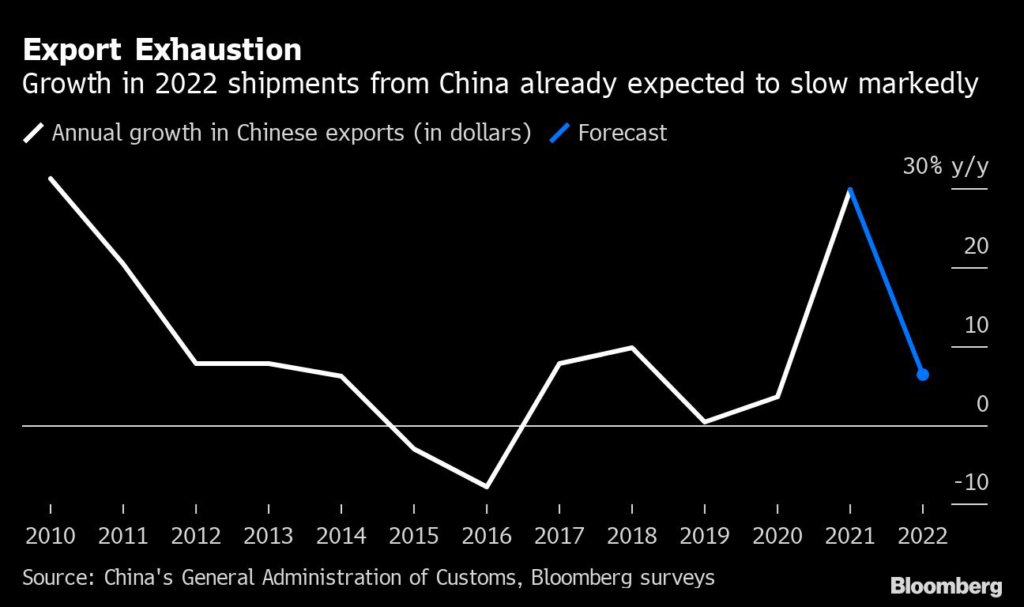
After two years of record exports, Chinese manufacturers are turning downbeat as consumers in their biggest markets curb spending and Covid lockdowns drive customers to competitors in the region.


On The Wire

China Grain Reserves Group, known as Sinograin, is buying newly harvested wheat for national reserves at levels that are about 30% higher than the minimum purchase price, showing the government’s determination to bolster production at a time of global shortage.

  • Copper Edges Up as Traders Seen Moving Metals to China on Demand
  • China Steel Sector to Turn Around in June as Work Resumes: CICC
  • Return of Dine-In Services in Beijing to Boost Food Demand
  • China Fears Wind Is Blowing Covid Virus in From North Korea
  • Chinese Carmaker Joins SpaceX in Low-Earth-Orbit Satellite Race
  • China’s Busy Abbatoirs Signal Limited Gains for Pork, Soybeans: BI

The Week Ahead

Thursday, June 9

  • China to release May aggregate financing & money supply by June 15
  • China’s 1st batch of May trade data, incl. steel, aluminum & rare earth exports; steel, iron ore & copper imports; soybean, edible oil, rubber and meat & offal imports; oil, gas & coal imports; oil products imports & exports. ~11:00
  • USDA weekly crop export sales, 08:30 EST

Friday, June 10

  • China inflation data for May, 09:30
  • China weekly iron ore port stockpiles
  • Shanghai exchange weekly commodities inventory, ~15:30
  • China farm ministry’s monthly crop supply-demand report (CASDE)
  • USDA’s monthly world crop supply-demand report (WASDE), 12:00 EST

More stories like this are available on bloomberg.com

©2022 Bloomberg L.P.
TSMC Expects 30% Sales Rise Despite Global Economic Ructions

(Bloomberg) — Taiwan Semiconductor Manufacturing Co. expects revenue to grow about 30% in 2022, signaling resilient demand for electronics despite global macroeconomic uncertainty.

Sales growth this year should accelerate from 2021’s 24.9%, which was in dollar terms, Chairman Mark Liu said at the company’s annual shareholder meeting on Wednesday. That’s in line with executive remarks in April that gave an official outlook of topping mid- to high-20% growth in 2022.

TSMC’s projection comes as concerns persist that inflation, the war in Ukraine and Chinese lockdowns will hammer demand for gadgets. On Wednesday, executives acknowledged smartphones and computers have been hard-hit but that spending in other areas such as electric vehicles have exceeded expectations. They played down the effect of inflation, saying the rise in prices was gradually abating.

“The current inflation has no direct impact on the semiconductor industry as the demand drop is mainly for consumer devices like smartphones and PCs while EV demand is very strong and partially exceeds our supply capacity so we are making inventory adjustments,” Liu said. “Utilization rate is full for the rest of the year.”

TSMC May Be Recession Proof, But Not Bulletproof: Tim Culpan

TSMC reaffirmed previous projections for $17.6 billion to $18.2 billion of revenue this quarter, supporting gross margins of as much as 58%.

TSMC, the most advanced maker of chips for tech giants from Apple Inc. to Nvidia Corp., rose more than 1% in Taipei, after having shed more than a tenth of its value this year. While the Taiwanese company has been one of the biggest beneficiaries in past years of soaring demand for chips in a growing range of connected devices, investors fear policy tightening around the world will begin to erode consumption in 2022.

Apple is planning to keep iPhone production roughly flat in 2022, Bloomberg News has reported — a conservative stance as the year turns increasingly challenging for the smartphone industry. At the same time, wait times for semiconductor delivery hit a record high in May though some companies are starting to see relief. Chipmakers are also raising prices due to rising costs. 

Read more: Apple to Keep IPhone Production Flat as Market Grows Tougher

Over the longer term, TSMC remains a linchpin of global business, a key supplier to industries from automobiles to crypto and the internet. Its technology is among the most sought-after in the industry. This week, a senior economist at a government-run research group in China — which considers Taiwan its territory — called on authorities to seize the company.

TSMC will continue with its new fab in Arizona despite a lack of progress in Congress on approving a $52 billion chip-funding bill, Liu told shareholders Wednesday. That could push up costs though it would be manageable, the TSMC chairman added.

Read more: Top Economist Urges China to Seize TSMC If US Ramps Up Sanctions

TSMC is building a $12 billion plant in Arizona in addition to capacity expansion underway closer to home. Speculation has persisted that the chip giant is considering a factory in Europe, but it has no concrete plans to build a fab in that region for now, Liu said. 

Executives reiterated that the company has earmarked $40 billion to $44 billion this year to expand and upgrade its facilities and should again spend more than $40 billion in 2023. That’s a record outlay intended to keep the company at the forefront of a rapidly evolving technology and sating future demand.

“TSMC has entered a period of structural high growth,” Liu said. “Technology leadership is key to our growth.”

(Updates with chairman quote and share action from fourth paragraph)

More stories like this are available on bloomberg.com

©2022 Bloomberg L.P.

China Tech Shares Rally as Game Approvals Give Nod to Recovery

(Bloomberg) — China’s tech stocks jumped as the government’s latest batch of new game approvals bolstered bets that the industry’s business outlook is on the mend.  

Hong Kong’s Hang Seng Tech Index Index advanced as much as 4.3% early Wednesday, tracking gains in the sector’s American depositary receipts. Bilibili Inc. and Alibaba Group Holding Ltd. led the rally, rising at least 8.3%. 

China’s entertainment regulator on Tuesday approved licenses for 60 new games in what is seen as a step towards policy normalization. Beijing’s wide-ranging tech crackdown spread to online gaming last summer when regulators introduced stringent measures to curb addiction. 

The gaming approvals coupled with a report this week that China is wrapping up its investigation into Didi Global Inc. have bolstered sentiment after Beijing’s heavy-handed crackdown sent global investors fleeing.  

Read More: China Approves More Games in a Step Toward Normalization (1) 

Shares of Tencent Holdings Ltd. and NetEase Inc. also rose, even though they were absent from the approval list. 

“I think the market is still excited about the potential restore of Didi on Apps stores and feels a bit risk-on sentiment,” said Willer Chen, an analyst at Forsyth Barr Asia Ltd. “The newest batch of gaming license approval, though Tencent and NetEase are not on the list, is also good news.”  

A leveling off of Covid flareups from Beijing to Shanghai has also raised hopes that the worst of the recent selloff is over, with the government ramping up efforts to support growth after lockdowns dealt a heavy blow.

Still, whether the market rebound will have staying power remains in doubt. Multiple stimulus pledges by Beijing’s top authorities have so far failed to keep markets higher for long, while China’s strict Covid Zero policy leaves the specter of future lockdowns hanging.  

China’s benchmark CSI 300 Index rose as much as 1.1% on Wednesday. Hong Kong’s Hang Seng Index gained 2.3%. 

The regulatory overhang for the tech sector will stay for several years, but “when the economy is struggling, the tightenings will take a break and the policy will become more pro-growth,” Winnie Wu, China equity strategist at BofA Securities, said in a Bloomberg TV interview. “So during those times we could see a strong trading rally of the internet sector in general, because they remain to be some of the largest, most liquid stocks that investors are familiar with.”

More stories like this are available on bloomberg.com

©2022 Bloomberg L.P.
Close Bitnami banner
Bitnami