
Bloomberg

Salesforce Raises Profit Forecast on Resilient Demand for Business Software

(Bloomberg) — Salesforce Inc. rose the most in almost two years on Wednesday after the company raised its annual profit forecast, signaling that demand for business software is holding up despite a broader downturn for major tech firms. 

Fiscal-year earnings, excluding some items, will be $4.74 to $4.76 a share, an increase of 12 cents a share from the company’s previous forecast. Revenue will be as much as $31.8 billion, San Francisco-based Salesforce said Tuesday in a statement. Analysts, on average, estimated annual profit of $4.68 a share, according to data compiled by Bloomberg.

“So far, we’re just not seeing any material impact from the broader economic world,” Chairman and co-Chief Executive Officer Marc Benioff said during a conference call after the results. “Our demand environment remains very strong.”

The shares rose as much as 13% to $181.32 Wednesday morning in New York, the biggest intraday increase since August 2020.

Salesforce, the leader in cloud-based customer management software, maintained hiring and high revenue growth through the pandemic, and expanded its products for business productivity with the $27.7 billion purchase of the messaging platform Slack. Last month, however, the company joined tech sector peers in slowing down hiring and travel to control expenses, according to a report from Insider. Salesforce said full-time equivalent positions rose 30% from a year earlier to 77,810 when the quarter ended April 30.

“We are hiring, but we’re doing it in a much more measured pace,” Chief Financial Officer Amy Weaver said during the call. “We’re focusing the majority of our new hires on roles that will support customer success and the execution of our top priorities.”

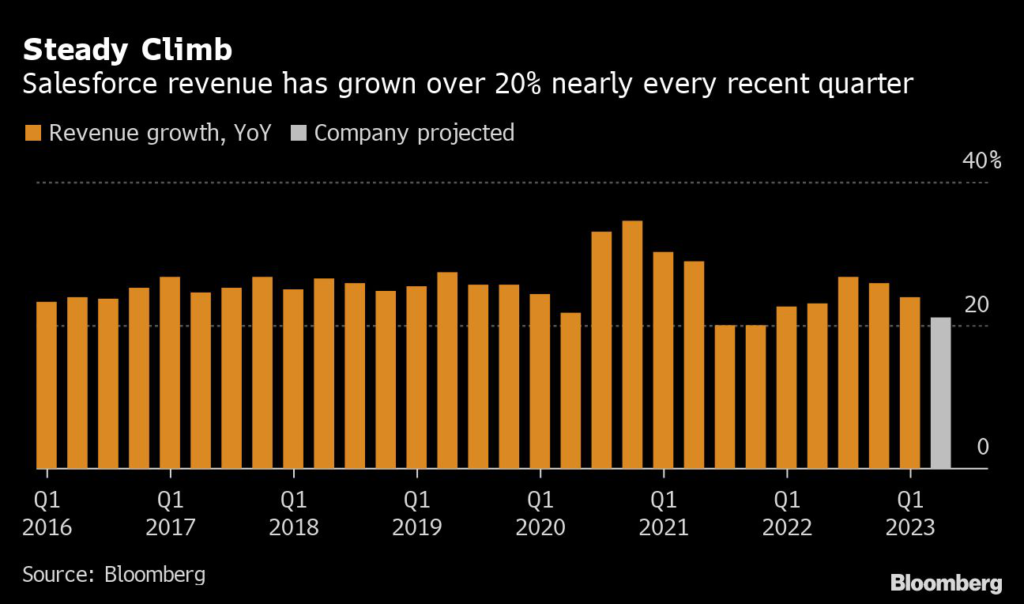
In the fiscal first quarter, revenue increased 24% to $7.41 billion, beating analysts’ projections. Current remaining performance obligation — or contracted sales that have yet to close, which is watched by analysts as a metric of near-term demand — grew 21% to $21.5 billion. Profit, excluding some items, was 98 cents a share, compared with analysts’ average estimate of 95 cents.

Salesforce said subscription revenue generated by its platform unit, which includes Slack, gained 55% to $1.42 billion — the fastest growth of any division in the quarter.

“Slack continues to exceed our revenue expectations,” co-CEO Bret Taylor said on the call. “This was the fourth consecutive quarter we’ve seen more than 40% growth in customers spending more than $100,000 with Slack annually.”

The shares climbed as high as $173.40 in extended trading after closing at $160.24 in New York. The stock declined 37% this year amid a broad technology rout that has particularly hit software vendors. The downturn left the company undervalued, wrote Mark Murphy, an analyst at JPMorgan, in a research note ahead of earnings.

Salesforce’s 24% constant currency growth in its current remaining performance obligation is a positive development because it remained high even in the face of rising interest rates and inflation, said Anurag Rana, an analyst at Bloomberg Intelligence. “This is the power of Salesforce, where you have a very well diversified revenue stream,” Rana said in an interview.

The company doubled its expected currency headwinds to $600 million for the fiscal year, owing to a strong U.S. dollar. Earlier this month, the Bloomberg dollar index hit its highest point since the early days of the pandemic, and remains elevated. 


Sales in the Mulesoft division, which helps customers connect their software across the internet, increased 9%, Weaver said during the call. A sales slowdown last year for the unit alarmed investors. Weaver said Mulesoft revenue is more volatile than other products, and that growth should pick up toward the second half of the fiscal year.

Management is also under internal pressure to cut ties with the National Rifle Association after the school shooting in Uvalde, Texas. Thousands of employees have signed a petition addressed to the company’s management team including Benioff, according to SFGate.

More stories like this are available on bloomberg.com

©2022 Bloomberg L.P.

US Equities Rise Amid Inflation Focus; Oil Gains: Markets Wrap

(Bloomberg) — US equities climbed and Treasuries pared declines as investors assessed developments in the debate over how much central bank monetary policy tightening is needed to fight inflation. 

The S&P 500 gained 0.8%, led by technology shares, while the Nasdaq 100 added 1.3%. The yield on 10-year Treasury was little changed after earlier gains as metals including gold, silver and copper spiked higher. The dollar pared an advance against major peers.

Oil rose as investors assessed the future of OPEC+ unity, just as ministers from the group prepare to meet on Thursday to discuss its supply policy for July. Crude advanced about 10% in May, stoking more inflation worries. 

Concerns that central-bank rate hikes may induce a recession are keeping investors guessing about the outlook for the economy as rising food and energy costs squeeze consumers, and volatility has picked up.

“We now find ourselves in a little bit more no man’s land,” Greg Boutle, US head of equity and derivative strategy at BNP Paribas, said in Bloomberg TV. “We are in this kind of a bear market environment yet we haven’t seen recession manifest in a macro data yet. So we still think there is a path for the US economy to have a soft rather than a hard landing.”

Europe’s Stoxx 600 Index was little changed in the wake of euro-zone figures Tuesday that showed a record jump in consumer prices. The data strengthen the case for the European Central Bank to lift interest rates by a half-point in July, according to Austrian central bank chief and Governing Council member Robert Holzmann. 

“There are heightened concerns around inflation and where central banks are likely to go trying to combat inflation,” Kristina Hooper, Invesco Advisers chief global markets strategist, said on Bloomberg Radio. “This has gone from just an inflation scare to a growth scare. Uncertainty has grown.”

Citigroup Inc. strategists said that after a difficult first five months of 2022, the pain may not be over yet for global equity markets. The prospect of downward revisions to earnings estimates is the latest headwind to face stock investors, already rattled by runaway inflation and the potential impact of central-bank tightening aimed at controlling it, the strategists led by Jamie Fahy wrote in a note.

Among individual stock moves, Salesforce Inc. climbed after the cloud-based customer management software company raised its annual profit forecast. ChargePoint Holdings Inc. slipped as analysts noted that the EV charging network firm’s margins came under pressure due to rising costs and supply-chain disruption. And Delta Air Lines Inc. wavered after raising its revenue outlook.

How will markets be affected by the Fed’s quantitative tightening? QT officially starts Wednesday and is the theme of this week’s MLIV Pulse survey. Click here to participate anonymously.

Here are some key events to watch this week:

  • The Federal Reserve is set to start shrinking its $8.9 trillion balance sheet Wednesday
  • The Fed releases its Beige Book report on regional economic conditions Wednesday
  • New York Fed President John Williams, St. Louis Fed President James Bullard speak at separate events Wednesday
  • OPEC+ virtual meeting Wednesday
  • Cleveland Fed President Loretta Mester discusses the economic outlook Thursday
  • US May employment report Friday
  • The UN’s Food and Agriculture Organization releases its monthly food price index at a time of maximum concern about global supplies on Friday

Some of the main moves in markets:

Stocks

  • The S&P 500 rose 0.8% as of 9:38 a.m. New York time
  • The Nasdaq 100 rose 1.3%
  • The Dow Jones Industrial Average rose 0.7%
  • The Stoxx Europe 600 rose 0.1%
  • The MSCI World index rose 0.6%

Currencies

  • The Bloomberg Dollar Spot Index was little changed
  • The euro fell 0.1% to $1.0719
  • The British pound fell 0.4% to $1.2550
  • The Japanese yen fell 0.6% to 129.44 per dollar

Bonds

  • The yield on 10-year Treasuries advanced one basis point to 2.86%
  • Germany’s 10-year yield advanced one basis point to 1.13%
  • Britain’s 10-year yield was little changed at 2.11%

Commodities

  • West Texas Intermediate crude rose 2.8% to $117.83 a barrel
  • Gold futures were little changed

More stories like this are available on bloomberg.com

©2022 Bloomberg L.P.

GM’s Buick Will Go All-Electric by 2030 in Product Line Makeover

(Bloomberg) — General Motors Co. will make all of its Buick models electric by 2030 in a move to remake the brand in the US.

The overhaul will start with an electric crossover SUV in 2024 that Buick said will offer some luxury amenities and a new styling theme while being priced beneath GM’s Cadillac EVs. It’s a play to draw new buyers into the brand with a value proposition because most plug-in models sell for well above the $45,000 average price of a new vehicle. 

“It’s exactly what is not in the market, an affordable premium SUV,” said Rob Peterson, brand marketing manager for Buick. “You can have a gorgeous electric vehicle that isn’t expensive.”

Buick plans to use EVs sold under the new Electra sub brand to market its electric makeover and grow a brand that sells fewer than 200,000 vehicles a year in the US. Sales grew last year in Buick’s domestic market, but it has been a far bigger force in China and less relevant for GM at home.

Buick doesn’t plan to go all electric in China, where it sells more than 800,000 vehicles a year.

Going forward, Buick’s electric models will be called Electra followed by some kind of alphanumeric addition to the name, a GM spokesman said. The brand sells the electric Velite 6 and Velite 7 in China and will add five new EVs in the market by 2025.

GM Chief Executive Officer Mary Barra plans to make Cadillac all electric by 2030, as well, and the rest of the company’s vehicles will be battery-powered by 2035.

Along with electric drive, Buick will start a new design theme for the brand. GM is revealing the Buick Wildcat EV concept, which the company says is a design exercise. The concept car’s forward-leaning front end, new trapezoid-shaped grille and flowing side view are meant to create a more elegant look. Still, Peterson said Buick is an SUV brand, suggesting the vehicle isn’t destined for production.

Buick hopes EVs will help bring in a new kind of buyer, which has been a challenge. While the brand gets 73% of buyers from other car labels, about 22% come from GM brands. That means only about half of customers are non-GM owners, said Alexander Edwards, president of marketing research firm Strategic Vision in San Diego.

“Buick isn’t bringing in enough new blood,” Edwards said. “They’re relying on cannibalism of GM brands.”

More stories like this are available on bloomberg.com

©2022 Bloomberg L.P.

Premium Diaper Startup Coterie Raises $24 Million in New Funding

(Bloomberg) — Coterie Baby Inc., a startup looking to take on the $6.2 billion US diaper market, raised $23.8 million to fund new products and bolster its advertising. 

The round, which included model Ashley Graham and was led by Airbnb Inc. and Impossible Foods Inc. investor Align Ventures, brings the company’s total fundraising to $34 million. Coterie declined to share its valuation.

Launched in 2019, the New York-based company sells premium diapers designed to be more absorbent and faster wicking than the leading brands. Procter & Gamble Co. and Kimberly-Clark Corp. alone hold 78% of the US market, according to Euromonitor International. Challengers such as Coterie, Honest Co. and Hello Bello, founded by actress Kristen Bell, have sought to challenge their dominance in recent years.

Coterie, which also sells wipes, plans to introduce other products parents need in the nursery, founder Frank Yu said in an interview, without elaborating. It’s also looking to expand its advertising beyond platforms such as Facebook and into other avenues including TV.

“We’re investing in marketing campaigns,” Yu said. “Now is the time to invest in brand equity and do more partnerships.”

The company sells most of its products online, though it recently entered Amazon.com Inc.’s Whole Foods Market. Coterie almost quadrupled its business last year and has sold more than 80 million diapers since inception, Yu said. It targets parents in their late 20s and early 30s with disposable income.

More stories like this are available on bloomberg.com

©2022 Bloomberg L.P.
Oman Backs U.S. Firm Mining Crypto to Cut Natural Gas Flaring

(Bloomberg) —

Oman’s sovereign wealth fund took an equity stake in a U.S. firm that helps fossil-fuel producers cut flaring by using stranded natural gas to power cryptocurrency mining instead. 

Oman Investment Authority was part of the $350 million equity round that Crusoe Energy Systems Inc. raised in April, according to a statement. Ismail Ibrahim Al-Harthi, senior manager of technology investments at Oman Investment Authority, said the firm’s policy doesn’t comment on the size of stakes. Crusoe also declined to reveal terms.

Denver-based Crusoe will open an office in Muscat, Oman, to help deploy power generators and mining equipment for capturing gas at well sites, said Chief Executive Officer Chase Lochmiller. The Middle East and North Africa account for about 38% of the world’s flaring — the burning of excess natural gas from oilfields. The practice has come under fire for releasing harmful greenhouse gases and worsening climate change. 

“We’ve always felt it was important for us to have a presence in the MENA region,” given its share of global flaring, Lochmiller said. “Having the buy-in from nations that are actively trying to solve the flaring issues is what we are looking for.”

Crypto mining has also come under scrutiny for being energy intensive and reliant on burning natural gas. Crusoe, which keeps all the coin it mines, focuses on setting up shop in remote areas where it’s not economically feasible to build infrastructure to cut flaring. 

Crusoe held a workshop in Oman on Monday with the country’s biggest producers, including OQ SAOC and Petroleum Development Oman. The first Middle East pilot will be launched by year-end or early 2023, Lochmiller said. While the drop in Bitcoin prices “certainly has some impact on our top-line revenue, it doesn’t impact any plans for growth and expansion.”  

The Oman government, which signed on to the World Bank’s initiative to end routine flaring by 2030, invested in Crusoe early last year, then increased that stake with the April round, Al-Harthi said in a phone interview.

“Oman is committed to reduce greenhouse gases in line with the Paris climate agreement,” Al-Harthi said in an emailed statement.

More stories like this are available on bloomberg.com

©2022 Bloomberg L.P.

Spotify Podcasters Are Making $18,000 a Month With Nothing But White Noise

(Bloomberg) — People on the prowl for a new podcast to consume often go for a stimulating option like a political debate or a true crime mystery to quicken the pulse. But when the din of the world becomes too much, listeners often need the opposite vibe: something soothing and sedating, maybe with the sound of static or falling rain. Perhaps a touch of crickets. 

Enter — quietly, on tippy-toes — the white noise podcasters. 

While the top of the podcast charts on Spotify and Apple are still dominated by garrulous, jawboning hosts, these days you can also reliably find a smattering of white noise shows appearing in the mix. Relatively new to the podcast scene, the tranquil programs haves names like  “Calming White Noise,” “Best Noise Labs,” “Relaxing White Noise” and “Deep Sleep Sounds.”

Who is behind the popular offerings is a bit of a mystery.

To date, the major podcast networks have yet to pile into the field, leaving independent creators to serve the growing market. Curiously, at time when most podcasters clamor for public attention, the white noise podcast creators remain a relatively tight-lipped group. Requests to speak with multiple shows, even those with a contact form, were declined or went unanswered. In one case, the name of a website’s owner was hidden— its host was listed, improbably, as “Earth.”  

Those who did respond to interview requests say they are making good money, winning over fans and marveling at the power of podcast distribution. Collectively, the shows represent a burgeoning and lucrative podcast genre.

Todd Moore, a Florida Keys resident, quit his cybersecurity job in 2009 to focus full-time on an app, which he named White Noise. In 2019, he launched a podcast named “Tmsoft’s White Noise Sleep Sounds,” using Anchor, Spotify’s free podcast-hosting software. Moore says that his white noise show now gets around 50,000 listens per day — a figure that would rank in the top 25 percent of all podcasts, according to Marshall Williams, partner and chairman of the podcast ad agency Ad Results Media.

Moore and his white noise team — yes, he has five employees and contractors — offer a subscription plan. But most people listen to the free, ad-supported version. Because Moore doesn’t want to interrupt the calming aura of his show, he opts to include only pre-roll ads. Anchor manages the commercial load and pays Moore $12.25 per thousand listens, which adds up to about $612.50 per day, or around $18,375 per month.

“I never thought writing a little app on a weekend would turn into my full-time life,” Moore said. “You just never know.”

Though Moore primarily built his business through his app, he says streaming content now provides the majority of his revenue. In addition to the podcast, he also releases his lulling sounds as music tracks, which generate income from royalties, and as videos on YouTube.

“Tmsoft’s White Noise Sleep Sounds,” success appears to be tied to various factors: Moore buys ads on Spotify and places house ads around his website and app, which might prompt people to check it out. Spotify’s algorithm also can steer listeners toward such podcasts based on their search queries or previous selections. The automated process has already minted at least one accidental white-noise star.

In 2019, Brandon Reed, a Walt Disney Co. employee who lives in Florida, started using Anchor to host some white noise programming that he hoped would help his baby son fall asleep.  Reed wasn’t aiming to build a successful podcast, he said, but soon the Spotify algorithm started pushing people to his show, “12 Hour Sound Machines (no loops or fades).” That year, he created three, free episodes filled with hours of static noises.

Now, three years later, around 100,000 listeners play his show daily. What began as essentially a cozy sound blanket for his baby, now regularly pops up around the world on Spotify’s charts of the most popular podcast episodes. Last year, Reed’s show made the top charts in four different countries.

“I didn’t even intend for people to listen to this,” he said. 

At one point last year, it climbed to number 15 on the top podcast chart, putting him in the company of programs like Dax Shepard’s “Armchair Expert” and the New York Times’ “The Daily.”

“The amount of production that goes into some of these podcasts, the production value, and then for this silly noise that plays for 12 hours to be in the top 100 feels crazy,” Reed said. “People are absolutely devouring it.”

His inadvertent hit has also made the charts on Apple Inc.’s Podcasts app and has reached over 26.6 million total listens, he said. Reed now offers a $2.99 monthly subscription, which gives paying customers access to additional sounds and the ability to request new ones. When a chiropractor needed railroad clacking for an anxious patient, Reed went out and captured it. So far, he’s made over $10,000 through subscriptions. Listeners also tip him, he says, typically about $5 to $7. Occasionally, they go higher. A person whose rescue dog sleeps to Reed’s handiwork once sent him $100 as a thank you. 

White noise fans tend to be fiercely loyal, Reed says. One time, he changed the frequency of a static track and afterward he heard from a regular listener frantically begging him to change it back because it was the only sound that would put their baby to sleep.

“What’s funny is how important this has become to people,” Reed said. 

Like Moore, Reed chose to host on Anchor, which Spotify acquired in 2019, because it’s free and allows for multi-hour episodes, unlike music tracks. These days, 97% of Reed’s audience and 94% of Moore’s listen on Spotify. Typing in “sound machine” on the service can bring up Reed’s program as the top result. Typing in “ocean waves” or “jungle sounds” can summon Moore’s.  

Though Spotify appears to have stumbled into the demand for white noise podcasts, the shows arrive at a time when all the networks are looking for new hits and are courting a wider array of creators. Last year, Apple Podcasts introduced subscriptions ahead of Spotify. Meanwhile, Amazon.com Inc is investing in meditation and other wellness-related podcasts that will be exclusively available through Amazon Music.

Despite his early success, Reed says he has no plans to quit his day job. White noise podcasting remains the thing he does for fun. He’s now taking his family on outings to capture various ambient sounds. Reed, who is something of a white noise purist, knows he could make good money with advertisements. But he doesn’t include them because he worries the sound of commerce would disturb his audience’s restful slumber. 

“It’s embarrassing to say how much money I would be making,” he said. 

More stories like this are available on bloomberg.com

©2022 Bloomberg L.P.
Furious Streak of Hurricanes Is Set to Persist in the Atlantic

(Bloomberg) — The pattern that’s emerged over the last decade is devastatingly clear: Atlantic hurricanes are becoming more violent, frequent and costly. This year is forecast to add more even more evidence.

The 2022 season, which officially kicks off Wednesday, is expected to be the record seventh straight year with an above-average number of storms that reach tropical strength or greater. The US National Weather Service expects up to 21 such storms will form — well above the annual average of 14. Colorado State University predicted 19 in its April forecast. AccuWeather Inc. and WeatherTiger LLC warn of above-normal activity, too.

“It does have the potential to be a bad year,” said Paul Walker, a meteorologist at AccuWeather Inc., which has called for 16 to 20 named storms in the Atlantic this year. 

An above-normal season would be the latest in a string of extreme weather events, including wildfires, floods and tornadoes, that have unleashed devastation across a wide swath of the globe over the past few years. Scientists say climate change is contributing to the destructive power of hurricanes, triggering heavier rainfall and worse storm surge. This year, storms threaten to disrupt supplies of everything from food to oil at a time when pandemic-driven snags are already sending commodity prices into the stratosphere.

Read more: Florida’s shrinking orange crop faces hyperactive storm season

The National Hurricane Center names storms when they reach tropical strength, with winds reaching at least 39 miles (63 kilometers) per hour. The first one in 2022 that reaches that mark will be called Alex, which could come this week as remnants of the Pacific storm Agatha cross over Mexico. Tropical storms become hurricanes when their winds reach 74 miles an hour.

Two major factors are creating ideal conditions for hurricanes to take shape this year. One is warm ocean temperatures in the Atlantic, which provide fuel for storms to intensify. The other is La Nina, a weather pattern that weakens wind shear, or sudden changes in wind speed and direction, and makes it easier for tropical cyclones to form. Forecasters are calling for La Nina to continue through the fall. 

An overcharged hurricane season this year would continue a pattern of heightened activity that began in 1995 and reached the pinnacle in 2020, when the Atlantic produced a record 30 named storms. Better satellite coverage and changes to forecasters’ methodology have contributed to the increase, but even with those factors taken into account, more tropical cyclones are emerging. The US National Weather Service is predicting 14 to 21 named storms this year.

As Atlantic storms become more frequent, they’re also getting more intense. The past few years have seen an uptick in so-called major hurricanes— those with winds of at least 111 miles per hour — slamming into the US.

Because of warmer ocean waters, it’s also becoming more common for storms to undergo a deadly shift called rapid intensification, in which winds increase by at least 35 mph within 24 hours of landfall. Hurricanes that quickly gain power are more likely to catch people unawares, with catastrophic consequences. 

Since 2017, 16 hurricanes have hit the US and seven of those were major hurricanes, said John Cangialosi of the US National Hurricane Center. Of the 16, half underwent rapid intensification.

Since 1980, hurricanes and tropical storms have caused $1.16 trillion in damages and losses in the US and lead to deaths of at least 6,708 people, more than any other climate disaster, according to the US National Centers for Environmental Information. In recent years, an increasing number of storms inflicted at least $1 billion of damage on the US.

The US had its longest drought of major hurricanes hitting the Lower 48 states between October 2005, when Wilma pummeled Florida, and August 2017, when Harvey struck the Texas coast. Part of the reason for the lapse was a low-pressure trough that often settled along the eastern edge of the country in those years, nudging storms away, said Phil Klotzbach, lead author of Colorado State University’s forecast. But since then, high pressure in the Atlantic has edged closer to the US most summers, allowing storms to crash into the Gulf Coast and East Coast.

Wind circulation on the south side of the high pressure system is from East to West, which “helps push hurricanes closer to the US,” Klotzbach said. 

More stories like this are available on bloomberg.com

©2022 Bloomberg L.P.

Rapid EV Growth Hastens the Peak, Then Fall, of Internal Combustion

(Bloomberg) —

BloombergNEF published its annual long-term electric vehicle outlook today, a deep look at the future on two, three, four and more wheels. The trends are clear: Despite the challenges of a pandemic, supply-chain crunches and trouble sourcing critical minerals, electric vehicles are eating into the transportation system and taking bigger bites every year.

Before we jump into the future, it’s worth mentioning the present state of EVs. At the end of this year, there will be more than 27 million electric passenger vehicles on the road out of a global fleet of more than 1 billion. There are currently fewer than 2 million electric buses and commercial vehicles plying streets worldwide.

There are also just short of 300 million electric two- and three-wheelers — the scooters, trikes and tuk-tuks that dominate roads in Asia. Electrifying every one of these segments contributes to reducing global oil consumption. Today, it’s these smallest vehicles that are denting oil demand most, although not enough to make global oil consumption fall, at least yet.

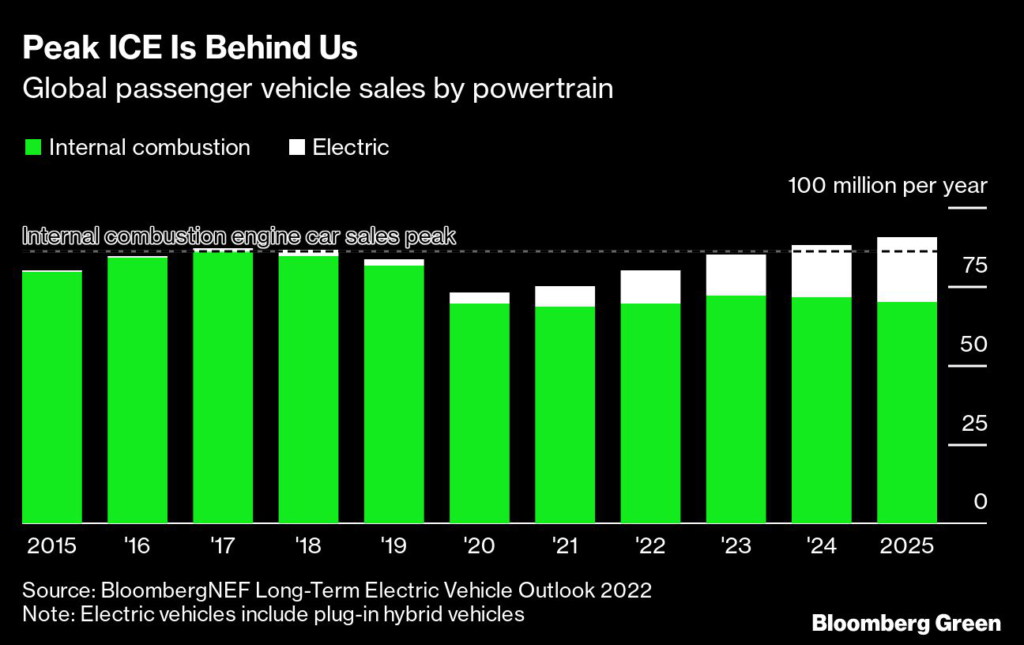
Today’s fleet is a result of yesterday’s habits, so to speak. With another year of global auto sales behind us, we can definitively point to the peak of a more than century-long trend of increasing internal combustion engine car sales.

In 2017, global new vehicle sales reached 87 million, and all but 1.1 million had an engine. That year will end up being the all-time high for deliveries of internal combustion cars. Sales dropped below 82 million in 2019, and in 2020 they plummeted to fewer than 70 million. ICE car sales will probably tick back up, but EVs are the predominant reason total auto sales will get back to where they one were sometime around the middle of the decade.

As sales rise and fall, so shall the fleet. BNEF expects that the world’s fleet of ICE cars, excluding hybrids and plug-in hybrids, will peak at just over 1.2 billion this year, dropping only slightly in 2023. And after that, the decline is marked. By the end of the next decade, the global fleet of cars with an engine, rather than a battery or fuel cell, will be less than half the size it is today.

That switch in the source of automotive growth obviously has implications for carmakers, which have already devoted tens of billions of dollars of capital to electrification. Most of the biggest manufacturers, in fact, are already aiming more than half their capital expenditures and research-and-development spending to EVs and digital efforts, which is self-fulfilling. Today’s investment serves tomorrow’s output. If investment is going electric, then so will production and sales.

That shift has major implications for infrastructure, as well, both at the street level and for whole countries’ grids. BNEF anticipates there will be at least $1 trillion worth of investment in EV charging networks by 2040 to construct and install 339 million charging connections in its base-case scenario. If governments are serious about hitting net-zero emissions in the transport sector, charging infrastructure will need more than $1.4 trillion for just under half a billion chargers. 

Energizing this new, vast system of cars and chargers will require a significant amount of electricity. EVs could increase global electricity demand by more than 4,700 terawatt-hours by 2040. That’s more than the current total consumption of the US. By 2050, the increase could be more than 8,800 terawatt-hours, more than China’s consumption last year. EVs could account for between 10% and 13% of global electricity demand in 2040, and between 15% and 21% in 2050. 

The electrification of road transport is well under way. There are hundreds of millions of personal electric vehicles on the road, and more than a million commercial vehicles and trucks. EV sales are growing fast and the internal combustion era is starting to fade. In less than two decades, EVs will also begin to reshape our grids, the investment that goes into building them and the strategies that enable their growth. And if countries increase their efforts to reach net-zero emissions by 2050, we will see even more dramatic change. 

Nathaniel Bullard is BNEF’s Chief Content Officer. 

More stories like this are available on bloomberg.com

©2022 Bloomberg L.P.

Klarna CEO’s LinkedIn Post Names Hundreds of Staff Dismissed in Cost-Cutting

(Bloomberg) — The chief executive officer of Klarna Bank AB has polarized opinion on social media after posting a contact list of former employees recently dismissed by the Swedish company as part of a drive to curb costs.

Sebastian Siemiatkowski, 40, wrote on LinkedIn that he has “mixed feelings about this document” because it reflects both the caliber of the departing Klarna staff and a “very hard decision that saddens me deeply.” 

Those named on the list have signed up for it voluntarily and it was created by an employee who remains at the company, a spokesperson for Klarna said.

Reactions to the CEO’s post ranged from outrage over its “tone deaf” content to praise for grabbing the attention of recruiters. The largest trade union in Sweden’s financial industry, Finansforbundet, told Bloomberg that it has asked to discuss the posting of the list with Klarna.

The union also said it wasn’t consulted on the job cuts and “expected information from the company at an early stage and not to have to read about the process in the media,” the head of the union, Ulrika Boethius, said in emailed comments.

Klarna’s spokesperson says the company “has not given notice of dismissal, and is therefore not obliged to inform the unions, but hopes to reach an agreement with the employees concerned. Should a redundancy arise, it will be handled in accordance with laws and regulations.”

Read More: Klarna to Lay Off Staff as Europe’s Star Startup Cuts Costs

(Adds further comment from Klarna spokesperson in final paragraph.)

More stories like this are available on bloomberg.com

©2022 Bloomberg L.P.

Elon Musk’s Boring Co. Pitched Texas on Tunnels for Cars, People and Water

(Bloomberg) — Before the end of Year One of the Covid-19 pandemic, Elon Musk did something a lot of other people were doing at the same time: He moved. Once in Texas, several of his business ventures followed, including Boring Co., a startup seeking to create underground transportation systems. The company, which had previously set its sights mainly on the coasts, is suddenly focused sharply on the Lone Star State.

Public documents obtained by Bloomberg show the extent of Boring’s ambitions in Texas. Over the last year, company representatives have pitched state officials on at least eight projects. The proposals range from kernels of ideas to detailed presentations. None has moved beyond the concept phase.

Most of the projects would be in the Austin area, near Boring’s headquarters in the suburb of Pflugerville. The pitches include transport for cars, groundwater culverts and a pedestrian walkway. Almost all of them have never been reported on before. Each was referenced in communications with Texas officials or other government documentation that Bloomberg received through a public information request. Here is the list of the Boring projects under consideration in Texas:

Underwater tunnel to a barrier island

One of the first projects Boring sought to develop in Texas was an underwater tunnel for cars near the Gulf of Mexico. Brian Gettinger, Boring’s self-described “tunnel evangelist,” who joined as the business development head in May 2021, was pitching a tunnel under the Aransas channel after about a month on the job. Port Aransas near Corpus Christi is in a popular vacation destination for people from around the state. Roads and ferry routes there are routinely clogged.

Although the company has never dug under a body of water at this scale, it has pitched similar projects to Miami and Ft. Lauderdale, Florida. So far, no one has offered Boring a contract, and a Texas official didn’t appear eager to take a risk on the startup. “Nothing new,” Valente Olivarez, the Texas Department of Transportation district engineer for the area, wrote in the last email on record about the proposal. “I’ll contact you if I need additional information.”

Texas Hyperloop

Before Boring, there was the Hyperloop. Musk envisioned a tubular, vacuum-sealed transportation system that would allow people to travel between cities at astonishing speeds. He urged engineers to build the systems to his specifications. Some tried, and none has yet succeeded. Boring’s own plans have faced resistance, in part from regulators who were not in a hurry to approve a system between New York and Washington, D.C.

The Hyperloop remains in Boring’s plans. A company presentation marked as confidential, which Gettinger emailed to a Texas transportation official in June 2021, said, “All loop tunnels are designed for the loading and sealing requirements to accommodate Hyperloop, allowing increases in speeds from Loop’s 150 mph to Hyperloop’s 600+ mph.”

Tunnel between two major highways

Musk, a former Angeleno, founded Boring in Southern California with the stated goal that it would “solve traffic.” Austin offers a challenge similar to the one in Los Angeles. Traffic in the Texas capital is terrible and getting worse. The population reached nearly 1 million in the 2020 census, a more than 20% increase over the previous decade.

In September, Gettinger asked a state transportation official whether his agency would support a project to create a new connection between two major roads running through Austin, US Highway 290 and Texas State Highway Loop 1. The latter is known colloquially as MoPac, named after the Missouri Pacific Railroad, a Civil War-era rail project. For Austinites, MoPac congestion is a routine source of frustration. (A popular Twitter account among locals is called Evil MoPac.) Highway 290 and MoPac already intersect in the southern part of Austin, but Gettinger apparently was envisioning an additional conjunction in the north. The Central Texas Regional Mobility Authority official, James Bass, called Gettinger the next day, but the documents contained no description of their conversation.

Subterranean route connecting downtown Austin, the airport and a Tesla factory

Perhaps the most promising development in Texas so far—and the only one on this list that has been previously disclosed—is one that Gettinger took to calling “the project.” In November, he met with state transportation officials and asked for diagrams of structures, geotechnical data and the depths of various roads. The focus was on streets around Tesla Inc.’s Gigafactory, where the company manufactures cars, and ones near the airport and through downtown.

Underground walkway for a public high school

Pflugerville, where Boring is now based, is a big football town. The Pflugerville High School Panthers regularly play to crowds of 10,000 people at their stadium. In January, Gettinger floated an idea: Would the Texas transportation department help pay for a pedestrian tunnel from the school to the stadium? “Likely about $3 million in all. Certainly less than $5 million,” Gettinger wrote. The official said he forwarded the email to his colleagues. It’s not clear what, if anything, transpired.

Musk has outlined big ambitions for Boring, but the company has expressed plenty of interest in small, suburban developments. On May 3, the city council in Kyle, Texas, approved a preliminary engineering study of a Boring tunnel that would connect a housing estate to a retail development about two miles away.

Tunnel under an unused 28-mile rail line

MoKan, an abandoned railway track near Austin, has long been the subject of debate among regional authorities. Should the corridor be used for hiking and biking trails or a new highway? Gettinger offered another idea: What about a tunnel? The subject was on the agenda for an online meeting between Boring and the state transportation department on Feb. 4. Two days later, Gettinger followed up by email: “Could be a great tunneled application, and not just in Pflugerville.” Officials suggested Gettinger inquire about a subterranean lease.

Drainage for groundwater

Boring’s only commercial project, in Las Vegas, is designed to transport people in modified Tesla cars. The startup intends to do more, though. It pitched two water drainage systems in Texas. One in Austin would service Interstate 35. “Our standard tunnel offering is likely in the right size range to be useful and would be substantially less expensive,” Gettinger wrote on April 18. “We aren’t hydraulic engineers but with local Austin resources we could do the civil/structural/technical planning and design of this work and then build it.” It’s unclear if the engineer was open to the suggestion. Gettinger proposed another drainage system in Houston in March, although the procurement deadline had already passed earlier in the month without an application from Boring.

More stories like this are available on bloomberg.com

©2022 Bloomberg L.P.

Close Bitnami banner
Bitnami