Bloomberg

Ford’s CEO Sees EVs Helping Carmaker Pare Its $3 Billion Ad Budget

(Bloomberg) — Ford Motor Co. Chief Executive Officer Jim Farley doesn’t see a need for traditional advertising for his company’s electric vehicles — if they’re good enough to sell themselves.

“We spend $500 to $600 per vehicle on public advertising. Get rid of all of it,” Farley said Wednesday at the Bernstein Strategic Decisions Conference. “If you ever see Ford Motor Co. doing a Super Bowl ad on our electric vehicles, sell the stock.”

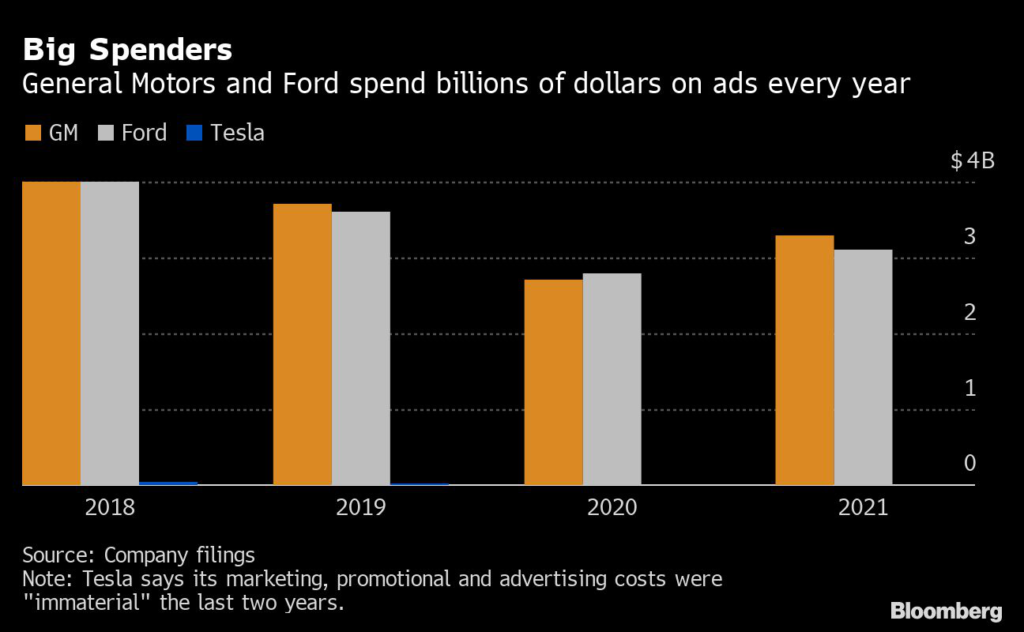
Ford is one of the nation’s biggest advertisers, spending $3.1 billion last year promoting its products. But Farley wants to emulate Tesla Inc., which controls the US market for EVs despite not buying traditional advertising. He said Ford hasn’t needed to advertise its new F-150 Lightning plug-in pickup and that it stopped promoting its electric Mustang Mach-E because “it’s sold out for two years.”

“I’m not convinced we need public advertising for” electric vehicles “if we do our job,” Farley said.

Farley, who is spending $50 billion on EVs through 2026, said his company’s advertising budget would be better spent to improve the customer experience for Ford’s car buyers, giving them special service and treatment at dealers throughout the life of their vehicle.

“Our model’s messed up,” Farley said. “We spend nothing post-warranty on the customer experience.”

Farley said Tesla has a cost advantage of $2,000 a car because the electric automaker has a direct sales model that doesn’t include car dealers.

But Farley isn’t looking to do away with dealers, who he contends could be a competitive advantage. He sees their role changing to focus on service after the sale. He also believes dealers will have to do 100% of sales online, with no-haggle pricing.

“Our dealers can do it, but the standards will be brutal,” Farley said. “Their business will change a lot and there will be a lot of winners and losers and, I believe, consolidation.”

More stories like this are available on bloomberg.com

©2022 Bloomberg L.P.

Stocks Fall as Data Show a Still-Hot Economy: Markets Wrap

(Bloomberg) — US equities started the month lower after a strong set of data suggested the Federal Reserve has not yet slowed growth enough to tamp down inflation, while JPMorgan Chase & Co.’s Jamie Dimon warned restrictive policies threaten to tip the economy into recession.

The S&P 500 fell as data showed an unexpected advance in US manufacturing activity as well as exceptionally high job openings, fueling concern the Fed will need to get more restrictive to slow runaway price gains. Financial firms in the index plunged more than 2% after Dimon said private borrowers may be stranded as conditions tighten. 

The yield on 10-year Treasuries spiked higher as traders raised bets on the path for rate hikes. Oil rose ahead of an OPEC+ meeting to discuss supply policy. And tech shares outperformed, led by a 10% surge in Salesforce Inc. The business-software giant jumped the most in nearly two years after raising its forecast in a sign demand remains robust.

The strong data landed in a market where investors are on edge over whether the Fed’s tighter policies will induce a recession, a sentiment underscored by Dimon’s comments. The central bank has twice raised rates since March and signaled it will enact two additional 50 basis-point increases at its next meetings. While some economic data have started to slow, others remain robust enough that investors now see the chances growing for a third 50-point increase. 

“We now find ourselves in a little bit more no man’s land,” Greg Boutle, US head of equity and derivative strategy at BNP Paribas, said on Bloomberg TV. “We are in this kind of a bear market environment yet we haven’t seen recession manifest in a macro data yet. So we still think there is a path for the US economy to have a soft rather than a hard landing.”

Citigroup Inc. strategists said that after a difficult first five months of 2022, the pain may not be over yet for global equity markets. The prospect of downward revisions to earnings estimates is the latest headwind to face stock investors, already rattled by runaway inflation and the potential impact of central-bank tightening aimed at controlling it, the strategists led by Jamie Fahy wrote in a note.

Among individual stock moves, ChargePoint Holdings Inc. slipped as analysts noted that the EV charging network firm’s margins came under pressure due to rising costs and supply-chain disruption. Delta Air Lines Inc. also fell after raising its revenue outlook but warned it likely won’t grow capacity through the year’s end.

Europe’s Stoxx 600 Index extended declines in the wake of euro-zone figures Tuesday that showed a record jump in consumer prices, strengthening the case for the European Central Bank to lift interest rates. Meanwhile, in the US, Treasury Secretary Janet Yellen gave her most direct admission yet that she made an incorrect call last year in predicting that elevated inflation wouldn’t pose a continuing problem.

“Big picture, the market has priced in an economic slowdown but not a recession,” Ned Davis Research strategists Ed Clissold and Thanh Nguyen said in a note. “The timing and magnitude of any Fed pivot is the biggest factor in determining whether the rally can continue deep into the second half of the year. Another hurdle for the market is that earnings estimates appear vulnerable to further downward revisions.”


How will markets be affected by the Fed’s quantitative tightening? QT officially starts Wednesday and is the theme of this week’s MLIV Pulse survey. Click here to participate anonymously.

Here are some key events to watch this week:

  • The Federal Reserve is set to start shrinking its $8.9 trillion balance sheet Wednesday
  • The Fed releases its Beige Book report on regional economic conditions Wednesday
  • OPEC+ virtual meeting Wednesday
  • Cleveland Fed President Loretta Mester discusses the economic outlook Thursday
  • US May employment report Friday
  • The UN’s Food and Agriculture Organization releases its monthly food price index at a time of maximum concern about global supplies on Friday

Some of the main moves in markets:

Stocks

  • The S&P 500 fell 1.2% as of 12:15 p.m. New York time
  • The Nasdaq 100 fell 1.1%
  • The Dow Jones Industrial Average fell 1%
  • The MSCI World index fell 1.1%

Currencies

  • The Bloomberg Dollar Spot Index rose 0.6%
  • The euro fell 0.8% to $1.0645
  • The British pound fell 1% to $1.2474
  • The Japanese yen fell 1% to 130.00 per dollar

Bonds

  • The yield on 10-year Treasuries advanced eight basis points to 2.93%
  • Germany’s 10-year yield advanced six basis points to 1.19%
  • Britain’s 10-year yield advanced five basis points to 2.16%

Commodities

  • West Texas Intermediate crude rose 1.1% to $115.93 a barrel
  • Gold futures rose 0.1% to $1,850.80 an ounce

More stories like this are available on bloomberg.com

©2022 Bloomberg L.P.

Tim Hortons App Tracked People Illegally, Canada Watchdogs Say

(Bloomberg) — Tim Hortons, the ubiquitous Canadian coffee chain owned by Restaurant Brands International, violated Canadian privacy rules by tracking its customers’ movements with its mobile app even when the app wasn’t in use, a government investigation found.

The company was told Wednesday to shut off that capability after an investigation by federal and provincial authorities found that the Tim Hortons app “misled many users to believe information would only be accessed when the app was in use.”

“In reality,” the authorities said, “the app tracked users as long as the device was on, continually collecting their location data. The app also used location data to infer where users lived, where they worked, and whether they were traveling. It generated an ‘event’ every time users entered or left a Tim Hortons competitor, a major sports venue, or their home or workplace.”

The investigation also found that Tim Hortons “continued to collect vast amounts of location data for a year after shelving plans to use it for targeted advertising, even though it had no legitimate need to do so.”

Concerns about the Tim Hortons app were first raised in a 2020 newspaper report by the Financial Post, which revealed that the app had collected a vast trove of data on its users.

Tim Hortons says it will implement the recommendations in the report. They include deleting any remaining location data and directing third-party providers to do the same; establishing and maintaining a privacy management program; and reporting back to the authorities with details on the measures it has taken to comply with the recommendations.

The joint investigation was conducted by the privacy commissioner of Canada and provincial authorities in Quebec, British Columbia and Alberta.

More stories like this are available on bloomberg.com

©2022 Bloomberg L.P.

Bank of England Says Stablecoins Aren’t Stable for Investors

(Bloomberg) — Stablecoins that are meant to be an alternative to traditional currencies aren’t steady enough for widespread use by consumers, a Bank of England official said.

Andrew Hauser, executive director for markets at the UK central bank, said the digital currencies such as TerraUSD and Tether lack real-time information about their value and details about how they maintain convertibility. 

“Stable they are not,” Hauser said Wednesday in a text of remarks prepared for a panel hosted by the Federal Reserve Bank of New York. “Holders of such coins must accept at least the possibility of finding themselves badly out of pocket.”

The remarks are part of the BOE’s effort to build the case for regulating digital currencies, which they see as an increasing risk to the financial system. The $1.7 trillion market is now bigger than the subprime mortgage were when they upended global markets in 2008.

TerraUSD and Tether once were key to the digital currency system, offering users a predictable way of trading money. Yet the former saw its value recently fall to zero over the course of a few days, while the latter dropped below parity. Hauser said that regulators will take a greater interest in the securities as their use grows.

“Buyer beware warnings may be sufficient for coins that are only in niche use, but they cannot be enough for any that reach systemic scale,” Hauser said.

Those rules may require issuers to back such coins with deposits at the central bank, he said. His remarks also covered a number of other digital currency topics, noting that:

  • A “central bank digital currency” or CBDC for retail investors could have big implications for bank balance sheets
  • Monetary policy would be affected by governments issuing a CBDC because digital currencies don’t fund loans at the moment
  • Central bank balance sheets probably would shift if CBDCs were in use
  • “CBDCs, if adopted, would be the first new type of central bank liability for centuries. They could have important implications for the size, composition and risk profile of our balance sheets; for the monetary policy transmission mechanism, and for monetary control. We need to understand these effects, and build them into the design of CBDCs”


More stories like this are available on bloomberg.com

©2022 Bloomberg L.P.

Oman Backs U.S. Firm Mining Crypto to Cut Gas Flaring

(Bloomberg) —

Oman’s sovereign wealth fund took an equity stake in a U.S. firm that says it helps fossil-fuel producers cut flaring by using stranded natural gas to power cryptocurrency mining instead. 

Oman Investment Authority was part of the $350 million equity round that Crusoe Energy Systems Inc. raised in April, according to a statement. Ismail Ibrahim Al-Harthi, senior manager of technology investments at Oman Investment Authority, said the firm’s policy doesn’t comment on the size of stakes. Crusoe also declined to reveal terms.

Denver-based Crusoe will open an office in Muscat, Oman, to help deploy power generators and mining equipment for capturing gas at well sites, said Chief Executive Officer Chase Lochmiller. The Middle East and North Africa account for about 38% of the world’s flaring — the burning of excess natural gas from oilfields. The practice has come under fire for releasing harmful greenhouse gases and worsening climate change. 

“We’ve always felt it was important for us to have a presence in the MENA region,” given its share of global flaring, Lochmiller said. “Having the buy-in from nations that are actively trying to solve the flaring issues is what we are looking for.”

Crypto mining has come under scrutiny for being energy intensive and reliant on burning natural gas. Crusoe, meanwhile, has faced criticism from climate experts who say the fact the company uses gas that would otherwise go to waste doesn’t negate the fact that it burns fossil fuel to mine crypto.  

The company, which keeps all the coin it mines, focuses on setting up shop in remote areas where it’s not economically feasible to build infrastructure to cut flaring. 

Crusoe held a workshop in Oman on Monday with the country’s biggest producers, including OQ SAOC and Petroleum Development Oman. The first Middle East pilot will be launched by year-end or early 2023, Lochmiller said. While the drop in Bitcoin prices “certainly has some impact on our top-line revenue, it doesn’t impact any plans for growth and expansion.”  

The Oman government, which signed on to the World Bank’s initiative to end routine flaring by 2030, invested in Crusoe early last year, then increased that stake with the April round, Al-Harthi said in a phone interview.

“Oman is committed to reduce greenhouse gases in line with the Paris climate agreement,” Al-Harthi said in an emailed statement.

(Adds context in the fifth paragraph.)

More stories like this are available on bloomberg.com

©2022 Bloomberg L.P.

Mercedes Doubles GLC’s Electric Range as Emissions Rules Bite

(Bloomberg) — Mercedes-Benz AG’s revamped GLC plug-in hybrid will go twice as far in electric-only mode as its predecessor to keep pace with increasingly stringent regulations on tailpipe emissions.

The new version of Mercedes’s best-selling model can cover a distance of more than 100 kilometers (62 miles) on just the battery, the company announced Wednesday. The sport utility vehicle will only be offered as a mild or plug-in hybrid, helping the German manufacturer meet European Union emissions targets while still delivering plenty of high-end gas burners such as the G-Wagon.

“As the best-selling Mercedes-Benz model in the last two years, it is one of the most important vehicles in our product portfolio,” said Britta Seeger, Mercedes’s board member responsible for sales.

Mercedes and other automakers are relying on the profitability of bigger combustion-engine models to help fund their transition to a battery-powered future. While the company launched an all-electric version of its flagship S-Class last year, its biggest money makers typically include the G-Class and high-performance AMG models.

The manufacturer plans to pare back its suite of entry-level cars and channel more than three-quarters of its investment to higher-end vehicles. Mercedes also has pledged to spend more than 40 billion euros ($43 billion) this decade to electrify its lineup and halve greenhouse-gas emissions by the end of the decade from 2018 levels.

Mercedes hasn’t yet released a starting price for the new GLC. The current model starts at around 48,000 euros in Germany.

More stories like this are available on bloomberg.com

©2022 Bloomberg L.P.

Inside Twitter, Shuffled Jobs and Elon Musk Tweets Dampen Morale

(Bloomberg) — Twitter Inc. employees are enduring the whiplash of public commentary from the social network’s future owner, a changeover in leadership and a hiring freeze. On top of all that, some will be assigned new jobs as the company shifts away from its riskier projects.

Executives told workers of plans to pull back resources for some long-term ambitions, including audio spaces, newsletters and communities, in favor of focusing on more immediate needs, like user growth and personalization efforts, according to people familiar with the matter. That means many employees will be shuffled within the company’s consumer product group, the people said. 

Jay Sullivan, who took over product leadership earlier this month when Chief Executive Officer Parag Agrawal fired the division’s prior boss, is leading the restructuring. Employees speculate about layoffs, though none are planned, according to the company. 

“We are making some updates to our consumer product team structure and roadmap to better focus on the areas that will have the greatest positive impact to the public conversation,” a Twitter spokesperson said in a statement.

Teams inside Twitter continue to work on an edit button feature, a person familiar with the matter said. The aim is to release the update later this year, allowing users to edit a tweet within a time-limited window of sending it. The tweet’s prior history will also be available to view, the person said.

It may be months before Twitter is under the control of its future owner, Tesla Inc. CEO Elon Musk. The world’s richest man agreed to acquire Twitter for $54.20 per share in late April, a price that values the company around $44 billion, but the deal has not yet closed. Employees are struggling with squaring what might be the best financial outcome for shareholders, including themselves, with the chaos of working through the wait.

Musk’s constant tweeting, including trolling of Twitter employees, has complicated the feeling. Workers’ messages in internal Slack groups show Musk has alienated many of them by criticizing Twitter’s policies around speech and harassment and singling out the company’s top lawyer, Vijaya Gadde, who is well-liked internally. 

Musk gave employees even more reason for consternation this week after he apparently sent an email to staff at Tesla with a subject line: “Remote work is no longer acceptble” [sic]. He said that “anyone who wishes to do remote work must be in the office for a minimum (and I mean *minimum*) of 40 hours per week or depart Tesla. This is less than we ask of factory workers.” Such a policy would run counter to Twitter’s current stance, which is one of the most prominent big tech companies to allow most employees to work from home permanently. 

In one internal discussion shortly before Twitter’s board accepted the deal, an employee asked if anyone was “excited about the idea of having Elon on board?” The question prompted 446 replies from dozens of employees over three days, many of them negative, according to posts reviewed by Bloomberg. Some replied that Musk didn’t seem to grasp the challenges Twitter faces around speech, or building a social network more generally. Others were excited about Musk, or at least felt his deal was a better option than staying the current course or selling to private equity.

Twitter executives have used recent staff meetings to explain that the company’s board has a fiduciary duty to find the best possible outcome for shareholders. In a recent thread, an employee wrote that Musk “puts the douche in fiduciary.”

News reports on May 19 from Insider that Musk settled a sexual harassment claim with a former SpaceX employee for $250,000 led to a new wave of internal posts. 

“Is there going to be any response from Twitter leadership around Elon Musk’s alleged sexual harassment and sexual violence here?” one employee asked on Slack. “As a woman working at Twitter, I find this radio silence extremely disheartening.” Twitter’s executives have yet to address the news story with employees, according to two sources. 

When Musk sent a recent tweet about former CEO Jack Dorsey leaving the company’s board, he included a sexual joke that also seemingly mocked the recent harassment report. Dorsey replied with a tweet of his own that included a horse emoji, presumably a nod to a reported detail that Musk offered to buy the victim a horse in exchange for an erotic massage. That exchange also made it to Twitter’s internal message boards. “Doesn’t everyone feel so proud?” a Twitter employee posted, mockingly.

In addition to the uncertainty around the reorganization and the reaction to Musk’s unpredictable tweeting, workers are also grappling with a hiring freeze and other cost cutting measures Twitter has implemented to stabilize the business during a tumultuous time for the broader economy. Those reductions included rescinding offers that had already been made to some prospective new employees. 

In one instance, a worker planning to join Twitter’s office in Mexico City from the Bay Area learned just four days before his start date that his job offer had been recalled. That sent him scrambling to get his old job back, and immediately soured his opinion on the company he was excited about.

“I told [Twitter’s] lawyers ‘don’t talk to me for the future. Don’t consider me for anything for the future,’” the person said. “I don’t ever want to hear the word Twitter.”

More stories like this are available on bloomberg.com

©2022 Bloomberg L.P.

Italy’s Open Fiber in Talks on Carrying Branson’s Virgin Brand

(Bloomberg) — Italian network operator Open Fiber SpA is in talks on a broadband deal with a group that holds rights to billionaire Richard Branson’s Virgin brand, people familiar with the matter said.

If the accord goes ahead, Open Fiber could begin offering Virgin-branded broadband service in Italy as soon as this summer, the people said. The deal could also include TV programming, they said.

Tom Mockridge, the former chief executive officer of Virgin Media in the UK, may have negotiated the license deal with London-based Virgin Group, one of the people said. The new brand could be dubbed Virgin Fibra, the people said.

The Virgin brand is already licensed to London-based cable group Liberty Global Plc for the UK and Ireland, and to Spanish telecoms company Euskaltel, in a deal set up by acquisition firm Zegona Communications Plc, which is run by former Virgin Media UK executives. The Italian venture is not related to Liberty Global, a company spokesman said.

Mockridge, a one-time lieutenant of media mogul Rupert Murdoch, played a key role in setting up Italy’s first pay-TV service, Sky Italia, and he’s based in the country, according to his LinkedIn profile. In 2020 he founded Milan-based telecoms company Fulmine in Mano, where he serves as chairman.

Representatives for Open Fiber and Virgin Group declined to comment for this story. Representatives for Euskaltel and Zegona didn’t immediately respond to a request for comment. Mockridge declined to comment. 

Italy already has one of the world’s most competitive telecoms markets, so the arrival of a new player could pose a serious threat to existing carriers. France’s Iliad SA moved into the Italian mobile sector in 2018, and its positioning as a cutthroat, no-frills specialist sparked a price war that led to three profit warnings from ex-monopolist Telecom Italia SpA last year. 

Recent developments, however, may favor Open Fiber as it looks to sell Virgin-branded services. Telecom Italia earlier this week signed a preliminary deal to combine its grid with Open Fiber’s, in a bid to create a single national network and fulfill a plan sponsored by Prime Minister Mario Draghi.


More stories like this are available on bloomberg.com

©2022 Bloomberg L.P.
Father of VIX Wades Into Bitcoin ETF Battle to Back Grayscale Bid

(Bloomberg) — The man who created Wall Street’s favorite fear gauge is throwing his support behind Grayscale Investments LLC’s bid to turn the world’s biggest Bitcoin fund into an exchange-traded product.

Robert Whaley, who created the Cboe Volatility Index in 1993, said in a May 25 letter to the Securities and Exchange Commission that officials should approve the firm’s application to convert the $20 billion Grayscale Bitcoin Trust (ticker GBTC) into an ETF. He joins thousands of other letter-writers after Grayscale launched a campaign to solicit comments to the SEC.

Whaley’s argument centers on the fact that the SEC allowed the ProShares Bitcoin Strategy ETF (BITO), the first US Bitcoin derivatives-backed fund, to launch in October, while repeatedly denying applications for physically-backed crypto ETFs. He compared the returns of the Chicago Mercantile Exchange’s index of Bitcoin futures, which BITO tracks, to those of the CoinDesk Bitcoin Price Index, which GBTC would follow, from January through May 25 and found that the two are “near perfect substitutes.” 

Future-based ETFs have to factor in the cost of continuously rolling forward contracts as they expire, which only strengthens the case for a spot Bitcoin ETF, Whaley wrote.

“Futures-based Bitcoin ETFs like BITO are a much more costly and inefficient way for investors to access Bitcoin compared to what would be a more transparent and well-designed spot-based Bitcoin ETP like GBTC,” Whaley, a finance professor at Vanderbilt University in Nashville, wrote in the letter. “Because the Commission has already approved futures-based Bitcoin ETFs, it must implicitly be comfortable with a spot-based Bitcoin ETP like GBTC.”

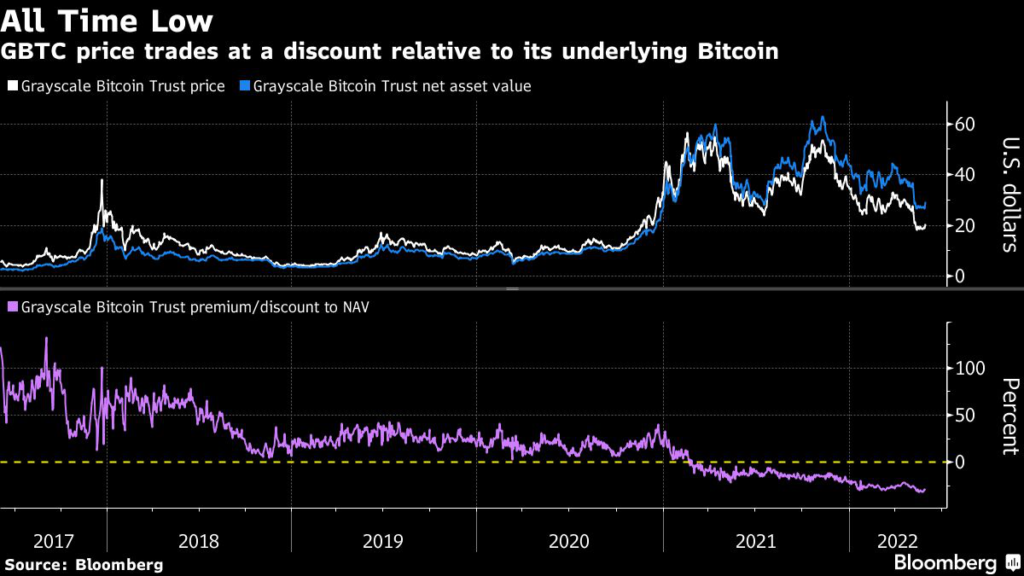
Accounting for delays, the SEC has until early July to make a decision on the application, which was filed in October. Grayscale met with the SEC last month on the topic. Since GBTC is a trust, not an ETF, shares can’t be redeemed as demand cools — leaving GBTC at a discount relative to the Bitcoin it holds. Converting the trust into an ETF would unlock as much as $8 billion in value, should the discount be repaired, Grayscale said last month.

Should the SEC reject the application, the company wouldn’t rule out a lawsuit challenging the decision, Grayscale Chief Executive Officer Michael Sonnenshein said in March. There’s little indication that the regulator’s stance has changed — just in the last week, it denied an application from One River Asset Management to launch a spot Bitcoin ETF.

More stories like this are available on bloomberg.com

©2022 Bloomberg L.P.

Snoop Dogg Buys Two NFTs Created By Ex-Trader at Barclays

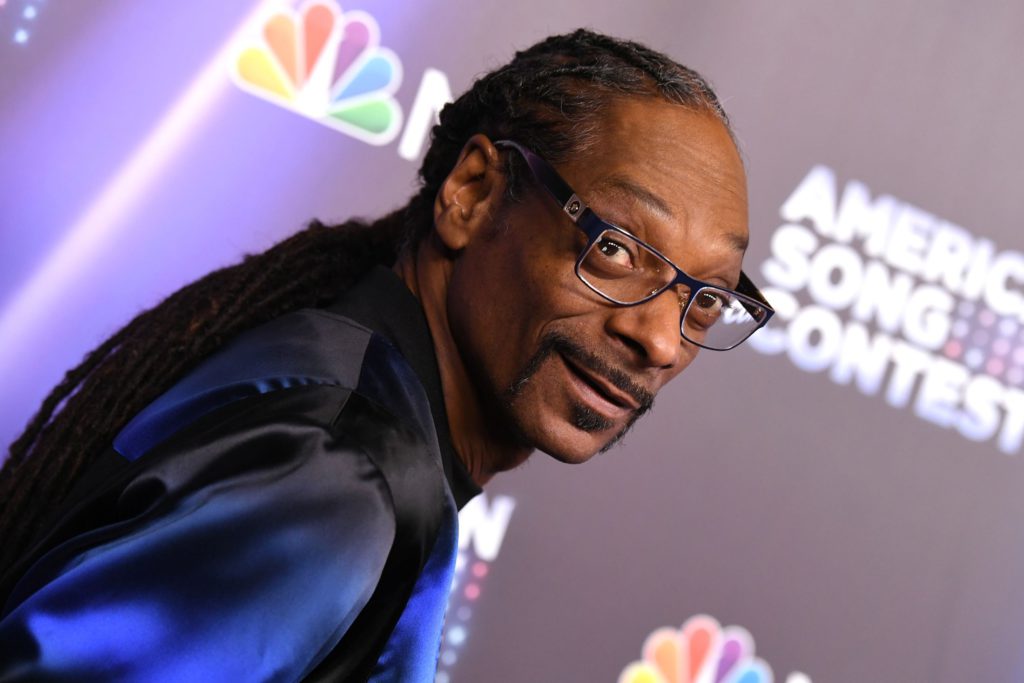
(Bloomberg) — Rapper Snoop Dogg has bought two of the nonfungible tokens created by former Barclays Plc trader Ovie Faruq. 

The tokens, part of a collection called “rektguy,” were bought by Snoop Dogg on May 28, Faruq said. Snoop Dogg didn’t immediately respond to a request for comment, though the two NFTs are now listed on a verified account for Snoop Dogg’s Death Row Records on NFT platform opensea.io. Snoop Dogg also tweeted “Got #Rekt” on the day with an image of the NFT and made it his profile picture on Twitter. 

NFTs, or digital collectibles, have soared in value in recent years, drawing investment from venture capitalists such as Andreessen Horowitz and attention from celebrities ranging from Paris Hilton to Reese Witherspoon. A part of the cryptocurrency market, they have fallen in value along with Bitcoin and Ether — the token of choice for trading NFTs — in recent weeks.

“I’ve had some success with my art this year, but it was with people within the crypto and NFT community, so it was incredible to have someone so high profile buy it unsolicited,” Faruq said. “It hasn’t really sunk in yet.” 

Snoop Dogg bought the two NFTs for 0.38 Ether ($760) each. Other rektguy NFTs are now trading higher on opensea.io and are being quoted between 0.7-0.9 Ether. 

Faruq and colleague Mike Anderson, who go by the pseudonyms OSF and Mando online, left Barclays earlier this year to trade NFTs. They have amassed a collection that includes several Bored Ape Yacht Club NFTs.  

“I also imagine I will get a lot more eyes on my art and it has given Mike and myself a real opportunity to build something out of it,” Faruq said. 

Faruq said the NFT market has been hit hard by the volatility in the crypto space, with prices for some tokens falling more than 50%. 

“This market is always going to be volatile and correlated with tech stocks,” he said. “We believe, with regulation, it will become a more stable and fundamentally solid market in the medium term.” 

More stories like this are available on bloomberg.com

©2022 Bloomberg L.P.

Close Bitnami banner
Bitnami