Bloomberg

Google and France’s Engie Team Up to Accelerate Wind Power

(Bloomberg) — French utility Engie SA will begin using an experimental technology from Google that aims to boost efficiency and power from wind farms, the companies announced on Wednesday.

Google is selling the service through its cloud division, which is trying to lure clients with tools for managing energy usage and reducing emissions. In 2019, Google said it worked with DeepMind, a sister company of parent Alphabet Inc., to make artificial intelligence software that could predict wind power output thirty-six hours in advance. That would let energy providers schedule inputs into energy grids ahead of time with more accuracy, countering some of the unpredictability of wind generation. Early tests on Google’s data centers improved the value of wind energy by 20 percent, according to Google.

For utility customers, Google’s AI service offers forecasts that can sharpen their decisions when they buy and sell in energy markets, said Larry Cochrane, director of global energy solutions for Google Cloud. “The best way to think about it is as a trading recommendations tool,” he said.

Engie will be the first customer to use Google’s feature, starting with the utility’s wind portfolio in Germany. If the pilot program is successful, the companies plan to expand across Europe, Cochrane said. The companies did not share financial terms. According to Cochrane, Google may soon offer similar forecasting services for other renewable markets like solar power and storage.

The French utility plans to more than double its renewable power generation to 80 gigawatts by 2030, despite a recent uptick in prices for solar panels and wind turbines. Previously, Engie has publicized its work with Amazon Web Services, a Google cloud rival.

More stories like this are available on bloomberg.com

©2022 Bloomberg L.P.

A Flurry of Deals Ahead of the Jubilee Weekend: The London Rush

(Bloomberg) — Here’s the key business news from London-listed companies this morning.

GSK Plc: The pharma giant took another step toward spinning off its consumer health-care unit, picking July 18 for its London listing.

  • The unit makes products like Panadol painkillers and Sensodyne toothpaste and is currently a joint venture between GSK and Pfizer Inc, with GSK holding 68% and Pfizer the rest

John Wood Group Plc: The engineering company agreed to sell its Built Environment consulting business to WSP Global for gross proceeds of about $1.9 billion.

  • The unit helps governments and companies assess environmental risks, and the proceeds of the sale will be used to cut debt

Tullow Oil Plc: The Africa-focused oil and gas developer will merge with Capricorn Energy Plc, creating a new business with what Capricorn’s CEO called “significant scale and opportunities for growth”.

  • Capricorn investors will get 3.8068 new Tullow shares for each Capricorn share they hold under the merger, while Tullow shareholders will own about 53% of the combined company

BT Group Plc: The British telecommunications company’s joint venture with Warner Bros. Discovery Inc will face scrutiny by the UK’s competition and markets authority.

  • BT announced the deal last month which would sell its pay-TV Sports operations to the American media giant, creating a 50-50 sports broadcasting joint venture in the process

Outside The City

Conservative MPs war-gaming how a rebellion against Boris Johnson might play out are worried the prime minister could respond to an attempted coup by calling a general election.

Meanwhile, UK consumers are being urged to brace for inflation getting worse before it gets better as soaring costs force retailers to keep raising prices, according to a survey by the British Retail Consortium. 

In Case You Missed It 

HSBC Holdings Plc is offering UK-based employees the chance to lease electric vehicles, including Teslas, with their pretax paychecks, as the lender introduces a popular way for workers to cut their travel emissions.

And Britain is taking school snobbery to new heights, writes Bloomberg Opinion’s Therese Raphael. 

Looking Ahead

Much of the UK will be putting their feet up for the rest of the week for the Jubilee weekend.

London will get back to work after that with a busy week of earnings including cigarette-maker British American Tobacco Plc, airline Wizz Air Holdings Plc and derivatives dealer CMC Markets Plc.

More stories like this are available on bloomberg.com

©2022 Bloomberg L.P.

Nomura M&A Banker Chung Joins Crypto Firm Riot Blockchain

(Bloomberg) — Riot Blockchain Inc., a Bitcoin infrastructure company, has hired investment banker Jason Chung from Nomura Holdings Inc. as its head of corporate development.

Chung, until recently a Hong Kong-based managing director at Nomura, has joined Castle Rock, Colorado-based Riot Blockchain, the crypto firm said in a statement on Wednesday, confirming an earlier Bloomberg News report. He will also help on financing strategy.

The former banker has been working on mergers and acquisitions at the Japanese lender since 2014, first based in New York and then in Hong Kong, according to his LinkedIn profile. Prior to that, he spent about eight years with Societe Generale SA.

Riot Blockchain has the largest Bitcoin mining and hosting facility in North America through its subsidiary Whinstone U.S., according to its website. The company was a biotech testing equipment maker until it renamed itself in 2017 to reflect a new focus on buying cryptocurrency and blockchain businesses. It reported a net loss of $7.9 million in 2021, narrowing from $12.7 million net loss a year earlier. 

Shares of Riot Blockchain have plunged about 68% this year in New York as Bitcoin prices slid. The company has a market value of about $913 million.

The departure of Chung follows that of other investment bankers and lawyers who are leaving Wall Street to join fast-growing crypto companies.

In February, Binance Holdings Ltd. tapped Vishal Sacheendran, a former Bank of New York Mellon Corp. banker, as its director of Middle East and Africa. Robbie Nakarmi, the crypto firm’s senior counsel in Dubai, joined late last year after almost a decade as a M&A lawyer. Citigroup Inc.’s Lee Smallwood, chief operating officer for markets in North America, left after six years with the bank to join Hivemind Capital Partners, the crypto investment firm founded by former Citi executive Matt Zhang.

(Updates throughout with Riot Blockchain’s confirmation)

More stories like this are available on bloomberg.com

©2022 Bloomberg L.P.

EV Sales Will Triple by 2025 and Still Need More Oomph to Reach Net Zero

(Bloomberg) — Electric vehicle sales are poised to more than triple by 2025, and yet governments and manufacturers need to lean even harder into eliminating emissions from road transportation by the middle of this century, according to BloombergNEF.

The research firm lays out the stakes and calls for action in its seventh annual Long-Term Electric Vehicle Outlook, released Wednesday. BNEF’s analysts deem EVs “a remarkable success story,” predicting plug-in passenger vehicle sales will soar to 20.6 million in 2025, much higher than its 14 million forecast just a year ago, mainly due to faster uptake in China.

Yet for all the progress, replacing the 1.2 billion passenger vehicles on the road that run on internal combustion engines takes time. Just over two-thirds of the global fleet will be zero-emission by 2050, if no new policies or regulations are enacted. Heavier commercial vehicles are on track to trail far behind, with only 29% of the fleet decarbonizing on that timeline.

“Despite the rapid rise in EV adoption, road transport is still not on track for carbon neutrality by 2050,” analysts led by Colin McKerracher, BNEF’s head of advanced transport, write in the report. “Aggressive action from policymakers will be required, especially on heavier vehicles where both batteries and hydrogen fuel cells are vying for a place in the market. The window to stay on track for net zero is closing quickly.”

The 201-page report covers the gamut of opportunities electric vehicles present, the impact they may have and the risks they face. It also highlights how governments can make the challenging transition easier by combatting car dependency. If the amount of miles traveled by passenger vehicles and size of the fleet is just 11% lower than what BNEF is modeling for 2050, it would spare the world 2.25 gigatons of cumulative CO2 emissions and reduce the strain on battery supply chains.

Read more: Battery Metal Prices Could Keep EVs Costly for Years

With EVs attracting growing consumer interest, worldwide sales of internal combustion engine vehicles peaked in 2017 and are now in permanent decline, according to BNEF. The global fleet of combustion cars on roads will start to shrink in 2024, and by the following year, deliveries will have dropped roughly 19% from their high point.

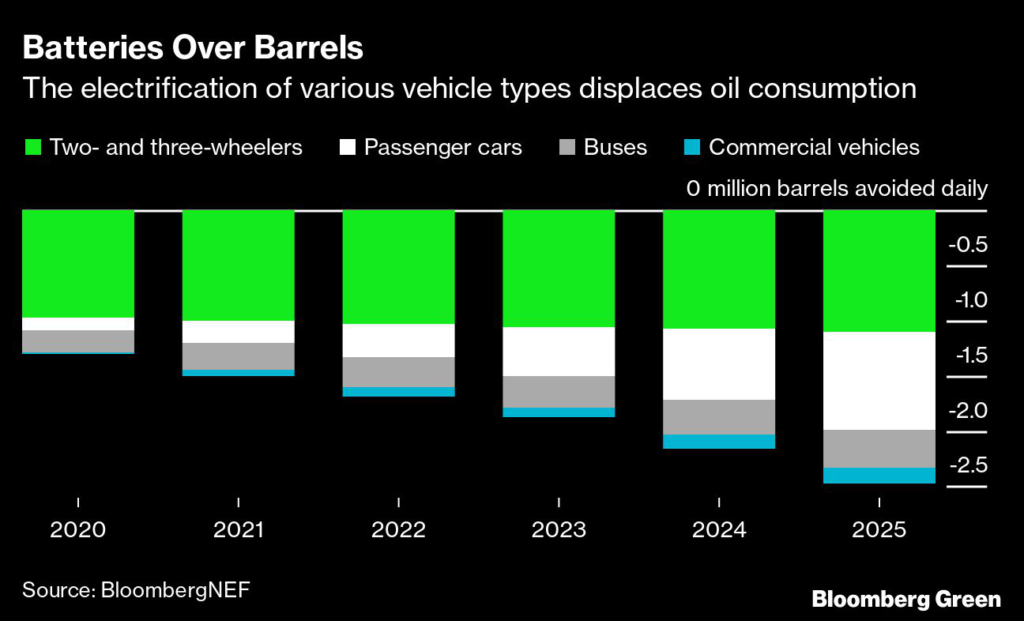
In their place, all types of EVs — two- and three-wheelers, buses, passenger and commercial vehicles — are together already displacing 1.5 million barrels of oil a day, and should displace almost 2.5 million barrels daily by 2025. BNEF expects gasoline demand to peak in 2026, and total oil demand from road transport to crest the following year.

EV penetration is also moderating the rise in road transport emissions from the trough reached during the first year of the pandemic in 2020. Still, the amount of CO2 emitted is poised to rise for two years after oil demand peaks, due to additional emissions from power plants supplying electricity to the fleet.

In its scenario forecasting how transport will transition if the industry is left to economic trends and market forces, BNEF sees Germany, the UK, France and China coming close to fully phasing out combustion vehicle sales by 2038. The US, Japan and Australia would have catching up to do, while India, Southeast Asia and the rest of the world are even further back.

The researcher outlines a number of policies authorities should implement to move toward a net-zero emission trajectory. Across all segments, governments should set a no later than 2035 phase-out date for sales of new combustion vehicles. Fuel-economy and battery-recycling standards ought to be stricter, and policy makers may want to consider shifting some subsidies to supporting the build up of charging networks.

BNEF flags a number of concerns including the growing gap in EV uptake between wealthy and emerging economies, insufficient charging infrastructure and the potential for tight supply of battery raw materials to raise vehicle sticker prices. The researcher singles out countries and regions including India, Southeast Asia, Mexico, Brazil, Turkey and Russia for slow EV uptake.

“Without additional policies in those countries, the net-zero trajectory will remain out of reach for global road transport,” the analysts write. “Air quality in urban areas is already markedly different between wealthy and emerging economies, and this gap will widen further” unless EV adoption improves.

Under BNEF’s net-zero scenario, $1.4 trillion of investment will be needed to build out charging infrastructure by 2040. It will be a challenge scaling up networks quickly enough to keep pace with EV uptake, especially in the US, where average annual public charging installs need to increase sixfold in the next four years.

On the battery front, BNEF sees little slack in supplies of lithium, cobalt, manganese and nickel — the key EV battery ingredients — this decade. Battery production lines, which China will continue to dominate, must sustain unprecedented growth to keep pace with demand.

The point when pack prices will drop below $100 per kilowatt hour — a widely cited benchmark around which battery costs are competitive with combustion engines — is now less certain because of significant cost pressures.

“If raw material prices remain elevated or climb further, this could delay the timeline by a couple of years, out from 2024 in most markets,” the analysts write. That said, they don’t expect the rising cost of batteries to derail near-term EV adoption. “Some of the factors that are driving high battery raw material costs — war, inflation, trade friction — are also pushing the price of gasoline and diesel to record highs, which is driving more consumer interest in EVs.”

More stories like this are available on bloomberg.com

©2022 Bloomberg L.P.

Rimac Group Raises $537 Million to Build EVs, Porsches, Bugattis

(Bloomberg) — Rimac Group has raised another €500 million ($536.6 million) to help it build future Porsches, Bugattis, and Koenigseggs.

SoftBank Vision Fund 2 and Goldman Sachs Asset Management led the latest round of funding, which also included Rimac shareholders Investindustrial and Porsche. Mate Rimac, who founded his eponymous company in a garage in 2009, remains the largest shareholder.

“It’s great to have Porsche on board, but also, you know, we don’t want to be fully dependent on them,” Rimac said during a call with reporters on May 31. Porsche holds a 45% stake in Bugatti Rimac, the company formed in 2021 between Bugatti, Porsche, and Rimac.

Formed in January, Rimac Group is an umbrella company that holds a 55% stake in Bugatti Rimac and 100% of Rimac Technology, an independent subsidiary formed in January. (Bugatti Rimac owns 100% of Rimac Automobili, the group’s hypercar division.) Porsche owns the remaining 45% of Bugatti Rimac.

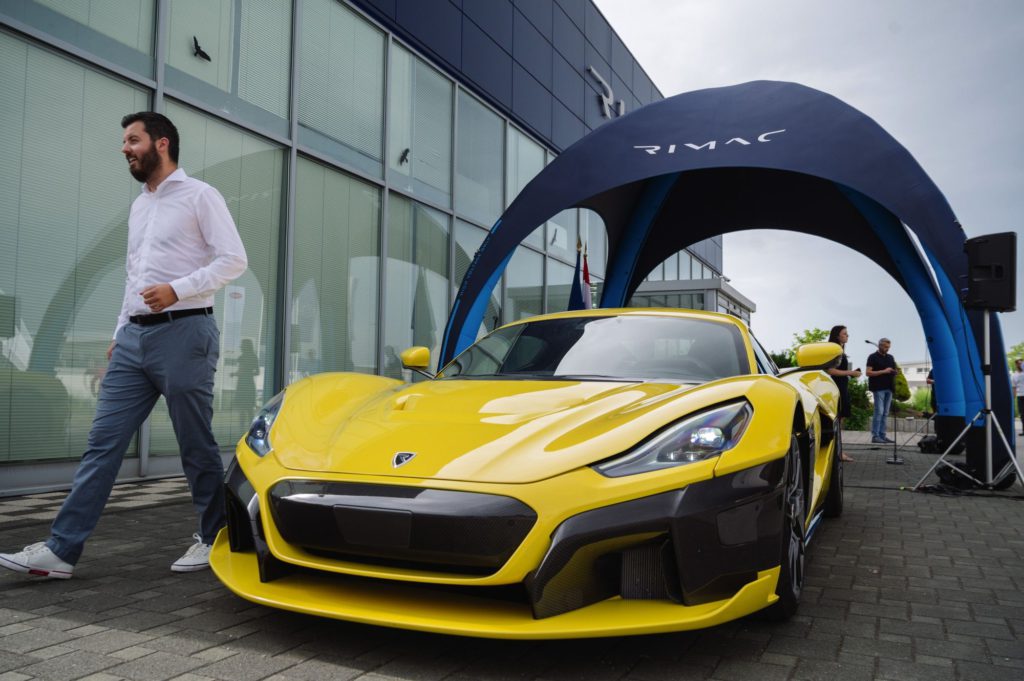
The Croatia-based group oversees the manufacture of such multimillion-dollar supercars as the Bugatti Chiron and Bugatti Bolide, plus upcoming vehicles that bear the Rimac brand name, like the $2.4 million Rimac Nevera electric hypercar. The Nevera will see its first customer deliveries in “the next few weeks,” Mate Rimac said.

It’s also working on unspecified projects for automakers such as Aston Martin, Koenigsegg, and Porsche. A spokesperson declined to comment on specific vehicles.

Mate Rimac said he plans to use the additional funding to hire 700 more workers and by next year complete construction on a campus and factory that can house 2,500 people—the largest such complex in Croatia, according to Rimac. It was unclear how large the campus is, with some Rimac documents claiming 25 acres and others claiming 50 acres. The space will go toward building Rimac-branded supercars, Bugatti supercars, and other high-end vehicles the company declined to name.

“Most of the capital will actually be used for scaling up to meet the demand for batteries and powertrains and the other systems to help the car industry go electric,” Mate Rimac said. Rimac Technology will produce tens of thousands of components annually, with products ranging from hybrid and fully electric battery systems to full rolling chassis, he said. Such vehicles, technology, and components could go to existing clients that have said they will sell hybrid and electric vehicles such as the Koenigsegg Gemera, Aston Martin Valkyrie, and Porsche 718.

“We were already convinced of the company’s potential in 2018 and are pleased that we were able to contribute to its progress and current success with our commitment,” said Lutz Meschke, the deputy chairman of the executive board of Porsche AG, in a statement about the latest infusion of funds. “With new investors on board, Rimac is further expanding its position in electromobility and thus becoming an even stronger partner for Porsche.”

The announcement comes after strong progress for the now not-so-fledgling brand and its uncommonly bold founder. Last year it received 150 orders for Bugatti cars, a record number, which sold out all of its vehicles until 2025. The range-topping $4.7 million Bolide hypercar sold out all of its 40 unit allocations two months after it debuted.

Amid this growth, Rimac batted away rumors that one of its existing partnerships with Hyundai had soured. In 2019, Hyundai and Kia invested $90 million in the Croatian company to develop at least two vehicles with the partnership—a fully electric variant of Hyundai’s N sports car and a performance fuel-cell vehicle. A spokesperson for the company did not immediately respond to a request for comment regarding when production would start for those two vehicles.

“The growth has been quite persistent over time,” Mate Rimac said of the company headcount. “We are doubling basically every one or half, two years.”

Contrary to where the big market is for luxury saloons like Mercedes-Maybach’s S-Class, Rimac’s growth doesn’t come from dealerships in China. Instead, it comes from Europe and North America.

“Affluent Chinese buyers usually don’t buy supercars in China, for different reasons,” he said, noting regulatory challenges that make selling supercars in mainland China complicated and expensive. “They usually buy them in London or in Sydney or in Toronto—in the Western cities where they have their other residences.”

More stories like this are available on bloomberg.com

©2022 Bloomberg L.P.
Bigger Battery Metal Costs Could Keep Electric Cars Expensive

(Bloomberg) — A surge in battery metal prices means it could take several years longer for electric vehicles to become as affordable as conventional cars, according to BloombergNEF.

Prices of lithium, cobalt and nickel have soared in the past year, eating into EV makers’ margins at a crucial point in the development of the burgeoning industry. With demand climbing, they now face a dilemma: swallow the incremental costs, or try passing them on to consumers.

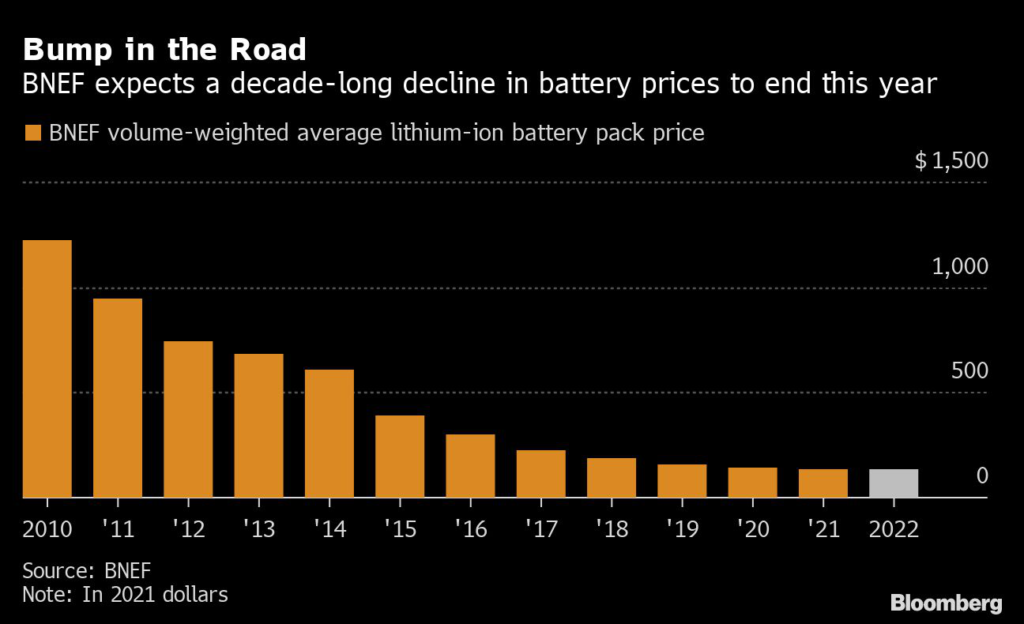
Before the rally, battery prices were nearing levels that would make upfront costs of EVs competitive with traditional cars without state subsidies, BNEF said in a report Wednesday. But that’s now starting to change. Battery pack prices are set to rise this year for the first time in more than a decade, and broader inflation could severely delay a crucial tipping point where average battery prices fall below $100 a kilowatt-hour.

“Reducing battery pack prices to $100 a kilowatt-hour is now an achievable goal with the emerging generation of battery chemistries and cell designs,” BNEF analysts said in the report. “However, if raw-material prices remain elevated, or climb further, this point could be delayed by several years.”

Click here for BNEF’s electric vehicle outlook.

One measure of lithium prices has spiked more than fivefold over the past year, while cobalt and nickel prices also have climbed.

Why an Electric Car Battery Is So Expensive, For Now: QuickTake

There are some signs of relief for carmakers, however, with lithium, cobalt and nickel prices retreating or steadying in recent weeks. And while long-term prospects remain strong, Goldman Sachs Group Inc. expects the price of those three crucial metals to ease in the next two years as producers race to bring on new supply.

At the same time, sticker prices for conventional cars are rising, as well, and high fuel prices are making EVs more attractive.

“The rising cost of batteries does not derail near-term EV adoption,” BNEF analysts said. “Some of the factors that are driving high battery raw-material costs — war, inflation, trade friction — are also pushing the price of gasoline and diesel to record highs.”

More stories like this are available on bloomberg.com

©2022 Bloomberg L.P.

Race for Cheaper EVs May Face Years-Long Setback on Metal Costs

(Bloomberg) — A surge in battery metal prices means it could take several years longer for electric vehicles to become as affordable as conventional cars, according to BloombergNEF.

Prices of lithium, cobalt and nickel have soared in the past year, eating into EV makers’ margins at a crucial point in the development of the burgeoning industry. With demand climbing, they now face a dilemma: swallow the incremental costs, or try passing them on to consumers.

Before the rally, battery prices were nearing levels that would make upfront costs of EVs competitive with traditional cars without state subsidies, BNEF said in a report Wednesday. But that’s now starting to change. Battery pack prices are set to rise this year for the first time in more than a decade, and broader inflation could severely delay a crucial tipping point where average battery prices fall below $100 a kilowatt-hour.

“Reducing battery pack prices to $100 a kilowatt-hour is now an achievable goal with the emerging generation of battery chemistries and cell designs,” BNEF analysts said in the report. “However, if raw-material prices remain elevated, or climb further, this point could be delayed by several years.”

Click here for BNEF’s electric vehicle outlook.

One measure of lithium prices has spiked more than fivefold over the past year, while cobalt and nickel prices also have climbed.

Why an Electric Car Battery Is So Expensive, For Now: QuickTake

There are some signs of relief for carmakers, however, with lithium, cobalt and nickel prices retreating or steadying in recent weeks. And while long-term prospects remain strong, Goldman Sachs Group Inc. expects the price of those three crucial metals to ease in the next two years as producers race to bring on new supply.

At the same time, sticker prices for conventional cars are rising, as well, and high fuel prices are making EVs more attractive.

“The rising cost of batteries does not derail near-term EV adoption,” BNEF analysts said. “Some of the factors that are driving high battery raw-material costs — war, inflation, trade friction — are also pushing the price of gasoline and diesel to record highs.”

More stories like this are available on bloomberg.com

©2022 Bloomberg L.P.
Stocks Fluctuate, Yields Rise on Inflation Debate: Markets Wrap

(Bloomberg) — Stocks in Asia were mixed Wednesday and bond yields extended their advance amid a debate about the scale of monetary tightening to fight inflation.

Equities climbed in Japan as the yen weakened. A pullback in technology stocks and reopening challenges were a drag in Hong Kong. Sluggish Chinese manufacturing data and the government’s pursuit of Covid Zero weighed on shares and the yuan. US futures rose after benchmarks retreated Tuesday.  

Treasuries extended a decline, pushing 10-year yields closer to 2.9% as traders raised bets on Federal Reserve interest-rate hikes. Euro-zone consumer prices jumped 8.1% to a record from a year earlier in May, further spooking investors. The dollar advanced. 

Oil rose to near $115 a barrel as investors assessed the future of OPEC+ unity, just as ministers from the group prepare to meet on Thursday to discuss its supply policy for July. Crude rose after advancing about 10% in May, stoking inflation worries. 


Concerns that central-bank rate hikes may induce a recession are keeping investors guessing about the outlook for the economy as rising food and energy costs squeeze consumers, and volatility has picked up.

“It’s times like these when investors need a crystal ball,” wrote LPL Financial strategists Jeff Buchbinder and Ryan Detrick. “We fully acknowledge how tough it is to see the bull case for stocks right now, and a retest of recent lows is certainly possible, but this week we lay out the bull case for the second half of the year. It starts with inflation.”

President Joe Biden used a rare meeting with Federal Reserve Chair Jerome Powell to declare that he’s respecting the central bank’s independence – while simultaneously shifting responsibility for taming decades-high inflation ahead of the November midterms. The meeting came ahead of US payroll numbers Friday. 

“There are heightened concerns around inflation and where central banks are likely to go trying to combat inflation,” Kristina Hooper, Invesco Advisers chief global markets strategist, said on Bloomberg Radio. “This has gone from just an inflation scare to a growth scare. Uncertainty has grown.”

How will markets be affected by the Fed’s quantitative tightening? QT officially starts Wednesday and is the theme of this week’s MLIV Pulse survey. Click here to participate anonymously.

Here are some key events to watch this week:

  • The Federal Reserve is set to start shrinking its $8.9 trillion balance sheet Wednesday
  • The Fed releases its Beige Book report on regional economic conditions Wednesday
  • New York Fed President John Williams, St. Louis Fed President James Bullard speak at separate events Wednesday
  • OPEC+ virtual meeting Wednesday
  • Cleveland Fed President Loretta Mester discusses the economic outlook Thursday
  • US May employment report Friday
  • The UN’s Food and Agriculture Organization releases its monthly food price index at a time of maximum concern about global supplies on Friday

Some of the main moves in markets:

Stocks

  • S&P 500 futures rose 0.4% as of 1 p.m. in Tokyo. The S&P 500 fell 0.6%
  • Nasdaq 100 futures rose 0.3%. The Nasdaq 100 fell 0.3%
  • Topix index rose 1.2%
  • Australia’s S&P/ASX 200 Index rose 0.1%
  • Hang Seng Index fell 0.8%
  • Shanghai Composite Index was little changed
  • Euro Stoxx 50 futures rose 0.6%

Currencies

  • The Bloomberg Dollar Spot Index rose 0.1%
  • The Japanese yen fell 0.4% to 129.13 per dollar
  • The offshore yuan was at 6.7011 per dollar, down 0.2%
  • The euro fell 0.2% to $1.0718

Bonds

  • The yield on 10-year Treasuries advanced two basis points to 2.86%
  • Australia’s 10-year bond yield rose seven basis points to 3.42%

Commodities

  • West Texas Intermediate crude rose 0.4% to $115.09 a barrel
  • Gold was at $1,836.77 an ounce

More stories like this are available on bloomberg.com

©2022 Bloomberg L.P.
China’s EV Maker WM Motor Said to Weigh $1 Billion Hong Kong IPO

(Bloomberg) — Chinese electric vehicle manufacturer WM Motor Holdings Ltd. is considering raising about $1 billion in a Hong Kong initial public offering, according to people familiar with the matter. 

The company could launch the share sale before the end of the year, said the people, who asked not to be identified as the information is private. Deliberations are ongoing and details including size and timeline could change, the people said.

The firm filed pre-listing documents with the Hong Kong exchange on Wednesday, in an initial step to join a slew of competitors already trading in the Asian financial hub. Large size deals vanished from Hong Kong’s exchange this year as factors including regulatory woes in China, surging inflation and hawkish central banks led several issuers to scrap IPO plans worldwide.

A representative for WM Motor declined to comment. Haitong International Capital Ltd., CMB International Capital Ltd. and BOCI Asia Ltd. are joint sponsors, according to the filing. 

WM Motor was working with financial advisers for an IPO in Shanghai about two years ago, Bloomberg reported then, but an offering didn’t take place. 

Founded in 2015, the Shanghai-based company doubled sales to 44,152 vehicles in 2021 from a year earlier, contributing to a 77.5% jump in revenue, according to the filing. As of March 31, the company had cash and cash equivalents of 3.68 billion yuan ($551 million).

Starting with electrified sports utility vehicles and later turning to sedans, WM is expected to launch a total of five models by 2022, targeting China’s young and tech-savvy users, particularly families, it said. The company has already established two manufacturing bases in Wenzhou in Zhejiang province, and Huanggang in Hubei province, with a total annual production capacity of 250,000 units by completion. 

Chinese EV startups Xpeng Inc., Li Auto Inc. and Nio Inc. are all trading on the Hong Kong exchange, in addition to their US listings, to widen their fundraising channels as well as avoiding potential geopolitical risks from Washington. 

In the meantime, the automotive industry in China, in particular electric vehicle production, has been placed under huge pressure by surging raw material prices, Covid-related disruptions, and cooling economic growth. 

More stories like this are available on bloomberg.com

©2022 Bloomberg L.P.
Korea’s Export Gains Point to Resilience in Global Demand

(Bloomberg) — South Korea’s exports grew at a faster-than-expected pace in May, suggesting global demand remains resilient in the face of war in Ukraine and a slowing economy in China.

Overseas shipments advanced 21.3% in May from a year ago, helped by strengthening car exports, trade ministry data showed Wednesday, exceeding economists’ forecasts for an 18.4% gain. Exports to China rose 1.2% in May after dropping a month earlier. Total semiconductor shipments increased 15%. 

While the monthly figure was stronger than forecast, the gains were inflated by two extra working days in the month compared with a year earlier. Average daily shipments rose 10.7%, for the smallest increase since January 2021, continuing a trend of stabilization in double-digit year-over-year gains.  

Still, the result shows global trade is holding up better than expected as the pandemic recovery continues, despite the impact of Russia’s war in Ukraine, surging commodity prices and supply snarls exacerbated by China’s lockdowns.

“The export growth is impressive given the slowdown in its largest market China and a high base of comparison,” said Ho Woei Chen, economist at United Overseas Bank Ltd. in Singapore. “External demand looks to be supported especially as China’s Covid situation eases.” 

The risks of higher global inflation and withdrawal of policy accommodation on consumer demand still need to be monitored closely going forward, Ho added.

Korea’s manufacturers are positioned widely across global supply chains and the nation’s export data comes out ahead of peers, providing an early pulse check on the strength of world trade.

An economic recovery in the US has helped shore up Korean exports, with demand for technology products such as displays and semiconductors staying resilient. Refined-oil exports have also gotten a boost from higher energy prices.

With an economy heavily reliant on trade, South Korea needs exports to remain strong to maintain economic momentum and provide room for the Bank of Korea to stick to its path of policy normalization. The central bank has raised rates five times since last summer, with the governor signaling more hikes to come.

Demand has been weakening in Europe and China since the Russian invasion and the lockdowns in China under its Covid zero policy. As those restrictions in Chinese cities are eased, trade with China should regain further momentum. 

“Exports to regions where economies are reopening, including the US, EU, the Middle East and Central/South America, are all growing too, making it too early to determine that exports are cooling just yet,” said Ha Keon-hyeong, an economist at Shinhan Investment Corp.

Overall exports to the US gained 29.2%, while those to Japan increased 19.3% and to the European Union were up 23.5%

Total automobile shipments advanced 18.9% in May from a year earlier, three times faster than in April when car exports rose 6.1%. Exports of wireless communications devices rose 8.4%, while shipments of petroleum goods jumped 107.2%.

Overall imports rose 32% from a year earlier, resulting in a trade deficit of $1.71 billion.

(Adds economist comments)

More stories like this are available on bloomberg.com

©2022 Bloomberg L.P.
Close Bitnami banner
Bitnami