

Bloomberg

UN Human Rights Chief to Give Details of Visit to Uyghur Region

(Bloomberg) — The United Nations’ top human rights official will debrief Saturday on her controversial trip to China, including its remote Xinjiang region where the US accuses Beijing of committing genocide. 

Michelle Bachelet will hold a press conference to mark the end of her landmark trip that began Monday, and which she said at its outset was not an “investigation.” 

Bachelet’s visit has been criticized for failing to secure guarantees of unfettered access to Xinjiang, where a 2019 United Nations assessment said an estimated 1 million people have been detained. US Ambassador Nicholas Burns voiced to Bachelet “profound concerns” about Beijing’s attempts to manipulate her trip, according to people on a Monday call who asked for anonymity as they weren’t authorized to speak.

Beijing claims the facilities in Xinjiang are vocational training centers to counter religious extremism and bring prosperity to the region and vehemently denies accusations of genocide, a major source of tension between the world’s two largest economies.

Earlier in the week, President Xi Jinping held a call with Bachelet, an unusual move for a leader who usually speaks with other heads of state that underscored the importance China places on her visit. Chinese state media later said Bachelet praised China’s track record on human rights on the call — something her office later appeared to deny in an emailed “clarification” of her “actual” remarks. 

UN Corrects China on Human Rights Chief’s ‘Actual’ Words to Xi

She also met Chinese Foreign Minster Wang Yi, who was pictured holding a copy of book by Xi on human rights, and addressed students at Guangzhou University, in southern China, on a broad range of topics including human rights and sustainable development.  

Philip Alston, a law professor at New York University School of Law, said on a Friday webinar that despite the criticism Bachelet’s trip was “extremely important” because it put a spotlight on Xinjiang and demanded accountability from China.

The former special rapporteur to the UN Human Rights Council said claims Bachelet had walked into a trap were “silly.” 

“She’s highly experienced, she’s very sophisticated,” he said of the 70-year-old former two-term president of Chile. “She’s totally aware of all of the different political dimensions of what she’s undertaking.”

More stories like this are available on bloomberg.com

©2022 Bloomberg L.P.

Apple Atlanta Workers Drop Bid for Union Vote Next Week, Claiming Intimidation

(Bloomberg) — The labor group trying to organize Apple Inc. employees at an Atlanta store is withdrawing its request for an election, citing what it alleges are illegal union-busting tactics by the company.

The Communications Workers of America said it took the step “because Apple’s repeated violations of the National Labor Relations Act have made a free and fair election impossible,” according to an emailed statement Friday. The labor group also cited Covid-19 infections among staff at the store, located at the city’s Cumberland Mall, which it said “have raised concerns about the ability of eligible employees to vote and the safety of in-person voting.”

“Apple has conducted a systematic, sophisticated campaign to intimidate them and interfere with their right to form a union,” the CWA said. Under NLRB rules, a union’s choice to withdraw from an election generally means the vote is canceled and the union would have to wait at least six months before petitioning again to represent the same group of workers.

The news represents a setback for the nascent efforts by several U.S. unions to organize Apple’s retail stores. In addition to the push in Georgia, workers at stores in New York, Maryland and Kentucky have announced campaigns. The CWA — a group that won elections this year among Verizon Communications Inc. retail employees, Activision Blizzard Inc. quality-assurance testers and subcontracted Google Fiber staff — has said it’s been hearing from numerous Apple workers around the country.

When asked about the move, Apple said it was “fortunate to have incredible retail team members and we deeply value everything they bring to Apple.”

“We are pleased to offer very strong compensation and benefits for full-time and part-time employees, including health care, tuition reimbursement, new parental leave, paid family leave, annual stock grants and many other benefits,” the Cupertino, California-based company said.

In complaints filed last week with the National Labor Relations Board, the CWA accused Apple of violating federal labor law by forcing workers in Atlanta and New York City to attend “captive audience” meetings about unionization.

Existing precedent allows companies to hold such meetings, but the labor board’s current general counsel, Jennifer Abruzzo, views them as inherently coercive and illegal. And she’s pursuing cases that could change the precedent.

Abruzzo, a former CWA attorney, is also trying to resurrect an old doctrine requiring employers to negotiate with a labor group if they have no “good faith doubt” that most employees support the union.

In its statement Friday, the CWA said that it had the support of an “overwhelming majority” of the Atlanta store’s workers when it petitioned in April for an election.

In the weeks since employees announced their organizing efforts, Apple has moved to boost its pay and warned of potential negative consequences from unionization. In a recent video message, Apple retail chief Deirdre O’Brien told employees, “We have a relationship that is based on an open and collaborative and direct engagement.” She said she worried about “what it would mean to put another organization in the middle of our relationship.”

On Wednesday, the company told employees it would hike the minimum pay for its retail staff to $22.

The Apple store’s union organizing committee vowed to press on. “We’re going to reset and strengthen our union,” according to an email sent to workers Friday. “We can share our experience with other stores to help them really prepare for what’s coming their way.”

The Atlanta workers had been slated to vote June 2 through June 4 in what would have been the first NLRB election at an Apple store. Major unions have sometimes been wary of such elections, because of the leeway federal law provides companies to aggressively campaign against organizing. But in recent months, unions pulled off stunning wins at an Amazon.com Inc. warehouse and dozens of Starbucks Corp. cafes across the country, emboldening workers and organizers elsewhere.

“We are dedicated to our work and to supporting each other,” Atlanta employee Derrick Bowles said in a statement shared by the union. “We are on this journey together. We want to create a truly democratic union that aligns with Apple’s public values.”

(Updates with union email in 13th paragraph.)

More stories like this are available on bloomberg.com

©2022 Bloomberg L.P.

EV Startup Electric Last Mile Warns It May Run Out of Cash in June

(Bloomberg) — Electric Last Mile Solutions Inc. warned Friday it may run out of cash in June, at least one month sooner than previously projected, unless it can raise additional capital.

The latest projections reflect higher costs in a number of areas, including employee retention and payments to suppliers, the Troy, Michigan-based electric vehicle startup said in a filing.

“The company expects that, without obtaining additional financing, it has sufficient cash to continue operations into June 2022,” it said in the filing, adding that it was “actively pursuing potential sources of liquidity” to bolster its finances.

Electric Last Mile had said in March that it had enough cash on hand to fund operations through sometime between July and September. The company is under SEC investigation and has been without an auditor since February.

The stock has fallen 90% so far this year as the company faces several financial reporting challenges, including a long-past deadline to file its annual 10-K, a delay in filing its first-quarter 10-Q, and the need to redo, or restate, at least two quarters of past financial statements. Electric Last Mile has until May 31 to submit a plan to Nasdaq outlining how it will regain compliance with its listing rules.

Read more: EV Startup’s Streak With No Auditor Adds to Company’s Woes

More stories like this are available on bloomberg.com

©2022 Bloomberg L.P.
Amazon Shareholders Narrowly Approve Pay Plans for Executives

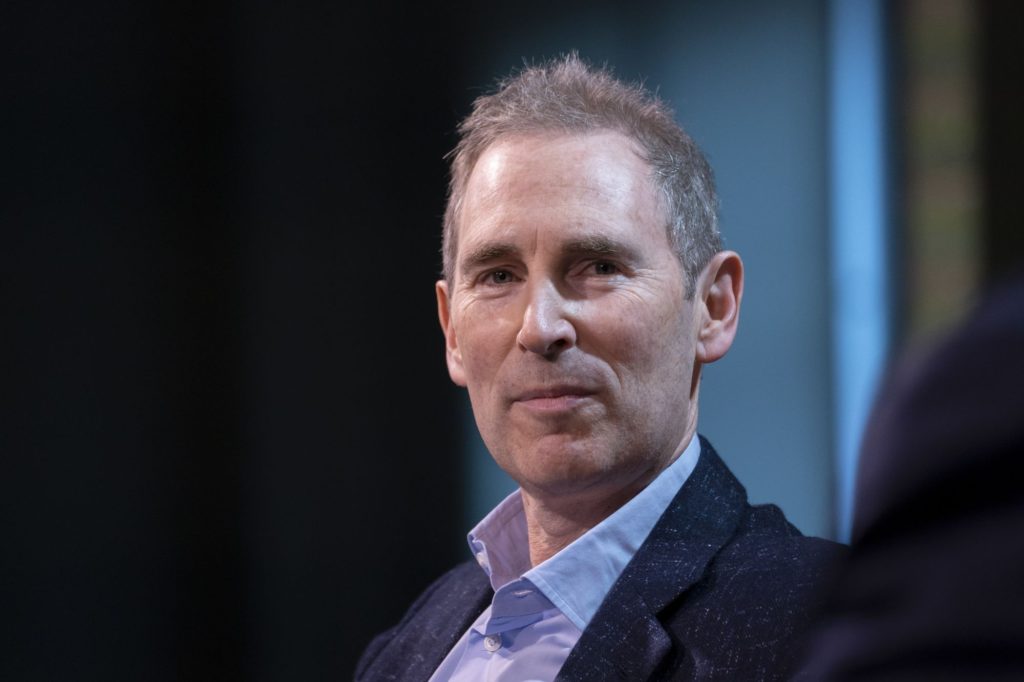
(Bloomberg) — Amazon.com Inc. shareholders delivered a rebuke to the company over the pay for Chief Executive Officer Andy Jassy and other top executives, with an unusually close vote in the symbolic measure to ratify compensation packages for the company’s leaders. 

Vote totals disclosed in a filing Friday show 56% of shareholders supported the company’s executive pay for 2021, which included $350 million in compensation to three top executives, the vast majority of which comes in stock grants that vest over a period of years. Such votes have passed with more than 80% approval for nearly 9 of 10 companies in the S&P 500, according to data for 2022 to date tallied by Farient Advisors. 

Investor advisory firms had recommended shareholders vote against the pay package at Amazon’s annual meeting earlier this week, saying the stock awards were excessive and not tied to company performance. Amazon said its compensation practices are designed to emphasize long-term value rather than short-term goals, and that pay for Jassy, Worldwide Consumer unit CEO Dave Clark, and Amazon Web Services CEO Adam Selipsky were comparable to compensation of leaders of other giant technology and retail firms. 

Last year, 81% of shareholders voted in favor of Amazon’s pay practices. The figure was 97% in each the prior two years. Jassy’s predecessor, founding CEO Jeff Bezos, took only a token salary and received no stock awards. 

All 15 of the shareholder-proposed resolutions failed, but some were close. 

A proposal requesting Amazon produce a report describing how the company could cut its plastics use to reduce ocean pollution garnered 49% of the vote. A resolution asking for more disclosure on Amazon’s lobbying of government officials received 47% of the vote. And a request that Amazon compile a report on working conditions in its warehouses, a focus of shareholder activism amid critiques of Amazon over high injury rates and hostility toward organized labor groups, received 44% of the vote. 

The measures are nonbinding, but Amazon has previously taken cues from investors following close votes. The company this year said it would conduct a racial equity audit of its hourly workforce after a shareholder resolution that requested a similar study received 43% approval at the 2021 meeting.

More stories like this are available on bloomberg.com

©2022 Bloomberg L.P.
Bitcoin Breaks From Stocks and Keeps On Falling as Crypto Slides

(Bloomberg) — Crypto had another bad week — and it may only get weirder.

Bitcoin led a decline in digital assets across the whole crypto spectrum, with the world’s largest token set for an eighth straight weekly loss in its longest such slump since August 2011.

Bitcoin fell 2.4% on Friday to about $28,700 as of 5 p.m. in New York, buffeted by both the macro headwinds of Federal Reserve monetary tightening and the crypto-specific fallout from this month’s implosion of the TerraUSD algorithmic stablecoin, which continues to weigh on digital assets — particularly those related to decentralized finance. Altogether, the crypto market has lost some $500 billion in market value so far in May, a 29% plunge.  

For a second day, cryptocurrencies declined even as risks assets such as stocks rose, marking a break from their recent lockstep relationship — and a sign of shaky conviction that could portend a worrisome trend. 

The market’s swoon “took a lot of confidence out of the asset class,” Matt Maley, chief market strategist at Miller Tabak + Co., said by email. “Therefore, as investors become a little more confident about the markets in general, they’re looking at other areas in which to buy on weakness. They don’t want to get burned again in the cryptos.”

Ether, the second-largest cryptocurrency, and other altcoins linked to popular DeFi projects like Avalanche and Solana were among the biggest decliners, down between 4% and 6% on Friday. And in the market for nonfungible tokens, even popular collections like Bored Ape Yacht Club and CryptoPunks are coming under pressure, market data show. Meanwhile, short interest in the first US Bitcoin-futures backed exchange-traded fund is near the highest since the fund’s October 2021 inception, as investors step up bearish bets.

Read more: Short-Sellers Target Biggest US Bitcoin ETF as Drawdown Deepens

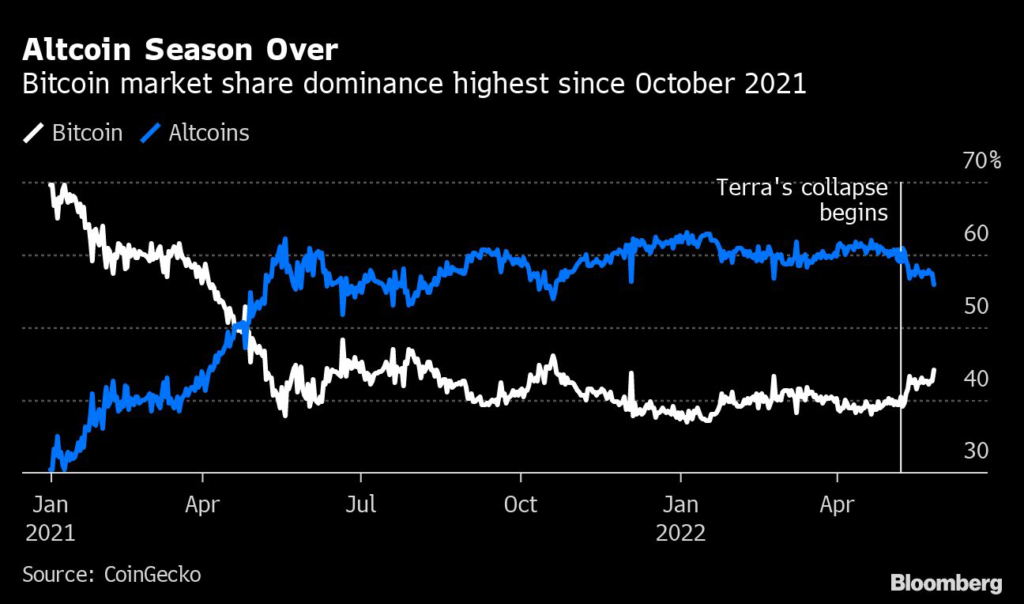
With the reverberations from Terra’s collapse hitting altcoins harder, Bitcoin now claims a larger share of the cryptosphere, accounting for 44% of the total market’s value. That’s the most since October, just before the latest bull market peaked, based on data from CoinGecko. But it’s not as if Bitcoin has been spared: It is now down almost 60% from its all-time high in November, though it has generally traded in a range of $28,000 to $30,000 in the past couple of weeks.


The biggest cryptocurrency remains below its 20-, 50- and 200-day moving averages. “With each moving average currently sloping lower, it’s the epitome of a downtrend,” Frank Cappelleri, a trading-desk strategist at Instinet, said. 


There is no question that the strong correlation between cryptocurrencies and other risk assets has broken down recently. As tech stocks in the US rally after weeks in the doldrums, digital assets have largely stayed in the sidelines, Fiona Cincotta, senior market analyst at City Index, said by email.

“This is far from the decoupling that the Bitcoin bulls were looking for,” Cincotta said. “I doubt this will be the end of the Bitcoin-Nasdaq positive correlation. However, the concern is Bitcoin may only trace the Nasdaq when it falls.”

A move below $28,000 would be significant to continue the downtrend and test the year’s $25,425 low, Cincotta said. Beyond this, $20,000 is the next psychological level that comes into play. On the flipside, buyers will be looking for a move over $31,500 for a breakout to the upside and for any chance of a recovery in the price, she added. 

If anything, the fact that Bitcoin is trading sideways is already a good thing, Miller Tabak’s Maley said. 

“The longer it can stabilize, the higher the odds will be that it can regain some upside momentum. Confidence is such an important part of new assets like cryptocurrencies,” he said by email. “Until investors regain more confidence in the cryptos, they will no longer be a good a risk-on/risk-off indicator.”

Read more: Crypto Trading May ‘Get Weird’ Over Memorial Day, Fundstrat Says

Investors looking for a respite over the long Memorial Day weekend in the US may be disappointed. Liquidity has been low and could tighten further, while leverage in the Bitcoin market is increasing, Sean Farrell, head of digital-asset strategy at the financial research firm Fundstrat, wrote in a note on Thursday. The macro outlook also remains unfavorable to risk assets as the Fed hikes interest rates and starts quantitative tightening, he said.

“Things could get weird,” Farrell said about the upcoming holiday weekend. The combination of low liquidity, increasing leverage and tightening monetary conditions “could lead to large price swings, and potentially further volatility to the downside in the immediate term.”

Buying put protection on long-crypto positions and cutting exposure to more speculative altcoins are a couple of safeguards, Farrell wrote. 

(Updates prices.)

More stories like this are available on bloomberg.com

©2022 Bloomberg L.P.

Robert Smith’s Vista Equity Snags Early $9 Billion for New Fund

(Bloomberg) — Vista Equity Partners is almost halfway to raising the $20 billion target it set for its flagship fund, according to people familiar with the situation.

Led by billionaire Robert F. Smith, the eighth iteration of the private equity firm’s main fund has garnered more than $9 billion in investor commitments, said one of the people, who asked not to be identified because the information is private. The early capital pledges for Vista Equity Partners Fund VIII LLP since initial plans surfaced late last year underscores the cache Smith brings to tech dealmaking.

A representative for Vista declined to comment.

A final close for the fund could come at year end, said one of the people. The re-emergence of Vista comes at a bustling time for dealmaking, particularly given the stronghold private equity funds have because of a pullback in public equities.

Based in Austin, Texas, Vista’s prowess for growing software companies has established it among the top tier of private equity firms. While public markets have roiled after pandemic highs, big buyout firms have deployed new strategies — from early-bird discounts to splitting capital commitments — in hopes of edging out competitors.  

Smith, a 59-year-old Denver native, was putting in more face time with investors as the firm sought to raise money for the largest buyout fund in its 22-year history, Bloomberg News reported in November. That push ended a relatively quiet period for the firm and Smith, coming after after a federal tax probe in 2020 and the resignation of Vista co-founder Brian Sheth. 

Vista has more than $93 billion in assets under management, according to its website. Vivid Seats Inc. and Solera are among the firm’s notable investments. This month, residential relocation services app Updater Inc. said it had received $215 million in financing from Vista’s credit arm.

More stories like this are available on bloomberg.com

©2022 Bloomberg L.P.

Crypto Giant FTX Ready With Billions of Dollars for Acquisitions

(Bloomberg) — Fast-growing crypto exchange FTX is prepared to spend billions of dollars to buy stakes in other companies as it looks to grow the suite of products it offers customers, according to the firm’s chief executive officer.

Billionaire Sam Bankman-Fried, who’s also the firm’s co-founder, said on Friday that recent rounds of fundraising by FTX and its US entity — totaling more than $2 billion — could be used to bankroll the moves.

“FTX is a profitable company,” he said in an interview. “You can look at the amount that we’ve raised over the last year or two — it’s a few billion dollars. That gives maybe a sense of where we are in terms of cash that was explicitly viewed from a potential acquisition angle.”

Bankman-Fried, 30, has emerged as one of the most recognizable people in crypto. FTX crashed into the mainstream with Super Bowl ads, naming rights to the Miami Heat’s home court, and its logo on Major League Baseball umpire uniforms. Most recently, FTX has been making waves in traditional financial circles with a plan that could cut out brokerages from clearing some derivatives.

FTX has no shortage of funds in its war chest for deal-making. In January, the exchange raised $400 million at a $32 billion valuation, bringing the total amount raised in the prior half a year to close to $2 billion. At the same time, its US entity separately raised $400 million. 

While Bankman-Fried said FTX doesn’t need to buy new firms to grow, the company has already been on a spending spree. 

Last year, the American arm bought LedgerX, a Commodity Futures Trading Commission-regulated exchange and clearinghouse, to gain a foothold in the US crypto derivatives market. In April, FTX bought a significant stake in IEX Group Inc., owner of the stock-trading platform made famous by “Flash Boys.” This month, Bankman-Fried revealed that he’d bought a 7.6% stake in Robinhood Markets Inc.

“It’s always something that we’re going to be open to and keeping our ears to the ground on,” Bankman-Fried said of additional acquisitions. Being able to offer more products to investors, including the ability to trade stocks, so that they don’t have to go elsewhere for those services is one of FTX’s ambitions, he added. 

Companies with substantial user bases or with teams that have deep knowledge and expertise in areas FTX isn’t as well-versed in can be attractive acquisition targets, he said. And sometimes it just makes sense from an economic perspective, he said. “If it’s cheap, sure.”

The latter was a big motivator in the crypto executive’s recent Robinhood investment, he said. At the time of his purchase, the brokerage’s stock had fallen by about 90% from an August peak of $85-per-share. 

FTX’s ambitions are requiring the firm to spend a lot of time working with Washington regulators, he said, adding that he’s been coming to the US capital almost every other week. 

While Bankman-Fried said his firm is engaging with the Commodity Futures Trading Commission and the Securities and Exchange Commission as FTX expands market offerings, the firm isn’t currently planning to seek a federal bank charter as some crypto firms have.  

More stories like this are available on bloomberg.com

©2022 Bloomberg L.P.
Terra Stablecoin’s Woes Prompted in Part by Celsius Network Activities, Researcher Says

(Bloomberg) — The collapse of the TerraUSD (UST) stablecoin that sent shockwaves throughout the crypto ecosystem can’t be attributed to a single attacker, according to researcher Nansen. Instead, they identified the trades of a small number of players, including lender Celsius Network, as contributing to the decline.

UST, a stablecoin that ran on the Terra blockchain, was designed to maintain its dollar peg through algorithms and trading incentives that also involved a sister token, Luna. It became hugely popular in part because users could earn as much as 20% interest by lending it on Terra’s Anchor Protocol. It stopped working as intended earlier this month after selling pressure triggered a “death spiral” that sent UST and Luna tumbling and wiped out more than $40 billion in combined market value. The fallout also sparked declines in the broader market and continues to pressure prices of many coins.

“We refute the popular narrative of one ‘attacker’ or ‘hacker’ working to destabilize UST,” Nansen wrote in a research note out today based on its analysis of blockchain data between May 7 and May 11, when the stablecoin collapsed.

“The de-peg of UST could instead have resulted from the investment decisions of several well-funded entities, e.g. to abide by risk-management constraints or alternatively to reduce UST allocations deposited into Anchor in the context of turbulent macroeconomic and market conditions.” 

While the trading activity may not have been informed by any specific intent to destabilize the coin, it nevertheless served to break UST’s 1-to-1 peg with the US dollar, leading to its ultimate downfall, Nansen said. 

Some of these parties made money through arbitrage bets related to the difference in UST’s price on the Curve lending app relative to where it traded on decentralized exchanges and centralized exchanges like Coinbase Global Inc., Nasen found.

The battle between UST inflows and outflows on Curve intensified several hours after Terra’s co-founder Do Kwon posted a tweet mocking users’ concerns.

A wallet associated with the Luna Foundation Guard, where Kwon was a founding member and that was responsible for safeguarding UST’s peg, withdrew about 150 million UST from Curve. Four addresses, including one associated with Celsius, then put in about 105 million UST onto Curve. LFG counteracted with UST withdrawals, “and the back-and-forth continued into the morning of May 8,” Nansen said.

A small group of large holders started withdrawing UST from Anchor Protocol, and moved those funds onto Ethereum via the Wormhole bridge. They then swapped large amounts of UST for other stablecoins on Curve and — as UST started losing its peg — made money on arbitrage between Curve, decentralized and centralized exchanges by buying and selling positions. Withdrawals from Anchor began in mid-April of this year, Nansen found.

Two wallet addresses “significantly impacted the UST de-peg,” Nansen said, and one of them was associated with Celsius. The two addresses withdrew about 420 million UST from Anchor via 15 transactions, and they were the top wallets that used the Wormhole bridge to withdraw the funds into Ethereum at the time, Nansen said. Celsius was also “a close counterparty that has sent and received funds” from another wallet whose activities led to the de-pegging, Nansen said.

On May 11, Celsius tweeted, “As part of our responsibility to serve our community, @Celsius Network implemented and abides by robust risk management frameworks to ensure the safety and security of assets on our platform. All user funds are safe. We continue to be open for business as usual.” 

Celsius didn’t return multiple request for comment on the Nansen report.

Celsius pulled about $500 million of funds from the Anchor lending protocol, the Block reported earlier. A person familiar with the situation confirmed to Bloomberg that Celsius had moved some founds out of Anchor.

Celsius allows individual investors to earn interest on their crypto holdings by lending them out, offering returns as high as 18.63%. It had $11.8 billion in assets as of May 17, according to its website, down from about $16.9 billion on May 6. Celsius changed its rules earlier this year to allow only accredited US investors to add new coins for lending purposes and earning rewards after regulators raised concerns. In November, Celsius announced it closed a $750 million round of funding. 

Celsius has been subject to state and federal regulatory scrutiny. The company, along with several others, is the subject of a broad inquiry by the Securities and Exchange Commission into companies that pay interest on virtual token deposits, Bloomberg reported earlier this year. 

Read more: Crypto Lending Firms Celsius Network, Gemini Face SEC Scrutiny

Securities regulators in Alabama, Kentucky and several other states last year ordered or threatened to order the company to stop selling its products to residents. New York Attorney General Letitia James sent Celsius and other crypto companies a demand for information, often a precursor to a formal investigation.

Celsius recently filed with SEC for an initial public offering of its crypto mining subsidiary.

More stories like this are available on bloomberg.com

©2022 Bloomberg L.P.
Dell’s Sales Top Estimates on Strong Office PC Growth

(Bloomberg) — Dell Technologies Inc. surged the most in two years after reporting quarterly revenue that topped analysts estimates on strong demand for business PCs and networking services, a sign that companies have been upgrading their systems as workers return to the office. 

The shares jumped 13% to $49.58 at the close Friday in New York, the largest single-day rally since March 2020. Dell’s stock has fallen about 12% this year, which is less than many of its tech-sector peers.

Sales climbed 16% to $26.1 billion in the fiscal first quarter, which ended April 29. Analysts, on average, projected $25 billion, according to data compiled by Bloomberg. Revenue was bolstered by a 22% rise to $12 billion from commercial PCs, one of Dell’s highest-grossing products, the Round Rock, Texas-based company said Thursday in a statement. Profit, excluding some items, was $1.84 a share, also topping analyst estimates.

Co-Chief Operating Officer Jeff Clarke touted growth across business units in the statement. “We are built to outperform, in a balanced and consistent way across the company.”

Revenue from the Infrastructure Solutions Group, which includes most of Dell’s technology services, increased 16% to $9.3 billion from a year earlier. Server and networking sales climbed 22% to $5 billion, while storage revenue gained 9% to $4.2 billion.

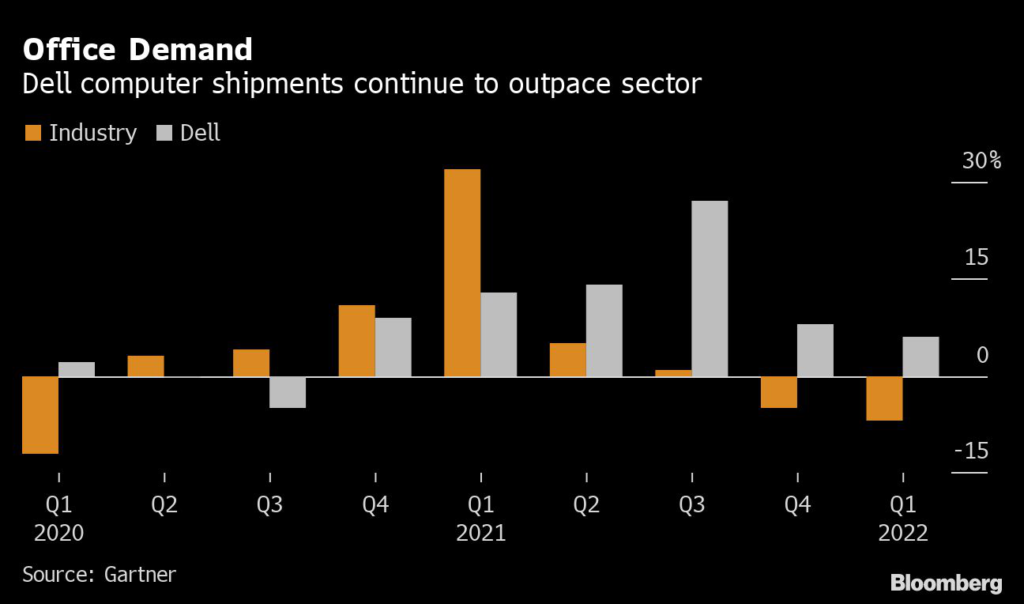
While Dell saw gains, personal computer shipments across the industry declined 6.8% in the first three months of 2022 compared with the same period a year earlier, according to Gartner Inc., an industry analyst. Much of the decline, however, came from reduced demand for Chromebooks used by schools, which saw a huge jump during the pandemic. Business PC shipments increased in the quarter driven by hybrid work and the return to offices, which created a need for new desktop machines, Gartner said.

That trend of greater demand for PCs in the enterprise market was seen in Dell’s numbers. The company’s global shipments increased 6.1% in the quarter, Gartner reported. 

Dell said fiscal first-quarter revenue from consumer PCs increased 3% to $3.6 billion. Demand is broadly shifting from consumers and PCs to data infrastructure, Clarke said in prepared remarks for the company’s earnings conference call.

The company is navigating supply chain issues and uncertainties about the global economy. Semiconductor shortages and Covid restrictions in China contributed to order backlogs that are likely to continue through at least the current quarter, Clarke said in the prepared remarks. In addition, cheaper component costs helped offset the impact of higher rates in the first quarter, he said, but “in Q2, we expect component costs to turn inflationary and logistics costs to remain at elevated levels.”

In addition to the challenges of managing the supply chain, Clarke said inflation, chip shortages and geopolitical issues have added uncertainty to the economic outlook. Still, “IT demand is currently healthy,” he said.

Revenue in the current period, which ends in July, is projected to be $26.1 billion to $27.1 billion, Chief Financial Officer Tom Sweet said on the call. Analysts, on average, estimated $25.5 billion. Earnings, excluding some items, will be $1.55 to $1.70 a share, he said. Analysts projected $1.45 a share.

“We expect foreign currency to be a headwind for both Q2 and for the full year,” Sweet said.

Last year, Dell spun out VMware Inc., the software vendor acquired in 2016 as part of its $67 billion purchase of EMC. The two companies have remained important business partners since, but the relationship could be weakened by Broadcom Inc.’s planned $61 billion takeover of VMware, which was announced earlier Thursday, said Bloomberg Intelligence’s Woo Jin Ho.

Michael Dell, chairman and chief executive officer of the company that bears his name, also is board chairman of VMware and supports the sale to Broadcom.

(Updates with closing shares in the second paragraph.)

More stories like this are available on bloomberg.com

©2022 Bloomberg L.P.

Relativity’s 3D Printed Rocket on Path for Summer Debut Flight

(Bloomberg) — Relativity Space Inc., a Los Angeles-area startup that makes rockets using advanced 3D printing technology, is taking another step closer toward the debut of its Terran 1 craft this summer, a move toward gaining a foothold in the commercial launch industry.

Pre-launch testing wrapped up last week, and the rocket will be trucked from a facility in Long Beach, California, on May 31 to the launch site at Cape Canaveral, Florida, Chief Financial Officer Mo Shahzad said an interview. The project is about 18 months behind schedule, from an initial target date of 2020.

The Terran 1 is built to carry payloads as heavy as 1,000 kilograms (2,204 pounds) into orbit. The first launch is for demonstration purposes and contracts have been inked with NASA and the Department of Defense’s innovation unit for subsequent flights, according to Shahzad.

The company’s flagship Terran R rocket, which is under development, is designed to lift 20 times the payload of the Terran 1, making it more attractive for hauling heavy cargo like commercial-grade satellites, CFO Shahzad said. Going forward, “we are prioritizing Terran R” given customer interest in that size of vehicle.

The company, whose workforce has grown five-fold in the past two years to almost 800 people, said it has raised $1.3 billion from backers including initial investor billionaire Mark Cuban, Blackrock Inc., Tiger Global Management LLC and actor Jared Leto.

It’s competing in a crowded market of rocket startups and more established aerospace companies such as Elon Musk’s Space Exploration Technologies Corp., Rocket Lab USA Inc., Virgin Orbit Holdings Inc., Astra Space Inc. and Jeff Bezos’s Blue Origin LLC. Relativity says it can build rockets and launch customer payloads far more rapidly than rivals given its 3D-additive production capacity, with more than 90% of its rockets “printed” by machines, reducing costs compared to traditional manufacturing methods.

Relativity is in the process of moving its Terran R production into a bigger factory near Long Beach Airport, a 1 million-square-foot (93,000 square-meter) lot where Boeing Co. once built C-17 military cargo planes. Relativity has hopes to one day use its 3D-printing technology to establish an industrial base on Mars.

The company had a market value of $4.2 billion as of its last fundraising round about a year ago, according to Pitchbook. 

More stories like this are available on bloomberg.com

©2022 Bloomberg L.P.

Close Bitnami banner
Bitnami