
Bloomberg

MoneyGram CEO Sees a Future in Stablecoin Remittances

(Bloomberg) — One of the largest money-transfer services in the US is attempting to broaden the adoption of digital currencies.

MoneyGram International Inc. is preparing to launch a service in partnership with the Stellar blockchain that would allow users to send stablecoins and easily convert them to hard currency. 

“The world of crypto and the world of fiat are not really compatible today,” MoneyGram Chief Executive Officer Alex Holmes said in an interview with Bloomberg News. “We’re trying to be a bridge from the crypto world to the fiat world.”

The move arrives as remittances become more popular in emerging markets, but also as stablecoins — digital assets meant to maintain a 1-to-1 relationship with a commodity or currency like the US dollar — come under heightened scrutiny. Once the service fully launches, users with digital wallets on the Stellar blockchain will be able to convert their holdings into Circle Internet Financial’s USDC stablecoin, which can then be cashed out through MoneyGram’s network, Holmes said.

This month’s collapse of the TerraUSD stablecoin has put an unfavorable light on these kinds of digital assets and triggered market instability. Even though Terra is different from USDC, which is backed by dollar-equivalent assets kept in reserve, the Terra meltdown has raised concerns that these stablecoins could lose their peg too. The world’s largest stablecoin, Tether Holdings Ltd.-issued USDT, briefly lost its dollar peg on May 12. Regulators have raised questions over the riskiness of USDT’s reserves, which include commercial paper, a type of short-term debt. Tether released a new token pegged to the Mexican peso on Thursday.

A de-pegging is unlikely to happen with USDC, the stablecoin used in MoneyGram’s partnership with Stellar, because the currency is fully backed by safe liquid assets, according to Dante Disparte, chief strategy officer and head of global policy for Circle. 

“We’re not taking the dollar and putting it in the reserves and then lending it out,” he said in an interview. “Instead, the reserves are strictly cash and US Treasuries.”

Crypto Confidence

The Terra debacle also deepened a broader crypto market downturn. The price of Bitcoin, the most popular digital currency, has slumped down more than 20% this month. 

Holmes said he’s still confident in digital currencies. Cryptocurrency “is obviously here to stay and its going to be here for a long time despite recent selloffs and volatility,” he said. “I think adopting it, bringing it into the mainstream is important.” 

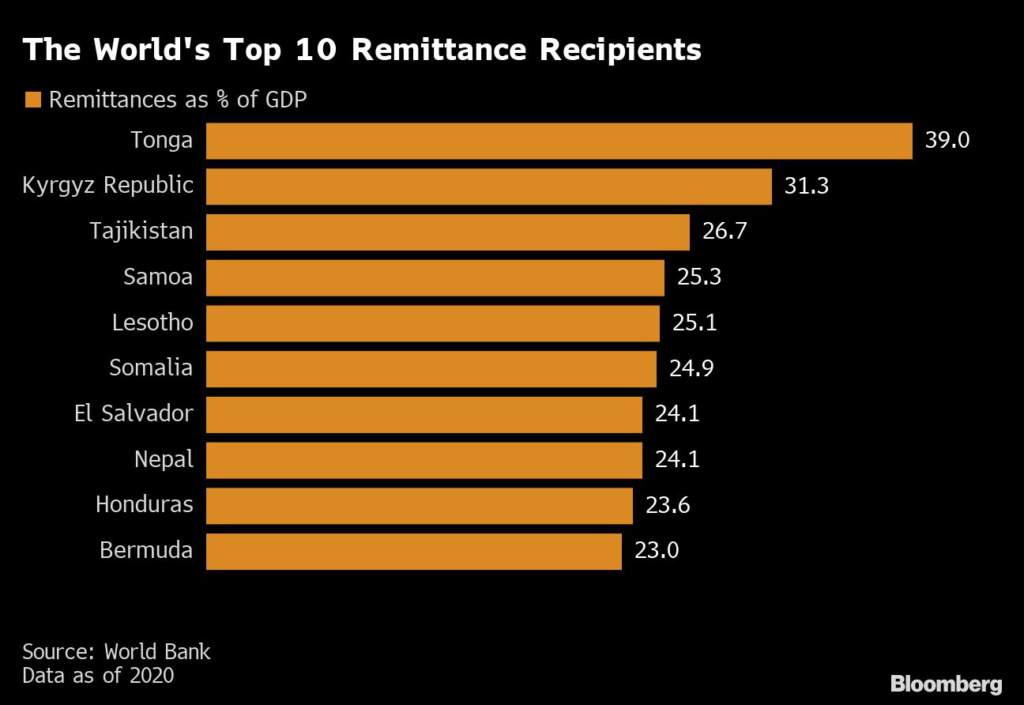
MoneyGram’s new service with Stellar could also help spread crypto usage in emerging markets. Remittances to low- and middle-income countries grew to $589 billion last year and are projected to increase this year, according to the World Bank. For countries like El Salvador, which made Bitcoin legal tender last year, remittances account for more than 20% of gross domestic product. 

“There are billions of cash-dependent people globally who could benefit from the utility that digital assets and blockchain provide,” Denelle Dixon, CEO of the Stellar Development Foundation, said in a written response to questions. “The answer is what we’re building through this partnership — a service for helping them go from cash to digital assets.”

El Salvador President Nayib Bukele has criticized remittance companies for charging hefty fees and said using Bitcoin will save the country $400 million a year on money sent home by nationals living abroad. In the US, where remittances abroad total more than $100 billion annually, MoneyGram has been accused by New York state and the U.S. Consumer Financial Protection Bureau of delaying international money transfers and failing to disclose prices.

Holmes said fees for sending money to El Salvador from the US via MoneyGram range from 0.5-2.5% of a transaction’s face value, below the World Bank’s target of 3%. The costs to acquire and transfer Bitcoin through custodial wallets or exchanges and convert it back to dollars on the receiving end can exceed those of traditional remittance networks, he said.

“When I look at it from our view of the world on the remittance side, I think that [Bukele’s] comment was slightly misplaced,” Holmes said. “I think it was part of the grandstanding and the advertising of what things like crypto can bring into the world.” 

‘Where the World Is Going’

El Salvador’s government launched its own Bitcoin wallet last year called Chivo and gave users a $30 signup bonus. Holmes said third-party wallets are starting to appear in El Salvador and MoneyGram is holding discussions with some of those companies on potential partnerships so it can further compete in the digital-wallet space for Bitcoin and other currencies.

“If a country like El Salvador is going to make Bitcoin seamless with US dollars in country, I think that consumers, through MoneyGram, should be able to transfer Bitcoin to El Salvador or transfer dollars and convert them to Bitcoin,” Holmes said. “If that’s where the world is going, let’s participate in that world and let’s see how we can help fulfill that opportunity.”

MoneyGram previously worked with Ripple Labs Inc., which was co-founded by Jed McCaleb who ultimately left Ripple to help launch Stellar. The partnership between MoneyGram and Ripple ended in March 2021 following a lawsuit filed against Ripple by the U.S. Securities and Exchange Commission in December 2020, alleging that the company held an unregistered securities offering of its XRP token.

In July, MoneyGram courted takeover interest from Stellar Development Foundation, the nonprofit that manages the Stellar blockchain, and private equity firm Advent International. The company then teamed up with Stellar in October on developing a crypto remittance service and released a pilot program in November.

Other companies like Meta Platforms Inc. have also begun to experiment with new remittance channels and last year launched a pilot program in Guatemala and the US called Novi, a digital wallet in partnership with Paxos Trust Company, which issues the Pax Dollar stablecoin. 

More stories like this are available on bloomberg.com

©2022 Bloomberg L.P.

Shanghai Unveils Fresh Policies to Support Economy Hit by Covid

(Bloomberg) — Shanghai offered some tax rebates for companies and allowed all manufacturers to resume operations from June as authorities rolled out scores of policies to revitalize an economy impacted by Covid lockdowns.

The financial hub will accelerate approvals for property projects and supply new residential developments, according to a plan issued by the Shanghai municipal government. The quota for car ownership this year will be increased by 40,000, a purchase tax for some passenger vehicles will be reduced and subsidies will be given to electric car buyers. 

The measures were part of 50 measures in eight categories aimed at stabilizing the city’s economy after the current Covid outbreak hurt economic and social development. Companies in Shanghai will no longer need to be on a “whitelist” to resume production starting from June 1, Vice Mayor Wu Qing said at a briefing on Sunday.

China’s dogged adherence to its Covid Zero policy at all costs — epitomized by Shanghai’s lockdown that began in late March and restrictions imposed elsewhere in the country of 1.4 billion — has slowed everything from consumer spending to manufacturing in the world’s second-largest economy. Industrial output and consumer spending slid to the worst levels in April since the pandemic began in early 2020, while the confinement has sparked clashes between residents and police.

Shanghai will loosen Covid test requirements for people who enter public places from June 1 as the city tries to restore a sense of normalcy after a two-month lockdown of its 25 million population. It reported 122 new local Covid cases for Saturday, a decline from the 170 for Friday. Only one positive case was found outside government quarantine.

Capital Beijing eased mobility curbs in several districts after authorities said its outbreak was under control. The city reported 21 new cases on Sunday, declining for the seventh straight day.

Other measures in Shanghai’s newly published plan include:

  • More tax, fee cuts for companies; reducing rents for more firms
  • Encouraging commerce firms and e-commerce platforms to issue coupons to boost consumption
  • Supporting construction of infrastructure projects in railway, airport hubs, ports and energy sectors; accelerating implementation of major projects in integrated circuits and new energy vehicles
  • Boosting financial support to foreign trade firms
  • Helping foreign companies resume operations and supporting multinational companies to establish regional headquarters and research centers in Shanghai
  • Starting more urban renovation projects and supporting local government to sell special bonds for city renovation projects
  • Properly increasing construction land quota for 2022

The new measures — in place till end-2022 — together with policies issued in March, will reduce the burden for entities by 300 billion yuan ($44.8 billion) this year, Hua Yuan, head of Shanghai Municipal Development & Reform Commission, said at the briefing.

More stories like this are available on bloomberg.com

©2022 Bloomberg L.P.

Shanghai Unveils Economic Support Measures as Lockdowns Ease

(Bloomberg) — Shanghai offered tax rebates for companies and allowed all manufacturers to resume operations from June as authorities rolled out scores of policies to revitalize an economy impacted by Covid lockdowns.

The financial hub will accelerate approvals for property projects and supply new residential developments, according to a plan issued by the Shanghai municipal government. The quota for car ownership this year will be increased by 40,000, a purchase tax for some passenger vehicles will be reduced and subsidies will be given to electric car buyers. 

The measures were part of 50 measures in eight categories aimed at stabilizing the city’s economy after the current Covid outbreak hurt economic and social development. Companies in Shanghai will no longer need to be on a “whitelist” to resume production starting from June 1, Vice Mayor Wu Qing said at a briefing on Sunday.

China’s dogged adherence to its Covid Zero policy at all costs — epitomized by Shanghai’s lockdown that began in late March and restrictions imposed elsewhere in the country of 1.4 billion — has slowed everything from consumer spending to manufacturing in the world’s second-largest economy. Industrial output and consumer spending slid to the worst levels in April since the pandemic began in early 2020, while the confinement has sparked clashes between residents and police.

Shanghai will loosen Covid test requirements for people who enter public places from June 1 as the city tries to restore a sense of normalcy after a two-month lockdown of its 25 million population. It reported 122 new local Covid cases for Saturday, a decline from the 170 for Friday. Only one positive case was found outside government quarantine.

Capital Beijing eased mobility curbs in several districts after authorities said its outbreak was under control. The city reported 21 new cases on Sunday, declining for the seventh straight day.

Other measures in Shanghai’s newly published plan include:

  • More tax, fee cuts for companies; reducing rents for more firms
  • Encouraging commerce firms and e-commerce platforms to issue coupons to boost consumption
  • Supporting construction of infrastructure projects in railway, airport hubs, ports and energy sectors; accelerating implementation of major projects in integrated circuits and new energy vehicles
  • Boosting financial support to foreign trade firms
  • Helping foreign companies resume operations and supporting multinational companies to establish regional headquarters and research centers in Shanghai
  • Starting more urban renovation projects and supporting local government to sell special bonds for city renovation projects
  • Properly increasing construction land quota for 2022

The new measures — in place till end-2022 — together with policies issued in March, will reduce the burden for entities by 300 billion yuan ($44.8 billion) this year, Hua Yuan, head of Shanghai Municipal Development & Reform Commission, said at the briefing.

More stories like this are available on bloomberg.com

©2022 Bloomberg L.P.
H.K. Police to Step Up Web Security Regulation, Ming Pao Says

(Bloomberg) — Hong Kong should step up regulation of internet security as a lack of coordination and comprehensive scrutiny on service providers has created loopholes, Ming Pao reported, citing Deputy Police Commissioner Edwina Lau Chi-wai.

The city plans to start a consultation on internet security law by the end of this year and should create a “strategic Internet security system” to coordinate on matters including licenses, inspection and investigation, Lau told a Hong Kong forum yesterday, the newspaper said.

Hong Kong has no room for “lying flat” as the city may become a battlefield of geo-politics, Lau said, explaining the need to defend internet security, the paper said. Suggestions include having service operators monitor content, keep records and inspect users and report violations, the paper cited Lau as saying. 

More stories like this are available on bloomberg.com

©2022 Bloomberg L.P.
Bachelet Tells China Anti-Terror Actions Must Respect Rights

(Bloomberg) — The United Nation’s top human rights official said any actions by China’s government to address alleged terrorism and reverse what Beijing terms radicalism must not come at the expense of human rights. 

Michelle Bachelet spoke at a press briefing at the end of her six-day trip to China, which she’s repeatedly said wasn’t an “investigation” of Chinese practices in the Xinjiang region or elsewhere.  

“I encouraged the government to undertake a review of all counterterrorism and deradicalization policies to ensure they fully comply with international human right standards, and in particular — that they are not applied in an arbitrary and discriminatory way,” Bachelet said. 

Her comments were quickly criticized by human rights advocates on social media.  

“It is absolutely stunning,” Adrian Zenz, senior fellow in China studies at the Victims of Communism Memorial Foundation, told Bloomberg News of the remarks. “It betrays a lack of understanding or wanting to understand what has been taking place in the region.”  

Bachelet said she raised “the lack of independent judicial oversight” of the VETC system, or what China refers to as Vocational Education and Training Centers in Xinjiang, but are effectively detention camps. Yet she wasn’t able to “assess the full scale” of the VETCs, she added. 

Bachelet mostly steered clear of controversy in her press conference, at which she took questions from reporters in English and Chinese, Her most detailed answer was to a question about gun violence and racism in the US from a reporter with Chinese state media.  

US Secretary of State Antony Blinken’s press office said in a statement late Saturday that the US remained concerned about efforts to restrict and manipulate Bachelet’s visit 

“We are concerned the conditions Beijing authorities imposed on the visit did not enable a complete and independent assessment of the human rights environment” in China, according to the statement. “We are further troubled by reports that residents of Xinjiang were warned not to complain or speak openly about conditions in the region.”

Bachelet’s visit had already been criticized for failing to secure guarantees of unfettered access to Xinjiang, where a 2019 United Nations assessment said an estimated 1 million people have been detained. 

Bachelet said at the briefing that she was able to speak “unsupervised” with Chinese people. She said she’d visited a prison and a former vocational training and education center, and got to interact with a range of civil society organizations, academics, and community and religious leaders.  

US Ambassador Nicholas Burns earlier voiced to Bachelet “profound concerns” about Beijing’s attempts to manipulate her trip, according to people on a call this week with China-based diplomats who asked for anonymity as they weren’t authorized to speak publicly. 

Call With Xi

Earlier in the week, President Xi Jinping held a call with Bachelet, an unusual move for a leader who speaks mostly with other heads of state that underscored the importance China placed on her visit. 

Chinese state media later said Bachelet praised China’s track record on human rights on the call — something her office later appeared to deny in an emailed “clarification” of her “actual” remarks.  

UN Corrects China on Human Rights Chief’s ‘Actual’ Words to Xi

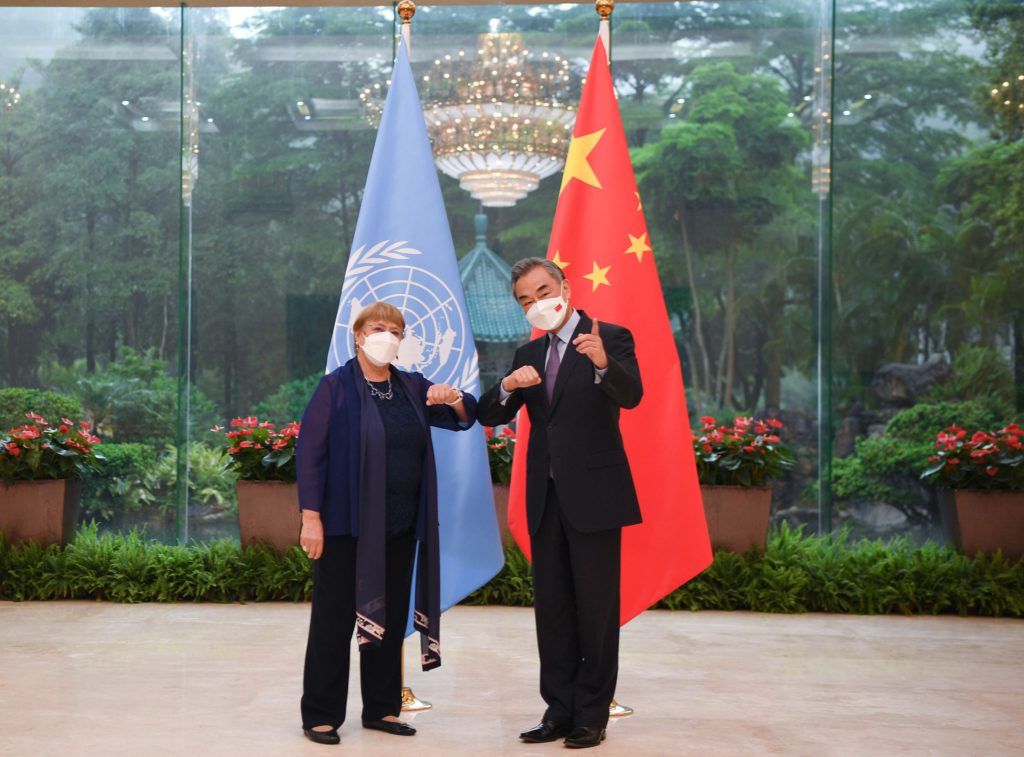
She also met Chinese Foreign Minster Wang Yi, who was pictured holding a copy of book by Xi on human rights, and addressed students at Guangzhou University, in southern China, on a broad range of topics including human rights and sustainable development.  

Vice Foreign Minister Ma Xhaoxu briefed the media on Bachelet’s visit on Saturday, China’s foreign ministry said on its website. The two sides “had extensive, in-depth and candid discussions in the spirit of mutual respect and openness,” according to the ministry.

Western Interference

The Chinese readout decried the recent tendency “of politicizing and instrumentalizing the UN Human Rights Council,” and of Western countries “using human rights to interfere with others’ domestic affairs.” 

Philip Alston, a law professor at New York University School of Law, said on a Friday webinar that despite the criticism, Bachelet’s trip was “extremely important” because it put a spotlight on Xinjiang. 

The former special rapporteur to the UN Human Rights Council rejected claims she was being used by Beijing. 

“She’s highly experienced, she’s very sophisticated,” he said of the 70-year-old, who was the first woman elected to lead a South American nation. “She’s totally aware of all of the different political dimensions of what she’s undertaking.”

Zenz, though, said that “it will be very easy for Chinese state propaganda to portray this at least as a partial absolution of their policies in Xinjiang.”  

(Updates with comment from US secretary of state’s office in eighth and ninth paragraphs.)

More stories like this are available on bloomberg.com

©2022 Bloomberg L.P.

Walmart, Gap and Others Amass $45 Billion in Extra Stuff to Sell

(Bloomberg) — Big retailers rushed to build up inventories last year amid soaring consumer demand and transportation bottlenecks — going so far in some cases as to rent their own cargo ships. Now, they’re trying to figure out how to sell all their stuff. 

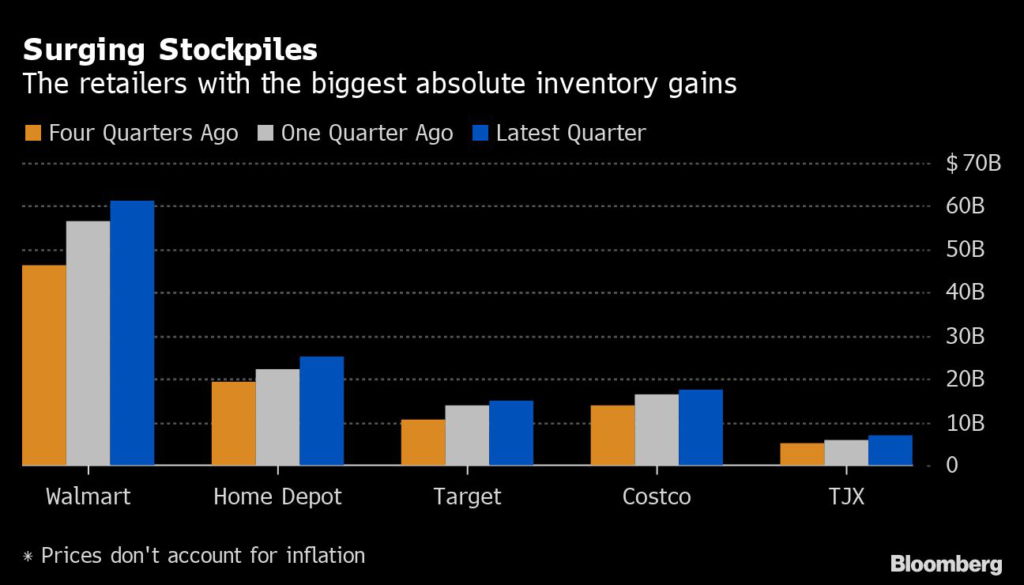
Inventories rose $44.8 billion for companies on S&P consumer indexes with a market value of at least $1 billion that reported earnings over the last two weeks, according to data compiled by Bloomberg. That’s up 26% from this time last year. The glut dented profits at some retailers, with Walmart Inc. paying more for storage and Target Corp. and Gap Inc. cutting prices on key goods.

It’s far from clear what comes next. In the past, ballooning retail inventories have signaled economic slowdowns or recessions as shoppers bought less. But consumer spending in April climbed at the quickest pace in three months after adjusting for inflation, the Commerce Department said Friday. As long as Americans keep shopping, well-stocked warehouses could buoy retailers if port congestion worsens this summer.

“The just-in-time mentality is broken now,” said Jen Bartashus, a retail analyst at Bloomberg Intelligence. “So you’re seeing retailers carry more inventory than they traditionally carried.”

Economists expected money allocated toward services would outpace merchandise as pandemic concerns subsided, but both categories have continued to move upward. Inflation-adjusted spending on services increased 0.5% in April from the prior month while goods rose 1%.

While that leaves plenty of demand for retailers, consumer tastes are changing. At Macy’s Inc., shoppers spent more on back-to-work apparel and clothing for special occasions, instead of on the leisurewear and home goods that were popular earlier in the pandemic. The sharper-than-expected shift left the company with a glut of merchandise that consumers didn’t want. 

That means Macy’s will have to cut prices in slower categories to make room for in-demand items. Target, which recorded a 43% jump in inventory, is in the same boat, as are Gap Inc. and Abercrombie & Fitch Co. Walmart Chief Executive Officer Doug McMillon told analysts he was glad inventory was higher, while acknowledging that the 32% increase in the first quarter “is higher than we want.” 

Macy’s, which saw a 17% jump in inventories, said having merchandise on hand early will ensure key shopping seasons go smoothly. CEO Jeffrey Gennette sees “storm clouds looming in the supply chain” once delayed cargoes leave China and make their way to busy ports on the US West Coast. As a result, the department-store operator is pushing up some of its ship dates on important goods ahead of back-to-school and the holidays.

Similarly, Costco Wholesale Corp. said its 26% jump in inventory was fueled in part by a decision to replenish its stockpile after high demand last year, and as insurance in case supply-chain disruptions get worse. The company expects to sell through it “without really a lot of heartburn,” said Bob Nelson, senior vice president of finance. Some of the extra inventory consists of holiday goods that will still be good this year.

A lot of seasonal goods are “just Christmas stuff that came in late,” Nelson said May 26 on a conference call with analysts. “We’ve got it in deep freeze and we’re going to put it out this fall.”

More stories like this are available on bloomberg.com

©2022 Bloomberg L.P.
Elizabeth Holmes Urges Judge to Overturn Verdict and Acquit Her

(Bloomberg) — Elizabeth Holmes asked a judge to toss out her conviction, claiming no rational juror could have found her guilty of conspiracy and wire fraud beyond a reasonable doubt.

The request, filed late Friday in federal court in San Jose, California, is a routine and long-shot attempt to overturn a jury verdict.

“Sufficiency of the evidence challenges are raised in almost every appeal from a trial court disposition; maybe one such appeal a year is successful in a fraud case in any federal circuit court of appeals,” criminal defense attorney Seth Kretzer said.

The founder and former Chief Executive Officer of Theranos Inc. was convicted in January of four out of 11 counts of conspiracy and wire fraud and acquitted of four counts that she deceived patients. The jury was unable to reach a unanimous consensus on three other counts.

She was convicted of conspiring with former Theranos President Ramesh “Sunny” Balwani to commit fraud, but her lawyers argued prosecutors cited no evidence of such an agreement. 

At trial, the government showed jurors numerous emails and texts to demonstrate coordination between the two. “Of the hundreds of text messages admitted at trial, the government cites only one that appears to relate to the content of representations to an investor,” lawyers for Holmes wrote in the filing, referring to a message about an investment by Rupert Murdoch. 

But the text, described by a witness for context, “provides no inkling that Mr. Balwani and Ms. Holmes were conspiring to defraud Mr. Murdoch,” the lawyers wrote.

“Even if the judge were grant this motion, the government would still appeal to the Ninth Circuit” court of appeals, Kretzer said. “Prosecutors are heavily trained to present trials with abundant evidence so that even if some part were to fall apart on appeal, there is still enough to sustain at least one count of conviction.”

Holmes’s lawyers also attacked the wire fraud counts that she was convicted of, which were the backbone of the government’s case against her. 

The basis for the charges was that Holmes lied about the capabilities and accuracy of Theranos blood analyzers. The investor fraud counts relied heavily on the testimony of whistleblower Erica Cheung, lawyers for Holmes argued. But Cheung testified about failures of Theranos results before Holmes promoted to investors a later version of its analyzers, the miniLab, they said.

“Investors, with whom Theranos partnered, were focused on the long-term goals of the company and its ability to impact health care in the future,” Holmes’s lawyers wrote.

US District Judge Edward Davila has scheduled a hearing in July to consider Holmes’s request. She’s scheduled to be sentenced in September.

Meanwhile, Balwani’s trial on the same charges Holmes faced is still underway.

Abraham Simmons, a spokesman for the US Attorney’s Office in San Francisco, didn’t immediately respond to a request for comment.

Read more: Elizabeth Holmes’s Ex May Hold Her Ticket to Less Prison Time

The case is U.S. v. Holmes, 18-cr-00258, U.S. District Court for the Northern District of California (San Jose).

More stories like this are available on bloomberg.com

©2022 Bloomberg L.P.

Battered DeFi Investors Put Their Hopes in Ethereum Revamp

(Bloomberg) — Decentralized-finance investors are betting on Ethereum’s revamp to help thaw out the market’s more than two-months-long crypto winter. 

The DeFi sector, where investors earn yields by trading and staking cryptocurrencies without centralized intermediaries, has declined sharply following the collapse of the TerraUSD stablecoin, and as soaring inflation puts the Federal Reserve on a path of monetary tightening. The Ethereum “Merge,” one of the most significant technical upgrades to the blockchain since its inception in 2015, may be one of the few catalysts that could give DeFi a much-needed lift.

Despite multiple delays, core developers have made major progress and Ethereum co-founder Vitalik Buterin has said the upgrade is set to take place in August. The Merge will shift the Ethereum blockchain from a proof-of-work consensus mechanism, where miners use powerful computers to order and validate transactions for users, to proof-of-stake. The new mechanism replaces miners with Ether holders performing the same tasks. 

The Merge will be the most important event in the crypto space this year by far, said Vance Spencer, co-founder of venture capital firm Framework Ventures. “If you think about how crypto markets usually move, the biggest event is usually Bitcoin halving, cutting supply of Bitcoin in half,” he said. “Here, we have the supply of Ethereum getting cut by 90% in one moment.” 

From ‘Risk-off’ to ‘Risk-on’

Fewer new issuances of Ether, a smaller carbon footprint and higher yields are among the upgrade outcomes that DeFi investors say will fuel an Ethereum rally and boost the industry.

“Our DeFi fund has been risk-off the market all year and now for the first time we are risk-on because we have been accumulating Ether every single day,” said Wes Cowan, managing director of decentralized finance at crypto investment firm Valkyrie. “We continue to trade stablecoins such as USDC for more Ether in the fund.”   

The transition will also eliminate tens of millions dollars of fees that are paid to Ether miners every day. “Ethereum miners have earned $42 million on average per day in 2022,” said Jaran Mellerud, mining analyst at Arcane Crypto.

Ether holders, who will become the blockchain validators after the upgrade, are also more likely to hold on to their Ether rewards and stake them for higher yields, as opposed to miners who tend to sell their mined Ether to cash out or cover operational costs, further reducing the supply of the currency. 

“The expenses for a validator are a fraction of the expenses for a miner,” said Rex Hygate, founder of technical risk analysis company DeFiSafety. “Because the cost of operations is low, the amount of Ether they would issue to cover the cost is reduced.” 

Staking rewards, which is what validators receive in return for putting their assets on the blockchain to secure the Ethereum network, will also be higher post-Merge, as core Ethereum developers plan to financially incentivize more staking participation, Hygate said. 

Ethereum could also face less selling pressure compared to Bitcoin, especially if a slump in prices triggers another round of sell-offs among cash-strapped Bitcoin miners that have large holdings. Public mining companies such as Riot Blockchain started selling their mined coins for the first time earlier this year. 

“If you are in the middle of the bear market and the Bitcoin miners are selling, meanwhile Ethereum just has no latent supply and instead just gives fees to users, Bitcoin will require a lot more inflows to maintain this position than Ethereum will,” said Spencer.

The Flip Side of The Coin

While the Merge is one of the most hotly anticipated events for crypto in 2022, the bullish sentiment around it is unlikely to spread to the broader market, where interest-rate hikes and a weak economic outlook have kept investors away from riskier asset classes.

A potential security threat to Ethereum’s beacon chain earlier this week could also push back the timing of the Merge. The chain, which is key to introducing the new proof-of-stake mechanism, underwent a blockchain reorganization on Wednesday. Ether plunged as much as 11% on Thursday before paring losses at around $1,843, well below its $2000 benchmark.

The glitch might have been due to a network failure such as a bug, or malicious attacks from miners with high resources, resulting in a duplicate version of the blockchain and heightened security risks.

“As this is yet to be confirmed, the impact on the timing of the Merge is still unknown,” said Marc-Thomas Arjoon, a research associate at CoinShares. “If it is an easy fix there may not be a delay, but if this issue uncovers something deeper then the Ethereum Foundation and developers will need to discuss further depending on the type of issue.” 

Other technical glitches on Ethereum’s testnets could further delay the upgrade.

And once the Merge does take place, it could even create headwinds for other projects within the DeFi sector, including so-called layer 1 projects. The term layer 1 is typically used to describe a base layer blockchain network, such as Bitcoin, on top of which other applications are built. 

“All these Ethereum-based projects are going to pick up so much steam,” said Hygate. “In our opinion, it is going to suck the air out of a lot of the other layer 1 markets.” For instance, some layer 1 projects like Solana and Cardano are often considered “Ethereum killers” as they provide alternative blockchain networks for traders on Ethereum.

More stories like this are available on bloomberg.com

©2022 Bloomberg L.P.

Rechristened Luna Trades After ‘Airdrop’ to Terra Investors

(Bloomberg) — Luna, the new token distributed to investors who saw the value of their cryptocurrencies tied to the Terra blockchain wiped out, has begun trading on digital-asset exchanges. 

TerraForm Labs, the developer of the failed blockchain, awarded the tokens in a process referred to as an airdrop to previous holders of Luna and TerraUSD (UST) tokens. The new Luna was trading at about $6.28 per coin, according to price data on CoinGecko.

Under a measure approved earlier this week, the original blockchain was split off and be known as Terra Classic, while Luna, which plunged close to zero this month, was renamed Luna Classic with the ticker LUNC. The new Terra blockchain won’t include a stablecoin. 

Despite the billions of dollars lost, Terra has once again generated a buzz in the crypto market with the new Luna 2.0 token giveaway. Before the airdrop, “Luna 2.0” already started trending on social media platforms like Twitter. It has also brought criticism. 

Prior to the airdrop, most major crypto exchanges announced support of the event. According to CoinGecko, most of the trading in the new token is happening on KuCoin and OKX. Millions of the new tokens are already changing hands, data showed. 

Rival blockchains like Polygon and NEAR have been offering financial support to lure ventures from Terra, raising more questions about whether the new Terra will be sustainable.   

Read more: Terra’s Woes Prompted in Part by Celsius Activities, Nansen Says

(Updates with more detail about where Luna is trading after the airdrop)

More stories like this are available on bloomberg.com

©2022 Bloomberg L.P.

Musk Wants Market Access for Tesla Before Building Local Plants

(Bloomberg) — Tesla Inc. will not set up auto manufacturing plants in any location where it is not allowed to first sell and service its vehicles, Chief Executive Officer Elon Musk said in a tweet when asked on his plans for India.

Tesla wants the Indian government to lower taxes so it can sell imported cars to test the market before committing to building a factory in the country. Prime Minister Narendra Modi’s administration has encouraged Tesla to produce locally, and has asked the company to avoid selling cars made at its Shanghai factory in India.

Musk also said his other company, Space Exploration Technologies Corp., is awaiting government approval in India to start its Starlink internet service. Starlink uses satellites to provide internet services, creating an alternative to land-based systems.

More stories like this are available on bloomberg.com

©2022 Bloomberg L.P.

Close Bitnami banner
Bitnami