Bloomberg

Twitter Will Keep Durban on Board Despite Shareholder Vote

(Bloomberg) — Egon Durban, the co-Chief Executive Officer of private equity firm Silver Lake, will remain on Twitter Inc.’s board of directors despite failing to receive enough votes for re-election at the company’s annual shareholder meeting on Wednesday. 

Institutional Shareholders Services Inc., an advisory firm, had recommended against Durban’s re-election because he serves on the boards of “more than five publicly traded companies.”

In total, Durban sits on the boards of 17 organizations, including six publicly traded companies: Qualtrics International Inc., Carbon Black Inc., VMware Inc., Dell Technologies Inc., Unity Software Inc. and Twitter. Durban agreed to reduce his public board appointments to five by May 25, 2023.

Durban had tendered his resignation. But the board exercised its power to reject it, according to a filing on Friday morning with the Securities and Exchange Commission. 

Twitter said its committee considered the fact that Durban was appointed to the board as part of an agreement in March 2020 with Silver Lake and Elliott Management Corp. Durban is also an ally of Elon Musk, who is in the process of buying Twitter in a $44 billion deal.

“The Board considers Mr. Durban a highly effective member and believes that he brings to the Board an unparalleled operational knowledge of the industry, a unique perspective, and an invaluable skill set and experience with mergers and acquisitions,” according to the filing.

Twitter confirmed that Durban would remain a board director.

More stories like this are available on bloomberg.com

©2022 Bloomberg L.P.

US Wage Increases Show Signs of Peaking in Welcome Sign for Fed

(Bloomberg) — Sign up for the New Economy Daily newsletter, follow us @economics and subscribe to our podcast.

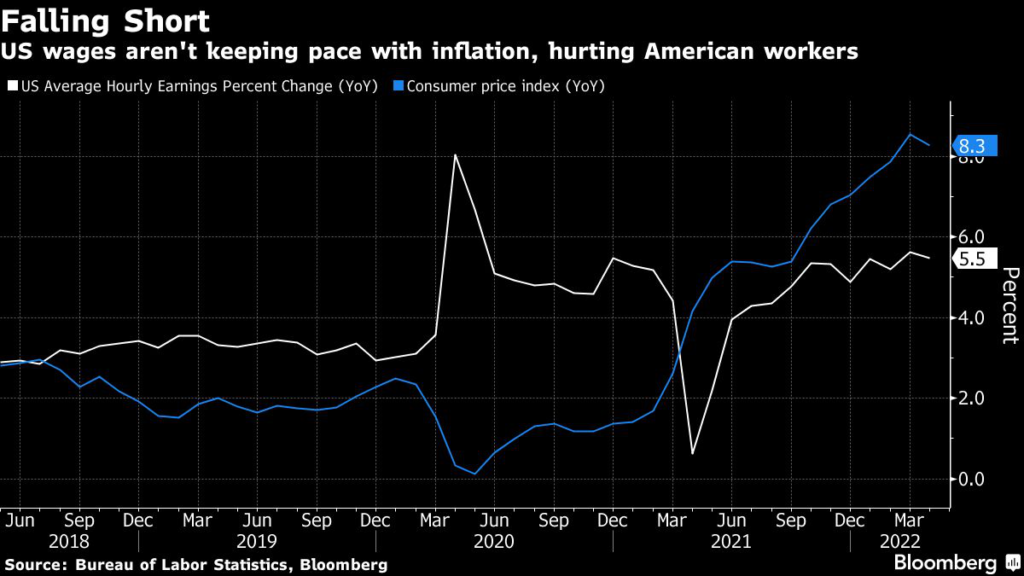
US wage growth looks to be peaking, a heartening development for the Federal Reserve if not for American workers.

After handing out hefty salary increases over the past year, companies are now becoming more cautious with their cash over concern further big payouts will eat into profits, according to staffing companies, business owners and recent surveys. 

Economists are penciling in a moderation in annual earnings growth to 5.2% in May from April’s 5.5% in data out next week. Those figures are among the highest in records dating back to 2007.

Employers have had success passing on higher labor costs to customers so far, but may be reaching a tipping point at which higher price depress demand. That’s exactly what the Fed is hoping for in its all-out mission to tame some of the worst inflation in 40 years.

Chair Jerome Powell has zeroed in on the tight job market as a possible source of the problem, so any cooling in wage growth — and therefore, potentially inflation — would be welcome news for the central bank, as it walks a tightrope to rein in price pressures without sinking the economy.

“We’ve reached a level of wage inflation where employers are going to say, ‘I’ve done as much as I can,’” said Jonas Prising, chief executive officer of ManpowerGroup Inc., the Milwaukee-based staffing company that serves more than 100,000 clients worldwide. “‘My consumers and customers aren’t going to accept me passing these costs on any further, so we need to start to mitigate them.’”

That mindset should encourage Fed policy makers, who are counting on what they see as anchored inflation expectations to keep price pressures in check as they try to soft-land the economy. Their biggest fear is that expectations become unhinged, leading to a 1970s style wage-price spiral in which consumers anticipating higher prices will, in turn, demand higher wages — forcing companies to charge their customers more.

Increased chances of a soft landing would be good news for investors, who’ve seen stocks slide to their lowest levels in more than a year on fears the Fed’s efforts to curb inflation toward its 2% target will result in recession. The central bank’s preferred price gauge, the personal consumption expenditures index, showed a 6.3% increase in April from a year ago in data released Friday.

What Bloomberg Economics Says…

If pay increases subside, that “improves the odds that the Federal Reserve can manage a soft landing for the US economy.” But it won’t stop the Fed from raising interest rates by another 50 basis points in June and then again in July, which the central bank has indicated is its preferred path.

— Yelena Shulyatyeva and Eliza Winger, economists

To read the full note, click here

That’s taking a toll on American workers, who are seeing their wage gains eaten away by higher prices for everything from food and gas to shelter.

Burning Glass Institute Chief Economist Gad Levanon said the US is transitioning from a pandemic-driven job market — where many Americans weren’t actively seeking work due to fears of the virus and related issues — to one that is more traditionally tight because unemployment is low. That might take some of the edge off wage increases, but pay is still likely to grow rapidly, said Levanon, whose institute specializes in labor-market research.

“Every company still needs people but they don’t need hundreds of people,” said Tom Gimbel, chief executive officer of Chicago-based employment agency LaSalle Network. “They’re being choosier about who they’re hiring than they were six months ago.”

Many companies, especially larger ones like Chipotle Mexican Grill Inc. and T.J. Maxx owner TJX Cos., are still successfully passing on higher labor and materials costs to their customers. That’s a trend that most Fed policy makers commented on at their meeting earlier this month, according to minutes of the gathering released on Wednesday.

However, “a few participants added that some of their contacts were starting to report that higher prices were hurting sales,” the central bank said.

That’s especially true among smaller firms, which generally have thinner profit margins, and can only boost pay and benefits so much. They also tend to be concentrated in industries with a larger proportion of low-skilled workers, where wage pressures coming out of the pandemic have been the greatest.

“The competition with larger companies is capping the ability of smaller firms to add to headcount,” said Nela Richardson, chief economist of Automatic Data Processing Inc., which provides payroll management and other services to companies.

Beveridge Well Drilling Inc. is among those feeling the pinch. The Nebraska-based company is offering an hourly wage of $16.50 for manual labor, up from $12 about a year ago. But even with “100%” health care benefits and other generous perks, it can’t fill all the open slots, vice president of construction Brandon Jones said. 

And while the firm could bump up its offers to about $18 an hour, that’s “about as high as we feel we can do” against the backdrop of rising fuel and supply costs, Jones said.

Wage growth should slow to 4.5% by year end as temporary factors that have boosted pay, such one-time raises to compensate workers for pandemic hardship, come to an end, according to Goldman Sachs Group Inc. economist Spencer Hill. That will go some way toward the 3.5% to 4% pace he reckons is compatible with the Fed’s 2% inflation target.

“If wage growth comes part of the way down as temporary factors fade, the remaining task for the Fed would be more manageable,” Hill said in a note to clients this week.

(Updates with PCE price index in eighth paragraph)

More stories like this are available on bloomberg.com

©2022 Bloomberg L.P.

NFT App Blocks Users in China, Sending Digital Tokens Plunging

(Bloomberg) — Nine months after officially declaring all cryptocurrency transactions illegal, China still has the power to roil digital assets. 

GST, a token linked to the “move-to-earn” fitness app STEPN, fell about 10% after the app’s operator said Thursday that users in China would effectively be barred from using it starting July 15. Another cryptocurrency tied to the app called GMT plunged more than 30% before rebounding, data from CoinGecko show. 

STEPN uses blockchain technology that lets users buy virtual sneakers in the form of nonfungible tokens, which they can then use to earn GMT or GST coins by walking or running. With STEPN shutting off GPS services to users located in China, those customers will no longer be able to accumulate the tokens.  

“STEPN has always attached great importance to compliance obligations and always strictly abides by the relevant requirements of local regulatory agencies,” it said in the Chinese-language tweet, without specifying whether Chinese regulators had explicitly requested the move. 

While China has banned all trading and mining of cryptocurrencies, it still permits NFTs and blockchains — but with restrictions aimed curtailing speculation. It relies on so-called permission-based blockchains that operate under state oversight, and there’s no secondary market for NFTs like OpenSea.  

How China Is Embracing NFTs, With Strings Attached: QuickTake

STEPN users earn Green Satoshi Tokens (GST) when they walk or run, and can then use those to level up their NFT sneakers. When their NFT sneakers have reached a certain level, they receive Green Metaverse Tokens (GMT). 

Since starting in December, STEPN has garnered more than 580,000 users worldwide, and about 38,000 of them were active in the last 24 hours, according to data from Dune Analytics. The data doesn’t break out users by country.  

In January, STEPN said it raised $5 million from investors including Sequoia Capital and Alameda Research.

The company said in the tweet that it’s never engaged in any direct business in China, and that it hasn’t provided any way of downloading its app there. It will shut off GPS access to users whose IP address or GPS location shows they’re in the country. 

GMT was listed in March. Its market capitalization has fallen to around $600 million since peaking at $2.4 billion in April, according to CoinGecko. Solana, the native token of the blockchain STEPN uses for its app, fell as much as 9.6% on Friday. 

More stories like this are available on bloomberg.com

©2022 Bloomberg L.P.

Latin American Startups Are Facing a Wipeout, Says Clip CEO

(Bloomberg) — A crash in venture capital funding is set to wipe out startups across Latin America and delay potential initial public offerings for years, but the head of Mexican payments company Clip says his company is set to thrive. 

Latin America was the world’s fastest-growing region for venture funding last year. But now it’s facing a “hangover” as investors recoil from risky bets and many companies are not going to survive, said Clip Chief Executive Officer Adolfo Babatz. 

“Right now, an IPO is out of discussion, but if we list, it will definitely be in the US,” Babatz said in an interview this week from the company’s cozy tech-startup style headquarters high in one of Mexico City’s new towers. While Mexico’s more mature startups had been expected to possibly go public this year or next, the current “meltdown” will “delay everything for maybe 24 months,” he said.


Mexico’s other so-called unicorns that are valued more than $1 billion, such as used-car seller Kavak and cryptocurrency exchange Bitso, are also expected to choose US markets when they eventually list in what would be another blow for the local stock market, which has seen a spate of delistings and hasn’t had a major IPO since 2017.

Babatz said he has no need to raise funds from private investors or turn to public markets any time soon. Early last year, Clip received a $250 million investment from SoftBank Group Corp.’s Latin American fund and Viking Global Investors LP that took it to a $2 billion valuation.

Clip is focused on consolidating its position. At a presentation on Wednesday evening, Babatz held forth Silicon Valley-style, showing off the latest versions of the company’s point-of-sale terminals that start as low as $10 along with a new tablet on a stand that sells for $150.

“With the launch of this product, Clip is going to change the face of commerce in Mexico,” Babatz said as he strode across the stage in a black t-shirt.

Babatz declined to discuss specific data and there is little independent analysis available on closely-held startup companies like his.

Clip’s white and orange devices, which also help manage inventory, are becoming common across Mexico at corner shops and restaurants but there is still a huge market. Only about 900,000 merchants are served by traditional bank terminals out of 11 million formal and informal businesses in the country, Babatz said. 

Argentina’s MercadoLibre Inc, with its Mercado Pago product, PayPal Holdings Inc.’s Zettle and local startup Sr. Pago, bought by Mexican lending fintech Konfio last year, have been Clip’s competitors. Argentina’s Uala, the mobile payments company backed by George Soros, Steve Cohen and Tencent Holdings, launched a terminal last month.

One big factor limiting growth has been the country’s payment network, which is controlled by two companies owned by big banks. Babatz said he was confident Mexico would take steps to increase competition as Brazil and Argentina did around a decade ago. 

“With more competition at the network level, we will have better opportunity for us to have lower fees, better access, most importantly, better technology so we can provide more sophisticated products to the merchant, like e-commerce payments and things like that. And it will also increase competition by allowing making it easier for foreign players to come in,” Babatz said.

More stories like this are available on bloomberg.com

©2022 Bloomberg L.P.
Short-Sellers Target Biggest US Bitcoin ETF as Drawdown Deepens

(Bloomberg) — The first US Bitcoin-futures backed exchange-traded fund is turning into a target for crypto bears. 

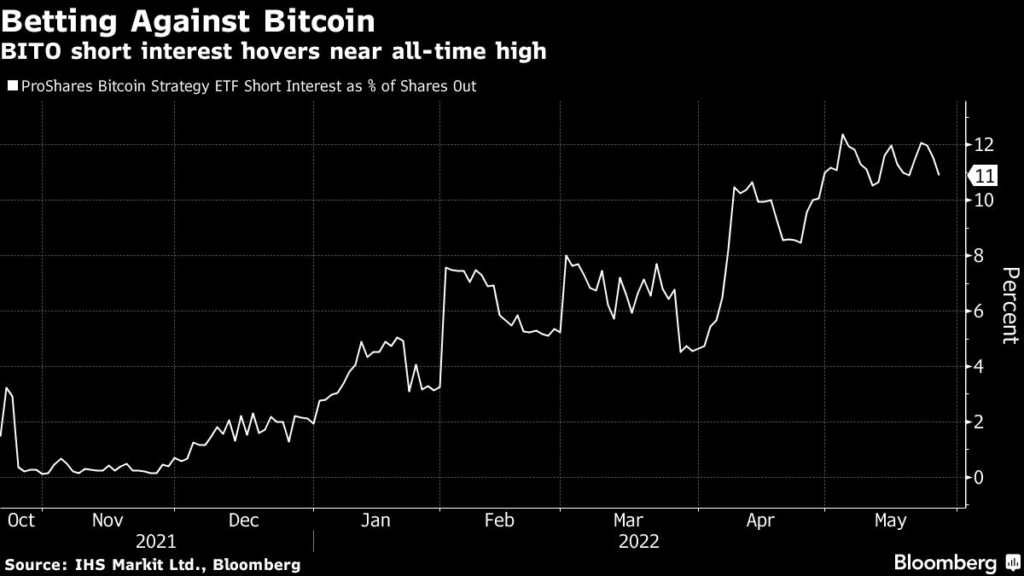
Short interest in the $748 million ProShares Bitcoin Strategy ETF (ticker BITO) as a percentage of shares outstanding is nearly 11%, close to the highest since the fund’s October 2021 inception, IHS Markit Ltd. data show. Meanwhile, the fund’s ratio of open interest in bearish put contracts to call open interest has soared since mid-April to all-time highs.

That suggests that crypto bears are flocking to BITO as a way to short sell the token as they wait for the rollout of inverse Bitcoin ETFs, which would bet against it. Issuers such as Direxion, ProShares and AXS have filed applications for funds that would offer short exposure to Bitcoin futures contracts in the past few months, but none have launched yet. In the meantime, betting against BITO — the first and largest US-listed Bitcoin derivatives ETF — appears to be serving as a proxy.

“BITO is the first, it’s bigger and there’s more volume,” said Athanasios Psarofagis, Bloomberg Intelligence ETF analyst. “The other ones have been a bit of a flop.”

BITO has plunged nearly 37% so far in 2022, mirroring a fall in the world’s biggest cryptocurrency. The entire digital assets landscape has been pressured by ultra-hot inflation and tightening Federal Reserve policy. As a result, BITO is this year’s third worst-performing ETF in the US among non-leveraged funds, Bloomberg data show. 

More stories like this are available on bloomberg.com

©2022 Bloomberg L.P.

Turkey’s Digital ‘Fake News’ Proposal Fuels Censorship Fears

(Bloomberg) — Sign up for our Middle East newsletter and follow us @middleeast for news on the region.

Turkey’s ruling party has sent to parliament a draft bill seeking prison terms of as much as three years for the spread of “disinformation” and “fake news” on digital platforms, a move government critics say would enable censorship and stifle dissent. 

Anyone distributing “false information” on Turkey’s domestic and external security, public order and welfare could face between one and three years in jail for instigating “concern, fear and panic in society,” according to the proposal seen by Bloomberg News. 

There could be stiffer penalties if the dissemination is linked to the “activities of an organization” or hides the identity of a “criminal offender,” President Recep Tayyip Erdogan’s AK Party and its nationalist MHP ally propose in the draft. Together the parties control 333 of parliament’s 600 seats.

“Those who get funded by various places and want to create chaos in our country will have to think again,” Deputy Minister of Transportation and Infrastructure Omer Fatih Sayan said on Twitter of the bill. “We have never allowed and will never allow disinformation and manipulation on social media platforms.”

Turkey’s journalists’ union, however, condemned the proposed legislation and called for its immediate withdrawal. “The bill will boost systematic censorship and self-censorship in Turkey, instead of fighting disinformation,” said the union, known as TGS. 

While countries around the world are introducing laws to fight disinformation, it’s unclear how that will be defined in Turkey, said Ozgur Ogret, Turkey representative of the Committee to Protect Journalists. The draft would restrict “already problematic” press freedoms in Turkey, Ogret said. 

Turkey’s government has already tightened its grip on online content and digital platforms in recent years, while curbing official advertisements and announcements in opposition-linked media outlets.

Reporters Without Borders’ World Press Freedom Index ranks Turkey 149th out of 180 nations, saying 90% of the national media is under government control. The organization has accused Erdogan’s presidency of stepping up attacks on journalists to deflect attention from economic and other problems ahead of elections set for next year.

In 2020, Turkey passed a contentious law that obligated social-media companies with more than one million daily users in the country to appoint local representatives, and gave authorities more power to block access to sites. 

The president has also repeatedly threatened to shut down some social media, citing what he considered to be personal attacks against himself and his family. He’s been a vocal critic of the platforms, describing them as “a threat to democracy” and “a national security problem.”

Courts banned YouTube and Wikipedia for years, while access to Twitter was slowed to a trickle at times of heightened strife, such as cross-border operations into Syria and terrorist attacks at home. 

More stories like this are available on bloomberg.com

©2022 Bloomberg L.P.

Auto Suppliers Stage M&A Deal Wave in Twilight Years for Engines

(Bloomberg) —

Last week, Bloomberg News reported that auto supplier American Axle had hired bankers and was exploring a potential sale, mostly likely to a private equity firm that would pull off a leveraged buyout.

American Axle issued a statement a few days later to say that while it isn’t engaged in a process to sell, the company regularly considers “strategic opportunities” that would be in the best interest of shareholders.

We may be in the midst of a trend, with a series of LBOs and M&A deals involving suppliers that are highly reliant on gasoline-powered vehicles. Already this year, we’ve seen muffler maker Tenneco agree to be taken private by Apollo. The same week in February, diesel-engine manufacturer Cummins reached a deal to acquire Meritor, the main selling point of which was electric-drive technology for commercial trucks.

Any company whose business is dependent on internal combustion engines has a few options: sell out to a PE firm or a competitor that’s better-positioned for the electric-vehicle age, or develop or acquire technology that makes its business more relevant as the world pivots to battery-powered transport.

Electric vehicle sales more than doubled to 6.6 million last year, approaching 9% of the global auto market. If a company in the industry isn’t big in EVs, its business is bound to slowly erode, and its stock price will follow suit.

Private equity companies are well-versed in managing these sorts of businesses. They come in, wring out costs, perhaps roll up a company with others in the same field and run out the clock on the operation with an emphasis on cash flow. It could be a while before these businesses go fully bust, because consumers will keep buying and servicing combustion vehicles for years to come. They’ll just buy a smaller portion every year.

Apollo’s $1.6 billion deal for Tenneco is a classic private equity takeout. Tenneco makes aftermarket parts and has two major units producing powertrain and emissions components. More than 80% of its revenue comes from those two business lines.

American Axle is similarly positioned. While the company has said EV parts and systems are 35% of its order backlog, Credit Suisse analyst Dan Levy wrote last week that a full transition to electric vehicles is still in question and could pressure margins. If he’s right, the Detroit-based supplier may have a rough time remaining on the public market. The $357 million in free cash flow generated last year also would fit nicely with a private equity buyer. Levy sees this figure rising to around $400 million in 2023.

Allison Transmission could be another candidate. The supplier to medium- and heavy-duty trucks recently announced a partnership with China’s Jing-Jin Electric to work together on the electric motors and inverters needed for EVs. But that agreement isn’t yet a year old, and the company remains heavily reliant on internal combustion. Like American Axle, Allison has healthy cash flow.

There are also some smaller deals that could happen, with large suppliers that do have growing businesses catering to EVs either hiving off internal-combustion assets or spare-parts businesses. BorgWarner, for example, has an expanding e-propulsion operation as well as an old-line aftermarket parts business that generated just $853 million of its $14.8 billion revenue last year.

For the time being, the capital markets have cooled dealmaking. With interest rates rising, the debt issued for an LBO may end up trading at a discount by the time a transaction closes. But once interest rates stabilize, watch out. We could see the next phase of upheaval from the electric revolution.

Like getting this newsletter? Subscribe to Bloomberg.com for unlimited access to trusted, data-driven journalism and subscriber-only insights.

More stories like this are available on bloomberg.com

©2022 Bloomberg L.P.
Meta Copied VR Technology Key to Metaverse Gaming, Immersion Claims

(Bloomberg) — Meta Platforms Inc. built its industry-leading virtual reality headset by infringing Immersion Corp.’s patents, the smaller company alleged in a lawsuit.

The Meta Quest 2, which dominates the market, infringes six patents covering haptic technology, Immersion said in a complaint filed Thursday in federal court in Waco, Texas. In video game systems and controllers, haptics allow users to experience vibrations that mimic real-life forces — such as blocking a punch in a virtual boxing game.

Meta Chief Executive Officer Mark Zuckerberg has committed to spending $10 billion a year to bring to life his vision of a virtual reality-enabled metaverse. Sales of Meta Quest 2 hit 8.7 million units in 2021, twice as much as in the prior year, and the company owns 80% of the market.

Immersion is seeking a court order blocking Meta’s use of the infringing technology and unspecified damages.

Meta representatives didn’t immediately respond outside regular business hours to a request for comment.

Immersion, which specializes in haptics patents, is known for taking on some of the world’s largest companies in licensing disputes.

The case is Immersion Corp. v. Meta Platforms Inc., 22-cv-541, U.S. District Court, Western District of Texas (Waco).

More stories like this are available on bloomberg.com

©2022 Bloomberg L.P.

Once Immune From Crypto Winter, Bored Apes Are Feeling the Cold

(Bloomberg) — Blue-chip NFTs like CryptoPunks, Bored Ape Yacht Club and Mutant Ape Yacht Club are no longer immune to the recent collapse in cryptocurrency prices, with one closely watched benchmark — the lowest priced item in the collections — down about 50% in the last month. 

For months, many top-tier nonfungible tokens — particularly Bored Apes — have held their value even when Bitcoin and Ether prices were falling. That’s changing now, with the Nansen Blue Chip-10 Index sliding 41% so far this year. JPG NFT Index, which debuted this spring and features “premier” collections like CryptoPunks, fell to its lowest value yet Thursday, and is down 57% in a little over a month, according to data tracker CoinMarketCap.   

The reasons for the swift catch up are mounting. The most expensive and popular NFTs are purchased in Ether, which is down 33% in the past month, when the entire crypto ecosystem was shaken up by the collapse of the UST stablecoin and related coin Luna. The related loss of more than $40 billion in market value deepened the crypto slump that began in early November. Trading volume on OpenSea, the world’s biggest NFT marketplace, is down 40% over the last 30 days, according to DappRadar.

“The most expensive stuff has relatively few owners, and owners and potential buyers tend to be committed to keeping prices high,” said Aaron Brown, a crypto investor who writes for Bloomberg Opinion. “But economics humble us all, rich and poor, committed and uncommitted.”   

CryptoPunks’ floor price has been declining since October, according to tracker NFT Price Floor. The lowest-possible prices of Bored Apes and Mutant Apes peaked in late April before beginning to drop. Holders of both collections could receive extra ApeCoins earlier this year, and to buy additional NFTs called Otherdeeds, which were released on May 1.   

More stories like this are available on bloomberg.com

©2022 Bloomberg L.P.

Orban’s Economy Chief Defends Windfall Tax After Market Rout

(Bloomberg) — Hungary’s planned windfall tax is the least harmful way of raising revenue needed to consolidate the budget that’s been effectively cut off from European Union funding, a key government official said.

The tax, announced this week, is “extremely targeted” and seeks to add revenue of more than 800 billion forint ($2.2 billion) this year and in 2023, mostly to cover household utility subsidies as costs have soared after Russia attacked Ukraine, Economic Development Minister Marton Nagy said in an interview late Thursday.

The levy on eight industries, primarily energy and banking, differs from the blunt sectoral taxes Hungary introduced in 2010 that contributed to a recession and pushed the nation’s sovereign credit grade to junk category, he said. It seeks to minimize the hit on economic activity by targeting only “extra profit” resulting from outside factors, such as the pandemic or the war in Ukraine, he said.

“People have forgotten the concept of windfall taxes because it’s been so long since they were used,” Nagy said. “There’s a huge difference between just taxing profit, which can be harmful, and taxing ‘extra profit,’ which is money that just fell into the lap of a company and tapping it for the public good.”

Investors didn’t embrace the concept on Thursday, when Hungarian refiner Mol Nyrt. fell more than 9% and the country’s largest lender fell 8.2%. Government bond yields jumped and the forint was volatile. OTP fell a further 0.6% while Mol was up 0.4% by 12:14 p.m. in Budapest on Friday.

The government is committed to reducing the budget deficit to 4.9% of gross domestic product this year and 3.5% in 2023, Nagy said. While Britain this week announced windfall taxes targeting its energy industry, Hungary’s levy also cover banking, insurance, energy, retail, airlines, telecommunications, pharmaceuticals and advertising.

Mol Nyrt., whose profit swelled on selling Russian crude, will take the biggest hit and pay about 250 billion forint of the 300 billion forint windfall tax for energy companies, Nagy said, adding that proved the aim wasn’t to target foreign companies.

Banks, which have profited from rising interest rates, will have to pay the tax based on their net interest income in Hungary. OTP Bank Nyrt. is thus poised to account for about a third of the 250 billion forint in windfall levy for the banking industry. 

Overreaction?

“We think that the alarm was much bigger than the actual impact” of the windfall tax on corporate profit, especially on OTP, Erste Group Bank AG’s investment arm in Hungary said in a note to clients. The levies may shave 600 forint off the value of Mol and OTP shares, the group estimated. OTP fell more than 1,000 forint this week.

The government is also seeking to boost transaction tax revenue from banks by raising the maximum fees for wire transfers to 10,000 forint from 6,000 forint. 

It will also target online fintech platforms Revolut and Wise Payments and will extend the levy for the sale or purchase of securities, which until now enjoyed an exemption, Nagy said. Other measures include the introduction of a departure fee for air travelers.

Revenue from the windfall tax, which will be published via decree, makes up 40% of the $5.5 billion budget consolidation package. The rest will come from cuts in the spending of ministries and by the delay of state investments, mainly in construction, Nagy said.

These measures are aimed at consolidating the budget as the EU imposes an effective funding freeze against Prime Minister Viktor Orban’s government, which it says flouts democratic norms. 

Hungary is “flexible” in terms of financing and it “makes sense” to sell foreign-currency bonds because of their lower yield compared with those denominated in forint, Nagy said. 

The central bank, meantime, must balance between risks, including the chance that raising what is already the EU’s highest effective interest rate may potentially trigger a credit crunch, said Nagy, a former central bank deputy governor and Orban’s economic adviser before becoming a minister this week. 

On the other hand, it must also not lose sight of the forint, which fell to near a record low against the euro on Thursday, and whose continuing weakness makes the inflation challenge worse. 

“It’s thin ice and the central bank is doing its best to keep its balance,” he said.

(Updates with market reaction in fifth paragraph, analyst forecast in ninth.)

More stories like this are available on bloomberg.com

©2022 Bloomberg L.P.

Close Bitnami banner
Bitnami