

Bloomberg

Zilingo’s Fired CEO Responds to Questions of Mystery Payments

(Bloomberg) — Ankiti Bose, who was fired last week as chief executive officer of the Singapore startup Zilingo Pte, says she’ll keep fighting to clear her name.

The fashion e-commerce platform terminated her employment after an investigation into claims of what it called “serious financial irregularities” and said it “reserves the right to pursue appropriate legal action.” The probe included questions about Zilingo’s accounting practices and payments to several service providers of more than $7 million that were signed by her without the knowledge of senior executives, according to people familiar with the matter.

In two interviews, before and after her dismissal, Bose denied wrongdoing and provided detailed responses to key points of the investigation. She said that, in the end, the company fired her for a lack of cooperation in the investigation rather than for actual financial improprieties. She’s determined to protect her reputation.

“There is not a single payment made by Zilingo that did not have proper documents or either the finance, tech or operations teams were not aware of,” said Bose, a former McKinsey & Co. consultant who had been CEO of Zilingo since its founding. “I feel like my baby has been taken away from me without giving me a proper explanation or a chance to fight for her back. I’m grieving and fighting for myself simultaneously.”

Once a shining example of the potential for tech startups in Southeast Asia, Zilingo ran into trouble after internal whistleblowers voiced complaints this year that triggered conflicts between Bose and her longtime backers. The board suspended her on March 31 and hired investigative firm Kroll Inc. to examine the complaints. Now Zilingo’s very survival is in question. 

Bose co-founded Zilingo with Dhruv Kapoor in 2015 after a visit to Bangkok’s Chatuchak market, where 15,000 merchants sell goods from across Thailand. Their aim was to build a technology platform to help those kinds of tiny merchants sell to consumers across Southeast Asia. In 2018, they began to reposition themselves as a business-to-business platform to reduce the high cash burn of working with consumers. 

Zilingo’s pitch that it would help digitize the fashion industry’s antiquated supply chain helped draw venture backers, including Sequoia Capital India and Temasek Holdings Pte. It raised $226 million at a valuation of $970 million in 2019, when Bose was just 27 years old. But with pressure to grow quickly, Zilingo found itself dealing with thousands of vendors and merchants across nine countries from Sri Lanka to Indonesia. The complexity ended up straining the young company’s ability to track revenue and other financial figures.

Millions in Payments

Zilingo and its board haven’t publicly detailed their allegations against Bose. The company didn’t respond to multiple requests for comment, beyond earlier public statements. 

“Following an investigation led by an independent forensics firm that was commissioned to look into complaints of serious financial irregularities, the company has decided to terminate Ms. Ankiti Bose’s employment with cause, and reserves the right to pursue appropriate legal action,” the company said on May 20. Social media campaigns and leaked information have “caused irreparable damage to the company, the board, employees and investors.”

People familiar with the Bose probe said one of the most serious allegations involves the payments to service providers that the CEO had signed off on without the knowledge of other senior managers. The payments went to about five information technology and consulting firms during the two-year period covered by the Kroll probe, said the people, asking not to be identified because details of the inquiry are private. These firms received either monthly or one-time payments from Zilingo totaling millions of dollars over that period, while it wasn’t clear what services they delivered, the people said. 

Bose said all of the payments are legitimate and they certainly weren’t made to benefit her personally. She added it’s possible other senior mangers weren’t aware of the payments, although there wasn’t anything nefarious about that.

“I am 100% certain that there is nothing amiss about the way in which the payments are made,” she said. “I have heard that several individuals in the company have claimed that they are not aware of various business relationships. While I find that odd to believe, because there are so many jurisdictions and so many parts of the company, it’s possible that they were not officially aware.” 

Bose said that she has not been able to check internal documents to clarify what the payments were for following her suspension, even after requesting access under Kroll’s supervision. She also hasn’t been able to contact staff or external parties who may be able to clear her name.

“I was not given sufficient access to provide documents that would exonerate me,” she said. “All I ask my shareholders and stakeholders to do is to not believe that I did not make an attempt to answer these questions.”

Kroll didn’t respond to a request for comment.

While Kroll investigators conducted forensic audits to help identify potential financial irregularities, their work did not cover whether there were links between the Zilingo payments and the CEO, the people familiar said. Such a task would require access to bank accounts, which was beyond the scope of the forensic investigation, they added.

Another key area that Bose says Kroll officials have asked about is a discrepancy in revenue figures listed in documents provided to current and potential investors. The idea that Zilingo may have used different sets of financial figures has fueled fears among investors that the startup could have been inflating numbers or misleading backers.

Bose maintains that such differences are merely the result of trying to comply with complex accounting standards across multiple countries. For example, in some cases sales made by certain merchants on the platform were counted as Zilingo’s own revenue — even though such transactions would normally be classified as gross merchandise value, or GMV, under traditional accounting rules. Here, Bose said the rules in certain countries forced her hand.

“About 12% or 13% of our GMV historically has had to be recorded as revenue due to various regulatory requirements when goods are exported from several Asian countries,” she said in the interview before she was fired, citing India, Indonesia and Bangladesh as examples. “We have tried to work around this to reduce the impact of this between fiscal ‘21 and ‘22.”

A related issue is the timing of certain transactions. Zilingo is supposed to book revenue only when goods are shipped, but Bose said there was sometimes a 30- to 90-day lag between counting revenue and when the sales would be sent out. That also resulted in two sets of numbers at times, she said.

Independent accounting experts are hesitant to make a definitive judgment without examining Zilingo’s books, but at least one questioned her reasoning. 

Mak Yuen Teen, an accounting and governance expert at the National University of Singapore Business School, called it “not convincing” since most countries, including those she cited, adhere to global accounting standards. “Counting GMV as revenue is a significant risk for startups because their performance is often assessed based on revenues.”

Zilingo’s methods of accounting for discounts and incentives also had an influence on the books. The company has used aggressive methods for recognizing revenue, but Bose says the calculations are standard practice for the industry and that all of its investors were fully aware of them. She emphasized during the hours of discussion that she started Zilingo when she was 23 and depended on the finance department to sort through such quantitative questions. 

“All these matters are well understood by all investors,” Bose said in the earlier interview. “Unless I am a chartered accountant I cannot touch the books, let alone cook the books.”

Absent Audits

Uncertainty at Zilingo has been aggravated by a lack of audited figures. Public records in Singapore show it has not filed its fiscal 2020 or 2021 financial results, even though that is a basic regulatory requirement for all businesses registered in the city-state. 

Bose says the delays to its fiscal 2020 audited results were due to efforts to fix an issue involving an Indonesian entity that had been missed in fiscal 2019. She says it is not unusual for startups in Singapore and Southeast Asia to miss such filing deadlines. In Singapore, companies which miss their deadline for filing annual financial statements are fined as much as S$600 ($437), a relatively small sum.

Zilingo declined to comment. One venture capitalist, who asked not to be identified because of the dispute’s contentiousness, said it is not uncommon for startups to make late filings. 

In Zilingo’s case, that failure to file contributed to challenges. After Covid-19 slashed the company’s revenues, it took two rounds of financing to fund operations. One was a $25 million convertible note in late 2020 from Sequoia and state-owned investors EDBI and Temasek, while another was a near $40 million mezzanine debt facility in mid-2021 from Varde Partners and Indies Capital Partners, according to people familiar with the company’s finances, who asked not to be identified because the details are confidential.

In March 2022, Varde and Indies told the firm it was in default of the loan agreement citing a wide range of documents it was yet to receive, including the audited filings from fiscal 2020 and fiscal 2021, ordering it to cease drawing on funds. By May, they recalled the loan, putting the company in a precarious financial position with little cash to continue operations. The board said on May 13 it had appointed an independent financial adviser to explore options for Zilingo. 

‘It’s Not About Money’

Bose argued the investigation against her is an unfair effort to blame her for the company’s struggles. She said she has yet to see the full report of allegations against her, despite four interviews with Kroll. 

She said she was asked to attend another meeting on May 19, but requested to delay it until the following week because she was relocating her family. The next day, she was fired with a termination letter she said cited several causes including insubordination, neglect, failure to produce relevant documents and refusal to comply with direction.

“I want an opportunity to talk about every single one of the allegations,” she said. “I was denied the opportunity, time and access to do so.”

Bose, now 30, pointed out that she hopes to have a substantial professional future, ideally working at startups with ambitious plans for the tech industry.

“I’m not going to live with a stain on my reputation and my career,” Bose said. “It’s not about money — it’s about my career, it’s about my reputation, it’s about my life, it’s about my parents.”

More stories like this are available on bloomberg.com

©2022 Bloomberg L.P.
Brace for Crypto Market to ‘Get Weird’ Over Memorial Day

(Bloomberg) —

Cryptocurrencies are probably headed for more bouts of downside volatility and investors should consider reining in their risk, according to Fundstrat.

Buying put protection on long-crypto positions and cutting exposure to more speculative altcoins are a couple of safeguards, Sean Farrell, head of digital-asset strategy at the financial research firm, wrote in a note on Thursday. 

Liquidity has been low and could tighten further over the US Memorial Day holiday, while leverage in the Bitcoin market is increasing, according to Farrell. The macro outlook also remains unfavorable to risk assets as the Federal Reserve hikes interest rates and starts quantitative tightening, he said.

“Things could get weird,” Farrell said about the upcoming holidays. The combination of low liquidity, increasing leverage and tightening monetary conditions “could lead to large price swings, and potentially further volatility to the downside in the immediate term.”

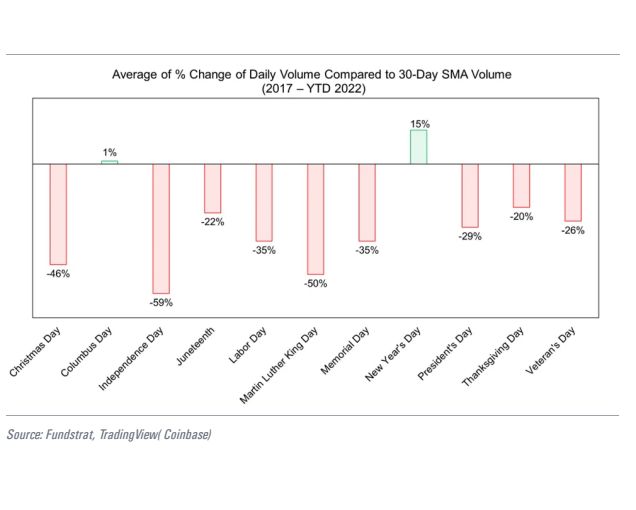
Crypto-market volume dropped 43% and 35% during the Memorial Day periods in 2020 and 2021, respectively, and activity is likely to be “extremely low” again this year, Farrell wrote. With institutional trading largely absent on holidays, “outsized price swings” are possible, he said. 

Bitcoin and Ether, the largest cryptocurrencies, are both down about 60% from their record highs in November, and some altcoins are off even more as central banks tighten monetary conditions. The collapse of the so-called Terra ecosystem this month dealt another blow to investor confidence in the asset class. 

Even so, Fundstrat expressed optimism about the longer-term outlook for digital assets. 

“We remain constructive on cryptoasset prices for 2022 and expect tides to shift” early in the second half, Farrell said.

More stories like this are available on bloomberg.com

©2022 Bloomberg L.P.
KPMG Plans to Hire 3,500 UK Tech Staff in Digital Expansion

(Bloomberg) —

KPMG LLP is looking to hire 3,500 UK engineers, data scientists and designers in the next three years, part of the consulting firm’s push into digital tools and applications services. 

The investment “signals a significant change in how we operate and serve the organizations we work with,” Lisa Heneghan, Global Chief Digital Officer at KPMG UK, said in an emailed statement Friday.  

The company currently has about 15,300 partners and staff in the UK. The new hires will more than double the current 3,000 tech staff. 

Read more: KPMG UK Hires Crypto Trade Body Boss, Bolsters Advisory Team

More stories like this are available on bloomberg.com

©2022 Bloomberg L.P.
Hedge Fund Buyers Return to Hong Kong Stocks, JPMorgan Says

(Bloomberg) — JPMorgan Chase & Co.’s hedge fund clients have returned to buying Hong Kong stocks since mid-March after continuous selling for more than a year, the Wall Street bank said in a note Thursday. 

In China, flows have stabilized as purchases to cover short positions were offset by a reduction in bullish wagers in the last few weeks, the U.S. lender said.

“This is the fourth instance that we’ve seen since Jan 2020 of sharp selling, followed by stabilization…typically preceding a recovery in flows,” the investment bank wrote. 

The comments add to signs of a shift in sentiment among Greater China stock investors as they weigh whether the deep pessimism that had engulfed the market is peaking. A prolonged rout has so far this year largely deterred stock-pickers from buying the dip. 

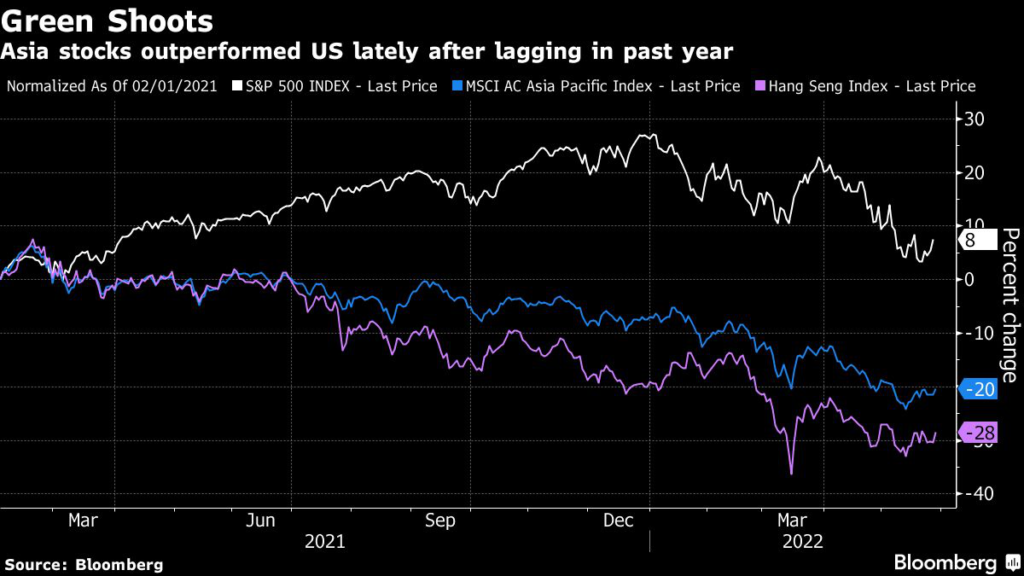
The benchmark Hang Seng Index of Hong Kong-listed stocks and the CSI 300 Index of yuan-denominated shares traded in Shanghai and Shenzhen have both slumped by nearly a third since mid-February 2021.

A spokesperson for JPMorgan was not immediately available for comment. 

Since late April, hedge funds have been net sellers of stocks that can benefit from Asia’s recovery from Covid, in addition to cooling toward beneficiaries of China’s move toward decarbonization this year, the bank said. By contrast, they have been adding to bullish bets and more recently reducing bearish wagers on stocks set to profit from Asia’s semiconductor chip shortage.

In recent weeks, multistrategy hedge funds led buying in both China and Hong Kong, JPMorgan said. They were joined by stock-focused quant hedge funds in China, where traditional stock pickers remained sellers, it added. 

More broadly, the Asia-Pacific region has seen the most net buying by the bank’s hedge fund clients in the past month, after “extreme” selling in March and recent outperformance, JPMorgan said. 

“Whether this trend continues is likely dependent on a number of macro risks that might need to be overcome, such as: higher inflation, supply chain issues from the Russia/Ukraine conflict and Covid lockdowns, and the risk of a growth slowdown,” according to the note.

More stories like this are available on bloomberg.com

©2022 Bloomberg L.P.

Didi Is Said to Draw China FAW’s Interest in Buying Stake

(Bloomberg) — State-owned automaker China FAW Group Co. is considering acquiring a significant stake in the troubled ride-hailing giant Didi Global Inc., according to people familiar with the matter.

The Chinese carmaker has reached out to Didi’s top executives and expressed its interest in becoming a major shareholder in the firm, said the people, who asked not to be identified as the information is private. FAW pledged to help Didi resolve issues related to data security, paving the way for a Hong Kong listing, the people said.

Discussions are at an early stage and might not lead to any transaction, the people said. Representatives for Didi and FAW didn’t immediately respond to requests for comment.

Shares of Didi jumped almost 10% in premarket trading in New York after the Bloomberg News report.

Didi became a symbol of China’s crackdown on technology companies after the ride-hailing firm proceeded with its $4.4 billion US IPO despite Beijing’s objections, erasing more than $70 billion in market value since China placed it under a cybersecurity probe.

FAW is unlikely to be the only firm interested in getting a stake in Didi. Shouqi Group — part of the influential Beijing Tourism Group, and other companies based in Beijing were looking at a stake in the ride-hailing firm, Bloomberg News reported last September.

Red Flag Limo

FAW is one of China’s biggest automobile conglomerates, makers of the Hongqi or Red Flag limousine that transported Chairman Mao Zedong. The company has since evolved into one of the country’s most important state-backed corporations, a partner to foreign giants from Toyota Motor Corp. and Volkswagen AG with ambitions to delve into newer arenas such as electric vehicles and autonomous driving.

Shareholders of Didi this week approved a plan to delist from the New York Stock Exchange, capping its 11-month ordeal that’s seen its market value plunge. Its biggest shareholders include SoftBank Group Corp., Tencent Holdings Ltd. and Uber Technologies Inc.

While the vote clears the way for Didi to work with Chinese regulators on the overhaul of its data systems, its future is still in limbo as the actual punishment by the Cyberspace Administration of China remains unclear. The company had to put its Hong Kong listing plan on hold given the uncertainty, Bloomberg News has reported.

Some investors could be forced to sell because their mandates don’t allow them to hold unlisted shares. Hedge funds have already reduced their Didi holdings by 29% to about $232 million during the first quarter, according to a Bloomberg analysis of filings.

(Add Didi’s shares price in fourth paragraph.)

More stories like this are available on bloomberg.com

©2022 Bloomberg L.P.
Bitcoin’s Crypto Dominance Is Strongest Since Bull Market Highs

(Bloomberg) — Bitcoin is regaining its dominance of the cryptocurrency universe.

It now accounts for 44% of total crypto market value, the most since October, just before the latest bull market peaked, based on data from CoinGecko. Bitcoin’s renewed hegemony is a reflection of how the collapse of the TerraUSD stablecoin earlier this month has ravaged smaller tokens like Avalanche and Solana. 

The largest cryptocurrecy was down about 1.5% on Friday, making it a relative safe haven compared with altcoins like Avalanche, which tumbled as much as 11%. Bitcoin has also been outperforming second-largest token Ether, which has been rocked by concerns about a glitch in the effort to make its underlying blockchain less energy intensive. 

“Typically, when there’s a correction in crypto markets, altcoins underperform Bitcoin, as they are perceived as higher risk coins than Bitcoin,” said Julio Moreno, a senior analyst at CryptoQuant. 

Read more: Ether, Altcoins Lead Crypto Rout as Terra DeFi Fallout Deepens

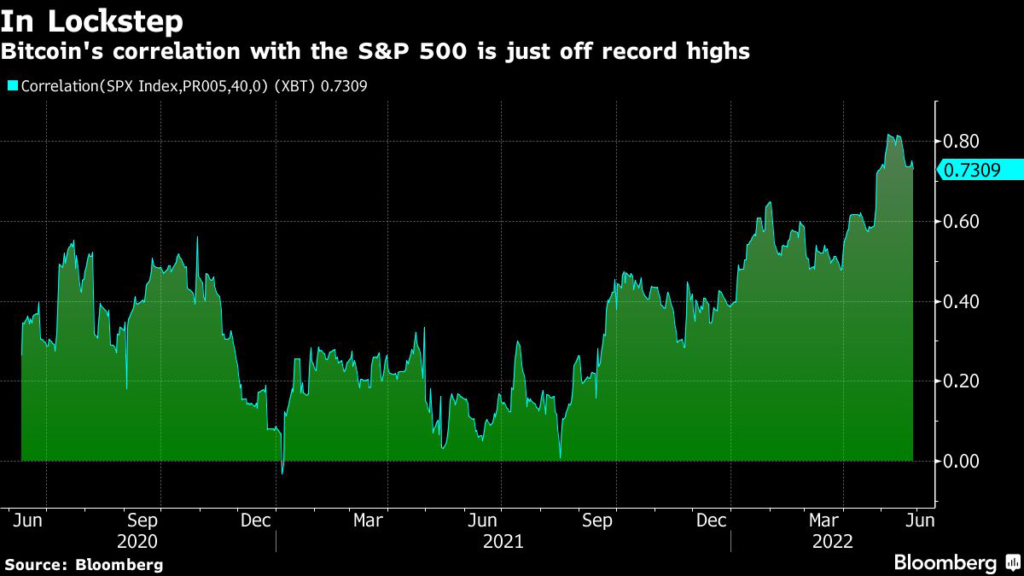
Even with its recent outperformance, Bitcoin still faces a host of challenges, including monetary tightening by central banks around the world. And while Friday’s decline was small compared to other digital coins, it came against the backdrop of global equities advancing. In the past few months, Bitcoin has tended to move in tandem with stocks.

In addition, large Bitcoin holders — known in industry parlance as whales — are moving their tokens to exchanges, suggesting they may be getting ready to sell, according to Moreno. The share of exchange inflows from whales to total inflows is at the highest since August 2019, he said. 

“In the past, when whales were moving their coins to exchanges at this pace a price correction happened, and in the current macro context this cannot be ruled out,” he said. 

More stories like this are available on bloomberg.com

©2022 Bloomberg L.P.
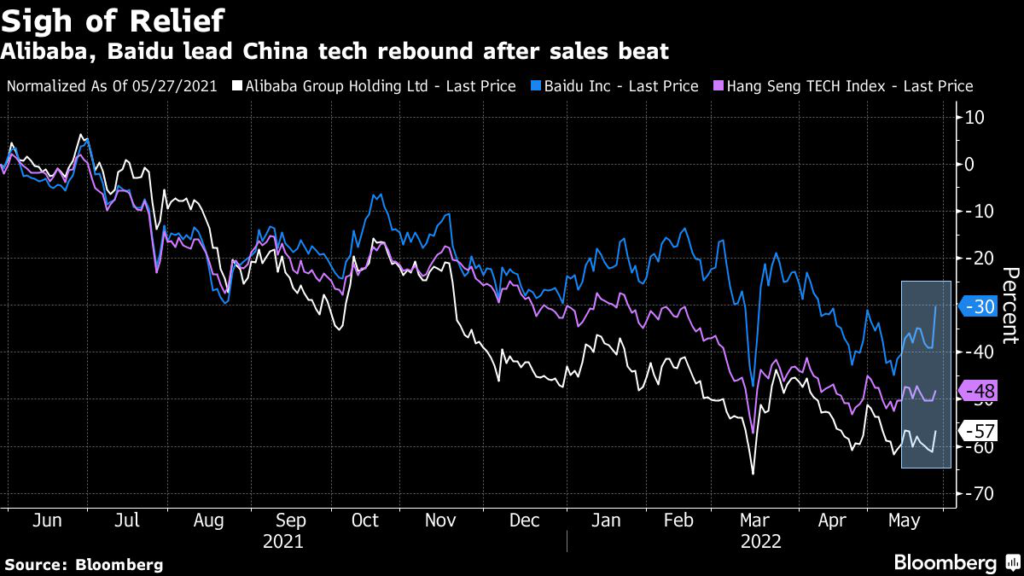
Alibaba Share Surges as Sales Beats Boost Sentiment

(Bloomberg) — Chinese tech shares jumped as two of the biggest Internet giants reported sales that topped estimates, lifting some of the gloom that had beset the sector following Covid-19 lockdowns and regulatory headwinds.  

Hong Kong’s Hang Seng Tech Index rose 3.8% on Friday, the most in a week. E-commerce leader Alibaba Group Holding Ltd. and Baidu Inc. were the top gainers, rallying by at least 12% each.

Both Alibaba and Baidu reported sales growth that were higher than expected, suggesting some of China’s largest businesses have found ways to wade through strict Covid restrictions in key cities. The revenue beats offer a rare but encouraging sign in an economy that’s come to a standstill due to stringent movement controls. 

“We do expect the second quarter to mark the bottom in growth for our companies,” Ronald Keung, head of Asia Internet research at Goldman Sachs Group Inc. said in a Bloomberg TV interview. “Depending on the Covid policies and the government’s policies in helping to drive back consumption confidence, we do expect easier comps for China tech companies particularly as you enter into September and December quarter.”

Investors are also hoping the more than a yearlong crackdown on private enterprise is approaching an end. Policy makers have been vowing support for the industry as part of their effort to support a sputtering economy.    

After slumping to a record low in mid-March, the Hang Seng Tech gauge has seen brief bouts of recoveries as policy optimism attracted dip buyers. The index remains down more than 60% from a February 2021 peak as investors struggle to reach consensus on whether the sector is set for a sustainable rally. 

“Street estimates for Chinese tech appear to be more pessimistic than reality. That coupled with the easing crackdown and stimulus measures should provide a base for these shares to rally,” said Justin Tang, head of Asian research at United First Partners in Singapore. 

The Nasdaq Golden Dragon China Index of Chinese firms trading in the U.S. jumped 7.6% on Thursday. The benchmark Hang Seng Index gained 2.9% on Friday, while China’s CSI 300 Index climbed 0.2%. 

Still, traders remain wary that fresh virus outbreaks and Beijing’s adherence to a Covid Zero policy may roil further market upside. Any policy support may also be gradual, with Tencent Holdings Ltd. executives warning last week that it will take time for Beijing to act on promises to support the sector.  

Technology shares no longer enjoy high growth, “so there will only be range-bound trading going forward,” said Steven Leung, executive director at UOB Kay Hian.

More stories like this are available on bloomberg.com

©2022 Bloomberg L.P.

Didi Is Said to Draw State-Backed FAW’s Interest in Buying Stake

(Bloomberg) — State-owned automaker China FAW Group Co. is considering acquiring a significant stake in the troubled ride-hailing giant Didi Global Inc., according to people familiar with the matter.

The Chinese carmaker has reached out to Didi’s top executives and expressed its interest in becoming a major shareholder in the firm, said the people, who asked not to be identified as the information is private. FAW pledged to help Didi resolve issues related to data security, paving the way for a Hong Kong listing, the people said.

Discussions are at an early stage and might not lead to any transaction, the people said. Representatives for Didi and FAW didn’t immediately respond to requests for comment.

Didi became a symbol of China’s crackdown on technology companies after the ride-hailing firm proceeded with its $4.4 billion US IPO despite Beijing’s objections, erasing more than $70 billion in market value since China placed it under a cybersecurity probe.

FAW is unlikely to be the only firm interested in getting a stake in Didi. Shouqi Group — part of the influential Beijing Tourism Group, and other companies based in Beijing were looking at a stake in the ride-hailing firm, Bloomberg News reported last September.

Red Flag Limo

FAW is one of China’s biggest automobile conglomerates, makers of the Hongqi or Red Flag limousine that transported Chairman Mao Zedong. The company has since evolved into one of the country’s most important state-backed corporations, a partner to foreign giants from Toyota Motor Corp. and Volkswagen AG with ambitions to delve into newer arenas such as electric vehicles and autonomous driving.

Shareholders of Didi this week approved a plan to delist from the New York Stock Exchange, capping its 11-month ordeal that’s seen its market value plunge. Its biggest shareholders include SoftBank Group Corp., Tencent Holdings Ltd. and Uber Technologies Inc.

While the vote clears the way for Didi to work with Chinese regulators on the overhaul of its data systems, its future is still in limbo as the actual punishment by the Cyberspace Administration of China remains unclear. The company had to put its Hong Kong listing plan on hold given the uncertainty, Bloomberg News has reported.

Some investors could be forced to sell because their mandates don’t allow them to hold unlisted shares. Hedge funds have already reduced their Didi holdings by 29% to about $232 million during the first quarter, according to a Bloomberg analysis of filings.

More stories like this are available on bloomberg.com

©2022 Bloomberg L.P.

Elon Musk’s Starlink Gets Nod to Provide Internet in Philippines

(Bloomberg) — Elon Musk’s Starlink has been authorized to provide satellite internet services in the Philippines, paving the way for the SpaceX unit’s expansion to Southeast Asia. Shares of possible partners rose. 

The Philippine National Telecommunications Commission said it approved Starlink’s registration as a value-added service provider, according to a statement Friday. This would allow Starlink to directly access satellite systems, and to build and operate broadband facilities.

The Philippines will be the first country in Southeast Asia to offer Starlink’s high speed, low latency satellite internet service, the NTC said. 

Starlink’s entry will benefit under-served areas in the Philippines, NTC Commissioner Gamaliel Cordoba said in the statement. The government last year eased access to satellite technology to expand internet connectivity in the archipelago. 

Transpacific Broadband Group International Inc., which said in October it’s looking to partner with Starlink, jumped as much as 15.3% Friday. IT solutions provider DFNN Inc., whose chairman met with SpaceX executives, climbed as much as 12.6%. Converge ICT Solutions, Inc., which signed a deal with SpaceX to lease infrastructure, rose as much as 3.3%.

More stories like this are available on bloomberg.com

©2022 Bloomberg L.P.

Yankees, Rays Turn Over Twitter Feeds to Posts on Gun Violence

(Bloomberg) — The New York Yankees and Tampa Bay Rays dedicated their Twitter feeds to posting gun awareness messages rather than baseball stats and up-to-the-minute game details, during their meeting Thursday night.

Prompted by the Texas Uvalde school massacre and the recent mass shooting at a grocery store in Buffalo, New York, both teams posted a series of tweets containing shocking gun statistics.

Describing those events as tragedies that must not be normalized, the franchises timed their action to coincide with when fans would most likely be visiting their social media feeds.

Without explicitly advocating for gun control measures, the messages sent by the teams detailed the deleterious effects of easy access to firearms and offered contact hotlines for anyone affected by the issues discussed.

Earlier in the week, NBA head coach Steve Kerr of the Golden State Warriors declined to discuss basketball in his pre-game press conference and urged US legislators to vote for background checks to help prevent any more school shootings.

“When are we gonna do something?” the coach asked in an unsteady voice. His call was followed by the NBA on TNT broadcast, featuring Hall of Fame players Shaquille O’Neal and Charles Barkley, dedicating a segment to discuss the country’s gun violence problem.

More stories like this are available on bloomberg.com

©2022 Bloomberg L.P.

Close Bitnami banner
Bitnami