Chinese Business

Stocks, oil dive as recession fears return after brief market respite

Equities and oil prices tumbled Wednesday after a brief respite from last week’s painful rout across world markets, with recession fears continuing to build as central banks hike interest rates to combat decades-high inflation.

While Asia, Wall Street and Europe all enjoyed healthy gains on Tuesday, analysts warned the downbeat mood on trading floors means the selling is unlikely to end any time soon.

Federal Reserve boss Jerome Powell’s two-day testimony to Congress this week will be pored over for an idea about officials’ plans for fighting runaway prices, which are being fanned by supply chain snarls, China’s lockdowns and the war in Ukraine.

Most observers expect them to hike rates by three-quarters of a point several more times this year, having announced such a move in June — the sharpest lift in almost 30 years.

However, while many believe the Fed’s front-loaded tightening drive is needed — allowing it to begin cutting sooner as price rises settle back — there is a building consensus that the world’s top economy is heading for a contraction next year.

“The Fed has entered into a policy cocktail that we would describe as hammer time,” Gene Tannuzzo, at Columbia Threadneedle Investments, told Bloomberg Television.

“You have to be planning defensively at this point. There are a lot of questions on all risk assets.”

In Asian trade, Hong Kong, Tokyo, Shanghai, Sydney, Singapore, Seoul, Manila, Taipei, Jakarta and Bangkok were all deep in the red.

London followed suit, dropping more than one percent after official data showed UK inflation had reached a fresh 40-year high.

– Crude prices hammered –

Stephen Innes at SPI Asset Management said that while the selling from last week had abated, traders continued to fret over a recession and the prospect of more rate hikes, adding that the Fed could be more compelled to respond if oil prices surge again and push up inflation further.

“One cause of the market malaise could be the thought of business confidence catching down to consumer confidence; hence the risk in equities is for an earnings downgrade,” he wrote in a note.

“We could see that play out in the context of weaker University of Michigan sentiment on Friday, which could lead investors to conclude US consumers will start tightening their purse strings.

“Indeed, an extremely powerful equity market sell signal.”

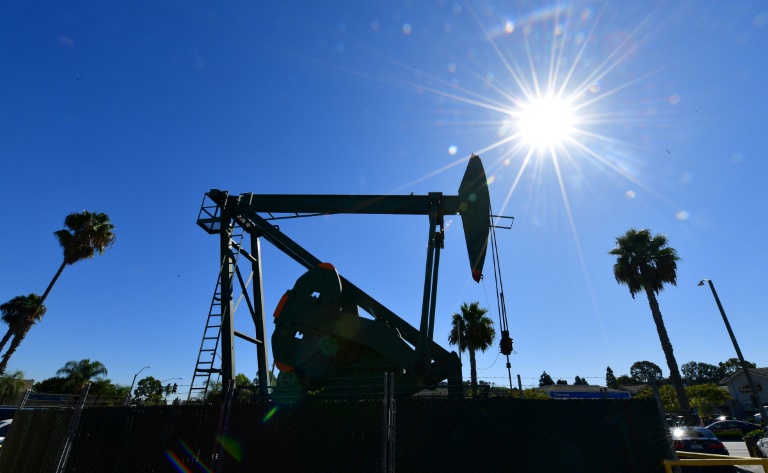
Oil prices were feeling the heat from recessionary fears, with both main contracts tanking Wednesday on demand worries caused by any recession, despite China’s reopening moves, the US holiday driving season and tight supplies. 

Still, Goldman Sachs said that with demand still outpacing supplies, the market remains tight.

“Investors should remember that Fed-induced slowdowns are simply a short-term abatement of the symptom, inflation, and not a cure for the problem, underinvestment,” it added.

Bets on the Fed’s rate hikes and the Bank of Japan’s refusal to move from its policy of ultra-low rates continue to pile pressure on the yen, which is sitting at a 24-year low above 136.50 to the dollar.

Japanese Prime Minister Fumio Kishida’s comment that it “is up to the central bank” how to maintain its easy money policy added to pressure on the country’s currency, though famed economist Nouriel Roubini said he expects Tokyo to take action if the yen hits 140.

“If you go well above 140, the BoJ will have to change policy and the first change in policy is going to be yield curve control,” he said referring to a policy of keeping long-term rates artificially at a chosen level.

“So I think another 10 percent fall in the yen will imply a change in policy,” he told Bloomberg Television at the Qatar Economic Forum.

– Key figures at around 0720 GMT –

Tokyo – Nikkei 225: DOWN 0.4 at 26,149.55 (close)

Hong Kong – Hang Seng Index: DOWN 2.4 percent at 21,040.37

Shanghai – Composite: DOWN 1.2 percent at 3,267.20 (close)

London – FTSE 100: DOWN 1.3 percent at 7,057.87

West Texas Intermediate: DOWN 5.1 percent at $103.92 per barrel

Brent North Sea crude: DOWN 5.6 percent at $108.62 per barrel

Euro/dollar: DOWN at $1.04.86 from $1.0535 late Tuesday

Pound/dollar: DOWN at $1.2218 from $1.2273

Euro/pound: UP at 85.81 pence from 85.80 pence

Dollar/yen: DOWN at 136.54 yen from 136.64 yen

New York – Dow: UP 2.2 percent at 30,530.25 (close)
Sri Lanka bets on casino magnate to revive wrecked economy

Sri Lankan casino magnate Dhammika Perera entered parliament on Wednesday with a mandate to revive the bankrupt island nation’s wrecked economy — working alongside a premier who once accused him of corruption.

The 54-year-old Perera is a long-time loyalist of the powerful Rajapaksa clan, whom protesters have accused of mismanaging the country into its current predicament.

He replaces President Gotabaya Rajapaksa’s youngest brother, Basil, who resigned from parliament this month after stepping down as finance minister in April.

“He was nominated by the president and will shortly take over the investment promotion portfolio and enter the cabinet,” a ruling party official told AFP. 

Perera will serve in a unity government formed to tackle the crisis alongside Prime Minister Ranil Wickremesinghe, who in 2015 accused the casino boss of being a “demon who protected the corrupt regime of Rajapaksas”.

Wickremesinghe has also described Perera as one of four most corrupt businessmen in the country.

Both men shook hands on Wednesday soon after Perera was sworn into parliament before the chamber’s speaker. 

Perera — who also has interests in banking, hotels, manufacturing, logistics and exports — takes office at a time when Sri Lanka is suffering through months-long shortages of food, fuel and other essential goods. 

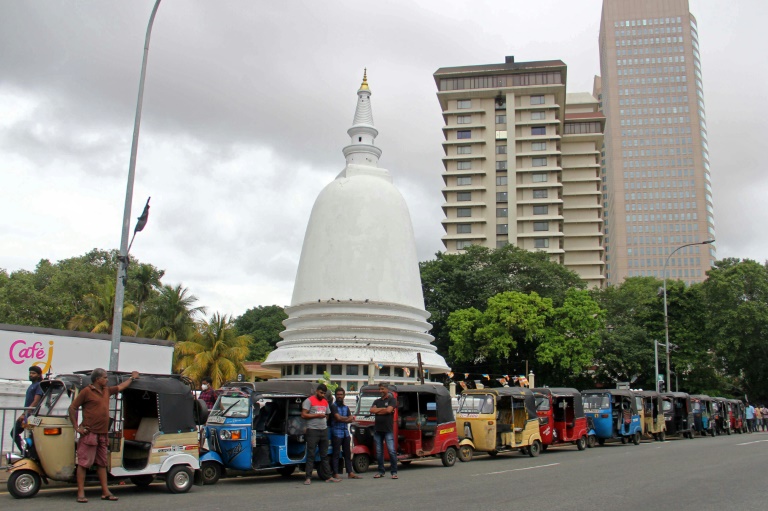
Long queues form outside gas stations each day for scarce petrol supplies, while regular blackouts and runaway inflation have made life difficult for the island nation’s 22 million people.

The government has defaulted on its $51 billion foreign debt and is seeking an International Monetary Fund bailout. 

Perera has claimed to have devised a plan to raise Sri Lanka’s per capita income more than threefold to $12,000 — a figure higher than China’s.

He has also pledged to address Sri Lanka’s critical foreign currency shortage by selling 10-year visas to foreigners willing to deposit at least $100,000 in local bank accounts — a scheme already in place since April. 

Ancient Afghan Buddhist city threatened by Chinese copper mine

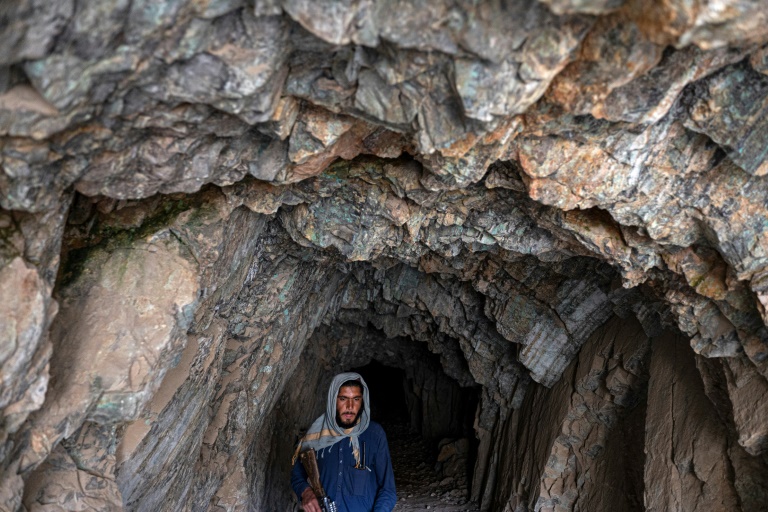
An ancient Buddhist city carved out of immense peaks near Kabul is in danger of disappearing forever, swallowed up by a Chinese consortium exploiting one of the world’s largest copper deposits.

Located at the confluence of Hellenistic and Indian cultures, Mes Aynak — believed to be between 1,000 and 2,000 years old — was once a vast city organised around the extraction and trade of copper.

Archaeologists have uncovered Buddhist monasteries, stupas, fortresses, administrative buildings and dwellings, while hundreds of statues, frescoes, ceramics, coins and manuscripts have also been unearthed.

Despite looting at the beginning of the century, Mes Aynak is “one of the most beautiful archaeological sites” in the world, says Bastien Varoutsikos, an archaeologist for the French company Iconem, which is working to digitise the city and its heritage.

But the need for the Taliban — who returned to power in August last year — to find new revenue streams after international aid was frozen has made mining the project a priority, and could put an end to further archaeological work.

– Mining consortium –

Objects discovered date mainly from the 2nd to 9th century AD, but an earlier occupation is also believed likely, and pottery dating back to the Bronze Age — well before the birth of Buddhism — has also been found.

Forgotten for centuries before being rediscovered by a French geologist in the early 1960s, Mes Aynak, in Logar province, has been compared to Pompeii and Machu Picchu in size and significance.

The ruins, which cover 1,000 hectares, are perched high on a massive peak whose brown flanks betray the presence of copper.

But in 2007 the Chinese mining giant Metallurgical Group Corporation (MCC) headed a state-owned consortium — that later took the name MJAM — and signed a $3 billion contract to mine ore over 30 years.

Fifteen years later, the mine still does not exist — insecurity and disagreements between Beijing and Kabul over financial terms of the contract have caused delays.

The project is once again a priority for both parties, however, and talks are ongoing on how to proceed.

– Duty of preservation –

Fears are rising that a place once considered one of the most prosperous trade hubs on the Silk Road could disappear without oversight.

In the early 2010s, it was “one of the largest archaeological projects in the world”, Varoutsikos told AFP.

MJAM originally suspended the start of operations for three years to allow archaeologists to focus on the area directly threatened by the mine.

That period was inadvertently lengthened as the security situation prevented the Chinese from building planned infrastructure.

As a result, thousands of objects were unearthed — some were taken to the Kabul museum, others kept nearby.

When it was last in power the Taliban shocked the world by dynamiting the giant Buddhas of Bamiyan in March 2001, but today they say they are determined to preserve the findings of Mes Aynak.

“It is the duty of the Ministry of Information and Culture to protect them,” Esmatullah Burhan, the spokesman for the Ministry of Mines and Petroleum, told AFP.

But while the rhetoric seems sincere, many of the remains are simply too bulky or fragile to be moved and seem destined to disappear.

The Chinese favour open-pit rather than underground mining. If this goes ahead, it would open up the copper mountain and bury all the fragments of the past.

– Environmental consequences –

Afghanistan is sitting on huge mineral resources of copper, iron, bauxite, lithium and rare earths estimated to be worth more than a trillion dollars.

The Taliban hope to earn more than $300 million a year from Mes Aynak — about 60 percent of the full state budget for 2022 — and now want to speed up the process.

“This project must begin, it must not be delayed any longer,” they have repeatedly told MJAM in recent weeks, according to Burhan.

The discussions are about “80 percent finished”, says the spokesman, with only technical points remaining to be settled, which should be done soon.

The Taliban are demanding that the contract — which includes the construction of a power station to supply the mine and Kabul, and a railroad to Pakistan — be respected. 

They also insist that the copper be processed locally with an Afghan workforce.

China, whose economy is in dire need of copper, is reluctant to meet these demands.

MJAM, which did not respond to AFP, also continues to demand a reduction in royalties due.

The project is also coupled with concerns about its environmental consequences. 

Copper mining is polluting and requires large quantities of water, and Logar is already an arid region.

According to Burhan, the Taliban are paying “strict attention” to these issues and will ensure that the consortium meets its obligations in this regard.

For now, the delay is some salvation for archeologists.

While there is currently no work going on at the site, Varoutsikos hopes to restart the excavation before the start of mining operations.

But even that will depend on international collaboration and funding, he notes.

Markets struggle as recession fears weigh heavily

Equities struggled Wednesday after a brief respite from last week’s painful rout across world markets, with recession fears continuing to build as central banks hike interest rates to combat decades-high inflation.

While Asia, Wall Street and Europe all enjoyed healthy gains on Tuesday, analysts warned the downbeat mood on trading floors means the selling is unlikely to end any time soon.

Fears about a global contraction have also put downward pressure on oil prices, despite China’s reopening moves, the US holiday driving season and tight supplies. 

Federal Reserve boss Jerome Powell’s two-day testimony to Congress this week will be pored over for an idea about officials’ plans for fighting runaway prices, which are being fanned by supply chain snarls, China’s lockdowns and the war in Ukraine.

Most observers expect them to hike rates by three-quarters of a point several more times this year, having announced such a move in June — the sharpest lift in almost 30 years.

However, while many believe the Fed’s front-loaded tightening drive is needed — allowing it to begin cutting sooner as price rises settle back — there is a building consensus that the world’s top economy is heading for a contraction next year.

“The Fed has entered into a policy cocktail that we would describe as hammer time,” Gene Tannuzzo, at Columbia Threadneedle Investments, told Bloomberg Television.

“You have to be planning defensively at this point. There are a lot of questions on all risk assets.”

– Crude prices drop –

In early Asian trade, Hong Kong, Singapore, Sydney, Seoul, Taipei, Jakarta and Manila all fell, while Tokyo and Shanghai were barely moved. There were small gains in Wellington.

Stephen Innes at SPI Asset Management said that while the selling from last week had abated, traders continued to fret over a recession and the prospect of more rate hikes, adding that the Fed could be more compelled to respond if oil prices surge again and push up inflation further.

“Even more worryingly from a policy perspective is that virtually every recession in the past three decades has been a function of a demand shock, but this is a supply shock; hence monetary policy is less potent,” he added.

“Despite the uptick in risk sentiment, it still feels we are eons away from shaking the event-driven bear market blues due to prevailing recession obsession headwinds.”

Oil prices were feeling the heat from recessionary fears, with both main contracts down more than three percent Wednesday, though Goldman Sachs said that with demand still outpacing supplies, the market remains tight.

“Investors should remember that Fed-induced slowdowns are simply a short-term abatement of the symptom, inflation, and not a cure for the problem, underinvestment,” it added.

Bets on the Fed’s rate hikes, and the Bank of Japan’s refusal to move from its policy of ultra-low rates, continues to pile pressure on the yen, which is sitting at a 24-year low above 136.50 to the dollar.

Japanese Prime Minister Fumio Kishida’s comment that it “is up to the central bank” how to maintain its easy money policy adding to pressure on the country’s unit though famed economist Nouriel Roubini said he expects Tokyo to take action if the yen hits 140.

“If you go well above 140, the BoJ will have to change policy and the first change in policy is going to be yield curve control,” he said referring to a policy of keeping long-term rates artificially at a chosen level.

“So I think another 10 percent fall in the yen will imply a change in policy,” he told Bloomberg Television at the Qatar Economic Forum.

– Key figures at around 0230 GMT –

Tokyo – Nikkei 225: FLAT at 26,255.95 (break)

Hong Kong – Hang Seng Index: DOWN 0.6 percent at 21,424.70

Shanghai – Composite: FLAT at 3,307.00

Euro/dollar: DOWN at $1.0508 from $1.0535 late Tuesday

Pound/dollar: DOWN at $1.2238 from $1.2273

Euro/pound: UP at 85.87 pence from 85.80 pence

Dollar/yen: DOWN at 136.25 yen from 136.64 yen

West Texas Intermediate: DOWN 3.5 percent at $105.70 per barrel

Brent North Sea crude: DOWN 3.4 percent at $110.76 per barrel

New York – Dow: UP 2.2 percent at 30,530.25 (close)
London – FTSE 100: UP 0.4 percent at 7,152.05 (close)

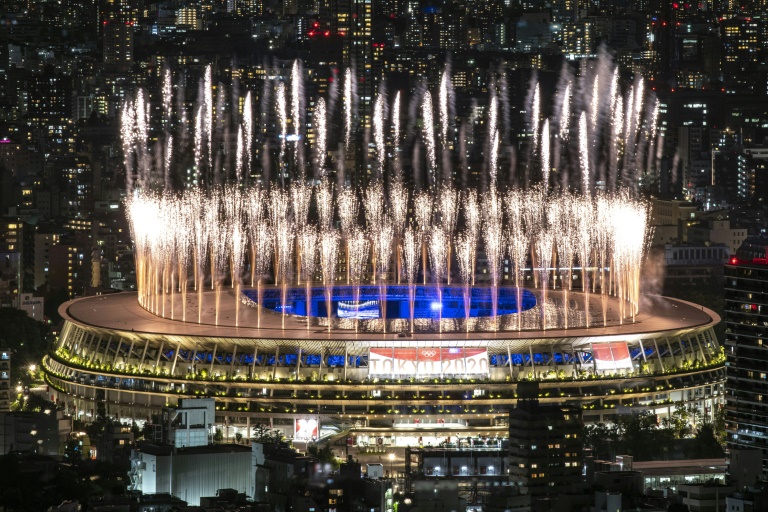
Delayed Tokyo 2020 Olympics cost double original estimate

The final price tag for last year’s Tokyo Olympics was more than double the city’s original 2013 estimate after a one-year coronavirus postponement added to the already hefty bill.

The organising committee said Tuesday the Games had cost 1.42 trillion yen, the equivalent of $13 billion at the time. At today’s rates, with the yen at a 24-year low against the dollar, the figure would be $10.4 billion.

Tokyo 2020 was held a year later than planned because of the pandemic — the first Olympics postponed in peacetime — and spectators were banned from nearly all events, which were held under strict Covid-19 countermeasures.

The Games cost twice the 734 billion yen that the Tokyo Games organisers had predicted in their bid to the International Olympic Committee in 2013, but less than the final pre-Games budget unveiled in December 2020.

Despite losing out on ticket sales, organisers saved some cash by simplifying events and avoiding the cost of hosting millions of fans.

The organising committee, which disbands at the end of June, said the event’s final cost was 200 billion yen less than projected in its pre-Games budget in 2020 and 29 billion yen less than the final slimmed-down costs prediction in December 2021.

“It’s up to everyone involved in this event to pass on the legacy of the Tokyo Olympics to the next generation,” said Tokyo 2020 chief Seiko Hashimoto.

Tokyo experienced a Covid-19 surge last year as the Olympics approached, fuelling fears the event could worsen outbreaks in Japan and possibly the world.

The northern Japanese city of Sapporo is bidding to host the Winter Olympics in 2030.

A March survey of Sapporo and the surrounding region showed that a majority of the public are in favour of holding the event.

Officials have ruled out holding a public referendum on the 2030 bid.

Australian activists file legal bid to stop gas project

Australian conservationists have launched a legal bid to block a massive gas project, saying it would harm the Great Barrier Reef by warming the planet.

Claiming gas giant Woodside Energy’s Scarborough project would generate 1.37 billion tonnes of greenhouse emissions and likely harm the World Heritage-listed reef, the Australian Conservation Foundation applied on Tuesday for an injunction to halt the work.

The proposed, Aus$16 billion ($11 billion) Scarborough project would be located off the coast of Western Australia, thousands of kilometres from the Great Barrier Reef.

But the foundation argued gas drilled from Scarborough would fuel climate change to such an extent — raising global temperatures by 0.0004 degrees Celsius (32 Fahrenheit) — that it would have a “significant impact” on the natural wonder.

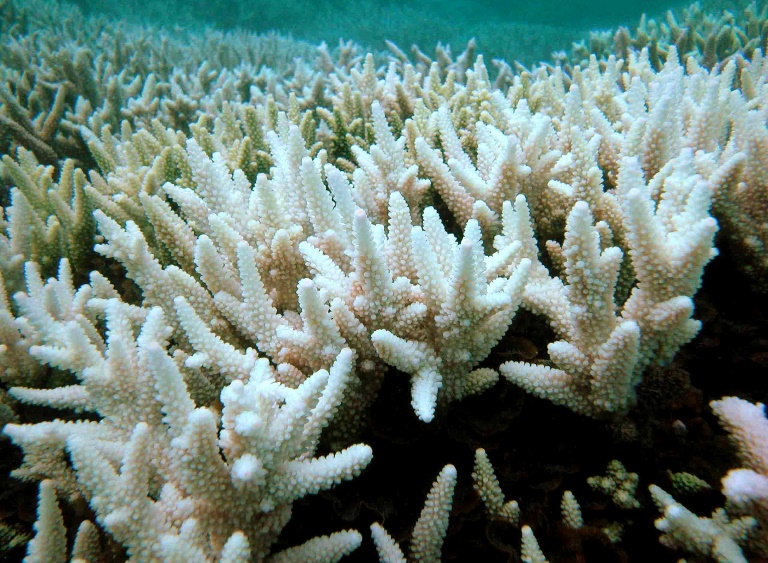
Climate change stress has already caused four “mass bleaching” events on the Great Barrier Reef since 2016, including this year when 91 percent of its corals were drained of their vibrant colours.

“Scarborough’s gas is a climate bomb about to be detonated,” said Australian Conservation Foundation Chief Executive Kelly O’Shanassy.

“We must not fall for the accounting trick that suggests these emissions won’t affect reefs in Australia simply because the gas will mostly be burned overseas,” she said.

“The reef is not concerned with the source of the greenhouse gases that damage it.”

The foundation’s projections for the climate impact of Scarborough, drawn from research by non-profit Climate Analytics, were significantly higher than Woodside’s estimate of 878 million tonnes, which was approved by the regulator.

Woodside’s chief executive Meg O’Neill said the company would “vigorously defend” itself against the court proceedings.

She said the project had received all primary environmental approvals and was “proceeding to schedule”.

The lawsuit was lodged as Greenpeace Australia released a report on Wednesday about Woodside’s Burrup Hub, of which the Scarborough gas project is a part.

Greenpeace claimed a “credible” spill scenario could reach the West Australian coast and as far north as Indonesia, concluding that the Burrup project was “too risky to proceed” because of the climate impact and Woodside’s safety record.

A Woodside spokesperson said the company “has an established track record of safe and reliable operations”.

US vows enforcement as ban on Xinjiang imports takes effect

The United States on Tuesday promised enforcement as a landmark ban took effect on most imports from Xinjiang, the Chinese region where rights groups say the Uyghur people are being forced into slave labor.

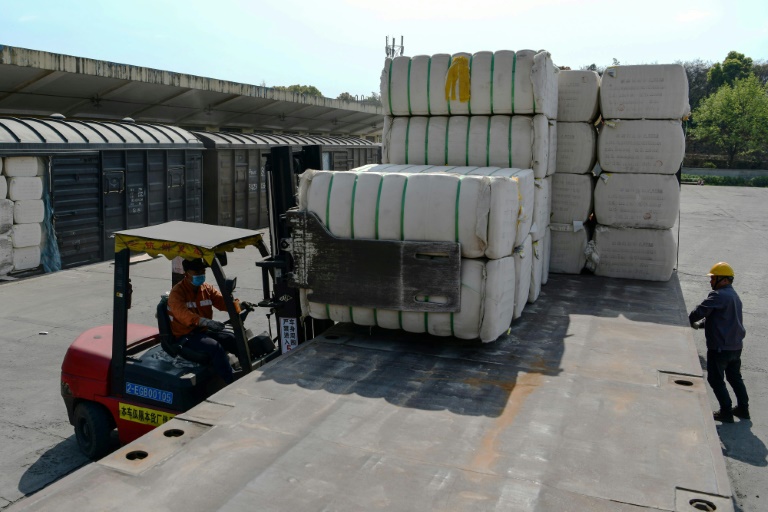
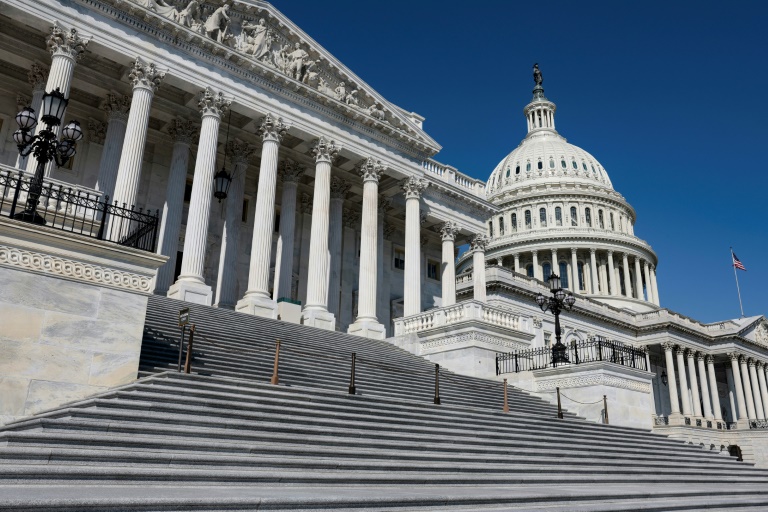
The Uyghur Forced Labor Prevention Act, which will be felt especially in the textile industry, took effect six months after it was signed into law by President Joe Biden following bipartisan support in Congress.

“We are rallying our allies and partners to make global supply chains free from the use of forced labor,” Secretary of State Antony Blinken said in a statement.

The US Customs and Border Protection service, which will enforce the new law, issued guidance that said it would presume products from Xinjiang involve forced labor and are therefore banned unless businesses can document otherwise.

The act “requires that importers demonstrate due diligence, effective supply chain tracing and supply chain management measures to ensure that they do not import any goods made, in whole or in part, by forced labor,” its advisory said.

It said it would look at the complete supply chain and not exempt goods shipped from other parts of China or third countries.

An estimated 20 percent of garments imported into the United States each year include some cotton from Xinjiang, according to labor rights groups.

The vast western region is also a major center of tomatoes canned for export.

Senator Marco Rubio, a Republican hawk who teamed up with liberal Democrats to push for the legislation, called the act “the most significant change in America’s relationship with China since 2001.”

“No longer will we look at images of bareheaded prisoners in shackles and blindfolds, lined up like animals for slaughter, and shrug,” he wrote in an opinion piece for Real Clear Politics.

– ‘Undermines free market principles’ –

China entered the World Trade Organization in 2001, helping usher in soaring growth as it became the manufacturing hub for the world.

US policymakers across party lines have gradually come to reject their bet that trade integration would moderate Beijing, which the Biden administration has identified as the top global competitor of the United States.

China again voiced anger over the trade ban and said it went against global efforts to decrease inflation and stabilize supply chains. 

“The act is solid evidence of the US’s arbitrariness in undermining international economic and trade rules,” foreign ministry spokesman Wang Wenbin said.

“The US move is against the trend of the times and bound to fail.”

But Omer Kanat, executive director of the Uyghur Human Rights Project, called the law a “huge win” for the movement and said it would push other governments to take similar action.

Rights groups, citing witness accounts, say that well more than one million Uyghurs and other predominantly Muslim Turkic-speaking people have been locked up in re-education camps in a bid to integrate them forcibly into China’s Han majority.

Beijing denies the charges and says it is providing vocational training to reduce the allure of Islamist extremism following violence.

Markets climb as calm returns after sharp selloff

Stock markets rose Tuesday as calm returned following last week’s rout, but analysts warned that recession fears have not gone away and will cause more turmoil.

After a three-day holiday weekend, Wall Street burst higher, with the Dow up 1.9 percent while the broad-based S&P 500 gained 2.6 percent and the tech-heavy Nasdaq shot up 3.2 percent in late morning trading.

European equities rose for a second straight day, but pared down some of their gains from the morning.

Oil prices extended gains on hopes of improving energy demand in key consumers China and the United States, while the euro climbed on the prospect of rising eurozone borrowing costs.

“Risk appetite has managed to recover for now, perhaps because we get a much needed-break from central bank decisions this week,” IG analyst Chris Beauchamp told AFP.

“But while a bounce is overdue, it is probably only temporary.”

There remains an overarching sense of gloom as traders speculate that the sharp lift in borrowing costs around the world will tip economies into recession.

The focus this week is on Federal Reserve boss Jerome Powell’s two days of testimony to lawmakers in Washington, which will be closely watched for clues regarding the bank’s plans for fighting surging consumer prices.

“Where we go from here depends largely on whether Federal Reserve Chair Powell spooks the markets with his pre-released comments and what inflation data from the UK shows tomorrow (Wednesday),” City Index analyst Fiona Cincotta told AFP.

The Fed announced a hefty interest rate hike last week, days after inflation data had smashed forecasts and hit a four-decade high. 

Several officials — including at the Fed, Bank of England, Reserve Bank of Australia and European Central Bank — have come out in recent days to flag a further tightening of borrowing costs.

Inflation has rocketed to multi-decade highs around the world on a host of factors, including the global supply crunch and the Ukraine conflict, which has fuelled strong gains for food and energy prices.

“These small recoveries in stock markets shouldn’t provide any comfort,” said Craig Erlam, senior analyst at OANDA trading platform.

“Recession is increasingly becoming the base case and so equities are vulnerable to further losses,” he said.

In currency trading, the yen struck a 24-year dollar low of 136.34 yen following comments by Prime Minister Fumio Kishida that it “is up to the central bank” how to maintain its easy money policy while central banks elsewhere are raising rates. 

“The market is clearly looking to test the resolve of the Bank of Japan in terms of how much they are prepared to tolerate further currency weakness,” said market analyst Michael Hewson at CMC Markets UK.

In corporate news, shares in German chemicals group Bayer fell by 4.7 percent following the US Supreme Court declining to hear a bid from Bayer-owned Monsanto to quash lawsuits claiming its weedkiller Roundup causes cancer, before clawing back part of the drop.

The decision marks a major blow to the German conglomerate’s legal fight against Roundup-related cases, and Bayer has set aside more than $15 billion to deal with a wave of US lawsuits linked to the weedkiller.

– Key figures at around 1530 GMT –

New York – Dow: UP 1.9 percent at 30,445.23 points

EURO STOXX 50: UP 0.7 percent at 3,494.00

London – FTSE 100: UP 0.4 percent at 7,152.05 (close)

Frankfurt – DAX: UP 0.2 percent at 13,292.40 (close)

Paris – CAC 40: UP 0.8 percent at 5,964.66 (close)

Tokyo – Nikkei 225: UP 1.8 percent at 26,246.31 (close)

Hong Kong – Hang Seng Index: UP 1.9 percent at 21,559.59 (close)

Shanghai – Composite: DOWN 0.3 percent at 3,306.72 (close)

Euro/dollar: UP at $1.0558 from $1.0511 late Monday

Pound/dollar: UP at $1.2276 from $1.2253

Euro/pound: UP at 86.00 pence from 85.78 pence

Dollar/yen: UP at 136.18 yen from 135.07 yen

Brent North Sea crude: UP 0.6 percent at $114.84 per barrel

West Texas Intermediate: UP 1.4 percent at $111.13

burs-rl/lth

Dead rivers: The cost of Bangladesh's garment-driven economic boom

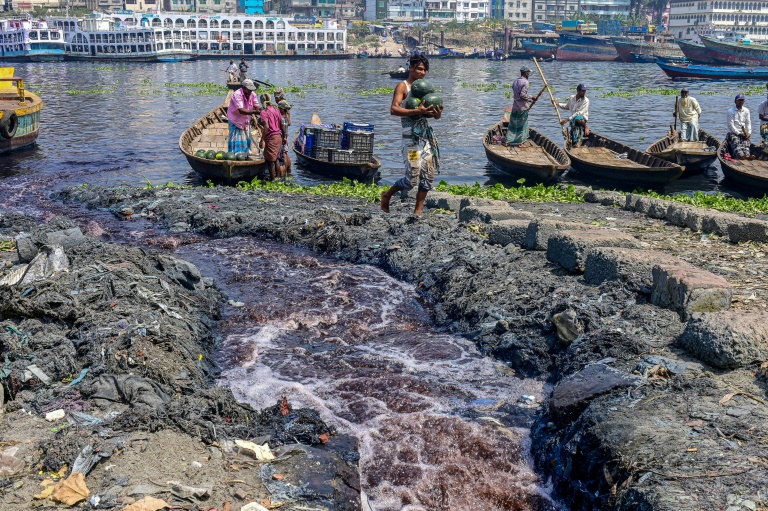
Bangladeshi ferryman Kalu Molla began working on the Buriganga river before the patchwork of slums on its banks gave way to garment factories — and before its waters turned pitch black.

The 52-year-old has a constant cough, allergies and skin rashes, and doctors have told him the vile-smelling sludge that has also wiped out marine life in one of Dhaka’s main waterways is to blame.

“Doctors told me to leave this job and leave the river. But how is that possible?” Molla told AFP near his home on the industrial outskirts of the capital Dhaka. “Ferrying people is my bread and butter.”

In the half-century since a devastating independence war left its people facing starvation, Bangladesh has emerged as an often unheralded economic success story.

The South Asian country of 169 million has overtaken its neighbour India in per capita income and will soon graduate from the United Nations’ list of the world’s least developed countries.

Underpinning years of runaway growth is the booming garment trade, servicing global fast-fashion powerhouses, employing millions of women and accounting for around 80 percent of the country’s $50 billion annual exports.

But environmentalists say the growth has come at an incalculable cost, with a toxic melange of dyes, tanning acids and other dangerous chemicals making their way into the water.

Bangladesh’s capital Dhaka was founded on the banks of the Buriganga more than 400 years ago by the Mughal empire.

“It is now the largest sewer of the country,” said Sheikh Rokon, the head of the Riverine People environmental rights group.

“For centuries people built their homes on its banks to bask in the river breeze,” he added. “Now the smell of toxic sludge during winter is so horrible that people have to hold their noses as they come near it.”

Water samples from the river found chromium and cadmium levels over six times the World Health Organization’s recommended maximums, according to a 2020 paper by the Bangladeshi government’s River Research Institute. 

Both elements are used in leather tanning and excessive exposure to either is extremely hazardous to human health: chromium is carcinogenic, and chronic cadmium exposure causes lung damage, kidney disease and premature births. 

Ammonia, phenol and other byproducts of fabric dyeing have also helped to starve the river of the oxygen needed to sustain marine life. 

– ‘They are powerful people’ –

In Shyampur, one of several sprawling industrial districts around Dhaka, locals told AFP that at least 300 local factories were discharging untreated wastewater into the Buriganga river.

Residents say they have given up complaining about the putrid smell of the water, knowing that offending businesses are easily able to shirk responsibility.

“The factories bribe (authorities) to buy the silence of the regulators,” said Chan Mia, who lives in the area. 

“If someone wants (to) raise the issue to the factories, they’d beat them up. They are powerful people with connections.” 

The crucial position of the textile trade in the economy has created a nexus between business owners and the country’s political establishment. In some cases, politicians themselves have become powerful industry players. 

Further south, in Narayanganj district, residents showed AFP a stream of crimson-coloured water draining into stagnant canals from a nearby factory. 

“But you cannot say a word about it loudly,” an area resident told AFP, speaking on condition of anonymity. “We only suffer in silence.”

The Bangladesh Garment Manufacturers and Exporters Association (BGMEA), which represents the interests of around 3,500 top factories, defends its record by pointing out the environmental certifications given out to its members.

“We are going green — that’s why we are witnessing big jumps in export orders,” BGMEA president Faruque Hassan told a recent press conference.

But smaller factories and sub-contractors operating on the industry’s razor thin margins say they are unable to afford the cost of wastewater treatment.

A top garment official in the Savar industrial district, speaking to AFP on condition of anonymity, said even most high-end factories serving major US and European brands often do not turn on their treatment machinery. 

“Not everyone regularly uses it. They want to save costs,” he said.

– ‘Facing the same fate’ –

Bangladesh is a delta country criss-crossed by more than 200 waterways, each of them connected to the mighty Ganges and Brahmatura rivers that course from the Himalayas and through the South Asian subcontinent.

More than a quarter of them are now heavily contaminated with industrial pollutants and need to be “urgently” saved, said an April legal notice sent to the government by the Bangladesh Environmental Lawyers Association (BELA). 

Authorities have established a commission tasked with saving key water bodies, upon which close to half the country’s population depend for farming, according to the UN Food and Agriculture Organization. 

The National River Commission has launched several high profile drives to fine factories found to have polluted rivers.

Its newly appointed chief, Manjur Chowdhury, said “greedy” industrialists were to blame for the state of the country’s waterways.

But he also admitted that the enforcement of existing penalties was inadequate to address the scale of the problem.

“We have to frame new laws to face this emergency situation. But it will take time,” he told AFP.

Any action will be too late for the five rivers that circle Dhaka and its industrial outskirts.

All are already technically dead, meaning they are completely devoid of marine life, said prominent environmental activist Sharif Jamil. 

“With factories now moving deep into the rural heartland, rivers across the country are facing the same fate,” he told AFP.

Most markets climb as calm returns after sharp sell-off

Equities rose in most cities Tuesday in Asia as some stability returned to markets after last week’s upheaval, but analysts warned of further pain for traders after central bank officials hinted at more interest rate hikes to reel in inflation.

While there was no catalyst from Wall Street owing to a public holiday, a healthy performance across Europe provided a little boost and bargain-buying was also lending support.

However, there remains an overarching sense of gloom as traders speculate that the sharp lift in borrowing costs around the world will tip economies into recession.

Focus this week is on Federal Reserve boss Jerome Powell’s two days of testimony to lawmakers in Washington, which will be closely watched for insight into the bank’s thinking and possible clues about its plans for fighting surging prices.

The Fed announced a three-quarter point lift last week, after inflation data days earlier had smashed forecasts and hit a four-decade high.

“While (investors do) not expect Powell to reinvent the policy wheel, we could expect him to reinforce the idea that the Fed is in data-dependent mode,” said Stephen Innes of SPI Asset Management. 

“Hence, any shift in Fed rhetoric will be a function of incoming data, virtually all of which now presents event risk. From that perspective, further evidence of persistent inflation will trigger policy panic, while any signs of sluggish growth momentum will confirm the recession narrative.

“Neither suggests that now is the time to board the rally wagon.”

Tokyo, Hong Kong, Sydney, Seoul, Singapore, Wellington, Taipei, Mumbai, Bangkok and Jakarta all rose but Shanghai and Manila slipped.

London opened barely moved, while Paris and Frankfurt edged up.

“There might be a narrative that we’ve hit a bottom, we are oversold, the Fed is taking inflation seriously and that might be slightly bullish in the interim,” Frances Stacy, of Optimal Capital, told Bloomberg TV.

However, while the volatility of last week has gone, banks’ intention to continue hiking rates could cause fresh ructions.

Several officials — including at the Fed, Bank of England, Reserve Bank of Australia and European Central Bank — have come out in recent days to flag a further tightening of borrowing costs.

In commodities markets, oil extended gains as traders moved back in after Friday’s plunge fuelled by concerns over a possible recession.

The gains have been helped by optimism for a boost to demand as China gradually eases out of its period of Covid containment, while the US summer driving period picks up.

“The physical market is as tight as ever, and thus, the speculative capitulation in futures markets (on Friday) probably shouldn’t be taken as a picture of the reality on the ground in the real world,” said OANDA’s Jeffrey Halley.

“The bottom line seems to be that until we see physical demand destruction, oil and other energy markets are as tight as ever.”

– Key figures at around 0810 GMT –

Tokyo – Nikkei 225: UP 1.8 percent at 26,246.31 (close)

Hong Kong – Hang Seng Index: UP 1.9 percent at 21,559.59 (close)

Shanghai – Composite: DOWN 0.3 percent at 3,306.72 (close)

London – FTSE 100: UP 0.6 percent at 7,160.94

Dollar/yen: UP at 135.25 yen from 135.06 yen

Pound/dollar: UP at $1.2292 from $1.2243

Euro/dollar: UP at $1.0556 from $1.0528 Monday

Euro/pound: DOWN at 85.85 pence from 86.02 pence

West Texas Intermediate: UP 1.6 percent at $111.27

Brent North Sea crude: UP 0.9 percent at $115.18 per barrel

New York – Dow: DOWN 0.1 percent at 29,888.78 (close)

Close Bitnami banner
Bitnami