Chinese Business

China unveils sweeping measures to rescue property sector

Chinese authorities have unveiled sweeping measures to rescue struggling property sector, as regulators seek to offset years of harsh pandemic curbs and a real estate crackdown that have stalled the world’s number-two economy.

The banking regulator and central bank on Friday issued a 16-point set of internal directives to promote the “stable and healthy development” of the industry, which were verified by Chinese media on Monday. 

The measures include credit support for debt-laden housing developers, financial support to ensure completion and handover of projects to homeowners, and assistance for deferred-payment loans for homebuyers.

That came on the same day the National Health Commission issued 20 rules for “optimising” Beijing’s zero-Covid policy, where certain restrictions were relaxed to limit the policy’s social and economic impact.

“We view this as the most crucial pivot since Beijing significantly tightened financing of the property sector,” wrote Ting Lu, chief China economist at Nomura, in a note.

“We believe these measures demonstrate that Beijing is willing to reverse most of its financial tightening measures.”

Hong Kong stocks surged more than three percent Monday, extending Friday’s more than seven percent rally, after the measures were unveiled.

Beijing imposed widespread lending curbs on property developers in 2020, which exacerbated their liquidity issues and caused several of the largest to default on bond payments. 

The knock-on effects on the massive real estate sector were severe, with cash-strapped developer Evergrande — China’s largest — and others failing to compete projects, sparking mortgage boycotts and protests from homebuyers. 

The measures emphasised “guaranteeing the handover of buildings”, and ordered development banks to provide “special loans” for the purpose, according to a copy circulating online.  

The document ordered financial institutions to treat state-owned and private real estate enterprises equally, as well as “actively cooperating with distressed real estate enterprises in risk management”.

The measures also included “extending the transition period arrangements… of real estate loans” for distressed developers, and support for “high-quality real estate enterprises to issue bond financing”. 

“The plan includes financial stability measures that aim to prevent massive defaults and hence provide a ‘soft landing’,” ANZ analysts wrote in a note.

But analysts cautioned that these changes — alongside the limited loosening of zero-Covid measures — would not cause an immediate recovery for the ailing sector.

New home prices have been dropping for more than a year, while demand is struggling to pick up owing to ongoing strict pandemic controls that have dampened consumer confidence. 
Most Asian markets extend global rally on China hopes

Asian markets mostly rose Monday, extending a global surge, as a loosening of China’s Covid rules and plans to help its property sector followed a drop in US inflation that eased rate hike fears.

Equities rocketed last week and the dollar sank after data showed US price rises eased in October, providing the Federal Reserve with room to take its foot off the pedal in tightening monetary policy.

The news led some commentators to suggest a feared recession in the world’s top economy could be shallower than first feared, or might be averted entirely.

The optimistic mood was given an extra injection late Friday by news that Beijing would relax some of its strict Covid-19 restrictions, a day after officials vowed to stick to their zero-tolerance strategy that has hammered growth.

Authorities have also reportedly unveiled a 16-point plan to support the beleaguered property sector, a major component of the country’s sprawling economy

The industry has come under immense pressure since China imposed a number of restrictions in 2020 aimed at reeling in debt, with major developers teetering on the brink of collapse.

The news indicates the leadership is beginning to focus on supporting the economy, a crucial driver of global growth.

“It’s a meaningful easing,” said Larry Hu of Macquarie Group.

“It seems that the room for policy change has widened on various fronts after the Party Congress (last month), including for the two major headwinds to the Chinese economy: Covid Zero and property.”

Nomura’s Lu Ting said the support for the developers was “the most crucial pivot since Beijing significantly tightened financing of the property sector”.

“We believe these measures demonstrate that Beijing is willing to reverse most of its financial tightening measures,” he added.

“Those cash-strapped developers (especially private ones), construction companies, mortgage borrowers and other related stakeholders can now breathe a sigh of relief.”

He warned, however, that the sector continued to struggle and the “measures may have little direct impact on stimulating home purchases”.

In early trade, Hong Kong led gains again — having soared more than seven percent Friday — with property firms the best performers.

Shanghai, Sydney, Singapore, Seoul, Taipei and Manila were all well up, though Tokyo was hit by profit-taking. There were also small losses in Bangkok, Jakarta and Wellington.

While the mood has lightened after the US inflation read, there is still a sense of trepidation among traders who fear the Federal Reserve will continue to lift borrowing costs while analysts warn last week’s rally may have been overdone.

“It was always clear that it would be easy to bring inflation down from 9-10 percent to 4-5 percent,” said SPI Asset Management’s Stephen Innes.

“Pushing it back to two percent could be much more complicated and require higher rates for longer. Hence, the central bank fight is far from over. But for now and until an indication of inflation proves stickier than expected, risk-on could roll on a bit further.”

Still, the yen, pound and euro held most of their gains against the dollar, which came in reaction to the consumer price index reading.

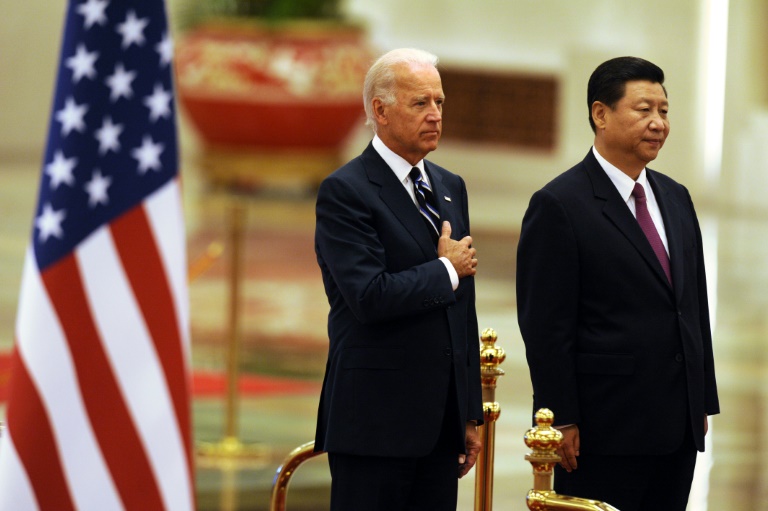
Traders are keenly awaiting a meeting later in the day between US President Joe Biden and Chinese counterpart Xi Jinping, with hopes for an easing of tensions between the superpowers.

The two are due to meet at the G20 summit in Bali, with Biden saying he wanted to repair lines of communication and help establish “guardrails” to keep the competing superpowers from veering into conflict.

– Key figures around 0230 GMT –

Tokyo – Nikkei 225: DOWN 0.8 percent at 28,047.58 (break)

Hong Kong – Hang Seng Index: UP 2.4 percent at 17,733.96

Shanghai – Composite: UP 0.4 percent at 3,099.19

Pound/dollar: DOWN at $1.1782 from $1.1839 on Friday

Euro/dollar: DOWN at $1.0323 from $1.0361

Dollar/yen: UP at 139.17 yen from 138.70 yen

Euro/pound: UP at 87.60 pence from 87.49 pence

West Texas Intermediate: UP 0.4 percent at $89.30 per barrel

Brent North Sea crude: UP 0.4 percent at $96.41 per barrel

New York – Dow: UP 0.1 percent at 33,747.86 (close)

London – FTSE 100: DOWN 0.8 percent at 7,318.04 (close)

Alibaba keeps Singles Day sales tally under wraps for first time

Chinese e-commerce giant Alibaba has not released full sales figures for its annual Singles Day event for the first time ever, as a cooling economy dampened demand.

Launched in 2009, Singles Day is the world’s largest shopping festival, dwarfing similar US events such as Black Friday and Cyber Monday in terms of sales. 

Alibaba’s sales last year hit 540.3 billion yuan ($76.1 billion), and many were watching to see if the company and other retailers taking part could combine for a record one trillion yuan in sales.

In a statement Saturday, Alibaba said results for this year’s event were “in line with last year’s… despite macro challenges and Covid-related impact,” without offering details.

Some 290,000 brands participated in 2022, it added, with merchants offering varying levels of discounts starting as early as late October.

Research firm Syntun a day earlier estimated that platforms including Alibaba and JD.com had reached a combined 262 billion yuan between 8:00 pm Thursday and 2:00 pm (0600 GMT) Friday.

Once a festival of frenzied consumption led by Alibaba’s effervescent founder Jack Ma, Singles Day has been more muted in recent years amid a Beijing crackdown on online platforms and waning state media coverage.

In April, regulators fined Alibaba $2.8 billion for anti-competitive practices, and Ma’s public presence has been noticeably diminished over the past two years.

“In terms of communications from the platform companies around the festival, there’s been a shift away from celebrating excessive consumption and emphasizing gross merchandise value (GMV),” Jacob Cooke, CEO of e-commerce consultancy WPIC Marketing + Technologies said. 

“The shift has been going on for a few years now, and that’s related to common prosperity, the anti-monopoly drive,” he added, referring to President Xi Jinping’s ongoing drive to curb the influence of big tech. 

Consumers are also tightening their belts as Beijing persists with a zero-Covid strategy that has led to widespread pay cuts and disrupted supply chains.

Conceived by Alibaba, the event’s title riffs on a tongue-in-cheek celebration of singlehood inspired by the four ones — “11/11” — that denote its date of November 11.

Alibaba is scheduled to report its earnings to stakeholders next week. 

Cryptocurrency platform FTX files for bankruptcy, boss resigns amid tumult

Crisis-struck cryptocurrency platform FTX has gone bankrupt in the United States and its chief executive Sam Bankman-Fried has resigned, it said Friday, the latest blow in a saga that has reverberated across the digital currency landscape.

The filing comes after the world’s biggest cryptocurrency platform Binance agreed to buy its rival earlier this week but backed out, leading market players to consider possible regulator responses.

FTX Group announced in a statement Friday that it filed for Chapter 11 bankruptcy proceedings, adding it has begun an “orderly process to review and monetize assets for the benefit of all global stakeholders.”

Chapter 11 is a US mechanism allowing a company to restructure its debts under court supervision while continuing to operate.

This week’s financial chaos at FTX has seen major cryptocurrencies, including bitcoin, plunge.

Bankman-Fried issued a “sincere” apology Thursday, adding FTX would do “everything we can to raise liquidity.”

The cash-strapped company added in its statement that it has appointed John J. Ray as chief executive with immediate effect.

“The immediate relief of Chapter 11 is appropriate to provide the FTX Group the opportunity to assess its situation,” said Ray in the statement.

“Stakeholders should understand that events have been fast-moving and the new team is engaged only recently.”

“Many employees of the FTX Group in various countries are expected to continue with the FTX Group and assist Mr. Ray and independent professionals in its operations during the Chapter 11 proceedings,” the statement said.

Binance agreed to buy FTX.com on Tuesday — before scrapping the takeover just a day later.

Binance chief executive Changpeng Zhao defended himself against accusations of any purposeful plot after the deal fell apart.

“FTX going down is not good for anyone in the industry. Do not view it as a win for us. User confidence is severely shaken,” he tweeted.

The platform’s collapse came as a shock even for an already turbulent industry.

Bankman-Fried, who worked as a broker on Wall Street before moving to Hong Kong in 2017, had cultivated friends in Washington and basked in glowing tributes when he stepped in to rescue other ailing crypto companies earlier in the year.

The turmoil at FTX, at one point valued at $32 billion, is a spectacular reversal of fortune for the founder and one-time cryptocurrency wunderkind.

“This is another black eye for the industry,” David Holt, a cryptocurrency industry expert at CFRA, said of FTX’s troubles.

The fall from grace even stretched to the world of sports where the Miami Heat announced its FTX Arena is set for a rename and the Mercedes Formula One team said it had suspended a sponsorship deal with FTX and removed the company’s logos from its cars ahead of this weekend’s Sao Paulo Grand Prix.

The Heat tweeted Friday that it and Miami-Dade County were “immediately taking action to terminate our business relationships with FTX,” including finding “a new naming rights partner for the arena.”

– Growing doubts –

Doubts had already been growing about the financial stability of FTX, despite Bankman-Fried’s good standing in Washington as a public face of crypto investing.

Attention had focused on the relationship between FTX and Alameda Research, a trading house also owned by Bankman-Fried that was taken down from the internet on Wednesday, reports said.

Specialist media site CoinDesk reported that 40 percent of Alameda’s balance sheet comprised FTX’s FTT tokens, raising concerns of a potential conflict of interest.

“We don’t know exactly what happened, but from all the reporting it looks like there was a lot of misconduct,” former US Securities and Exchange Commission (SEC) lawyer Howard Fischer said on the CNBC network Friday, predicting that some clients would sue in order to recover their investments.

The company is currently under investigation by the SEC, according to the New York Times, citing sources familiar with the matter.

The regulator, which does not usually comment on ongoing investigations, did not respond to AFP’s request for comment Friday, nor did the Department of Justice. 

Media reports suggest FTX had needed to find about $8 billion to plug a massive hole in its finances and escape bankruptcy.

Binance meanwhile axed its FTX takeover deal late on Wednesday and cited recent press reports about mismanagement of client funds and potential investigations.

Bankman-Fried, the son of Stanford Law School professors and a graduate of the elite Massachusetts Institute of Technology, has long been a vocal advocate for smoother access to the crypto market for the general public, particularly in the United States.

Kevin O’Leary, president of a venture capital firm and television personality who had invested in FTX, on Friday called for urgent regulations to safeguard the industry. 

“I lost money in the account, but I’m still going to invest on crypto,” he told CNBC. 

European stocks up despite recession warnings, US shares extend rally

Global stocks mostly ended higher on Friday as slower US inflation and an easing of Covid restrictions in China boosted investor sentiment, despite prospects of a downturn.

Frankfurt and Paris managed to advance by more than half a percent by the end of trading, although gains were capped as the European Union warned that the eurozone was set to fall into recession this winter.

US stocks also ended higher, extending Thursday’s rally after closely-watched government data showed annual inflation in the world’s biggest economy had eased slightly — dimming expectations of more aggressive interest rate hikes from the Federal Reserve.

Oil prices picked up as well following China’s announcement that it would relax some of its hardline Covid-19 restrictions, including shortening its quarantine requirements for international travelers by two days.

“This has been sufficient to prevent more than modest losses on some indices, with the week ending in a far more optimistic tone,” noted Chris Beauchamp, chief market analyst at online trading platform IG.

“Confident for now that the Fed can walk back some of its most hawkish rhetoric, stocks look well set for additional gains into the second half of November.”

The dollar slumped against rival currencies following the inflation data release, at one point reaching a three-month low against the euro and weakening against the yen and pound.

– ‘Bordering on silly’ –

But Daniel Berkowitz, senior investment officer for Prudent Management Associates, struck a note of caution on the slower inflation rate.

“While it always feels good to see markets rally, we think this… is bordering on silly,” he said.

“The market is reacting as if this is the continuance of a multiple-month, downward trend in inflation, and it is not,” he added.

Michael Hewson, chief market analyst at CMC Markets UK, also said that markets appeared to be “getting slightly ahead of themselves” given that the quarantine to enter China remains long, and that Covid infection rates are rising rather than decreasing.

London’s benchmark FTSE 100 index ended in the red after official data indicated that the UK economy was probably at the start of a prolonged recession.

“The FTSE’s struggles suggest UK investors are more worried about deteriorating domestic, eurozone and global economies than (they) are hopeful about the US and other central banks easing rate hikes,” noted Fawad Razaqzada, market analyst at City Index trading group.

In the UK, inflation is seen rising further. Currently at 10.1 percent, the Bank of England is forecasting it will hit around 11 percent this year before starting to cool.

– Key figures around 2130 GMT –

New York – Dow: UP 0.1 percent at 33,747.86 points (close)

New York – S&P 500: UP 0.9 percent at 3,992.93 (close)

New York – Nasdaq: UP 1.9 percent at 11,323.33 (close)

London – FTSE 100: DOWN 0.8 percent at 7,318.04 points (close)

Frankfurt – DAX: UP 0.6 percent at 14,224.86 (close)

Paris – CAC 40: UP 0.6 percent at 6,594.62 (close)

EURO STOXX 50: UP 0.6 percent at 3,868.50 (close)

Tokyo – Nikkei 225: UP 3.0 percent at 28,263.57 (close)

Hong Kong – Hang Seng Index: UP 7.7 percent at 17,325.66 (close)

Shanghai – Composite: UP 1.7 percent at 3,087.29 (close)

Pound/dollar: UP at $1.1839 from $1.1724 on Thursday

Euro/dollar: UP at $1.0361 from $1.0219

Dollar/yen: DOWN at 138.7 yen from 140.67 yen

Euro/pound: UP at 87.49 pence from 87.10 pence

Brent North Sea crude: UP 2.5 percent at $95.99 per barrel

West Texas Intermediate: UP 2.9 percent at $88.96 per barrel

burs-bys/fb

European stocks up despite recession warnings

European stocks mostly ended on a high on Friday as slower US inflation and a relaxing of Covid restrictions in China boosted investor sentiment despite recession prospects.

Frankfurt and Paris managed to advance by more than half a percent by at the end of trading, although gains were capped as the European Union warned the eurozone was set to fall into recession this winter.

The moves followed soaring gains overnight in Asia and on Wall Street and came despite the European Commission hiking regional inflation forecasts for 2022 and 2023 on the back of high energy prices.

In the United States, annual inflation came in at a lower-than-expected 7.7 percent in October, down from 8.2 percent in September, dimming expectations of more aggressive interest-rate hikes from the Federal Reserve.

Oil prices were also up as China relaxed some hardline Covid-19 restrictions.

“This has been sufficient to prevent more than modest losses on some indices, with the week ending in a far more optimistic tone,” noted Chris Beauchamp, chief market analyst at online trading platform IG.

“Confident for now that the Fed can walk back some of its most hawkish rhetoric, stocks look well set for additional gains into the second half of November.”

The dollar slumped against rival currencies following the inflation data release, at one point reaching a three-month low against the euro and weakening against the yen and pound.

– ‘Bordering on silly’ –

Daniel Berkowitz, senior investment officer for Prudent Management Associates, struck a note of caution regarding the slower inflation.

“While it always feels good to see markets rally, we think this… is bordering on silly,” he said.

“The market is reacting as if this is the continuance of a multiple-month, downward trend in inflation, and it is not.”

Michael Hewson, chief market analyst at CMC Markets UK, added: “Markets appear to be getting slightly ahead of themselves given that the quarantine time in China is still quite long, and that Covid infection rates are rising and not decreasing.”

But London’s benchmark FTSE 100 index ended in the red after official data indicated that the UK economy was probably at the start of a prolonged recession.

“The FTSE’s struggles suggest UK investors are more worried about deteriorating domestic, eurozone and global economies than (they) are hopeful about the US and other central banks easing rate hikes,” noted Fawad Razaqzada, market analyst at City Index trading group.

In the UK, inflation is seen rising further. Currently at 10.1 percent, the Bank of England is forecasting it will hit around 11 percent this year before starting to cool.

– Key figures around 1630 GMT –

London – FTSE 100: DOWN 0.8 percent at 7,318.04 points (close)

Frankfurt – DAX: UP 0.6 percent at 14,224.86 (close)

Paris – CAC 40: UP 0.6 percent at 6,594.62 (close)

EURO STOXX 50: UP 0.6 percent at 3,868.50

New York – Dow: DOWN 0.8 percent at 33,432.14 

Tokyo – Nikkei 225: UP 3.0 percent at 28,263.57 (close)

Hong Kong – Hang Seng Index: UP 7.7 percent at 17,325.66 (close)

Shanghai – Composite: UP 1.7 percent at 3,087.29 (close)

Pound/dollar: UP at $1.1770 from $1.1642 on Thursday

Euro/dollar: UP at $1.0328 from $1.0131

Dollar/yen: DOWN at 139.06 yen from 143.15 yen

Euro/pound: UP at 87.72 pence from 87.20 pence

Brent North Sea crude: UP 2.5 percent at $96.04 per barrel

West Texas Intermediate: UP 3.0 percent at $89.06 per barrel

burs/imm/gil

European stocks held back by recession warnings

European stock markets on Friday failed to match soaring gains overnight in Asia and on Wall Street, as recession prospects offset a boost from slower US inflation.

London’s benchmark FTSE 100 index fell around 0.5 percent in afternoon deals after official data indicated that the UK economy was likely at the start of a prolonged recession.

“The FTSE’s struggles suggest UK investors are more worried about deteriorating domestic, eurozone and global economies than are hopeful about the US and other central banks easing rate hikes,” noted Fawad Razaqzada, market analyst at City Index trading group.

Frankfurt and Paris managed to advance around half-a-percent by mid-afternoon trading, but gains were capped as the EU warned the eurozone was set to fall into recession this winter.

Brussels also hiked regional inflation forecasts for 2022 and 2023 on the back of high energy prices.

Asian equities closed sharply higher after a bumper session on Wall Street Thursday, as lower US inflation dimmed expectations of more aggressive interest-rate hikes from the Federal Reserve.

Hong Kong’s main equities index rocketed more than 7.7 percent, while Tokyo won three percent.

Shanghai won 1.7 percent and oil prices rose strongly as China relaxed some hardline Covid-19 restrictions.

In the US, annual inflation came in at a lower-than-expected 7.7 percent in October, down from 8.2 percent in September.

The latest inflation data should be welcome news to Fed policymakers because prices are “finally showing some response” to the steep rate hikes, said Rubeela Farooqi of High Frequency Economics.

The dollar slumped against rival currencies following the data release as traders bet that upcoming US interest rate hikes will be smaller than in recent months and amid expectations of less stringent Chinese Covid curbs.

The dollar was at a three-month low against the euro, plunging more than once percent at around 1300 GMT, and weakened against the yen and pound.

Daniel Berkowitz, senior investment officer for Prudent Management Associates, struck a note of caution regarding the slower inflation.

“While it always feels good to see markets rally, we think this… is bordering on silly,” he said.

“The market is reacting as if this is the continuance of a multiple-month, downward trend in inflation, and it is not.”

In the UK, inflation is seen rising further. Currently at 10.1 percent, the Bank of England is forecasting it will hit around 11 percent this year before starting to cool.

Traders pounced on the slower US number, however.

Wall Street’s Dow shares index was up 3.7 percent at Thursday’s close and the tech-heavy Nasdaq index soared 7.4 percent. 

– Key figures around 1345 GMT –

London – FTSE 100: DOWN 0.5 percent at 7,342.36 points 

Frankfurt – DAX: UP 0.3 percent at 14,193.98

Paris – CAC 40: UP 0.4 percent at 6,583.78

EURO STOXX 50: UP 0.5 percent at 3,865.85

Tokyo – Nikkei 225: UP 3.0 percent at 28,263.57 (close)

Hong Kong – Hang Seng Index: UP 7.7 percent at 17,325.66 (close)

Shanghai – Composite: UP 1.7 percent at 3,087.29 (close)

New York – Dow: UP 3.7 percent at 33,715.37 points (close)

Pound/dollar: UP at $1.1788 from $1.1642 on Thursday

Euro/dollar: UP at $1.0310 from $1.0131

Dollar/yen: DOWN at 139.25 yen from 143.15 yen

Euro/pound: UP at 87.52 pence from 87.20 pence

Brent North Sea crude: UP 2.8 percent at $96.31 per barrel

West Texas Intermediate: UP 3.1 percent at $89.17 per barrel

burs/imm/cdw

European stocks held back by recession warnings

European stock markets on Friday failed to match soaring gains overnight in Asia and on Wall Street, as recession prospects offset a boost from slower US inflation.

London’s benchmark FTSE 100 index fell in midday deals after official data indicated that the UK economy was likely at the start of a prolonged recession.

“The FTSE’s struggles suggest UK investors are more worried about deteriorating domestic, eurozone and global economies than are hopeful about the US and other central banks easing rate hikes,” noted Fawad Razaqzada, market analyst at City Index trading group.

Frankfurt and Paris managed to advance around half-a-percent but gains were capped as the EU warned the eurozone was set to fall into recession this winter.

Brussels also hiked regional inflation forecasts for 2022 and 2023 on the back of high energy prices.

Asian equities closed sharply higher after a bumper session on Wall Street Thursday, as lower US inflation dimmed expectations of more aggressive interest-rate hikes from the Federal Reserve.

Hong Kong’s main equities index rocketed more than 7.7 percent, while Tokyo won three percent.

Shanghai won 1.7 percent and oil prices rose strongly as China relaxed some hardline Covid-19 restrictions.

In the US, annual inflation came in at a lower-than-expected 7.7 percent in October, down from 8.2 percent in September.

The latest inflation data should be welcome news to Fed policymakers because prices are “finally showing some response” to the steep rate hikes, said Rubeela Farooqi of High Frequency Economics.

The dollar slumped against rival currencies following the data release as traders bet that upcoming US interest rate hikes will be smaller than in recent months.

Daniel Berkowitz, senior investment officer for Prudent Management Associates, struck a note of caution regarding the slower inflation.

“While it always feels good to see markets rally, we think this… is bordering on silly,” he said.

“The market is reacting as if this is the continuance of a multiple-month, downward trend in inflation, and it is not.”

In the UK, inflation is seen rising further. Currently at 10.1 percent, the Bank of England is forecasting it will hit around 11 percent this year before starting to cool.

Traders pounced on the slower US number, however.

Wall Street’s Dow shares index was up 3.7 percent at Thursday’s close and the tech-heavy Nasdaq index soared 7.4 percent. 

– Key figures around 1200 GMT –

London – FTSE 100: DOWN 0.4 percent at 7,346.14 points 

Frankfurt – DAX: UP 0.5 percent at 14,218.05

Paris – CAC 40: UP 0.3 percent at 6,578.94 

EURO STOXX 50: UP 0.6 percent at 3,871.35

Tokyo – Nikkei 225: UP 3.0 percent at 28,263.57 (close)

Hong Kong – Hang Seng Index: UP 7.7 percent at 17,325.66 (close)

Shanghai – Composite: UP 1.7 percent at 3,087.29 (close)

New York – Dow: UP 3.7 percent at 33,715.37 points (close)

Pound/dollar: UP at $1.1757 from $1.1642 on Thursday

Euro/dollar: UP at $1.0291 from $1.0131

Dollar/yen: DOWN at 139.37 yen from 143.15 yen

Euro/pound: UP at 87.49 pence from 87.20 pence

Brent North Sea crude: UP 3.1 percent at $96.59 per barrel

West Texas Intermediate: UP 3.4 percent at $89.44 per barrel

burs/bcp/rfj/rox

ASEAN agrees to talk to Myanmar opposition

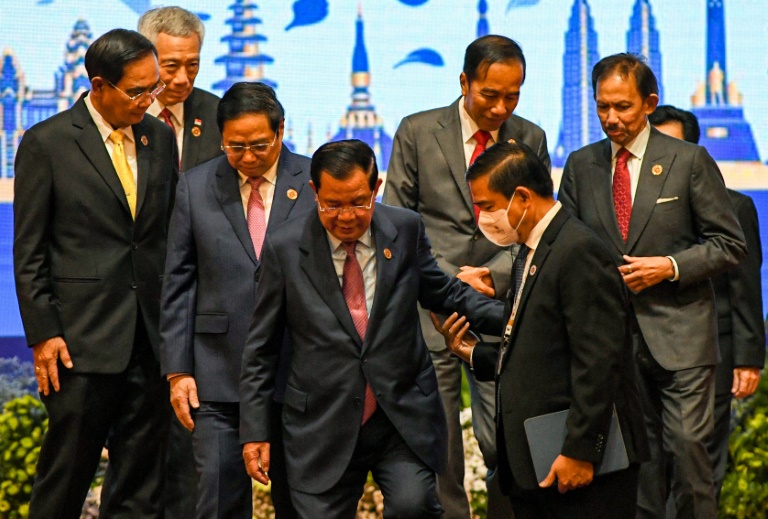
Southeast Asian leaders agreed Friday to engage Myanmar opposition groups as they seek ways to quell the country’s escalating bloodshed which has seen thousands killed in clashes since last year’s coup.

The Myanmar crisis dominated the first day of a gathering of the Association of Southeast Asian Nations (ASEAN) regional bloc in Phnom Penh that US President Joe Biden will join on Saturday.

Myanmar has spiralled into bloody conflict since the military ousted Aung San Suu Kyi’s civilian government in February last year.

ASEAN agreed a “five-point consensus” peace plan with Myanmar in April last year but the junta has so far ignored it and the bloc has struggled for months to come up with ways to enforce it.

Frustrated by the generals’ foot-dragging, leaders on Friday tasked their foreign ministers with drawing up “an implementation plan that outlines concrete, practical and measurable indicators with specific timeline”.

In a 15-point statement thrashed out over two days of difficult talks among foreign ministers, the bloc agreed to “engage all stakeholders soon”.

“Engagement would be done in a flexible and informal manner, primarily undertaken by the Special Envoy of the ASEAN Chair on Myanmar,” the leaders’ statement said.

This will likely involve meeting representatives of Myanmar’s National Unity Government (NUG), a self-declared parallel body dominated by former lawmakers from Suu Kyi’s party.

The NUG considers itself to be the country’s legitimate government but the junta regards its members as “terrorists”, and engaging with the group would be a significant step for ASEAN.

– ‘This is a warning’ –

The leaders also warned the generals that if they do not step up, the bloc could expand a ban on junta figures attending ASEAN meetings.

“This is a warning, this is a strong message from the leaders,” Indonesian Foreign Minister Retno Marsudi told reporters.

Within the bloc, Indonesia has been one of the main voices calling for tougher action on the junta, along with Malaysia and Singapore.

Philippine Assistant Secretary for ASEAN Affairs Dan Espiritu said that after more than a year of junta inaction it was time to “implement some other alternative plan in view of the limited progress”.

He characterised the situation in Myanmar as “critical and fragile with growing violence”.

The five-point plan calls for an end to violence, dialogue between all sides in Myanmar mediated by the ASEAN envoy and humanitarian aid.

Last year’s coup slammed the door on Myanmar’s brief dalliance with democracy after decades under army rule.

Earlier this month Singapore’s Foreign Minister Vivian Balakrishnan warned that the Myanmar military had “a very high tolerance for pain, very high tolerance for isolation” and the crisis could take decades to resolve.

Elsewhere on Friday, the summit agreed “in principle” to let East Timor join ASEAN, granting it observer status while it works towards full membership.

– US pressure – 

ASEAN has blocked Myanmar junta chief Min Aung Hlaing from attending the gathering in Phnom Penh, which Chinese Premier Li Keqiang is also attending.

China, the bloc’s biggest trading partner, has historically had good ties with the Myanmar junta, though it has voiced some unease at the ongoing chaos in the country.

Western powers have heaped sanctions on the junta and the United States has urged ASEAN to take a “forceful” stance to squeeze the junta to reduce the violence, which escalated in recent weeks with deadly military air strikes on civilian targets including a school and concert.

Daniel Kritenbrink, the top US diplomat for East Asia, said Myanmar would be a top subject when Biden meets ASEAN leaders on Saturday.

On Sunday Biden will sit down with Li in Phnom Penh at the East Asia Summit, which takes in ASEAN members plus other regional powers including Russia, Australia and New Zealand.

A day later the US leader flies to a high-stakes meeting with his Chinese counterpart Xi Jinping on the sidelines of the G20 summit in Indonesia.

Myanmar state media have slammed ASEAN’s involvement, accusing the bloc of being a “lapdog for the US”, while the junta warned against imposing a timeline on the peace process, saying it could lead to “negative implications”.

Chinese shoppers spend billions but Singles Day more muted

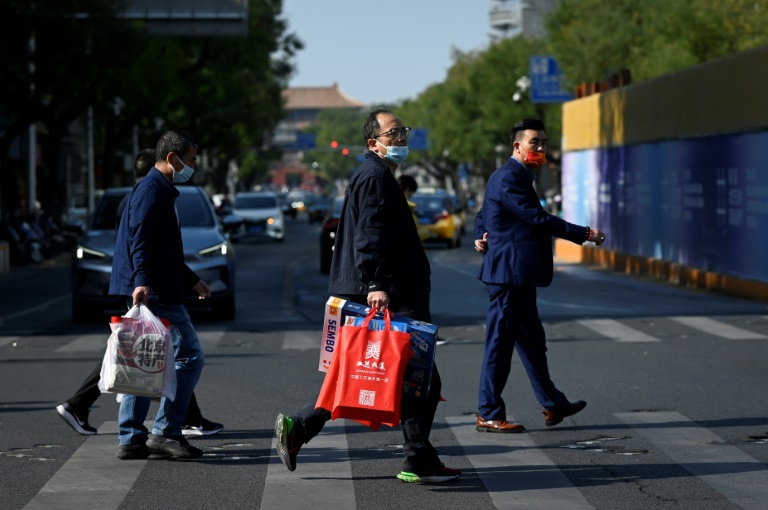
Chinese shoppers flocked to online commerce giants on Friday, snapping up hundreds of billions of yuan in bargains, though an economic malaise took some shine off the annual Singles Day fever.

Sales revenues across platforms operated by tech giants such as Alibaba and JD.com hit around 262 billion yuan ($36.7 billion) between 8:00 pm on Thursday and 2:00 pm (0600 GMT) on Friday, according to an estimate by research firm Syntun.

Analysts said demand was more muted than in previous years, while consumers told AFP that a lack of spending power and an economy groaning under a hardline zero-Covid policy had dampened desire to spend.

Nonetheless, the combined gross value of products sold since late October “may surpass a trillion yuan” for the first time, Xiaofeng Wang, principal analyst at research firm Forrester, said earlier in a note.

“This year, merchants and platforms are focusing less on sales and more on profit and conversion rates,” said tech analyst Liu Xingliang.

“After so many years, it’s natural for (Singles Day) to become less popular,” he said, adding that a bright spot appeared to be greater interest in livestreamed sales.

“Chinese consumers have become more rational and no longer hoard large amounts of goods like they did in years gone by”, economist Song Qinghui told AFP.

“They buy according to their needs, perhaps because consumption is becoming more transparent, and also because of the impact of the Covid-19 pandemic,” he said.

Conceived by Alibaba, the event’s title riffs on a tongue-in-cheek celebration of singlehood inspired by the four ones — “11/11” — that denote its date of November 11.

It has grown to encompass much of China’s retail sector, with merchants offering varying levels of discounts starting in late October.

Once a festival of frenzied consumption led by Alibaba’s effervescent founder Jack Ma, Singles Day has been more muted in recent years as Beijing cracks down on online platforms and state media coverage has waned.

Beijing resident Liu Yingxue said the Single’s Day atmosphere was “not as enthusiastic” as in previous years.

The platforms “used to have more ads and promotions… and don’t give so many discounts these days,” she told AFP. 

– Economic strain –

The mood has been dampened further this year as Beijing persists with a zero-Covid strategy that has hammered business confidence and chipped away at consumer demand.

The event, conceived in 2009, has previously lured throngs of Chinese influencers alongside Western celebrities including Kim Kardashian and Taylor Swift, drawing heavy coverage in both domestic and international media.

This time around, a series of scandals and a campaign against tax evasion have lowered expectations of celebrity endorsements, with influential Chinese live-streamer Viya disappearing from social media late last year in the wake of a tax probe.

Alibaba said last week the event could “make a big difference” for retailers struggling with supply-chain disruptions and inflation this year, including a slew of foreign brands.

Businesses and consumers alike have been laid low by China’s Covid prevention policies, which see officials wield snap lockdowns, mass testing and lengthy quarantines in response to a handful of cases.

Beijing resident Li Xiaofeng said the “state of the whole economy” was likely putting platforms and merchants under more pressure, “so they are offering fewer discounts”.

Another denizen of the capital, Lin Xiangru, blamed Covid — adding that “people have less guaranteed income than before, so they don’t want to spend money on desired products.”

China is the last major economy wedded to a zero-Covid strategy, with officials insisting they will stick “unswervingly” to the policy.

But Beijing announced the relaxation of some of its harsher curbs on Friday, cutting quarantine for overseas arrivals and scrapping Covid-related flight bans.

bur-tjx-sbr-mjw/dva

Close Bitnami banner
Bitnami