Chinese Business

ASEAN leaders struggle for answers to Myanmar crisis

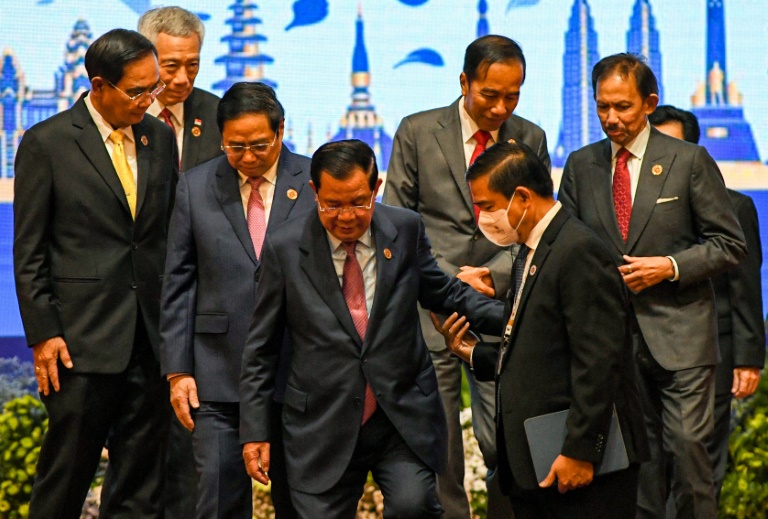
The escalating crisis in Myanmar was set to dominate summit talks Friday between Southeast Asian leaders struggling to find a way to calm the bloodshed in the junta-ruled country.

Leaders from the Association of Southeast Asian Nations (ASEAN) regional bloc will discuss ways to implement a peace plan agreed with Myanmar last year which the junta has so far ignored.

Myanmar has spiralled into bloody conflict since the military ousted Aung San Suu Kyi’s civilian government in February last year, with thousands killed in clashes since.

There is growing frustration among the other nine ASEAN countries at the generals’ foot-dragging on the so-called “five-point consensus” but so far no concrete plan to enforce it. 

President Ferdinand Marcos Jr of the Philippines called for “patience” in resolving the crisis at talks with Cambodian premier Hun Sen, the summit host.

ASEAN has blocked junta chief Min Aung Hlaing from attending the gathering in Phnom Penh, which US President Joe Biden will join on Saturday.

Biden will then go on to hold a high-stakes meeting with his Chinese counterpart Xi Jinping on the sidelines of the G20 summit in Indonesia on Monday.

China, ASEAN’s biggest trading partner, has historically had good ties with the Myanmar junta, though it has voiced some unease at the ongoing chaos in the country.

Chinese Premier Li Keqiang will hold talks with ASEAN leaders on Friday afternoon, before joining Biden and other regional leaders for an East Asia Summit in Phnom Penh on Sunday.

– US pressure –

Western powers have heaped sanctions on the junta and the United States has urged ASEAN to take a “forceful” stance to squeeze the junta to reduce the violence, which escalated in recent weeks with deadly military air strikes on civilian targets including a school and concert.

Daniel Kritenbrink, the top US diplomat for East Asia, said Myanmar would be a top subject when Biden meets ASEAN leaders on Saturday.

Within the bloc, Indonesia, Malaysia and Singapore have led a push for tougher action.

Indonesian President Joko Widodo met Singapore Prime Minister Lee Hsien Loong on the sidelines of ASEAN late Thursday to discuss their concerns about the situation in Myanmar.

“Both leaders expressed disappointment with the absence of commitment of the Myanmar military junta in implementing the five-point consensus,” Indonesian Foreign Minister Retno Marsudi said in a statement.

Earlier this month Singapore’s Foreign Minister Vivian Balakrishnan warned that the Myanmar military had “a very high tolerance for pain, very high tolerance for isolation” and the crisis could take decades to resolve.

– Junta defiance –

ASEAN foreign ministers held emergency talks on Myanmar last week and said afterwards they were “even more determined” to find a solution.

Myanmar state media have slammed ASEAN’s involvement, accusing the bloc of being a “lapdog for the US” while the junta warned against imposing a timeline on the peace process, saying it could lead to “negative implications”.

An early draft of a leaders’ statement seen by AFP tasks ASEAN officials with drawing up an “implementation plan”, but gives no details of what this would involve.

Ahead of the meeting, a senior ASEAN diplomat told AFP that expelling Myanmar from the bloc was not under consideration.

But the diplomat and the draft statement both suggest ASEAN could take up official contact with Myanmar’s National Unity Government (NUG).

The NUG is a self-declared parallel body dominated by former lawmakers from Suu Kyi’s party which considers itself to be Myanmar’s legitimate government.

The Myanmar junta regards the NUG as “terrorists”, and engaging with the group would be a significant step for ASEAN.

On the eve of the summit, rights campaign group Amnesty International called on the leaders to agree a complete embargo on the transfer of arms and aviation fuel to Myanmar.

Asian shares surge as investors cheer slower US inflation

Asian markets surged on Friday after a bumper session on Wall Street as lower US inflation dimmed expectations of more aggressive Federal Reserve rate hikes.

Hong Kong stocks rocketed six percent at the open while Tokyo’s key Nikkei index jumped more than three percent, although both had retreated slightly by mid-morning.

The gains extended global rallies after the US consumer price index (CPI) showed that the annual pace of inflation was a lower-than-expected 7.7 percent in October, down from 8.2 percent in September.

As US residents reel from sky-high costs, the central bank has moved forcefully to lower demand by raising the benchmark lending rate six times this year.

The latest inflation data should be welcome news to Fed policymakers, because prices are “finally showing some response” to the steep rate hikes, said Rubeela Farooqi of High Frequency Economics.

“Inflation has finally started to drop like a rock in the US and this is the best news that anyone can expect,” added AvaTrade analyst Naeem Aslam.

The dollar slumped against rival currencies following the data release, and shares rallied as investors cheered the prospect of less hawkish moves by the central bank.

The Dow was up 3.7 at the close and the tech-heavy Nasdaq index soared 7.4 percent, while European markets also ended higher.

Most Asian markets matched the upbeat mood.

Taipei jumped 3.5 percent, Seoul was up 2.8 percent and Sydney climbed 2.6 percent.

Singapore rose 1.4 percent, Shanghai was up 1.1 percent and Wellington put on 2.0 percent, but Bangkok lost 0.2 percent.

“As expected, buying in Asia tech is standing out this morning,” Stephen Innes of SPI Asset Management said.

“But with investors still looking over their shoulders at the crypto schism and rising Covid cases in China, that tide that was lifting all boats is starting to recede in places,” he cautioned.

Trade may also be “dominated by profit-taking and position squaring” after the rallies overnight and ahead of a US market holiday on Friday.

The crypto world has meanwhile been rocked by a surprise decision from Binance, the world’s biggest cryptocurrency platform, to scrap a possible acquisition of rival FTX.com — plunging bitcoin to a two-year low.

– Key figures around 0230 GMT –

Tokyo – Nikkei 225: UP 2.7 percent at 28,200.75 (break)

Hong Kong – Hang Seng Index: UP 5.2 percent at 16,925.56

Shanghai – Composite: UP 1.1 percent at 3,071.43

Pound/dollar: UP at $1.1678 from $1.1642 on Thursday

Euro/dollar: DOWN at $1.0188 from $1.0131

Dollar/yen: DOWN at 142.13 yen from 143.15 yen

Euro/pound: UP at 87.26 pence from 87.20 pence

West Texas Intermediate: UP 0.3 percent at $86.75 per barrel

Brent North Sea crude: UP 0.3 percent at $93.95 per barrel

New York – Dow: UP 3.7 percent at 33,715.37 points (close)

London – FTSE 100: UP 1.1 percent at 7,375.34 (close)

Twitter chaos deepens as key executives quit

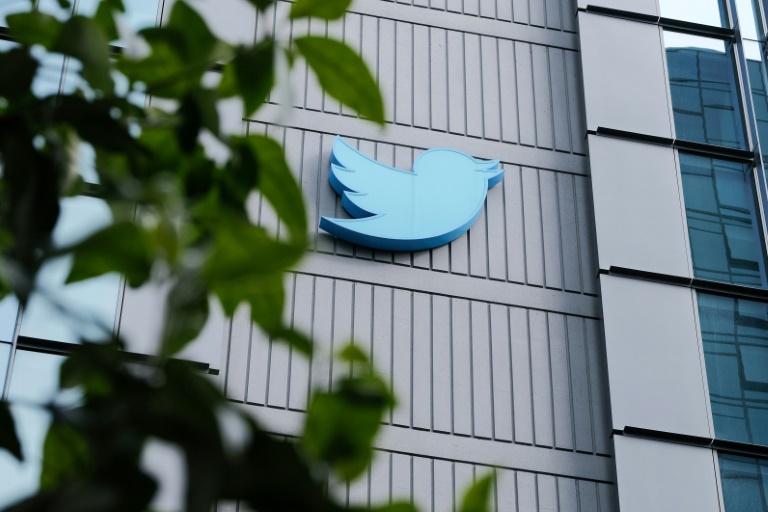
Elon Musk’s ownership of Twitter descended ever deeper into chaos on Thursday as key security executives resigned from the platform, drawing a sharp warning from US regulators.

The walkouts came a day after the turbulent launch of new features introduced by Tesla and SpaceX owner Musk following his $44 billion buyout of the influential messaging app.

Musk on Thursday warned employees that the site was burning dangerously through cash, raising the specter of bankruptcy if the situation was not turned around.

“I’ve made the hard decision to leave Twitter,” tweeted chief security officer Lea Kissner, who reportedly stepped down with other key privacy or security executives.

In the most extraordinary exit, US media reported that Yoel Roth, the site’s head of trust and safety stepped down just a day after staunchly defending Musk’s content moderation policy to advertisers.

The convulsions followed the unveiling of the site’s long-awaited Twitter Blue subscription service, which allows users to pay $7.99 per month for a coveted blue tick, as well as a separate gray “official” badge for some high-profile accounts.

But the release descended into tumult on Wednesday when Musk scrapped the new gray label almost immediately, overshadowing the launch of the pay service, which is currently only available on the mobile app on iPhones and in the United States.

The launch also saw the emergence of a flurry of fake accounts as users used the opportunity to impersonate celebrities and politicians such as NBA star LeBron James or former British prime minister Tony Blair.

Early media reports also said Robin Wheeler, who held a key role linking Twitter with advertisers and was considered a key Musk ally inside the company, was leaving but late Thursday she tweeted: “I’m still here.”

– ‘Deep concern’ –

The chaos drew a rare warning from the Federal Trade Commission, the US authority that oversees consumer safety which had put Twitter under watch for past security and privacy breaches.

“We are tracking recent developments at Twitter with deep concern,” a spokesperson for the FTC said in a statement.

“No CEO or company is above the law, and companies must follow our consent decrees,” the spokesperson added, referring to past commitments by Twitter to obey US privacy rules.

Violating FTC decisions could cost Twitter millions of dollars in fines.

The 51-year-old entrepreneur fired half of the 7,500 employees of the California company a week ago, 10 days after buying the site and becoming its sole owner.

For the first time since the layoffs, Musk on Thursday addressed his remaining employees and urged them to help the site reach one billion users, according to employee text messages seen by AFP.

Musk also warned that the company was bleeding cash and expressed fear about the effects of the poor economy on his newly bought business.

“You may have noticed I sold a bunch of Tesla stock. The reason I did that is to save Twitter,” he is reported to have said.

Wedbush analyst Dan Ives meanwhile warned that the Twitter episode could have serious repercussions for electric car manufacturer Tesla.

“Brand destruction is our biggest worry with this Twitter circus show. It’s that simple and I can’t ignore it for Tesla stock,” Ives wrote on the site.

Twitter is also crippled by the decision of advertisers to stay away from the platform, concerned about Musk’s plans.

The tycoon announced he was ending work-from-home policies at Twitter, which had been a widespread practice at the San Francisco-based company.

“If you don’t show up at the office, resignation accepted,” he told employees.

Stocks rally, dollar slumps after US inflation slows

Stocks rallied while the dollar slumped against rival currencies on Thursday after news of lower US inflation dimmed expectations of more aggressive Federal Reserve rate hikes.

The consumer price index (CPI), a key measure of inflation, rose at an annual pace of 7.7 percent in October.

That was below analyst expectations and a dip from the 8.2 percent rate recorded in September.

The dollar plunged more than four percent against the yen, while the pound jumped 3.2 percent against the greenback and the euro rose two percent.

Meanwhile, Wall Street stocks surged, with the Dow ending 3.7 percent higher with a nearly 1,200-point jump.

The broader S&P 500 jumped 5.5 percent and the tech-heavy Nasdaq Composite index soared 7.4 percent.

“I don’t recall having ever seeing the Nasdaq being up seven percent ever (and) I’ve been watching the markets for over 50 years,” Peter Cardillo of Spartan Capital Securities told AFP.

“Inflation has finally started to drop like a rock in the US and this is the best news that anyone can expect,” added AvaTrade analyst Naeem Aslam.

He expects that the Fed will still continue with rate hikes, though at a slower pace.

The Fed’s benchmark lending rate currently stands at between 3.75 to 4.0 percent, the highest since January 2008.

Investors have been keenly watching for signs that Fed policymakers will pivot away from their aggressive 0.75 percentage point hikes or pause them altogether.

Matt Weller at StoneX said that after the softer inflation reading, traders are now pricing in an 80 percent chance that the Fed will shift down to a 0.50 percentage point interest rate hike and now see rates peaking below 5.0 percent.

“There’s optimism that the worst of the selling may be behind us,” on equity markets, which are down heavily this year.

– Covid and crypto –

Markets are grappling also with the impact of strict zero-Covid measures in China, with supply chains and activity slowed by harsh lockdowns and testing policies.

“China’s domestic demand is weak and their key trading partners are entering recession territory,” said Edward Moya at OANDA trading group.

The crypto world has meanwhile been rocked by a surprise decision from Binance — the world’s biggest cryptocurrency platform — to scrap a possible acquisition of rival FTX.com a day after disclosing it had signed a non-binding letter of intent to buy it.

The near-collapse of FTX has plunged bitcoin to a two-year low.

“FTX’s slump from over a $32 billion valuation to zero in less than a few days raises numerous issues,” said Stephen Innes at SPI Asset Management.

“Prominent investors are wearing eggs on their faces after diving in head first.”

He added that gold and silver would be the biggest beneficiaries of the crypto fallout with investors looking to the trusted precious metals for stability.

– Key figures around 2130 GMT –

New York – Dow: UP 3.7 percent at 33,715.37 points (close)

New York – S&P 500: UP 5.5 percent at 3,956.37 (close)

New York – Nasdaq: UP 7.4 percent at 11,114.15 (close)

EURO STOXX 50: UP 3.2 percent at 3,846.56 (close)

London – FTSE 100: UP 1.1 percent at 7,375.34 (close)

Frankfurt – DAX: UP 3.5 percent at 14,146.09 (close)

Paris – CAC 40: UP 2.0 percent at 6,556.83 (close)

Tokyo – Nikkei 225: DOWN 1.0 percent at 27,446.10 (close) 

Hong Kong – Hang Seng Index: DOWN 1.7 percent at 16,081.04 (close)

Shanghai – Composite: DOWN 0.4 percent at 3,036.13 (close)

Euro/dollar: UP at $1.0219 from $1.0076 Wednesday 

Pound/dollar: UP at $1.1724 from $1.1544

Dollar/yen: DOWN at 140.67 yen from 145.58 yen

Euro/pound: DOWN at 87.10 pence from 87.26 pence

West Texas Intermediate: UP 0.7 percent at $86.47 per barrel

Brent North Sea crude: UP 1.1 percent at $93.67 per barrel

burs-rl-bys/dw

Apple limits file-sharing for Chinese iPhone users after anti-govt protest

Apple limited file-sharing for Chinese iPhone users Thursday, a month after reports that anti-government protesters were using the function to share digital leaflets with strangers.

Under the update to the AirDrop function, users of smartphones sold by Apple in China can only opt in to receive files from non-contacts during a 10-minute window before it automatically shuts off. The feature did not previously have a time limit.

The update, rolled out in the operating system released overnight, makes it virtually impossible to receive unexpected files from strangers.

The change follows widespread reports of people using AirDrop to spread leaflets critical of the Chinese Communist Party in crowded public spaces, partly inspired by a protest in Beijing in which a man hung banners calling for the removal of President Xi Jinping.

Chinese censors quickly scrubbed online videos and posts referring to the protest, while hundreds of users on the popular payment and chat app WeChat had their accounts blocked after speaking about the rare act of rebellion.

Apple declined AFP’s request for comment on the record but the company is now understood to be planning a roll out of the feature across the globe.

Apple phones sold outside mainland China on Thursday did not appear to be affected by the update, while iPhones sold in China displayed the limit regardless of which country the user’s App Store account was based in.

The description for users said the update “includes bug fixes and security updates”.

-‘Less appealing’-

The California-based tech giant, which touts security and privacy protections as key features of its devices, has previously faced criticism for alleged concessions to Beijing.

China is seen by Western observers as becoming increasingly repressive as President Xi Jinping embarks on his third term as the country’s most powerful figure.

“This is one small sample of a type of China cost…that’s making China much less appealing as a investment and manufacturing destination for many global multinationals many global companies,” Isaac Stone Fish, CEO of Strategy Risks, told AFP.

“Apple has to understand the very real risks of being overly exposed to China in 2022,” he added.

Other apparent concessions included opening a data centre in China, as well as removing an app in 2019 that allowed Hong Kong pro-democracy protesters to keep track of police.

It has also faced boycott threats in China as it stands in the crossfire of US-China tensions, with Beijing warning in 2020 that it could turn its citizens against Apple if Washington blocked Chinese apps.

Some Chinese social media users on Thursday hailed the iPhone update as a positive step in preventing unsolicited messages from strangers. One Weibo user said the change would “greatly reduce the probability of iPhone users being harassed”.

A handful questioned why the function was only being rolled out on Chinese iPhones, with one Weibo commenter joking about Apple CEO Tim Cook’s friendliness with Beijing: “So is Tim Cook a Party member or not?”

Changpeng Zhao, the undisputed king of crypto

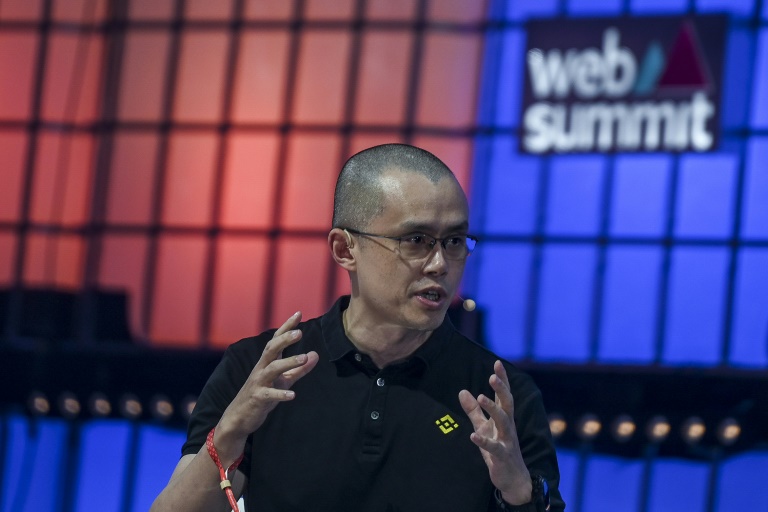
At parties, on stages and in meetings, Changpeng Zhao is rarely seen without his black polo shirt, emblazoned with the insignia of his crypto firm Binance.

The look is vital to the myth of Zhao, the boy from rural China who once flipped burgers for a living in Canada but now has a personal fortune of $17 billion, according to Forbes.

“I’m a small entrepreneur,” he told AFP earlier this year when comparing himself to Elon Musk, adding for good measure that he was just a “normal guy” in comparison to the world’s richest man.

Yet Binance has cornered more than half of the crypto-trading market and its main rival, FTX, was all but wiped out this week — elevating his company to the pinnacle of the crypto world.

And 45-year-old Zhao, who founded Binance in Shanghai in 2017, has emerged as the most central and most visible figure in crypto.

Hyperactive on social media, popping up at every possible tech conference and rarely out of TV studios, he expanded his reach even further recently by shovelling $500 million to Musk to buy Twitter.

Yet his breakneck rise has been dogged by controversy.

His cryptocurrency exchange has been repeatedly accused of facilitating money laundering and sanctions busting — claims it denies — and last month it was hacked for around $100 million. 

– True grit? –

The rags-to-riches tale of Zhao’s life has become almost mythical in crypto circles.

His early life in China was scarred by hardship when his parents were denounced and sent to the countryside for a dose of peasant hardship.

After the family emigrated to Canada a decade later, young Zhao had to work at McDonald’s and a petrol station to help the family survive.

This instilled “drive, grit, and initiative” into the young man and helped to create today’s “crypto leader”, according to the Binance website.

Zhao’s nomadic childhood informed his adult life, which has seen him crop up everywhere from New York to Tokyo.

The official legend has it that he caught the bitcoin bug during a conversation around a poker table, and started Binance a few years later in Shanghai.

He quickly left China and has since hinted that he might set up Binance in many jurisdictions — Singapore, France, Malta, Dubai, Bahrain — without definitively committing to any of them.

He often says he “favours good regulation over bad” and dismisses the idea of a company needing headquarters as a “complex issue”, before swiftly changing the subject.

This opacity has made him a popular figure among crypto purists, who loathe any form of regulation, and has kept regulators from knocking too hard at his door — so far.

– Musk flirtation –

However, like many crypto companies, there has long been a whiff of scandal around Binance.

It has been accused of pursuing growth at any cost and failing to properly check the identities of customers, allowing money laundering and sanctions busting to flourish.

Zhao has feuded openly with journalists over the claims — accusing outlets including Reuters of peddling fake news.

However, a Reuters story this month suggesting Binance had handled billions of dollars in transactions involving Iranian entities proved harder to brush off.

Binance admitted in a blog post — not written by Zhao — that it had “interacted with certain Iran-based nexuses” and had moved to freeze the accounts.

It remains to be seen what further action might come Binance’s way for the sanctions faux-pas, but Zhao’s bruising run-ins with the media have seen him increasingly champion the free speech absolutism also favoured by Musk.

Surprisingly, given their shared interests and newly entwined businesses, the two men have not met in person.

“He’s busy, I’m busy,” Zhao told a press conference at the Web Summit in Portugal in early November.

But ever mindful of his blue-collar image, he added: “If we happen to be in the same city, I wouldn’t mind it. If he’s a good drinker.”

Stocks rally, dollar slumps after US inflation slows

Stocks rallied while the dollar slumped against rival currencies on Thursday after a drop in US inflation dimmed expectations of more aggressive Federal Reserve rate hikes.

The consumer price index (CPI), a key measure of inflation, rose at an annual pace of 7.7 percent in September.

That was below analyst expectations and a dip from the 8.2 percent rate in September.

The dollar plunged more than three percent against the yen, while the pound jumped 2.7 percent against the greenback and the euro rose 1.5 percent.

Meanwhile, stocks surged.

On Wall Street, the Dow gained nearly a thousand points in late morning trading, or 3.0 percent.

The broader S&P 500 jumped 4.5 percent and the tech heavy Nasdaq Composite soared 5.9 percent.

“Inflation has finally started to drop like a rock in the US and this is the best news that anyone can expect,” said AvaTrade analyst Naeem Aslam.

“The Fed will still continue to increase the interest rate but there is no need to be aggressive about this — which means that the pace of interest rate hikes will slow down now.”

The Fed’s main policy rate currently stands at between 3.75 to 4.0 percent, and investors have been keen on determining when policymakers will “pivot” away from its aggressive 0.75 percentage point hikes or “pause” them altogether.

Matt Weller at StoneX said that after the soft inflation reading traders are now pricing in an 80 percent chance the Fed will shift down to a 0.50 percentage point interest rate hike and now see rates peaking below 5.0 percent.

“This dovish shift has had an outsized impact on markets,” he said.

“There’s optimism that the worst of the selling may be behind us,” on equity markets, which are down heavily this year.

– Covid and crypto –

Markets are grappling also with the impact of strict zero-Covid measures in China, with supply chains and activity slowed by harsh lockdowns and testing policies.

“China’s domestic demand is weak and their key trading partners are entering recession territory,” said Edward Moya at OANDA trading group.

The crypto world has meanwhile been rocked by a surprise decision from Binance, the world’s biggest cryptocurrency platform, to scrap a possible acquisition of rival FTX.com a day after disclosing it had signed a non-binding letter of intent to buy it.

The near-collapse of FTX has plunged bitcoin to a two-year low.

“FTX’s slump from over a $32 billion valuation to zero in less than a few days raises numerous issues,” said Stephen Innes at SPI Asset Management.

“Prominent investors are wearing eggs on their faces after diving in head first.”

He added that gold and silver would be the biggest beneficiaries of the crypto fallout with investors looking to the trusted precious metals for stability.

– Key figures around 1630 GMT –

New York – Dow: UP 3.0 percent at 33,474.29 points

EURO STOXX 50: UP 3.2 percent at 3,846.56

London – FTSE 100: UP 1.1 percent at 7,375.34  

Frankfurt – DAX: UP 3.5 percent at 14,146.09

Paris – CAC 40: UP 2.0 percent at 6,556.83 

Tokyo – Nikkei 225: DOWN 1.0 percent at 27,446.10 (close) 

Hong Kong – Hang Seng Index: DOWN 1.7 percent at 16,081.04 (close)

Shanghai – Composite: DOWN 0.4 percent at 3,036.13 (close)

Euro/dollar: UP at $1.0131 from $1.0017 Wednesday 

Pound/dollar: UP at $1.1642 from $1.1352

Dollar/yen: DOWN at 143.15 yen from 146.37 yen

Euro/pound: DOWN at 87.20 pence from 88.19 pence

West Texas Intermediate: UP 1.2 percent at $86.85 per barrel

Brent North Sea crude: UP 1.3 percent at $93.84 per barrel

burs-rl/ach 

Stocks rally, dollar slumps after US inflation slows

Stocks rallied while the dollar slumped against rival currencies after a drop in inflation dimmed expectations of more aggressive Federal Reserve rate hikes.

The consumer price index (CPI), a key measure of inflation, rose at annual pace of 7.7 percent in September.

That was below analyst expectations and a dip from the 8.2 percent rate in September.

The dollar plunged against the euro, pound and yen after the data was released, and US treasury bond yields also dropped.

European stocks, which had been lower in midday trading, shot higher.

Frankfurt stocks were up 2.9 percent in afternoon trading as Wall Street open, with Paris 1.6 percent higher and London rising 0.8 percent.

US stock futures also rocketed after the data was published, and at the opening bell the Dow jumped 2.5 percent higher.

The S&P 500 sprang up 3.7 percent and Nasdaq Composite soared 4.8 percent.

“Inflation has finally started to drop like a rock in the US and this is the best news that anyone can expect,” said AvaTrade analyst Naeem Aslam.

“The Fed will still continue to increase the interest rate but there is no need to be aggressive about this — which means that the pace of interest rate hikes will slow down now.”

The Fed’s main policy rate currently stands at between 3.75 to 4.0 percent, and investors have been keen on determining when policymakers will “pivot” away from aggressive hikes or “pause” them altogether.

Stuart Clark, portfolio manager at Quilter Investors, said the slowdown in inflation will provide some relief to consumers and investors, as well as “giving some momentum to the idea that the worst is now behind us.”

But we’re “not completely out of the woods yet,” he added, pointing food and housing costs continue to rise.

Clark said “the Federal Reserve is going to remain in a hawkish mood for some time to come… the market will have to wait for any indication of a pivot or pause from the central bank.”

– Covid and crypto –

Markets are grappling also with the impact of strict zero-Covid measures in China, with supply chains and activity slowed by harsh lockdowns and testing policies.

“China’s domestic demand is weak and their key trading partners are entering recession territory,” said Edward Moya at OANDA trading group.

Oil prices extended recent losses on weaker Chinese demand.

The crypto world has meanwhile been rocked by a surprise decision from Binance, the world’s biggest cryptocurrency platform, to scrap a possible acquisition of rival FTX.com a day after disclosing it had signed a non-binding letter of intent to buy it.

The near-collapse of FTX has plunged bitcoin to a two-year low.

“FTX’s slump from over a $32 billion valuation to zero in less than a few days raises numerous issues,” said Stephen Innes at SPI Asset Management.

“Prominent investors are wearing eggs on their faces after diving in head first.”

He added that gold and silver would be the biggest beneficiaries of the crypto fallout with investors looking to the trusted precious metals for stability.

– Key figures around 1330 GMT –

London – FTSE 100: UP 0.8 percent at 7,355.53 points 

Frankfurt – DAX: UP 2.9 percent at 14,057.12

Paris – CAC 40: UP 1.6 percent at 6,533.37 

EURO STOXX 50: UP 2.4 percent at 3,817.93

New York – Dow: UP 2.5 percent at 33,328.77

Tokyo – Nikkei 225: DOWN 1.0 percent at 27,446.10 (close) 

Hong Kong – Hang Seng Index: DOWN 1.7 percent at 16,081.04 (close)

Shanghai – Composite: DOWN 0.4 percent at 3,036.13 (close)

Euro/dollar: UP at $1.0131 from $1.0017 Wednesday 

Pound/dollar: UP at $1.1642 from $1.1352

Dollar/yen: DOWN at 143.15 yen from 146.37 yen

Euro/pound: DOWN at 87.20 pence from 88.19 pence

West Texas Intermediate: DOWN 0.5 percent at $85.41 per barrel

Brent North Sea crude: DOWN 0.1 percent at $92.55 per barrel

burs-rl/cdw

Stock markets drop before US inflation

Stock markets mostly fell Thursday looking ahead to key inflation data in the United States and as traders digested the country’s inconclusive midterm election results as well as a cryptocurrency crisis.

US inflation numbers due Thursday will help markets to gauge the speed of future rate hikes by the Federal Reserve. The dollar was mixed before the latest data. 

“US growth looks still too strong to bring inflation down,” noted Tapas Strickland of National Australia Bank.

“The ongoing resilience in the (consumer prices) data and stickiness in inflation continue to point to the Fed hiking rates closer to 5.0 percent or higher.” 

Rates currently stand at between 3.75 to 4.0 percent.

In US midterm elections, Republicans appeared likely to win a majority in the House of Representatives, but with a much smaller victory than they had hoped for — and that pollsters forecast.

Markets are grappling also with the impact of strict zero-Covid measures in China, with supply chains and activity slowed by harsh lockdowns and testing policies.

“China’s domestic demand is weak and their key trading partners are entering recession territory,” said Edward Moya at OANDA trading group.

Oil prices fell Thursday, extending recent losses on weaker Chinese demand.

The crypto world has meanwhile been rocked by a surprise decision from Binance, the world’s biggest cryptocurrency platform, to scrap a possible acquisition of rival FTX.com a day after disclosing it had signed a non-binding letter of intent to buy it.

The near-collapse of FTX has plunged bitcoin to a two-year low.

“FTX’s slump from over a $32 billion valuation to zero in less than a few days raises numerous issues,” said Stephen Innes at SPI Asset Management.

“Prominent investors are wearing eggs on their faces after diving in head first.”

He added that gold and silver would be the biggest beneficiaries of the crypto fallout with investors looking to the trusted precious metals for stability.

– Key figures around 1200 GMT –

London – FTSE 100: DOWN 0.1 percent at 7,291.54 points 

Frankfurt – DAX: FLAT at 13,667.53

Paris – CAC 40: DOWN 0.5 percent at 6,401.60 

EURO STOXX 50: DOWN 0.1 percent at 3,725.10

Tokyo – Nikkei 225: DOWN 1.0 percent at 27,446.10 (close) 

Hong Kong – Hang Seng Index: DOWN 1.7 percent at 16,081.04 (close)

Shanghai – Composite: DOWN 0.4 percent at 3,036.13 (close)

New York – Dow: DOWN 2.0 percent at 32,513.94 (close)

Euro/dollar: DOWN at $0.9945 from $1.0017 Wednesday 

Pound/dollar: UP at $1.1376 from $1.1352

Dollar/yen: UP at 146.49 yen from 146.37 yen

Euro/pound: DOWN at 87.42 pence from 88.19 pence

West Texas Intermediate: DOWN 0.6 percent at $85.33 per barrel

Brent North Sea crude: DOWN 0.4 percent at $92.29 per barrel

Apple limits file-sharing for Chinese iPhone users after anti-govt protest

Apple limited file-sharing for Chinese iPhone users Thursday, a month after reports that anti-government protesters were using the function to share digital leaflets with strangers.

Under the update to the AirDrop function, users of smartphones sold by Apple in China can only opt in to receive files from non-contacts for a 10-minute window before it automatically shuts off. The feature did not previously have a time limit.

The update, rolled out in the operating system released overnight, makes it virtually impossible to receive unexpected files from strangers.

The change follows widespread reports of people using AirDrop to spread leaflets critical of the Chinese Communist Party in crowded public spaces, partly inspired by a protest in Beijing in which a man hung banners calling for the removal of President Xi Jinping.

Chinese censors quickly scrubbed online videos and posts referring to the protest, while hundreds of users on the popular payment and chat app WeChat had their accounts blocked after speaking about the rare act of rebellion.

Apple did not respond immediately to AFP’s request for comment and did not give a reason for the specific change.

It said in its update description for users the operating system now “includes bug fixes and security updates”.

Apple phones sold outside mainland China did not appear to be affected by the update, while iPhones sold in China displayed the limit regardless of which country the user’s App Store account was based in.

The California-based tech giant, which touts security and privacy protections as key features of its devices, has previously faced criticism for alleged concessions to Beijing.

That included opening a data centre in China, as well as removing an app in 2019 that allowed Hong Kong pro-democracy protesters to keep track of police.

It has also faced boycott threats in China as it stands in the crossfire of US-China tensions, with Beijing warning in 2020 that it could turn its citizens against Apple if Washington blocked Chinese apps.

Some Chinese social media users on Thursday hailed the iPhone update as a positive step in preventing unsolicited messages from strangers. One Weibo user said the change would “greatly reduce the probability of iPhone users being harassed”.

A handful questioned why the function was only being rolled out on Chinese iPhones, with one Weibo commenter joking about Apple CEO Tim Cook’s friendliness with Beijing: “So is Tim Cook a Party member or not?”

Close Bitnami banner
Bitnami