Chinese Business

Vietnam struggles to break one of world's biggest coal addictions

Despite Vietnam’s solar boom and ambitious climate targets, the fast-growing economy is struggling to quit dirty energy — leaving one of the world’s biggest coal power programmes largely intact.

During the COP26 climate summit last year, the government boldly promised to end the construction of new coal plants and phase out the dirtiest of those already running, even as energy demands soar in the manufacturing powerhouse.

“But this is not actually what Vietnam is doing at a national level,” Nandini Das, an energy research and policy analyst at Climate Analytics, told AFP.

Vietnam pledged to reach net-zero carbon emissions by 2050, but with coal and gas still a major part of its energy mix one year later, that commitment is on shaky ground, she said. 

The authoritarian communist state has also jailed four green activists this year, including anti-coal campaigner Nguy Thi Khanh, alarming environmentalists who argue it will be even harder for Vietnam to banish dirty energy without them. 

“With the climate leaders in prison I think there’s grave doubt about the country’s ability to achieve its goals,” said Michael Sutton, director of the Goldman Environmental Foundation. 

He said “leaders like Khanh are instrumental in building public support” for radical change to Vietnam’s economy.

– Solar boom – 

After China and India, Vietnam has the world’s third-largest pipeline of new coal power projects. 

But at COP27 this week, G7 countries could announce billions of dollars in funding to help steer Vietnam away from fossil fuels and the country could attract billions more in clean energy investment as part of the Just Energy Transition Partnership.

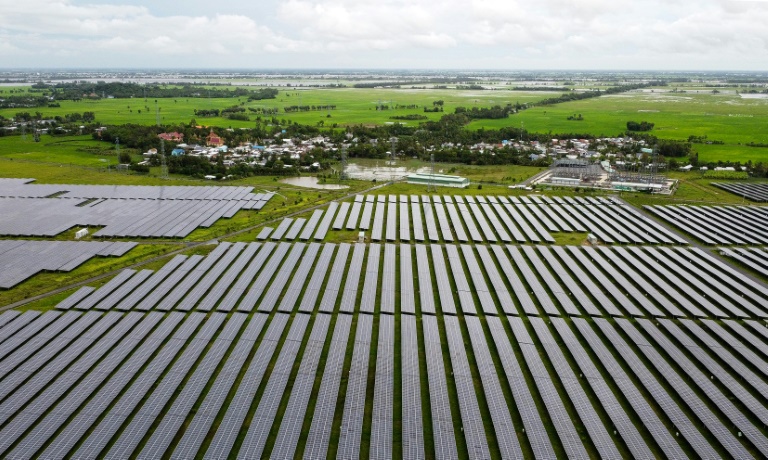
The rise of solar energy in the Southeast Asian nation has also been meteoric.

The share of electricity generated by solar saw the biggest rise in the world in 2021, jumping to 10 percent from two percent a year earlier, according to independent energy think tank Ember. 

Last year, the country ranked in the top 10 globally for solar energy capacity.

In the Mekong Delta, farmer Doan Van Tien — whose community is poor, remote and has little access to the national grid — is one of those who benefited.  

For most of his life, he relied on a costly oil generator, until the arrival of 14 solar power batteries funded by Green ID, the non-profit environmental group founded by activist Khanh.

“It changed my life a lot,” he told AFP, gesturing to his lucrative avocado and mandarin crops.

“In the past we wanted to grow these fruit trees but we could not (afford to power) the water pump,” he said. Now he waters his plants for free.

Others jumped on solar thanks to generous feed-in tariffs, but its success has hit a roadblock: infrastructure limitations mean transmission lines cannot handle supply spikes, forcing a limit on how much power operators can feed into the grid.

– Changing mindsets –

In other strides down a greener path, the environment ministry’s latest climate targets, issued in July, are “clear and much more ambitious than previous” goals, according to Thang Do, a research fellow at the Crawford School of Public Policy at the Australian National University. 

The ministry’s new strategy boosted the reduction target for greenhouse gases by 2030 from last year’s goal of nine percent relative to business as usual, to 43.5 percent. Emissions are expected to peak in 2035 before falling to net-zero in 2050.

The problem, Das argued, is that the new policies have yet to be implemented.

“We’ll give it six months to see,” she said.

The arrests of climate campaigners have made Vietnam’s energy intentions even more difficult to decipher.

Khanh worked closely with the government to find a way to reduce coal use, while Dang Dinh Bach, an NGO worker, made it his mission to inform residents about the health impacts of potential power plant projects.

He “offered advice to them so they understood their rights and could practice those rights”, Bach’s wife Tran Phuong Thao told AFP.

In 2017, Bach and his non-profit group Law & Policy of Sustainable Development helped push the government into a rare climbdown over a power plant in Binh Thuan province that it had permitted to sink a million cubic metres of coal sludge into the sea.

He was arrested in June 2021, and sentenced this year to five years in prison.

Although there is little time to waste for Vietnam, one of the countries most vulnerable to climate change due to its long and densely populated coastline, researcher Thang believes there is no choice but to be patient.

“The whole economy is now dependent on coal so that makes it very challenging to change,” he said.

“It’s not an easy decision to make to just close a coal power plant and tomorrow we’ll open a solar and wind, it takes a lot of time and resources and also mindsets to be changed.”

Apple says iPhone production hit by China Covid lockdown

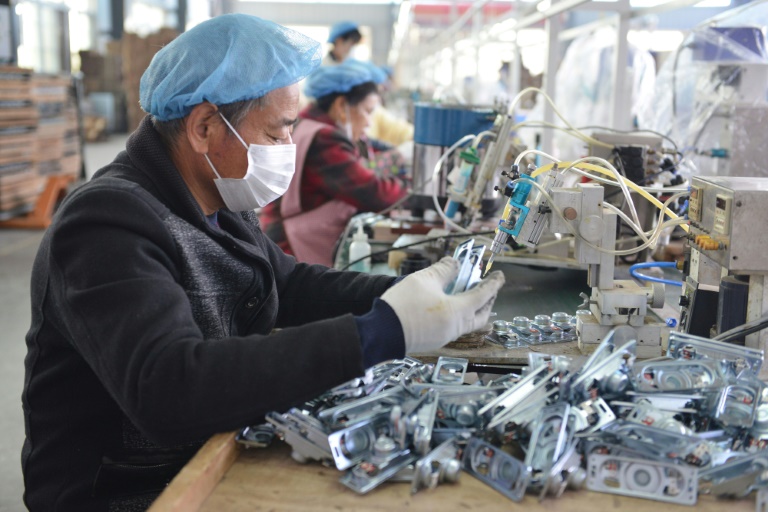
Apple warned customers would face longer wait times for iPhones with the holiday season approaching, after Covid restrictions in central China “temporarily impacted” production at the world’s largest factory producing the smartphone.

Foxconn, Apple’s principal subcontractor, locked down its massive factory in Zhengzhou last month after a spike in infections — in line with China’s zero-Covid policy. 

In a separate statement Monday, the Taiwanese firm said its fourth quarter earnings this year would take a hit from the coronavirus lockdowns.

Panicking workers last week had fled the site on foot in the wake of allegations of poor conditions at the facility, which employs hundreds of thousands of workers.

“Covid-19 restrictions have temporarily impacted the primary iPhone 14 Pro and iPhone 14 Pro Max assembly facility located in Zhengzhou, China,” California-based Apple said in a statement late Sunday.

“The facility is currently operating at significantly reduced capacity.”

Despite strong demand for Apple’s products ahead of the holiday season, “we now expect lower iPhone 14 Pro and iPhone 14 Pro Max shipments than we previously anticipated”, it said. 

“Customers will experience longer wait times to receive their new products.” 

Foxconn is China’s biggest private sector employer, with more than a million people working across the country in about 30 factories and research institutes.

But Zhengzhou is the Taiwanese company’s crown jewel, churning out iPhones in quantities not seen anywhere else.

“In a normal situation, almost all the iPhone production is happening in Zhengzhou,” Ivan Lam, an analyst with specialist firm Counterpoint, told AFP.

The company was initially “cautiously optimistic” about its fourth quarter earnings, it said. 

“But due to the pandemic affecting some of our operations in Zhengzhou, the company will ‘revise down’ the outlook for the fourth quarter,” Foxconn said in a statement. 

“Foxconn is now working with the government in (a) concerted effort to stamp out the pandemic and resume production to its full capacity as quickly as possible,” the company said. 

It did not give any statistical projection for how badly it expected earnings to be hit.

“This is a dark sign of the zero-Covid policy in China impacting production for Apple with Foxconn,” Dan Ives, analyst at Wedbush Securities, told AFP.

“It confirms the Street’s fears with Apple this quarter and will be an albatross on the tech market this week.”

– ‘We are drowning’ –

Local authorities locked down the area surrounding the factory on Wednesday, but not before reports emerged of a lack of adequate medical care at the plant.

Multiple workers have recounted scenes of chaos and increasing disorganisation at Foxconn’s complex of workshops and dormitories, which form a city-within-a-city near Zhengzhou’s airport.

“People with fevers are not guaranteed to receive medicine,” a 30-year-old Foxconn worker, who asked to remain anonymous, told AFP.

“We are drowning,” he said.

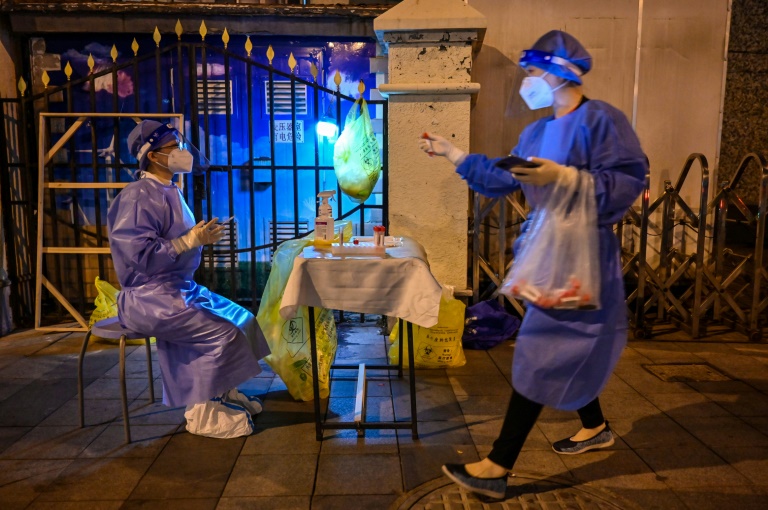
China is the last major economy wedded to a strategy of extinguishing Covid outbreaks as they emerge, imposing snap lockdowns, mass testing and lengthy quarantines despite the widespread disruption to businesses and international supply chains.

And authorities poured cold water on speculation that the policy could be relaxed Saturday, with National Health Commission (NHC) spokesperson Mi Feng saying that Beijing would “stick unswervingly to… the overall policy of dynamic zero-Covid”.

“At present, China is still facing the dual threat of imported infections and the spread of domestic outbreaks,” Mi said at a press briefing.

“The disease control situation is as grim and complex as ever,” he said. “We must continue to put people and lives first.”

New Zealand locks horns with Canada in dairy trade row

New Zealand’s trade minister accused Canada on Monday of having “locked out” his nation’s farmers in a dispute over dairy exports destined to be settled by an independent panel.

Damien O’Connor said the Canadians are “not living up” to promises made under a 2018 trans-Pacific free trade agreement to allow dairy products into Canada.  

“This is impacting New Zealand exporters, who remain effectively locked out of the Canadian market,” O’Connor said in a statement.

The Comprehensive and Progressive Agreement for Trans-Pacific Partnership was signed in 2018 by Canada, New Zealand and nine other countries in the Asia-Pacific region.

New Zealand first said in May it had beef with Canada’s administration of tariff rate quotas to allow dairy products to be imported with lower import taxes.

New Zealand started dispute settlement proceedings against the Canadians over lost dairy market access — worth about $40 million over two years — which “did not resolve matters”, O’Connor said.

“New Zealand has therefore made the decision to request the establishment of a panel to hear and decide the dispute,” he said.

New Zealand Prime Minister Jacinda Ardern revealed Monday that she had already told her Canadian counterpart Justin Trudeau “to his face” that her nation would escalate the trade dispute.

“I think it would be unusual that given the amount of contact we have for me not to raise the issue. Our relationship with Canada means I can be very forthright,” Ardern told reporters in Wellington.

She said she had told Trudeau “we were at an impasse” and that Ardern didn’t “see any reason why we should have officials continue a back and forth” which would only “waste time”. 

“If we can speak frankly as leaders and know we are between ourselves not going to be able to resolve it, it was time to escalate. That’s what we’ve done,” Ardern added.

There has been no official response from Canadian representatives. Diplomatic officials in Wellington said a response would have to come from Ottawa. 

The government in Wellington wants three experts on the neutral panel, to be chosen by Canada and New Zealand, to settle the row.

Global dairy exports contributed $10.96 billion to New Zealand’s economy in 2021 which was around 23 percent of total exports.

China exports fall in October, first decline since 2020

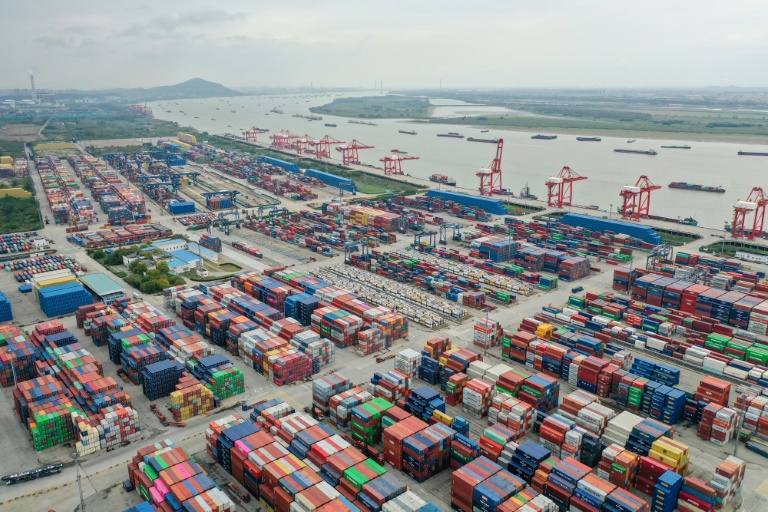
China’s exports shrank in October, the first such decline since mid-2020, customs authorities said Monday, as a domestic slowdown and the threat of global recession hit international trade.

Exports fell 0.3 percent year-on-year in October, according to the General Administration of Customs, a steep drop from September’s 5.7 percent increase and well below analysts’ expectations.

Year-on-year imports were down 0.7 percent in October, negative for the first time since March this year and down from September’s 0.3 percent growth.

The slowdown in trade comes as global demand for Chinese products weakens with energy prices soaring and the United States facing the threat of recession.

Sporadic Covid-19 lockdowns have also hurt consumer enthusiasm and business confidence in the world’s second-largest economy.

Analysts surveyed by Bloomberg forecast export growth of 4.3 percent in October, but expected only 0.1 percent growth in imports amid weakening demand at home.

“The recent decline in export volumes appears to reflect a reversal in the pandemic-era surge in global demand for Chinese goods,” Capital Economics analyst Zichun Huang said in a note on Monday.

Import volumes are “likely to continue weakening given the challenging domestic outlook”, Huang said.

– Domestic challenges –

China’s factory activity shrank in October, official data showed last week, which the National Bureau of Statistics blamed on virus outbreaks last month.

Factory activity has been in contraction territory for six months of the year so far, as sweeping Covid restrictions paralysed major industrial cities such as Shanghai, Shenzhen and Chengdu.

Apple on Monday warned of delayed shipments after Covid restrictions “temporarily impacted” production at its massive factory in Zhengzhou, central China.

Chinese leaders have set out an annual economic growth target of about 5.5 percent, but many observers think the country will struggle to hit the target, despite announcing a better-than-expected 3.9 percent expansion in the third quarter.

It is the last major economy wedded to a strategy of extinguishing Covid outbreaks as they emerge, imposing snap lockdowns, mass testing and lengthy quarantines despite the widespread disruption to businesses and international supply chains.

And authorities poured cold water on speculation that the policy could be relaxed Saturday, with National Health Commission (NHC) spokesperson Mi Feng saying that Beijing would “stick unswervingly to… the overall policy of dynamic zero-Covid”.

Authorities had imposed enhanced virus curbs on a total area accounting for more than 10 percent of China’s overall gross domestic product as of Thursday, according to Nomura analysts.

Asian markets mostly up after solid US jobs data

Most Asian markets rose on Monday following strong US jobs data, with fresh rallies seen in Hong Kong even after China said it would stick to its strict zero-Covid policy.

Global stock markets and oil prices were buoyant last week on hopes that Beijing would roll back some of its economically painful policies aimed at stamping out the disease within its borders.

But on Saturday, the Chinese government said it would “unswervingly” stick to its current plan, which involves harsh lockdowns and strict quarantine and testing regimens for even the smallest clusters of cases.

Wall Street equities had enjoyed a boost on Friday from the latest US jobs data, which showed that hiring remained resilient and wages continued to rise, though at a slower pace.

The data, which comes days ahead of critical US midterm elections, raised hopes of a soft landing for the world’s biggest economy despite aggressive Fed rate hikes aimed at taming inflation.

All three main US indexes ended around 1.3 percent higher on Friday, and Tokyo shares extended those gains, trading up 1.3 percent in the early afternoon.

Hong Kong shares dipped slightly at the open, then rocketed 3.4 percent by the break — adding to a jump of more than five percent in the previous session.

Bourses in Shanghai and Shenzhen also edged up 0.5 percent and 0.6 percent respectively, having started the day flat.

“Last week, the financial market was stirring on rumours of China reopening,” Raymond Yeung and Zhaopeng Xing of ANZ Research said in a note on Monday.

But as the rumours about a reopening were unsubstantiated, “it is more likely the market is over-interpreting new information and downplaying old developments”, they wrote.

“Obviously, China feels the urgency to normalise the economy… But the political leadership will not adopt ‘living with Covid’,” the pair added.

“In our view, the availability of locally developed new vaccines will be a game changer”.

China is the last major economy wedded to a strategy of extinguishing Covid-19 outbreaks as they emerge, despite the widespread disruption to businesses and international supply chains.

In morning trade on Monday, Seoul rose 0.9 percent, Taipei was up 1.5 percent and Sydney was up 0.5 percent. Singapore added 0.3 percent, and Jakarta was flat.

Dashed hopes of a Chinese reopening also drove down oil prices, which had rallied on Friday on the optimism that Beijing could soon change course, pushing up demand for crude.

– Key figures around 0400 GMT –

Tokyo – Nikkei 225: UP 1.3 percent at 27,543.52

Hong Kong – Hang Seng Index: UP 3.4 percent at 16,714.57 (break)

Shanghai – Composite: UP 0.5 percent at 3,084.87 

London – FTSE 100: UP 2.0 percent at 7,334.84 (close)

Pound/dollar: DOWN at $1.1309 from $1.1376 Friday

Euro/dollar: DOWN at $0.9937 from $0.9964

Dollar/yen: UP at 147.21 yen from 146.62 yen

Euro/pound: UP at 87.71 pence from 87.56 pence

West Texas Intermediate: DOWN 1.3 percent at $91.41 per barrel

Brent North Sea crude: DOWN 1.0 percent at $97.55 per barrel

New York – Dow: UP 1.3 percent at 32,403.22 (close)

N. Korea vows 'overwhelming' response to US-South Korea war games

The North Korean military said its response to US-South Korean war drills would be “resolute and overwhelming”, state media reported Monday.

The warning came after a spate of North Korean weapons tests last week — including an intercontinental ballistic missile — as the United States and South Korea conducted their biggest-ever air force exercise.

The United States and South Korea have warned that such missile launches could culminate in a nuclear test by North Korea.

The North Korean military, formally known as the Korean People’s Army (KPA), said it was responding to Vigilant Storm — the US-South Korean exercise — describing it as “an open provocation”, according to the official Korean Central News Agency (KCNA).

Vigilant Storm was “aimed at intentionally escalating the tension in the region and a dangerous war drill of very high aggressive nature directly targeting” North Korea, the KPA said.

North Korea will respond to all “anti-DPRK war drills” with “sustained, resolute and overwhelming” measures, it said.

The United States has dismissed criticism of the exercise as North Korean propaganda, saying it posed no threat to other nations.

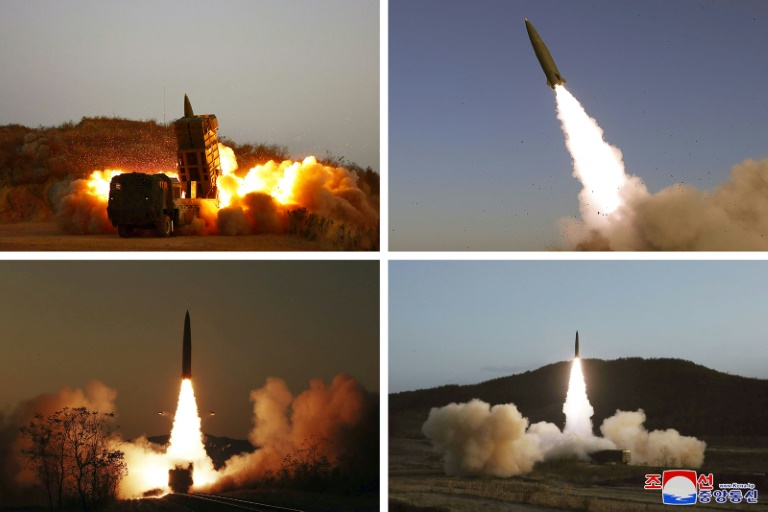
The KPA said it conducted operations, including the launch of tactical ballistic missiles that simulated attacks on air force bases, and practised shooting down enemy aircraft.

One ballistic missile was launched to test “a special functional warhead paralyzing the operation command system of the enemy”, the KPA said, without providing any further details about that weapon.

The North Korean air force also conducted a “large-scale all-out combat sortie operation”, involving 500 planes, according to KCNA.

That mobilisation prompted South Korea to scramble fighter jets on Friday.

Images of North Korean military operations released on Monday by KCNA showed missiles being fired from various undisclosed locations, including some from mobile launchers.

– Weak air force –

Experts say Pyongyang is particularly sensitive about drills such as Vigilant Storm because its air force is one of the weakest links in its military, lacking high-tech jets and properly trained pilots.

The details of North Korea’s operations last week indicate the importance it places on destroying air bases in the South, said Cheong Seong-chang, a researcher at the Sejong Institute in Seoul.

“North Korea considers it important to strike and neutralise air bases first because their air power is weak,” Cheong told AFP.

Compared with North Korea’s ageing fleet, Vigilant Storm saw some of the most advanced US and South Korean warplanes in action, including F-35 stealth fighters.

The exercise was meant to run from Monday to Friday last week, but Washington and Seoul extended it by a day in response to the flurry of North Korean missile launches.

Two US Air Force B-1Bs — long-range heavy bombers — joined the drills in a show of force.

US-South Korea joint drills have long sparked strong reactions from North Korea, which sees them as rehearsals for an invasion.

Pyongyang has especially condemned past deployments of US strategic weapons such as long-range bombers and aircraft carrier strike groups.

Parts of the KPA statement, including the claim that it could counter the “theory of superiority” of US and South Korean air forces, were domestic propaganda, said Park Won-gon, a professor at the Ewha University in Seoul.

“It is saying that North Korea responded sufficiently against the largest joint drills between Seoul and Washington and that they prevailed.”

South Korea began its annual Taegeuk computer-simulated military exercise on Monday, which aims to improve its ability to respond to various North Korean threats.

Asian markets mostly up after solid US jobs data

Most Asian markets started the week with gains Monday following strong US jobs data, although stocks in Shanghai were flat after China said it would stick to its strict zero-Covid policy.

Global stock markets and oil prices rallied last week on hopes that Beijing would roll back some of its economically painful policies aimed at stamping out the disease within its borders.

But on Saturday, the Chinese government said it would “unswervingly” stick to its current plan, which involves harsh lockdowns and strict quarantine and testing regimens for even the smallest clusters of cases.

Wall Street equities had enjoyed a boost on Friday from the latest US jobs data, which showed that hiring remained resilient and wages continued to rise, though at a slower pace.

The data, which comes days ahead of critical US midterm elections, raised hopes of a soft landing for the world’s biggest economy despite aggressive Fed rate hikes aimed at taming inflation.

All three main US indexes ended around 1.3 percent higher on Friday, and Tokyo shares extended those gains on Monday to end the morning session 1.2 percent up.

Hong Kong shares dipped slightly at the open but quickly recovered to add 1.4 percent — adding to a jump of more than five percent in the previous session.

Bourses in Shanghai and Shenzhen were barely changed in morning trade, however.

“Last week, the financial market was stirring on rumours of China reopening,” Raymond Yeung and Zhaopeng Xing of ANZ Research said in a note on Monday.

But as the rumours about a reopening were unsubstantiated, “it is more likely the market is over-interpreting new information and downplaying old developments”, they wrote.

“Obviously, China feels the urgency to normalise the economy… But the political leadership will not adopt ‘living with Covid’,” the pair added.

“In our view, the availability of locally developed new vaccines will be a game changer”.

China is the last major economy wedded to a strategy of extinguishing Covid-19 outbreaks as they emerge.

It is still imposing snap lockdowns, mass testing and lengthy quarantines — despite the widespread disruption to businesses and international supply chains.

Seoul rose 0.8 percent, Taipei was up 1.1 percent and Sydney was up 0.5 percent in early trade on Monday. Singapore was flat and Jakarta dipped 0.3 percent.

Dashed hopes of a Chinese reopening also drove down oil prices, which had rallied on Friday on the optimism that Beijing could soon change course, pushing up demand for crude.

– Key figures around 0230 GMT –

Tokyo – Nikkei 225: UP 1.2 percent at 27,528.66 (break)

Hong Kong – Hang Seng Index: UP 1.4 percent at 16,393.36

Shanghai – Composite: DOWN 0.1 percent at 3,068.62

London – FTSE 100: UP 2.0 percent at 7,334.84 (close)

Pound/dollar: DOWN at $1.1325 from $1.1376 Friday

Euro/dollar: DOWN at $0.9933 from $0.9964

Dollar/yen: UP at 147.21 yen from 146.62 yen

Euro/pound: UP at 87.80 pence from 87.56 pence

West Texas Intermediate: DOWN 1.4 percent at $91.28 per barrel

Brent North Sea crude: DOWN 1.2 percent at $97.43 per barrel

New York – Dow: UP 1.3 percent at 32,403.22 (close)

Apple says iPhone production hit by China Covid lockdown

Apple said Covid restrictions have “temporarily impacted” production at the world’s largest iPhone factory in central China, warning that customers will now face longer wait times ahead of the holiday season.

Foxconn, Apple’s principal subcontractor, locked down its massive factory in Zhengzhou last month after a spike in infections — in line with China’s zero-Covid policy. 

In a separate statement Monday, the Taiwanese firm said its fourth quarter earnings this year would take a hit from the coronavirus lockdowns.

Panicking workers last week had fled the site on foot in the wake of allegations of poor conditions at the facility, which employs hundreds of thousands of workers.

“Covid-19 restrictions have temporarily impacted the primary iPhone 14 Pro and iPhone 14 Pro Max assembly facility located in Zhengzhou, China,” California-based Apple said in a statement late Sunday.

“The facility is currently operating at significantly reduced capacity.”

Despite strong demand for Apple’s products ahead of the holiday season, “we now expect lower iPhone 14 Pro and iPhone 14 Pro Max shipments than we previously anticipated”, it said. 

“Customers will experience longer wait times to receive their new products.” 

Foxconn is China’s biggest private sector employer, with over a million people working across the country in about 30 factories and research institutes.

But Zhengzhou is the Taiwanese company’s crown jewel, churning out iPhones in quantities not seen anywhere else.

“In a normal situation, almost all the iPhone production is happening in Zhengzhou,” Ivan Lam, an analyst with specialist firm Counterpoint, told AFP.

The company was initially “cautiously optimistic” about its fourth quarter earnings, it said. 

“But due to the pandemic affecting some of our operations in Zhengzhou, the company will ‘revise down’ the outlook for the fourth quarter,” Foxconn said in a statement. 

“Foxconn is now working with the government in (a) concerted effort to stamp out the pandemic and resume production to its full capacity as quickly as possible,” the company said. 

It did not give any statistical projection for how badly they expected earnings to be hit. 

– ‘We are drowning’ –

Local authorities locked down the area surrounding the factory on Wednesday, but not before reports emerged of a lack of adequate medical care at the plant.

Multiple workers have recounted scenes of chaos and increasing disorganisation at Foxconn’s complex of workshops and dormitories, which form a city-within-a-city near Zhengzhou’s airport.

“People with fevers are not guaranteed to receive medicine,” another Foxconn worker, a 30-year-old man who also asked to remain anonymous, told AFP.

“We are drowning,” he said.

China is the last major economy wedded to a strategy of extinguishing Covid outbreaks as they emerge, imposing snap lockdowns, mass testing and lengthy quarantines despite the widespread disruption to businesses and international supply chains.

And authorities poured cold water on speculation that the policy could be relaxed Saturday, with National Health Commission (NHC) spokesperson Mi Feng saying that Beijing would “stick unswervingly to… the overall policy of dynamic zero-Covid”.

“At present, China is still facing the dual threat of imported infections and the spread of domestic outbreaks,” Mi said at a press briefing.

“The disease control situation is as grim and complex as ever,” he said. “We must continue to put people and lives first.”

China doubles down on zero-Covid after reopening rumours boosted markets

China said on Saturday that it would “unswervingly” stick to its zero-Covid policy, dampening the outlook for global markets following their recent surge on hopes that Beijing would cast aside some of its economically damaging virus curbs.

China is the last major economy wedded to a strategy of extinguishing outbreaks as they emerge, imposing snap lockdowns, mass testing and lengthy quarantines despite the widespread disruption to businesses and international supply chains.

Stock markets climbed on Friday in part on unsubstantiated rumours that Beijing was poised to announce significant changes to the policy or even lay out a path towards a full reopening.

But authorities poured cold water on the speculation, with National Health Commission (NHC) spokesperson Mi Feng confirming on Saturday that Beijing would “stick unswervingly to… the overall policy of dynamic zero-Covid”.

“At present, China is still facing the dual threat of imported infections and the spread of domestic outbreaks”, Mi said at a press briefing.

“The disease control situation is as grim and complex as ever,” he said. “We must continue to put people and lives first.”

China recorded 3,659 new infections on Saturday, the majority of which were asymptomatic, according to the NHC.

The thousands of domestic cases logged in the past week represent a tiny fraction of the country’s vast population, but have been enough for officials to take drastic action — sometimes with unpopular or tragic consequences.

A lockdown of the world’s biggest iPhone factory in the central city of Zhengzhou prompted large numbers of workers to flee on foot, alleging food shortages, inadequate medical care and poor treatment from their employer, Taiwanese tech giant Foxconn.

On Thursday, authorities in the northwestern city of Lanzhou made a rare apology after a three-year-old boy died of carbon monoxide poisoning following his denial of medical treatment during a weeks-long Covid lockdown.

Officials on Saturday criticised the use of “excessively layered” and “one-size-fits-all” policies in some locales but insisted the overall zero-tolerance virus approach was “correct”.

– Reopening rumours –

Chinese stocks jumped on Friday in part on rumours that China might loosen the policies, which include a ten-day quarantine for inbound travellers and a “circuit-breaker” on Covid-affected international passenger flights.

The Hang Seng Index closed up more than 5 percent, while bourses in Shanghai and Shenzhen rose 2.4 percent and 3.2 percent respectively.

But a reopening still appears to be a long way off, with areas contributing over 10 percent of China’s overall gross domestic product under some form of enhanced virus curbs as of Thursday, according to a calculation by Nomura.

The Japanese bank also warned that the impact of any policy easing “would likely be very limited” and said it foresaw a “very small probability to materially ending (zero-Covid) before March 2023”.

China’s year-on-year economic growth rebounded to 3.9 percent in the third quarter of this year, but analysts still expect Beijing to miss its stated goal of around 5.5 percent annual GDP growth by a wide margin.

President Xi Jinping, who has made fighting the pandemic a cornerstone of the ruling Communist Party’s legitimacy, lauded zero-Covid’s “significant positive results” at a congress last month as he sealed a precedent-busting third term in power.

German leader calls for equal trade ties in controversial China summit

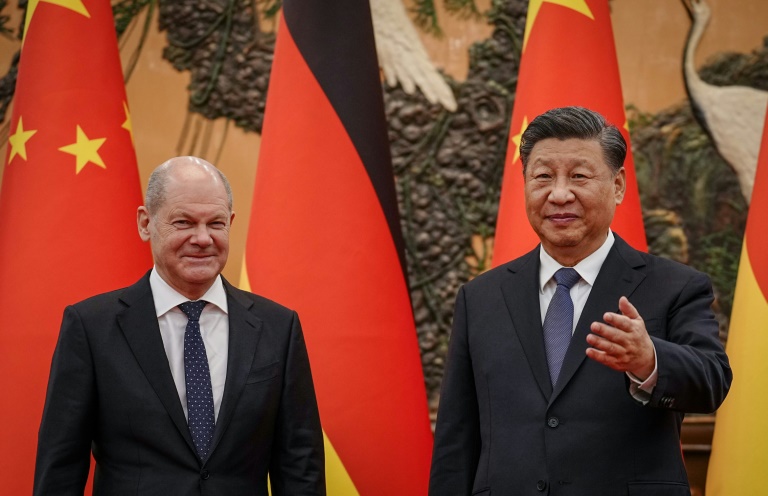
German Chancellor Olaf Scholz told Chinese leaders in Beijing on Friday that Berlin expected equal treatment on trade as he tried to drum up greater economic cooperation despite growing distrust of the Asian superpower in the West.

Scholz is under pressure to push Beijing to get tough on Russia over the war in Ukraine, and he said Friday that Germany and China had agreed they both opposed any use of nuclear weapons in the conflict.

The German chancellor is the first G7 leader to visit China since the start of the coronavirus pandemic, which led the world’s number two economy to close its borders and President Xi Jinping to largely eschew in-person diplomacy.

But his trip has prompted criticism at home over Berlin’s growing economic reliance on Beijing, and sparked controversy for coming so soon after Xi strengthened his hold on power in China just last month.

Tensions are also running high between the West and Beijing on issues ranging from Taiwan to alleged human rights abuses.

Scholz held talks with human rights lawyers critical of the regime in Beijing ahead of the trip, a source in his entourage told AFP.

Received by a smiling Xi at Beijing’s Great Hall of the People shortly after arriving, Scholz said he hoped to “further develop” economic cooperation — while alluding to areas of disagreement.

“It is good that we are able to have an exchange here about all questions, including those questions where we have different perspectives — that’s what an exchange is for,” Scholz said. 

“We also want to talk about how we can further develop our economic cooperation on other topics: climate change, food security, indebted countries.”

“Xi underscored the need for China and Germany, two major countries with great influence, to work together in times of change and instability and contribute more to global peace and development,” Beijing’s Xinhua News Agency reported.

Scholz also spoke with Chinese Premier Li Keqiang at a meeting in which he called for fair trade between the two countries. 

At a press briefing during which Chinese officials said there was “not enough time” for questions, Scholz urged Beijing to do more to “use its influence” on its ally Russia, currently engaged in a months-long war in Ukraine.

Both sides said they opposed the use of nuclear weapons in the conflict, with Scholz telling reporters: “Everyone says clearly that an escalation via the use of a tactical nuclear weapon is ruled out”.

China has steadfastly avoided criticising Russia for invading Ukraine and instead blames the United States and NATO for the war.

– ‘Keep doing business’ –

The German delegation of more than 60 people was met on the tarmac at Beijing airport by a military guard — as well as health workers in white hazmat suits who conducted mandatory PCR tests in buses converted into mobile laboratories. 

Scholz’s PCR test was taken in his plane by a German doctor he brought with him and supervised by Chinese health officials, according to the German government.

China’s economic importance is seen by some in Berlin as more crucial than ever, as Germany hurtles towards a recession battling an energy crisis triggered by the Ukraine war. 

China is a major market for German goods, from machinery to cars.

But German industry’s heavy dependence on China is facing fresh scrutiny after the over-reliance on Russian energy imports left it exposed when Moscow turned off the taps.

Scholz’s approach is still underpinned by the idea that “we want to keep doing business with China, no matter what that means for the dependence of our economy, and for our ability to act”, opposition lawmaker Norbert Roettgen told the Rheinische Post newspaper.

Concern about China has also come from within Germany’s ruling coalition, with Foreign Minister Annalena Baerbock saying past mistakes with Russia must not be repeated.

– ‘All the more important’ –

There are also concerns that the trip — coming on the heels of Xi securing a historic third term at a Communist Party Congress last month — may have unsettled the United States and the European Union.

“For Beijing, this is less about concrete outcomes and more about the symbolism of the German chancellor paying Xi a visit so soon after the party congress,” said Noah Barkin, visiting senior fellow in the Asia Program at the US German Marshall Fund.

“It gives international legitimacy to his leader-for-life status, and it shows that China is not isolated,” he added.

Berlin, however, says there have been consultations with key partners, and Scholz has insisted he is visiting China as a “European” as well as the leader of Germany.

In an article published before his departure, he said direct talks with Chinese leaders were “all the more important” after the long hiatus caused by the pandemic.

He promised to raise thorny topics such as respect for civil liberties and the rights of minorities in Xinjiang.

“We strongly agree with what he (Scholz) shared in that op-ed”, including “encouraging President Xi to press President Putin on never using a nuclear weapon of any kind”, US Secretary of State Antony Blinken said Friday after a meeting of G7 foreign ministers in Germany.

Close Bitnami banner
Bitnami