Chinese Business

Stocks mostly fall on European gas woes, inflation worries

Global equities mostly fell Tuesday as concerns over European gas supplies and the Ukraine conflict again came to the fore, adding to worries over central bank efforts to counter inflation.

Paris, Frankfurt and London all closed in the red, failing to hang on to earlier gains. Wall Street stocks began strongly, but later came under pressure as investors bet on more aggressive Federal Reserve moves to counter inflation. 

“There’s little doubt instability is here to stay, and nerves are frayed as central bankers pull out all the stops to battle with inflation,” Danni Hewson, analyst at AJ Bell said.

“And there’s plenty of tension too over Russian moves to try to annex parts of Ukraine as well as worries about gas supplies after it emerged the pipeline that carries gas from Russia to Europe has suffered some kind of damage.”

European natural gas prices surged nearly 10 percent at one point, to 190.50 euros, following news that the two Nord Stream gas pipelines linking Russia and Europe have been hit by unexplained leaks.

EU chief Ursula Von der Leyen said the leaks were due to “sabotage,” threatening the “strongest possible response” to any deliberate disruption of European energy infrastructure.

The pipelines have been at the center of geopolitical tensions in recent months as Russia cut gas supplies to Europe in suspected retaliation against Western sanctions following its invasion of Ukraine.

“This damage is the clearest signal so far that Europe will have to survive the winter without significant Russian gas flows,” analysts at Charles Schwab said in a note to clients.

– Strong dollar – 

Recession prospects have risen in recent weeks as central banks keep hiking interest rates to try and cool decades-high inflation, boosting in particular the dollar.

Expectations for more Federal Reserve interest rate hikes dampened enthusiasm on Wall Street, where stocks opened solidly higher following several losing sessions in a dynamic initially attributed to an “oversold” market. 

But markets later reversed course following better-than-expected data, including a jump in consumer confidence in September. 

While the Nasdaq finished higher, both the Dow and S&P 500 declined.

The good economic data “further emboldens the Fed,” said Art Hogan, analyst of B. Riley Wealth Management, noting that the pullback in stocks followed a jump in the yield on the 10-year US Treasury note.

The aggressiveness of the Fed has also boosted the dollar against other currencies, although the greenback retreated Tuesday against the pound after hitting an all-time high on Monday.

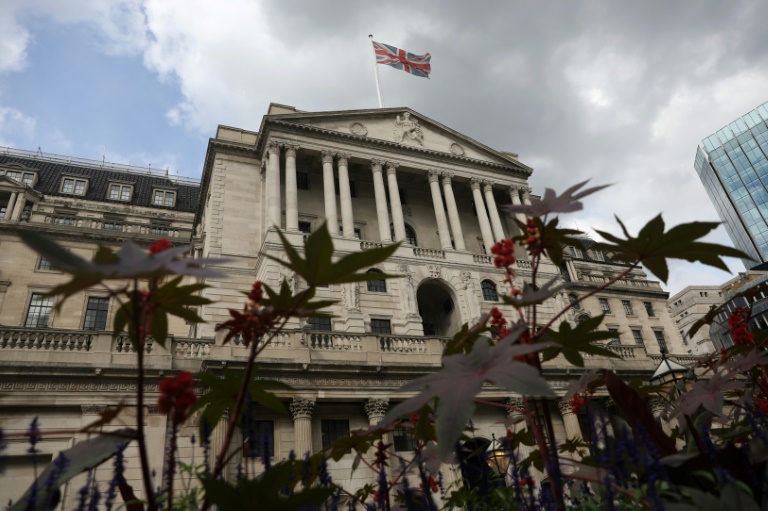
The small recovery in the pound came after the Bank of England said it would “not hesitate to change interest rates by as much as needed.”

During a visit to North Carolina, US Treasury Secretary Janet Yellen told reporters that the Fed is “moving faster than many other countries” in explaining the dollar’s surge.

“These kinds of developments, which represent a tightening of financial conditions are part of what’s involved in addressing inflation but I’m not seeing at this stage — and we are monitoring carefully — disorderly financial market developments,” Yellen said.

– Key figures at around 2050 GMT –

New York – Dow: DOWN 0.4 percent at 29,134.99 (close)

New York – S&P 500 DOWN 0.2 percent at 3,647.29 (close)

New York – Nasdaq: UP 0.3 percent at 10,829.50 (close)

London – FTSE 100: DOWN 0.5 percent at 6,984.59 (close)

Frankfurt – DAX: DOWN 0.7 percent at 12,139.68 (close) 

Paris – CAC 40: DOWN 0.3 percent at 5,753.82 (close)  

EURO STOXX 50: DOWN 0.4 percent at 3,328.65 (close)

Tokyo – Nikkei 225: UP 0.5 percent at 26,571.87 (close)

Hong Kong – Hang Seng Index: FLAT at 17,860.31 (close)

Shanghai – Composite: UP 1.4 percent at 3,093.86 (close)

Pound/dollar: UP at $1.0730 from $1.0689 on Monday

Euro/dollar: DOWN at $0.9595 from $0.9609

Euro/pound: DOWN  at 89.39 pence from 89.90 pence 

Dollar/yen: UP at 144.81 yen from 144.75 yen

Brent North Sea crude: UP 2.6 percent at $86.27 per barrel

West Texas Intermediate: UP 2.3 percent at $78.50 per barrel
Stocks slide amid Ukraine, gas worries, as pound rebounds

European equities fell Tuesday as concerns over European gas supplies and the Ukraine conflict again came to the fore, while the dollar weakened slightly against major rivals, helping the pound to rebound from a record low.

Paris, Frankfurt and London all closed in the red, failing to hang on to earlier gains. Wall Street followed suit in mid-morning trades after an early rally.

“There’s little doubt instability is here to stay, and nerves are frayed as central bankers pull out all the stops to battle with inflation,” Danni Hewson, analyst at AJ Bell said.

“And there’s plenty of tension too over Russian moves to try to annex parts of Ukraine as well as worries about gas supplies after it emerged the pipeline that carries gas from Russia to Europe has suffered some kind of damage.”

European natural gas prices surged nearly 10 percent at one point, to 190.50 euros, following news that the two Nord Stream gas pipelines linking Russia and Europe have been hit by unexplained leaks.

Explosions were recorded before the mysterious leaks, seismologists said Tuesday, raising suspicions of sabotage amid tensions over Moscow’s war in Ukraine.

The pipelines have been at the centre of geopolitical tensions in recent months as Russia cut gas supplies to Europe in suspected retaliation against Western sanctions following its invasion of Ukraine.

“This damage is the clearest signal so far that Europe will have to survive the winter without significant Russian gas flows,” analysts at Charles Schwab said in a note to clients.

– Tackling red-hot inflation – 

In the latest warning of a looming economic downturn, World Trade Organization chief Ngozi Okonjo-Iweala said Tuesday that the world was heading towards a global recession as multiple crises collide.

Recession prospects have risen in recent weeks as central banks keep hiking interest rates to try and cool decades-high inflation, boosting in particular the dollar.

The Federal Reserve has carried out three successive bumper US hikes and is warning of more to come.

That has seen investors pile into the dollar, sending it to record or multi-decade peaks, in turn rattling governments from Tokyo to Beijing and London.

On Monday, the pound hit an all-time low at $1.0350, with traders spooked by a UK tax giveaway they warned could further fuel inflation and significantly ramp up British state borrowing.

In late afternoon deals on Tuesday, the pound rose 0.6 percent to $1.0755, having earlier rebounded by more than one percent.

The small recovery came after the Bank of England said it would “not hesitate to change interest rates by as much as needed”.

With the pound showing record weakness against the dollar this week, analysts are forecasting a big rate increase when the BoE holds its next regular policy meeting on November 3.

Oil prices jumped more than two percent, helped by a weaker dollar.

“Oil remains a sellers’ market with worries about a global recession and high interest rates intensifying,” Fawad Razaqzada, analyst at City Index and FOREX.com said.

“In addition, with currencies of major oil importing nations tumbling, anything traded in US dollars will cost more… such as oil.”

– Key figures at around 1745 GMT –

London – FTSE 100: DOWN 0.5 percent at 6,984.59 (close)

Frankfurt – DAX: DOWN 0.7 percent at 12,139.68 (close) 

Paris – CAC 40: DOWN 0.3 percent at 5,753.82 (close)  

EURO STOXX 50: DOWN 0.4 percent at 3,328.65 

New York – Dow: DOWN 0.04 percent at 29,252.34

Tokyo – Nikkei 225: UP 0.5 percent at 26,571.87 (close)

Hong Kong – Hang Seng Index: FLAT at 17,860.31 (close)

Shanghai – Composite: UP 1.4 percent at 3,093.86 (close)

Pound/dollar: UP at $1.0776 from $1.0689 on Monday

Euro/dollar: UP at $0.9625 from $0.9611

Euro/pound: DOWN  at 89.37 pence from 89.87 pence 

Dollar/yen: DOWN at 144.62 yen from 144.72 yen

Brent North Sea crude: UP 2.8 percent at $86.38 per barrel

West Texas Intermediate: UP 2.5 percent at $78.66 per barrel

Stocks stabilise as pound rebounds

Equity markets stabilised Tuesday after recent volatility, as the dollar weakened slightly against major rivals, helping the pound to rebound from a record low.

Shares in Paris, Frankfurt and London pushed higher in mid-afternoon trading, as investors track central bank moves aimed at tackling soaring inflation.

Wall Street stocks also climbed, rallying after several losing sessions that analysts have said left the market “oversold” in the short term.

Recession prospects have risen in recent weeks as central banks keep hiking interest rates to try and cool decades-high inflation, boosting in particular the dollar.

In the latest warning of a looming economic downturn, World Trade Organization chief Ngozi Okonjo-Iweala said Tuesday that the world was heading towards a global recession as multiple crises collide.

The Federal Reserve has carried out three successive bumper US hikes and is warning of more to come.

That has seen investors pile into the dollar, sending it to record or multi-decade peaks, in turn rattling governments from Tokyo to Beijing and London.

On Monday, the pound hit an all-time low at $1.0350, with traders spooked by a UK tax giveaway they warned could further fuel inflation and significantly ramp up British state borrowing.

“Dollar strength remains the driving force — or wrecking ball — in financial markets at the moment,” said Markets.com analyst Neil Wilson.

Sterling staged a small recovery Tuesday after the Bank of England said it would “not hesitate to change interest rates by as much as needed”.

With the pound showing record weakness against the dollar this week, analysts are forecasting a big rate increase when the BoE holds its next regular policy meeting on November 3.

“A rate hike of over 150 basis points is currently priced in for the coming meeting,” Commerzbank analyst Esther Reichelt noted Tuesday, questioning if that would even be enough. 

The Bank of England’s statement “is unlikely to calm all those who had already questioned the BoE’s determination to fight inflation even prior to these events”, she added.

– Gas, oil –

Elsewhere, European natural gas prices surged nearly 10 percent to 190.50 euros following news that the two Nord Stream gas pipelines linking Russia and Europe have been hit by unexplained leaks, raising suspicions of sabotage.

The pipelines have been at the centre of geopolitical tensions in recent months as Russia cut gas supplies to Europe in suspected retaliation against Western sanctions following its invasion of Ukraine.

“This damage is the clearest signal so far that Europe will have to survive the winter without significant Russian gas flows,” analysts at Charles Schwab said in a note to clients.

A major new pipeline that will bring in Norwegian gas via Denmark was inaugurated in Poland on Tuesday in a move aimed at helping strengthen Europe’s energy security.

Oil prices jumped more than two percent, helped by a weaker dollar.

“Oil remains a sellers’ market with worries about a global recession and high interest rates intensifying,” Fawad Razaqzada, analyst at City Index and FOREX.com said.

“In addition, with currencies of major oil importing nations tumbling, anything traded in US dollars will cost more… such as oil.”

– Key figures at around 1350 GMT –

London – FTSE 100: UP 0.2 percent at 7,036.62 points

Frankfurt – DAX: UP 0.4 percent at 12,276.85 

Paris – CAC 40: UP 0.6 percent at 5,798.37 

EURO STOXX 50: UP 0.4 percent at 3,356.97

New York – Dow: UP 1.0 percent at 29,552.47

Tokyo – Nikkei 225: UP 0.5 percent at 26,571.87 (close)

Hong Kong – Hang Seng Index: FLAT at 17,860.31 (close)

Shanghai – Composite: UP 1.4 percent at 3,093.86 (close)

Pound/dollar: UP at $1.0766 from $1.0689 on Monday

Euro/dollar: UP at $0.9635 from $0.9611

Euro/pound: DOWN  at 89.41 pence from 89.87 pence 

Dollar/yen: DOWN at 144.61 yen from 144.72 yen

Brent North Sea crude: UP 2.5 percent at $86.13 per barrel

West Texas Intermediate: UP 2.4 percent at $78.51 per barrel

Pound rebounds, stocks steady tracking recession risks

The dollar weakened slightly against major rivals Tuesday, helping the pound to rebound from a record low, while equity markets stabilised after recent volatility.

The world is heading towards a global recession as multiple crises collide, World Trade Organization’s chief Ngozi Okonjo-Iweala told the global trade body’s annual public forum in Geneva.

Recession prospects have risen in recent weeks as central banks keep hiking interest rates to try and cool decades-high inflation, boosting in particular the dollar.

The Federal Reserve has carried out three successive bumper US hikes and is warning of more to come.

That has seen investors pile into the dollar, sending it to record or multi-decade peaks, in turn rattling governments from Tokyo to Beijing and London.

On Monday, the pound hit an all-time low at $1.0350, with traders spooked by a UK tax giveaway they warned could further fuel inflation and significantly ramp up British state borrowing.

“Dollar strength remains the driving force — or wrecking ball — in financial markets at the moment,” said Markets.com analyst Neil Wilson.

Sterling staged a small recovery Tuesday after the Bank of England said it would “not hesitate to change interest rates by as much as needed”.

With the pound showing record weakness against the dollar this week, analysts are forecasting a big rate increase when the BoE holds its next regular policy meeting on November 3.

“A rate hike of over 150 basis points is currently priced in for the coming meeting,” Commerzbank analyst Esther Reichelt noted Tuesday, questioning if that would even be enough. 

The Bank of England’s statement “is unlikely to calm all those who had already questioned the BoE’s determination to fight inflation even prior to these events”, she added.

Elsewhere, European natural gas prices surged nearly ten percent to 190.50 euros following news that the two Nord Stream gas pipelines linking Russia and Europe have been hit by unexplained leaks, raising suspicions of sabotage.

The pipelines have been at the centre of geopolitical tensions in recent months as Russia cut gas supplies to Europe in suspected retaliation against Western sanctions following its invasion of Ukraine.

A major new pipeline that will bring in Norwegian gas via Denmark was inaugurated in Poland on Tuesday in a move aimed at helping strengthen Europe’s energy security.

Oil prices jumped almost two percent, helped by a weaker dollar.

– Key figures at around 1100 GMT –

London – FTSE 100: DOWN 0.1 percent at 7,016.35 points

Frankfurt – DAX: UP 0.7 percent at 12,315.34

Paris – CAC 40: UP 0.7 percent at 5,811.35

EURO STOXX 50: UP 0.7 percent at 3,367.42

Tokyo – Nikkei 225: UP 0.5 percent at 26,571.87 (close)

Hong Kong – Hang Seng Index: FLAT at 17,860.31 (close)

Shanghai – Composite: UP 1.4 percent at 3,093.86 (close)

New York – Dow: DOWN 1.1 percent at 29,260.81 (close)

Pound/dollar: UP at $1.0821 from $1.0689 on Monday

Euro/dollar: UP at $0.9642 from $0.9611

Euro/pound: DOWN at 89.11 pence from 89.87 pence 

Dollar/yen: DOWN at 144.28 yen from 144.72 yen

Brent North Sea crude: UP 1.7 percent at $85.47 per barrel

West Texas Intermediate: UP 1.9 percent at $78.11 per barrel

Japan honours assassinated Abe at controversial funeral

Japanese and foreign dignitaries paid tribute to assassinated former prime minister Shinzo Abe at a state funeral on Tuesday that drew both mourners and protesters to central Tokyo.

Prime Minister Fumio Kishida described the former leader as a “person of courage” in a eulogy, listing his achievements, including efforts to strengthen Japan’s diplomatic ties.

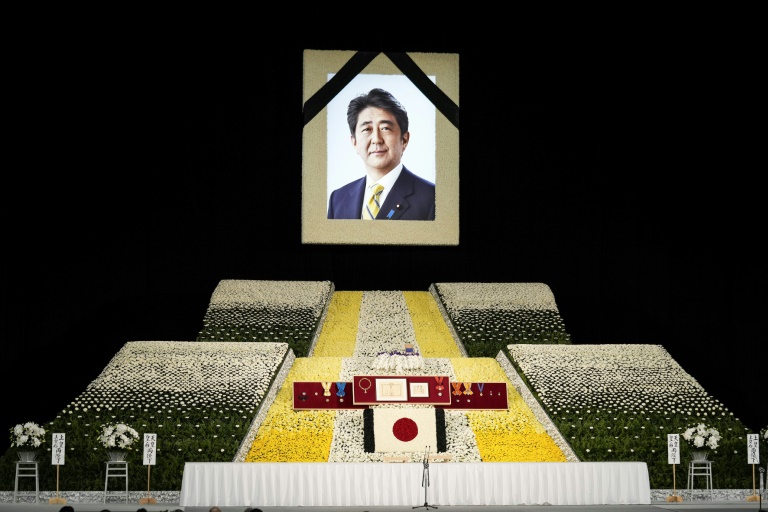
“I feel heart-breaking grief,” Kishida said as he faced a photograph of Abe that was hung above a grand floral structure used to display his ashes, medals and the Japanese flag.

The decorative box of ashes had been carried by his widow Akie into Tokyo’s storied Budokan venue, where a 19-gun salute sounded in honour of the slain politician.

Abe was Japan’s longest-serving prime minister and one of the country’s most recognisable political figures, known for cultivating international alliances and his “Abenomics” economic strategy.

He resigned in 2020 over recurring health problems, but remained a key political voice and was campaigning for his ruling party when a lone gunman killed him with a homemade weapon on July 8.

The shooting sent shock waves through a country with famously low gun crime and prompted international condemnation.

But the decision to give him a state funeral — only the second for a former premier in the post-war period — has provoked opposition, with around 60 percent of Japanese against the event in recent polls.

– ‘So much opposition’ –

US Vice-President Kamala Harris and world leaders including Indian Prime Minister Narendra Modi and Australian premier Anthony Albanese were among those in attendance at the Budokan.

Outside, thousands of people stood in line as the ashes arrived, waiting to deliver flowers and say a prayer in two mourning tents.

Koji Takamori came all the way from northern Hokkaido with his nine-year-old son.

“I wanted to thank him. He has done so much for Japan,” the 46-year-old told AFP.

“The way he died was so shocking. To be honest, I also came because there has been so much opposition. It’s almost like I’m here to oppose those who are opposing this (funeral),” he added.

Those opponents were also out, marching near the tents before a larger demonstration in front of the parliament.

“There are people struggling financially who suffered particularly under the ‘Abenomics’ policies. We must not forget this,” Ryo Machida, a 19-year-old student, said outside the Budokan.

“He may have been a strong leader, but in hindsight, he was iron-fisted and anti-democratic.”

– Divisive tenure –

Abe’s accused killer targeted the former leader believing he had ties to the Unification Church, which the attacker resented over massive donations his mother had made to the sect.

The assassination prompted fresh scrutiny of the church and its fundraising — and uncomfortable questions for Japan’s political establishment, with the ruling party admitting around half its lawmakers had links to the religious organisation.

Kishida has pledged the party will sever all ties with the church, but the scandal helped fuel discontent over the state funeral.

Thousands have protested in the run-up to the ceremony and a man set himself on fire last week near the prime minister’s office, leaving notes reportedly expressing his objection to the event.

Some lawmakers from opposition parties are also boycotting the funeral.

The controversy has several roots, with some accusing Kishida of unilaterally approving the funeral instead of consulting parliament, and others resentful of a nearly $12 million price tag.

It is also the legacy of Abe’s divisive tenure, marked by persistent allegations of cronyism, and opposition to his nationalism and plans to reform the pacifist constitution.

Kishida’s government may have hoped the solemnity of the event, attended by an estimated 4,300 people including 700 foreign invitees, would drown out the controversy.

Abe worked to cultivate close ties with Washington to bolster the key US-Japan alliance, and also courted a stronger “Quad” grouping of Japan, the United States, India and Australia.

Japan’s emperor and empress are not attending, as neutral national figures, but Crown Prince Akishino and his wife led mourners in offering flowers at the end of the service.

Dollar softens after rally, stocks stable but uncertainty reigns

The dollar lost a little of its strength Tuesday after starting the week by surging against major peers, including a record high versus the pound, but while equity markets stabilised, sentiment remained dampened by recession fears.

While central banks around the world are ramping up interest rates to fight inflation, the main focus is on the US Federal Reserve’s increasingly hawkish tone that has seen it unveil three successive bumper hikes with a warning of more to come.

That has seen investors pile into the dollar, sending it to record or multi-decade peaks, which has rattled governments from Tokyo to Beijing and London.

On Monday, it hit its highest-ever level against the pound — touching $1.0350 after traders were spooked by a massive tax giveaway mini-budget by new UK finance minister Kwasi Kwarteng.

Sterling staged a small recovery but fell back again after traders were left disappointed by a lack of solid action from the Bank of England, with Governor Andrew Bailey saying only it would not hesitate to increase rates by as much as needed.

However, speculation is rife that officials will announce a huge 1.5 percentage point hike at their next meeting in November.

The dollar’s rally against the pound was matched by advances across forex markets, with the euro hitting a new 20-year low and the yen pushing back to the level it hit when the government intervened to support the currency last week.

But the greenback surge ran out of steam Tuesday as a little stability returned to markets, though analysts warned that volatility would remain high as more global rate hikes were in the pipeline and geopolitical crises remained unresolved.

Added to that were concerns that inflation remained stubbornly high.

“The market is pricing in some Fed increases, but we’re a bit worried that it might not be pricing in everything,” Laila Pence, of Pence Wealth Management, told Bloomberg Television.

“We got whipsawed in August when inflation was up not down — everyone is nervous.”

– ‘Wrecking ball’ –

Another selloff in Wall Street stocks saw the S&P 500 suffer its lowest close since December 2020, though Asia was mixed.

Tokyo, Shanghai, Sydney, Seoul, Taipei and Mumbai all rose while Hong Kong eked out marginal gains but Singapore, Wellington, Bangkok, Manila and Jakarta were in the red.

London, Paris and Frankfurt were in positive territory in early business.

“Dollar strength remains the driving force — or wrecking ball — in financial markets at the moment,” said Markets.com analyst Neil Wilson. “It’s not only wrecking relative currency stability but is a major factor in the weakness for equities.”

And OANDA’s Edward Moya added: “Right now, financial markets are a mess.

“Wall Street is realising that we won’t be seeing a significant sign that inflation is easing fast enough in the next couple of months and that should make it tough to buy the dip just yet.”

Oil prices rallied around two percent as news filtered through that the two leaks have been identified on the Nord Stream 1 Russia-Europe gas pipeline in the Baltic Sea, hours after a similar incident on its twin pipeline.

However, both contracts remain wedged around their lowest levels since January owing to the stronger dollar and worries about demand caused by the expected recession.

And Moya added there appeared little chance the commodity will stage a near-term recovery, despite speculation that major producers could announce a fresh output cut.

“Chaos in the forex markets could keep crude prices heavy no matter what OPEC+ does over the short-term,” he wrote. “Forex volatility won’t let up anytime soon and that will send oil on a very long roller-coaster ride.”

– Key figures at around 0810 GMT –

Tokyo – Nikkei 225: UP 0.5 percent at 26,571.87 (close)

Hong Kong – Hang Seng Index: FLAT at 17,860.31 (close)

Shanghai – Composite: UP 1.4 percent at 3,093.86 (close)

London – FTSE 100: UP 0.7 percent at 7,069.40

Pound/dollar: UP at $1.0809 from $1.0689 on Monday

Euro/dollar: UP at $0.9647 from $0.9611

Euro/pound: DOWN at 89.26 pence from 89.87 pence 

Dollar/yen: DOWN at 144.30 yen from 144.72 yen

West Texas Intermediate: UP 2.0 percent at $78.23 per barrel

Brent North Sea crude: UP 1.9 percent at $85.67 per barrel

New York – Dow: DOWN 1.1 percent at 29,260.81 (close)

Japan honours assassinated Abe at controversial funeral

Japanese and foreign dignitaries paid tribute to assassinated former prime minister Shinzo Abe at a controversial state funeral on Tuesday, as long lines of people gathered to offer flowers and prayers.

Abe’s ashes, carried by his widow Akie, arrived at the storied Budokan venue in Tokyo, where a 19-gun salute sounded in honour of the slain former leader.

In a eulogy, Prime Minister Fumio Kishida described the politician as a “person of courage”, listing his achievements, including efforts to strengthen Japan’s diplomatic ties.

“I feel heart-breaking grief,” Kishida said as he faced a photograph of Abe that was hung above a grand floral structure used to display his ashes, medals and the Japanese flag.

Abe was Japan’s longest-serving prime minister and one of the country’s most recognisable political figures, known for cultivating international alliances and his “Abenomics” economic strategy.

He resigned in 2020 over recurring health problems, but remained a key political voice and was campaigning for his ruling party when a lone gunman killed him with a homemade weapon on July 8.

The shooting sent shock waves through a country with famously low gun crime and prompted international condemnation.

But the decision to give him a state funeral — only the second for a former premier in the post-war period — has provoked opposition, with around 60 percent of Japanese against the event in recent polls.

– ‘So much opposition’ –

US Vice-President Kamala Harris and world leaders including Indian Prime Minister Narendra Modi and Australian premier Anthony Albanese were among those in attendance at the Budokan.

Outside, thousands of people stood in line as the ashes arrived, waiting to deliver flowers and say a prayer in two mourning tents.

Koji Takamori came all the way from northern Hokkaido with his nine-year-old son. “I wanted to thank him. He has done so much for Japan,” the 46-year-old told AFP.

“The way he died was so shocking. To be honest, I also came because there has been so much opposition. It’s almost like I’m here to oppose those who are opposing this (funeral),” he added.

Those opponents were also out, marching near the tents before a demonstration in front of the parliament.

– Discontent over state funeral –

Abe’s accused killer targeted the former leader believing he had ties to the Unification Church, which the attacker resented over massive donations his mother had made to the sect.

The assassination prompted fresh scrutiny of the church and its fundraising, and uncomfortable questions for Japan’s political establishment, with the ruling party admitting around half its lawmakers had links to the religious organisation.

Kishida has pledged the party will sever all ties with the church, but the scandal helped fuel discontent over the state funeral.

Thousands have protested the ceremony and a man set himself on fire last week near the prime minister’s office, leaving notes reportedly expressing his objection to the event.

Some lawmakers from opposition parties are also boycotting the funeral.

The controversy has several causes, with some accusing Kishida of unilaterally approving the funeral instead of consulting parliament, and others resentful of a nearly $12 million price tag.

It is also the legacy of Abe’s divisive tenure, marked by persistent allegations of cronyism, and opposition to his nationalism and plans to reform the pacifist constitution.

Kishida’s government may be hoping the solemnity of the event, attended by an estimated 4,300 people including 700 foreign invitees, will drown out the controversy.

Abe worked to cultivate close ties with Washington to bolster the key US-Japan alliance, and also courted a stronger “Quad” grouping of Japan, the United States, India and Australia.

Japan’s emperor and empress are not attending, as neutral national figures, but Crown Prince Akishino and his wife led mourners in offering flowers at the end of the 90-minute service.

Dollar softens after rally but Asian stocks struggle to recover

The dollar lost a little of its strength Tuesday after starting the week by surging against major peers, including a record high versus the pound, though equity traders struggled to claw back recent losses owing to recession fears.

While central banks around the world are ramping up interest rates to fight inflation, the main focus is on the US Federal Reserve’s increasingly hawkish tone that has seen it unveil three successive bumper hikes with a warning of more to come.

That has seen investors pile into the dollar, sending it to record or multi-decade peaks, which has rattled governments from Tokyo to Beijing and London.

On Monday it hit its highest-ever level against the pound — touching $1.0350 after traders were spooked by a massive tax giveaway mini-budget by new UK finance minister Kwasi Kwarteng.

Sterling staged a small recovery but fell back again after traders were left disappointed by a lack of solid action from the Bank of England, with governor Andrew Bailey saying only it would not hesitate to increase rates by as much as needed.

The dollar’s rally against the pound was matched by advances across forex markets, with the euro hitting a new 20-year low and the yen pushing back to the level it hit when the government intervened to support the currency last week.

But the greenback surge ran out of steam Tuesday as a little stability returned to markets, though analysts warned that volatility would remain high as more global rate hikes were in the pipeline and geopolitical crises remained unresolved.

Added to that were concerns that inflation remained stubbornly high.

“The market is pricing in some Fed increases, but we’re a bit worried that it might not be pricing in everything,” Laila Pence, of Pence Wealth Management, told Bloomberg Television.

“We got whipsawed in August when inflation was up not down — everyone is nervous.”

Another selloff in Wall Street stocks saw the S&P 500 suffer its lowest close since December 2020, and Asia also struggled.

Tokyo, Shanghai and Sydney all rose but red was flashing up on screens in Hong Kong, Singapore, Seoul, Wellington, Taipei, Manila and Jakarta.

“Right now financial markets are a mess,” said OANDA’s Edward Moya.

“Wall Street is realising that we won’t be seeing a significant sign that inflation is easing fast enough in the next couple of months and that should make it tough to buy the dip just yet.”

Oil prices edged slightly higher, though both contracts remain wedged at their lowest levels since January owing to the stronger dollar and worries about demand caused by the expected recession.

And Moya added there appeared little chance the commodity will stage a near-term recovery, despite speculation that major producers could announce a fresh output cut.

“Chaos in the forex markets could keep crude prices heavy no matter what OPEC+ does over the short-term,” he wrote. “Forex volatility won’t let up anytime soon and that will send oil on a very long roller-coaster ride.”

– Key figures at around 0230 GMT –

Tokyo – Nikkei 225: Up 0.8 percent at 26,651.60 (break)

Hong Kong – Hang Seng Index: DOWN 0.6 percent at 17,755.57

Shanghai – Composite: UP 0.1 percent at 3,053.60

Pound/dollar: UP at $1.0761 from $1.0689 on Monday

Euro/dollar: UP at $0.9629 from $0.9611

Euro/pound: DOWN at 89.49 pence from 89.87 pence 

Dollar/yen: DOWN at 144.52 yen from 144.72 yen

West Texas Intermediate: UP 0.4 percent at $77.02 per barrel

Brent North Sea crude: UP 0.4 percent at $84.38 per barrel

New York – Dow: DOWN 1.1 percent at 29,260.81 (close)

London – FTSE 100: FLAT at 7,020.95 (close)

Dollar softens after rally but Asian stocks struggle to recover

The dollar lost a little of its strength Tuesday after starting the week by surging against major peers, including a record high versus the pound, though equity traders struggled to claw back recent losses owing to recession fears.

While central banks around the world are ramping up interest rates to fight inflation, the main focus is on the US Federal Reserve’s increasingly hawkish tone that has seen it unveil three successive bumper hikes with a warning of more to come.

That has seen investors pile into the dollar, sending it to record or multi-decade peaks, which has rattled governments from Tokyo to Beijing and London.

On Monday it hit its highest-ever level against the pound — touching $1.0350 after traders were spooked by a massive tax giveaway mini-budget by new UK finance minister Kwasi Kwarteng.

Sterling staged a small recovery but fell back again after traders were left disappointed by a lack of solid action from the Bank of England, with governor Andrew Bailey saying only it would not hesitate to increase rates by as much as needed.

The dollar’s rally against the pound was matched by advances across forex markets, with the euro hitting a new 20-year low and the yen pushing back to the level it hit when the government intervened to support the currency last week.

But the greenback surge ran out of steam Tuesday as a little stability returned to markets, though analysts warned that volatility would remain high as more global rate hikes were in the pipeline and geopolitical crises remained unresolved.

Added to that were concerns that inflation remained stubbornly high.

“The market is pricing in some Fed increases, but we’re a bit worried that it might not be pricing in everything,” Laila Pence, of Pence Wealth Management, told Bloomberg Television.

“We got whipsawed in August when inflation was up not down — everyone is nervous.”

Another selloff in Wall Street stocks saw the S&P 500 suffer its lowest close since December 2020, and Asia also struggled.

Tokyo, Shanghai and Sydney all rose but red was flashing up on screens in Hong Kong, Singapore, Seoul, Wellington, Taipei, Manila and Jakarta.

“Right now financial markets are a mess,” said OANDA’s Edward Moya.

“Wall Street is realising that we won’t be seeing a significant sign that inflation is easing fast enough in the next couple of months and that should make it tough to buy the dip just yet.”

Oil prices edged slightly higher, though both contracts remain wedged at their lowest levels since January owing to the stronger dollar and worries about demand caused by the expected recession.

And Moya added there appeared little chance the commodity will stage a near-term recovery, despite speculation that major producers could announce a fresh output cut.

“Chaos in the forex markets could keep crude prices heavy no matter what OPEC+ does over the short-term,” he wrote. “Forex volatility won’t let up anytime soon and that will send oil on a very long roller-coaster ride.”

– Key figures at around 0230 GMT –

Tokyo – Nikkei 225: Up 0.8 percent at 26,651.60 (break)

Hong Kong – Hang Seng Index: DOWN 0.6 percent at 17,755.57

Shanghai – Composite: UP 0.1 percent at 3,053.60

Pound/dollar: UP at $1.0761 from $1.0689 on Monday

Euro/dollar: UP at $0.9629 from $0.9611

Euro/pound: DOWN at 89.49 pence from 89.87 pence 

Dollar/yen: DOWN at 144.52 yen from 144.72 yen

West Texas Intermediate: UP 0.4 percent at $77.02 per barrel

Brent North Sea crude: UP 0.4 percent at $84.38 per barrel

New York – Dow: DOWN 1.1 percent at 29,260.81 (close)

London – FTSE 100: FLAT at 7,020.95 (close)

Japan honours assassinated Abe at controversial funeral

Thousands of Japanese offered flowers and prayers on Tuesday in honour of assassinated former prime minister Shinzo Abe ahead of a controversial state funeral attended by hundreds of foreign dignitaries.

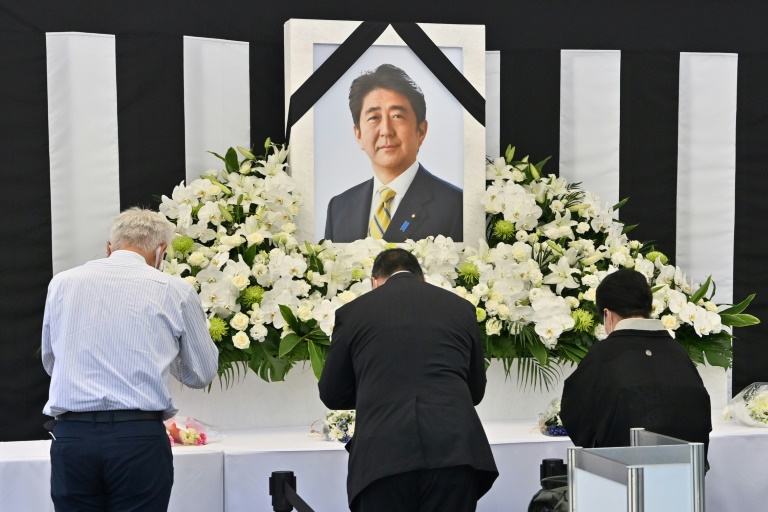
Abe’s ashes will arrive in the afternoon for the ceremony at Tokyo’s Budokan venue, but a huge line of people gathered from early in the morning to lay flowers at a mourning tent nearby.

Koji Takamori came all the way from northern Hokkaido with his nine-year-old son.

“I wanted to thank him. He has done so much for Japan,” the 46-year-old told AFP.

“The way he died was so shocking.

“To be honest, I also came because there has been so much opposition. It’s almost like I’m here to oppose those who are opposing this (funeral),” he added.

Abe was Japan’s longest-serving prime minister and one of the country’s most recognisable political figures, known for cultivating international alliances and his “Abenomics” economic strategy.

He resigned in 2020 over recurring health problems, but remained a key political voice and was campaigning for his ruling party when a lone gunman killed him on July 8.

The shooting sent shock waves through a country with famously low gun crime and prompted international condemnation.

But the decision to give him a state funeral — only the second for a former premier in the post-war period — has provoked opposition, with around 60 percent of Japanese against the event in recent polls.

– Discontent over state funeral –

Abe’s accused killer targeted the former leader believing he had ties to the Unification Church, which he resented over massive donations his mother had made to the sect.

The assassination prompted fresh scrutiny of the church and its fundraising, and uncomfortable questions for Japan’s political establishment, with the ruling party admitting around half its lawmakers had links to the religious organisation.

Prime Minister Fumio Kishida has pledged the party will sever all ties with the church, but the scandal helped fuel discontent over the state funeral.

Thousands have protested the ceremony and a man set himself on fire last week near the prime minister’s office, leaving notes reportedly expressing his objection to the event.

Some lawmakers from opposition parties are also boycotting the funeral altogether.

The controversy has various causes, with some accusing Kishida of unilaterally approving the funeral instead of consulting parliament, and others resentful of a nearly $12 million price tag.

It is also the legacy of Abe’s divisive tenure, marked by persistent allegations of cronyism, and opposition to his nationalism and plans to reform the pacifist constitution.

Despite the controversy, so many people lined up to offer flowers in Tokyo that officials opened the tent half an hour earlier than planned.

– Moment of silence –

The crowd, some dressed smartly in black but others wearing casual clothes, spanned age groups, and mourners placed mostly white bouquets before a photo of Abe with black ribbons draped across its top corners.

Kishida’s government may be hoping the solemnity of the event, attended by an estimated 4,300 people including 700 foreign invitees, will drown out the controversy.

US Vice President Kamala Harris and world leaders including Indian Prime Minister Narendra Modi and Australian premier Anthony Albanese will attend the ceremony.

Abe worked to cultivate close ties with Washington to bolster the key US-Japanese alliance, and also courted a stronger “Quad” grouping Japan, the United States, India and Australia.

Abe’s ashes are expected to arrive at the site to the sound of a 19-gun salute, and chief government spokesman Hirokazu Matsuno will open proceedings around 2:00 pm (0500 GMT) before the national anthem and a moment of silence.

Eulogies will follow from Kishida and politicians including Yoshihide Suga, who succeeded Abe after his resignation.

Japan’s emperor and empress will not attend, as neutral national figures, but Crown Prince Akishino and his wife are expected to lead mourners in offering flowers at the end of the 90-minute service.

The event will involve a massive security operation, accounting for a significant part of the estimated 1.7 billion yen cost of the funeral.

The security flaws that allowed a gunman to approach and kill Abe have prompted a policing overhaul, and local media reported that 20,000 police officers would be deployed for the funeral.

Close Bitnami banner
Bitnami