Chinese Business

Japan government intervenes to support cratering yen

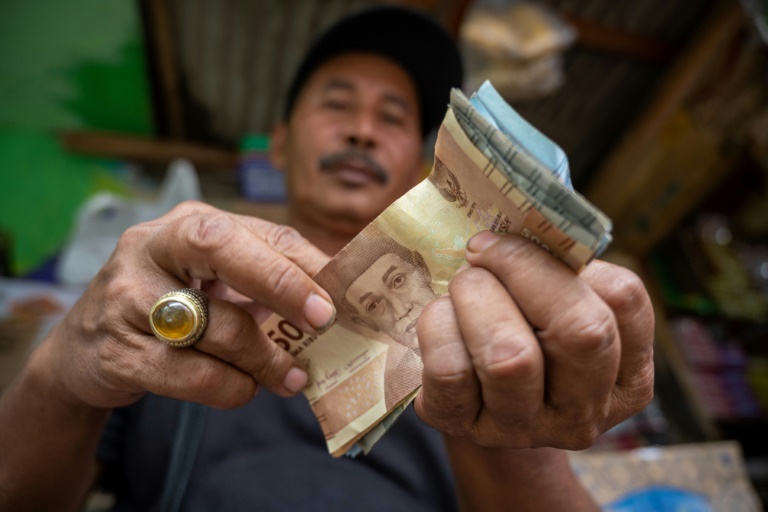
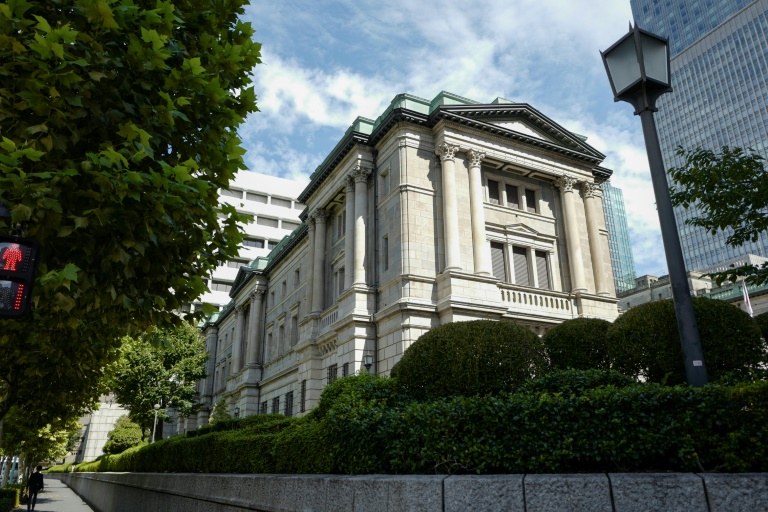
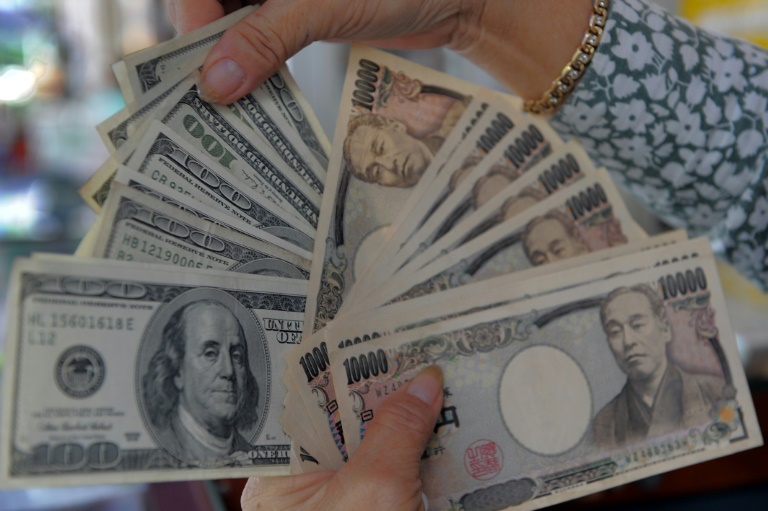
Japan’s finance ministry said Thursday it intervened in the currency market to bolster the yen, which has plummeted against the dollar in recent months on the widening policy gap between the US and Japanese central banks.

It was the first government intervention to prop up the currency since 1998 and came after the dollar neared 146 yen earlier in the day.

“Although exchange rates are in principle determined by the market, excessive fluctuations caused by speculation cannot be tolerated,” Finance Minister Shunichi Suzuki told reporters.

“Based on this, we intervened in the foreign exchange market today. We will continue to monitor developments in the market with a strong sense of urgency and take necessary action against excessive fluctuations,” he added.

He declined to detail the scale of the intervention, or its length. And he refused to confirm whether it had been coordinated with Washington or other capitals, saying only he was “in constant contact with relevant monetary authorities”.

The move, which involves selling dollars and buying yen, saw the greenback retreat as low as 140.70 before gaining slightly.

Top currency official Masato Kanda told reporters that the intervention was not triggered by the yen falling to a particular level.

“We don’t think about the level at all. In principle, (what matters) is volatility.”

The yen has been weakening against the dollar for months, but sank further on Thursday after the US Federal Reserve again hiked rates to tame inflation, while the Bank of Japan left its ultra-loose monetary policy in place.

Prices in Japan are rising, with the Consumer Price Index (CPI) rising by 2.8 percent year-on-year in August, the highest level since 2014.

But the central bank views the increases as temporary, and believes its dovish policy is needed to achieve a long-standing target of sustained two-percent inflation — seen as necessary to turbocharge growth in the world’s third-largest economy.

After a two-day meeting, it said it would leave its current policy in place until “CPI exceeds two percent and stays above the target in a stable manner.”

– ‘Temporary respite’ –

A weaker yen has some positive effects, particularly for Japanese exporters, but the recent rapid depreciation has begun to stir concern in Japan, pushing up the cost of imported goods for consumers and businesses.

Earlier this month, the central bank reportedly conducted a “rate check”, an operation often seen as a precursor to a currency intervention.

The move came shortly after the yen neared the 145 point, but the reports only temporarily bolstered the Japanese unit.

It has plunged from around 115 in March, and the Bank of Japan (BoJ) on Thursday repeated that “it is necessary to pay due attention to developments in financial and foreign exchange markets and their impact on Japan’s economic activity and prices”.

But BoJ Governor Haruhiko Kuroda, whose term expires next year, told reporters before the intervention announcement that the bank’s role did not extend to moving foreign exchange.

“We haven’t been and will not be targeting certain levels of foreign exchange,” he said.

“It is desirable that forex rates reflect economic and financial fundamentals, however the recent rapid depreciation of the yen is not that and is negative for the economy,” he added.

He noted though that the dollar has gained against most major currencies, and analysts said that the yen’s surge after the intervention could prove little more than a “temporary respite”.

“Basically the only thing stopping USD/JPY from rising towards 150 is Japanese foreign exchange intervention, but even then it will only be a temporary respite,” said Alvin Tan, head of Asia FX Strategy at RBC Capital Markets.

“The yawning policy divergence between the Fed and the BoJ, along with the related widening USD-JPY yield spread, is exerting a powerful and fundamental force, propelling USD/JPY higher,” he told AFP, saying he anticipated the dollar breaking 150 yen by 2023.
Markets tumble again as Fed hikes rates, warns more pain to come

European stocks sank Thursday following sharp losses in Asia and on Wall Street, but the dollar spiked after the Federal Reserve signalled more hefty US interest rate hikes.

Equities tanked after the US central bank warned of more pain to come, as it unveiled the third straight jumbo rate increase on Wednesday to tackle decades-high inflation.

The British pound briefly dived to a new 37-year low at $1.1212, even as the Bank of England prepared to announce its second bumper rate rise in a row later Thursday.

The greenback also soared to a fresh 24-year high of 145.90 yen, prompting the Bank of Japan to embark on a rare intervention to protect its currency. The euro wallowed at a 20-year dollar low.

– Pricing in recession –

“Share prices are falling, the dollar is surging, and the bond market is pricing in a recession as the US Federal Reserve keeps tightening monetary policy and seemingly snuffs out any hope for a pivot or even a pause in its new-found zeal for fighting inflation,” said AJ Bell investment director Russ Mould.

“Fed chair Jerome Powell … noted there was no painless way to bring inflation under control,” he added.

The world’s major central banks are rushing to ramp up rates to dampen red-hot global consumer prices, but traders fear rising borrowing costs will herald recession.

Switzerland and Norway sprang hefty interest rate hikes on Thursday, mirroring this week’s big rises in Sweden and the United States.

In Asia, Indonesia and the Philippines also tightened monetary policy but the BoJ left its status quo in place.

While the Fed’s 0.75-percentage-point rise was widely expected, there was some surprise at the central bank’s forecast that borrowing costs would likely be held above four percent throughout next year.

Powell reiterated his determination to focus on bringing down inflation — which is at a four-decade high — and accepted that the campaign would hit Americans hard.

– No ‘painless way’ –

“We have got to get inflation behind us,” Powell said after the decision.

“I wish there were a painless way to do that. There isn’t.”

He added that “the historical record cautions strongly against prematurely loosening policy” and the Fed would “keep at it until the job is done”.

In reaction, Wall Street tumbled as traders contemplated an era of higher-for-longer rates, which could hit companies’ bottom lines.

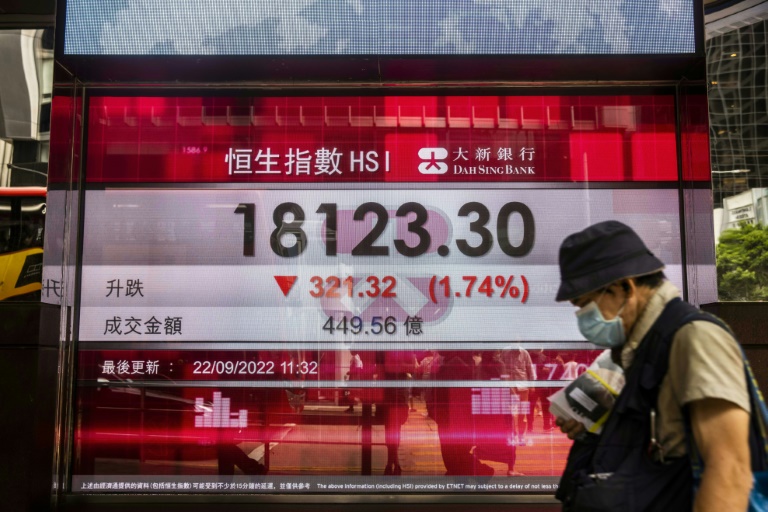
Asia followed suit, with Hong Kong down at an 11-year low — while Tokyo, Shanghai, Seoul, Singapore, Mumbai, Taipei and Manila also down.

The Fed has for months tried to walk a fine line between fighting soaring prices and trying to keep the economy from contracting, but officials accept the chances of success are narrow.

“With the new rate projections, the Fed is engineering a hard landing — a soft landing is almost out of the question,” said Seema Shah, of Principal Global Investors.

Commentators are now betting on a fourth straight 75-basis-point rate hike at the next Fed meeting in November.

Oil prices extended recent gains after Russian President Vladimir Putin’s announced a partial mobilisation of the Russian army and a veiled threat to use nuclear weapons against the West.

– Key figures at around 1015 GMT –

London – FTSE 100: DOWN 0.4 percent at 7,211.71 points

Frankfurt – DAX: DOWN 0.7 percent at 12,680.86

Paris – CAC 40: DOWN 0.8 percent at 5,985.64

EURO STOXX 50: DOWN 0.7 percent at 3,468.83

Tokyo – Nikkei 225: DOWN 0.6 percent at 27,153,83 (close)

Hong Kong – Hang Seng Index: DOWN 1.6 percent at 18,147.95 (close)

Shanghai – Composite: DOWN 0.3 percent at 3,108.91 (close)

New York – Dow: DOWN 1.7 percent at 30,183.78 (close)

Pound/dollar: UP at $1.1332 from $1.1270 Wednesday

Euro/dollar: UP at $0.9875 from $0.9837

Euro/pound: DOWN at 87.14 pence from 87.29 pence 

Dollar/yen: DOWN at 142.50 yen from 144.06 yen

Brent North Sea crude: UP 1.0 percent at $90.76 per barrel

West Texas Intermediate: UP 1.2 percent at $83.89 per barrel

burs-rfj/yad

'Very high chance' Hong Kong will end year in recession

Hong Kong is set to end the year in the midst of a full-blown recession, the city’s finance chief warned Thursday, as spiralling interest rates join strict Covid-19 controls in hammering the economy.

“There is a very high chance for Hong Kong to record a negative GDP growth for this year,” Financial Secretary Paul Chan told reporters, adding that interest rates were being raised “at a pace that was never seen in the past three decades”.

The Chinese city’s monetary policy moves with the Federal Reserve because its currency, one of the cornerstones of its business hub reputation, is pegged to the US dollar.

The Fed’s hawkish rate hikes, aimed at curbing soaring inflation, come at an especially difficult time for Hong Kong, dampening sentiment when the economy is already struggling.

The city is currently in a technical recession — recording two consecutive quarters of negative growth this year.

The government has adhered to a version of China’s zero-Covid policy for more than 2.5 years, enforcing strict coronavirus controls and mandatory quarantine for international arrivals.

Quarantine, once as long as three weeks, has been reduced to three days. The government has signalled it may soon join the rest of the world in scrapping travel curbs.

Chan signalled his support for making travel and business easier. 

“The aspects related to the pandemic need to continue to improve in order for us to see larger investments because people are more cautious in a high interest rates environment,” he said.

– ‘Falling behind’ –

Business leaders have long been warning that the pandemic controls, combined with Beijing’s ongoing crackdown on dissent, have made it harder to attract talent and cut off Hong Kong internationally, especially as rivals reopen.

The city has seen a net outflow of more than 200,000 people in the last two years, a record population drop.  

“Hong Kong should be ahead of other Asian cities. But now there’s a feeling that we’re falling behind and being left isolated,” Eden Woon, the new head of the city’s American Chamber of Commerce told the South China Morning Post in an article published Thursday. 

“There are people leaving and the problems of retaining talent. All these things add up together and need to be addressed,” he added.

But earlier this week a senior Chinese official said it was “inappropriate” to say the city was seeing an exodus. 

“Hong Kong’s population drop is caused by various factors and there is no way to suggest that it is a result of an emigration wave,” Huang Liuquan, deputy director of the Hong Kong and Macau Affairs Office, said Tuesday. 

The Fed’s rate hikes hit Hong Kong’s stock market, which fell as much as 2.6 percent on Thursday, to 17,965.33, the lowest since December 2011. It pared some of those losses by the close, ending down 1.6 percent. 

The Hang Seng Index has been one of the worst performing top bourses in the past two years, shedding more than 22 percent since the start of January following last year’s 14 percent drop.

While the Hong Kong Monetary Authority has no choice but to follow the Fed, major banks such as Standard Chartered and HSBC have resisted that pressure. 

But on Thursday, both HSBC and Standard Chartered hiked their prime lending rates in Hong Kong by 12.5 basis points, the first raise in years. 

That could impact the city’s once white-hot property sector, with Goldman Sachs Group estimating prices may slide by about 20 percent over the next four years. 

Hong Kong also saw a recession in 2019 when months of huge and sometimes violent democracy protests rocked the city.

Indonesia hikes rates for second straight month to stem inflation

Indonesia’s central bank hiked its key interest rate for the second month in a row Thursday to combat rising inflation stoked by fuel prices and the war in Ukraine.

Bank Indonesia pushed the policy rate to 4.25 from 3.75 percent, and the jump was higher than expected by analysts.

Its two other main rates were also raised by 50 basis points.

The central bank hiked interest rates in August for the first time since 2018 to defend against accelerating inflation, with Russia’s invasion of Ukraine driving up global energy and food prices and pushing millions into poverty.

But a fuel price rise this month has put more pressure on the central bank to act.

The government raised heavily subsidised fuel prices by about 30 percent, a policy expected to further stoke inflation already at 4.69 percent.

Some analysts have forecast inflation reaching as high as seven percent by the end of the year.

Thurday’s rate hike was a “frontloaded, pre-emptive and forward-looking” move aimed at “lowering inflation expectation”, Bank Indonesia Governor Perry Warjiyo said.

It sought to bring down core inflation to within the central bank’s target of between 2 and 4 percent in the second half of next year, he said, predicting it could rise to nearly six percent this month.

President Joko Widodo came to power in 2014 on a pledge to boost annual growth to seven percent.

The commodities-driven economy has remained stuck around five percent, however, and has fallen below that after the onset of the coronavirus pandemic in early 2020.

The outlook for monetary policy is likely even more tightening as the government tries to get a greater handle on inflation, economists said.

“While a rate hike today was never in doubt, the size of the increase was,” said Gareth Leather, Asia economist from Capital Economics.

“With inflation set to jump sharply higher in September and remain well above target until late 2023, further tightening is likely.”

Japan government intervenes to bolster cratering yen

Japan’s finance ministry said Thursday it intervened in the currency market to bolster the yen, which has plummeted against the dollar in recent months on the widening policy gap between the US and Japanese central banks.

It was the first government intervention to prop up the currency since 1998 and came after the dollar surged to nearly 146 yen earlier in the day.

The yen has been weakening against the dollar for months, but sank further on Thursday after the US Federal Reserve again hiked rates to tame inflation, while the Bank of Japan left its ultra-loose monetary policy in place.

“There have been some rapid, one-sided developments on the back of speculative movement in the foreign exchange market,” Japan’s vice finance minister for international affairs Masato Kanda told reporters on Thursday evening.

“The government is worried about these excessive fluctuations and has just taken resolute action,” he added, confirming this referred to intervention.

His remarks saw the yen pare most of its losses, with the dollar retreating as low as 140.70 yen.

Inflation in Japan is rising, with the consumer price index in August at 2.8 percent, its highest level since 2014, but the central bank views the increases as temporary.

In its policy statement earlier Thursday, it said it would leave its current policy in place, “aiming to achieve the price stability target of two percent, as long as it is necessary”.

“It will continue expanding the monetary base until the year-on-year rate of increase in the observed CPI exceeds two percent and stays above the target in a stable manner.”

The bank said it sees Japan’s economy as on a recovery path, “with the impact of Covid-19 and supply-side constraints waning”, though it warned of uncertainty from commodity price increases linked to the war in Ukraine.

The yen’s rapid depreciation has caused concern in Japan, pushing up the cost of imported goods for consumers and businesses.

– ‘BoJ has no choice’ –

Earlier this month, the central bank reportedly conducted a “rate check”, an operation often seen as a precursor to a currency intervention.

The move came shortly after the yen came close to breaching the psychologically significant 145 barrier, and reports of the operation temporarily bolstered the Japanese unit.

It has plunged from around 115 in March, and the BoJ on Thursday repeated that “it is necessary to pay due attention to developments in financial and foreign exchange markets and their impact on Japan’s economic activity and prices”.

Governor Haruhiko Kuroda, whose term expires next year, told reporters before the intervention announcement that the bank would stick with its long-standing programme.

“We haven’t been and will not be targeting certain levels of foreign exchange,” he said.

“It is desirable that forex rates reflect economic and financial fundamentals, however the recent rapid depreciation of the yen is not that and is negative for the economy,” he added.

He noted though that the dollar has gained against most major currencies.

There is little expectation the BoJ will shift course, wrote Shigeto Nagai, head of Japan Economics at Oxford Economics, in a note.

“Although foreign investors might continue challenging the yen and (Japanese government bond) yields until the Fed’s rate tightening cycle peaks, we believe that the BoJ has no choice but to stick to the current… policy.”

Markets tumble again as Fed hikes rates, warns more to come

Asian and European markets sank Thursday and the dollar rallied after the Federal Reserve unveiled a third straight jumbo interest rate hike, said more were in the pipeline and warned the battle against inflation was straining the US economy.

While the three-quarter-point rise was widely expected, there was some surprise at the central bank’s forecast that borrowing costs would likely be held above four percent throughout next year.

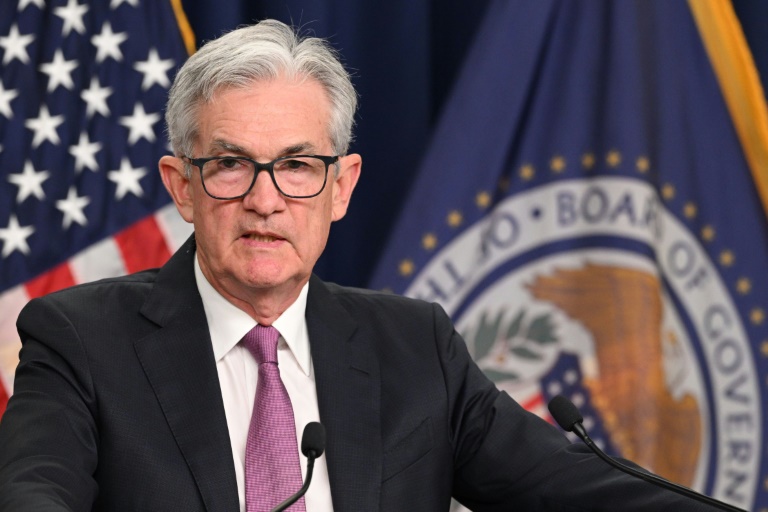
Fed boss Jerome Powell reiterated his determination to focus on bringing down inflation — which is at a four-decade high — and accepted that the campaign would hit Americans hard.

“We have got to get inflation behind us,” Powell said after a two-day meeting of the Fed policy committee. “I wish there were a painless way to do that. There isn’t.”

He added that “the historical record cautions strongly against prematurely loosening policy” and the Fed would “keep at it until the job is done”.

All three main indexes on Wall Street tumbled Wednesday as traders contemplated an era of higher-for-longer rates, which could hit companies’ bottom lines.

Asia followed suit, with Hong Kong down at an 11-year low — while Tokyo, Shanghai, Seoul, Singapore, Mumbai, Taipei and Manila also down.

London, Paris and Frankfurt extended the losses in early trade.

However, the dollar continued its strong march higher, striking a fresh 24-year high of 145.90 yen, which prompted the government to embark on a rare intervention to protect its currency.

The US Fed has for months tried to walk a fine line between fighting soaring prices and trying to keep the economy from contracting, but officials accept the chances of success are narrow.

“With the new rate projections, the Fed is engineering a hard landing — a soft landing is almost out of the question,” said Seema Shah, of Principal Global Investors.

“Jerome Powell almost channelled his inner Paul Volcker… talking about the forceful and rapid steps the Fed has taken, and is likely to continue taking, as it attempts to stamp out painful inflation pressures and ward off an even worse scenario later down the line.”

Volcker used aggressive measures to quell runaway prices in the 1980s, when inflation was last as high as it is now.

Commentators are now betting on a fourth straight 75-basis-point rate hike at the next Fed meeting in November.

All three main indexes on Wall Street tumbled Wednesday as traders contemplated an era of higher-for-longer rates, which could hit companies’ bottom lines.

– ‘Bitter medicine’ –

“This meeting once again demonstrates that the Fed is willing to do what is necessary to bring inflation under control. It will slow demand by keeping rates higher for longer — even if this means growth and jobs are lost,” said Christian Scherrmann, of asset management firm DWS.

“The current view of the central bankers is still that this will cause a slowdown, but not a recession. We fully agree that bitter medicine to win back price stability is necessary. But we fear its side-effects will be harsher than the Fed is currently projecting.”

And Fidelity International’s Anna Stupnytska said a long-hoped-for change of direction from the Fed “now seems further away”, though added that a significant tightening of monetary financial conditions could see an earlier pause in the rate hikes.

The Swiss central bank followed up Thursday with a 0.75 percentage point hike and Norway lifted its rate to an 11-year high. Indonesia and the Philippines also tightened policy.

Investors are now preparing for a large move from the Bank of England later in the day.

Still, the Bank of Japan decided not to shift from its ultra-loose measures owing to its determination to kickstart the country’s torpid economy. The decision leaves it as the only major central bank with negative rates, a policy that has sent the yen plunging 20 percent this year.

However, the currency got a bounce after the finance ministry stepped into the currency markets, pushing the dollar back below 143 yen.

Other currencies were also under pressure, with the euro wallowing at a 20-year low and sterling touching a fresh 37-year nadir of $1.1221.

The greenback was also at multi-year highs on the South Korean won, Chinese yuan, Australian dollar and Canadian dollar, among others.

Oil prices edged up after a rollercoaster Wednesday.

Both contracts spiked in reaction to President Vladimir Putin’s announcement of a partial mobilisation of the Russian army and a veiled threat to use nuclear weapons against the West.

But they soon retreated as investors once again turned to the likely impact on demand from an expected recession across world economies.

– Key figures at around 0810 GMT –

Tokyo – Nikkei 225: DOWN 0.6 percent at 27,153,83 (close)

Hong Kong – Hang Seng Index: DOWN 1.6 percent at 18,147.95 (close)

Shanghai – Composite: DOWN 0.3 percent at 3,108.91 (close)

London – FTSE 100: DOWN 0.4 percent at 7,209.75

Dollar/yen: UP at 142.63 yen from 144.02 yen Wednesday

Pound/dollar: DOWN at $1.1275 from $1.1275

Euro/dollar: DOWN at $0.9840 from $0.9847

Euro/pound: UP at 87.25 pence from 87.31 pence 

West Texas Intermediate: UP 0.6 percent at $83.46 per barrel

Brent North Sea crude: UP 0.7 percent at $90.41 per barrel

New York – Dow: DOWN 1.7 percent at 30,183.78 (close)

'Very high chance' Hong Kong will end year in recession

Hong Kong is set to end the year in the midst of a full-blown recession, the city’s finance chief warned Thursday, as spiralling interest rates join strict Covid-19 controls in hammering the economy.

“There is a very high chance for Hong Kong to record a negative GDP growth for this year,” Financial Secretary Paul Chan told reporters, adding that interest rates were being raised “at a pace that was never seen in the past three decades”.

The Chinese city’s monetary policy moves with the Federal Reserve because its currency, one of the cornerstones of its business hub reputation, is pegged to the US dollar.

The Fed’s hawkish rate hikes, aimed at curbing soaring inflation, come at an especially difficult time for Hong Kong, dampening sentiment when the economy is already struggling.

The city is currently in a technical recession — recording two consecutive quarters of negative growth this year.

The government has adhered to a version of China’s zero-Covid policy for more than 2.5 years, enforcing strict coronavirus controls and mandatory quarantine for international arrivals.

Quarantine, once as long as three weeks, has been reduced to three days. The government has signalled it may soon join the rest of the world in scrapping travel curbs.

Chan signalled his support for making travel and business easier. 

“The aspects related to the pandemic need to continue to improve in order for us to see larger investments because people are more cautious in a high interest rates environment,” he said.

– ‘Falling behind’ –

Business leaders have long been warning that the pandemic controls, combined with Beijing’s ongoing crackdown on dissent, have made it harder to attract talent and cut off Hong Kong internationally, especially as rivals reopen.

The city has seen a net outflow of more than 200,000 people in the last two years, a record population drop.  

“Hong Kong should be ahead of other Asian cities. But now there’s a feeling that we’re falling behind and being left isolated,” Eden Woon, the new head of the city’s American Chamber of Commerce told the South China Morning Post in an article published Thursday. 

“There are people leaving and the problems of retaining talent. All these things add up together and need to be addressed,” he added.

But earlier this week a senior Chinese official said it was “inappropriate” to say the city was seeing an exodus. 

“Hong Kong’s population drop is caused by various factors and there is no way to suggest that it is a result of an emigration wave,” Huang Liuquan, deputy director of the Hong Kong and Macau Affairs Office, said Tuesday. 

The Fed’s rate hikes hit Hong Kong’s stock market which fell as much as 2.6 percent on Thursday, to 17,965.33, the lowest since December 2011.

The Hang Seng Index has been one of the worst performing top bourses in the past two years, shedding more than 22 percent since the start of January following last year’s 14 percent drop.

While the Hong Kong Monetary Authority has no choice but to follow the Fed, major banks such as Standard Chartered and HSBC had resisted that pressure. 

But on Thursday, HSBC raised its prime lending rate in Hong Kong by 12.5 basis points to 5.125 percent, the bank’s first rise in four years.

Others are likely to follow suit. 

That could impact the city’s once white hot property sector with Goldman Sachs Group estimating prices may slide by about 20 percent over the next four years. 

Hong Kong also saw a recession in 2019 when months of huge and sometimes violent democracy protests rocked the city.

Cheap mealboxes a taste of Hong Kong's economic woes

Hong Konger Kitty Chan pivoted to takeout to help her restaurant survive the pandemic, but she has since opened a second shop as demand for cheap mealboxes surges in a city enduring economic woes.

Small shops selling inexpensive two-dish mealboxes have mushroomed across one of the world’s least affordable cities, cropping up in working-class and white-collar areas alike as people tighten their belts.

“The Covid restrictions were a catalyst,” she told AFP at her restaurant in Kowloon, one of the world’s most densely populated city districts, as a queue of hungry patrons snaked down the street.

“There are multiple factors in this city that make us many people’s kitchen.”

Hong Kong took an economic hit in 2019 when months of democracy protests kept visitors away and helped tip the city into a prolonged recession.

More than 2.5 years of strict Covid controls have again pushed the Asian finance hub into negative growth. 

Hong Kong finance chief Paul Chan warned Thursday there is a “very high chance” the city will end the year in a full-blown recession while the fiscal deficit is expected to balloon to HK$100 billion ($12.7 billion), twice initial estimates.

The mealbox boom “is similar to the emergence of dollar shops during the (2008) financial crisis,” said Andy Kwan, director of the ACE Centre for Business and Economic Research think tank.

“People tend to spend less when the economy is not well and confidence is low,” he told AFP. 

Chan’s restaurants are selling 2,000 to 3,000 mealboxes per day at around HK$48 ($6).

Mealboxes go for anything from HK$25 to HK$80 depending on ingredients and shop locations, and many include a drink or soup.

– Buffet in a box – 

To compete in what is now a crowded market, Chan tries to supply the kind of food you can get in a sit-down restaurant — mostly wok-fried Cantonese dishes such as black-pepper beef short ribs, steamed fish and razor clams.

Her strategy has attracted a mostly white-collar clientele.

“The two-dish mealbox is a very interesting entry point to observe our economy,” said Fred Ku, an economist at the Chinese University of Hong Kong. 

Ku said that while the two-dish restaurant had long been a feature of the city, “the consumers’ perception has changed and these mealboxes are no longer a symbol of relatively low income”.

China and Hong Kong have largely escaped the runaway inflation seen across the globe. 

But food in particular has become more expensive — Chan estimates her grocery purchases have risen about 20 percent this year.

Mealbox restaurants are also popular with Hong Kongers who have refused to vaccinate themselves against Covid.

The city uses a QR code system that denies unvaccinated people access to most public premises.

Retiree Grace, who gave only her first name, described herself as “a denied person” because she had only gotten one vaccination shot. 

“At first I thought why not give (mealboxes) a try since I had to have takeaway,” the 68-year-old told AFP. “But now I find it pretty attractive… it feels like having a buffet.”  

– Tourist trickle –

A Facebook group for sharing tips on mealbox restaurants, started by social worker Andrew Wong, has grown to 87,000 members.

“When I opened the group at the end of 2021, we found 110 to 120 such restaurants, and so far in 2022, we have found 150 brand new spots,” he told AFP.

Another crowd-sourced map lists more than 440 two-dish restaurants across Hong Kong, up from around 330 in May.

Wong said the boom was fuelled by Covid restrictions and the drop in tourist numbers over the last three years.

Before the protests and pandemic, Hong Kong would see around 65 million tourists a year, with 78 percent coming from the Chinese mainland.

That has slowed to a trickle, with the Chinese border effectively closed and international arrivals still facing mandatory hotel quarantine on arrival.

City leader John Lee has vowed to reopen the city and hinted at further Covid relaxations in the coming weeks. 

But Hong Kong’s international access remains far behind rivals such as Singapore, London and Tokyo.

“People are wondering if there is any policy to stabilise the economy and whether the government is enterprising enough to bring changes,” think-tank director Kwan said. 

“Meanwhile, people are cutting daily expenses so they can have more to spend if the worst happens”.

Pressure grows after World Bank chief dodges climate questions

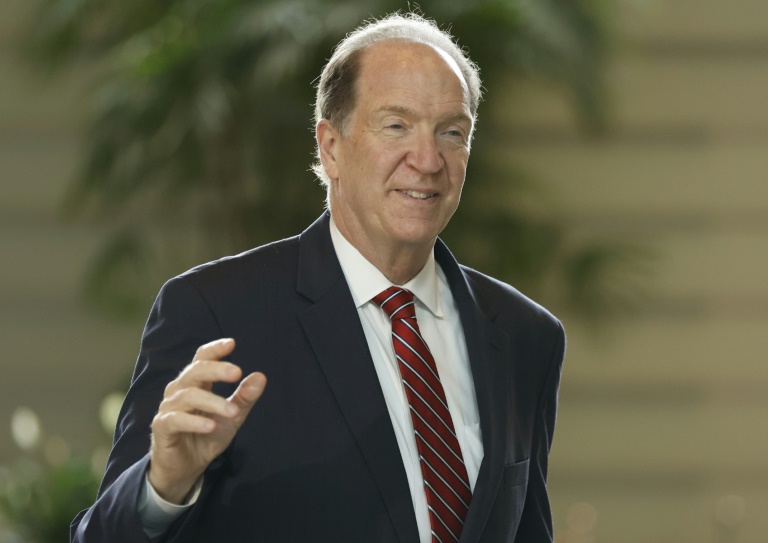
Climate groups called Wednesday for the World Bank’s president to be removed after he refused multiple times to say if he believed man-made emissions contributed to global warming.

Activists have previously called for David Malpass to resign or be removed for what they say is an inadequate approach to the climate crisis.

The head of the World Bank is traditionally an American while the other big international lender in Washington, the IMF, tends to be European. Malpass is a veteran of Republican administrations in the United States and was appointed in 2019 while Donald Trump, who famously and repeatedly denied the science behind climate change, was president.

The chorus against Malpass grew louder after his appearance Tuesday at a New York Times conference on climate finance.

Asked by a journalist to respond to former US vice president Al Gore’s claim that he was a climate denier, Malpass said that some of his critics “may not know what the World Bank is doing.” He boasted that its climate funding is “by far the biggest” among international financial institutions.

After another attempt failed to get a straight answer, the journalist, David Gelles, said: “Let me just be as clear as I can: Do you accept the scientific consensus that the man made burning of fossil fuels is rapidly and dangerously warming the planet?”

Malpass again pointed to the World Bank’s work on the issue, at which point multiple people in the audience shouted: “Answer the question!”

“I don’t even know. I’m not a scientist,” responded a clearly frustrated Malpass.

The Big Shift, a consortium of climate groups, called Wednesday for the World Bank’s board to remove Malpass over the comments.

“For the World Bank to maintain any shred of decency Malpass cannot remain as President,” said Tasneem Essop, executive director of the Climate Action Network, a Big Shift member group.

A separate group of activist organizations said they would on Thursday unveil a banner at the World Bank’s headquarters in Washington that reads: “The World Bank Group is Run by a Climate Denier.”

Malpass’s term ends in 2024 and he can only be removed by a vote of the World Bank’s board.

Climate groups have called on President Joe Biden to up the outside pressure.

Biden’s climate change envoy, former US secretary of state John Kerry, declined during an appearance at the same Times event to comment on Malpass’s future, saying “that’s the president’s decision.”

The World Bank declined to comment on the situation when reached by AFP.

US stocks fall, dollar gains as Fed unveils latest big rate hike

Wall Street stocks tumbled and the dollar rallied Wednesday after the Federal Reserve announced another large interest rate increase and signaled it expects more monetary tightening ahead to fight inflation.

The US central bank announced its third consecutive interest rate increase of 0.75 percentage point, continuing the forceful action to tamp down inflation that has surged to the highest in 40 years.

US stocks had climbed ahead of the announcement, following positive sessions on leading European bourses and declines in Asia. 

Equities gyrated after the Fed press release before taking a final decisive push lower during Fed Chair Jerome Powell’s news conference. The S&P 500 ended down 1.7 percent.

“The higher-for-longer narrative kicked in,” Art Hogan, analyst of B. Riley Wealth Management, said of the market’s reaction to an announcement that was more “hawkish” than expected.

Markets had been expecting another big interest rate increase, but were caught off guard by the Fed’s outlook as far as the need for additional hikes. 

The latest Fed statement included interest rate projections for the end of 2023 and 2024 that are higher than the previous forecasts, signaling the US central bank now sees the need for a more prolonged monetary tightening cycle in light of inflation trends.

Powell emphasized the need for a “restrictive” monetary policy.

He acknowledged that bringing inflation down will require a period of slower growth and higher unemployment, noting that the job market is out of sync, with far more openings than workers.

“We have got to get inflation behind us,” Powell said. “I wish there were a painless way to do that. There isn’t.”

“The Fed is having to be cruel in order to restore price stability,” noted Russ Mould, investment director at AJ Bell.

“Higher rates will cause pain to households and businesses, with the jobs market being closely watched for signs of redundancies and hiring freezes.”

The Fed announcement also boosted the dollar, which hit a near 20-year peak against the euro.

“Once again, the Fed’s hawkish rate guidance kept the dollar biased higher as it distinguishes America’s central bank from its less aggressive counterparts abroad,” said Convera’s Joseph Manimbo.

The British pound also tumbled, even as the Bank of England prepares to announce its own large interest rate hike Thursday.

Although European and US equity indices were advancing ahead of the Fed’s decision, City Index analyst Fawad Razaqzada said he believes “the path of least resistance is to the downside and the selling pressure will likely resume amid a bearish macro-outlook.”

Elsewhere, oil prices finished lower on worries about weakening US demand, reversing a rally earlier on worries about the escalating Russia-Ukraine conflict after President Vladimir Putin called up Russian military reservists.

– Key figures at around 2030 GMT –

New York – Dow: DOWN 1.7 percent at 30,183.78 (close)

New York – S&P 500: DOWN 1.7 percent at 3,789.93 (close)

New York – Nasdaq: DOWN 1.8 percent at 11,220.19 (close)

London – FTSE 100: UP 0.6 percent at 7,237.64 (close)

Frankfurt – DAX: UP 0.8 percent at 12,6767.15 (close)

Paris – CAC 40: UP 0.9 percent at 6,031.33 (close)

EURO STOXX 50: UP 0.7 percent at 3,491.87 (close)

Tokyo – Nikkei 225: DOWN 1.4 percent at 27,313.13 (close)

Hong Kong – Hang Seng Index: DOWN 1.8 percent at 18,444.62 (close)

Shanghai – Composite: DOWN 0.2 percent at 3,117.18 (close)

Pound/dollar: DOWN at $1.1275 from $1.1381 Tuesday

Euro/dollar: DOWN at $0.9847 from $0.9971

Euro/pound: DOWN at 87.31 pence from 87.61 pence 

Dollar/yen: UP at 144.02 yen from 143.75 yen

Brent North Sea crude: DOWN 0.9 percent at $89.83 per barrel

West Texas Intermediate: DOWN 1.2 percent at $82.94 per barrel

burs-jmb/bfm

Close Bitnami banner
Bitnami