Chinese Business

Stocks push higher, but yen and euro under pressure

European and US stocks rose Tuesday, but gains were capped by economic slowdown fears and central bank efforts to contain surging inflation.

Frankfurt, London and Paris equities carved out gains despite poor German data, a day after tumultuous trading as Russia curbed gas supplies to Europe.

Wall Street stocks opened higher after a three-day holiday weekend, with the Dow adding 0.4 percent

The euro approached a 20-year low versus the dollar that it struck on Monday, while sterling was lifted by reports that new UK Prime Minister Liz Truss could freeze a looming surge in energy bills, and the yen struck a new 24-year dollar low.

– ‘Wait-and-see mood’ –

Briefing.com analyst Patrick O’Hare said the positive start on Wall Street was primarily due to the fact that main indices are down around 10 percent from the highs they struck on August 16.

There is “an expectation that it is due for a bounce from a short-term oversold condition.”

Nevertheless, traders are still wary.

“Investors remain cautious amid worries about the slowing global economy,” noted Hargreaves Lansdowne analyst Susannah Streeter.

“There is a wait-and-see mood hanging over markets.”

Frankfurt rebounded somewhat despite news that Germany’s industrial orders slumped for the sixth consecutive month in July.

That again raised the spectre that recession was looming in Europe’s biggest economy.

The European Central Bank is expected to hike interest rates on Thursday to tackle surging eurozone inflation.

Eurozone stocks had tumbled Monday on heightened energy concerns after Russia said it would not restart gas flows to Germany and effectively most of the continent.

– ‘Catch-22’ for euro –

Russia’s decision — in retaliation for sanctions over Ukraine — sent shock waves through trading floors as it ramped up expectations of a painful recession in major economies.

That continues to bedevil the euro, as well as the measures that European governments take to prop up their economies. 

City Index and FOREX.com analyst Fawad Razaqzada said these measures are likely to fuel inflation even further. This would require the ECB to hike interest rates even more aggressively, meaning a sharper recession.

“So, it is a catch-22 situation for the ECB,” he said.

“For this reason, traders are reluctant to buy the euro.”

In Asia on Tuesday, Shanghai advanced after China unveiled fresh economy-boosting measures, but the overall picture was mixed.

Sydney dipped after the Reserve Bank of Australia lifted interest rates to a near eight-year high and warned of more pain ahead.

– Key figures at around 1330 GMT –

London – FTSE 100: UP 0.4 percent at 7,312.85 points

Frankfurt – DAX: UP 1.0 percent at 12,891.67

Paris – CAC 40: UP 0.4 percent at 6,115.12

EURO STOXX 50: UP 0.5 percent at 3,505.67

New York – Dow: UP 0.4 percent at 31,428.94 

Tokyo – Nikkei 225: FLAT at 27,626.51 (close)

Hong Kong – Hang Seng Index: DOWN 0.1 percent at 19,202.73 (close)

Shanghai – Composite: UP 1.4 percent at 3,243.45 (close)

Euro/dollar: DOWN at $0.9899 from $0.9929 on Monday

Pound/dollar: UP at $1.1539 from $1.1517

Dollar/yen: UP at 142.46 yen from 140.60 yen

Euro/pound: DOWN at 85.79 pence from 86.21 pence

West Texas Intermediate: UP 1.0 percent at $87.71 per barrel

Brent North Sea crude: DOWN 1.9 percent at $93.91 per barrel

burs-rl/lth
European stocks climb, euro steadier

European stocks rose Tuesday but gains were capped by Europe’s worsening energy crisis, economic slowdown fears and central bank efforts to contain surging inflation.

Frankfurt, London and Paris equities carved out gains nearing the half-way stage, despite poor German data and after tumultuous trading the previous day as Russia curbed gas supplies to Europe.

The euro climbed a day after hitting a 20-year low versus the dollar, while sterling was lifted by reports that new UK Prime Minister Liz Truss could freeze a looming surge in energy bills.

World oil prices slid on demand concerns, one day after jumping as OPEC and allies trimmed production in an attempt to lift the market. 

– ‘Wait-and-see mood’ –

“Investors remain cautious amid worries about the slowing global economy,” noted Hargreaves Lansdowne analyst Susannah Streeter.

“There is a wait-and-see mood hanging over markets.”

Frankfurt rebounded somewhat despite news that Germany’s industrial orders slumped for the sixth consecutive month in July.

That again raised the spectre that recession was looming in Europe’s biggest economy.

The European Central Bank was Thursday expected to hike interest rates to tackle surging eurozone inflation.

Eurozone stocks had tumbled Monday on heightened energy concerns after Russia said it would not restart gas flows to Germany and effectively most of the continent.

Russia’s decision — in retaliation for sanctions over Ukraine — sent shock waves through trading floors as it ramped up expectations of a painful recession in major economies.

In Asia on Tuesday, Shanghai advanced after China unveiled fresh economy-boosting measures, but the overall picture was mixed.

Sydney dipped after the Reserve Bank of Australia lifted interest rates to a near eight-year high and warned of more pain ahead.

Wall Street reopens Tuesday following a long US holiday weekend.

– Key figures at around 1010 GMT –

London – FTSE 100: UP 0.3 percent at 7,309.63 points

Frankfurt – DAX: UP 1.2 percent at 12,914.47

Paris – CAC 40: UP 0.7 percent at 6,133.90

EURO STOXX 50: UP 0.8 percent at 3,518.27

Tokyo – Nikkei 225: FLAT at 27,626.51 (close)

Hong Kong – Hang Seng Index: DOWN 0.1 percent at 19,202.73 (close)

Shanghai – Composite: UP 1.4 percent at 3,243.45 (close)

New York – Dow: Closed for public holiday

Euro/dollar: UP at $0.9938 from $0.9929 on Monday

Pound/dollar: UP at $1.1598 from $1.1517

Dollar/yen: UP at 141.62 yen from 140.60 yen

Euro/pound: DOWN at 85.69 pence from 86.21 pence

West Texas Intermediate: DOWN 0.2 percent at $86.74 per barrel

Brent North Sea crude: DOWN 2.8 percent at $93.06 per barrel

burs-rfj/bcp/cdw

Asian markets mostly rise as bargain-buying offsets fears over outlook

Asian investors squeezed out gains Tuesday as they tried to recover from the previous day’s losses, but they remain gripped by fears over Europe’s worsening energy crisis, China’s economic slowdown and central bank efforts to contain surging inflation.

The dollar lost some momentum, with the euro supported ahead of an expected European Central Bank interest rate hike and sterling lifted by reports that new UK Prime Minister Liz Truss will unveil plans to cut energy bills.

Russia’s decision not to resume gas supplies to Europe — in retaliation for sanctions over Ukraine — sent shock waves through trading floors Monday as it ramped up expectations of a painful recession in major economies.

“This shouldn’t have been a surprise to most people, given that it was widely expected that Putin would play this card at some point,” said CMC Markets analyst Michael Hewson. 

“Now that he has, Russia doesn’t really have anywhere else to go, and while natural gas prices did shoot higher, they closed well off the highs of the day.”

With Wall Street closed for a holiday, Asia had few new catalysts to drive buying.

Markets fluctuated between gains and losses in the morning but managed to clamber up as the day progressed.

Shanghai enjoyed a healthy bounce after China unveiled fresh economy-boosting measures. 

But analysts warned that while a stimulus was welcomed as growth dwindles, traders were only looking for signs of an easing in the country’s zero-Covid strategy, which has left millions in lockdown and threatens economic activity.

Singapore, Seoul, Taipei, Manila, Mumbai, Bangkok and Jakarta all rose, while Tokyo was marginally up and Hong Kong inched down. 

Sydney dipped after the Reserve Bank of Australia lifted interest rates to a near eight-year high and warned of more pain ahead. Wellington also slipped.

London, Paris and Frankfurt enjoyed small gains.

– Global recession risk –

“A lot of clients are asking, have we seen the bottom yet and are we going into a global recession?” Grace Tam, of BNP Paribas Wealth Management Hong Kong, told Bloomberg Television.

“We do think the risk of a global recession, especially next year, is actually quite high” and that the energy crisis “is not fully priced” into markets, she said.

The next key event for investors is the ECB rate decision Thursday, with some observers tipping a 75 basis point hike to bring down record-high inflation.

That is followed later in the month by the Federal Reserve’s meeting, where policymakers will debate a similar move, which would be the third rise in a row.

However, while central banks are lifting borrowing costs to fight surging prices, they have little power over the cost of oil, a key driver of the rises.

And on Monday, OPEC and other major producers announced a surprise cut in output, sending both main contracts rising. The move came after the crude market fell in recent months on demand fears caused by a possible recession.

“In absolute terms, the 100,000 barrels a day supply cut doesn’t matter that much to global supply balances,” said Noah Barrett of Janus Henderson Investors.

“However, in terms of signalling, the move is important as it indicates that OPEC+ is watching demand very closely and is trying to manage supply to keep a floor on oil prices.”

Several countries including the United States had earlier called for a rise in production, which was followed by a small lift of 100,000 barrels.

“The modest increase we got a month ago is now gone, so OPEC+ is clearly sending a message that they are not bowing to external demands,” said Barrett.

“We should expect continued volatility in oil prices, with global demand indicators driving price movements.”

Brent and WTI were both down from Monday’s levels.

– Key figures at around 0810 GMT –

Tokyo – Nikkei 225: FLAT at 27,626.51 (close)

Hong Kong – Hang Seng Index: DOWN 0.1 percent at 19,202.73 (close)

Shanghai – Composite: UP 1.4 percent at 3,243.45 (close)

London – FTSE 100: UP 0.3 percent at 7,305.39

Euro/dollar: UP at $0.9967 from $0.9921 on Monday

Pound/dollar: UP at $1.1568 from $1.1507

Dollar/yen: UP at 141.65 yen from 140.53 yen

Euro/pound: DOWN at 86.10 pence from 86.22 pence

West Texas Intermediate: DOWN 0.2 percent at $89.30 per barrel

Brent North Sea crude: DOWN 0.1 percent at $95.69 per barrel

New York – Dow: Closed for public holiday

Asian markets mixed as bargain-buying tempers fears over outlook

Asian investors struggled Tuesday to recover from the previous day’s losses on growing fears over Europe’s worsening energy crisis, China’s economic slowdown and central bank efforts to contain surging inflation.

However, the dollar lost some of its momentum against its major peers on profit-taking, with the euro finding some support ahead of an expected European Central Bank interest rate hike and sterling lifted by the election of a new prime minister.

Russia’s decision not to resume gas supplies to Europe — in retaliation for sanctions over Ukraine — sent shock waves through trading floors Monday as it ramped up expectations of a painful recession in major economies.

European bourses took the brunt of the selling, though they pared their earlier losses as commentators said the shutoff had been expected to come at some point.

With Wall Street closed for a holiday, Asia had few new catalysts to drive buying.

In early trade, markets fluctuated between gains and losses, with Hong Kong, Seoul and Wellington down, while Shanghai, Sydney, Singapore, Taipei and Jakarta edged up. Tokyo and Manila were flat.

“A lot of clients are asking, have we seen the bottom yet and are we going into a global recession?” Grace Tam, of BNP Paribas Wealth Management Hong Kong, told Bloomberg Television.

“We do think the risk of a global recession, especially next year, is actually quite high” and that the energy crisis “is not fully priced” into markets, she said.

The next key event for investors is the ECB rate decision Thursday, with some observers tipping a 75 basis point hike to bring down record-high inflation.

That is followed later in the month by the Federal Reserve’s meeting, where policymakers will debate a similar move, which would be the third rise in a row.

However, while central banks are lifting borrowing costs to fight surging prices, they have little power over the cost of oil, a key driver of the rises.

And on Monday OPEC and other major producers announced a surprise cut in output, sending both main contracts rising. The move came after the crude market fell in recent months on demand fears caused by a possible recession.

“In absolute terms, the 100,000 barrels a day supply cut doesn’t matter that much to global supply balances,” said Noah Barrett of Janus Henderson Investors.

“However, in terms of signalling, the move is important as it indicates that OPEC+ is watching demand very closely and is trying to manage supply to keep a floor on oil prices.”

Several countries including the United States had earlier called for a rise in production, which was followed by a small lift of 100,000 barrels.

“The modest increase we got a month ago is now gone, so OPEC+ is clearly sending a message that they are not bowing to external demands,” said Barrett.

“We should expect continued volatility in oil prices, with global demand indicators driving price movements.”

Brent and WTI were both down from Monday’s levels.

– Key figures at around 0230 GMT –

Tokyo – Nikkei 225: FLAT at 17,624.96 (break)

Hong Kong – Hang Seng Index: DOWN 0.3 percent at 19177.54

Shanghai – Composite: UP 0.4 percent at 3213.31

Euro/dollar: UP at $0.9960 from $0.9921 on Monday

Dollar/yen: DOWN at 140.40 yen from 140.53 yen

Pound/dollar: UP at $1.1587 from $1.1507

Euro/pound: DOWN at 85.96 pence from 86.22 pence

West Texas Intermediate: DOWN 1.0 percent at $88.54 per barrel

Brent North Sea crude: DOWN 1.0 percent at $94.80 per barrel

New York – Dow: Closed for public holiday

London – FTSE 100: UP 0.1 percent at 7,287.43 (close)

Floods cripple Indian tech hub Bangalore

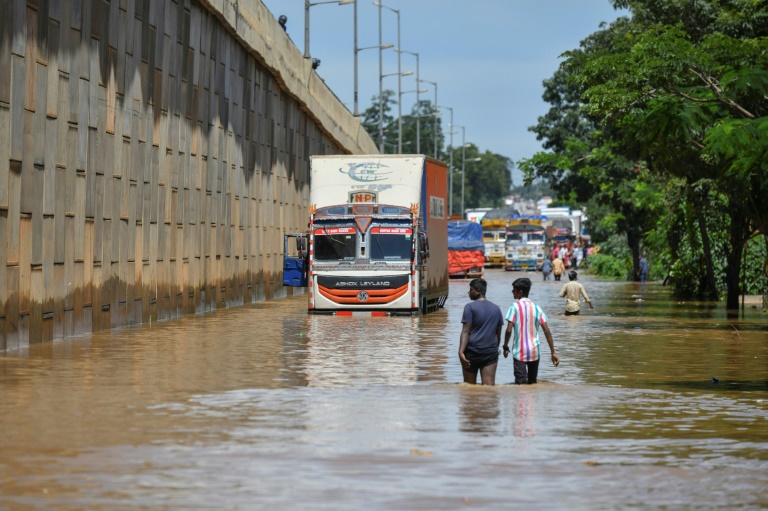
Floods blamed on shoddy infrastructure crippled Indian IT hub Bangalore on Monday, with employees in the huge tech sector told to work from home and dozens of areas reportedly left without drinking water.

The southern metropolis of around 8.5 million people boomed in the 1990s, with its myriad outsourcing and software companies now employing millions in the “back office of the world”.

But the city’s companies have complained that infrastructure development has not kept up, with perennial traffic jams and unplanned construction on the dried-up beds of lakes leading to frequent flooding even after moderate rainfall.

On Monday large parts of the city were under water, with authorities deploying rubber dinghies to ferry people around and footage on social media showing tractors being used to transport travellers from the airport.

The umbrella group for the IT sector, the Outer Ring Road Companies Association (ORRCA), advised employees to work from home while many schools and colleges were shut.

The supply of drinking water to more than 50 areas of the city was halted for two days after a pumping station was inundated, media reports said, as more rain was forecast.

“Honestly, the traffic situation in Bangalore is always bad but this is now another level,” said one back-office employer for food delivery company Swiggy, requesting to stay anonymous.

“It’s worse than ever before because of how many people have rushed back to the city after Covid. The infrastructure can’t take the strain,” he told AFP.

str-ash-ng-stu/dva

European stocks, euro tumble as Russia fuels energy crisis

European stocks tumbled Monday and the euro hit a new 20-year dollar low on energy crisis fears, after Russia said it would not restart gas flows to Germany and effectively most of the continent.

Natural gas prices spiked almost a third, while oil rallied on expectations OPEC and its Russia-led allies could decide at a meeting Monday to lower crude output in a bid to lift prices.

Europe’s fast-moving gas crisis sent Frankfurt equities slumping more than three percent before trimming losses, while Paris shed two percent at one stage.

London stocks also lost ground before the much-anticipated announcement of Britain’s next prime minister at around 1130 GMT.

– ‘Weaponization of energy’ –

“Russia’s ongoing weaponization of energy supplies continues to increase downside risks for European economies and the euro,” said Lee Hardman, currency analyst at financial services group MUFG. 

The euro sank Monday to $0.9878, its lowest since December 2002, despite expectations the European Central Bank will hike interest rates again Thursday to combat soaring inflation.

The shared eurozone unit has collapsed by about 13 percent against the dollar since the start of the year, hit also by the US Federal Reserve’s more aggressive monetary tightening.

State gas giant Gazprom announced late Friday the key Nord Stream pipeline would remain shut indefinitely, blaming leaks.

Gazprom’s announcement came the same day as the G7 nations said they would work to quickly implement a price cap on Russian oil exports, a move that would starve the Kremlin of critical revenue for its war on Ukraine.

Resumption of deliveries via the pipeline, which runs from near Saint Petersburg to Germany under the Baltic Sea, had been due to resume on Saturday after what Gazprom had described as three days of maintenance work.

– ‘Grim shadow before winter’ –

The news intensified an energy crisis caused by Europe’s sanctions on Moscow for its invasion of Ukraine in February.

Investors are fearful of an energy supply crunch during the peak-demand northern hemisphere winter.

That could potentially lead to a painful recession.

“Russia’s decision to turn off Europe’s gas hangs over the continent like a grim shadow ahead of winter,” said AJ Bell investment director Russ Mould.

At the same time, governments worldwide are grappling with the impact of rocketing domestic energy costs.

Germany on Sunday unveiled a new 65-billion-euro ($65-billion) package to help households cope with soaring prices, and eyed windfall profits from energy companies to help fund the move.

That took Berlin’s total relief to almost 100 billion euros since the start of the Ukraine war.

Elsewhere on Monday, Asian bourses experienced mixed trade as last week’s upbeat US jobs report partly offset fears over Europe’s outlook — and China’s new Covid lockdowns.

– Key figures at around 1000 GMT –

London – FTSE 100: DOWN 0.6 percent at 7,234.88 points

Frankfurt – DAX: DOWN 2.3 percent at 12,747.73

Paris – CAC 40: DOWN 1.6 percent at 6,071.27

EURO STOXX 50: DOWN 1.9 percent at 3,478.13

Tokyo – Nikkei 225: DOWN 0.1 percent at 27,619.61 (close)

Hong Kong – Hang Seng Index: DOWN 1.2 percent at 19,225.70 (close)

Shanghai – Composite: UP 0.4 percent at 3,199.91 (close)

New York – Dow: DOWN 1.1 percent at 31,318.44 (close)

Euro/dollar: DOWN at $0.9927 from $0.9954 on Friday

Dollar/yen: UP at 140.43 yen from 140.20 yen

Pound/dollar: UP at $1.1515 from $1.1509

Euro/pound: DOWN at 86.20 pence from 86.48 pence

West Texas Intermediate: UP 2.7 percent at $89.17 per barrel

Brent North Sea crude: UP 2.7 percent at $95.52 per barrel

burs-rfj/bcp/cdw

European markets, euro tumble as Russia fans energy crisis

European markets tumbled Monday and the euro hit a fresh 20-year low on growing fears about an energy crisis after Russia said it would not restart gas flows to the continent, while traders are also preparing for another interest rate hike this week.

The selling came after a mixed day in Asia, where the positive vibes from a US jobs report were offset by growing fears about the European outlook as well as Chinese Covid lockdowns and geopolitical tensions.

Paris, Frankfurt and London all sank sharply at the open after Russia’s Gazprom said it would not restart gas supplies to Europe, citing problems with a pipeline.

The announcement came the same day as the G7 nations said they would work to quickly implement a price cap on Russian oil exports, a move that would starve the Kremlin of critical revenue for its war effort.

The news ramped up an energy crisis in the continent caused by sanctions on Moscow for its invasion of Ukraine in February.

It has sent shockwaves through the eurozone economy and fanned expectations it will sink into recession, while sending the euro tanking to a 20-year low against the dollar. The single currency hit a nadir of $0.9878 at one point.

“Russia’s ongoing weaponisation of energy supplies continues to increase downside risks for European economies and the euro,” said Lee Hardman, currency analyst at financial services group MUFG. 

The issue has given the European Central Bank a huge headache. It is forced to lift interest rates as it struggles to contain runaway inflation.

Policymakers are due to announce a second straight lift at its meeting this week, with some observers betting on a 0.75 percentage point rise.

“The outlook is poor for Europe. It started to get choppy at the tail end of last week, and it is almost certainly going to get worse,” Gordon Shannon, of TwentyFour Asset Management, said.

“The ECB had only just started to catch up with the Fed in terms of hiking rates, but if we are going into a prolonged recession, I think this slows down their attempts.”

The move offset a broadly positive payrolls report showing US employment growth moderating and unemployment ticking higher, easing pressure on the Federal Reserve to sharply lift interest rates. 

In response to the figures, traders lowered their expectations for a third successive three-quarter point hike this month, with many now predicting 50 basis points.

“The increase in the participation rate and a softening in average hourly earnings may be a tentative sign that intense labour market tightness is starting to ease slightly,” said National Australia Bank’s Tapas Strickland.

He added that it “eases some of the fears stemming from other indicators such as job openings. Markets interpreted the print as lessening the chances of a 75 basis point hike”.

Still, the dollar continued to strengthen across the board, holding above 140 yen — a 24-year high — while the pound was on in on its way to hitting levels not seen since 1985.

However, all three main indexes in New York reversed their gains after the Gazprom announcement.

And in Asia on Monday, Hong Kong was the biggest loser, with tech firms hit by reports that the United States was considering imposing fresh limits on investments in Chinese firms.

Tokyo, Seoul, Taipei, Manila, Bangkok and Wellington also fell but there were gains in Shanghai, Sydney, Mumbai Singapore and Jakarta.

The Gazprom move helped lift oil prices Monday, with buying also supported by talk that OPEC and other major producers are considering cutting output at their meeting later Monday.

Investors were also dealing with more bad news out of China, where tens of millions of people across several cities have been thrown into lockdown as part of officials’ zero-Covid strategy.

The measures follow an extended shutdown in Shanghai earlier in the year that battered the world’s number two economy.

Observers said Chinese authorities were unlikely to budge ahead of a key Communist Party meeting in October, where Xi Jinping is expected to be handed a third five-year term as president.

“Following this, it is unclear whether China will start to pivot away from its zero-Covid policy,” said NAB’s Strickland.

“For as long as the policy exists, any stimulus measures are unlikely to gain traction, amid a challenging time for the Chinese property market and the economy in general.”

– Key figures at around 0810 GMT –

Frankfurt – DAX: DOWN 2.9 percent at 12,674.36

Paris – CAC 40: DOWN 2.0 percent at 6,046.66

EURO STOXX 50: DOWN 2.3 percent at 3,463.47

London – FTSE 100: DOWN 0.8 percent at 7,221.53

Tokyo – Nikkei 225: DOWN 0.1 percent at 27,619.61 (close)

Hong Kong – Hang Seng Index: DOWN 1.2 percent at 19,225.70 (close)

Shanghai – Composite: UP 0.4 percent at 3,199.91 (close)

Dollar/yen: UP at 140.57 yen from 140.16 yen on Friday

Euro/dollar: DOWN at $0.9911 from $0.9957

Pound/dollar: DOWN at $1.1479 from $1.1515

Euro/pound: DOWN at 86.34 pence from 86.45 pence

West Texas Intermediate: UP 2.4 percent at $88.91 per barrel

Brent North Sea crude: UP 2.5 percent at $95.35 per barrel

New York – Dow: DOWN 1.1 percent at 31,318.44 (close)

Asian markets mixed as US jobs offset by recession fears

Asian markets were mixed Monday as the positive vibes from a US jobs report were offset by growing fears about an energy crisis in Europe, Chinese Covid lockdowns and geopolitical tensions.

The closely watched payrolls for August showed employment growth moderating and unemployment ticking higher, easing pressure on the Federal Reserve to sharply lift interest rates. 

In response to the figures, traders lowered their expectations for a third successive three-quarter point hike this month, with many now predicting 50 basis points.

“The increase in the participation rate and a softening in average hourly earnings may be a tentative sign that intense labour market tightness is starting to ease slightly,” said National Australia Bank’s Tapas Strickland.

He added that it “eases some of the fears stemming from other indicators such as job openings. Markets interpreted the print as lessening the chances of a 75 basis point hike”.

The news helped send European markets surging and provided a boost to Wall Street.

However, all three main indexes in New York reversed after Russia’s Gazprom said it would not restart gas supplies to Europe citing problems with a pipeline.

The announcement came the same day as the G7 nations said they would work to quickly implement a price cap on Russian oil exports, a move that would starve the Kremlin of critical revenue for its war effort.

The news, which came after European trading ended, ramped up an energy crisis in the continent caused by sanctions on Moscow for its invasion of Ukraine in February.

It has sent shockwaves through the eurozone economy and fanned expectations it will sink into recession, while sending the euro tanking to a 20-year low against the dollar.

The issue has given the European Central Bank a huge headache — it is forced to lift interest rates as it struggles to contain runaway inflation.

Policymakers are due to announce a second straight lift at its meeting this week, with some observers betting on a 0.75 percentage point rise.

“The outlook is poor for Europe — it started to get choppy at the tail end of last week, and it is almost certainly going to get worse,” Gordon Shannon, of TwentyFour Asset Management, said.

“The ECB had only just started to catch up with the Fed in terms of hiking rates, but if we are going into a prolonged recession, I think this slows down their attempts.”

– ‘Challenging time’ for China –

The Gazprom move helped lift oil prices Monday, with buying also supported by talk that OPEC and other major producers are considering cutting output at their meeting later Monday.

Investors were also dealing with more bad news out of China, where tens of millions of people across several cities have been thrown into lockdown as part of officials’ zero-Covid strategy.

The measures follow an extended shutdown in Shanghai earlier in the year that battered the world’s number two economy.

Observers said Chinese authorities were unlikely to budge ahead of a key Communist Party meeting in October, where Xi Jinping is expected to be handed a third five-year term as president.

“Following this, it is unclear whether China will start to pivot away from its zero-Covid policy,” said NAB’s Strickland.

“For as long as the policy exists, any stimulus measures are unlikely to gain traction, amid a challenging time for the Chinese property market and the economy in general.”

In early Asian trade on Monday, Hong Kong was the biggest loser, with tech firms hit by reports that the United States was considering imposing fresh limits on investments in Chinese firms.

Shanghai, Tokyo, Taipei, Manila and Wellington also fell but there were gains in Sydney, Seoul, Singapore and Jakarta.

– Key figures at around 0230 GMT –

Tokyo – Nikkei 225: DOWN 0.1 percent at 27,610.75 (break)

Hong Kong – Hang Seng Index: DOWN 1.8 percent at 19,109.68

Shanghai – Composite: DOWN 0.1 percent at 3,184.25

Dollar/yen: UP at 140.32 yen from 140.16 yen on Friday

Euro/dollar: DOWN at $0.9908 from $0.9957

Pound/dollar: DOWN at $1.1470 from $1.1515

Euro/pound: DOWN at 86.37 pence from 86.45 pence

West Texas Intermediate: UP 1.6 percent at $88.24 per barrel

Brent North Sea crude: UP 1.5 percent at $94.41 per barrel

New York – Dow: DOWN 1.1 percent at 31,318.44 (close)

London – FTSE 100: UP 1.9 percent at 7,281.19 (close)

K-pop, K-drama… K-art. Frieze fair lands in Seoul

The art world landed in Seoul this week for the inaugural edition of Frieze in Asia, as the vibrant South Korean capital looks to position itself as the region’s next art hub.

Previous Frieze fairs have been held in traditional art capitals like London, Paris and New York, but industry experts say Seoul was a natural pick for the first Asian edition of the prestigious event.

South Korea has emerged as a cultural powerhouse in recent years with the global success of the Oscar-winning film “Parasite” and the Netflix series “Squid Game”, and with K-pop superstars BTS sweeping the Billboard music charts.

“Frieze looks to cities where there is a vast appreciation of culture,” Patrick Lee, the inaugural director of Frieze Seoul, told AFP.

Seoul boasts a rich art scene, he added, with “incredibly talented artists, world-class museums, corporate collections, non-profits, biennales and galleries, which make it an ideal location for an art fair”.

The fair also takes place at a time when the art world is turning away from Hong Kong — long considered the hub of the lucrative Asian art market — over looming financial and political uncertainties, as well as quarantine restrictions still imposed on visitors. 

“Seoul is definitely the most vibrant and exciting market in Asia for now,” said Alice Lung, director of Galerie Perrotin, which opened its second Seoul gallery last month.

Tim Schneider, art business editor of Artnet News, said the openings by major Western galleries like Pace, Lehmann Maupin, Perrotin and Thaddaeus Ropac, followed by Frieze, confirmed that Seoul had “levelled up” on the international art stage.

“Frieze Seoul is just the final confirmation that the demand has been here,” he told AFP.

– Covid boost –

The local art market has seen explosive growth since the start of the Covid-19 pandemic, with local art fairs seeing record foot traffic and sales figures last year.

“When the borders were closed for a while, people focused on online viewing,” Lung of Galerie Perrotin told AFP.

“This helped Korean artists and galleries grow faster without any physical limitation, bringing in new collectors,” especially millennials and Generation Z, she said.

During this time, skyrocketing housing prices prompted many young South Koreans to seek alternate investment options, such as stocks, cryptocurrency and, for some, artworks.

“Many young people tasted bitter losses from stock and crypto investments and artwork appeared a safe bet, especially after high-profile success cases,” said Hwang Dal-seung, president of the Galleries Association of Korea.

The late Samsung chairman Lee Kun-hee left a trove of antiques and artworks — including works by Claude Monet, Salvador Dali and Pablo Picasso — reportedly worth two to three trillion won ($1.5-2.2 billion) which had soared in value during his decades-long ownership, Hwang added.

Schneider said South Korea was a “microcosm of Asia” in terms of the rise of collectors born after 1980, who now exercise heavy influence on the market.

“Buyers from this age group and this region have been reshaping the hierarchy of which artists are most in demand internationally, as well as significantly ramping up the speed at which artists can transition from the emerging level to blue-chip prices and global fame,” he added.

The country’s art market was estimated to be worth around 532.9 billion won in the first half of 2022, according to a July report from the state-run Korea Arts Administration Service — more than the whole of 2021.

– Fresh approach –

Thaddaeus Ropac, who opened his Seoul gallery last year, said South Korea offered a balanced demographic of collectors.

“You have very established collectors who are not too young anymore and who have incredible experience and who collect art for 30 years or 40 years and you see the results, which I think is quite astonishing in its quality,” Ropac told AFP.

“But then you also feel a very fresh new approach to art” from younger collectors, he added.

The Austrian gallerist, who began working with South Korean artists nearly two decades ago, said the country’s art scene — artists, curators, collectors — had been “built for generations”.

The arrival of Frieze Seoul would certainly open new doors for South Korea’s art market, he said, but it was “also a result of what Seoul has become”.

Schneider added: “Historically, anytime a grade-A international fair sets up shop in a new city, it simultaneously confirms that the art-market infrastructure there is sustainable.”

But he dismissed framing Seoul’s rise in terms of Hong Kong’s potential fall.

“I think it’s misguided to act as if Asia –– a massive continent composed of numerous countries with unique cultural histories and tremendous wealth –– can’t support two legitimate art-market hubs,” he said.

US stocks fall after Gazprom shutdown announcement

After following European equities higher Friday, Wall Street stocks reversed course, finishing sharply lower after Russia kept shut a key gas pipeline to Germany.

US stocks had initially gained following August jobs data that showed employment growth moderating and unemployment ticking higher in a report seen by investors as lessening pressure on the Federal Reserve to increase interest rates. 

But markets did a 180-degree turn midday as worries increased about the winter ahead after Russian gas giant Gazprom moved to keep natural gas deliveries to Germany off-line.

In a statement, Gazprom indicated it had discovered “oil leaks” in a turbine during a planned three-day maintenance operation, a statement that was seen skeptically in light of international condemnation of Russia’s invasion of Ukraine.

The announcement by Gazprom came the same day as the G7 nations said they would work to quickly implement a price cap on Russian oil exports, a move which would starve the Kremlin of critical revenue for its war effort. 

Fear of shortages of natural gas has driven futures contracts for electricity in France and Germany to record levels.

“You can draw a line to that Gazprom news,” said Briefing.com analyst Patrick O’Hare. “We’re going to continue to be stuck with this energy crisis hitting Europe and the prospect of a recession there.”

After opening higher, the broad-based S&P 500 finished at 3,924.35, down 1.1 percent for the day and 3.3 percent for the week.

The Gazprom announcement came after European bourses had already closed, with London, Paris and Frankfurt all posting solid gains following the US jobs data.

Labor Department data showed US employment increased by 315,000 jobs last month, which was in line with what economists were expecting but at a much slower pace than the 526,000 hires in July.

Markets have been expecting a third 0.75-percentage-point hike later this month. While the August jobs growth remained solid, unemployment rose to 3.7 percent from 3.5 percent.

“This is a goldilocks scenario for traders who now know that the Fed is unlikely to increase the rate aggressively,” said Naeem Aslam, chief market analyst at Avatrade.

“This factor has pushed the dollar index lower and gold prices moved higher on the back of this,” he added.

The dollar had rallied this week to highs not seen for decades including against the pound, euro and yen on expectations that the Fed would continue to raise interest rates aggressively.

The yen hit a new 24-year low against the dollar on Friday.

– Key figures at around 2020 GMT –

New York – Dow: DOWN 1.1 percent at 31,318.58 (close)

New York – S&P 500: DOWN 1.1 percent at 3,924.35 (close)

New York – Nasdaq: DOWN 1.3 percent at 11,630.86 (close)

London – FTSE 100: UP 1.9 percent at 7,281.19 (close)

Frankfurt – DAX: UP 3.3 percent at 13,050.27 (close)

Paris – CAC 40: UP 2.2 percent at 6,167.51 (close)

EURO STOXX 50: UP 2.5 percent at 3,544.38 (close)

Tokyo – Nikkei 225: FLAT at 27,650.84 (close)

Hong Kong – Hang Seng Index: DOWN 0.7 percent at 19,452.09 (close)

Shanghai – Composite: UP 0.1 percent at 3,186.48 (close)

Dollar/yen: UP at 140.16 yen from 139.44 yen on Thursday

Euro/dollar: UP at $.9957 from $0.9946

Pound/dollar: DOWN at $1.1515 from $1.1545

Euro/pound: UP at 86.45 pence from 86.14 pence

West Texas Intermediate: UP 0.3 percent at $86.87 per barrel

Brent North Sea crude: UP 0.7 percent at $93.02 per barrel

burs-jmb/bfm

Close Bitnami banner
Bitnami