Chinese Business

European stocks drop on record eurozone inflation

European equities slid Wednesday as record-high eurozone inflation fanned fears that more interest rate hikes could herald recession.

Frankfurt, London and Paris stocks dropped as data showed eurozone inflation hit 9.1 percent in August on surging fuel prices, sparking talk of rising European Central Bank rates.

Most Asian markets meanwhile fell on concerns the US Federal Reserve’s rate-hiking policy would send the world’s biggest economy into recession, with oil prices diving on demand jitters.

The ECB is set to lift borrowing costs next week, having increased them in July for the first time in a decade to help tackle rampant inflation.

– ‘Real’ recession risk –

“The reality is that a more aggressive (ECB) tightening is going to be needed, and when the economy is already as fragile as it is, the situation quickly starts to look quite problematic,” OANDA analyst Craig Erlam told AFP.

“That’s not good for stocks as it’s extremely difficult for companies to prosper if the bloc is in a deep recession made worse by higher interest rates, which is now a real risk.”

Major central banks are rushing to contain runaway consumer price inflation that has largely been prompted by fallout from key energy supplier Russia’s invasion of Ukraine.

State energy giant Gazprom suspended gas deliveries to Germany on a major pipeline on Wednesday.

It was the latest in a series of supply halts that have fuelled Europe’s energy crisis and sent gas and electricity prices soaring before the peak-demand winter.

– Sentiment takes a hiding –

Wall Street’s three main indexes fell for a third straight day Tuesday to sit at a one-month low, despite healthy data on US consumer sentiment and job openings.

Investor sentiment took a hiding after Fed chief Jerome Powell warned last Friday that the US central bank would need to tighten policy much more to tackle sky-high inflation.

“Inflation remains the key issue, with commentary from both the Fed and ECB serving to highlight the fact that controlling prices will remain the central target irrespective of economic suffering,” IG analyst Joshua Mahony told AFP.

“A drawn out period of higher costs, higher wages, and lower demand point towards further downside for equity markets,” he noted.

Traders are now awaiting the release of US job-creation figures on Friday for a better idea about the state of the economy.

– Key figures at around 1130 GMT –

London – FTSE 100: DOWN 1.1 percent at 7,279.75 points

Frankfurt – DAX: DOWN 0.4 percent at 12,912.99

Paris – CAC 40: DOWN 0.7 percent at 6,168.14

EURO STOXX 50: DOWN 0.5 percent at 3,545.14

Tokyo – Nikkei 225: DOWN 0.4 percent at 28,091.53 (close)

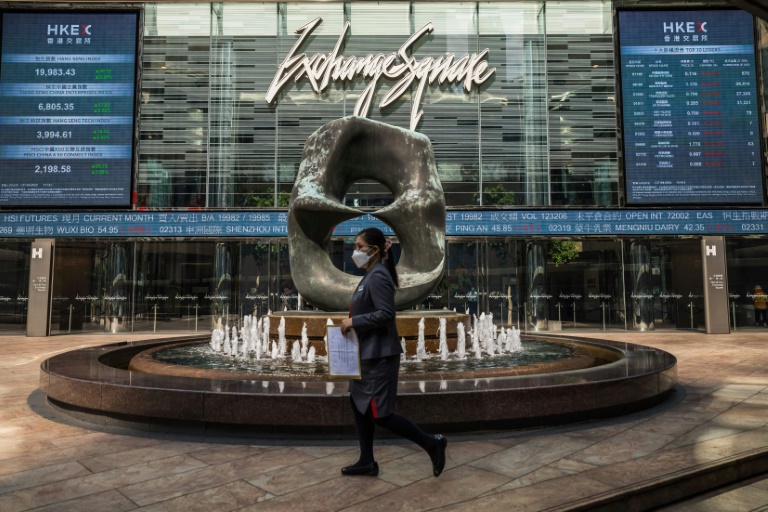
Hong Kong – Hang Seng Index: FLAT at 19,954.39 (close)

Shanghai – Composite: DOWN 0.8 percent at 3,202.14 (close)

New York – Dow: DOWN 1.0 percent at 31,790.87 (close)

Euro/dollar: DOWN at $0.9996 from $1.0015 on Tuesday

Pound/dollar: DOWN at $1.1629 from $1.1656

Euro/pound: UP at 85.95 pence from 85.92 pence

Dollar/yen: DOWN at 138.71 yen from 139.00 yen

West Texas Intermediate: DOWN 2.7 percent at $89.16 per barrel

Brent North Sea crude: DOWN 3.3 percent at $96.00 per barrel

burs-rfj/lcm

Chinese electric carmaker BYD plummets after Buffett sale

Shares in Chinese electric carmaker BYD plunged on Wednesday after its largest backer, Warren Buffett’s Berkshire Hathaway, reduced its stake amid speculation of a potential exit.

Hong Kong-listed shares of the EV manufacturer fell by as much as 13 percent, a day after a regulatory filing showed Berkshire reducing its holdings from 20.04 percent to 19.92 percent.

It ended the day 7.9 percent lower, while its Shenzhen-listed stock finished 7.4 percent down.

The sale of around 1.33 million securities was valued at approximately $47 million.

Electronic carmakers in China were left scrambling after the government response to coronavirus outbreaks this year disrupted supply chains, with plants across the country suspending production for weeks.

While the Shenzhen-based firm reported strong earnings this week, rumours have swelled that the legendary American investor behind Berkshire may be looking to offload his entire stake.

Berkshire first bought 225 million BYD shares in 2008 and has been the biggest stakeholder in the company, now China’s largest EV manufacturer and a major rival to Tesla.

Berkshire sold around 6.3 million shares in BYD between June 30 and August 24, Bloomberg News reported, citing filings from both companies.

BYD told Chinese media that there was “no need to over-interpret” the stake sale, adding that the company was operating normally and had no major moves to disclose.

On Monday, the Shenzhen-based company reported that net income had tripled to 3.6 billion yuan ($521 million) from a year earlier, overcoming supply chain disruptions caused by the pandemic and China’s economic slowdown.

BYD said in a filing that it achieved record output and sales in the first half, with revenue jumping 66 percent year-on-year to 151 billion yuan.

The carmaker added that it was leading the domestic new energy vehicle sector with 24.7 percent market share in the first six months, citing data from the China Automobile Association.

“Investors could interpret this as the beginning of Berkshire closing its position in BYD,” Bridget McCarthy, a market research analyst at hedge fund Snow Bull Capital, told Bloomberg.

“I would expect arguably one of the world’s greatest investors to take some profits after over a decade, especially on his highest-returning investment, percentage-wise.”

Some analysts have argued that BYD’s strong fundamentals, coupled with Beijing’s push to develop its domestic green energy sector, means the company still has room to grow.

“Despite the short term share price struggle, there is value to invest in the company with its solid business model in the medium to long term,” Andy Wong, fund manager at LW Asset Management Advisors in Hong Kong, said.

Last month, a stake identical to the size of Berkshire’s holdings was entered into Hong Kong’s Central Clearing and Settlement System. 

Hong Kong requires anyone who owns more than five percent of a listed company to notify the stock exchange when initiating a trade that changes the stake percentage into the next whole number.

Asian markets mostly drop as traders eye more monetary tightening

Most Asian markets resumed their downward trend Wednesday, with traders fearing the Federal Reserve’s determination to beat inflation with higher interest rates will tip the world’s top economy into recession.

After bouncing from their June lows, global equities are once again taking a hiding from worried investors after Fed chief Jerome Powell warned last week the bank would need to tighten policy much more to succeed in its battle against prices.

Wall Street’s three main indexes fell for a third straight day Tuesday to sit at a one-month low, with healthy data on US consumer sentiment and job openings indicating the economy remained resilient despite recent rate hikes and four-decade-high inflation.

But analysts said the readings were a case of good news being bad news as they would allow the Fed to stick to its plan of lifting borrowing costs further. Expectations are growing for a third successive three-quarter-point increase next month.

Traders are now awaiting the release of US job-creation figures on Friday for a better idea about the state of the economy.

However, commentators said trying to plot a course through the next few months would be tricky owing to inflation and rate increases as well as other issues such as the Ukraine war, geopolitical tensions and China’s Covid-damaged economy.

“What’s clear is that predicting this market is not clean cut,” Angeline Newman, of UBS Global Wealth Management, told Bloomberg Television.

“We are living in a world where conflicting economic signals are making the path of monetary policy very difficult to determine.”

Shanghai dropped after a report on Chinese factory activity showed another contraction, as the sector was buffeted by lockdowns due to Beijing’s zero-Covid strategy and high temperatures that led to energy rationing.

The reading reinforced the view that the world’s number-two economy continued to struggle.

There were also losses in Tokyo, Sydney, Singapore, Wellington, Manila and Bangkok, though Seoul, Jakarta and Taipei rebounded from early losses. Hong Kong was flat.

London, Paris and Frankfurt all fell after reversing a positive start.

“Having seen such a promising start to August, last week’s speech by… Powell appears to have been the final straw for any sort of hope that we might see another positive month for equity markets,” said CMC Markets analyst Michael Hewson.

Worries about an economic slowdown and the possible hit to demand were also dragging on oil, which was on course for a third monthly drop, with both main contracts tumbling more than five percent Tuesday.

However, market watchers pointed out the commodity had plenty of upside potential as investors grapple with a range of supply issues including unrest in Libya and Iraq and expectations that Iran nuclear talks will not end any time soon.

Adding to the upward pressure was news that Russian energy giant Gazprom had shut off gas deliveries for three days from Wednesday via the Nord Stream pipeline through Germany.

– Key figures at around 0810 GMT 

Tokyo – Nikkei 225: DOWN 0.4 percent at 28,091.53 (close)

Hong Kong – Hang Seng Index: FLAT at 19,954.39 (close)

Shanghai – Composite: DOWN 0.8 percent at 3,202.14 (close)

London – FTSE 100: DOWN 0.3 percent at 7,340.96

Euro/dollar: DOWN at $1.0007 from $1.0024 on Tuesday

Pound/dollar: DOWN at $1.1644 from $1.1661

Euro/pound: DOWN at 85.92 pence from 85.95 pence

Dollar/yen: DOWN at 138.59 yen from 138.66 yen

West Texas Intermediate: DOWN 0.5 percent at $91.18 per barrel

Brent North Sea crude: DOWN 0.7 percent at $98.60 per barrel

New York – Dow: DOWN 1.0 percent at 31,790.87 (close)

China's factory activity contracts for second straight month in August

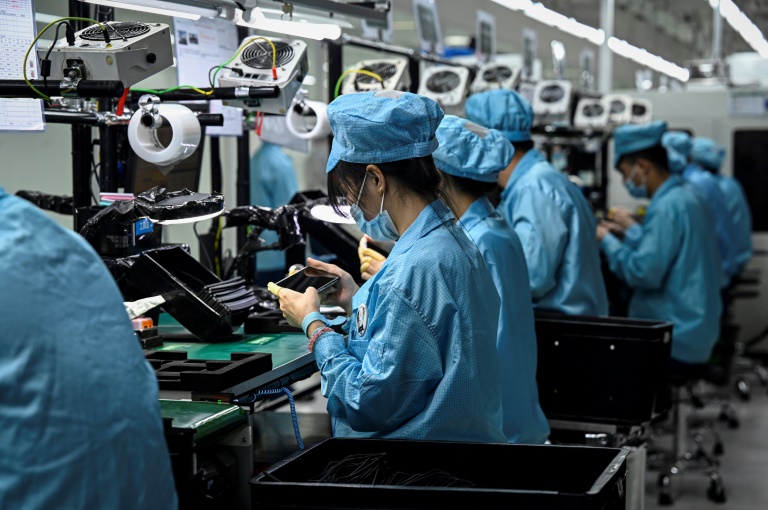
China’s factory activity shrank in August for the second month in a row, official data showed Wednesday, as the sector was hit by strict zero-Covid restrictions and extreme heat.

The Purchasing Managers’ Index (PMI), a key gauge of manufacturing in the world’s second-biggest economy, came in at 49.4, up from July’s 49.0 but still below the 50-point mark separating growth from contraction, National Bureau of Statistics (NBS) data showed.

Sporadic Covid-19 lockdowns around China have dampened consumer enthusiasm and business confidence, while searing temperatures across large parts of the country this summer prompted power rationing for factories.

The economy faced “unfavourable factors including the epidemic and high temperatures” this month, NBS senior statistician Zhao Qinghe said in a statement.

Zhao said the data showed “the recovery of manufacturing production and demand still needs to be strengthened”, though he noted an uptick in activity in agricultural product processing and food producers ahead of the mid-Autumn festival on September 10.

China’s manufacturing PMI has been in contraction territory for five out of the past six months, in the wake of a disruptive months-long lockdown in Shanghai and Covid-related restrictions elsewhere.

But officials show few signs of relaxing strict pandemic curbs, with the southern tech hub of Shenzhen sealing off the world’s largest electronics market this week despite just dozens of daily cases in the city of more than 18 million.

Chinese leaders had originally set a full-year GDP growth target of around 5.5 percent, but with economic expansion of just 0.4 percent in the second quarter, analysts believe it is unlikely to hit that goal.

Zhao noted that while larger businesses saw an expansion in activity this month, small and medium-sized enterprises reported contractions, dragging the overall PMI down.

“China’s economic weakness is increasingly becoming demand-driven,” ANZ’s Greater China chief economist Raymond Yeung, said.

“Consumption and investment sentiment among households and enterprises are weak, increasing the risk of a deflationary spiral.”

China’s non-manufacturing PMI came in at 52.6 points in August, down from 53.8 in July, NBS data showed.

Statistician Zhao said that the accommodation, food and beverage and telecommunications industries saw “sustained rapid growth” in the past month.

But ANZ’s Yeung noted that weak expansion in the service sector “bodes ill for China’s overall growth outlook”.

He said authorities were likely to continue their tough Covid approach in the leadup to a key political meeting in October — the 20th Communist Party Congress.

Asian markets down again as traders eye more monetary tightening

Stock markets resumed their downward trend Wednesday, with traders fearing the Federal Reserve’s determination to beat inflation with higher interest rates will tip the world’s top economy into recession.

After bouncing from their June lows, global equities are once again taking a hiding from worried investors after Fed chief Jerome Powell warned last week the bank would need to tighten policy much more to succeed in its battle against prices.

Wall Street’s three main indexes fell for a third straight day Tuesday to sit at a one-month low, with healthy data on US consumer sentiment and job openings indicating the economy remained resilient despite recent rate hikes and four-decade high inflation.

But analysts said the readings were a case of good news being bad news as they would allow the Fed to stick to its plan of lifting borrowing costs further. Expectations are growing for a third successive three-quarter-point increase next month.

Traders are now awaiting the release of US jobs creation figures on Friday for a better idea about the state of the economy.

But commentators said trying to plot a course through the next few months would be tricky owing to inflation and rate increases as well as other issues such as the Ukraine war, geopolitical tensions and China’s Covid-damaged economy.

“What’s clear is that predicting this market is not clean cut,” Angeline Newman, of UBS Global Wealth Management, told Bloomberg Television.

“We are living in a world where conflicting economic signals are making the path of monetary policy very difficult to determine.”

Hong Kong and Shanghai-led Asian markets opened lower after a report on Chinese factory activity showed another contraction, as the sector was buffeted by lockdowns due to Beijing’s zero-Covid strategy and high temperatures that led to energy rationing.

The reading reinforced the view that the world’s number two economy continued to struggle.

There were also big losses in Tokyo, Seoul, Singapore, Manila and Jakarta.

Worries about an economic slowdown and the possible hit to demand were also dragging on oil, which was on course for a third monthly drop, with both main contracts tumbling more than five percent Tuesday.

However, while they remain wedged below $100 a barrel, market-watchers pointed out the commodity had plenty of upside potential as investors grapple with a range of supply issues including unrest in Libya and Iraq and expectations that Iran nuclear talks will not end anytime soon.

Adding to the upward pressure was news that Russian energy giant Gazprom intends to shut off gas deliveries for three days from Wednesday via the Nord Stream pipeline through Germany.

– Key figures at around 0230 GMT –

Tokyo – Nikkei 225: DOWN 0.6 percent at 28,039.91 (break)

Hong Kong – Hang Seng Index: DOWN 1.3 percent at 19,684.90

Shanghai – Composite: DOWN 0.7 percent at 3,203.54

Euro/dollar: DOWN at $1.0021 from $1.0024 on Tuesday

Pound/dollar: UP at $1.1666 from $1.1661

Euro/pound: DOWN at 85.91 pence from 85.95 pence

Dollar/yen: DOWN at 138.54 yen from 138.66 yen

West Texas Intermediate: UP 0.7 percent at $92.26 per barrel

Brent North Sea crude: UP 0.5 percent at $99.85 per barrel

New York – Dow: DOWN 1.0 percent at 31,790.87 (close)

London – FTSE 100: DOWN 0.9 percent at 7,361.63 (close)

Exec departures at Snap after report of workforce cuts

Two top executives at Snap are leaving to join Netflix, the streaming giant said Tuesday, after a report emerged that the Snapchat parent company is to slash its workforce by a fifth.

Netflix said in a statement that Snap’s chief business officer Jeremi Gorman and Peter Naylor, the vice president of ad sales for the Americas, will be joining the company in September.

The announcement came after tech news website The Verge reported that the southern California-based Snap Inc. plans to lay off about 20 percent of its more than 6,400 employees. or

Snap declined to comment on the report but shares sank more than four percent to less than $10 in after-market trades.

On an earnings call in July, Snap chief financial officer Derek Andersen said the company has seen “macroeconomic challenges develop” through the first half of this year and that headcount was a significant portion of its operating expenses.

Snap reported that its loss in the recently ended quarter nearly tripled to $422 million despite revenue increasing 13 percent under conditions “more challenging” than expected.

A hit with young internet users in its early days, image-centric ephemeral messaging app Snapchat has remained a small player in the social networking space as competition has grown ever more intense.

The number of people using Snapchat daily grew to 347 million in the recently ended quarter, Snap reported.

Snap recast itself a while back as a “camera company,” fielding offerings such as picture-taking glasses called Spectacles and a pocket-sized Pixy flying camera drone.

“Long-term the most exciting opportunity is (augmented reality) and we’re investing heavily around the future of AR,” Andersen said in the earnings call.

Meanwhile, the battle for people’s attention online grows increasingly fierce as established titans such as Meta and Google adapt offerings to changing trends and relative newcomers such as TikTok grab the spotlight.

Stocks extend Fed-induced sell-off into third day

Stock markets mostly tumbled again on Tuesday, extending losses that were sparked by last week’s Federal Reserve warning that more monetary tightening was on the way.

London’s FTSE 100 ended down after a public holiday closure the day before, while the Paris CAC 40 fell after staging a rally earlier in the day.

Wall Street indices started the morning in the green, only for the rebound to fizzle and dash analyst predictions of “Turnaround Tuesday”.

“US stocks turned negative after confidence and job opening data supported the argument for the Fed to stick to an aggressive stance with fighting inflation,” said Edward Moya, analyst at OANDA trading platform.

“Turnaround Tuesday disappeared faster than dessert does at the Moya household.”

The Frankfurt DAX bucked the trend to end the day up 0.5 percent.

Most markets have been slumping since Friday after Federal Reserve chief Jerome Powell warned of more interest rate hikes to fight runaway four-decade high inflation, even at the cost of economic pain.

A closely-watched US survey found Americans consumers to be happier about the state of the economy than expected, and more willing to spend.

The strong data will boost the idea that the US economy does not need extra help from the Fed, said Ipek Ozkardeskaya, Swissquote Bank analyst.

“Cherry on top: the consumer sentiment regarding the future is improving,” she added. 

“Hence, there is no reason for the Fed to soften its stance.” 

– Energy woes –

Central banks are scrambling worldwide to tame consumer prices that have surged higher since Russia invaded Ukraine in late February.

German inflation data showed consumer prices rose by 7.9 percent in the year to August as the ongoing energy crisis further stoked price pressures.

In Spain, the inflation rate slowed to 10.4 percent in August as fuel prices eased, but it remained elevated due to rising electricity and food prices.

The European Central Bank — which raised interest rates for the first time in over a decade in July — is expected to hike them again when it meets next week.

Energy prices retreated on Tuesday, however, with oil contracts tanking on fears about a major hit to demand from any global economic slowdown — and more Covid restrictions in key consumer market China.

Brent North Sea crude dipped below $100 per barrel.

Natural gas prices, which have soared this year over supply disruptions from key producer Russia, dipped in Europe as German Chancellor Olaf Scholz said government measures have left his country better prepared to cope with further delivery cuts in the winter.

Many European countries are facing severe supply problems as Moscow turns off the gas taps in response to EU military and diplomatic backing for Ukraine.

Russian energy giant Gazprom plans to suspend gas deliveries through the Nord Stream pipeline, which runs to Germany, for three days of “maintenance” work from Wednesday.

Elsewhere, Asian stocks indices diverged on Tuesday, winning limited support from bargain-buying.

A record 96 percent on-year drop in earnings from China’s largest developer Country Garden Holdings served as a grim reminder of the country’s beleaguered property sector.

Investors are also anxious about “flaring geopolitical tensions”, said Naeem Aslam of AvaTrade, especially as Taiwan and Beijing exchanged angry barbs over Chinese drone incursions at an outlying Taiwanese island.

– Key figures at around 1545 GMT –

London – FTSE 100: DOWN 0.9 percent at 7,361.63 points (close)

Frankfurt – DAX: UP 0.5 percent at 12,961.14 (close)

Paris – CAC 40: DOWN 0.2 percent at 6,210.22 (close)

EURO STOXX 50: DOWN 0.2 percent at 3,561.92 

New York – Dow: DOWN 0.8 percent at 31,838.l29

Tokyo – Nikkei 225: UP 1.1 percent at 28,195.58 (close)

Hong Kong – Hang Seng Index: DOWN 0.4 percent at 19,949.03 (close)

Shanghai – Composite: DOWN 0.4 percent at 3,227.22 (close)

Euro/dollar: UP at $0.9993 from $0.9972 on Monday

Pound/dollar: DOWN at $1.1636 from $1.1709

Euro/pound: UP at 85.89 pence from 85.38 pence

Dollar/yen: UP at 138.93 yen from 138.68 yen

West Texas Intermediate: DOWN 5.39 percent at $91.80 per barrel

Brent North Sea crude: DOWN 4.87 percent at $97.93 per barrel

burs-rox/lth

In shadow of abandoned US airbase, Bagram's economy withers

For years, the sprawling military base at Bagram, just north of Kabul, was a potent symbol of the United States’ two decades of war in Afghanistan.

The sprawling complex included an air base that was the linchpin of the US invasion; a prison where rights groups allege widespread violations occurred; and a residential area that featured swimming pools, cinemas and spas.

But weeks before Washington officially ended its military presence in Afghanistan last August, US troops left the airbase in the dead of night.

Today, the military base is occupied by the Taliban, who took over the country in a swift offensive as US forces were exiting.

The US departure from Bagram has also seen the collapse of the economy in the nearby town of the same name, an illustration of how Afghanistan’s fortunes were so heavily tied to the war and foreign aid.

“Today, I’m jobless. I don’t know much about politics, but the exit of US forces from the base is a big economic loss,” said Saifulrahman Faizi, one of the town’s 80,000 residents.

Faizi earned $30 a day when he was employed at the base, at a time when hundreds would queue for hours outside the compound in the hope of getting work.

“Now, nobody goes there. Everything has just crashed, everybody is struggling”, he said.

– Shuttered shops –

Nowhere is the town’s economic collapse more evident than in the main market.

It is marked by rows of shuttered shops and warehouses, and those that remain open have seen sales plummet. 

Shah Wali, a 46-year-old grocery store keeper, said he used to earn an income of between 20,000 and 30,000 Afghanis ($230 and $340). 

Today, he can barely pay his rent.

“With the Islamic Emirate (Taliban) coming to power, peace has returned but business has gone,” Wali told AFP, clutching his prayer beads.

At the peak of the US invasion, Bagram was home to tens of thousands of troops and contractors, with the town serving as a hub for tons of supplies that would service the base.

The airfield was first built by the Americans for their Afghan ally during the Cold War in the 1950s.

The Soviet Union vastly expanded it after the Red Army invaded Afghanistan in 1979.

After their withdrawal, the base was controlled by the Moscow-backed government, and later by the shaky mujahideen administration during the 1990s civil war.

With the Taliban seizing power last year, the airfield is now under their control.

– ‘Empty town’ –

When the US military pulled out, it took much of its military hardware home, but tons of civilian equipment was left behind. 

For several months, the town managed to thrive on a booming scrap business, but residents say that now that, too, is dying.

Shops that sold used gym equipment, generators, air conditioners and spare car parts are either shut or receive few orders.

Several houses are now deserted, their residents having moved to Kabul or elsewhere in search of work.

Many who had worked at the base have also fled the country, fearing reprisals from the Taliban.

“Half the people have gone, the town feels so empty,” said Faizi.

Stocks extend Fed-induced sell-off

Stock markets mostly tumbled again on Tuesday, extending losses that were sparked by last week’s Federal Reserve warning that more monetary tightening was on the way.

London’s FTSE 100 was down in afternoon deals after a public holiday closure the day before, while the Paris CAC 40 fell after staging a rally earlier in the day.

Wall Street indices started the morning in the green, only for the rebound to fizzle.

The Frankfurt DAX bucked the trend as it rose 0.5 percent, though lower than earlier in the day.

Most markets have been slumping since Friday after Federal Reserve chief Jerome Powell warned of more interest rate hikes to fight runaway four-decade high inflation, even at the cost of economic pain.

Oil prices tanked Tuesday on fears about a major hit to demand from any global economic slowdown — and news of more Covid restrictions in key consumer China.

Brent North Sea crude dipped below $100 per barrel.

– Energy woes –

Central banks are scrambling worldwide to tame consumer prices that have surged higher since Russia invaded in Ukraine in late February

German inflation data showed consumer prices rose by 7.9 percent in the year to August as the ongoing energy crisis further stoked price pressures.

In Spain, the inflation rate slowed to 10.4 percent in August as fuel prices eased, but it remained elevated due to rising electricity and food prices.

The European Central Bank, which raised interest rates for the first time in over a decade in July, is expected to hike them again when it meets next week.

Natural gas prices dipped Tuesday despite jitters over supply disruptions from key producer Russia.

Europe’s benchmark Dutch TTF gas contract edged down to 272.500 euros per megawatt hour, having struck a March peak late on Friday.

Many European countries are facing severe supply problems as Moscow turns off the gas taps in response to EU military and diplomatic backing for Ukraine

Russian energy giant Gazprom plans to suspend gas deliveries through the Nord Stream pipeline, which runs to Germany, for three days of “maintenance” work from Wednesday.

In France, French energy firm Engie said Tuesday that Gazprom was further slashing its gas deliveries to the company “due to a disagreement between both sides over the execution of contracts”.

Elsewhere, Asian stocks indices diverged on Tuesday, winning limited support from bargain-buying.

In China, a record 96 percent on-year drop in first-half earnings from the country’s largest developer Country Garden Holdings also served as a grim reminder of China’s beleagured property sector.

– Key figures at around 1330 GMT –

London – FTSE 100: DOWN 0.6 percent at 7,384.94 points

Frankfurt – DAX: UP 0.5 percent at 12,962.09

Paris – CAC 40: DOWN 0.1 percent at 6,214.24 

EURO STOXX 50: DOWN 0.1 percent at 3,567.30

New York – Dow: DOWN 0.6 percent at 31,921.35

Tokyo – Nikkei 225: UP 1.1 percent at 28,195.58 (close)

Hong Kong – Hang Seng Index: DOWN 0.4 percent at 19,949.03 (close)

Shanghai – Composite: DOWN 0.4 percent at 3,227.22 (close)

Euro/dollar: UP at $1.0008 from $0.9972 on Monday

Pound/dollar: DOWN at $1.1664 from $1.1709

Euro/pound: UP at 85.79 pence from 85.38 pence

Dollar/yen: UP at 138.72 yen from 138.68 yen

West Texas Intermediate: DOWN 4.84 percent at $92.31 per barrel

Brent North Sea crude: DOWN 5.05 percent at $99.78 per barrel

burs-rox/lth

Eurozone equities bounce from Fed-induced sell-off

Eurozone stocks rebounded Tuesday from recent losses, but London gains were capped as investors played catch-up after a long weekend.

In midday deals, Frankfurt equities jumped 1.9 percent ahead of key German inflation data and Paris won 1.2 percent.

Both markets had slumped Monday as traders digested Federal Reserve chief Jerome Powell’s warning of more interest rate hikes to fight runaway inflation.

London eked out gains on Tuesday after a public holiday closure the day before, while the euro held above one dollar.

Sentiment had soured late Friday after Powell indicated more monetary tightening was needed to bring inflation down from four-decade highs, news that sent Wall Street into a tailspin.

– Positive note –

“European markets have started the week on a positive note following Friday’s sell-off on Wall Street after Powell struck a hawkish tone,” said Interactive Investor analyst Victoria Scholar on Tuesday.

“US futures are pointing to a bounce back, as markets look set to regain some lost ground.”

German inflation data is expected to show how the ongoing energy crisis has further stoked price pressures in the eurozone’s powerhouse economy.

Natural gas prices however dipped Tuesday despite jitters over supply disruptions from key producer Russia.

Europe’s benchmark Dutch TTF gas contract slid to 259.405 euros per megawatt hour, having stuck a March peak late on Friday.

French energy firm Engie said Tuesday that Russian energy giant Gazprom was slashing its natural gas deliveries “due to a disagreement between both sides over the execution of contracts”.

Engie added in a statement that Russian gas supplies had already been reduced drastically after Russia invaded Ukraine in February.

Many European countries are facing severe supply problems as Moscow turns off the gas taps in response to EU military and diplomatic backing for Ukraine.

Asian stocks indices diverged on Tuesday, winning limited support from bargain-buying.

Confidence remains at a premium as traders contemplate the prospect of more Fed rate hikes and a possible recession.

Oil tanked Tuesday on fears about a major hit to demand from any global economic slowdown — and news of more Covid restrictions in key consumer China.

– Key figures at around 1100 GMT –

London – FTSE 100: UP 0.1 percent at 7,435.36 points

Frankfurt – DAX: UP 1.9 percent at 13,141.45

Paris – CAC 40: UP 1.2 percent at 6,298.71

EURO STOXX 50: UP 1.5 percent at 3,622.75

Tokyo – Nikkei 225: UP 1.1 percent at 28,195.58 (close)

Hong Kong – Hang Seng Index: DOWN 0.4 percent at 19,949.03 (close)

Shanghai – Composite: DOWN 0.4 percent at 3,227.22 (close)

New York – Dow: DOWN 0.6 percent at 32,098.99 (close)

Euro/dollar: UP at $1.0034 from $0.9972 on Monday

Pound/dollar: UP at $1.1736 from $1.1709

Euro/pound: UP at 85.50 pence from 85.38 pence

Dollar/yen: DOWN at 138.34 yen from 138.68 yen

West Texas Intermediate: DOWN 1.8 percent at $95.23 per barrel

Brent North Sea crude: DOWN 2.4 percent at $102.53 per barrel

burs/rfj/jj

Close Bitnami banner
Bitnami