Chinese Business

Stocks mostly retreat over recession fears

Stock markets mostly dropped on Friday, with investors focussed firmly on the outlook for interest rate hikes as central banks battle to bring down sky-high inflation.

The dollar rose sharply against its main rivals, while oil prices steadied as traders assessed the risk of a possible global recession.

European gas prices were heading towards a fresh record-high closing price as the Ukraine war impacts supplies.

Elsewhere, bitcoin slumped nearly nine percent as investors shunned risky assets.

A two-month equity markets rally from June lows appears to have run out of steam. 

“Stocks will most likely struggle for direction for the rest of the summer as Wall Street is still uncertain with how aggressive the Fed will be in September,” said OANDA trading platform analyst Edward Moya.

Patrick O’Hare, analyst at Briefing.com, said the recent rally has been driven by the market “embracing a belief that the Fed won’t have to get overly restrictive with its monetary policy before ultimately shifting to an easing stance.”

The gains have come in the face of a number of problems that have caused unease on trading floors, including China-US tensions, the Ukraine war, supply chain snarls and extreme weather across much of the northern hemisphere.

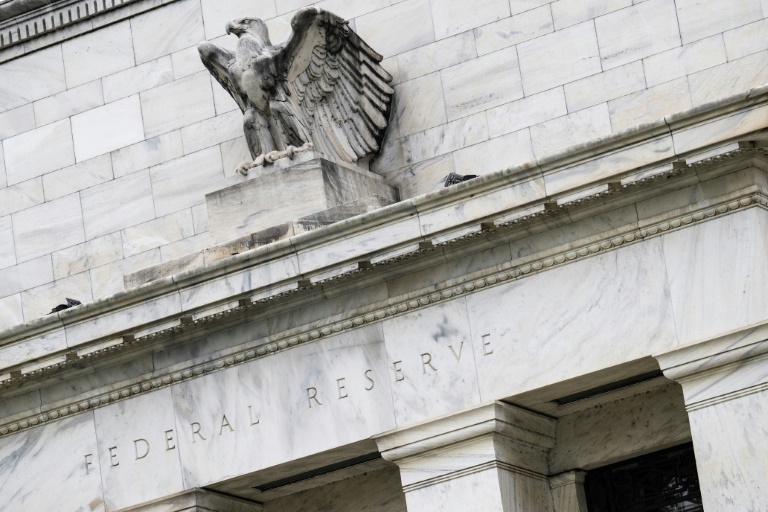
The US Federal Reserve and other central banks have begun hiking interest rates to get a grip on soaring inflation, but those increases had been largely priced into the stock market in the first half of the year when equities slumped.

– Darkening clouds –

Thus, the darkening clouds on the economic horizon mean that central banks may not need to raise rates as sharply as many investors believed, triggering the rebound in stocks.

A statement by policymakers and comments from Fed chief Jerome Powell after last month’s board meeting suggested they could be considering slowing the pace of rate hikes as the economy slows.

That was followed by a drop in US inflation, which lifted markets.

But there has been downward pressure after minutes from the Fed’s most recent meeting showed policymakers are determined to keep lifting borrowing costs until prices are brought under control.

Several officials have also recently reasserted the need to continue to tighten monetary policy to get inflation down from four-decade highs, and poured cold water on hopes for possible rate cuts in the new year.

Data this week showing British inflation had jumped into the double digits, as well as German producer price inflation surging to 37 percent on higher energy costs, also dampened sentiment on the chances monetary policymakers will tap the brakes on interest rate hikes.

“The penny appears to have dropped that central banks are likely to have to go much harder on rates if they are to have any chance of getting on top of the inflation genie,” said market analyst Robert Hewson at CMC Markets. 

The longer interest rates remain higher, the greater is the risk of a possible recession. 

All eyes are now on next week’s central bankers’ symposium in Jackson Hole, Wyoming, where finance chiefs and central bankers will speak, with all attention on the utterances of Powell.

Wall Street’s three main indices were lower in morning trading, with the tech-heavy Nasdaq Composite slumping two percent.

In Europe, London’s blue-chip FTSE-100 index just barely managed to stay in the green, but Paris and Frankfurt stocks slumped.

Most Asian markets fell.

– Key figures at around 1530 GMT –

New York – Dow: DOWN 0.8 percent at 33,722.94 points

EURO STOXX 50: DOWN 1.3 percent at 3,727.33

London – FTSE 100: UP 0.1 percent at 7,550.37 (close)

Frankfurt – DAX: DOWN 1.1 percent at 13,544.52 (close)

Paris – CAC 40: DOWN 0.9 percent at 6,495.83 (close)

Tokyo – Nikkei 225: FLAT at 28,930.33 (close)

Hong Kong – Hang Seng Index: UP 0.1 percent at 19,773.03 (close)

Shanghai – Composite: DOWN 0.6 percent at 3,3258.08 (close)

Euro/dollar: DOWN at $1.0039 from $1.0095 Thursday

Pound/dollar: DOWN at $1.1804 from $1.1937

Euro/pound: UP at 85.04 pence from 84.56 pence

Dollar/yen: UP at 137.16 yen from 135.88 yen

West Texas Intermediate: UP 0.6 percent at $91.00 per barrel

Brent North Sea crude: UP 0.2 percent at $96.81 per barrel

burs-rl/spm
China banks to repay more customers after protests

Chinese regulators on Friday offered repayments to more customers of rural banks whose withdrawals were frozen, in the ongoing saga of one of the country’s biggest-ever banking scandals that triggered rare mass protests. 

China’s rural banking sector has been hit hard by Beijing’s efforts to rein in a property bubble and spiralling debt, in a financial crackdown that has had ripple effects across the world’s second-largest economy.

Four banks in Henan province froze cash withdrawals in mid-April as regulators cracked down on mismanagement, locking hundreds of thousands of customers out from their funds and sparking sporadic protests.

The provincial banking regulator in mid-July said individual customers with deposits of up to 50,000 yuan ($7,341) would get their money back, after one of the largest protests erupted into violence.

Regulators have since been gradually offering repayments to more customers with deposits of higher value. 

On Friday, the Henan banking and insurance regulator promised to repay those who had deposited between 350,000 to 400,000 yuan ($51,300 to $58,600), saying in a statement that this group would begin receiving it on August 22.

The statement added that “repayments of (deposit amounts) under 350,000 will continue to be paid”, suggesting that not all customers with smaller bank balances had received their money yet.

Authorities have named the four banks as well as another rural bank in nearby Anhui province as involved in a scheme to defraud investors, and launched a police investigation.

The Henan banking scandal has dealt an unprecedented blow to public confidence in China’s financial system owing to the size and scale of the fraud, analysts say, with the banks involved allegedly operating illegally for more than a decade.

Chinese authorities are desperate to avoid disruptions to social stability just months away from a major congress of the ruling Communist Party. 

A July 10 mass demonstration in Henan’s provincial capital Zhengzhou was violently quashed, with demonstrators forced onto buses by police and beaten, according to eyewitness accounts given to AFP and verified photos on social media.

Chinese city dims lights in heatwave power crunch

A provincial capital in southwest China has dimmed outdoor advertisements, subway lighting and building signs to save energy, official announcements said, as the area battles a power crunch triggered by record-high temperatures.

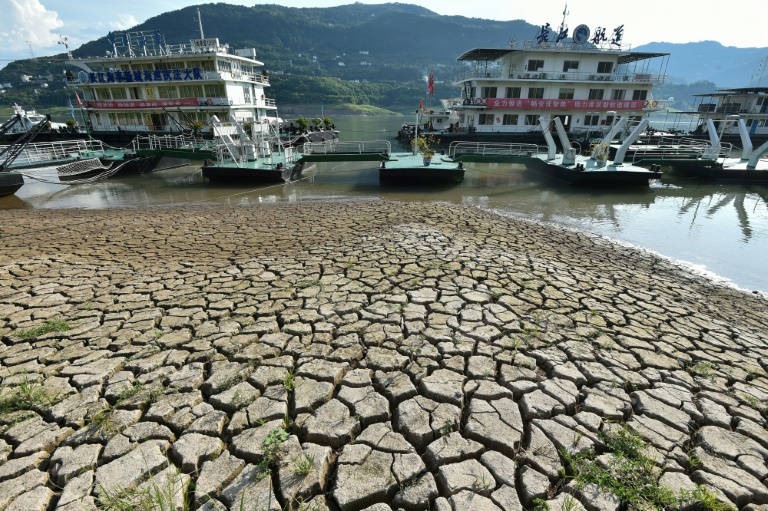
The mercury has soared beyond 40 degrees Celsius (104 Fahrenheit) in Sichuan province this week, fuelling massive demand for air conditioning and drying up reservoirs in a region reliant on dams for most of its electricity.

Factories including a joint venture with Japanese car giant Toyota in provincial capital Chengdu have been forced to halt work, while millions in another city Dazhou grappled with rolling power cuts.

“Hot and muggy weather has caused the city’s electricity supply for production and daily life to be pushed to its limit,” Chengdu’s urban management authorities said in a notice on social media Thursday.

Faced with a “most severe situation”, the city — home to over 20 million people — ordered landscape illumination and outdoor advertising lights to be switched off in notices issued Tuesday, the statement said. 

Building name signs will also be darkened.

The Chengdu metro said in a video on China’s Twitter-like platform Weibo that it would also turn off advertisement lights and “optimise” the temperature in stations to save energy.

Photos circulating on Weibo showed dimmed lights on metro platforms, walkways and in malls, with commuters walking in partial darkness.

The searing heat is also drying up the critical Yangtze River, with water flow on its main trunk about 50 percent lower than the average over the last five years, state media outlet China News Service reported Thursday.

Sichuan’s power woes could have ripple effects on the wider Chinese economy — the province is a key supplier of energy generated by hydropower to eastern industrial powerhouses including Jiangsu and Zhejiang.

China is battling extreme weather on several fronts, with 23 people killed and eight still missing after a flash flood in the northwest of the country on Thursday sparked by torrential rains.

Weather authorities in the eastern Jiangsu province warned drivers of tyre puncture risks on Friday as the surface temperature of some roads was poised to hit 68 degrees Celsius.

The China Meteorological Administration earlier said the nation was going through its longest period of sustained high temperatures since records began in 1961.

Scientists say extreme weather across the world has become more frequent due to climate change and that urgent global cooperation is needed to slow an impending disaster.

The world’s two largest greenhouse gas emitters are the United States and China. 

But this month Beijing announced it was freezing its cooperation with Washington on global warming in protest at a visit by US House Speaker Nancy Pelosi to Taiwan.

Fuel price hikes, scarce rice add to hardship in Myanmar

Dozens of people queue under monsoon drizzle for subsidised cooking oil in Myanmar’s commercial hub Yangon, waiting for one of the many commodities that have become scarce as economic misery strikes the city.

The country’s economy tanked following a military coup last year and has been further rattled by the junta’s attempts to seize foreign exchange as well as erratic rules governing businesses and imports.

Living standards are being hammered by global commodity price spikes sparked by Russia’s invasion of Ukraine, leaving many struggling to get by and relying on subsidies or charity to put food on the table.

“People can’t spend much of their income on food because of higher commodity prices,” said 55-year-old housewife Khin Khin Than as she waited to fill her plastic bottle with oil sold by a local association.

The market price for roughly 1.6 kilograms of oil has rocketed to 9,000 kyat ($4.25) from 5,000 kyat, she said. 

“If only one person is working, a family won’t have much money left for food.”

In July the World Bank said about 40 percent of the population were living under the national poverty line.

Consumer Price Index inflation hit 17.3 percent year-on-year in March, it added.

The price of rice has also shot up thanks to increased transport costs and as the military and anti-junta fighters turn swathes of the country into battlegrounds.

Even the state-backed Global New Light of Myanmar newspaper carries almost daily reports on the rising cost of rice, eggs, vegetables, bus travel and rent.

Last week the price of a litre of diesel jumped by around six US cents overnight, state media reported, to a high of 2,440 kyat ($1.15) per litre.

On the day before last year’s coup, customers in Yangon were paying 695 kyat at the pump in Yangon according to industry figures.

This week the junta announced it had formed a steering committee to purchase fuel from ally Russia, but gave no details on when or how this would begin.

Many people are relying on charity to make ends meet.

“If we cook at home, there is no electricity, rice is expensive to buy,” said Lay Lay, 68, one of hundreds queuing at a monastery for a free meal of curry and rice.

“Cooking costs are too high for someone who is retired.”

Ashin Ottamasiri, who supervises the distribution, said his monastery is giving out coupons to 500 people every day for food the monks cook using ingredients donated to them.

“But some days there are more than 600 people,” he said. “If we run out of rice and curry, we give cakes, snacks and fruits.”

“I can’t give shelter for many people but I can share food so people will have meals like I do.”

Chinese city dims lights in heatwave power crunch

A provincial capital in southwest China has dimmed outdoor advertisements, subway lighting and building signs to save energy, official announcements said, as the area battles a power crunch triggered by record-high temperatures.

The mercury has soared beyond 40 degrees Celsius (104 Fahrenheit) in Sichuan province this week, fueling massive demand for air conditioning and drying up reservoirs in a region reliant on dams for most of its electricity.

Factories including a joint venture with Japanese car giant Toyota in provincial capital Chengdu have been forced to halt work, while millions in another city Dazhou grappled with rolling power cuts.

“Hot and muggy weather has caused the city’s electricity supply for production and daily life to be pushed to its limit,” Chengdu’s urban management authorities said in a notice on social media Thursday.

Faced with a “most severe situation”, the city — home to over 20 million people — ordered landscape illumination and outdoor advertising lights to be switched off in notices issued Tuesday, the statement said. 

Building name signs will also be darkened.

And Chengdu metro said in a video on China’s Twitter-like Weibo platform that it would also turn off advertisement lights and “optimise” the temperature in stations to save energy.

Photos circulating on Weibo showed dimmed lights on metro platforms, walkways and in malls, with commuters walking in partial darkness.

The searing heat is also drying up the critical Yangtze River, with water flow on its main trunk about 51 percent lower than the average over the last five years, state media outlet China News Service reported Thursday.

Sichuan’s power woes could also have ripple effects on the wider Chinese economy — the province is a key supplier of energy generated by hydropower, including to eastern industrial powerhouses like Jiangsu and Zhejiang.

China is battling extreme weather on several fronts, with 17 people killed in a flash flood in the northwest of the country on Thursday following torrential rains.

Meanwhile, weather authorities in the eastern Jiangsu province warned drivers of tire puncture risks on Friday as the surface temperature of some roads were poised to hit 68 degrees Celsius.

The China Meteorological Administration earlier said the country was going through its longest period of sustained high temperatures since records began in 1961.

Scientists say extreme weather across the world has become more frequent due to climate change and that urgent global cooperation is needed to slow an impending disaster.

The world’s two largest emitters are the United States and China. 

But earlier this month Beijing announced it was freezing its cooperation with Washington on global warming in protest at a visit by US House Speaker Nancy Pelosi to Taiwan.

Power shift for Mumbai's double-decker buses

India’s entertainment capital is expanding its fleet of London-style red double-decker buses nearly a century after they made their debut — this time as electric vehicles.

The first of 200 new buses are expected to start service on Mumbai’s busy roads from December, joining nearly 400 single-floor EVs already in operation.

India — home to 1.4 billion people — is the world’s third-biggest carbon emitter, and the government has pledged to reach net-zero emissions by 2070. 

The drive to electrify public transport is fuelled in part by the need to reduce pollution in cities with some of the world’s worst air.

The electric bus was developed by Switch Mobility, an arm of Indian auto manufacturing giant Ashok Leyland. 

Similar electric double-deckers built by the company were rolled out in London in 2014.

“We want common people to use electric mobility and achieve their goals of net-zero,” Switch Mobility India chief executive Mahesh Babu told AFP at Thursday’s unveiling of the new fleet.

The Switch EiV 22 vehicle, built in India, has 65 passenger seats and a battery pack that would give it a range of 250 kilometres (155 miles).

Fossil fuel-powered red double-deckers made their Mumbai debut in 1937 and up to 900 of them worked city routes at the peak of their operations.

The ageing fleet has been slowly phased out since the 1990s and now less than 50 operate in the city.

Asian markets drift as investors assess Fed outlook

Stocks swung in Asia on Friday as investors tried to assess the Federal Reserve’s plans for lifting interest rates to fight inflation, with mixed data and differing opinions by bank officials providing little clarity.

The rally across markets from their June lows appears to have run out of steam this week after minutes from the Fed’s most recent meeting showed it was determined to keep lifting borrowing costs until prices were brought under control. 

The gains have come in the face of a number of problems that have caused unease on trading floors, including China-US tensions, the Ukraine war, supply chain snarls and extreme weather across much of the northern hemisphere.

A statement by policymakers and comments from Fed boss Jerome Powell after last month’s board meeting suggested they could be considering slowing the pace of rate hikes as the economy slows.

That was followed by a drop in inflation, which lifted markets, but was followed by several officials reasserting the need to continue to tighten monetary policy to get inflation down from four-decade highs.

This week’s minutes and comments from a number of Fed top brass reinforced that view, with some pouring cold water on hopes for possible rate cuts in the new year.

All eyes are now on next week’s central bankers symposium in Jackson Hole, Wyoming, where finance chiefs and central bankers will speak with all attention on the utterances of Powell.

“We don’t see how the Fed can pivot when they haven’t achieved anything pretty much,” said Marco Pirondini, of Amundi US. “The market will have to become more realistic on this.”

Still, Wall Street’s three main indexes edged up after Wednesday’s losses.

But Asian traders moved a little more cautiously.

Tokyo, Hong Kong, Sydney, Taipei, Manila and Jakarta rose but Shanghai, Singapore, Seoul and Wellington were down.

The prospect of tighter US monetary policy for an extended period lifted the dollar back up to multi-year highs against its peers.

And OANDA’s Edward Moya warned that markets would remain wobbly for a while.

“Stocks will most likely struggle for direction for the rest of the summer as Wall Street is still uncertain with how aggressive the Fed will be in September,” he said in a note.

“Traders however will continue to pay close attention to developments with the war in Ukraine.

“Turkish President (Recep Tayyip) Erdogan noted that he discussed ways on ending the war with (Ukrainian) President (Volodymyr) Zelensky. An imminent end to the war seems unlikely, but any de-escalations or improved passages for Ukraine grain exports would be welcome news for risk appetite.

However, others remained optimistic that the recent gains could be maintained.

Lewis Grant, of Federated Hermes, added: “We remain optimistic that the current rally will build into a longer term bull market, but cognisant that geopolitical risks remain elevated and it is too early to dismiss the possibility that we are witnessing a bear market rally.

“Investor risk appetite remains fragile.”

– Key figures at around 0230 GMT –

Tokyo – Nikkei 225: UP 0.1 percent at 28,967.64 (break)

Hong Kong – Hang Seng Index: UP 0.4 percent at 19,834.61

Shanghai – Composite: DOWN 0.1 percent at 3,273.79

Euro/dollar: DOWN at $1.0078 from $1.0095 Thursday

Pound/dollar: DOWN at $1.1917 from $1.1937

Euro/pound: DOWN at 84.54 pence from 84.56 pence

Dollar/yen: UP at 136.16 yen from 135.88 yen

West Texas Intermediate: DOWN 0.2 percent at $90.34 per barrel

Brent North Sea crude: DOWN 0.2 percent at $96.40 per barrel

New York – Dow: UP 0.1 percent at 33,999.04 (close)

London – FTSE 100: UP 0.4 percent at 7,541.85 (close) 

— Bloomberg News contributed to this story —

Stocks mostly up as markets digest Fed rate signals

US and European stock markets mostly rose on Thursday as investors digested US economic data and Federal Reserve signals that it will maintain its agressive monetary-tightening policy to combat inflation. 

European equities closed higher after seesawing earlier in the day.

Wall Street indices were mixed, with the Dow Jones Industrial Average flat near midday while the S&P 500 and the tech-rich Nasdaq were up after closing lower on Wednesday.

Major Asian markets finished the day in the red.

“Closely watched minutes of the last Federal Reserve meeting show US central bank policymakers are set to stay firmly on the path of rate rises,” noted Susannah Streeter, senior investment and markets analyst at Hargreaves Lansdown.

While policymakers said they would eventually have to start tempering their tightening pace, they said they would keep borrowing costs elevated “for some time”, though admitted there was a risk of going too far and damaging the economy.

But Craig Erlam, analyst at OANDA trading platform, said Wednesday’s minutes could also indicate that the Fed “is aware of the risks and may therefore ease off the break as soon as the opportunity arises in order to avoid tightening too much”.

“It also raises the possibility of a swift U-turn from hiking rates to cutting them as markets have indicated recently and policymakers have pushed back against,” he said.

“Needless to say, there are many more twists and turns to come.”

US markets were also reacting to US industry data showing that existing home sales fell sharply in July, the sixth consecutive monthly decline as borrowing costs rise.

Other data in focus were better-than-expected initial jobless claims and manufacturing activity in the very industrialised Philadelphia area, which was back in the green in August after two straight months of contraction.

Oil prices, meanwhile, rallied by more than 2.5 percent after data showed US crude inventories dropped last week due to strong domestic demand and higher exports.

Elsewhere, Norway’s central bank raised interest rates by half a percentage point to 1.75 percent, and flagged another hike in September.

Turkey’s central bank, meanwhile, stunned the markets by lowering its main interest rate even as inflation soared to a 24-year high — the opposite approach of other countries facing rising prices.

Turkish President Recep Tayyip Erdogan subscribes to the unorthodox belief that high interest rates cause inflation rather than rein it in.

– Key figures at around 1545 GMT –

New York – Dow: FLAT at 33,980.87 points

London – FTSE 100: UP 0.4 percent at 7,541.85 (close) 

Frankfurt – DAX: UP 0.5 percent at 13,697.41 (close)

Paris – CAC 40: UP 0.5 percent at 6,557.40 (close)

EURO STOXX 50: UP 0.6 percent at 3,777.38

Tokyo – Nikkei 225: DOWN 1.0 percent at 28,942.14 (close)

Hong Kong – Hang Seng Index: DOWN 0.8 percent at 19,763.91 (close)

Shanghai – Composite: DOWN 0.5 percent at 3,277.54 (close)

Euro/dollar: DOWN at $1.0120 from $1.0178 Wednesday

Pound/dollar: DOWN at $1.1984 from $1.2050

Euro/pound: UP at 84.47 pence from 84.44 pence

Dollar/yen: UP at 135.28 yen from 135.08 yen

Brent North Sea crude: UP 2.7 percent at $96.15 per barrel

West Texas Intermediate: UP 2.5 percent at $90.33 per barrel

Crisis-hit Sri Lanka warns of record 8% economic contraction

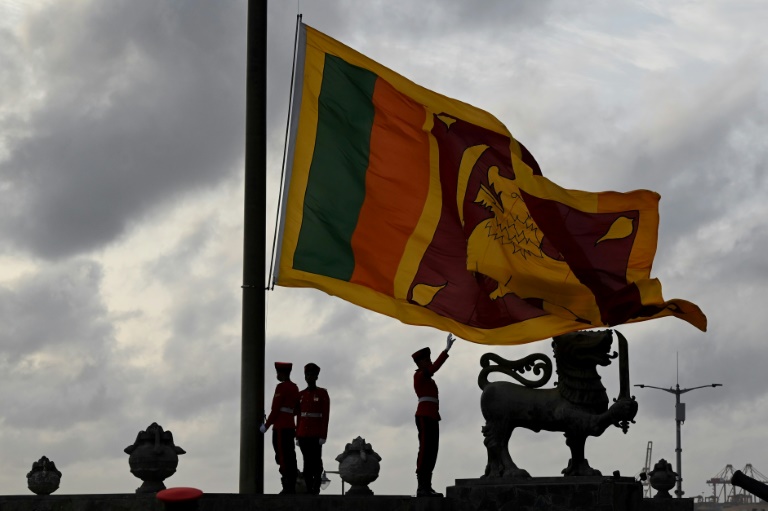
Sri Lanka’s economic meltdown will result in a record contraction of at least eight percent this year but the public could soon expect some relief from runaway inflation, the head of the country’s central bank said Thursday.

The island nation defaulted on its $51 billion foreign debt in April and is seeking an International Monetary Fund bailout after months of food, fuel and medicine shortages. 

Its 22 million people have also suffered through lengthy blackouts and spiralling cost-of-living pressures after scarcity and a currency crash drove up prices.

The Central Bank of Sri Lanka had already projected the economy could shrink a painful 7.5 percent for the calendar year, dwarfing the previous record 3.6 percent contraction in 2020 as the pandemic raged.

“But now we think it will exceed 8.0 percent,” governor Nandalal Weerasinghe told reporters in Colombo.

He said inflation — officially running at 60.8 percent — will peak at “about 65 percent” in September, followed by a gradual easing caused by lower demand and improvements in supplies.

The foreign exchange shortage that sparked the economic crisis had eased thanks to better currency inflows and lower imports, he added. 

“We are now able to finance the most essential imports such as petrol and diesel and medicines,” Weerasinghe said.

At the peak of Sri Lanka’s fuel shortages, motorists had to wait for days and sometimes weeks to top up, but strict fuel rationing has shortened queues.

Months of protests over the collapsing economy culminated in the resignation of president Gotabaya Rajapaksa, who was forced to flee his official residence after it was stormed by a huge crowd last month.

Rajapaksa is accused of mismanaging the island nation’s economy to the point where it was unable to finance even the most essential imports.

He has since travelled to Thailand and close associates have said he was desperate to return home, where he faces corruption charges that had been suspended because of his presidential immunity.

The political upheavals last month stalled talks with the IMF, but a delegation from the international lender of last resort is expected in Colombo before the end of August.

Weerasinghe said he was hopeful authorities would finalise a staff-level agreement with the Fund later this month ahead of a formal bailout deal.

US, Taiwan agree trade talks in face of 'growing China coercion'

Taiwan and the United States announced plans on Thursday for trade talks in the early autumn as a senior US diplomat warned Beijing will continue to squeeze the self-ruled democracy it claims as its own.

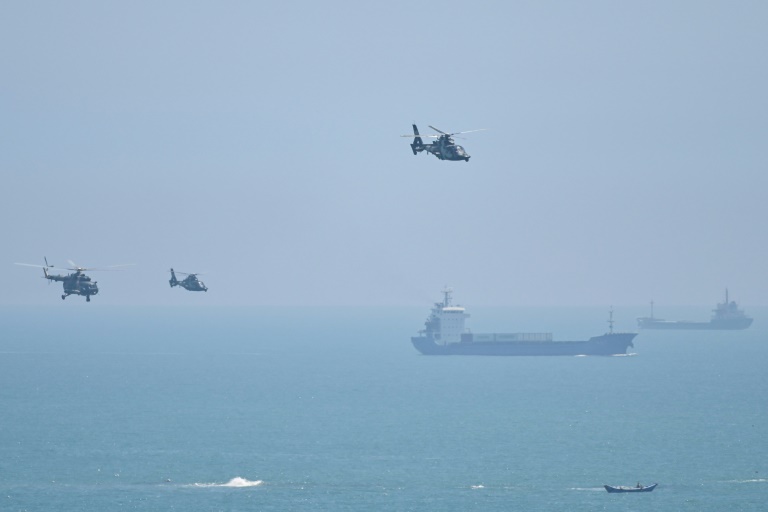
Tensions in the Taiwan Strait have soared to their highest in years after US House Speaker Nancy Pelosi visited Taipei, sparking a furious response from Beijing which launched its largest military drills around the island.

The negotiations would cover a variety of areas, including agriculture, digital trade, regulatory practices and removing trade barriers, the Office of the US Trade Representative said in a statement.

The talks “will deepen our trade and investment relationship, advance mutual trade priorities based on shared values, and promote innovation and inclusive economic growth for our workers and businesses,” said Deputy United States Trade Representative Sarah Bianchi. 

“We welcome this opportunity to deepen economic collaboration between our 2 freedom-loving countries while shaping a new model for trade cooperation in the Indo-Pacific,” Taiwan’s foreign ministry said in a tweet. 

Taipei’s representative in Washington Hsiao Bi-Khim wrote: “We welcome this announcement, and Taiwan’s ready to start!”

The United States and Taiwan share a longstanding trade and investment relationship. The island is also a crucial global supplier of some of the most advanced semiconductors, used in everything from mobile phones and laptops to cars and missiles. 

But Taiwan’s largest trading partner by far remains China, which bristled at the announcement and said it “firmly opposes this”.

“China has always opposed any official exchanges between any country and the Taiwan region of China,” Beijing’s commerce ministry spokeswoman Shu Jueting told reporters on Thursday, adding that the matter concerned China-US relations.

Beijing views Taiwan as its own territory to be seized one day, by force if necessary, and last year 42 percent of Taiwan’s exports went to China and Hong Kong compared with 15 percent for the United States.

Washington diplomatically recognises Beijing over Taipei, but maintains de facto relations with Taiwan and supports the island’s right to decide its future.

– ‘Intimidate and coerce’ –

The United States has said its position on Taiwan remains unchanged and has accused China of threatening peace in the Taiwan Strait and using the visit by Pelosi as a pretext for military exercises.

Its top envoy in East Asia on Thursday said Beijing will likely ramp up pressure on Taiwan in the coming months after the drills.

“While our policy has not changed, what has changed is Beijing’s growing coercion,” Daniel Kritenbrink, assistant secretary of state for East Asian and Pacific affairs, told reporters on a teleconference call.

“These actions are part of an intensified pressure campaign… to intimidate and coerce Taiwan and undermine its resilience,” he said.

The envoy said Washington would respond to China’s aggression with “calm, but resolute steps” to keep the Taiwan Strait open and peaceful.

His comments come after a top US naval commander said this week that Washington and its allies must contest China’s ballistic missile fire over Taiwan, which he called a “gorilla in the room”.

China’s exercises included firing multiple ballistic missiles into waters off Taiwan — some of the world’s busiest shipping routes — which was the first time China has taken such a step since the mid-1990s.

Taiwan has staged its own drills simulating a defence against invasion and on Wednesday displayed its most advanced fighter jet in a rare nighttime demonstration in the wake of China’s moves around the island.

“In the face of the threat from Chinese communist forces’ recent military exercises, we have stayed vigilant while establishing the concept of ‘battlefields everywhere and training anytime’… to ensure national security,” Taiwan’s air force said in a statement. 

Close Bitnami banner
Bitnami