Chinese Business

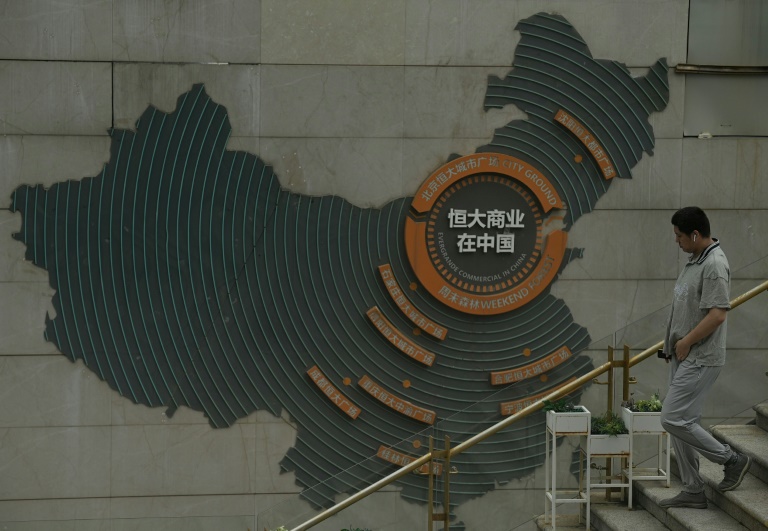
China Evergrande to get $818 mn for scrapping stadium deal

Embattled Chinese property giant Evergrande has cancelled a contract to build a football stadium in a southern city in return for 5.52 billion yuan ($818 million), it said in a filing.

The real estate behemoth has been involved in restructuring negotiations after racking up $300 billion in liabilities in the wake of  Beijing’s crackdown on excessive debt and rampant speculation in the property sector.

Last week, the company failed to meet a self-imposed deadline to publish a preliminary restructuring proposal, although it said it has made positive progress.

In a filing to the Hong Kong stock exchange late Thursday, Evergrande said “the group’s liquidity issue has adversely affected the development of and construction on the land” in Guangzhou.

Evergrande entered a contract with the city’s authorities in 2020 for use of the land, designated for sports and industrial purposes.

The contract allowed for commercial and sports uses of the land for 40 years, as well as other business uses for 50 years, the filing said.

Evergrande had started construction, including the building of the Guangzhou Evergrande Football Stadium, which was set to have at least 80,000 seats, it said.

The latest refund will enter a project escrow account designated by the government and will be used to settle debts relating to the deal, Evergrande said.

“It is expected that the group will record a loss of approximately 1.255 billion” yuan over the total book value of the land along with buildings, structures and other items at the site after deducting the refund, Evergrande said.

Evergrande, one of China’s biggest developers, has scrambled to offload assets in recent months, with chairman Hui Ka Yan paying off some of its debts using his personal wealth.

It has also found a potential buyer for its Hong Kong headquarters, according to earlier media reports.

Its troubles are emblematic of the problems rippling across China’s massive property sector, with smaller companies also defaulting on loans and others struggling to raise cash.

Cash-strapped developers have increasingly struggled to deliver projects on time, sparking mortgage boycotts from angry homebuyers in many cities.

Taiwan condemns 'evil neighbour' China over war drills

Taiwan blasted its “evil neighbour next door” on Friday after China encircled the island with a series of huge military drills that were condemned by the United States and other Western allies.

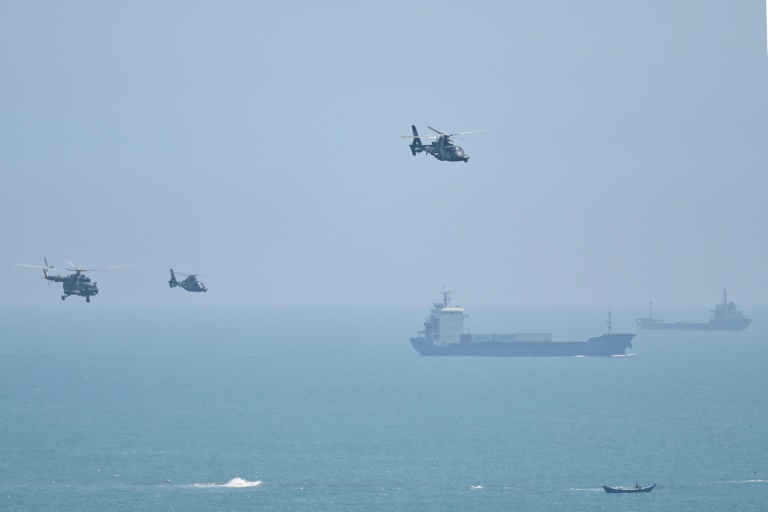
During Thursday’s military exercises, which continued Friday, China fired ballistic missiles and deployed both fighter jets and warships around Taiwan.

The People’s Liberation Army declared multiple no-go danger zones around Taiwan, straddling some of the busiest shipping lanes in the world and at some points coming within 20 kilometres (12 miles) of the island’s shores.

Beijing has said the exercises will continue until midday Sunday, and Taipei reported that Chinese fighter jets and ships crossed the “median line” that runs down the Taiwan Strait on Friday morning.

“As of 11am, multiple batches of Chinese warplanes and warships conducted exercises around the Taiwan Strait and crossed the median line of the strait,” Taipei’s defence ministry said in a statement. 

The median line is an unofficial but once largely adhered-to border that runs down the middle of the Taiwan Strait, which separates Taiwan and China.

Chinese incursions have become more common since Beijing declared in 2020 that the unofficial border no longer existed.

Beijing has called its war games a “necessary” response to a visit to the self-ruled, democratic island by US House Speaker Nancy Pelosi, but Washington countered that China’s leaders had “chosen to overreact”.

Pelosi defended her visit Friday, saying Washington will “not allow” China to isolate Taiwan.

“We have said from the start that our representation here is not about changing the status quo here in Asia, changing the status quo in Taiwan,” she told reporters in Tokyo on the final leg of an Asia tour.

Taiwan’s premier Su Tseng-chang, meanwhile, called for allies to push for de-escalation.

“(We) didn’t expect that the evil neighbour next door would show off its power at our door and arbitrarily jeopardise the busiest waterways in the world with its military exercises,” he told reporters.

– Missiles over Taiwan –

China’s drills involved a “conventional missile firepower assault” in waters to the east of Taiwan, the Chinese military said. 

The state-run Xinhua news agency said the Chinese army “flew more than 100 warplanes including fighters and bombers” during the exercises, as well as “over 10 destroyers and frigates”.

State broadcaster CCTV reported that Chinese missiles had flown directly over Taiwan.

Japan also claimed that of the nine missiles it had detected, four were “believed to have flown over Taiwan’s main island”.

Taipei’s military said it would not confirm missile flight paths, in a bid to protect its intelligence capabilities and not allow China “to intimidate us”.

– ‘Temperature’s pretty high’ –

China’s ruling Communist Party views Taiwan as part of its territory and has vowed to one day take it, by force if necessary.

But the scale and intensity of the drills have triggered outrage in the United States and other democracies.

“China has chosen to overreact and use the speaker’s visit as a pretext to increase provocative military activity in and around the Taiwan Strait,” John Kirby, a White House spokesman, told reporters.

“The temperature’s pretty high,” but tensions “can come down very easily by just having the Chinese stop these very aggressive military drills”, he added.

Japan lodged a formal diplomatic complaint against Beijing, with five of the missiles believed to have landed in its exclusive economic zone.

Prime Minister Fumio Kishida called China’s exercises a “serious problem that impacts our national security and the safety of our citizens” and called for an “immediate cancellation of the military drills”.

But Chinese Foreign Minister Wang Yi said the “flagrant provocation” by the United States had set an “egregious precedent”.

– Trading places – 

The manoeuvres are taking place along some of the busiest shipping routes on the planet, used to supply vital semiconductors and electronic equipment produced in East Asian factory hubs to global markets.

Taiwan’s Maritime and Port Bureau has warned ships to avoid the areas being used for the Chinese drills.

“The shutting down of these transport routes — even temporarily — has consequences not only for Taiwan, but also trade flows tied to Japan and South Korea,” Nick Marro, the Economist Intelligence Unit’s lead analyst for global trade, wrote in a note.

Taiwan said the drills would disrupt 18 international routes passing through its flight information region while several international airlines told AFP they would divert flights.

But markets in Taipei appeared to shrug off the tensions, with the Taiwan Taiex Shipping and Transportation Index, which tracks major shipping and airline stocks, up 2.3 percent early Friday.

And analysts broadly agree that despite all its aggressive posturing, Beijing does not want an active military conflict against the United States and its allies over Taiwan — just yet.

“The last thing Xi wants is an accidental war ignited,” Titus Chen, an associate professor of political science at the National Sun Yat-Sen University in Taiwan, told AFP.

Most Asian markets up as oil drops, eyes on Taiwan and US jobs

Asian equities mostly rose Friday as a drop in oil prices to pre-Ukraine war levels stirred hopes of a slowdown in inflation and central bank interest rate hikes, while focus turns to key US jobs data later in the day.

However, while markets have enjoyed a broadly positive week, optimism remains at a premium as traders fret over issues including the conflict in Eastern Europe, China’s military drills around Taiwan and a possible global recession.

Crude edged up but expectations that economies will contract — dampening demand — have sent the commodity tumbling more than 10 percent this week, with US data indicating Americans were driving less now than in summer 2020 at the height of the pandemic.

And while analysts are beating the drum of recession, traders are taking heart from the possibility of a reprieve from central bank monetary tightening.

“The recent fall in oil prices, which are now trading below the levels immediately before Russia’s invasion of Ukraine, has contributed to the market’s perception that inflation is likely to peak soon, taking pressure off the Fed to raise rates as aggressively,” said National Australia Bank’s Rodrigo Catril. 

Traders will now be closely watching the release of a crucial US jobs report later Friday for a fresh snapshot of the world’s top economy.

The Federal Reserve has said its rate decision will be guided by data, with signs of economic weakness seen as likely to mean any increases will be light.

Officials have said the economy remains healthy despite four-decade high inflation and a sharp lift in borrowing costs, while several have suggested they are open to more big increases to get on top of prices.

And SPI Asset Management’s Stephen Innes said: “Though some high-frequency data suggest employment and inflation have softened in some parts of the economy, markets may wonder if they are soft enough to change the course for the Fed.”

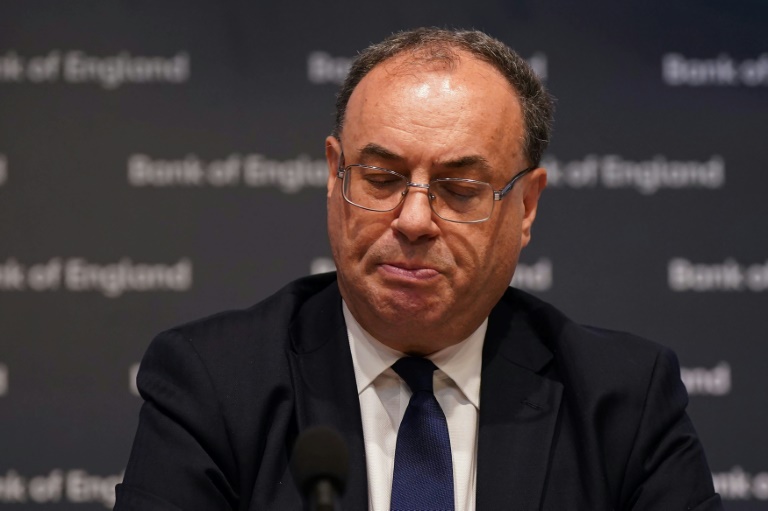
In a sign of the long road ahead, the Bank of England hiked rates by the most since it was made independent in 1997, and warned inflation will likely go higher than 13 percent while Britain will suffer an extended recession.

Wall Street provided a soft lead after recent gains, but Asia was largely higher.

Tokyo, Shanghai, Sydney, Seoul, Jakarta, Wellington and Singapore rose, though Hong Kong and Manila dipped.

Taipei surged more than two percent on easing concerns over a conflict with Beijing, even as China conducts its largest-ever military exercises around Taiwan in response to US House Speaker Nancy Pelosi’s visit this week.

China launched a series of exercises in multiple zones Thursday, straddling some of the busiest shipping lanes in the world.

While Taipei did not say where the missiles landed or whether they flew over the island, Japan said that of the nine missiles it had detected, four were “believed to have flown over Taiwan’s main island”.

Geir Lode, of Federated Hermes, said: “For a world facing a whole raft of major challenges, there sure is a lot of optimism across equities right now.

“Inflation is challenging corporate earnings and weighing on consumer sentiment. Global recession appears probable as growth becomes ever more scarce. Geopolitical tensions and the growth in populism accelerate the trend towards localisation (and increase the risk of even darker futures). Climate change looms over us all.

“And yet equities this week have continued July’s strong rally.”

– Key figures at around 0300 GMT –

Tokyo – Nikkei 225: UP 0.7 percent at 28,131.87 (break)

Hong Kong – Hang Seng Index: DOWN 0.1 percent at 20,145.45

Shanghai – Composite: UP 0.1 percent at 3,191.55

Euro/dollar: DOWN at $1.0233 from $1.0248 Thursday

Pound/dollar: DOWN at $1.2139 from $1.2166

Euro/pound: UP at 84.31 pence from 84.21 pence

Dollar/yen: UP at 133.22 yen from 132.95 yen

West Texas Intermediate: UP 0.4 percent at $88.87 per barrel

Brent North Sea crude: UP 0.2 percent at $94.35 per barrel

New York – Dow: DOWN 0.3 percent at 32,726.82 (close)

London – FTSE 100: FLAT at 7,448.06 (close)

South Korea's first lunar orbiter launched by SpaceX

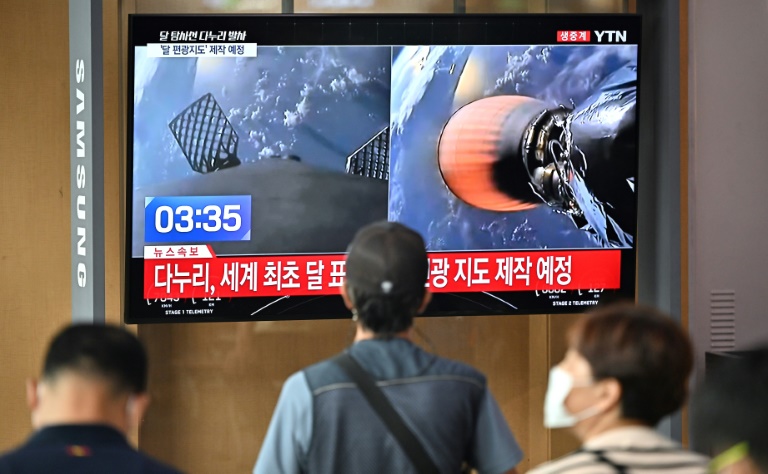
South Korea’s first lunar orbiter successfully launched on a year-long mission to observe the Moon, Seoul said Friday, with the payload including a new disruption-tolerant network for sending data from space.

Danuri — a portmanteau of the Korean words for “Moon” and “enjoy” — was on a Falcon 9 rocket launched from Cape Canaveral in Florida by Elon Musk’s aerospace company SpaceX. It aims to reach the Moon by mid-December.

“South Korea’s first lunar orbiter ‘Danuri’ left for space at 8:08 am on August 5, 2022,” Seoul’s science ministry said in a tweet, sharing a video of the rocket blasting off trailing a huge column of smoke and flames.

“Danuri will be the first step towards the Moon and the farther universe,” it said, apparently referring to the country’s ambitious space program, which includes plans for a Moon mission by 2030.

SpaceX tweeted that the launch had been a success.

“Deployment of KPLO confirmed,” it said, referring to Danuri using an acronym of its official name, the Korea Pathfinder Lunar Orbiter.

During its mission, Danuri will use six different instruments, including a highly sensitive camera provided by NASA, to conduct research, including investigating the lunar surface to identify potential landing sites.

One of the instruments will evaluate disruption-tolerant, network-based space communications, which, according to South Korea’s science ministry, is a world first.

– BTS in space –

Danuri will also try to develop a wireless Internet environment to link satellites or exploration spacecraft, they added.

The lunar orbiter will stream K-pop sensation BTS’ song “Dynamite” to test this wireless network.

Another instrument, ShadowCam, will record images of the permanently shaded regions around the poles of the Moon where no sunlight can reach.

Scientists also hope that Danuri will find hidden sources of water and ice in areas of the Moon, including the permanently dark and cold regions near the poles.

“This is a very significant milestone in the history of Korean space exploration,” said Lee Sang-ryool, head of the Korea Aerospace Research Institute, in a video shown before the launch.

“Danuri is just the beginning, and if we are more determined and committed to technology development for space travel, we will be able to reach Mars, asteroids, and so on in the near future.”

South Korean scientists say Danuri — which took seven years to build — will pave the way for the nation’s more ambitious goal of landing on the Moon by 2030. 

“South Korea will become the seventh country in the world to have launched an unmanned probe to the Moon,” an official at the Korea Aerospace Research Institute told AFP.

“We hope to continue contributing to the global understanding of the Moon with what Danuri is set to find out.”

– Lunar ambitions –

Danuri was launched by a private company — SpaceX — but South Korea recently became one of a handful of countries to successfully launch a one-tonne payload using their own rockets.

In June, the country’s homegrown three-stage rocket nicknamed Nuri — a decade in development at a cost of 2 trillion won ($1.5 billion) — launched successfully and put a satellite into orbit, on its second attempt after a failure last October.

That launch — coupled with Danuri’s launch Friday — helps bring South Korea ever closer to achieving its space ambitions.

In Asia, China, Japan and India all have advanced space programmes — and the South’s nuclear-armed neighbour North Korea has also demonstrated satellite launch capability.

Ballistic missiles and space rockets use similar technology and Pyongyang put a 300-kilogram (660-pound) satellite into orbit in 2012 in what Washington condemned as a disguised missile test.

China Evergrande to get $818 mn for scrapping stadium deal

Embattled Chinese property giant Evergrande has cancelled a contract to build a football stadium in a southern city in return for 5.52 billion yuan ($818 million), it said in a filing.

The real estate behemoth has been involved in restructuring negotiations after racking up $300 billion in liabilities in the wake of  Beijing’s crackdown on excessive debt and rampant speculation in the property sector.

Last week, the company failed to meet a self-imposed deadline to publish a preliminary restructuring proposal, although it said it has made positive progress.

In a filing to the Hong Kong stock exchange late Thursday, Evergrande said “the group’s liquidity issue has adversely affected the development of and construction on the land” in Guangzhou.

Evergrande entered a contract with the city’s authorities in 2020 for use of the land, designated for sports and industrial purposes.

The contract allowed for commercial and sports uses of the land for 40 years, as well as other business uses for 50 years, the filing said.

Evergrande had started construction, including the building of the Guangzhou Evergrande Football Stadium, which was set to have at least 80,000 seats, it said.

The latest refund will enter a project escrow account designated by the government and will be used to settle debts relating to the deal, Evergrande said.

“It is expected that the group will record a loss of approximately 1.255 billion” yuan over the total book value of the land along with buildings, structures and other items at the site after deducting the refund, Evergrande said.

Evergrande, one of China’s biggest developers, has scrambled to offload assets in recent months, with chairman Hui Ka Yan paying off some of its debts using his personal wealth.

It has also found a potential buyer for its Hong Kong headquarters, according to earlier media reports.

Its troubles are emblematic of the problems rippling across China’s massive property sector, with smaller companies also defaulting on loans and others struggling to raise cash.

Cash-strapped developers have increasingly struggled to deliver projects on time, sparking mortgage boycotts from angry homebuyers in many cities.

China to hold fresh drills around Taiwan despite US condemnation

China was set to press ahead Friday with its largest-ever military exercises encircling Taiwan despite firm statements of condemnation by the United States, Japan and the European Union.

Beijing’s decision to fire ballistic missiles and deploy fighter jets around Taiwan saw Washington lambast what it said was a gross overreaction to a visit to the self-ruled, democratic island by US House Speaker Nancy Pelosi.

The US House speaker was the highest-profile US official to go to Taiwan in years and defied stark threats from Beijing, which views the self-ruled island as its territory.

In retaliation, China on Thursday launched a series of exercises in multiple zones around Taiwan, straddling some of the busiest shipping lanes in the world and at some points coming just 20 kilometres (12 miles) from the island’s shores.

The drills involved a “conventional missile firepower assault” in waters to the east of Taiwan, the Chinese military said. Beijing has said they will continue until midday Sunday.

Beijing’s state-run Xinhua news agency reported the Chinese army “flew more than 100 warplanes including fighters and bombers” during the exercises, as well as “over 10 destroyers and frigates.”

State broadcaster CCTV reported that Chinese missiles had flown over Taiwan.

Taiwan said the Chinese military fired 11 Dongfeng-class ballistic missiles “in several batches”, while Japan claimed of the nine missiles it had detected, four were “believed to have flown over Taiwan’s main island”.

Taiwan has said it would not confirm missile flight paths, however.

“Considering the main goal of CCP’s (Chinese Communist Party’s) launch of missiles is to intimidate us and in order to protect the military’s intelligence, surveillance and reconnaissance capabilities, we will not release information such as its flight,” the defence ministry said in a statement.

– ‘Temperature’s pretty high’ –

China has defended the drills as just countermeasures in the face of provocations by the United States and its allies in Taiwan, which China views as its own territory and which it has vowed to retake.

But the drills have triggered outrage in the United States and other democracies.

“China has chosen to overreact and use the speaker’s visit as a pretext to increase provocative military activity in and around the Taiwan Strait,” John Kirby, a White House spokesman, told reporters.

“The temperature’s pretty high,” but tensions “can come down very easily by just having the Chinese stop these very aggressive military drills,” he added.

Japan has lodged a formal diplomatic complaint against Beijing for the drills, with five of the missiles believed to have landed in its exclusive economic zone.

And Prime Minister Fumio Kishida Friday slammed the drills as a “serious problem that impacts our national security and the safety of our citizens” and called for an “immediate cancellation of the military drills.”

While on the final leg of her tour of Asia, Pelosi said in Tokyo Friday that Washington will “not allow” China to isolate Taiwan.

“We have said from the start that our representation here is not about changing the status quo here in Asia, changing the status quo in Taiwan,” she added.

But Chinese Foreign Minister Wang Yi said in Phnom Penh, on the sidelines of a regional summit on Thursday, that the “flagrant provocation” by the United States had set an “egregious precedent.” 

“If it’s not corrected and countered, will the principle of non-interference in internal affairs still exist? Will the international law still be upheld?” he said, according to Xinhua.

– Trading places – 

The manoeuvers are taking place along some of the busiest shipping routes on the planet, used to supply vital semiconductors and electronic equipment produced in East Asian factory hubs to global markets.

Taiwan’s Maritime and Port Bureau has issued warnings to ships to avoid the areas being used for the Chinese drills.

The Taiwanese cabinet has also said the drills would disrupt 18 international routes passing through its flight information region (FIR).

Several international airlines have told AFP they will divert flights from airspace around Taiwan island. 

“China’s planned live-fire exercises are occurring in an incredibly busy waterway,” Nick Marro, the Economist Intelligence Unit’s lead analyst for global trade, wrote in a note.

“The shutting down of these transport routes — even temporarily — has consequences not only for Taiwan, but also trade flows tied to Japan and South Korea.”

But markets in Taipei appeared to shrug off the tensions, with the Taiwan Taiex Shipping and Transportation Index, which tracks major shipping and airline stocks, up 2.3 percent early Friday.

And analysts broadly agree that  despite all its aggressive posturing, Beijing does not want an active military conflict against the United States and its allies over Taiwan — just yet.

“The last thing Xi wants is an accidental war ignited,” Titus Chen, an associate professor of political science at the National Sun Yat-Sen University in Taiwan, told AFP.
Stocks mixed as markets digest BoE rate hike, recession forecast

European stocks pushed slightly higher on Thursday as the Bank of England delivered its biggest interest rate hike in 27 years, while Wall Street equities were mixed ahead of key US jobs data.

Although economists had anticipated the 0.50-percentage point rise, the UK central bank also grimly predicted the country would suffer a lengthy recession later in the year.

The rate hike mirrored aggressive monetary policy from the US Federal Reserve and the European Central Bank last month, as the world races to cool red-hot inflation that has been exacerbated by Russia’s invasion of Ukraine.

Wall Street stocks finished mixed with the Dow and S&P 500 modestly lower, while the Nasdaq pushed higher. 

The choppy session comes ahead of Friday’s monthly employment report, expected to show US job growth slowed to just 250,000 jobs, while unemployment held steady at 3.6 percent.

The data will inform the Federal Reserve’s plans ahead of its September 21 meeting, which is keeping investors on guard.

“Wall Street has heard enough from the Fed to know that we are stuck in wait-and-see mode for the next 48 days,” said Oanda’s Edward Moya.

The dollar — which has risen over the last year — declined ahead of the jobs data.

Oil prices fell again in the wake of the OPEC+ decision to slightly raise production, with the main US contract dropping back to levels not seen since before the war in Ukraine sent crude prices soaring.

Most Asian indices tracked the Wall Street rally the previous session fueled by healthy economic and earnings data, despite lingering concerns following US House Speaker Nancy Pelosi’s visit to Taiwan that provoked an angry response from China.

Beijing has suspended a limited amount of cross-strait shipping, and on Thursday began its largest-ever military exercises encircling Taiwan that are expected to last for days.

Soon after, Taiwan’s defense ministry said it was “preparing for war without seeking war”.

Taipei stocks fell again on worries that the Chinese maneuvers would hit shipping lanes and flights into Taiwan.

– Key figures at around 2045 GMT –

New York – Dow: DOWN 0.3 percent at 32,726.82 (close)

New York – S&P 500: DOWN 0.1 percent at 4,151.94 (close)

New York – Nasdaq: UP 0.4 percent at 12,720.58 (close)

London – FTSE 100: FLAT at 7,448.06 (close)

Frankfurt – DAX: UP 0.6 percent at 13,662.68 (close)

Paris – CAC 40: UP 0.6 percent at 6,513.39 (close) 

EURO STOXX 50: UP 0.6 percent at 3,754.60 (close)

Tokyo – Nikkei 225: UP 0.7 percent at 27,932.20 (close)

Hong Kong – Hang Seng Index: UP 2.1 percent at 20,174.04 (close)

Shanghai – Composite: UP 0.8 percent at 3,189.04 (close)

Euro/dollar: UP at $1.0248 from $1.0166 Wednesday

Pound/dollar: UP at $1.2166 from $1.2149

Euro/pound: UP at 84.21 pence from 83.63 pence

Dollar/yen: DOWN at 132.95 yen from 133.86 yen

Brent North Sea crude: DOWN 2.7 percent at $94.12 per barrel

West Texas Intermediate: DOWN 2.3 percent at $88.54 per barrel

burs-jmb/hs

European stocks rise as BoE unleashes big rate hike

European stocks pushed slightly higher on Thursday as the Bank of England delivered its biggest interest rate hike in 27 years and traders tracked Chinese military drills around Taiwan.

Although economists had anticipated the 0.50-percentage point rise, the UK central bank also grimly predicted the country would dip into a lengthy recession later in the year.

“The UK economy does not look like it is positioned for a prolonged downturn, so that should allow the mostly hawkish BoE to be aggressive with tightening,” said Edward Moya, from OANDA trading platform.

The rate hike mirrored aggressive monetary policy from the US Federal Reserve and the European Central Bank last month, as the world races to cool red-hot inflation that has been fuelled by Russia’s invasion of Ukraine.

Underscoring the urgency, the Bank of England also predicted UK inflation would peak this year at just over 13 percent, its highest level since 1980.

Analyst Kallum Pickering, from Berenberg, said the UK central bank’s moves would “contribute to a further tightening of UK financial conditions”.

“While this will do little to dampen the likely further rise in inflation near-term, it should help to contain inflation expectations. This will reduce the risk that high inflation persists once its mostly external triggers have faded,” he said. 

After the rate hike announcement, the British pound sank 0.7 percent versus the euro and dollar as dealers fretted over the gloomy outlook.

Shares in London closed just in the black, while Paris was 0.6 percent higher and Frankfurt advanced 0.5 percent. Wall Street stocks dipped slightly in mid-morning trading ahead of key US jobs data.

– Oil tumbles –

Oil prices tumbled with the main US oil contract falling back down to levels not seen since before the war in Ukraine sent crude prices soaring.

West Texas Intermediate dropped below the $90-mark in afternoon trading in Europe.

The fall comes after a decision by the OPEC+ oil cartel, led by Saudi Arabia and Russia, a day earlier to undertake just a small increase in production.

US energy data also revealed unexpectedly weak gasoline demand.

“The oil market is a mixed bag as demand destruction is met with limited spare capacity,” said OANDA’s Moya.

Most Asian indices tracked a Wall Street rally the previous session fuelled by healthy economic and earnings data, despite lingering Taiwan concerns.

New York surged on Wednesday after a report on the crucial US services sector showed surprise improvement, soothing recession fears in the world’s top economy.

Markets have swung this week after a number of Federal Reserve officials lined up to suggest there were still some big US rate hikes likely and talk of cuts next year might be overdone.

– Pelosi visit –

The mood in Asia was also a lot more settled after the upheaval of this week’s visit to Taiwan by US House Speaker Nancy Pelosi, which sparked outrage in China with warnings of stern military and economic responses.

Beijing has suspended a limited amount of cross-strait imports and exports, and on Thursday began its largest-ever military exercises encircling Taiwan that are expected to last for days.

Soon after, Taiwan’s defence ministry said it was “preparing for war without seeking war”.

Taipei stocks fell again on worries that the Chinese manoeuvres would hit shipping lanes and flights into Taiwan.

– Key figures at around 1545 GMT –

New York – Dow: DOWN 0.4 percent at 32,680.46 points

EURO STOXX 50: UP 0.6 percent at 3,754.60

London – FTSE 100: FLAT at 7,448.06 (close)

Frankfurt – DAX: UP 0.5 percent at 13,662.68 (close)

Paris – CAC 40: UP 0.6 percent at 6,513.39 (close) 

Tokyo – Nikkei 225: UP 0.7 percent at 27,932.20 (close)

Hong Kong – Hang Seng Index: UP 2.1 percent at 20,174.04 (close)

Shanghai – Composite: UP 0.8 percent at 3,189.04 (close)

Euro/dollar: UP at $1.0214 from $1.0166 Wednesday

Pound/dollar: DOWN at $1.2132 from $1.2149

Euro/pound: UP at 84.22 pence from 83.63 pence

Dollar/yen: DOWN at 133.35 yen from 133.86 yen

Brent North Sea crude: DOWN 2.8 percent at $94.09 per barrel

West Texas Intermediate: DOWN 2.6 percent at $88.32 per barrel

burs/rfj-kjm/raz

European stocks rise as BoE unleashes big rate hike

European stocks rose Thursday as the Bank of England delivered its biggest interest rate hike in 27 years and traders tracked Chinese military drills around Taiwan.

Although economists had anticipated the 0.50-percentage point rise, the UK central bank also grimly predicted the country would dip into a lengthy recession later in the year.

The rate hike mirrored aggressive monetary policy from the US Federal Reserve and the European Central Bank last month, as the world races to cool red-hot inflation that has been fuelled by Russia’s invasion of Ukraine.

Underscoring the urgency, the Bank of England also predicted that UK inflation would peak this year at just over 13 percent, its highest level since 1980.

Analyst Kallum Pickering, from Berenberg, said the UK central bank’s moves would “contribute to a further tightening of UK financial conditions”.

“While this will do little to dampen the likely further rise in inflation near-term, it should help to contain inflation expectations. This will reduce the risk that high inflation persists once its mostly external triggers have faded,” he said. 

After the rate hike announcement, the British pound sank 0.7 percent versus the euro and dollar as dealers fretted over the gloomy outlook.

In mid-afternoon trading, shares in London were 0.2 percent higher, while Paris and Frankfurt were both nearer one percent higher.

Wall Street stocks treaded water early on ahead of key US jobs data.

– Oil tumbles –

Oil prices tumbled with the main US oil contract falling back down to levels not seen since before the war in Ukraine sent crude prices soaring.

The drop comes after a decision by the OPEC+ oil cartel, led by Saudi Arabia and Russia, a day earlier to undertake just a small increase in production.

US energy data also revealed unexpectedly weak gasoline demand.

“The oil market is a mixed bag as demand destruction is met with limited spare capacity,” said Edward Moya, analyst at OANDA trading platform.

Most Asian indices tracked a Wall Street rally the previous session fuelled by healthy economic and earnings data, despite lingering Taiwan concerns.

New York surged Wednesday after a report on the crucial US services sector showed surprise improvement, soothing recession fears in the world’s top economy.

Markets have swung this week after a number of Federal Reserve officials lined up to suggest there were still some big US rate hikes likely and talk of cuts next year might be overdone.

– Pelosi visit –

The mood in Asia was also a lot more settled after the upheaval of this week’s visit to Taiwan by US House Speaker Nancy Pelosi, which sparked outrage in China with warnings of stern military and economic responses.

Beijing has suspended a limited amount of cross-strait imports and exports, and on Thursday began its largest-ever military exercises encircling Taiwan that are expected to last for days.

Soon after, Taiwan’s defence ministry said it was “preparing for war without seeking war”.

Taipei stocks fell again on worries that the Chinese manoeuvres would hit shipping lanes and flights into Taiwan.

– Key figures at around 1345 GMT –

London – FTSE 100: UP 0.2 percent at 7,462.37 points

Frankfurt – DAX: UP 0.96 percent at 13,717.96

Paris – CAC 40: UP 0.8 percent at 6,524.47 

EURO STOXX 50: UP 0.8 percent at 3,761.31 

New York – Dow:  DOWN 0.04 percent at 32,787.82 

Tokyo – Nikkei 225: UP 0.7 percent at 27,932.20 (close)

Hong Kong – Hang Seng Index: UP 2.1 percent at 20,174.04 (close)

Shanghai – Composite: UP 0.8 percent at 3,189.04 (close)

Euro/dollar: UP at $1.0195 from $1.0166 Wednesday

Pound/dollar:  DOWN at $1.2112 from $1.2149

Euro/pound: UP at 84.18  pence from 83.63 pence

Dollar/yen: DOWN at 133.52  yen from 133.86 yen

Brent North Sea crude: DOWN 1.5 percent at $95.28 per barrel

West Texas Intermediate: DOWN 1.4 percent at $89.43 per barrel

burs/rfj-kjm/lth

Alibaba quarterly revenue flat for first time ever in June

Chinese e-commerce giant Alibaba reported flat revenue growth on Thursday for the first time ever, as the country grappled with an economic slowdown and Covid-19 resurgences kept consumers jittery.

Alibaba’s performance is widely seen as a gauge of Chinese consumer sentiment, given its market dominance, and its revenue growth has slowed markedly over the past year.

Revenue came in at 205.6 billion yuan ($30.7 billion) in the April-June quarter, beating analyst expectations despite being slightly below the same period last year, following a decline in the company’s China commerce segment revenue, Alibaba said.

The company has been grappling with growing competition and economic fallout from strict Covid restrictions that have battered consumer sentiment, pushed the unemployment rate up and tangled supply chains.

“Following a relatively slow April and May, we saw signs of recovery across our businesses in June,” said Alibaba Group’s chairman and chief executive Daniel Zhang in a statement.

“Despite the soft economic conditions, we managed to deliver stable revenues and narrowed losses in several strategic businesses by improving operating efficiency,” he added in an earnings call.

The company’s revenue growth was flat “primarily due to a decline in China commerce segment revenue” although this was offset by growth in the cloud segment, Alibaba said.

Many parts of China have faced harsh lockdowns in recent months, as officials struggled to stamp out the Omicron variant under the country’s zero-Covid policy. 

Shanghai, China’s biggest city and a major economic hub, was sealed off for two months due to Covid-related restrictions during the quarter.

The firm cited “restrictions that resulted in supply chain and logistics disruptions in April and most of May” that bogged down performance in its China commerce sector, although there was a pick-up in demand in June during a popular shopping festival.

Its profit for the latest quarter stood at 22.7 billion yuan, down from 45.1 billion yuan a year earlier.

Alibaba has recently been building its international commerce businesses, such as Lazada in Southeast Asia and Trendyol in Turkey.

It has also shifted from its aggressive market expansion in the past, amid slowing growth.

– Challenges –

Apart from coronavirus curbs, Alibaba has been contending with a regulatory crackdown on China’s tech giants and other challenges abroad.

US authorities have put the company on a watchlist that could see it delisted in New York if it does not comply with disclosure orders, causing its shares to slump.

The company is seeking a primary listing in Hong Kong which could allow it to access mainland China’s vast pool of investors, a move that comes as Chinese tech firms trading in New York grow increasingly worried about regulatory action by US authorities.

Alibaba, a tech behemoth, has also seen its market value plummet after Beijing launched a sweeping crackdown in 2020.

In recent years, Chinese officials have taken aim at alleged anti-competitive practices by some of the country’s biggest names, driven by fears that major internet firms control too much data and expanded too quickly.

This included a last-minute cancellation of a planned IPO by Alibaba’s financial arm Ant Group, which would have been the world’s largest public offering at the time.

Last week, a report said Alibaba co-founder Jack Ma plans to give up control of Ant Group as part of a strategy to appease Chinese regulators and revive the digital payments unit’s initial public offering.

Following the latest results, Alibaba’s US-listed shares rose 4.5 percent in pre-market trading.

China’s economy expanded just 0.4 percent in the second quarter this year, logging its slowest growth since the initial coronavirus outbreak more than two years ago.

Close Bitnami banner
Bitnami