Chinese Business

Stocks advance ahead of US rate decision, dollar steady

European and US stock markets advanced while the dollar was largely steady on Wednesday as attention switched to the Federal Reserve and the size of its upcoming interest rate hike.

Tuesday saw a steep drop on Wall Street as traders pored over more company earnings that pointed to fallout caused by decades-high inflation.

After markets closed both Google and Microsoft reported disappointing earnings, but shares in both companies shot higher as trading got under way.

“The takeaway for many apparently is that their results and/or guidance was better than feared,” said market analyst Patrick J. O’Hare at Briefing.com.

Shares in Google jumped 6.6 percent and Microsoft stock climbed 4.8 percent.

They helped fuel a 2.5-percent rally in the tech-heavy Nasdaq Composite.

“Unlike a lot of other companies, it would appear that investors have a higher tolerance for misses from the likes of Microsoft and Google, although when you dig into the details, the numbers are still very good,” said Michael Hewson at CMC Markets.

But with both companies trading close to their lowest levels this year “a lot of bad news was probably already in the price,” he added.     

The blue-chip Dow was 0.4 percent higher in late morning trading, while the broader S&P 500 rose 1.4 percent.

In Europe, shares in London rose 0.6 percent, Paris climbed 0.8 percent and Frankfurt added 0.5 percent.

While traders will continue to sift over company results and economic data early in the US trading session, attention will later shift to the Fed’s rate decision.

Central banks are seeking to combat runaway prices by hiking interest rates, even though that risks pushing economies into recession.

The US central bank is widely tipped to announce a 0.75-percentage-point increase in interest rates, with traders particularly interested in any indications whether it will keep up this pace of rate hikes.

“This increase in the interest rate is already very much priced in,” noted Naeem Aslam, chief market analyst at Avatrade.

He added that should the Fed indicate a plan to raise rates by another 75 basis points at its next meeting, “that would be highly bullish for the dollar”. 

Focus was also on gas prices as Russian energy giant Gazprom slashed deliveries of the fuel to Europe via the Nord Stream pipeline.

EU states have accused Russia of squeezing supplies in retaliation for Western sanctions over Moscow’s war in Ukraine.

The price of natural gas reference, Dutch TTF, rose only marginally after strong gains on Tuesday after Gazprom announced the cut.

On the corporate front, Switzerland’s scandal-hit banking giant Credit Suisse appointed a new chief executive as higher litigation costs and financial market volatility pushed it deeper into the red.

Ulrich Koerner, head of asset management at the bank, takes the reins from Thomas Gottstein on Monday.

The bank has been hit by a series of scandals and crises including the implosions of financial services firms Greensill and Archegos last year.

After starting the day lower on the Swiss stock exchange, Credit Suisse shares rose one percent.

– Key figures at around 1530 GMT –

New York – Dow: UP 0.4 percent at 31,888.11 points

EURO STOXX 50: UP 1.0 percent at 3,609.42

London – FTSE 100: UP 0.6 percent at 7,348.23 (close) 

Frankfurt – DAX: UP 0.5 percent at 13,166.38 (close)

Paris – CAC 40: UP 0.8 percent at 6,257.94 (close)

Tokyo – Nikkei 225: UP 0.2 percent at 27,715.75 (close)

Hong Kong – Hang Seng Index: DOWN 1.1 percent at 20,670.04 (close)

Shanghai – Composite: DOWN 0.1 percent at 3,275.76 (close)

Euro/dollar: UP at $1.0132 from $1.0126 Tuesday

Pound/dollar: UP at $1.2042 from $1.2030 

Euro/pound: UP at 84.14 pence from 84.09 pence

Dollar/yen: UP at 137.19 yen from 136.95 yen

Brent North Sea crude: UP 2.2 percent at $106.67 per barrel

West Texas Intermediate: UP 2.6 percent at $97.49 per barrel

burs-rl/kjm
Stocks advance ahead of US rate decision, dollar dips

European and US stock markets advanced while the dollar retreated on Wednesday as attention switched to the Federal Reserve and the size of its upcoming interest rate hike.

Tuesday saw a steep drop on Wall Street as traders pored over more company earnings that pointed to fallout caused by decades-high inflation.

After markets closed both Google and Microsoft reported disappointing earnings, but shares in both companies shot higher as trading got under way.

“The takeaway for many apparently is that their results and/or guidance was better than feared,” said market analyst Patrick J. O’Hare at Briefing.com.

Shares in Google climbed 3.3 percent and Microsoft stock jumped 4.0 percent.

While traders will continue to sift over company results and economic data early in the US trading session, attention will later shift to the Fed’s rate decision.

Central banks are seeking to combat runaway prices by hiking interest rates, even though that risks pushing economies into recession.

The US central bank is widely tipped to announce a 0.75-percentage-point increase in interest rates, with traders particularly interested in any indications whether it will keep up this pace of rate hikes.

“This increase in the interest rate is already very much priced in,” noted Naeem Aslam, chief market analyst at Avatrade.

He added that should the Fed indicate a plan to raise rates by another 75 basis points at its next meeting, “that would be highly bullish for the dollar”. 

Focus was also on gas prices as Russian energy giant Gazprom slashed deliveries of the fuel to Europe via the Nord Stream pipeline.

EU states have accused Russia of squeezing supplies in retaliation for Western sanctions over Moscow’s war in Ukraine.

The price of natural gas reference, Dutch TTF, rose 3.5 percent to 210.25 euros per megawatt hour, building on Tuesday gains.

On the corporate front, Switzerland’s scandal-hit banking giant Credit Suisse appointed a new chief executive as higher litigation costs and financial market volatility pushed it deeper into the red.

Ulrich Koerner, head of asset management at the bank, takes the reins from Thomas Gottstein on Monday.

The bank has been hit by a series of scandals and crises including the implosions of financial services firms Greensill and Archegos last year.

After starting the day lower on the Swiss stock exchange, Credit Suisse shares rallied more than two percent.

– Key figures at around 1330 GMT –

London – FTSE 100: UP 0.6 percent at 7,349 points

Frankfurt – DAX: UP 0.2 percent at 13,128.54 

Paris – CAC 40: UP 0.4 percent at 6,235.00

EURO STOXX 50: UP 0.6 percent at 3,595.85

New York – Dow: UP 0.5 percent at 31,915.08

Tokyo – Nikkei 225: UP 0.2 percent at 27,715.75 (close)

Hong Kong – Hang Seng Index: DOWN 1.1 percent at 20,670.04 (close)

Shanghai – Composite: DOWN 0.1 percent at 3,275.76 (close)

Euro/dollar: UP at $1.0143 from $1.0126 Tuesday

Pound/dollar: UP at $1.2049 from $1.2030 

Euro/pound: UP at 84.20 pence from 84.09 pence

Dollar/yen: DOWN at 136.87 yen from 136.95 yen

Brent North Sea crude: UP 0.8 percent at $105.23 per barrel

West Texas Intermediate: UP 1.0 percent at $95.92 per barrel

burs-rl/lcm

Markets mixed as traders await US rate decision

Stock markets traded mixed and the dollar retreated Wednesday as attention switched to the Federal Reserve and the size of its upcoming interest rate hike.

Following Tuesday’s steep drop on Wall Street, Asia and Europe diverged as traders pored over more company earnings that pointed to fallout caused by decades-high inflation.

Central banks are seeking to combat runaway prices by hiking interest rates.

Fed officials are widely tipped to announce a 0.75-percentage-point raise later Wednesday.

“This increase in the interest rate is already very much priced in,” noted Naeem Aslam, chief market analyst at Avatrade.

He added that should the Fed indicate a plan to raise rates by another 75 basis points at its next meeting, “that would be highly bullish for the dollar”. 

Focus was also on gas prices as Russian energy giant Gazprom slashed deliveries of the fuel to Europe via the Nord Stream pipeline.

EU states have accused Russia of squeezing supplies in retaliation for Western sanctions over Moscow’s war in Ukraine.

The price of natural gas reference, Dutch TTF, surged nine percent to 218.13 euros per megawatt hour, building on similar gains Tuesday.

On the corporate front, Switzerland’s scandal-hit banking giant Credit Suisse appointed a new chief executive as higher litigation costs and financial market volatility pushed it deeper into the red.

Ulrich Koerner, head of asset management at the bank, takes the reins from Thomas Gottstein on Monday.

The bank has been hit by a series of scandals and crises including the implosions of financial services firms Greensill and Archegos last year.

After starting the day lower on the Swiss stock exchange, Credit Suisse shares rallied more than one percent.

– Key figures at around 1045 GMT –

London – FTSE 100: UP 0.6 percent at 7,347.47 points

Frankfurt – DAX: UP 0.3 percent at 13,138.51 

Paris – CAC 40: UP 0.5 percent at 6,242.18

EURO STOXX 50: UP 0.7 percent at 3,598.73

Tokyo – Nikkei 225: UP 0.2 percent at 27,715.75 (close)

Hong Kong – Hang Seng Index: DOWN 1.1 percent at 20,670.04 (close)

Shanghai – Composite: DOWN 0.1 percent at 3,275.76 (close)

New York – Dow: DOWN 0.7 percent at 31,761.54 (close)

Euro/dollar: UP at $1.0150 from $1.0126 Tuesday

Pound/dollar: UP at $1.2061 from $1.2030 

Euro/pound: UP at 84.13 pence from 84.09 pence

Dollar/yen: DOWN at 136.68 yen from 136.95 yen

Brent North Sea crude: UP 0.3 percent at $104.75 per barrel

West Texas Intermediate: UP 0.6 percent at $95.51 per barrel

Most markets rise as traders prepare for Fed meeting

Stocks mostly rose Wednesday, rebounding from an early sell-off thanks to earnings from top US tech giants that eased concerns about consumer demand.

The reports from Wall Street titans including Microsoft and Alphabet helped soothe anxiety ahead of an expected Federal Reserve interest rate hike.

The day started slowly following a steep drop on Wall Street fuelled by concerns that four-decade high inflation and rising borrowing costs were keeping Americans from spending, and pushing the economy towards a recession.

That was backed up by a profit warning by retail titan Walmart and a closely watched consumer confidence gauge sinking for the third month in a row, while the International Monetary Fund slashed its global growth forecasts.

Still, US futures rallied — helping drag much of Asia — after earnings releases from Microsoft and Texas Instruments provided upbeat forecasts, while Google parent Alphabet recorded better-than-expected revenues.

The reports gave a much-needed boost to investors ahead of announcements by Apple, Amazon and Intel.

Dan Morgan, at Synovus Trust, said Alphabet’s results would allow for “a sigh of relief”.

“You’re looking at an environment where the overall ad spend rates are definitely slowing down, yet Google still was able to deliver above and beyond.”

Tokyo, Sydney, Seoul, Singapore, Mumbai, Taipei, Manila, Jakarta and Bangkok all rose, while London, Paris and Frankfurt advanced in the morning.

But Hong Kong and Shanghai dropped after enjoying big gains Tuesday.

While equities are enjoying a broadly positive day, there remains a lot of caution about the outlook for markets.

There had been hope that a recent rally across markets indicated the long-running sell-off may have come to an end, and that signs of an economic slowdown could allow the Fed to ease off its tightening by next year and start cutting rates in 2023.

But observers warned there was still a lot of volatility to come as the bank was still hiking, prices were soaring, Russia’s war in Ukraine showed no sign of ending and China was still battling Covid with lockdowns.

“The Fed hasn’t even gotten to neutral yet,” Jason England, of Janus Henderson Investors, told Bloomberg Television.

“For them to start easing already or for them to start seeing eases priced in is, I think, a little premature.”

– Oil on the rise –

All eyes are now on the Fed meeting later in the day, which is followed Thursday by second-quarter economic growth figures.

Officials are widely tipped to announce a second successive three-quarter point increase but the main focus will be their outlook for the economy and clues about future moves as it begins to falter.

“Markets are pricing at a slower pace of tightening before the Fed pivots to an easing stance in 2023,” said SPI Asset Management’s Stephen Innes.

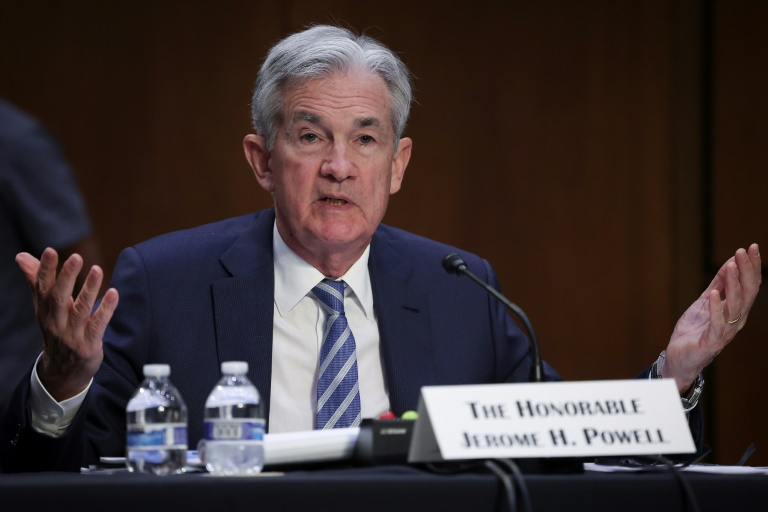
“However, Fed Chair Jerome Powell has been pushing back against a recession outcome while highlighting an outsized focus on combating inflation.”

And CMC Markets analyst Michael Hewson added: “Anyone thinking that in light of recent data that the Fed is likely to soften its tone is probably going to be disappointed.

“The last thing the Fed wants to do now is to allow the market to think it’s about to embark on a dovish pivot, despite increasing evidence that the economy is slowing.”

Oil prices edged up as recession worries were offset by data showing a big drop in US stockpiles, which pointed to strong demand at a time when supplies remain weak.

– Key figures at around 0810 GMT –

Tokyo – Nikkei 225: UP 0.2 percent at 27,715.75 (close)

Hong Kong – Hang Seng Index: DOWN 1.1 percent at 20,670.04 (close)

Shanghai – Composite: DOWN 0.1 percent at 3,275.76 (close)

London – FTSE 100: UP 0.4 percent at 7,338.70

Euro/dollar: UP at $1.0138 from $1.0126 Tuesday

Pound/dollar: UP at $1.2058 from $1.2030 

Euro/pound: DOWN at 84.08 pence from 84.09 pence

Dollar/yen: DOWN at 136.89 yen from 136.95 yen

West Texas Intermediate: UP 1.3 percent at $96.19 per barrel

Brent North Sea crude: UP 0.9 percent at $105.38 per barrel

New York – Dow: DOWN 0.7 percent at 31,761.54 (close)

— Bloomberg News contributed to this story —

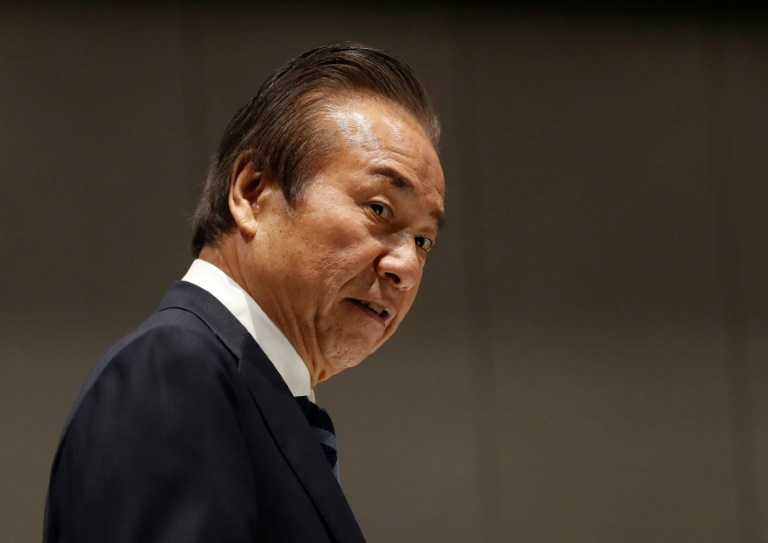
New Japan police raids over Tokyo Olympics claims: reports

Japanese police carried out new raids on Wednesday over allegations a 2020 Tokyo Olympics board member received money from a sponsor he signed a consulting contract with, local media reported.

Haruyuki Takahashi, 78, is suspected of receiving more than $300,000 from high street business suit retailer Aoki Holdings Inc., an “official partner” of last year’s pandemic-delayed mega-event.

That could reportedly constitute bribery because Takahashi was considered a quasi-civil servant who was not permitted to accept money or gifts related to his position.

Takahashi’s Tokyo home was raided by investigators on Tuesday morning according to reports.

And local media said searches were conducted Wednesday at the home of former Aoki chairman Hironori Aoki, 83, and the disbanded Tokyo 2020 organising committee office at the Tokyo Metropolitan Government.

The Tokyo Olympics organising committee wound down operations last month but it maintains a presence to deal with assets and liabilities.

The Tokyo prosecutors’ office told AFP it could not comment on individual cases.

Tokyo Governor Yuriko Koike told reporters the situation was “extremely regrettable” and she would “keep a close eye on developments.”

“I have told the organising committee that they should co-operate fully with this investigation,” she said.

A sports consulting firm run by Takahashi is suspected of receiving money from Aoki for a contract signed in 2017, according to local media.

Aoki in October 2018 became a Tokyo Games sponsor, allowing it to use the event’s logo and sell officially licensed products.

Takahashi told the Yomiuri Shimbun newspaper last week that the money his company received was for consultancy work.

“There was no conflict of interest whatsoever with my position as an organising committee board member,” he was quoted as saying.

Aoki issued a statement last week saying it had no comment on reports of the payments.

Takahashi, a former executive at Japan’s biggest advertising agency, Dentsu, served on the Tokyo 2020 board from June 2014.

Former Tokyo 2020 president Seiko Hashimoto told reporters Tuesday that she would “cooperate fully” with the investigation if instructed to do so.

“Matters such as this coming to light after the fact is very disappointing,” she said.

“We have to act in a way that will not tarnish what was achieved even with the pandemic.”

The case is not the first time questions have been raised about alleged impropriety around the Games.

French prosecutors launched an investigation into allegations of corruption linked to Tokyo’s bid for the Games in 2016.

The former head of Japan’s Olympic Committee, Tsunekazu Takeda, stepped down in 2019 as French authorities probed his involvement in payments made before Tokyo was awarded the event.

The Tokyo Olympics opened on July 23 last year after an unprecedented one-year delay because of the coronavirus pandemic.

The Games were held in largely empty stadiums after fans were banned over surging virus infections in Japan.

Bitter harvest: Malaysian palm oil farmers face labour crunch

Overripe palm oil fruits hang untouched in trees while others lie rotting scattered around a plantation, as Malaysian farmers reap the bitter harvest of a severe labour shortage.

The tropical country is the world’s second-biggest producer of the edible vegetable oil, which is found in many everyday goods from chocolate to cosmetics. 

The sector has long been reliant on migrants from neighbouring Indonesia for back-breaking plantation work, which is shunned by most in more affluent Malaysia. 

Lengthy Covid border closures had already reduced the foreign labour force, but now bureaucratic hurdles and a ban by Indonesia on sending new workers have dramatically worsened the problems.

“A lot of bunches of fruit are rotting on the trees,” Suzaidee Rajan, 47, who owns a 300-acre (120-hectare) plantation in Ijok, central Selangor state, told AFP. 

“We usually harvest twice a month. But now due to the labour shortage, we can (do so) just once a month. Our income has plunged and locals are angry.”

With just four foreign workers — two fewer than the number he needs — Suzaidee now has to drive into his plantation and load the fruit onto a lorry himself.

Palm oil is a controversial commodity, blamed by environmentalists for fuelling the destruction of rainforest in Malaysia and Indonesia, which together produce 85 percent of global output. 

Green groups say rapid expansion of plantations has destroyed rare animals’ habitats, while there have been allegations of foreign workers being abused and mistreated on some estates. 

The sector nevertheless remains a major contributor to Malaysia’s economy, and has continued to attract foreign workers who can earn higher wages than back home. 

Agricultural firms run large estates, while there are also numerous small-scale farmers like Suzaidee.

– ‘Darkness on horizon’ –

Other Malaysian industries, including construction and manufacturing, also rely on migrant workers from across Asia, and suffered as a result of lengthy pandemic border closures.

While authorities ended a freeze on hiring foreigners in February, labourers have been slow to return because of red tape and difficult negotiations with countries of origin. 

Problems in the plantation sector have been particularly acute, however, and look set to get worse after Indonesia banned sending new workers to Malaysia earlier this month.

Hermono — Indonesia’s ambassador in Kuala Lumpur, who goes by one name — said Jakarta took the decision as Malaysia was not abiding by an agreement aimed at protecting his compatriots.  

The Malaysian estate owners’ association says there is currently a shortage of about 120,000 workers. 

And this month Minister Zuraida Kamaruddin, who oversees the plantation sector, said the industry lost 10.46 billion ringgit ($2.35 billion) in the first five months of 2022 as palm oil fruit was left unharvested. 

“I can see only darkness on the horizon unless migrant workers are brought into the country immediately,” farmer Sahman Duriat, who has a plantation in Ijok, told AFP. 

“My earnings are falling while inflation and production costs are rising.”

After the Indonesian ban was announced, Malaysia’s human resources ministry vowed to address Jakarta’s concerns quickly to ensure it is reversed. 

For Indonesian plantation workers still in Malaysia, there is now much more to do.

“Usually we work in a group of five… but now there are just two of us,” said Zan, who goes by one name, as he cut fruit from a tree while a second man loaded it into a wheelbarrow.

“We harvest 200 tonnes a month with five people but now only 80 tonnes with just two of us.”

Most Asian markets down as Fed prepares latest hike

Stocks fell Wednesday as recession fears returned to the forefront of traders’ minds ahead of an expected Federal Reserve interest rate hike later in the day.

The selling followed a steep drop on Wall Street fuelled by concerns that four-decade high inflation and rising borrowing costs were keeping Americans from spending, and pushing the economy towards a recession.

That was backed up by a profit warning by retail titan Walman and a closely watched consumer confidence gauge sinking for the third month in a row.

And the International Monetary Fund slashed its global growth forecasts, warning the US economy would likely shrink.

There had been hope that a recent rally across markets indicated the long-running sell-off may have come to an end, and that signs of an economic slowdown could allow the Fed to ease off its tightening by next year and start cutting rates in 2023.

But observers warned there was still a lot of volatility to come as the bank was still hiking, prices were soaring, Russia’s war in Ukraine showed no sign of ending and China was still battling Covid with lockdowns.

“The Fed hasn’t even gotten to neutral yet,” Jason England, of Janus Henderson Investors, told Bloomberg Television.

“For them to start easing already or for them to start seeing eases priced in is, I think, a little premature.”

All eyes are now on the Fed meeting, which concludes Wednesday and is followed Thursday by second-quarter economic growth figures.

While officials are widely tipped to announce a second successive three-quarter point increase, the main focus will be their outlook for the economy and clues about future moves as it begins to falter.

“Markets are pricing at a slower pace of tightening before the Fed pivots to an easing stance in 2023,” said SPI Asset Management’s Stephen Innes.

“However, Fed Chair Jerome Powell has been pushing back against a recession outcome while highlighting an outsized focus on combating inflation.”

After a drop on Wall Street, most of Asia gave back a large chunk of Tuesday’s rally.

Hong Kong, Shanghai, Sydney, Seoul, Singapore, Taipei, Manila and Jakarta were all in the red, though Tokyo, Jakarta and Wellington eked out gains.

But US futures rallied after healthy earnings releases from tech titans, including Microsoft and Alphabet, soothed some worries about the consumer.

Oil prices fluctuated as recession worries were offset by data showing a big drop in US stockpiles, which pointed to strong demand at a time when supplies remain weak.

– Key figures at around 0230 GMT –

Tokyo – Nikkei 225: UP 0.1 percent at 27,692.89 (break)

Hong Kong – Hang Seng Index: DOWN 1.2 percent at 20,659.18

Shanghai – Composite: DOWN 0.3 percent at 3,268.76

Euro/dollar: UP at $1.0146 from $1.0126 Tuesday

Pound/dollar: UP at $1.2051 from $1.2030 

Euro/pound: UP at 84.19 pence from 84.09 pence

Dollar/yen: UP at 137.02 yen from 136.95 yen

West Texas Intermediate: FLAT percent at $94.96 per barrel

Brent North Sea crude: DOWN 0.2 percent at $104.22 per barrel

New York – Dow: DOWN 0.7 percent at 31,761.54 (close)

London – FTSE 100: FLAT at 7,306.28 (close)

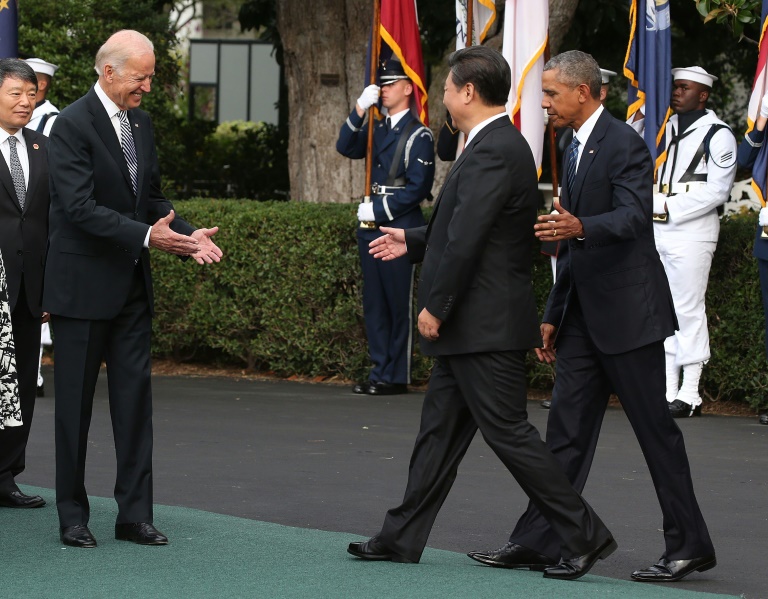
Biden undecided on China tariffs ahead of Xi call: W.House

President Joe Biden has still not decided whether to end some trade tariffs on China ahead of a phone call expected this week with his Chinese counterpart Xi Jinping, a senior official said Tuesday.

John Kirby, spokesman for the National Security Council, said the administration believes the tariffs imposed during a trade war under former president Donald Trump are not working, but that Biden has yet to settle on a next move.

“He wants a review of the tariffs that are in place to make sure that they are aligned with our strategic economic priorities, that they’re in our best national interests, and quite frankly, the best interests of the American people, but he hasn’t made a decision,” Kirby told reporters.

“I don’t have any decision to speak to with respect to tariffs by the president. He’s working this out with his team,” Kirby added.

However, the senior official made clear that Biden is not happy with the tariffs, which slapped 25 percent duties on billions of dollars of Chinese imports in retaliation for what the United States says are Beijing’s routinely unfair trade practices.

“We do believe… that the tariffs that were put in place by his predecessor were poorly designed. We believe that they’ve increased costs for American families and small businesses, as well as ranchers. And that’s, you know, without actually addressing some of China’s, China’s harmful trade practices,” Kirby said.

“So we thought that the previous administration’s approach to tariffs was a, was a shoddy deal.”

The call, which is expected this week but has yet to be finally scheduled, will be the fifth between Xi and Biden since the Democrat took office in 2021.

– Relationship tending –

Describing US-China ties as “one of the most consequential bilateral relationships in the world,” Kirby said Biden and Xi would cover “everything from the tensions over Taiwan, to the war in Ukraine, as well as how we better manage competition between our two nations, certainly in the economic sphere.”

“There’s a lot of focus on security challenges and tensions particularly in the Indo-Pacific region — with respect to Taiwan, with respect to the territorial claims in the South and East China Seas, but there’s also there’s also economic competition.”

One of the main goals of the call will be broadly what Kirby called Biden’s China “relationship tending.”

“He wants to make sure that the lines of communication with President Xi on all the issues, whether they’re issues again that we agree on or issues where we have significant difficulty with — that they can still pick up the phone and talk to one another candidly,” Kirby said.

One irritant in the relationship likely to come up is a reported plan by the speaker of the House of Representatives, Biden ally Nancy Pelosi, to visit Taiwan.

As second in line of succession to the US presidency, the speaker requires a significant security detail when she travels abroad and reports of her trip have infuriated Beijing, which claims sovereignty over Taiwan.

Kirby said he wanted to “stress the speaker has not announced any travel.” 

Stocks slide as gas prices and inflation erode confidence

Eurozone and US stocks sank on Tuesday on gas supply fears and renewed concerns about the impact of inflation.

In Europe, the natural gas reference price Dutch TTF surged nearly 13 percent to 203 euros ($205) per megawatt hour, one day after Russia’s Gazprom said it would cut daily gas deliveries to Europe via the Nord Stream pipeline.

“With no clear timeline for when capacity is likely to increase, the prospect of further uncertainty over gas supplies is weighing on European markets today,” CMC Markets analyst Michael Hewson told AFP.

Frankfurt’s DAX slumped 0.9 percent while the CAC in Paris shed 0.4 percent. 

“The euro is also under pressure as it becomes increasingly apparent that a slowing economy will make it increasingly difficult for the ECB to hike aggressively as we head into the winter months. Good luck raising rates against that sort of backdrop,” he added.

It fell by more than one percent to under $1.0120 at one point.

Eurozone bond yields also fell as investors fled to the relative safety of government debt.

Gazprom will cut gas deliveries to 33 million cubic metres a day — about 20 percent of the pipeline’s capacity — from Wednesday.

That has heightened market worries over supplies during the northern hemisphere winter later this year.

At the same time, European Union member states have reached agreement on how to cut their consumption of gas by 15 percent and reduce their dependence on Russian energy.

Gas prices remain way below the record March peak of 345 euros struck after Russia launched its assault on Ukraine.

EU states have accused Russia of squeezing supplies in retaliation for Western sanctions.

Elsewhere Tuesday, Asian stock markets closed mixed.

Investors welcomed news that e-commerce giant Alibaba would seek a primary listing in Hong Kong, which could pave the way for it to be traded by mainland Chinese investors.

Wall Street stocks slid, with a profit warning by Walmart rattling nerves about the impact of inflation on the economy and interest rates.

The retailer said it expects its earnings per share in its non-standard second quarter, which wraps up at the end of this month, to be down by 8-9 percent with an even bigger reduction next year.

Its shares were down around eight percent in morning trading.

“The basis for Walmart’s warning, though, is the real issue for the broader market,” said Patrick J. O’Hare at Briefing.com.

The retailer said food and fuel inflation was pushing consumers to defray discretionary spending on general merchandise.

“That is causing concerns about a trickle-down effect to other retailers, as well as suppliers to Walmart, that is weighing on sentiment and earnings expectations,” said O’Hare.

He said this was also fanning fears the US Federal Reserve, which began a two-day meeting Tuesday, will pursue aggressive rate hikes to tame inflation despite the risk of pushing the US economy into recession.

The International Monetary Fund also cut its forecast for global growth this year by four-tenths of a point to 3.2 percent surging inflation and severe slowdowns in the United States and China, the world’s two largest economies.

IMF chief economist Pierre-Olivier Gourinchas said the United States has only a slim chance of avoiding a downturn.

“The current environment suggest that the likelihood that the US economy can avoid a recession is actually quite narrow,” he said as the IMF cut its forecast for US economic growth this year by a drastic 1.4 percentage points to 2.3 percent.

– Key figures at around 1530 GMT –

New York – Dow: DOWN 0.6 percent at 31,798.59 points

EURO STOXX 50: DOWN 0.8 percent at 3,575.36

Frankfurt – DAX: DOWN 0.9 percent at 13,096.93 (close)

Paris – CAC 40: DOWN 0.4 percent at 6,211.45 (close)

London – FTSE 100: FLAT at 7,306.28 (close)

Tokyo – Nikkei 225: DOWN 0.2 percent at 27,655.21 (close)

Hong Kong – Hang Seng Index: UP 1.7 percent at 20,905.88 (close)

Shanghai – Composite: UP 0.8 percent at 3,277.44 (close)

Euro/dollar: DOWN at $1.0122 from $1.0223 Monday

Pound/dollar: DOWN at $1.2024 from $1.2046 

Euro/pound: DOWN at 84.20 pence from 84.83 pence

Dollar/yen: DOWN at 136.63 yen from 136.65 yen

Brent North Sea crude: DOWN 0.5 percent at $104.61 per barrel

West Texas Intermediate: DOWN 1.3 percent at $95.43 per barrel

burs-rl/lcm

IMF cuts global growth outlook due to US, China slowdowns

Surging inflation and severe slowdowns in the United States and China prompted the IMF Tuesday to downgrade its outlook for the global economy this year and next, while giving an even starker assessment of what may lie ahead.

“The outlook has darkened significantly since April,” said IMF chief economist Pierre-Olivier Gourinchas. “The world may soon be teetering on the edge of a global recession, only two years after the last one.”

“The world’s three largest economies, the United States, China and the euro area are stalling with important consequences for the global outlook,” he said at a briefing.

In its latest World Economic Outlook, the International Monetary Fund cut the 2022 global GDP estimate to 3.2 percent, four-tenths of a point lower than the April forecast, and about half the rate seen last year.

Last year’s “tentative recovery” from the pandemic downturn “has been followed by increasingly gloomy developments in 2022 as risks began to materialize,” the report said.

“Several shocks have hit a world economy already weakened by the pandemic,” including the war in Ukraine which has driven up global prices for food and energy, prompting central banks to raise interest rates sharply, the IMF said.

Ongoing Covid-19 lockdowns and a worsening real estate crisis have hindered economic activity in China, while the Federal Reserve’s aggressive interest rate hikes are slowing US growth sharply.

But the bad news may not stop there, IMF warned, saying that “risks to the outlook are overwhelmingly tilted to the downside,” and if they materialize could push the global economy into one of the worst slumps in the past half-century.

Key among concerns is the fallout from the Ukraine war including the potential for Russia to cut off natural gas supplies to Europe, as well as a further spike in prices and the specter of famines due to the war’s chokehold on grain supplies.

In an ominous warning, the WEO said “such shocks could, if sufficiently severe, cause a combination of recession accompanied by high and rising inflation (‘stagflation’).”

That would slam the brakes on growth, slowing it to 2.0 percent in 2023. The global growth rate has only been slower five times since 1970, the report said. 

Gourinchas said that would be “getting really close to a global recession.”

– Inflation priority –

The top priority for policymakers is to rein in soaring prices, even if it means pain for their citizens, the fund said, since the damage caused by out-of-control inflation would be much worse.

Gourinchas, in a blog post about the report, noted that the “synchronized” moves by major central banks to deal with the inflation threat “is historically unprecedented, and its effects are expected to bite.”

“Tighter monetary policy will inevitably have real economic costs, but delaying it will only exacerbate the hardship,” he said.

The IMF now sees consumer prices jumping 8.3 percent this year, nearly a full point higher than previously forecast, while emerging market economies face a 9.5 percent increase in consumer prices.

But, “further supply-related shocks to food and energy prices from the war in Ukraine could sharply increase headline inflation.”

That would increase the pain for poor nations least able to withstand the shock, where food makes up a larger share of family budgets.

– US, China slowdown –

While the global economy did a bit better than expected in the first three months of the year, it appears to have “shrunk in the second quarter — the first contraction since 2020,” the IMF said.

The IMF downgraded growth forecasts for most countries, including big revisions for the United States and China, cutting more than a point off the prior forecasts.

The fund now sees US growth this year of just 2.3 percent, amid slowing consumer spending and rising interest rates, and the report said a recession — defined by two quarters of negative growth — may already have begun.

Gourinchas said the US has a “very narrow path” to avoid a downturn, and even a “small shock” could tip the economy into recession.

China’s economy is expected to slow dramatically in 2022, expanding just 3.3 percent — the lowest in more than four decades with the exception of the 2020 pandemic crisis — due to continuing Covid concerns and a “worsening” property crisis, the report said.

“The slowdown in China has global consequences: lockdowns added to global supply chain disruptions and the decline in domestic spending are reducing demand for goods and services from China’s trade partners,” the report said.

There were some exceptions to the gloomy outlook, including upgrades for Italy, Brazil and Mexico, as well as for Russia which is still expected to contract but is benefiting from rising oil prices due to Western sanctions, the WEO said.

Close Bitnami banner
Bitnami