US Business

US Fed downshifts campaign to tame inflation but still 'some ways to go'

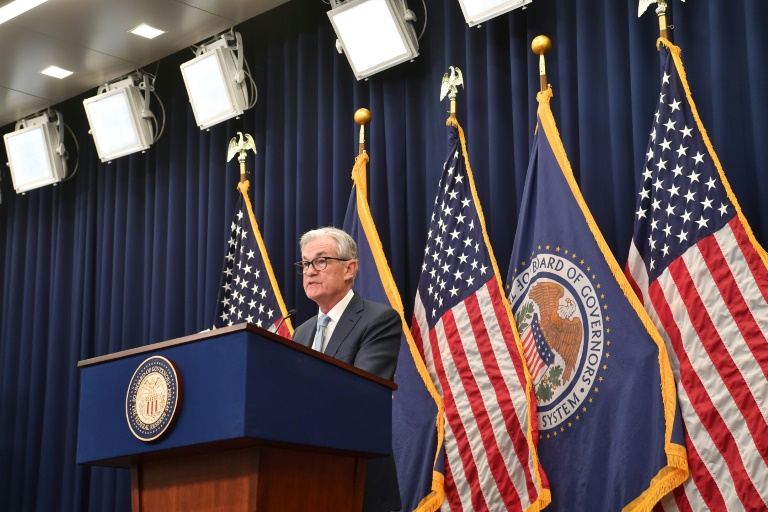
The Federal Reserve moderated its all-out campaign to cool US inflation Wednesday, lifting the benchmark lending rate by a half percentage point though warning there is still “some ways to go.”

America’s central bank has taken aggressive moves to ease demand in the world’s biggest economy, hiking rates seven times this year with interest-sensitive sectors like housing already reeling from tightening policy.

Its latest increase takes the rate to 4.25-4.50 percent, the highest since 2007.

But officials signaled that their battle to cool the US economy is not yet over.

In a statement, the Fed’s policy-setting Federal Open Market Committee (FOMC) said it “anticipates that ongoing increases in the target range will be appropriate” to reach a stance restrictive enough to rein in inflation.

A quarterly forecast released with Wednesday’s decision also saw policymakers downgrade US economic growth to 0.5 percent in 2023, just narrowly avoiding a contraction.

They also raised their unemployment and inflation estimates for next year.

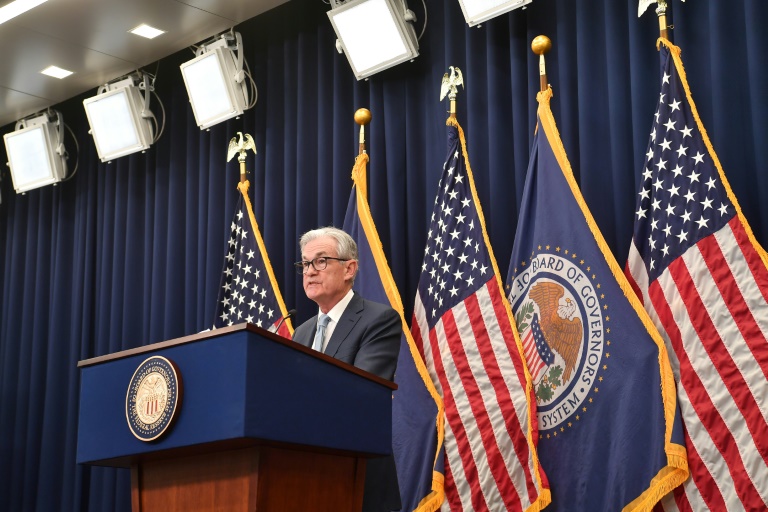
“Fifty basis points is still a historically large increase, and we still have some ways to go,” Fed Chair Jerome Powell told reporters in a press briefing after the rate announcement, and markets slumped on the central bank’s signals.

In their projections, policymakers expect rates would land higher than expected at 5.1 percent next year, according to a median forecast.

“I wouldn’t see us considering rate cuts until the committee is confident that inflation is moving down to two percent in a sustained way,” Powell said.

– ‘More evidence’ –

While consumer inflation eased in October and November, Powell said “it will take substantially more evidence to give confidence that inflation is on a sustained downward path.”

Households have been squeezed by red-hot prices, with conditions worsened by surging food and energy costs after Russia’s invasion of Ukraine, and fallout from China’s zero-Covid measures.

To make borrowing more expensive, the Fed has raised interest rates seven times including four bumper 0.75-point increases.

Asked if a “soft landing” for the economy remains achievable, Powell said this would be more likely if lower inflation readings persist.

Nancy Vanden Houten of Oxford Economics said: “The projections don’t explicitly call for a recession, although a rise in the unemployment rate by as much as the Fed now forecasts is consistent with a recession.”

The Fed lifted its median jobless rate forecast to 4.6 percent on Wednesday.

But Powell said: “I don’t think anyone knows whether we’re going to have a recession or not, and if we do, whether it’s going to be a deep one or not.”

– ‘Hawkish’ –

“The new forecasts are more hawkish than we expected,” said economist Ian Shepherdson of Pantheon Macroeconomics, referring to the higher inflation and unemployment rate expectations, and lower GDP growth projection.

“If policymakers implement all the hikes they now expect, they will have done too much,” he cautioned.

Analysts have warned that further tightening by the Fed risks cooling the economy at a time when it is already under pressure heading into 2023.

The latest increase suggests the Fed has “moved to phase two of its rate hiking cycle,” said Rubeela Farooqi of High Frequency Economics in a note.

This means it is shifting from its more aggressive path to “a slower pace of rate increases until rates are in a sufficiently restrictive stance,” she said.

Powell added Wednesday that the Fed’s focus now is “on moving our policy stance to one that is restrictive enough to ensure a return of inflation to our two percent goal over time.”

Consumer inflation came in at 7.1 percent year-on-year in November, according to government figures.

“We think that we’ll have to maintain a restrictive stance of policy for some time,” Powell said. 

“Historical experience cautions strongly against prematurely loosening policy,” he added.
US Fed downshifts campaign to tame inflation but still 'some ways to go'

The Federal Reserve moderated its all-out campaign to cool US inflation Wednesday, lifting the benchmark lending rate by a half percentage point though warning there is still “some ways to go.”

America’s central bank has taken aggressive moves to ease demand in the world’s biggest economy, hiking rates seven times this year with interest-sensitive sectors like housing already reeling from tightening policy.

Its latest increase takes the rate to 4.25-4.50 percent, the highest since 2007.

But officials signaled that their battle to cool the US economy is not yet over.

In a statement, the Fed’s policy-setting Federal Open Market Committee (FOMC) said it “anticipates that ongoing increases in the target range will be appropriate” to reach a stance restrictive enough to rein in inflation.

A quarterly forecast released with Wednesday’s decision also saw policymakers downgrade US economic growth to 0.5 percent in 2023, just narrowly avoiding a contraction.

They also raised their unemployment and inflation estimates for next year.

“Fifty basis points is still a historically large increase, and we still have some ways to go,” Fed Chair Jerome Powell told reporters in a press briefing after the rate announcement, and markets slumped on the central bank’s signals.

In their projections, policymakers expect rates would land higher than expected at 5.1 percent next year, according to a median forecast.

“I wouldn’t see us considering rate cuts until the committee is confident that inflation is moving down to two percent in a sustained way,” Powell said.

– ‘More evidence’ –

While consumer inflation eased in October and November, Powell said “it will take substantially more evidence to give confidence that inflation is on a sustained downward path.”

Households have been squeezed by red-hot prices, with conditions worsened by surging food and energy costs after Russia’s invasion of Ukraine, and fallout from China’s zero-Covid measures.

To make borrowing more expensive, the Fed has raised interest rates seven times including four bumper 0.75-point increases.

Asked if a “soft landing” for the economy remains achievable, Powell said this would be more likely if lower inflation readings persist.

Nancy Vanden Houten of Oxford Economics said: “The projections don’t explicitly call for a recession, although a rise in the unemployment rate by as much as the Fed now forecasts is consistent with a recession.”

The Fed lifted its median jobless rate forecast to 4.6 percent on Wednesday.

But Powell said: “I don’t think anyone knows whether we’re going to have a recession or not, and if we do, whether it’s going to be a deep one or not.”

– ‘Hawkish’ –

“The new forecasts are more hawkish than we expected,” said economist Ian Shepherdson of Pantheon Macroeconomics, referring to the higher inflation and unemployment rate expectations, and lower GDP growth projection.

“If policymakers implement all the hikes they now expect, they will have done too much,” he cautioned.

Analysts have warned that further tightening by the Fed risks cooling the economy at a time when it is already under pressure heading into 2023.

The latest increase suggests the Fed has “moved to phase two of its rate hiking cycle,” said Rubeela Farooqi of High Frequency Economics in a note.

This means it is shifting from its more aggressive path to “a slower pace of rate increases until rates are in a sufficiently restrictive stance,” she said.

Powell added Wednesday that the Fed’s focus now is “on moving our policy stance to one that is restrictive enough to ensure a return of inflation to our two percent goal over time.”

Consumer inflation came in at 7.1 percent year-on-year in November, according to government figures.

“We think that we’ll have to maintain a restrictive stance of policy for some time,” Powell said. 

“Historical experience cautions strongly against prematurely loosening policy,” he added.
Erdogan backs Turkmen gas link easing dependence on Russia

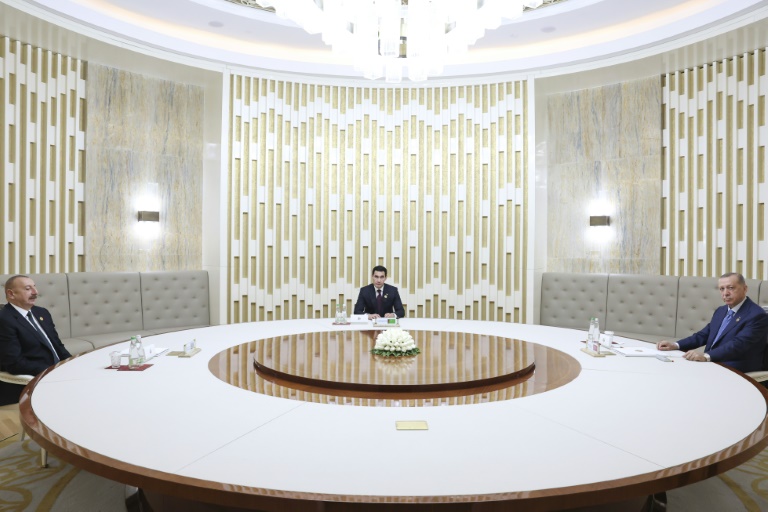
Turkish President Recep Tayyip Erdogan on Wednesday backed the creation of a new natural gas pipeline that could ease Europe’s dependence on Russia by linking up with energy-rich Turkmenistan.

The Turkish leader’s remarks came during a three-way summit with the presidents of Turkmenistan and Azerbaijan in the isolated Central Asian state’s city of Awaza.

The meeting came with Europe trying to end its dependence on Russian energy following the Kremlin’s invasion of Ukraine.

Erdogan has tried to play a role of a middle man in the conflict by maintaining close working relations with Russian President Vladimir Putin while supplying Kyiv with arms.

He has backed Putin’s idea of creating a new “gas hub” in Turkey that could supply European clients while bypassing existing pipelines running through Ukraine and under the Baltic Sea.

But he also lent his support on Wednesday to a new project that could link Turkmenistan with an existing pipeline running from Turkey to Azerbaijan.

“We carry Caspian Sea gas to Europe via (the existing) corridor, which is the backbone of the Trans-Anatolian natural gas pipeline,” Erdogan said in remarks released by his office.

“We need to launch work on transporting Turkmen natural gas to Western markets in the same way.”

The US Energy Information Administration lists Turkmenistan as the world’s sixth-largest holder of proven natural gas reserves.

Much of its past gas volumes have reached world markets via pipeline running to Russia.

But its has also been ramping up supplies to China and is looking for ways to access other markets via Turkey.

Erdogan has long dreamt of using Turkey’s location on the edges of the Middle East and Europe to turn it into one of the world’s main centres of the energy trade.

Central Asian countries have also been reassessing their once-close relations with Moscow since Russia’s war on Ukraine.

Russia’s decision to limit gas supplies in retaliation for Western sanctions have left European countries scambling for supplies as they head into the cold winter months.

Migrants amass on Mexico-US border as health policy to expire

Hundreds of migrants amassed Wednesday on the Mexican border, waiting for the expiry next week of a Covid-19 health measure that automatically blocks asylum seekers from entering the United States.

Long lines of migrants from Nicaragua, Venezuela, Colombia, Cuba, and elsewhere in Latin America began forming on Sunday in freezing temperatures, in the hopes of being allowed to seek asylum in the United States.

“We are seeing hundreds of people who are very cold, do not have food, and are trying to warm themselves a bit,” said Fernando Garcia of the NGO Border Network for Human Rights.

The unusual influx comes after a US federal judge in November ruled that the government could no longer use the controversial public health rules under Title 42 to block the entry of asylum seekers.

The measure, originally placed on the books in the 19th century to control contagious diseases, allows for the immediate removal of any foreigner or non-resident trying to enter the country without a visa.

It has been used to expel hundreds of thousands of people since being invoked by former president Donald Trump in the early days of the Covid-19 pandemic, and has been criticized as cruel and ineffective.

The measure expires at midnight on December 21, which has prompted migrants to amass at the border to try to enter the United States.

“This should not have been the case,” said Garcia. “It is the breakdown of the migration policy of the United States and Mexico.”

S.Africa's power utility CEO resigns amid energy crisis

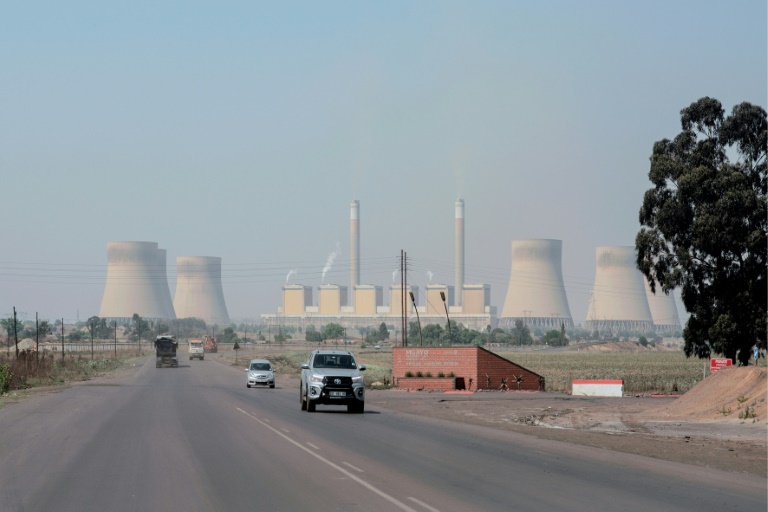
The head of South Africa’s beleaguered state-owned power utility Eskom, Andre de Ruyter, has resigned, the company said on Wednesday, as the country suffers from a worsening energy crisis. 

De Ruyter, a former packaging executive who took over as CEO in 2020, will stay on until the end of March next year to give the firm time to look for a successor, Mpho Makwana, the chairman of Eskom’s board said in a statement. 

“It has been an honour and privilege to serve Eskom and South Africa. I wish all the hard working people of Eskom well,” said De Ruyter.

Scheduled blackouts have burdened Africa’s most industrialised economy for years, with Eskom failing to keep pace with demand and maintain its ageing coal power infrastructure.

But the outages reached new extremes this year. 

Record power cuts have cost the country hundreds of millions of dollars in lost output, disrupting commerce and industry and angering the population, with lights going off often several times a day for a few hours. 

Last month, Eskom, which is struggling under a 400-billion-rand ($23.3 billion) debt — half of which the government has pledged to take on — said it had run out of funds to buy diesel to stabilise the system. 

De Ruyter had come under pressure from some government ministers that accused the company of not properly attending to the crisis, which analysts say is the result of years of mismanagement, disrepair and corruption.

“At a time when de Ruyter needed all the support he could muster and a free hand to deal with the most pressing challenge facing the country, he has been sacrificed at the altar of political expediency,” said Ghaleb Cachalia a lawmaker with the opposition Democratic Alliance (DA) party.

Public Enterprises Minister, Pravin Gordhan thanked De Ruyter for his “sacrifice and resilience in a difficult job”.

Red Cross fears 'enormous suffering' in 2023

The head of the International Committee of the Red Cross warned Wednesday “an enormous level of suffering” awaits the world in 2023 with famine spreading.

Mirjana Spoljaric, who took over at the ICRC in October, told a Geneva press conference: “We expect an enormous level of suffering.

“As the world is trending at the moment we don’t see any easing of the humanitarian pressures, they will be immense potentially,” she said.

“There is a possibility that we will see very high levels of hunger in many parts of the world and insecurity in general.”

Not only will prices be high for food, it will “simply not be available in the same amounts due to a lack of fertilisers and due to, again, the impact of climate change.”

She cited Somalia as a country of particular concern.

“In our four hospitals we have seen a tenfold increase of wounds caused by violence, violent, armed violence, conflict and we are also witnessing a three fold increase of malnutrition in children.

“The situation is extremely alarming,” Spoljaric said, adding her next trip would be to the Horn of Africa were some 20 million people are suffering from malnutrition.

The ICRC is seeking 2.8 billion euros for next year, up on last year’s 2.4 billion.

But the ICRC chief said it might not be enough, “depending on how the situation evolves”.

Germany signs contract to buy F-35 jets

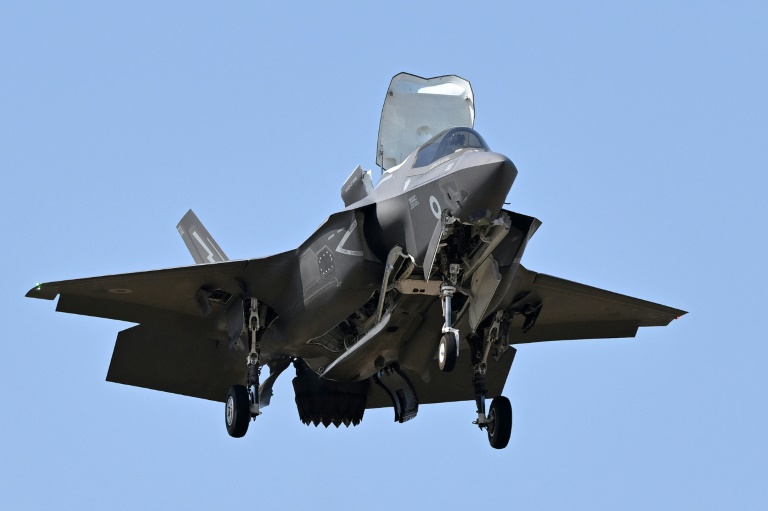
Germany on Wednesday signed a deal to buy dozens of US-made F-35 fighter jets, US officials said, part of the country’s military overhaul following Russia’s invasion of Ukraine. 

“The German F-35 programme will ensure the continuation of Germany’s alliance commitments and guarantee NATO’s credible deterrence in the future,” said the US embassy in Berlin in a statement. 

The 35 jets, the world’s most advanced warplanes, should be delivered between 2026 and 2029, it said. 

Berlin had announced in March the planned purchase of the aircraft made by Lockheed Martin to replace its ageing Tornado fleet. 

But the defence ministry in Berlin earlier this month raised concerns about the plan, warning of “delays and additional costs” in the nearly 10 billion euro ($10.5 billion) acquisition, in a letter to parliament’s budget committee. 

Germany’s lower house of parliament still decided to press ahead and approve the acquisition on Wednesday. 

“The German-US defence partnership has never been stronger and is a central pillar of NATO’s transatlantic partnership,” said the embassy statement. 

The cost of the jets is to come from a planned 100 billion euro investment in the armed forces, unveiled following the outbreak of the Ukraine war in a bid to overhaul Germany’s underfunded military.

Twitter suspends account tracking Elon Musk's jet

A Twitter account that tracked flights of Elon Musk’s private jet put out word Wednesday that it was suspended by the platform despite the billionaire’s talk of free speech.

“Well it appears @ElonJet is suspended,” creator Jack Sweeney tweeted from his personal @JxckSweeney account.

Sweeney attracted attention with his Twitter account that tracks the movements of the billionaire’s plane and even rejected Musk’s offer of $5,000 to shut down @ElonJet, which had hundreds of thousands of followers.

Musk had gone public saying he would not touch the account after buying Twitter in a $44 billion deal as part of his commitment to free speech at the platform.

Sweeney referred people to accounts he runs at social media services such as Instagram, Facebook and Mastodon for his latest posts regarding Musk’s jet.

Musk’s jet “flew from LA to Austin last night after my account was suspended on Twitter,” he said in an Instagram post Wednesday.

Flight-following websites and several Twitter accounts offer real-time views of air traffic, but that exposure draws pushback ranging from complaints to equipment seizures.

US rules require planes in designated areas be equipped with ADS-B technology that broadcasts aircraft positions using signals that relatively simple devices can pick up.

Figuring out or confirming to whom a plane actually belongs can require some sleuthing, said Sweeney, who filed a public records request with the US government in order to confirm Musk’s ownership of his plane.

Suspension of the account came a day after Twitter co-founder and former chief Jack Dorsey published an online post defending the tech firm’s workers, who Musk has criticized for decisions regarding content moderation.

“I’m a strong believer that any content produced by someone for the internet should be permanent until the original author chooses to delete it,” Dorsey wrote.

“It should be always available and addressable. Content takedowns and suspensions should not be possible.”

tWitch, Ellen DeGeneres DJ, dies in apparent LA suicide

Stephen “tWitch” Boss, the DJ from “The Ellen DeGeneres Show,” has died, his wife has said, in what Los Angeles media reported was an apparent suicide.

Entertainment website TMZ said the DJ and dancer was found in a hotel in the city on Tuesday with what appeared to be a self-inflicted gunshot wound.

The outlet said the 40-year-old’s wife, Allison Holker, had contacted police because she was concerned for her husband.

His body was discovered a short time later.

“It is with the heaviest of hearts that I have to share my husband Stephen has left us,” Holker, 34, said, according to multiple media.

“Stephen lit up every room he stepped into. He valued family, friends and community above all else, and leading with love and light was everything to him. He was the backbone of our family, the best husband and father, and an inspiration to his fans.”

A spokesman for Los Angeles Police Department said officers had responded to a call mid-morning Tuesday involving the death of a man.

The Los Angeles County coroner’s office said an autopsy was due to be carried out on 40-year-old Stephen Boss, who they said died Tuesday at a “hotel/motel.”

Boss became a fixture on “The Ellen DeGeneres Show” after he joined in 2014.

He stayed with the program until it ended this year.

He had also appeared on dance competition show “So You Think You Can Dance”, and had roles in movies “Step Up” and “Magic Mike XXL.”

Along with his wife Holker, he hosted reality show “Disney’s Fairy Tale Weddings.” 

The couple, who married in 2013, have three children.

“To say he left a legacy would be an understatement, and his positive impact will continue to be felt,” Holker said in her statement. 

“I am certain there won’t be a day that goes by that we won’t honor his memory.”

DeGeneres took to social media after news of the tragedy broke, posting a picture of her and Boss hugging.

“I’m heartbroken,” she wrote on Instagram.

“tWitch was pure love and light. He was my family, and I loved him with all my heart. I will miss him.”

EU vows investment in push to boost SE Asia ties

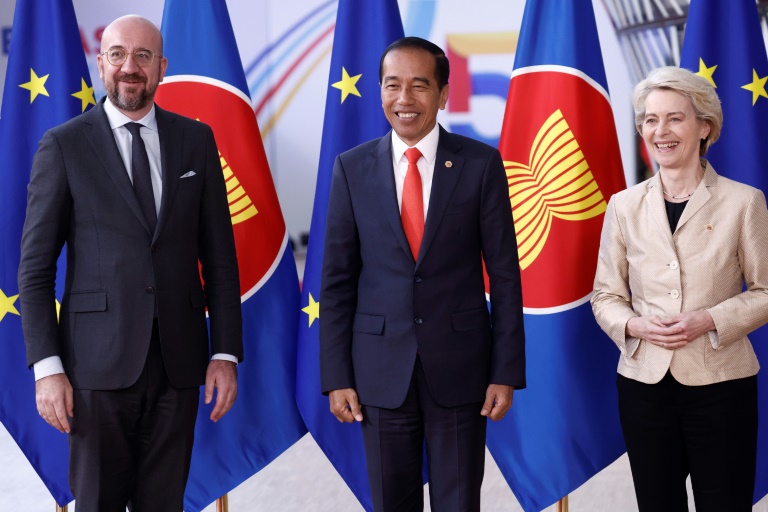
The EU vowed billions of dollars of investment in southeast Asia Wednesday, as leaders looked to bolster ties at a summit in the face of the Ukraine war and challenges from China. 

The European Union billed its first full summit with the Association of Southeast Asian Nations (ASEAN) in Brussels as a chance to push trade relations with the region’s fast-growing economies. 

“There might be many, many miles that divide us, but there are much more values that unite us,” European Commission President Ursula von der Leyen told the gathered leaders.

But different opinions over Russia’s war in Ukraine and concerns about tensions with China over a key shipping route for global trade loomed over the meeting. 

The EU has been on a diplomatic push to galvanise a global front against Moscow as its invasion has sent economic and political shock waves around the world. 

ASEAN’s 10 nations — nine of which were represented, after Myanmar’s junta was not invited — have been divided in their response to the Kremlin’s war on Ukraine.

Singapore has gone along with Western sanctions on Russia, while Vietnam and Laos, which have close military ties to Moscow, have remained more neutral. 

Along with Thailand, they abstained from a United Nations vote in October condemning Russia’s attempted annexation of regions of Ukraine seized since February.    

The diverging views led to intense wrangling over a declaration from the summit as the EU pushed for stronger language to condemn Moscow.

The final statement said “most members” decried Russia’s war, but conceded there were also “other views and different assessments”. 


– China looms –

While Europe pressed for a tougher response to Russia, another global giant figured prominently at the summit. 

Chinese claims over the South China Sea have set it against some neighbours and sparked fears in Europe over trade flows through the key global thoroughfare. 

But China remains the biggest trade partner for ASEAN and many in the region are wary of distancing themselves from their giant neighbour.

The EU is keen to pitch itself as a reliable partner for southeast Asia’s dynamic economies amid the growing rivalry between Beijing and Washington. 

The EU and ASEAN are each other’s third-largest trading partner and Europe sees the region as a key source for raw materials and wants to increase access to its booming markets.

EU nations are pushing to diversify key supply chains away from China as the war in Ukraine has highlighted Europe’s vulnerabilities. 

Von der Leyen offered an investment package over the next five years worth 10 billion euros ($10.6 billion) under the EU’s Global Gateway strategy designed as a counterweight to China’s largesse.

But ASEAN leaders insisted they would not be forced to make a choice between the global players competing for influence.  

“We absolutely refuse to go back to the situation of the Cold War where we have to pick sides in terms of who the superpower is that we are aligned with,” said Filipino President Ferdinand Marcos Jr.

– Sex law furore –

ASEAN and the EU suspended their push for a joint trade deal over a decade ago — but the bloc’s top officials said they hoped to relaunch efforts for a broad agreement. 

So far deals with Vietnam and Singapore are in place, and the EU is looking now to make progress with ASEAN’s largest economy Indonesia and to resume talks with Malaysia, Philippines and Thailand.

One issue that had risked clouding discussions was a new law in Indonesia criminalising sex outside marriage that has sparked fears for foreign visitors to the country.

But Indonesia’s President Joko Widodo pointedly insisted that the EU-ASEAN relationship needed to be based more on “equality”. 

“There must be no imposition of views,” he said. “There must not be one who dictates over the other and thinks that my standard is better than yours.”

Close Bitnami banner
Bitnami