US Business

Ukraine downs swarm of attack drones over Kyiv

Ukraine said Wednesday it had shot down more than a dozen Iranian-made drones launched at the capital by Russian forces in their latest assault on Kyiv. 

The attack came as the Kremlin promised no let-up to fighting over Christmas and as Ukraine leader Volodymyr Zelensky urged European leaders to back a court to try Russian officials.

“The terrorists started this morning with 13 Shaheds,” Ukrainian President Volodymyr Zelensky said, referring to the Iran-made weapons.

“All 13 were shot down” he added, urging residents to heed air raid sirens.

The national energy provider Ukrenergo said no electricity facilities had been damaged in the attack, crediting Ukrainian air defences for their “brilliant” work.

Ukraine has been subjected to nearly 10 months of air raid sirens and frequent aerial attacks since Russia invaded Ukraine in February and tried to capture the capital. 

But since a series of key battlefield setbacks this summer and autumn, Russia switched began systematically targeting critical infrastructure in Ukraine.

As temperatures drop, the missile and drone attacks disrupted electricity, water and heat to millions in Ukraine.

– ‘Nearly 7 million children’ at risk –

The strikes targeting Ukrainian energy infrastructure have piled pressure on the country’s power grid, whose operators have for weeks been forced to implement rolling blackouts.

They left “nearly seven million children without sustained access to electricity, heating and water, putting them at increased risk”, UNICEF, the UN children’s agency said Wednesday.

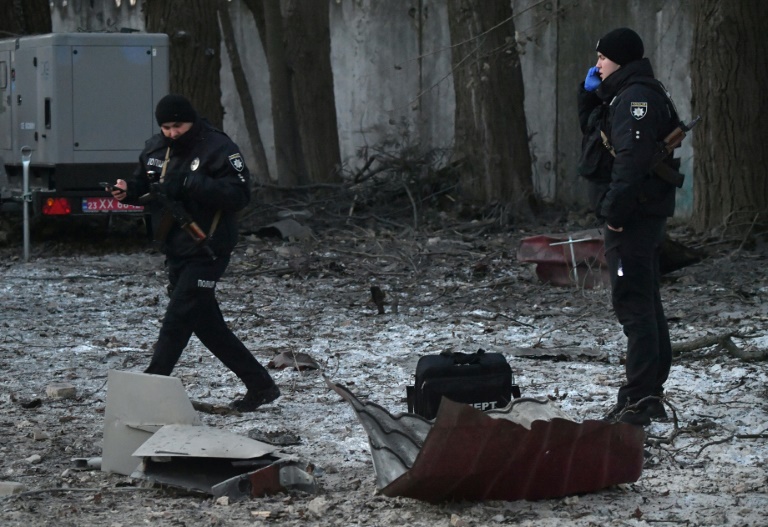
Explosions rang out over central Kyiv and AFP journalists later saw law enforcement and emergency service workers inspecting metal fragments at a snow-covered impact site.

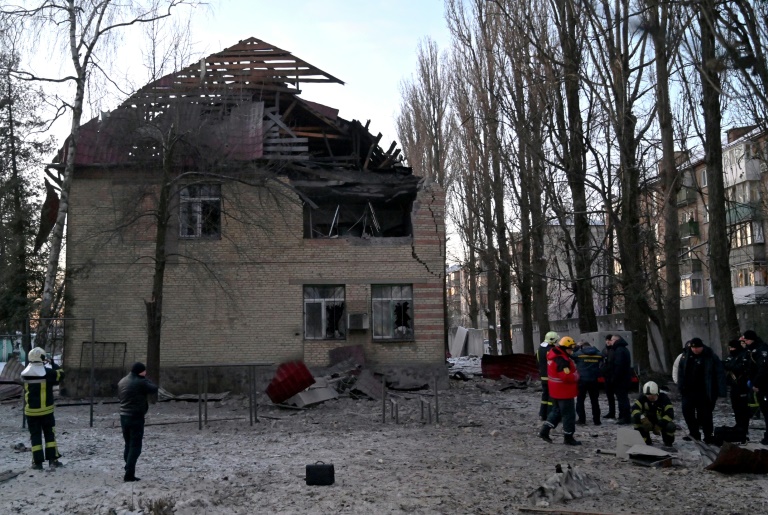
City officials said debris from the downed drones had damaged residential homes and an local administrative building. No one was reported injured or killed.  

The latest round of attacks came a day after dozens of countries and international organisations meeting up in Paris responded to a plea from Zelensky to help the country withstand Russia’s onslaught on its energy grid with 1 billion euros ($1.1 billion).

In a video message from Kyiv, Zelensky said Ukraine needed assistance for its battered energy sector and spare parts for repairs, high-capacity generators, extra gas and increased electricity imports.

Foreign Minister Dmytro Kuleba called on Ukraine’s allies to provide his country with more weapons to help it “fight through the winter” and sustain Kyiv’s military advances.

– US citizen freed –

Ukraine separately said Wednesday it had secured the release of US citizen Suedi Murekezi as well as 64 Ukrainian members of the military in its latest prisoner swap with Russian forces.

Russia’s state-run TASS news agency earlier reported that Murekezi had been arrested in the eastern Donetsk region of Ukraine in June and charged with attending anti-Russian protests.

After nearly 10 months of fighting, Russia has yet to fulfil any of its stated key goals in what it refers to as its “special military operation” in Ukraine, including seizing the capital or the eastern Donbas region.

The Moscow-installed leader of Ukraine’s Donetsk region on Wednesday however called for Russia to widen its goals and annex two more areas of Ukraine, the Black Sea region of Odessa and Chernigiv in the north.

The Kremlin said a ceasefire was not on Moscow’s agenda, and that it had not received any proposals from Kyiv to pause fighting in Ukraine during the upcoming holiday period.

“No, no proposals have been received from anyone and no topic of this kind is on the agenda,” the Kremlin’s spokesman Dmitry Peskov. 

Meanwhile on Wednesday, Zelensky accepted the European Union Sakharov Prize for human rights on behalf of the people of Ukraine. 

As he accepted the EU’s top rights award, he urged Europe to help set up a tribunal swiftly to try Russia’s leadership for the “crime of aggression”.
Polish fish farm fights 'myth of Russian caviar'

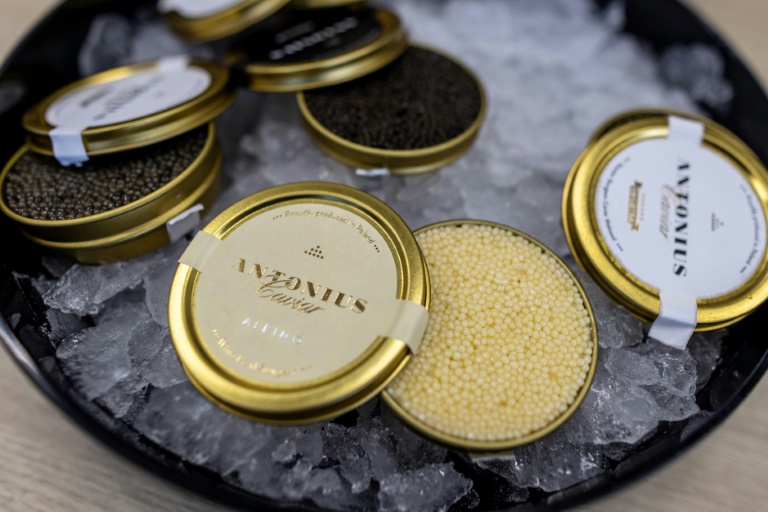
With Moscow blacklisted since it invaded Ukraine, Europe’s main producer of caviar wants to put an end, once and for all, to the delicacy’s traditional association with Russia.

“For most people, caviar means Russia, but that hasn’t been the case for a long time now,” said Agata Lakomiak-Winnicka, marketing and sales manager for Poland’s Antonius Caviar. 

Based in the northeastern village of Rus, the company is one of the world’s top makers of the luxury food, having produced 42 tonnes of black caviar last year — more than any one firm in Italy or France and almost as much as those in China.

“We used to get clients who couldn’t locate Poland on a map. Today we’re on a whole different level,” Lakomiak-Winnicka said.

The company exports mostly to the United Arab Emirates, the United States, France and Denmark and also supplies Michelin-starred restaurants around the world.

Retail prices range from 1,200 to 2,400 euros ($1,275-2,550) for sturgeon caviar and up to 8,000 euros for the albino kind.

The company’s challenge now, one faced by producers worldwide, is the battle against “the myth of Russian caviar”. 

“Take any box of caviar that reads ‘Russian tradition’ or ‘Russian method’ and you’ll see that 99 percent of the time it doesn’t actually come from Russia,” Lakomiak-Winnicka said. 

– Russia boycott –

Traditionally, caviar was made from eggs from wild sturgeon in the Caspian and Black seas with the best-known producers in Russia and Iran.

But years of overfishing and pollution left the sturgeon at risk of extinction, and it is now a protected species. 

Most caviar today is produced on fish farms and has nothing to do with Russia.

But consumers still associate the two — a challenge for those who out of solidarity for Ukraine no longer want to buy Russian.

“Because of the war… clients ask about the provenance of the caviar,” said Wiktoria Yerystova-Rostkowska, who owns a Russian shop outside Warsaw.

“They want good caviar but it can’t be Russian,” she told AFP, adding that she sources hers from Germany.

The EU and United States have banned Russian caviar as part of their sanctions against Moscow, but it was already practically impossible to buy due to restrictions to protect wild sturgeon.

– Aquaculture –

The green and black boxes of caviar are on display in the shop window. 

Featuring a drawing of the fish, the label reads “malossol” — the Russian for “lightly salted” and the name of the traditional method used to preserve caviar.

Yerystova-Rostkowska said the boycott of Russian products has left her struggling to stay open.

“It’s no longer profitable. I’m down 80 percent in revenue,” she said. 

Lakomiak-Winnicka for her part sees the boycott as an opportunity. 

“It’s a chance to explain that caviar no longer comes from Russia,” she said.

It has been years since wild Russian caviar was available on the international market.

“The Caspian Sea no longer has any importance in caviar production,” said Antonius head Marek Szczukowski.

“The vast majority of caviar sold around the world is derived from aquaculture,” including in Russia, he added.

– Sturgeon ‘on vacation’ –

On the Antonius fish farm in Rus, thousands of sturgeon — some more than a metre (three feet) in length — swim around in canals fed by the crystal clear water of a nearby river.

The company initially farmed trout there, but because of climate change they switched to sturgeon, which prefer warmer water.

“The sturgeon are on vacation here, like they’re in Hawaii,” Szczukowski said. 

The caviar is harvested after the fish reach maturity, with the entire operation taking under 20 minutes.  

Workers extract the caviar, wash and salt it, then box it up.

The label reads: “Proudly produced in Poland”. 

It used to also include the word “Russian” — to denote the fish species — but from now on it will just say “sturgeon caviar”. 

“At the express request of clients, we’re changing the labels, leaving no room for doubt,” Lakomiak-Winnicka said.  

Markets muted before expected US rate hike

Caution reigned on stock markets on Wednesday ahead of an expected interest rate hike from the Federal Reserve as inflation remains at decade-high levels despite moderate slowdowns. 

Wall Street’s main indices posted modest gains in morning trading, with the Dow adding 0.7 percent.

European stocks finished moderately lower, with London losses cushioned by news that UK inflation nudged lower in November.

Meanwhile, Frankfurt and Paris also fell despite the Ifo research institute’s forecast that Germany’s recession could be milder than previously predicted.

Asian stocks rose following Tuesday’s rebound on Wall Street.

The dollar drifted lower against its main rival currencies.

The Fed is forecast to increase borrowing costs 50 basis points Wednesday after four 75-point rises in a row.

The US central bank has embarked on an all-out campaign to cool demand in the world’s biggest economy, raising rates six times this year with interest-sensitive sectors like housing already reeling from tightening policy.

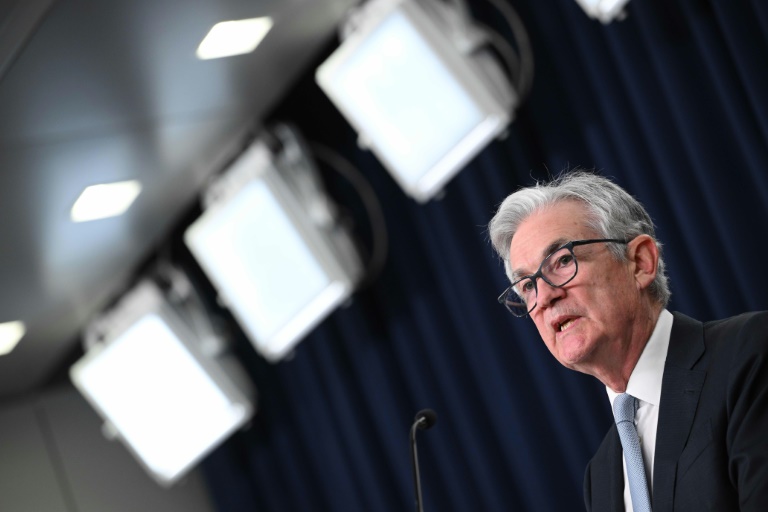
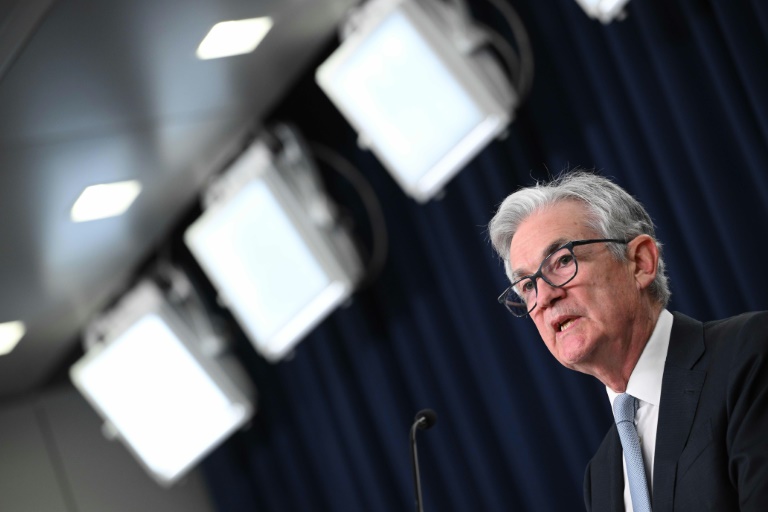
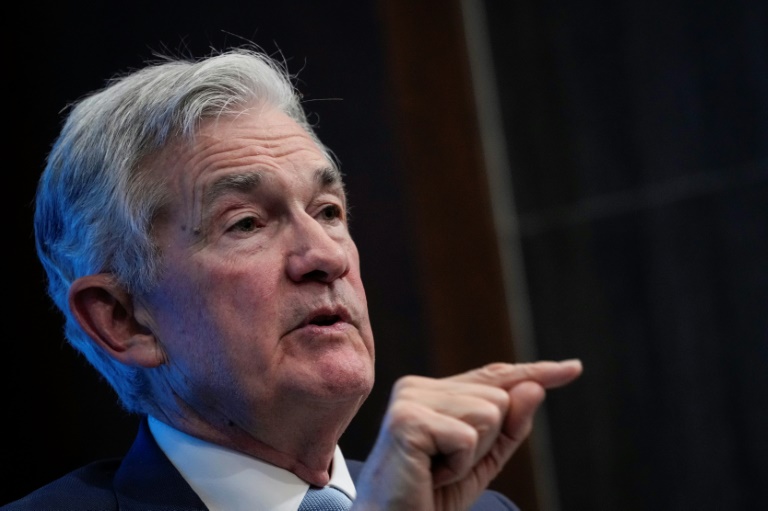
The US central bank’s post-meeting statement and boss Jerome Powell’s comments are the main focus for traders, along with the Fed’s infamous “dot plot” chart of the rate outlook.

“At the end of the day, it’s Jerome Powell, and the Fed, who will either give a green light for a modest Santa rally (for equities), or tell investors that Santa is stuck in a snow storm this year,” noted SwissQuote analyst Ipek Ozkardeskaya.

Investors will be looking for indications on the pace of future rate hikes, as well as what could be the “terminal rate”, or the highest interest rate before the Fed begins lowering rates again.

Briefing.com analyst Patrick O’Hare said the “tone and cadence from Fed Chair Powell will have an outsized impact today” on markets as official forecasts are subject to revision.

Later, the impact of higher interest rates on consumers and the wider economy will feed into investors’ calculations.

“That reality will be an inevitable drag on economic activity and it will be incorporated in the market’s concerns about the long and variable lags of monetary policy on economic activity,” he added.

It’s the turn of Europe on Thursday, with the Bank of England and European Central Bank expected to announce less aggressive rate hikes compared with their recent monetary policy decisions.

Wall Street rebounded Tuesday in reaction to data showing US consumer prices rose 7.1 percent last month, less than forecast and the slowest pace since December 2021.

The reading followed an October slowdown and fuelled hopes that inflation in the world’s biggest economy has finally peaked, after several months of Fed rate hikes.

Markets are also eyeing developments in China, which is continuing to roll back its strict zero-Covid strategy that has battered the world’s number two economy, though fears of a sharp surge in infections are causing some unease among dealers.

Oil prices pushed higher.

“Crude oil prices have continued their recent rise after the IEA warned that prices were likely to rise next year as sanctions further squeeze Russian supply, and demand starts to pick up as China starts to reopen properly,” said market analyst Michael Hewson at CMC Markets.

– Key figures around 1630 GMT –

New York – Dow: UP 0.7 percent at 34,350.80 points

EURO STOXX 50: DOWN 0.3 percent at 3,975.26

London – FTSE 100: DOWN less than 0.1 percent at 7,495.93 (close)

Frankfurt – DAX: DOWN 0.3 percent at 14,460.20 (close)

Paris – CAC 40: DOWN 0.2 percent at 6,730.79 (close)

Tokyo – Nikkei 225: UP 0.7 percent at 28,156.21 (close)

Hong Kong – Hang Seng Index: UP 0.4 percent at 19,673.45 (close)

Shanghai – Composite: FLAT at 3,176.53 (close)

Euro/dollar: UP at $1.0660 from $1.0635 on Tuesday

Dollar/yen: DOWN at 134.76 yen from 135.59 yen

Pound/dollar: UP at $1.2421 from $1.2366

Euro/pound: DOWN at 85.83 pence from 85.96 pence

Brent North Sea crude: UP 2.5 percent at $82.72 per barrel

West Texas Intermediate: UP 2.6 percent at $77.36 per barrel

burs-rl/lc

French prosecutors search Macron's party offices

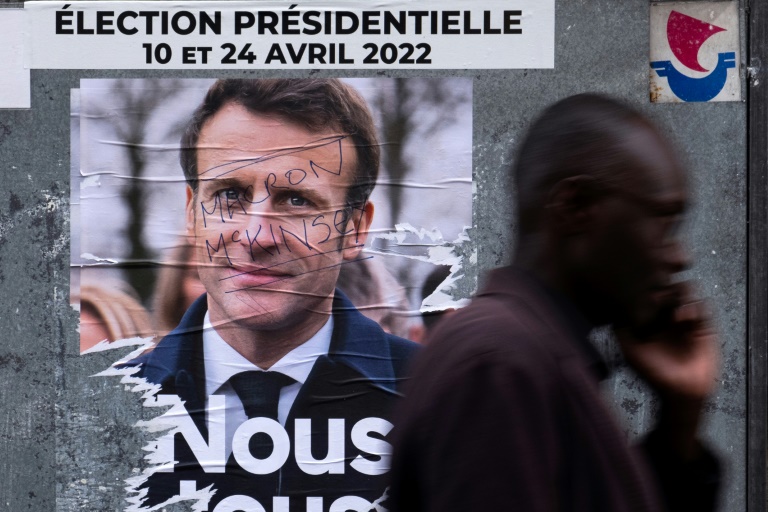
French prosecutors said Wednesday that they had searched the headquarters of President Emmanuel Macron’s Renaissance party in their investigation into the use of consulting firms by the government since 2017.

The Paris offices of US consulting giant McKinsey were also searched on Tuesday, the National Financial Prosecutors’ Office said, confirming a report in Le Parisien newspaper.

The use of consultants by Macron’s governments came under the spotlight in March after a French Senate inquiry concluded that public spending on them had more than doubled from 2018 to 2021, during Macron’s first term.

“It’s normal for the judiciary to investigate freely and independently to shed all the light on this subject,” a Renaissance spokesman, Loic Signor, told AFP.

He said the party remained at prosecutors’ disposal “to provide all useful information on the campaigns”.

McKinsey also confirmed the search of its offices, saying it was “cooperating fully with the authorities”.

Two probes have been underway since October, looking into possible false election campaign accounting, as well as possible favouritism and conspiracy.

Some McKinsey consultants are known to have worked as unpaid volunteers on Macron’s victorious 2017 election campaign and prosecutors are thought to be probing whether this entailed a hidden campaign expense.

They are also looking into whether the firm enjoyed special access and treatment afterwards when winning lucrative contracts with the government.

Finance Minister Bruno Le Maire acknowledged last month that there had been “excesses” with the use of consulting contracts in the past, but they had since been “corrected”.

– ‘McKinseygate’ –

Total outlays on consulting firms reached more than a billion euros ($1.1 billion) last year, according to the Senate panel report, a figure frequently cited by Macron’s opponents during his successful bid for a second term last April.

The panel also criticised fiscal strategies by McKinsey that it said allowed the US firm to pay no corporate taxes in France between 2011 and 2020.

That claim prompted the financial prosecutor’s office to open a separate preliminary investigation that led to a search of McKinsey’s Paris headquarters on May 24.

The prosecutors have not publicly identified the president or his campaign teams as the targets of the inquiry, of which Macron said in November that “I’m not scared of anything.”

But the use of expensive foreign firms for strategic advice, dubbed “McKinseygate” by national media, shocked many French voters even as Macron has repeatedly defended the contracts.

“When you want to go very quickly and very strongly with a policy, you need to make use of outside contractors occasionally,” he told reporters in March.

If prosecutors want to question Macron directly on the consulting claims, they may have to wait until he no longer enjoys presidential immunity in 2027, when he leaves office after the constitutional limit of two five-year terms.

France’s state auditor, the Cour des Comptes, has also found that several contracts for consulting firms during the Covid-19 crisis were awarded under “problematic” circumstances, Le Monde newspaper reported Monday, citing a confidential report.

France has strict rules on the financing of election campaigns and political parties, which have led to several convictions in recent decades.

Former president Nicolas Sarkozy received a one-year prison sentence in September 2021 for illegal financing of his 2012 re-election bid.

Judges concluded that Sarkozy spent nearly twice the legal limit on his doomed quest for a second term. He has appealed the ruling.

Markets muted before expected US rate hike

Caution reigned on stock markets on Wednesday ahead of an expected interest rate hike from the Federal Reserve as inflation remains at decade-high levels despite moderate slowdowns. 

Wall Street opened mixed, with the Dow adding 0.2 percent.

European stocks were moderately lower in afternoon trade, with London losses cushioned by news that UK inflation nudged lower in November.

Meanwhile, Frankfurt and Paris also fell despite the Ifo research institute’s forecast that Germany’s recession could be milder than previously predicted.

Asian stocks rose following Tuesday’s rebound on Wall Street.

The dollar drifted lower against its main rival currencies.

The Fed is forecast to increase borrowing costs 50 basis points Wednesday after four 75-point rises in a row.

The US central bank’s post-meeting statement and boss Jerome Powell’s comments are the main focus for traders, along with the Fed’s infamous “dot plot” chart of the rate outlook.

“At the end of the day, it’s Jerome Powell, and the Fed, who will either give a green light for a modest Santa rally (for equities), or tell investors that Santa is stuck in a snow storm this year,” noted SwissQuote analyst Ipek Ozkardeskaya.

Investors will be looking for indications on the pace of future rate hikes, as well as what could be the “terminal rate”, or the highest interest rate before the Fed begins lowering rates again.

Briefing.com analyst Patrick O’Hare said the “tone and cadence from Fed Chair Powell will have an outsized impact today” on markets as official forecasts are subject to revision.

Later, the impact of higher interest rates on consumers and the wider economy will feed into investors’ calculations.

“That reality will be an inevitable drag on economic activity and it will be incorporated in the market’s concerns about the long and variable lags of monetary policy on economic activity,” he added.

It’s the turn of Europe on Thursday, with the Bank of England and European Central Bank expected to announce less aggressive rate hikes compared with their recent monetary policy decisions.

Wall Street rebounded Tuesday in reaction to data showing US consumer prices rose 7.1 percent last month, less than forecast and the slowest pace since December 2021.

The reading followed an October slowdown and fuelled hopes that inflation in the world’s biggest economy has finally peaked, after several months of Fed rate hikes.

Markets are also eyeing developments in China, which is continuing to roll back its strict zero-Covid strategy that has battered the world’s number two economy, though fears of a sharp surge in infections are causing some unease among dealers.

Oil extended recent gains as traders awaited the weekly US inventories report for clues on demand in the world’s top crude consuming nation.

– Key figures around 1430 GMT –

London – FTSE 100: DOWN less than 0.1 percent at 7,498.46 points

Frankfurt – DAX: DOWN 0.5 percent at 14,424.85

Paris – CAC 40: DOWN 0.3 percent at 6,723.43

EURO STOXX 50: DOWN 0.4 percent at 3,972.18

New York – Dow: UP 0.2 percent at 34,165.75

Tokyo – Nikkei 225: UP 0.7 percent at 28,156.21 (close)

Hong Kong – Hang Seng Index: UP 0.4 percent at 19,673.45 (close)

Shanghai – Composite: FLAT at 3,176.53 (close)

Euro/dollar: UP at $1.0641 from $1.0635 on Tuesday

Dollar/yen: DOWN at 134.98 yen from 135.59 yen

Pound/dollar: UP at $1.2367 from $1.2366

Euro/pound: UP at 86.03 pence from 85.96 pence

Brent North Sea crude: UP 1.6 percent at $81.98 per barrel

West Texas Intermediate: UP 1.8 percent at $76.78 per barrel

burs-rl/lc

Ten years after Sandy Hook, a mother's grief and healing

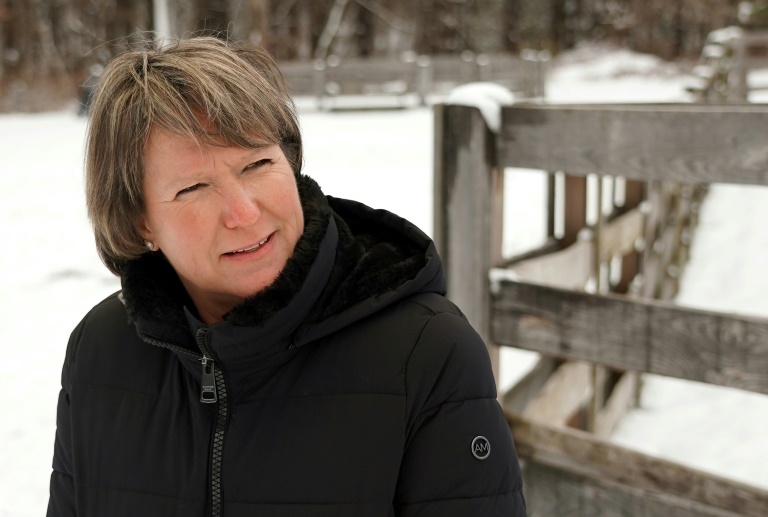
Jenny Hubbard struggles to believe that 10 years have passed since her six-year-old daughter’s murder at Sandy Hook Elementary during the deadliest mass shooting against schoolchildren in US history.

Catherine Violet Hubbard was among 20 children and six adults gunned down by Adam Lanza in the five-minute killing spree in Newtown, Connecticut, on December 14, 2012.

The massacre shocked America and the world, sparked heightened security measures at schools, and renewed a contentious fight for gun control laws that continues a decade later.

“It’s a reminder that time is so fleeting,” Hubbard, 50, says of Wednesday’s anniversary, which, like every year, will be marked with quiet reflection in the town of just 27,000 people.

“It’s been a lifetime because from that day to now, my life is totally different, and yet at the same time it was like it was yesterday,” she tells AFP. 

Hubbard remembers Catherine and her eight-year-old son’s excitement as she put them on the school bus that morning, with Christmas just around the corner.

“They were over the moon for the holidays. It was one of those mornings where I look back on, and I think it was rushed and chaotic, but it was also one of the best mornings that we had,” she recalls.

At 9:30 am (1430 GMT), 20-year-old Lanza entered the school armed with a Bushmaster AR-15 assault rifle and two pistols after shooting dead his mother at home.

“The phone call came in that something had happened, and the rest of the day was just a long fog of knowing that something terrible had happened but not understanding the magnitude of what that was,” says Hubbard.

– ‘The unthinkable loss’-

Lanza fired more than 150 times in the corridors and classrooms, killing 20 six-and-seven-year-olds, and six women who worked at the school, before committing suicide.

At a nearby firehouse, where authorities had taken children to be picked up by their parents, Hubbard learned that Catherine had died.

“Most people were just frozen. (It was) the unthinkable loss,” she says.

Slowly, over time, Hubbard says she has been able to heal, thanks to accepting the kindness of others and religious faith.

“The first step was just getting out of bed, and that was because of my son. I had to get up because he had a right to live his life. Then every single day, there was just one more step that I would take,” she says.

Difficult days include the first school day of every year and when other mass shootings occur, like at Robb Elementary School in Uvalde, Texas, in May when 19 children and two teachers were killed.

“I know that the journey that the families are about to take is not easy, and it’s lonely, and it’s dark at times,” says Hubbard.

Following Sandy Hook, described by Barack Obama as the worst day of his presidency, schools reinforced doors and windows, upped teaching children how to respond to an “active shooter,” and boosted staff training on how to barricade classrooms.

But tougher national restrictions on guns did not follow until after Uvalde, when Congress passed legislation that expanded background checks and reinforced measures to get firearms out of the hands of potentially dangerous people.

A stricter law that expired in 2004, banning military-style rifles with large capacity magazines, remains elusive amid opposition from Republicans who cite the constitutional right to gun ownership.

“We have a moral obligation to pass and enforce laws that can prevent these things from happening again,” President Joe Biden said Wednesday.

“I am determined to ban assault weapons and high-capacity magazines like those used at Sandy Hook,” he added.

– A gentle animal lover –

A circular memorial pool honoring the Sandy Hook victims opened near the school last month. Single white roses rested on each name this week.

Nearby, sits the 34-acre Catherine Violet Hubbard Animal Sanctuary that Hubbard founded in honor of her daughter, who loved animals.

Hubbard remembers Catherine as “fiercely determined,” “gentle” and “compassionate.”

Sometimes, she finds herself wanting to know what 16-year-old Catherine would be like, but tries to stop herself.

“I will never understand why that’s not possible in my life, but I carry with me the six years that she shared with me and the memories,” Hubbard says.

US Fed expected to slow pace of rate hikes as inflation eases

US central bankers opened the second day of a key policy meeting Wednesday, with growing anticipation of a smaller hike to the Fed’s benchmark lending rate as surging inflation shows signs of easing.

The Federal Reserve has embarked on an all-out campaign to cool demand in the world’s biggest economy, raising rates six times this year with interest-sensitive sectors like housing already reeling from tightening policy.

While it takes time for effects to ripple through sectors, there have been positive signs, with consumer inflation in the United States easing in November, according to government data released Tuesday.

The consumer price index, a key gauge of inflation, logged its smallest annual increase in nearly a year, fueling optimism that the Fed could soon moderate its efforts.

The figures nudged Wall Street stocks up, with Asian indices rising Wednesday as well, as all eyes turn to the Fed’s post-meeting statement and Fed Chair Jerome Powell’s comments for hints on the path to come.

Households have been squeezed by red-hot prices, with conditions worsened by surging food and energy costs after Russia’s invasion of Ukraine, and fallout from China’s zero-Covid measures.

To make borrowing more expensive, the Fed has raised interest rates six times, including four bumper 0.75-point increases, bringing the rate to between 3.75 percent and four percent.

Analysts widely expect the Fed to adopt a smaller, half-point hike on Wednesday, with Ian Shepherdson of Pantheon Macroeconomics calling it a “a done deal.”

While this marks a step down from earlier 0.75-point increases, it would still be a steep jump.

Shepherdson cautioned that Powell is “in no hurry to say what markets want to hear.”

“(Powell) is unlikely to deviate from his clear line that the Fed will do whatever is necessary to squeeze out inflation, and that some pain will be necessary,” Shepherdson added in an analysis.

– ‘Not yet proof’ –

Recent easing in data is welcome news to policymakers, but this is “not yet proof that inflation has sustainably cooled to levels consistent with the inflation target,” cautioned economist Edoardo Campanella of UniCredit Bank in a note.

The Fed has a longer-term target of two percent, while consumer inflation jumped 7.1 percent year-on-year in November.

“The Fed will likely further slow the pace of rate hikes early next year to 25 basis points,” Campanella added.

“However, with the labor market still very tight… and with broad financial conditions easing, the Fed will likely say that their job is not done,” he said.

Neil Saunders, managing director of GlobalData, added that the Fed is taking a “hawkish view on inflation” and will likely conclude further tightening is needed, based on the continued strength of underlying demand in the economy.

“As much as this action may have the desired effect, it will cool the economy at a time when it is already under pressure heading into 2023,” said Saunders.

The Fed’s further rate hike will also mark “a new phase” in its tightening cycle, said Nationwide chief economist Kathy Bostjancic in a note Monday.

This comes as officials look to adjust policy now that it is “within the range considered restrictive.”

Financial markets will be watching for signals of how high rates might go, and “the path for rates beyond that peak,” she added.

US Fed expected to slow pace of rate hikes as inflation eases

US central bankers opened the second day of a key policy meeting Wednesday, with growing anticipation of a smaller hike to the Fed’s benchmark lending rate as surging inflation shows signs of easing.

The Federal Reserve has embarked on an all-out campaign to cool demand in the world’s biggest economy, raising rates six times this year with interest-sensitive sectors like housing already reeling from tightening policy.

While it takes time for effects to ripple through sectors, there have been positive signs, with consumer inflation in the United States easing in November, according to government data released Tuesday.

The consumer price index, a key gauge of inflation, logged its smallest annual increase in nearly a year, fueling optimism that the Fed could soon moderate its efforts.

The figures nudged Wall Street stocks up, with Asian indices rising Wednesday as well, as all eyes turn to the Fed’s post-meeting statement and Fed Chair Jerome Powell’s comments for hints on the path to come.

Households have been squeezed by red-hot prices, with conditions worsened by surging food and energy costs after Russia’s invasion of Ukraine, and fallout from China’s zero-Covid measures.

To make borrowing more expensive, the Fed has raised interest rates six times, including four bumper 0.75-point increases, bringing the rate to between 3.75 percent and four percent.

Analysts widely expect the Fed to adopt a smaller, half-point hike on Wednesday, with Ian Shepherdson of Pantheon Macroeconomics calling it a “a done deal.”

While this marks a step down from earlier 0.75-point increases, it would still be a steep jump.

Shepherdson cautioned that Powell is “in no hurry to say what markets want to hear.”

“(Powell) is unlikely to deviate from his clear line that the Fed will do whatever is necessary to squeeze out inflation, and that some pain will be necessary,” Shepherdson added in an analysis.

– ‘Not yet proof’ –

Recent easing in data is welcome news to policymakers, but this is “not yet proof that inflation has sustainably cooled to levels consistent with the inflation target,” cautioned economist Edoardo Campanella of UniCredit Bank in a note.

The Fed has a longer-term target of two percent, while consumer inflation jumped 7.1 percent year-on-year in November.

“The Fed will likely further slow the pace of rate hikes early next year to 25 basis points,” Campanella added.

“However, with the labor market still very tight… and with broad financial conditions easing, the Fed will likely say that their job is not done,” he said.

Neil Saunders, managing director of GlobalData, added that the Fed is taking a “hawkish view on inflation” and will likely conclude further tightening is needed, based on the continued strength of underlying demand in the economy.

“As much as this action may have the desired effect, it will cool the economy at a time when it is already under pressure heading into 2023,” said Saunders.

The Fed’s further rate hike will also mark “a new phase” in its tightening cycle, said Nationwide chief economist Kathy Bostjancic in a note Monday.

This comes as officials look to adjust policy now that it is “within the range considered restrictive.”

Financial markets will be watching for signals of how high rates might go, and “the path for rates beyond that peak,” she added.

EU vows investment in push to boost SE Asia ties

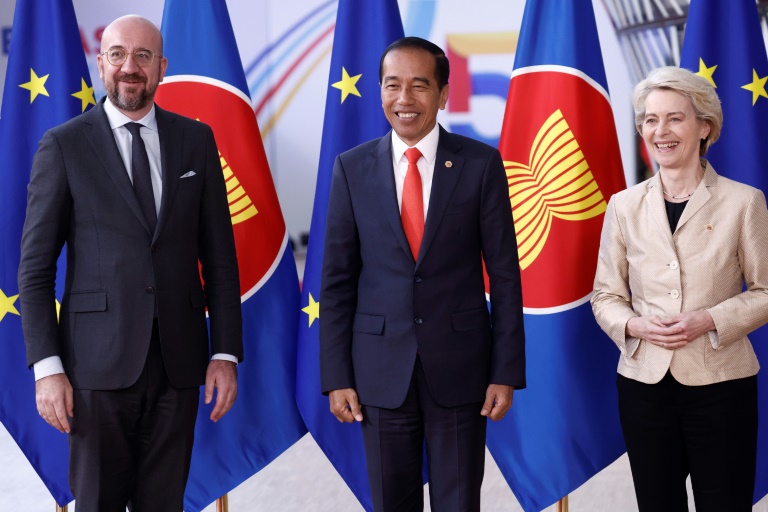
The EU vowed billions of dollars of investment in southeast Asia Wednesday, as leaders looked to bolster ties at a summit in the face of the Ukraine war and challenges from China. 

The European Union billed its first full summit with the Association of Southeast Asian Nations (ASEAN) in Brussels as a chance to push trade relations with the region’s fast-growing economies. 

“There might be many, many miles that divide us, but there are much more values that unite us,” European Commission President Ursula von der Leyen told the gathered leaders.

But different opinions over Russia’s war in Ukraine and concerns about tensions with China over a key shipping route for global trade loomed over the meeting. 

The EU has been on a diplomatic push to galvanise a global front against Moscow as its invasion has sent economic and political shock waves around the world. 

ASEAN’s 10 nations — nine of which were represented, after Myanmar’s junta was not invited — have been divided in their response to the Kremlin’s war on Ukraine.

Singapore has gone along with Western sanctions on Russia, while Vietnam and Laos, which have close military ties to Moscow, have remained more neutral. 

Along with Thailand, they abstained from a United Nations vote in October condemning Russia’s attempted annexation of regions of Ukraine seized since February.    

The diverging views led to intense wrangling over a final declaration from the summit as the EU pushed for stronger language to condemn Moscow.

A draft of the final statement said “most members” decried Russia’s war, but conceded there were also “other views and different assessments”. 

– China looms –

While Europe pressed for a tougher response to Russia, another global giant figured prominently at the summit. 

Chinese claims over the South China Sea have set it against some neighbours and sparked fears in Europe over trade flows through the key global thoroughfare. 

But China remains the biggest trade partner for ASEAN and many in the region are wary of distancing themselves from their giant neighbour.

The EU is keen to pitch itself as a reliable partner for southeast Asia’s dynamic economies amid the growing rivalry between Beijing and Washington. 

The EU and ASEAN are each other’s third-largest trading partner and Europe sees the region as a key source for raw materials and wants to increase access to its booming markets.

EU nations are pushing to diversify key supply chains away from China as the war in Ukraine has highlighted Europe’s vulnerabilities. 

Von der Leyen offered an investment package over the next five years worth 10 billion euros ($10.6 billion) under the EU’s Global Gateway strategy designed as a counterweight to China’s largesse.

“There is a battle of offers today in the geopolitical arena, not only a battle of narrative,” said EU foreign policy chief Josep Borrell. “We have to offer more.”

– Sex law furore –

ASEAN and the EU suspended their push for a joint trade deal over a decade ago — but the bloc’s top officials said they hoped to relaunch efforts for a broad agreement. 

So far deals with Vietnam and Singapore are in place, and the EU is looking now to make progress with ASEAN’s largest economy Indonesia and to resume talks with Malaysia, Philippines and Thailand.

One issue that risked clouding discussions was a new law in Indonesia criminalising sex outside marriage that has sparked fears for foreign visitors to country.

Indonesia’s President Joko Widodo insisted though that the EU-ASEAN relationship needed to be based more on “equality”. 

“There must be no imposition of views,” he said.  

“There must not be one who dictates over the other and thinks that my standard is better than yours.”

Ukraine downs swarm of attack drones over Kyiv

Ukraine said Wednesday it had shot down multiple Iranian-made drones launched at the capital by Russian troops in their latest attack on Kyiv. 

The Kremlin meanwhile said there no would be no let up in fighting over Christmas and the New Year while Ukraine President Volodymyr Zelensky urged European leaders to back a court to try Russian officials.

Explosions rang out over a central neighbourhood in Kyiv in the early hours and AFP journalists later saw law enforcement and emergency service workers inspecting metal fragments at a snow-covered impact site.

“The terrorists started this morning with 13 Shaheds,” Ukrainian President Volodymyr Zelensky said, referring to the Iran-made weapons.

“All 13 were shot down” he added, urging residents to heed air raid sirens.

Kyiv has been subjected to nearly ten months of air raid sirens and frequent aerial attacks since Russia invaded Ukraine in February and tried to capture the capital. 

But the attacks have increased up since October when Russia began systematically targeting critical infrastructure in Ukraine in attacks that have disrupted electricity, water and heat to millions in Ukraine.

Kyiv’s Western allies have been supplying Ukraine with more advanced air defence systems in response.

Ukrenergo, the national energy provider, said no energy infrastructure facilities were damaged in Wednesday’s drone attack, crediting Ukrainian air defences for their “brilliant” work.

– Civilian ‘suffering’ –

US ambassador in Ukraine Bridget Brink said on social media that Kyiv could continue to rely on Washington’s backing and that “more support is on the way”.

“It’s obvious that these attacks have just one aim: to increase the suffering of civilian population,” said Peter Stano, a spokesman for EU foreign policy chief Josep Borrel.

Mayor Vitali Klitschko announced that explosions were heard in the central district of Shevchenkivsky and city officials said debris from the downed drones had damaged residential homes and an local administrative building.

No one was reported injured or killed.

Since a series of key battlefield setbacks this summer and autumn, Russia has been pummelling critical infrastructure across Ukraine with missiles and drones.

Moscow most recently targeted Ukrainian energy infrastructure last week piling pressure on the country’s power grid, whose operators have for weeks been forced to implement rolling blackouts.

Prime Minister Denys Shmygal said this week that between 40 and 50 percent of the country’s grid was out of action because of Russia’s strikes.

The latest round of attacks on Wednesday came one day after Zelensky issued urgent appeals to around 70 countries and international organisations at a Paris conference to help Ukraine withstand Russian attacks this winter.

In a video message from Kyiv, Zelensky said Tuesday that Ukraine needed assistance worth around 800 million euros in the short term for its battered energy sector.

– ‘Fight through winter’ –

He also said that his country needs spare parts for repairs, high-capacity generators, extra gas and increased electricity imports.

Foreign Minister Dmytro Kuleba called on Ukraine’s allies to provide his country with more weapons to help it “fight through the winter” and sustain Kyiv’s military advances.

The Kremlin meanwhile said it had not received any proposals from Kyiv to pause fighting in Ukraine during the upcoming holiday period and that a ceasefire was not on Moscow’s agenda.

“No, no proposals have been received from anyone and no topic of this kind is on the agenda,” the Kremlin’s spokesman Dmitry Peskov. 

In nearly 10 months of fighting, Russia has yet to fulfil any of its stated key goals in what it refers to as its “special military operation” in Ukraine, including seizing the capital or the eastern Donbas region.

The Moscow-installed leader of Ukraine’s Donetsk region on Wednesday however called for Russia to widen its goals and annex two more areas of Ukraine, the Black Sea region of Odessa and Chernigiv in the north.

Separately, Ukraine’s SBU security service said it was carrying out raids at churches and monasteries across the country in its most recent searches on religious sites of the Russia-linked Ukrainian Orthodox Church.

Close Bitnami banner
Bitnami