US Business

Asian markets mixed as recession fears dampen China optimism

Asian markets were mixed Thursday as sentiment was pulled in opposite directions by worries about a US recession and China’s shift away from strict Covid restrictions.

A rally across equities at the start of the month has been hobbled this week by growing concerns that the Federal Reserve’s drive to rein inflation back from 40-year highs will spark a downturn and skittle company profits.

The US central bank has ramped up interest rates through 2022, including bumper increases of 75 basis points at its past four meetings.

And while data for October showed inflation appeared to be coming down — lifting hopes the Fed could take its foot off the pedal — forecast-busting figures on jobs creation and services sector activity suggested officials still had work to do to cool prices.

Analysts pointed out that two-year Treasury yields were much higher than those of 10-year bonds, which is usually considered a clear indication of a looming recession.

This week also saw the heads of some of Wall Street’s biggest banks warn of a downturn.

After sinking on Friday and Monday, New York’s three main indexes suffered another disappointing day Tuesday with the S&P 500 down for a fifth straight day and the Dow the best performer after ending barely changed.

The losses continued in Asia with Tokyo, Sydney, Seoul, Taipei and Jakarta all in the red.

Traders are now steeling themselves for the release next week of crucial inflation figures and the Fed’s final policy meeting of the year, which will be pored over for an idea about its intentions for 2023.

– Good news, bad news –

“The good news is that the market sees more than a reasonable chance of the Fed reversing gears next year, mainly in response to a downturn,” said Stephen Innes at SPI Asset Management.

“But the bad news is we are likely to fall into recession thanks in no small part to the lagged impact of the most aggressive Fed tightening campaign since (former Fed boss) Paul Volcker” in the 1980s.

The fear of a US recession is playing off against China’s shift away from its zero-Covid strategy of lockdowns and mass testing that has been blamed for clattering the world’s number two economy.

After widespread protests last month against the strict measures and calls for more political freedoms, authorities have scaled back many of them and on Wednesday announced a nationwide loosening of restrictions.

While there are worries that the more liberal approach will spark a surge in infections, it has helped fan a rally across markets, particularly in Hong Kong where Chinese tech firms and property developers are listed.

The Hang Seng Index has soared more than 30 percent since the end of October, and while it stumbled Wednesday it rose more than two percent Thursday.

There were also gains in Shanghai, Singapore and Wellington.

On oil markets both main contracts bounced after suffering selling over the past four days as demand concerns caused by a possible recession offset China’s reopening.

A jump in US gasoline stockpiles added to the downbeat mood among traders, with WTI sitting at its lowest levels of the year and Brent at its weakest since January.

– Key figures around 0230 GMT –

Tokyo – Nikkei 225: DOWN 0.7 percent at 27,480.49 (break)

Hong Kong – Hang Seng Index: UP 2.2 percent at 19,230.99

Shanghai – Composite: UP 0.1 percent at 3,203.89

Euro/dollar: DOWN at $1.0500 from $1.0510 on Wednesday

Dollar/yen: UP at 136.87 yen from 136.57 yen

Pound/dollar: DOWN at $1.2183 from $1.2209

Euro/pound: UP at 86.19 pence from 86.05 pence

West Texas Intermediate: UP 0.8 percent at $72.58 per barrel

Brent North Sea crude: UP 0.7 percent at $77.67 per barrel

New York – Dow: FLAT at 33,597.92 (close)

London – FTSE 100: DOWN 0.4 at 7,489.19 (close)
Grape expectations: India's biggest winemaker seeks millions

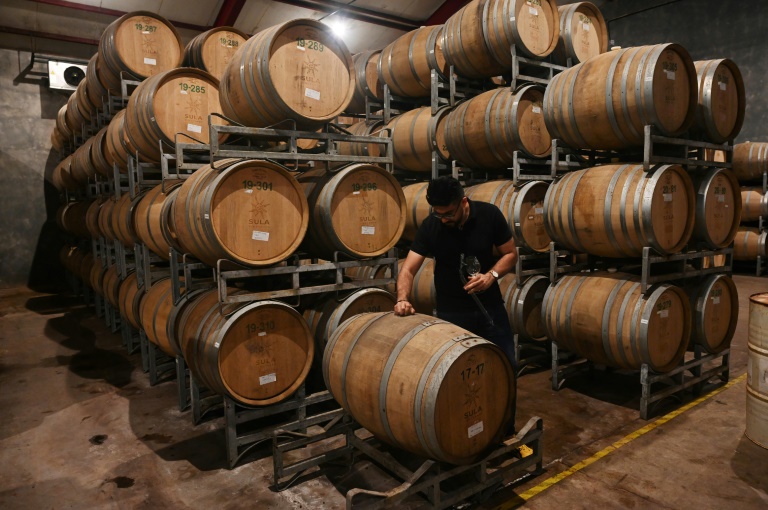
India’s largest winemaker Sula Vineyards is heading to the stock market, betting on the diversifying tastebuds of a booming urban middle class in a country that has long favoured strong liquor.

Wine makes up less than one percent of India’s massive alcohol market, with spirits the overwhelming drink of choice in the nation of 1.4 billion people.

On average, Indians each drink only a few spoonfuls of wine a year, but producers hope the country will replicate the wine boom in China when its economy took off in the 1980s.

Still, experts warn their rosé ambitions are tempered by uncertainties including the impact of climate change on viniculture, and an Australian trade deal lowering import tariffs.

“Wine’s time has come,” insists Sula’s founder and CEO Rajeev Samant.

When the Stanford University graduate returned from California, he initially tried growing roses and mangoes on family-owned land near Nashik, an ancient holy city about 160 kilometres (100 miles) from financial hub Mumbai.

“Where Sula is today, it was just grassland. There were leopards and snakes. There was no electricity, there was no telephone line,” as if it was a century earlier, Samant told AFP.

“I saw some beauty here, there was something about the place that really struck me.”

India is one of the world’s biggest grape producers and Nashik is one of its key regions, but back then the vines were all table grapes for eating and raisins, rather than wine grapes.

Samant was inspired by his visits to California’s Napa Valley wine country.

“Why not try to make a decent, drinkable wine right here in India, proudly made in India?” he thought. “And that’s what I decided to do.”

Named after Samant’s mother Sulabha, Sula planted its first vines in 1996, later building a sprawling resort and helping to cultivate a new reputation for Nashik as India’s wine capital.

Applications for shares in its IPO open next week, it said Wednesday, with its owners selling around a third of the company for up to 9.6 billion rupees ($116 million), valuing it at about $350 million.

– Sweet tooth –

Higher-priced Indian wines are becoming comparable to their international peers in terms of quality, according to Ajit Balgi, founder of Mumbai-based wine and spirit consultancy The Happy High, although they remained “Indian style” in flavour.

“They won’t be tasting the same as an Australian or a French wine,” he said. “India is too close to the equator, so our grapes that we choose are the riper ones.”

New drinkers tended to have a sweet tooth and were attracted to “jammier” wines, he added. “Most start their association with wine with sangria.”

Wine consumption in India has risen from negligible levels in 1995, while women drinking in public has become more acceptable as more joined the workforce, but volumes still stood at just 20 million litres last year, according to the International Organisation of Vine and Wine. 

Mumbai businessman Parimal Nayak is a fan, and visited the Sula vineyard with his family to celebrate his 44th birthday.

“Sula wines has improved a lot… and the atmosphere here is good,” he told AFP. “I’m proud of it.”

But the biggest obstacle to expansion was cost, said Balgi.

Wine is often taxed at similar levels to spirits in many Indian states, despite having much lower alcohol content.

“The price of a basic Indian wine is comparable to that of a full bottle of rum or basic whisky,” he said. “There is not much wine consumption in India because the masses cannot afford it.”

– Last glass –

Sula reported revenues of 4.5 billion rupees and a net profit of 521 million rupees in the last financial year, and saw average annual revenue growth of more than 13 percent in the decade to March 2022.

Samant, 55, plans to sell around five percent of his 27 percent stake in the firm.

But several recent Indian tech IPOs have flopped. Payments firm Paytm has lost three-quarters of its value since listing a year ago, and analysts say many firms are overvalued.

Previous wine pioneer Indage Vintners delisted in 2011 after debt and cash problems. 

Sula could face increasing competition from foreign wine, which currently makes up 17 percent of the Indian market.

A recent trade pact with its biggest supplier Australia will cut import duties for some wines from a punishing 150 percent.

Sula, meanwhile, warned in its IPO prospectus about the risk of “adverse climatic conditions” affecting grape quality.

Farmers in Nashik were already reporting floods and droughts nearly a decade ago, said the Mumbai-based World Resources Institute India’s climate programme manager Prutha Vaze.

Higher average temperatures also hasten grape ripening, lowering acidity and increasing sugars, which raises alcohol levels in wine. These changes impact a wine’s delicate balance of flavours, experts say.

If growers do not adapt to the changing climate, Vaze said, “there could be a day where we are… biting on the last piece of chocolate or having the last glass of wine”.

Putin says nuclear tensions 'rising' but Moscow won't deploy first

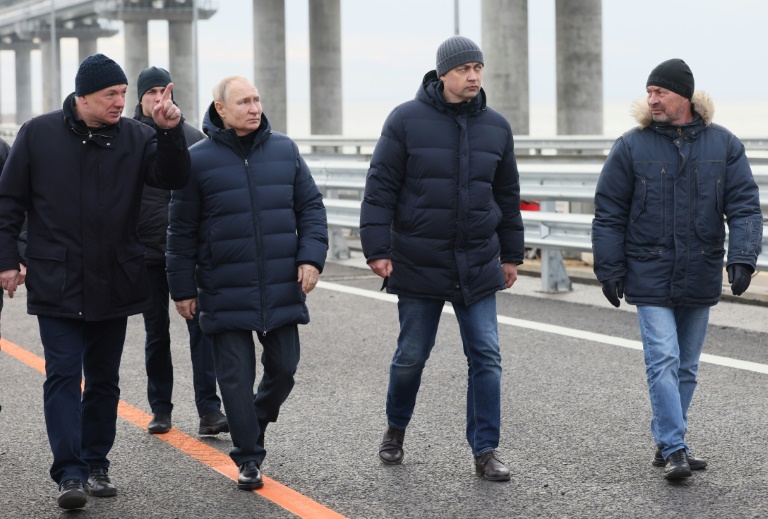
Russian President Vladimir Putin said Wednesday that nuclear tensions were rising, though he insisted “we have not gone crazy” and Moscow would not be the first to deploy them in the Ukraine conflict.

Speaking more than nine months after his forces launched their military operation, Putin warned the conflict could be “lengthy”.

Russian forces have missed most of their key military goals since February, raising fears that the battlefield stalemate could see Russia resort to its nuclear arsenal to achieve a breakthrough. 

“We have not gone crazy, we are aware of what nuclear weapons are,” Putin said Wednesday at a meeting of his human rights council. 

“We are not going to brandish them like a razor while running around the world.”

But he acknowledged the growing tensions, saying “such a threat is rising. Why make a secret out of it here?” 

He added, however, that Russia would use a nuclear weapon only in response to an enemy strike. 

“When we are struck, we strike back,” Putin said, stressing that Moscow’s strategy was based on a “so-called retaliatory strike” policy.

“But if we aren’t the first to use it under any circumstances, then we will not be the second to use them either, because the possibilities of using them in the event of a nuclear strike against our territory are very limited,” he said.

His comments drew an immediate rebuke from the US.

“We think any loose talk of nuclear weapons is absolutely irresponsible,” US State Department spokesman Ned Price told reporters.

“It is dangerous, and it goes against the spirit of that statement that has been at the core of the nuclear non-proliferation regime since the Cold War,” he said.

German Chancellor Olaf Scholz, however, declared that the risk of nuclear weapons being used in the Ukraine conflict has lessened thanks to international pressure heaped on Russia. 

“One thing has changed for the time being: Russia has stopped threatening to use nuclear weapons,” Scholz said in an interview with Germany’s Funke media group, saying it was “in response to the international community marking a red line”.

“The priority now is for Russia to end the war immediately and withdraw its troops,” he added. 

– Azov Sea –

Intense shelling continued along the front in eastern Ukraine, with President Volodymyr Zelensky announcing that strikes in Donetsk region’s Kurakhove killed 10 civilians on Wednesday. 

“The Russian army carried out a very brutal, absolutely deliberate strike at Kurakhove, precisely at civilians,” the president — who was named Time Magazine’s “Person of the Year” earlier in the day — said during his nightly address.

The shelling in Kurakhove comes a day after Ukrainian artillery strikes killed six people in the Donetsk region’s capital city of the same name, according to the Moscow-installed mayor.

Moscow had expected the fighting to last just days, but more than nine months after its forces entered Ukraine, Putin said its military operation could be a “lengthy process”. 

But he praised the announced annexation of four Ukrainian territories following September referendums held by Moscow proxies — denounced in the West as a sham.

“New territories appeared — well, this is still a significant result for Russia,” Putin said, referring to Donetsk, Lugansk, Kherson and Zaporizhzhia regions. 

He also made special reference to Russia’s gaining control of all the land along the Azov Sea.

“The Azov Sea has become an internal sea to the Russian Federation, that’s a serious thing,” he noted. 

Despite its best efforts, Russian troops at no point have entirely controlled any of the annexed territories and were even forced out from the capital of Kherson after a months-long Ukraine counter-offensive.

Amid domestic fears of a new callup — which triggered an exodus of Russians abroad in September to avoid an emergency draft — Putin said “there is no need” for a new mobilisation. 

“Out of 300,000 of our mobilised fighters, our men, defenders of the fatherland, 150,000 are in the area of operations,” including 77,000 in combat units, he said. 

– Person of the Year –

Meanwhile, Zelensky basked in unwavering support from the West as Time chose him as its most important global figure for 2022 — a title Putin himself received in 2007.

“In the weeks after Russian bombs began falling on Feb. 24, his decision not to flee Kyiv but to stay and rally support was fateful,” said Time editor-in-chief Edward Felsenthal.

“Whether the battle for Ukraine fills one with hope or with fear, Volodymyr Zelensky galvanized the world in a way we haven’t seen in decades.”

Biden leads vigil for US mass shooting victims

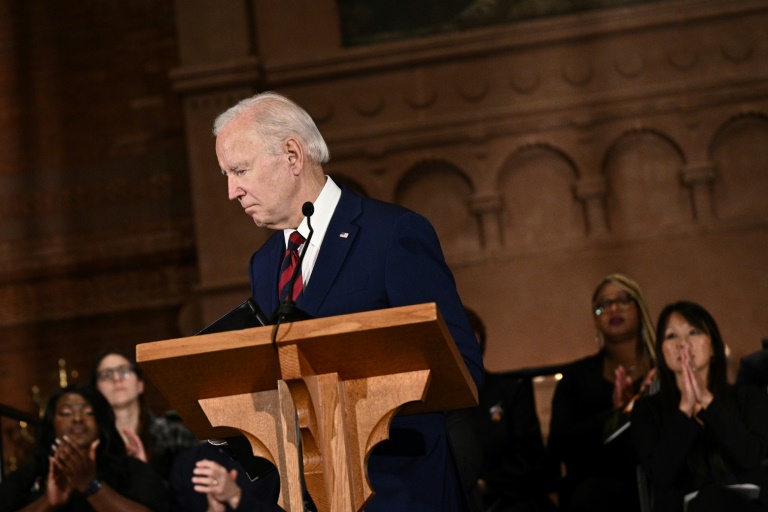
US President Joe Biden on Wednesday led a moment of silence at a vigil for victims of gun violence and urged a ban on military style weapons commonly used in mass shootings.

Biden addressed the Annual National Vigil for All Victims of Gun Violence at a Washington, DC, church, saying that the increasingly frequent mass shootings are tearing the country apart.

It’s “violence that rips at the very soul, at the very soul of this nation,” a somber Biden said.

Reflecting on his own family tragedy, including losing his first wife and infant daughter in a car accident, then one of his sons to cancer, Biden said he could empathize with survivors of mass murders, like the 2012 massacre in a Newtown, Connecticut, elementary school that left 26 dead.

“Everyone’s different but I know that feeling. You know, it’s like a black hole in the middle of your chest. You’re being dragged into it. You never know where there’s a way out,” the visibly moved president said.

Biden noted that in his first two years in office he had managed to get Congress to pass the “most significant gun law passed in 30 years but it’s still not enough.” The law expands background checks and reinforces measures to get firearms out of the hands of potentially dangerous people.

Biden again called for resurrecting a far stricter law which expired in 2004, banning military style rifles with large capacity magazines. This would include the AR-15 rifle, which is a best seller among legitimate gun enthusiasts but regularly crops up as the weapon of choice in mass shootings.

“A lot of people’s lives were saved” when the law went into effect in the 1990s, he said.

Since then, Congress has not been able to get a new ban passed but Biden insisted: “We can do it again.”

He was introduced at the church by Jackie Hagerty, who was seven years old when she survived the Sandy Hook Elementary massacre in Newtown and is now 17 and an activist.

“I heard and saw things no child, no person should ever have to see,” she said, before Biden spoke.

“The last 10 years have not been easy, but living my life honoring the victims has helped,” she said. “Many elected officials lack the courage to pass common sense laws. Thankfully we have a president who does more than send thoughts and prayers.”

Ramesh 'Sunny' Balwani gets prison time for Theranos fraud

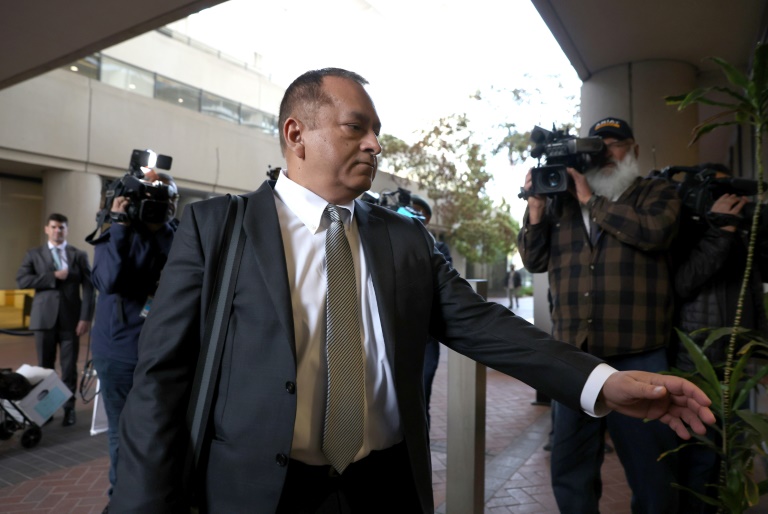
A judge on Thursday sentenced a top aide and ex-boyfriend of fallen Theranos founder Elizabeth Holmes to prison for duping people into trusting the failed blood testing startup.

US District Court Judge Edward Davila sentenced Ramesh “Sunny” Balwani to nearly 13 years in prison, then 3 years of supervised release for his role in what prosecutors argued was a massive fraud perpetuated on Theranos investors and patients.

Balwani is supposed to surrender to be taken into custody on March 15.

Fallen US biotech star Holmes, whose fraud trial was separate from that of Balwani, has asked an appeals court to overturn her conviction and a resulting sentence of more than 11 years in prison.

Holmes’s appeal said she is challenging the prison sentence handed down in November, as well as “any and all adverse rulings incorporated in, antecedent to, or ancillary to the judgment.”

She was convicted on four felony fraud counts in January for persuading investors that she had developed a revolutionary medical device before the company flamed out after an investigation by The Wall Street Journal.

Jurors found Balwani guilty on all 12 fraud counts filed by federal prosecutors, according to the court.

Holmes and Balwani are rare examples of tech executives facing charges over a young company not living up to its hype, in a sector littered with the carcasses of failed startups that once promised untold riches.

Holmes, who is pregnant, will not have to surrender until April of next year, as per an order by Davila, who presided over both trials in a courtroom in San Jose, California. 

The 38-year-old became a star of Silicon Valley when she said her start-up was perfecting an easy-to-use test kit that could carry out a wide range of medical diagnostics with just a few drops of blood.

During her trial, Holmes described Balwani as a controlling force at Theranos.

Her trial shined a spotlight on the blurred line between the hustle that characterizes the industry and outright criminal dishonesty.

US prosecutor Robert Leach told jurors in a federal courthouse in San Jose that 57-year-old Balwani piloted the firm alongside Holmes and that the pair were “partners in everything, including their crime.”

But Holmes and Balwani each rejected the accusation in court, countering that they truly believed in the potential of Theranos in what was failure, not fraud.

Balwani, nearly two decades Holmes’s senior, was brought in to help steer the company she founded in 2003 at just 19 years of age.

Prosecutors alleged Holmes and Balwani were aware the technology did not work as advertised, but continued to promote it as revolutionary to patients and the investors who pumped money into the company.

As Theranos soared, it attracted luminaries such as Rupert Murdoch and Henry Kissinger, but a series of reports casting doubt on the firm’s claims from Murdoch’s own Wall Street Journal set the company’s collapse in motion.

TikTok hit by US lawsuits over child safety, security fears

TikTok was hit Wednesday with a pair of lawsuits from the US state of Indiana, which accused it of making false claims about the Chinese-owned app’s safety for children.

The legal salvo came as problems are mounting for TikTok in the United States, with multiple accusations that the extremely popular app is a national security threat and a conduit for spying by China.

“The TikTok app is a malicious and menacing threat unleashed on unsuspecting Indiana consumers by a Chinese company that knows full well the harms it inflicts on users,” said Attorney General Todd Rokita in a statement.

The lawsuit said TikTok algorithms served up “abundant content depicting alcohol, tobacco, and drugs; sexual content, nudity, and suggestive themes” to users as young as 13.

The state also sued TikTok for allegedly deceiving customers into believing that “reams of highly sensitive data and personal information” were protected from the Chinese government.

In a statement, a TikTok spokesperson did not comment specifically on the case but said “the safety, privacy and security of our community is our top priority.”

“We build youth well-being into our policies, limit features by age, empower parents with tools and resources, and continue to invest in new ways to enjoy content based on age-appropriateness or family comfort,” the company said.

TikTok is facing a growing front of opposition in the United States, with several states and the US military banning its use on government devices.

Texas on Wednesday became the latest state to do so, calling for “aggressive action” against TikTok.

The highly popular app is often singled out for its alleged connections to the Beijing government with fears that China is able to use TikTok’s data to track and coerce users around the world.

TikTok is currently in negotiations with the US government to resolve national security concerns, hoping to maintain operations in one of its biggest markets.

TikTok said it was “confident that we’re on a path…to fully satisfy all reasonable US national security concerns.”

The spectacular success of TikTok has seen rival sites such as Meta-owned Instagram or Snapchat struggle to keep up, with once soaring ad revenues taking a hit.

But Federal Bureau of Investigation Director Christopher Wray told lawmakers last month that he is “extremely concerned” about security risks linked to TikTok.

Stock markets slide as recession worries weigh on investors

Major stock markets were hit by more selling Wednesday on growing recession fears, with Chinese trade data adding to the gloomy outlook and US oil prices finishing at another 2022 low.

Drops in Asia and Europe followed steep losses on Wall Street Tuesday after the heads of leading US banks warned about tough times in the coming year.

On Wednesday, two of the three major US indices finished lower following a choppy session.

Analysts described the market movements as reflecting hesitancy, ahead of closely-watched consumer price data next week and a Federal Reserve decision on monetary policy.

“Buyers remained a reluctant bunch amid lingering angst about global growth prospects,” said a Briefing.com note, adding that there was likely nervousness ahead of news events with potential to “spark outsized reaction.”

US oil benchmark West Texas Intermediate dropped 3.0 percent to end the day at $72.01 a barrel after US Energy Information Administration data showed a jump in gasoline stockpiles, indicating ebbing consumption in the world’s biggest economy.

The WTI also closed at a 2022 low on Monday, while international benchmark Brent slipped to a level not seen since January.

Analysts note that conditions in the oil market have loosened compared with earlier this year, adding to oversupply worries at a time when more economists are warning of a recession.

The pullback in oil prices also comes amid trader disappointment at a recent decision by OPEC oil exporters not to cut output, and as market watchers expect a price cap on Russian crude to have little impact on output.

– China easing on Covid –

Recession worries have countered optimism at China’s easing of its restrictive Covid-19 policies.

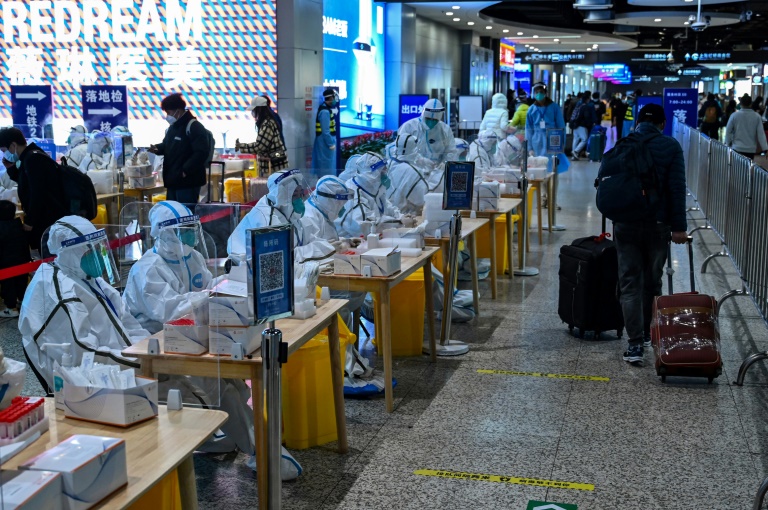
On Wednesday, officials announced a nationwide loosening of restrictions, including a reduction in mandatory PCR tests and allowing of some positive cases to quarantine at home.

In a sign of the impact that zero-Covid policies have had, data released the same day showed imports and exports plunged far more than expected in November.

But while the country edges back to normality, Zhiwei Zhang of Pinpoint Asset Management warned that this will take time.

“The zero-Covid policy has been loosened, but mobility has not recovered much on the national level,” he said. 

“I expect exports will stay weak in the next few months as China goes through a bumpy reopening process.”

– Key figures around 2140 GMT –

New York – Dow: FLAT at 33,597.92 (close)

New York – S&P 500: DOWN 0.2 percent at 3,933.92 (close)

New York – Nasdaq: DOWN 0.5 percent at 10,958.55 (close)

London – FTSE 100: DOWN 0.4 at 7,489.19 (close)
Frankfurt – DAX: DOWN 0.6 percent at 14,261.19 (close)

Paris – CAC 40: DOWN 0.4 percent at 6,660.59 (close)

EURO STOXX 50: DOWN 0.5 percent at 3,920.90 (close)

Tokyo – Nikkei 225: DOWN 0.7 percent at 27,686.40 (close)

Hong Kong – Hang Seng Index: DOWN 3.2 percent at 18,814.82 (close)

Shanghai – Composite: DOWN 0.4 percent at 3,199.62 (close)

Euro/dollar: UP at $1.0510 from $1.0467 on Tuesday

Dollar/yen: DOWN at 136.57 yen from 137.00 yen

Pound/dollar: UP at $1.2209 from $1.2133

Euro/pound: DOWN at 86.05 pence from 86.27 pence

Brent North Sea crude: DOWN 2.7 percent at $77.17 per barrel

West Texas Intermediate: DOWN 3.0 percent at $72.01 per barrel

burs-jmb/bys

Apple beefs up iCloud data defense against snooping

Apple on Wednesday said it is beefing up defense of data that users store in the cloud, a move that could thwart authorities as well as hackers.

The iPhone maker’s Advanced Data Protection plan extends something called end-to-end encryption beyond its iMessage service to photos and other data backed up to its iCloud storage service.

Apple said the move was urgent given an alarming increase in data breaches that had seen 1.1 billion personal records exposed across the globe in 2021, according to company research.

“Advanced Data Protection is Apple’s highest level of cloud data security,” said Ivan Krstić, Apple’s head of Security Engineering and Architecture.

It gives “users the choice to protect the vast majority of their most sensitive iCloud data with end-to-end encryption so that it can only be decrypted on their trusted devices,” he added.

Apple told the Wall Street Journal that with the heightened security, it would no longer be able to hand over iMessage history and other files, even when legally requested to do so by investigators.

The move will potentially rekindle a long period of standoffs involving technology firms and law enforcement.

Apple notably resisted a legal effort to weaken iPhone encryption to allow authorities to read messages from a suspect in a 2015 bombing in San Bernardino, California.

Police officials worldwide say encryption can protect criminals, terrorists and pornographers even when authorities have a legal warrant for an investigation.

Civil rights and privacy advocates, along with cybersecurity professionals, however, advocate encrypting data to protect against wrongful snooping by authorities as well as hackers.

“We constantly identify and mitigate emerging threats to (user) personal data on device and in the cloud,” Apple senior vice president of software engineering Craig Federighi said in a post. 

Under the new setting, Apple said only iCloud Mail, Contacts, and Calendar would remain unencrypted because of the need to operate with other systems.

The new level of security will be available in the United States by the end of this month and be rolled out globally next year, Apple said.

Apple has championed data privacy as a way to differentiate itself from tech giants Meta and Google, which closely track online activity by users to boost advertising revenue.

No convictions sought in French court over 2009 Rio-Paris crash

French prosecutors said Wednesday it was “impossible” to convict Air France and plane maker Airbus over the 2009 crash of a Rio-Paris flight, enraging victims’ families after an eight-week trial.

In an unusual conclusion to proceedings, prosecutors said they could not recommend a guilty verdict for the two companies which have been charged with involuntary manslaughter over the air disaster.

Their guilt “appears to us to be impossible to prove,” prosecutor Pierre Arnaudin told the court in Paris. 

“We know that this view will most likely be difficult to hear for the civil plaintiffs, but we are not in a position to demand the conviction of Air France and Airbus,” he added.

The decision not to seek a conviction by prosecutors does not mean that the three-person team of judges overseeing the trial has to follow their advice. 

The two France-based companies went on trial in October to determine their responsibility for the worst aviation disaster in Air France’s history, which left 228 dead on board flight AF447.

Both denied the involuntary manslaughter charges that carry a maximum fine of 225,000 euros ($236,000).

Prosecutors initially dropped charges against the companies in 2019 in a decision that also infuriated victims’ families.

A Paris appeals court overturned this decision in 2021 and ordered the trial to go ahead. 

“We have a prosecutor who is supposed to defend the people who in the end is defending the multinational Airbus,” Daniele Lamy, the head of the Entraide et Solidarite AF447 association, told reporters on Wednesday.

She denounced a “trial skewed against the pilots”.

“I’m ashamed to be French,” one furious civil plaintiff said as they left the court on Wednesday. “What’s the justice system for?” asked another.

– Pilot error – 

At the heart of hearings in Paris has been the role of defective so-called Pitot tubes, which are used to measure the flight speed of aircraft.

The court heard how a malfunction with the tubes, which became blocked with ice crystals during a mid-Atlantic storm, caused alarms to sound in the cockpit of the Airbus A330 and the autopilot system to switch off.

Technical experts have highlighted how, after the instrument failure, the pilots put the plane into a climb that caused the aircraft to lose upward lift from the air moving under its wings, thus losing altitude.

“For us, what led the crew to react in the way they did remains a mystery in most respects,” Air France representative Pascal Weil, a former test pilot, told the court on November 10. 

Airbus has also blamed pilot error as the main cause for the crash during proceedings.

But lawyers for victims’ families have emphasised how both companies were aware of the Pitot tube problem before the crash, and that the pilots were not trained to deal with a high-altitude emergency of this nature.

The court heard how 17 different incidents of defective Pitot tubes on Airbus aircraft were reported in the year before the crash, with Airbus and Air France previously warning their clients and pilots about the issue.

Air France’s reaction was “too slow and insufficient,” Thibault de Montbrial, a lawyer representing German victims, told the court on December 1.

He said at the time that the association he represented — HIOP — “feared for a long time … that there was a form of state interest in putting a lid over this case.”

Francois Saint-Pierre, Air France defence counsel, lamented the “discredit” he maintained civil plaintiffs had brought upon Air France and Airbus in describing proceedings as a “parody of justice.” He insisted there had been a “model trial.”

He added that Air France had, unlike Airbus, “never criticised the pilots.”

He said it “remains a mystery” quite what happened on the fateful flight. What caused the crash was “something imponderable and totally unforeseeable.”

– ‘Stall, stall’ –

Chief prosecutor Marie Duffourc acknowledged on Wednesday that the legal proceedings had been “far too long”, meaning the “suffering has been endlessly rekindled over these last 13 years.”

The model of Pitot tube used on the doomed Airbus plane, manufactured by French company Thales, was replaced on aircraft worldwide after the accident.

The crash also prompted an overhaul of training protocols across the industry, in particular to prepare pilots to handle the intense stress of unforeseen circumstances.

On October 17, lawyers and victims’ families were allowed to listen to the chilling in-flight voice recording of the pilots’ final minutes for the first time.

“We’ve lost our speeds,” one pilot is heard saying before a recorded warning sounds — “stall, stall, stall” — and the aircraft begins to plunge towards the Atlantic Ocean.  

It took nearly two years to recover the “black box” flight recorders which were found nearly 4,000 metres below sea level.

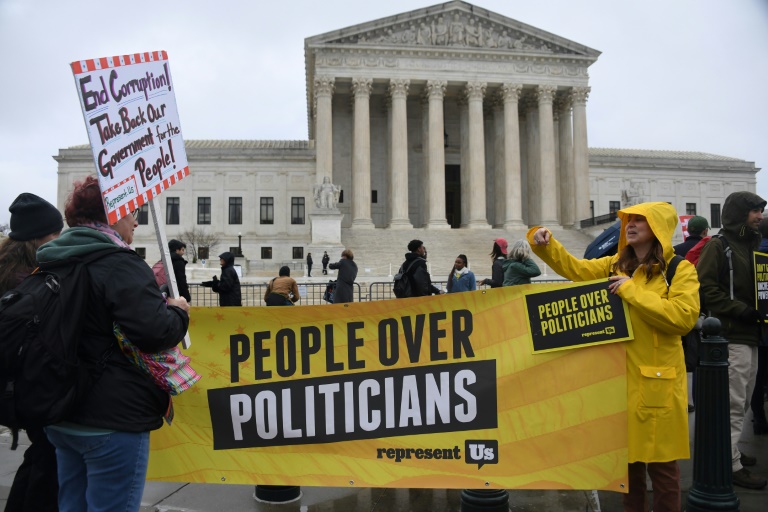
US Supreme Court hears high-stakes elections case

The US Supreme Court appeared sharply divided on Wednesday as it heard a case that could fundamentally alter the way elections for the White House and Congress are conducted.

The case brought by Republican lawmakers in North Carolina would potentially give state legislatures sole authority in deciding who votes, where and how in federal elections.

The prospect has raised concerns for democracy on the left — and to a lesser extent on the right — in a bitterly divided country still reeling from Donald Trump’s refusal to accept the 2020 election results.

The three liberal justices on the nation’s highest court appeared deeply skeptical as they heard oral arguments from a North Carolina lawyer in favor of what is known as the “independent state legislature” doctrine.

At least three of the six conservative justices seemed sympathetic, while it was unclear where the other three stood.

Under the Constitution, the rules for federal elections are set by state legislatures. 

“The Times, Places and Manner of holding Elections for Senators and Representatives, shall be prescribed in each State by the Legislature thereof,” the Elections Clause says. It gives Congress, however, the power to “alter such Regulations.”

State legislatures have used their authority to map congressional districts, set poll hours and agree on rules for voter registration and mail-in and absentee ballots.

They have also, at times, engaged in what is known as partisan gerrymandering — drawing up congressional districts to favor a particular political party.

Their laws have been subject, however, to scrutiny by the state courts and North Carolina’s Republican lawmakers are seeking to do away with that judicial input.

“Our position is the checks and balances do apply,” said David Thompson, a lawyer representing North Carolina lawmakers. “We’ve got the political check that the founders envisioned of going to Congress.”

Conservative Justice Samuel Alito appeared to back up that argument.

“No matter what we say the Elections Clause means, Congress can always come in and establish the manner of conducting congressional elections,” Alito said.

– ‘Big consequences’ –

Justice Elena Kagan, one of the three liberals on the court, warned that the “independent state legislature” doctrine could have “big consequences.”

“It would say that if a legislature engages in the most extreme forms of gerrymandering there is no state constitutional remedy for that, even if the courts think that that’s a violation of the Constitution,” Kagan said.

“It would say that legislators could enact all manner of restrictions on voting,” she added. “It might allow the legislatures to insert themselves, to give themselves a role in the certification of elections.

“What might strike a person is that this is a proposal that gets rid of the normal checks and balances on the way big governmental decisions are made in this country,” she said.

“And you might think, that it gets rid of all those checks and balances at exactly the time when they are needed most.”

Representing the Biden administration, Solicitor General Elizabeth Prelogar warned that accepting the “independent state legislature” doctrine would “wreak havoc” in the running of elections and “sow chaos on the ground.”

“State and federal elections would have to be administered under divergent rules,” Prelogar said. “And federal courts, including this court, would be flooded with new claims.”

– ‘Nonsense’ –

The case, Moore v. Harper, stems from an electoral dispute in North Carolina.

The 2020 census found that the state’s population had increased, earning it an extra seat in the US House of Representatives.

North Carolina lawmakers redrew the congressional map to add a new district but the state supreme court threw it out, arguing that it favored Republicans by grouping Democrats in certain districts, diluting their vote.

North Carolina lawmakers appealed to the Supreme Court arguing that local courts were usurping their authority.

Democrats, from the state level to President Joe Biden, law professors and leading civil rights organizations filed briefs urging the Supreme Court to reject the doctrine, while the Republican Party dismissed the criticism as “nonsense.”

The court is to deliver its ruling by the end of June.

Close Bitnami banner
Bitnami