US Business

Turkey inflation slows for first time since 2021

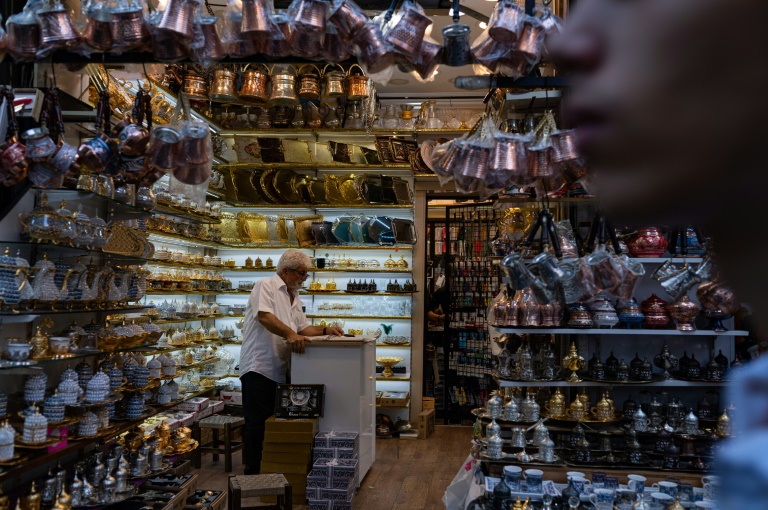
Turkey’s inflation slowed in November for the first time since May 2021, official data showed on Monday, delivering a boost to President Recep Tayyip Erdogan ahead of next year’s election.

The rate slowed to 84.39 percent, according to state statistics agency TUIK, down from 85.51 percent in October.

Turkey’s inflation has risen steadily since reaching a low of 16.6 percent in May 2021.

The emerging market’s troubled economy has turned into a major stumbling block on Erdogan’s path to a third decade in power in a presidential poll due by next June.

Erdogan’s approval rating began to suffer when he set off on an unusual economic experiment last year that tried to bring down chronically high consumer prices by lowering borrowing costs.

Conventional economic theory embraced by almost every other big nation pursues the exact opposite approach.

Turkey’s lira began to drop in value almost immediately, as consumers rushed to buy up dollars and gold to try and protect their savings.

The price of imports such as oil and gas soared, creating an inflationary spiral that the nominally independent central bank fed further by continuing to lower interest rates.

Erdogan has maintained that his unwavering focus on economic growth at all costs — achieved through cheap lending and state support — will eventually pay off.

“We will witness the rapid descent of inflation soon and we will see together that the dirty scenarios built on this trouble are torn and thrown away,” he repeated over the weekend.

Erdogan has blamed inflation on outside factors such as the global spike in food and energy prices caused by Russia’s invasion of Ukraine.

– Election strategy –

Erdogan’s much-criticised economic team hailed Monday’s announcement as vindication of their approach.

“As we have previously stated in various media, we have entered a downward trend in inflation, leaving the peak behind, unless there is an unexpected global development,” Finance Minister Nureddin Nebati tweeted.

Most economists believe that Turkey’s inflation rate will continue to slow but remain elevated for many months to come, unless Erdogan radically changes his approach.

An accompanying inflow of funding from the Kremlin and Turkey’s former rivals in the Middle East, which Erdogan secured through a major diplomatic reversal this year, will help the government prop up the lira, economists believe.

Erdogan’s strategy aims at “keeping the lira relatively strong this side of elections with foreign money”, Timothy Ash of BlueBay Asset Management said in a tweet.

“But that will destroy competitiveness with massive real appreciation.”

Yet many also question Turkey’s official statistics, which are produced by an agency whose leader has been replaced by Erdogan twice in the past year.

According to a respected monthly study released by independent economists from Turkey’s ENAG research institute, the annual rate of consumer price increases reached 170.70 percent in November.

A separate poll earlier this year showed the overwhelming major of Turks believing the ENAG figures over ones released by the government.
Putin ally joins tech giant Yandex

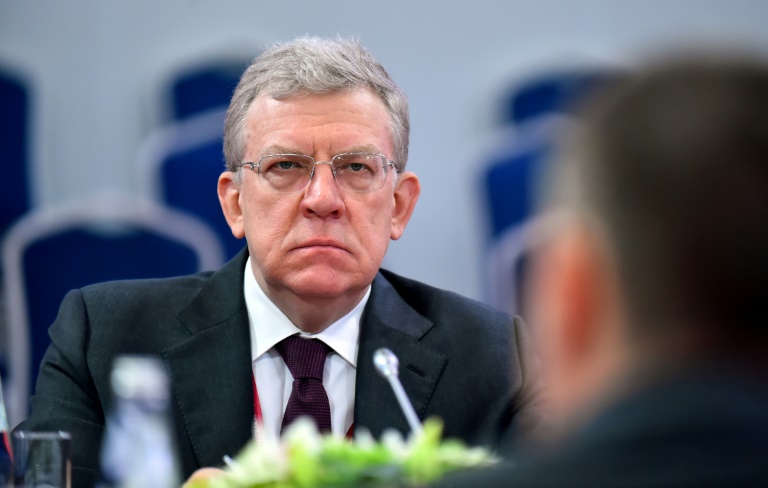
A long-time ally of President Vladimir Putin, Alexei Kudrin, said Monday he will be joining Yandex as the Kremlin seeks to tighten its grip on Russia’s top technology giant. 

The announcement from the former finance minister comes after months of instability at the internet company, with employees fleeing due to the military offensive in Ukraine and its founder hit by Western sanctions.

Russia’s top internet company and most popular search engine is being divided into Russian and international businesses because of Western penalties.

Analysts say that the move will cement government control over what was once seen as one of Russia’s top success stories.

Last week Kudrin announced he was stepping down as head of Russia’s Audit Chamber to focus on private initiatives with “significant impact on people”. 

“I accepted an offer from Yandex to become a corporate development adviser,” Kudrin said on Monday.

He added that in his role he will work to “ensure the long-term and sustainable development of the company on all markets, including international ones”. 

Kudrin is expected to oversee the operations of the restructured company, while its founder, Arkady Volozh, who was hit by EU sanctions in June, will develop a number of Yandex businesses outside Russia.

In recent years Russian authorities have steadily ramped up control over the internet — once considered the last bastion of free speech.

All major media organisations are already either state-owned or closely toe the Kremlin line.

– Staff exodus –

In August, Yandex sold its news feed Yandex News to state-affiliated rival VK, the owner of Russia’s largest social network.

“The state has decided to speed up the creation of purely Russian services and increasingly limit the access of Russians to foreign services,” economist Sergei Khestanov told AFP, referring to the authorities’s growing control over the internet in Russia.

He said that with Kudrin at the helm of Yandex authorities could create an internet “firewall” to shield the government from criticism.

In March, Russia banned Facebook and Instagram for “extremist activity” as part of efforts to clamp down on social media during Moscow’s assault on Ukraine.

Moscow’s military intervention in Ukraine triggered an exodus of Russians from the country, including many from Yandex and the IT sector.

Brussels describes Yandex as “promoting state media and narratives in its search results.”

The EU said that Volozh, 58, was “supporting, materially or financially” the Russian government in its assault on Ukraine.

When the sanctions were announced Volozh immediately stepped down as CEO and resigned from the board of directors to avoid the firm also being hit by sanctions.

The Bell, a respected Russian-language media outlet, reported earlier that Volozh turned to Kudrin for help in securing Putin’s support for the restructuring plan.

– ‘Too close to Putin’ –

Kudrin served as finance minister between 2000 and 2011 and was famously fired by then-president Dmitry Medvedev for insubordination in 2011 and later appointed chairman of the Audit Chamber.

The 62-year-old was seen as one of the government’s most prominent liberals in the earlier years of Putin’s rule and he supported opposition protests against widespread claims of election fraud in 2011-2012.

For Kudrin, Yandex offers an opportunity to distance himself from the government after Putin sent troops to Ukraine, said Tatiana Stanovaya, founder of the R.Politik political analysis firm.

“He has nowhere to go,” Stanovaya told AFP before the announcement was made. 

“He is too close to Putin. His departure would be seen as an act of betrayal.”

The Bell, citing sources, reported that Kudrin will have to “guarantee” to the Kremlin that Yandex and its technologies remain Russia-based.

But at the same time, the sources said, he will have to make sure that the company does not become another state-run behemoth, like technologies conglomerate Rostec.

Last month, Yandex confirmed plans to overhaul “the group’s ownership and governance in light of the current geopolitical environment.”

The company said this could include developing some of its services — including self-driving technologies, cloud computing and data labelling — “independently from Russia.”

Stocks rise as China eases more Covid measures

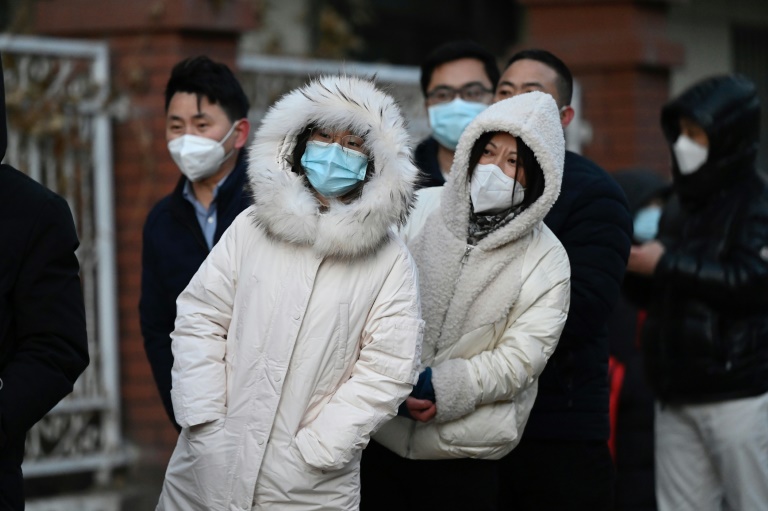
Most stocks rose on Monday as traders welcomed more easing of strict Covid containment measures in China that have hammered the world’s number-two economy.

The moves helped offset a forecast-busting US jobs report that dented hopes that the Federal Reserve will take a softer approach to hiking interest rates in its battle against inflation.

Investor sentiment has picked up considerably in recent weeks on indications the US central bank will slow down its monetary tightening as price rises appear to be slowing and the economy weakens.

That has come as Chinese leaders take a more pragmatic approach to fighting Covid after recent protests across the country that also called for more political freedoms.

The harsh zero-Covid strategy — which saw major cities including Shanghai locked down for months — has been blamed for a sharp slowdown in economic growth this year and sent shudders through markets.

The move to reopening helped fuel “market optimism about the tailwinds of a likely acceleration in growth in 2023 for China-sensitive assets”, said SPI Asset Management’s Stephen Innes.

“Although there have been several local changes to Covid policies, China has yet to shift away from the zero-Covid policy officially. Instead, they are trying to balance the expected reopening surge in Omicron cases against minimising economic and social costs.”

The brighter outlook lifted Asian markets with Hong Kong leading the way, jumping more than four percent while Shanghai put on more than one percent.

There were also gains in Tokyo, Sydney, Wellington, Singapore, Taipei and Manila.

London opened marginally higher, though Paris and Frankfurt inched down.

The prospect of the world’s number-two economy kicking back into gear helped traders overcome data on Friday showing far more jobs than expected were created in the United States in November.

A big jump in wages added to concerns that the economy remained hot, meaning the Fed still had plenty of work to do to get inflation down to its two percent target.

“If next week’s consumer price index data stays hot… then our forecast for the Fed funds rate to be raised by 50 basis points each in December and February to hit 4.75-5.00 percent may prove too low,” said Mansoor Mohi-uddin, of Bank of Singapore.

“If the Fed instead needs to keep hiking well into 2023 then the near-term outlook for risk assets will remain challenging for investors.”

Still, the dollar remained under pressure against its main peers as investors lower their expectations for US borrowing costs.

China’s yuan was among the best performers, breaking below the seven per dollar level for the first time in almost three months.

The reopening of China also lifted oil prices as demand expectations improved, while a decision by OPEC and top producers to not lift output also boosted the commodity.

Still, Innes added: “One major obstacle to prompt oil prices is that a widespread official reopening is unlikely to occur until spring. So, demand could remain exceptionally soft, including in the initial stages of a broader reopening of the economy.”

– Key figures around 0820 GMT –

Tokyo – Nikkei 225: UP 0.2 percent at 27,820.40 (close)

Hong Kong – Hang Seng Index: UP 4.5 percent at 19,518.29 (close)

Shanghai – Composite: UP 1.8 percent at 3,211.81 (close)

London – FTSE 100: FLAT at 7,556.74

Euro/dollar: UP at $1.0545 from $1.0531 on Friday

Dollar/yen: UP at 134.90 yen from 134.27 yen

Pound/dollar: UP at $1.2300 from $1.2296

Euro/pound: UP at 85.79 pence from 85.73 pence

West Texas Intermediate: UP 0.7 percent at $80.50 per barrel

Brent North Sea crude: UP 0.6 percent at $86.04 per barrel

New York – Dow: UP 0.1 percent at 34,429.88 (close)

Ghana offers local debt swap as part of IMF talks

Ghana offered investors a domestic debt swap on Monday to ease a crunch in payments as the government negotiates an IMF bailout during its worse economic crisis in decades.

The West African state is in talks for up to $3 billion in credit from the International Monetary Fund to help shore up its public finances.

Inflation is at more than 40 percent and the cedi currency has lost 50 percent in value this year, helping push up debt by $6 billion in 2022.

As part of IMF negotiations, Ghana’s government is seeking to make its debt more sustainable after facing warnings about the risks of it defaulting on obligations.

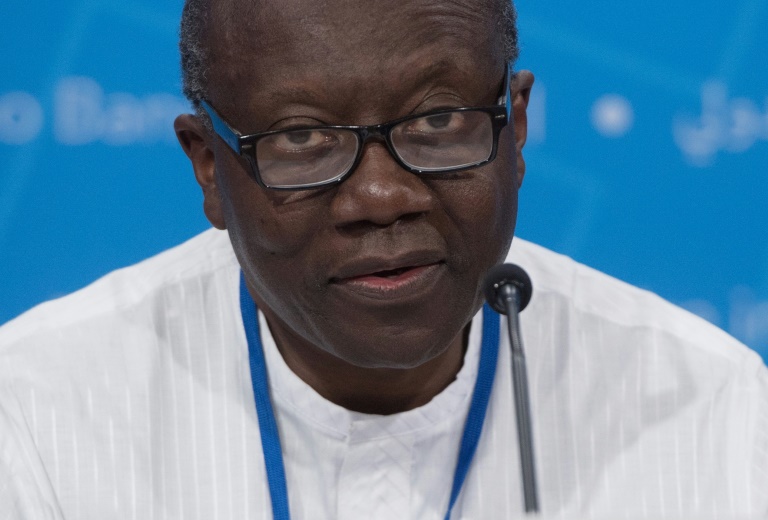
Finance Minister Kenneth Ofori-Atta said in a recorded statement late on Sunday on social media the debt exchange starting Monday would swap current debt for four new bonds maturing between 2027 and 2037.

“Our commitment to Ghanaians and the investor community, in line with the negotiations with the IMF is to restore macroeconomic stability in the shortest possible time,” he said.

A foreign debt restructuring programme would be presented later, he said.

Ghana, a top cocoa and gold producer, has oil and gas reserves but its debt payments are high and its revenues weak. Like the rest of Africa, it has been hit by economic fallout from the global pandemic and the Ukraine war. 

Ofori-Atta said the government had worked to minimise the swap impact on investors holding government bonds, especially small investors and other vulnerable groups. 

There will be no “haircuts” on principle value of bonds, he said.

The minister said the government recognised banks and financial institutions hold a large amount of local government debt, but regulatory agencies and the central bank would help ease the impact on them.

“These are difficult times and we count on the support of all Ghanaians and the investment community to make this exercise successful,” he said.

President Nana Akufo-Addo and his economic team have come under growing pressure over the crisis, after the government earlier this year did a U-turn and said it would go to the IMF for help.

Lawmakers have moved to censure Ofori-Atta over his economic performance and parliament is still reviewing that motion.

Last month, Akufo-Addo fired the government’s junior finance minister, Charles Adu Boahen, over corruption allegations after he appeared in a documentary on illegal gold mining.

Ex-Wirecard CEO goes on trial over 'unparalleled' fraud

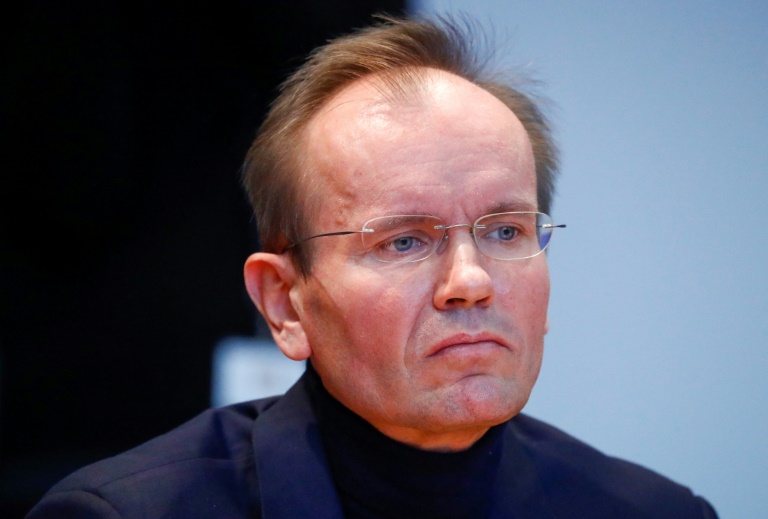
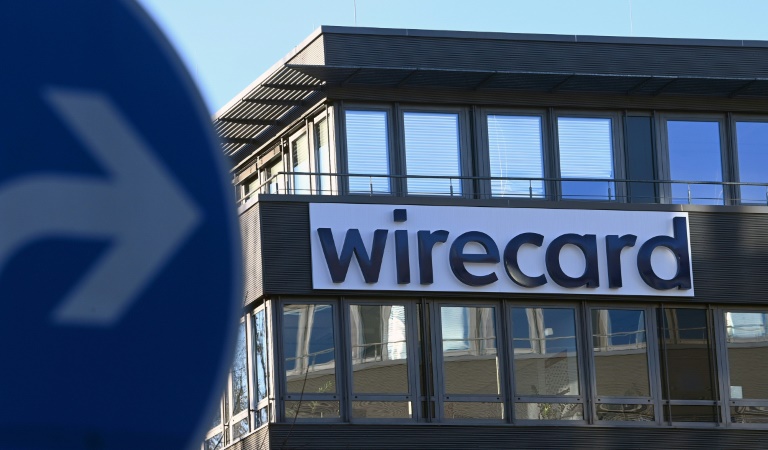
Ex-Wirecard CEO Markus Braun goes on trial in Munich this week for his role in the collapse of the once celebrated payments firm, brought down by the biggest accounting fraud scandal in German corporate history.

Austrian-born Braun and two other former Wirecard executives will appear in the dock from Thursday on charges of commercial gang fraud, breach of trust, market manipulation and accounting manipulation.

The Munich district court has scheduled 100 court dates for the mammoth trial.

Wirecard, once hailed as a standard-bearer for the German tech industry, imploded spectacularly in 2020 after admitting that 1.9 billon euros ($2 billion) missing from its accounts probably didn’t exist.

Chancellor Olaf Scholz, who was finance minister at the time, described the scandal as “unparalleled” in post-war Germany. 

Braun, who has been in custody for over two years, denies any wrongdoing.

The 53-year-old has pointed the finger at Wirecard’s fugitive former chief operating officer, Jan Marsalek, a shadowy figure with alleged ties to foreign intelligence agencies. 

Marsalek was reported earlier this year to be hiding out in Russia.

A senior Wirecard employee, however, told a German parliamentary inquiry last year that nothing happened at Wirecard without Braun’s knowledge.

“The group was shaped by Markus Braun, and so was the corporate culture. He decided everything, he dictated everything,” Rainer Wexeler told lawmakers.

– ‘Incorrect’ accounts –

On trial alongside Braun are Oliver Bellenhaus, the former head of Wirecard’s Dubai subsidiary, and ex-accounting boss Stephan von Erffa.

They face several years in prison if convicted.

Bellenhaus has admitted wrongdoing and will serve as a key witness for the prosecution.

It took German investigators more than 20 months to unravel the complex web of fraudulent transactions implicating Wirecard subsidiaries and third-party companies across the globe.

Prosecutors say the accused presented “incorrect” financial results from 2015 to 2018, by including fabricated revenues and profits from partner companies in Dubai, the Philippines and Singapore, and using forged documents to make Wirecard appear more successful than it was. 

Among the victims of the fraud were banks that had provided credit of 1.7 billion euros to Wirecard. Bonds worth 1.4 billion euros were also issued and are unlikely to be repaid.

– Fall from grace –

Founded in 1999, the Bavarian start-up Wirecard started out processing payments for porn and gambling sites and grew into a respectable electronic payments provider that edged traditional lender Commerzbank out of the blue-chip DAX index.

Rumours about possible cheating at Wirecard surfaced now and again over the years, including from shortsellers doing research on companies they suspected might be overvalued.

But Wirecard’s problems began in earnest with a series of Financial Times articles in 2019 alleging irregularities in its Asian division, based on revelations from former employees and leaked documents.

The company was initially able to fend off the claims, with the FT’s journalists themselves coming under investigation from German regulators.

But the scam finally unravelled in June 2020 when long-time auditor EY said it had discovered a 1.9-billion-euro hole in Wirecard’s accounts.

The sum, which made up a quarter of the balance sheet, was meant to be sitting in trustee accounts at two Filippino banks.

But the Philippines’ central bank has said the cash never entered its monetary system and both Asian banks, BDO and BPI, denied having a relationship with Wirecard.

– Regulatory overhaul –

Wirecard filed for insolvency soon after, becoming the first DAX company to fail.

Wirecard’s dramatic downfall sent shockwaves through Germany and prompted an overhaul of the country’s finance watchdog Bafin, heavily criticised for ignoring early warning signs about Wirecard.

The fallout also embarrassed Germany’s political establishment, with former chancellor Angela Merkel coming under fire for promoting Wirecard during a 2019 trip to China — when journalists were already raising doubts about the company.

In a grilling last year by lawmakers, Merkel said there was “no reason at that time” to believe there were “serious irregularities at Wirecard”.

Ex-Wirecard CEO goes on trial over 'unparalleled' fraud

Ex-Wirecard CEO Markus Braun goes on trial in Munich this week for his role in the collapse of the once celebrated payments firm, brought down by the biggest accounting fraud scandal in German corporate history.

Austrian-born Braun and two other former Wirecard executives will appear in the dock from Thursday on charges of commercial gang fraud, breach of trust, market manipulation and accounting manipulation.

The Munich district court has scheduled 100 court dates for the mammoth trial.

Wirecard, once hailed as a standard-bearer for the German tech industry, imploded spectacularly in 2020 after admitting that 1.9 billon euros ($2 billion) missing from its accounts probably didn’t exist.

Chancellor Olaf Scholz, who was finance minister at the time, described the scandal as “unparalleled” in post-war Germany. 

Braun, who has been in custody for over two years, denies any wrongdoing.

The 53-year-old has pointed the finger at Wirecard’s fugitive former chief operating officer, Jan Marsalek, a shadowy figure with alleged ties to foreign intelligence agencies. 

Marsalek was reported earlier this year to be hiding out in Russia.

A senior Wirecard employee, however, told a German parliamentary inquiry last year that nothing happened at Wirecard without Braun’s knowledge.

“The group was shaped by Markus Braun, and so was the corporate culture. He decided everything, he dictated everything,” Rainer Wexeler told lawmakers.

– ‘Incorrect’ accounts –

On trial alongside Braun are Oliver Bellenhaus, the former head of Wirecard’s Dubai subsidiary, and ex-accounting boss Stephan von Erffa.

They face several years in prison if convicted.

Bellenhaus has admitted wrongdoing and will serve as a key witness for the prosecution.

It took German investigators more than 20 months to unravel the complex web of fraudulent transactions implicating Wirecard subsidiaries and third-party companies across the globe.

Prosecutors say the accused presented “incorrect” financial results from 2015 to 2018, by including fabricated revenues and profits from partner companies in Dubai, the Philippines and Singapore, and using forged documents to make Wirecard appear more successful than it was. 

Among the victims of the fraud were banks that had provided credit of 1.7 billion euros to Wirecard. Bonds worth 1.4 billion euros were also issued and are unlikely to be repaid.

– Fall from grace –

Founded in 1999, the Bavarian start-up Wirecard started out processing payments for porn and gambling sites and grew into a respectable electronic payments provider that edged traditional lender Commerzbank out of the blue-chip DAX index.

Rumours about possible cheating at Wirecard surfaced now and again over the years, including from shortsellers doing research on companies they suspected might be overvalued.

But Wirecard’s problems began in earnest with a series of Financial Times articles in 2019 alleging irregularities in its Asian division, based on revelations from former employees and leaked documents.

The company was initially able to fend off the claims, with the FT’s journalists themselves coming under investigation from German regulators.

But the scam finally unravelled in June 2020 when long-time auditor EY said it had discovered a 1.9-billion-euro hole in Wirecard’s accounts.

The sum, which made up a quarter of the balance sheet, was meant to be sitting in trustee accounts at two Filippino banks.

But the Philippines’ central bank has said the cash never entered its monetary system and both Asian banks, BDO and BPI, denied having a relationship with Wirecard.

– Regulatory overhaul –

Wirecard filed for insolvency soon after, becoming the first DAX company to fail.

Wirecard’s dramatic downfall sent shockwaves through Germany and prompted an overhaul of the country’s finance watchdog Bafin, heavily criticised for ignoring early warning signs about Wirecard.

The fallout also embarrassed Germany’s political establishment, with former chancellor Angela Merkel coming under fire for promoting Wirecard during a 2019 trip to China — when journalists were already raising doubts about the company.

In a grilling last year by lawmakers, Merkel said there was “no reason at that time” to believe there were “serious irregularities at Wirecard”.

Five things to know about the Wirecard scandal

More than two years after the dramatic collapse of German digital payments firm Wirecard, ex-CEO Markus Braun and two former managers will go on trial for fraud.

Here are key things to know about the scandal, which has drawn comparisons with the massive accounting fraud that brought down US energy giant Enron in the early 2000s.

– Porn and gambling –

Founded in 1999 near Munich, Wirecard started out processing online payments for porn and gambling websites. The stable stream of revenues helped it survive the dotcom crisis. 

As more savoury forms of online commerce ramped up over the years, Wirecard’s star rose. 

With Braun in charge from 2002, the company grew at breakneck speed, expanding its services into banking and buying up smaller payment companies, especially in Asia.

– DAX darling –

In 2018, Wirecard elbowed traditional lender Commerzbank out of the blue-chip DAX index, reinforcing its reputation as a rare German success story in the booming fintech sector.

At its peak, the company was valued at more than 24 billion euros ($25 billion), outweighing even Deutsche Bank.

But Wirecard’s share price suffered when a series of articles in the Financial Times in 2019 alleged accounting irregularities at Wirecard’s Asian units.

In June 2020, the company admitted to auditor EY that 1.9 billion euros in cash meant to be held in two Philippine accounts likely didn’t exist. 

Wirecard’s share price tanked by 99 percent. It became the first DAX company to go bust and was booted off the index soon after.

– Web of deceit –

Wirecard stands accused of inflating earnings through fictitious transactions involving a complex web of subsidiaries and partner companies.

German prosecutors say Braun and his co-defendants presented inaccurate financial results for 2015-2018 by including revenues from so-called third party acquirers (TPAs) — businesses that processed payments for Wirecard where it lacked its own license to operate.

But revenues from these TPA companies in Dubai, the Philippines and Singapore “did not actually exist”, prosecutors say.

An FT investigation found that TPA firms accounted for around half of Wirecard’s reported revenues and a large chunk of its profits. But an address for one such firms led to a family home in the Philippines. Another was a Manila bus company.

FT journalist Dan McCrum said that’s when he knew Wirecard was faking it. “None of it’s real. It’s just an incredible bluff,” he said in a Netflix documentary.

– German blind spot –

The Wirecard revelations sparked fierce criticism of Germany’s market regulator Bafin, which failed to spot the trickery despite suspicions raised by journalists and shortsellers.

In fact, when the FT’s articles wreaked havoc on Wirecard’s stock price, Bafin’s response was to impose a temporary ban on shorting Wirecard shares.

The watchdog even filed criminal complaints against two FT journalists, claiming market manipulation. The complaints were dropped after Wirecard collapsed.

“Many didn’t want to believe that fraudsters were at work at Wirecard,” Volker Bruehl, a professor at the Center for Financial Studies in Frankfurt, told AFP. 

Bafin has since undergone a major shake-up, with a new president at the helm and tougher oversight powers.

Wirecard’s auditor EY also came under scrutiny, having signed off on the firm’s accounts for a decade. EY now faces legal action from Wirecard shareholders.

– Stranger than fiction –

The Wirecard saga has spawned a slew of articles, books, documentaries and a film starring popular German actor Christoph Maria Herbst as Braun, the geeky Wirecard boss with a penchant for black turtlenecks.

In the Netflix documentary “Skandal! Bringing Down Wirecard”, journalist McCrum chronicles his dogged pursuit of the story, which finally broke wide open when a whistleblowing ex-employee handed him a cache of leaked documents.

But with former COO Jan Marsalek still on the run, perhaps the most gripping part of the Wirecard tale remains untold.

Braun has painted fellow Austrian Marsalek as the mastermind behind the fraud, and himself as an unknowing victim.

With his connections to Russian intelligence agencies and his one-time bid to assemble a Libyan militia, the party-loving Marsalek remains shrouded in mystery.

Glitzy Washington gala honors legendary artists including George Clooney, U2

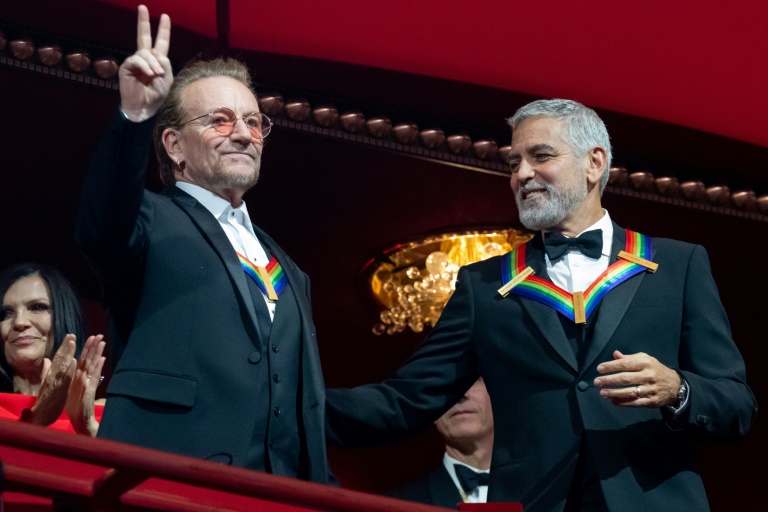
Hollywood’s finest joined politicos including President Joe Biden for a rare night of Washington glitz Sunday, celebrating the newest Kennedy Center honorees, including George Clooney and U2.

Soul legend Gladys Knight, along with Cuban-born American composer Tania Leon and contemporary Christian pop artist Amy Grant rounded out the 45th annual class receiving the highest US arts honor, after the elite group of stars enjoyed a special weekend in the American capital honoring their illustrious careers.

During the glamorous main event at the Kennedy Center — Washington’s performing arts complex that serves as a living monument to slain president John F. Kennedy — the inductees were honored with seats in the opera house’s presidential box.

They joined the president and first lady as well as the vice president and second gentleman, along with other politicians including Nancy Pelosi and her husband, who was making a public appearance weeks after he was violently attacked and hospitalized when an intruder looking for the congresswoman broke into their California home.

Clooney — accompanied by his human rights lawyer wife Amal Clooney, who stunned in a glittering silver gown — told journalists on the red carpet that the event, which he had grown up watching on television in small-town Kentucky, was “exciting.”

Speaking at the traditional State Department dinner one night prior, Clooney, 61, joked that during his extensive travel, both as an artist and as a humanitarian, he was told one universal truth: “You sucked at Batman.”

The self-deprecating celebrity has an impressive list of films to his name, as an actor and as director and producer — “Michael Clayton,” “Syriana” and “Ocean’s Eleven” among them.

“You must be someone pretty special in the arts, Mr. Clooney,” joked Sesame Street children’s TV icon Big Bird, a fellow Kennedy Center inductee.

Julia Roberts donned a ballroom gown adorned with images of Clooney, her longtime friend and frequent collaborator, whom she called “the best combination of a gentleman and playmate.”

“Not only is he handsome, and talented in all mediums he chooses to tackle, he is profoundly present and attentive to the world around him,” Roberts said of the actor. 

Roberts, along with Matt Damon, Richard Kind and Don Cheadle both razzed and praised Clooney before the beloved actor’s father Nick delivered a touching speech of his own.

– Trump jabs –

Eddie Vedder of rock band Pearl Jam led a rollicking tribute to U2’s vast songbook, singing the hit “Elevation” in his signature power warble, later bringing down the house with the ballad “One.” 

And Ukrainian singer Jamala joined Brandi Carlile and Hozier for a rendition of the U2 track “Walk On,” in support of Ukraine’s ongoing fight against Russia.

Actor Sean Penn also praised bandmembers Bono, the Edge, Adam Clayton and Larry Mullen Jr, calling them “great musical poets for the ages” who manage to stay “consistently relevant” despite nearly half-a-century in the industry.

And Sacha Baron Cohen — in character as his darkly humorous Borat — delivered a comedic tribute to the band that drew laughs, raised eyebrows and had actor Roberts cracking up as he twistedly speared Kanye West’s recent outbursts of anti-Semitism and pretended to mistake Biden to ex-president Donald Trump.

“Your pretty orange skin has become pale,” he said to Biden, as First Lady Jill burst into laughter.

– Powerful women –

Empress of Soul Knight earned heartfelt accolades including from LL Cool J, who praised her as foundational across genres including gospel, country, rock and hip hop.

“I once heard Gladys sing the ABCs and I thought I was in church — true story,” the rapper told the audience.

Singers Ariana DeBose, Mickey Guyton and Garth Brooks delivered heart-pounding versions of some of her most beloved songs, including the standard “Midnight Train to Georgia.”

Pulitzer Prize- and Grammy-award winning Leon, 79, has already won numerous recognitions for her pioneering, sweeping compositions and chamber works that followed her immigration to the United States from Cuba as a refugee at age 24.

The moving program honoring her life’s work brought the artist — herself a regular performer at the Kennedy Center — to tears.

Speaking prior to the show on the red carpet, Leon told AFP she was pleased the Kennedy Center was recognizing types of classical music outside the Western-oriented understanding of the genre.

“There’s many, many classical pieces in the world, of different nations or difficult cultural backgrounds,” she said.

She voiced delight at having visited the White House, describing to journalists an endearing anecdote of the president showing her the woodwork on his enormous desk.

And stars including Sheryl Crow and the country supergroup the Highwomen — comprised of Carlile, Natalie Hemby, Maren Morris and Amanda Shires — turned out to honor Grant.

The 62-year-old Grammy winner is the first contemporary Christian star the Kennedy Center has ever inducted, and said “never in my wildest dreams” did she envision receiving the honor.

Tunisians dream of moving to Germany as crisis bites

Germany is becoming a key destination for disillusioned young Tunisians despite a language barrier and the North African nation’s long history of ties with France.  

Europe’s biggest economy, with its low birth rate, is crying out for labour, and many Tunisians, exhausted by years of economic crisis, see an opportunity for a legal path to emigration. 

Numbers are still small but rising fast. Germany granted 5,474 work permits to Tunisians from January to October — up from 4,462 in the whole of last year and more than double the numbers for 2020.

The trend has been stimulated by the fact Germany has no quota restrictions for countries of origin and increasingly recognises foreign diplomas.

Germany “has a huge need for workers, not just in the health and IT sectors but also in hospitality, building, laying fibre-optic cables or driving heavy goods vehicles,” said Narjess Rahmani, a Berlin-based Tunisian who heads the immigration agency “Get In Germany”.

Some employers offer contracts to help ease the visa process and even pay for six months of language tuition to help their future workers.

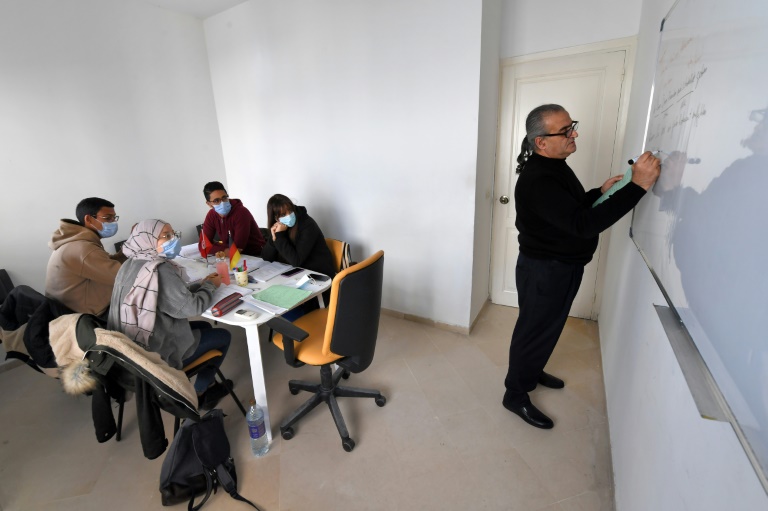
Yeft Benazzouz, who runs a language school in Tunis, said demand for German classes has risen sharply since 2020. 

“Before, I had groups of one or two people,” he said. “Now it’s gone up to six or seven.”

Yeft also teaches basic German cultural norms, including the line of advice that “puenktlich ist schon spaet” — “being on time is already late”. 

– High prices, few jobs –

Tunisia’s history as a French colony means its people are used to foreign languages, Rahmani said. “We are also very open to other cultures, through tourism and the cultural mix throughout our history.”

The language school’s students are often highly qualified, thanks to one of the Arab world’s most reputable education systems, but cursed by unemployment affecting 30 percent among young graduates.

Hydraulic engineer Nermine Madssia, 25, who wears a hijab, said she had chosen Germany over France, citing Islamophobia. 

She said she hoped to get “respect, consideration and a decent salary”, in contrast to Tunisia where the average pay is just 1,000 dinars (around 300 euros and dollars) per month. 

Even highly sought-after IT technicians can expect to earn a maximum of 2,000 dinars early in their careers.

Like many who hope to leave Tunisia, Nermine has had help from her parents in financing German lessons and the visa application.

“With the increase in the cost of living, a salary isn’t enough to start and support a family,” she said.

Inflation topped 9.0 percent year-on-year in October and Tunisia has endured years of economic crisis, pre-dating even the 2011 revolution that toppled dictator Zine El Abidine Ben Ali. 

With sluggish growth, vast public debt and many sectors closed off to new entrants, jobs are sparse, exacerbated by the Covid pandemic and fallout from the Ukraine war.

– Dangerous sea crossings –

President Kais Saied’s 2021 power grab, which has placed Tunisia’s decade-long democratic transition in doubt, has done little to improve economic confidence.

One in every two young people wants to leave, says the Tunisian Forum for Economic and Social Rights group.

Some leave legally — including more than 40,000 engineers and 3,300 doctors in the past five years — while many thousands more attempt dangerous journeys to Italy in makeshift boats, some drowning on the way.

Among the legal departees is Elyes Jelassi, 28, who packed a bottle of olive oil and some spices into his suitcase as he prepared for Germany.

As his family gathered in the town of Korba to wish him goodbye, he said he had never wanted to leave. 

But “after three years of studies and internships in several hospitals, I decided not to make a career in Tunisia,” he said.

Jelassi already has a job contract as a senior nurse in the German city of Wiesbaden, with free accommodation for the first six months. 

As well as a good salary, he said he expects to find better working conditions than in Tunisia, where the health system has been crippled by the pandemic and years of neglect.

“Our hospitals suffer from a lack of equipment, which causes conflict with patients,” he said. “It’s really stressful.”

He chose Germany over Canada, France or the Gulf because he already has friends there and will easily be able to further his studies. 

But he probably won’t stay there forever.

“I’d like to come back when I’m 50,” he said.

Asian stocks up, dollar down as China eases more Covid measures

Asian stocks rose and the dollar weakened further as traders welcomed more easing of strict Covid containment measures in China that have hammered the world’s number-two economy.

The moves helped offset a forecast-busting US jobs report that dented hopes that the Federal Reserve will take a softer approach to hiking interest rates in its battle against inflation.

Investor sentiment has picked up considerably in recent weeks on indications the US central bank will slow down its monetary tightening as price rises appear to be slowing and the economy weakens.

That has come as Chinese leaders take a more pragmatic approach to fighting Covid after recent protests across the country that also called for more political freedoms.

The harsh zero-Covid strategy — which saw major cities including Beijing and Shanghai face lockdowns for months — has been blamed for a sharp slowdown in economic growth this year and sent shudders through markets.

The move to reopening helped fuel “market optimism about the tailwinds of a likely acceleration in growth in 2023 for China-sensitive assets”, said SPI Asset Management’s Stephen Innes.

“Although there have been several local changes to Covid policies, China has yet to shift away from the zero-Covid policy officially. Instead, they are trying to balance the expected reopening surge in Omicron cases against minimising economic and social costs.”

The brighter outlook lifted Asian markets with Hong Kong leading the way, jumping more than three percent while Shanghai put on more than one percent.

There were also gains in Tokyo, Sydney, Seoul, Singapore, Taipei and Manila.

The prospect of the world’s number-two economy kicking back into gear helped traders overcome data on Friday showing far more jobs than expected were created in the United States in November.

A big jump in wages added to concerns that the economy remained hot, meaning the Fed still had plenty of work to do to get inflation down to its two percent target.

“If next week’s consumer price index data stays hot… then our forecast for the Fed funds rate to be raised by 50 basis points each in December and February to hit 4.75-5.00 percent may prove too low,” said Mansoor Mohi-uddin, of Bank of Singapore.

“If the Fed instead needs to keep hiking well into 2023 then the near-term outlook for risk assets will remain challenging for investors.”

Still, the dollar remained under pressure against its main peers as investors lower their expectations for US borrowing costs.

The reopening of China also lifted oil prices as demand expectations improve, while a decision by OPEC and top producers to not lift output also boosted the commodity.

– Key figures around 0230 GMT –

Tokyo – Nikkei 225: UP 0.1 percent at 27,808.74 (break)

Hong Kong – Hang Seng Index: UP 3.6 percent at 19,349.17

Shanghai – Composite: UP 1.1 percent at 3,189.66

Euro/dollar: UP at $1.0564 from $1.0531 on Friday

Dollar/yen: DOWN at 134.25 yen from 134.27 yen

Pound/dollar: UP at $1.2324 from $1.2296

Euro/pound: UP at 85.75 pence from 85.73 pence

West Texas Intermediate: UP 2.0 percent at $81.55 per barrel

Brent North Sea crude: UP 2.0 percent at $87.31 per barrel

New York – Dow: UP 0.1 percent at 34,429.88 (close)

London – FTSE 100: FLAT at 7,556.23 (close)

Close Bitnami banner
Bitnami