US Business

US high court to review refusal to provide service to same-sex couple

Can a business owner cite her religious convictions in declining to provide service to a same-sex couple?

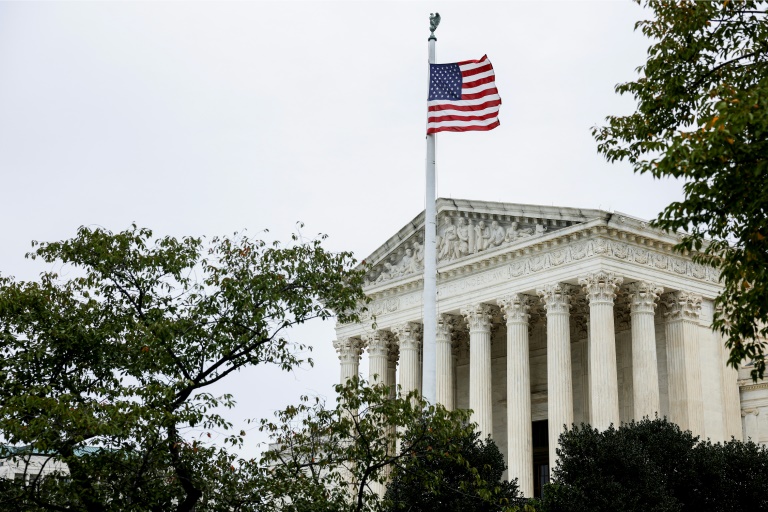
The conservative-dominated US Supreme Court is to examine the question on Monday in a case that closely resembles one from just a few years ago, pitting religious liberty and free speech rights against anti-discrimination laws.

In June 2018, the nation’s highest court partially ruled in favor of a Colorado baker who had refused to make a wedding cake for a gay couple.

The latest case involves a suit filed by Lorie Smith, owner of 303 Creative, a website design company also in Colorado.

Smith has said that as a devout Christian she cannot produce wedding websites for same-sex couples because it would be “inconsistent” with her religious beliefs.

Colorado’s anti-discrimination law prohibits businesses from refusing service to someone on the basis of sexual orientation. An appeals court ruled against Smith and she appealed to the Supreme Court.

– ‘To speak or stay silent’ –

In accepting the case, the court said it would examine whether Colorado’s law “to compel an artist to speak or stay silent violates the free speech clause of the First Amendment.”

In their brief to the court, lawyers for Smith said she is “willing to create custom websites for anyone, including those who identify as LGBT, provided their message does not conflict with her religious views.”

“Forcing artists like painters, photographers, writers, graphic designers and musicians to speak messages that violate their deeply held beliefs fails to comport with the First Amendment’s promise of ‘individual dignity and choice,'” they added.

Attorneys for Colorado said the law “simply requires that, once a business offers a product or service to the public, the business sells it to all.

“The company can define its service however it wants — including offering only websites that include biblical quotes describing marriage as the union of one man and one woman,” they said.

“But the company must sell whatever it offers to customers regardless of their race, religion, sexual orientation or other protected characteristic,” they said.

– ‘Replay of Masterpiece Cakeshop’ –

David Cole, national legal director of the American Civil Liberties Union, said the latest case is a “replay of Masterpiece Cakeshop,” the earlier case involving the baker.

“If the courts were to recognize a First Amendment right of the businesses that sell expressive services to discriminate, then architects could refuse to design homes for Black families,” Cole said.

“Bakeries could refuse to make custom birthday cakes for Muslim children. Florists could refuse to provide flowers for a gay person’s funeral.”

In the previous case, the justices voted 7-2 that the Colorado Civil Rights Commission had displayed anti-religious hostility toward the baker, thus violating his constitutional rights.

The court, however, did not squarely address the issue of whether a business can decline to serve gays and lesbians on religious grounds.

The Supreme Court has undergone a radical transformation since that ruling, with two conservative justices nominated by Donald Trump replacing two liberal justices, giving conservatives a 6-3 majority.

Trump’s Republican administration defended the position of the baker in the 2018 case, while this time the administration of President Joe Biden, a Democrat, is backing Colorado and its anti-discrimination laws.

The Supreme Court is expected to deliver its ruling before the end of June.

Clooney, U2 among honorees at glitzy Washington gala

Film icon George Clooney and soul legend Gladys Knight are among an elite circle of stars receiving honors at Washington’s Kennedy Center Sunday in the presence of President Joe Biden.

Hollywood A-listers and Washington politicos will also fete Irish rockers U2, Cuban-born US composer Tania Leon and contemporary Christian pop artist Amy Grant at the annual gala, a rare night of red carpet glamour in the US capital.

Biden will be joined by his wife Jill along with Vice President Kamala Harris and her husband Douglas Emhoff in the opera house’s presidential box for the glittering celebration of one of the country’s highest arts awards that’s now in its 45th year.

Last winter, Biden returned presidential tradition to the high-wattage awards program — the first time a sitting president had appeared at the event in five years.

Donald Trump opted out during his presidency, after several of the honored artists threatened to boycott the gala in his first year in office if the bombastic, divisive Republican were present.

Sunday’s event promises a slate of star-studded tributes to those being inducted at the Kennedy Center, Washington’s performing arts complex that serves as a living monument to slain president John F. Kennedy.

It comes on the heels of another highlight of the capital’s holiday social season, a lavish state dinner hosted by the Bidens in honor of visiting French leader Emmanuel Macron.

– The inductees –

Prior to Sunday evening’s red carpet, the honorees and their families were scheduled to attend a private White House reception with the Bidens and other distinguished guests.

That follows a State Department dinner for the honored artists on Saturday.

And the weekend’s main event was to include performances from fellow superstars paying homage to this year’s inductees, a show set for broadcast on December 28 on US television network CBS.

Clooney, the revered actor and humanitarian who broke out in the 1990s on the television show “ER,” was expected to be among the red carpet favorites along with his wife Amal, a human rights lawyer.

The 61-year-old Oscar winner is known for films including “The Descendants,” “Syriana” and the “Ocean’s Eleven” series, and also has a number of directing and producing credits to his name.

“Growing up in a small town in Kentucky I could never have imagined that someday I’d be the one sitting in the balcony at the Kennedy Center Honors,” he said in a statement. “To be mentioned in the same breath with the rest of these incredible artists is an honor.”

“Midnight Train to Georgia” singer Knight, 78, echoed the sentiment, saying she’s “humbled beyond words to be included amongst this prestigious group of individuals, both past and present.”

“The Kennedy Center’s commitment to the arts is unparalleled and I am so very grateful for this moment,” said the artist dubbed “The Empress of Soul.”

U2, the rock band that’s sold some 170 million albums worldwide, accepts the award after winning 22 Grammys and putting out powerful tracks including “I Still Haven’t Found What I’m Looking For” and “Sunday Bloody Sunday.”

The Pulitzer Prize- and Grammy-award winning Leon, 79, has already won most recognitions available to her for her pioneering, sweeping compositions and chamber works.

She arrived stateside at age 24 as a refugee, a budding pianist who went on to shape the sound of American classical music, blending traditional elements with modern infusions of the Cuban folk rhythms of her youth.

And Grant, 62, is the first Christian music artist to ever go platinum, and has earned six Grammy awards.

She is the first contemporary Christian star the Kennedy Center has ever inducted, and said “never in my wildest dreams” did she envision receiving the honor.

“Through the years, I’ve watched so many of my heroes serenaded by colleagues and fellow artists, always moved by the ability of music and film to bring us together and to see the best in each other,” Grant said in a statement.

“Thank you for widening the circle to include all of us.”

'Wakanda' stays atop N.America box office for 4th week

“Black Panther: Wakanda Forever” saw weekend ticket sales drop to an estimated $17.6 million but still extended its rule of the North American box office for a fourth week, industry watcher Exhibitor Relations said Sunday.

The Disney/Marvel sequel had taken in nearly $46 million for the previous Friday-through-Sunday period. Still, its domestic total has now reached an impressive $393.7 million on top of $339 million in international ticket sales.

Universal’s new holiday-timed “Violent Night” placed second for the weekend at $13.3 million, “a solid opening for an action comedy,” said David A. Gross of Franchise Entertainment Research. 

David Harbour of “Stranger Things” fame stars as a cranky, sledgehammer-wielding Santa who comes to the rescue when bad guys invade a rich family’s home on Christmas Eve. Gross said the film should play well until the December 16 release of much-anticipated “Avatar: The Way of Water.”

Disney’s computer-animated sci-fi film “Strange World” claimed third place while taking in just $4.9 million. Given its $180 million production budget, “the movie could lose more than $100 million,” according to HollywoodReporter.com.

In fourth was Searchlight’s horror-comedy “The Menu,” at $3.6 million. Ralph Fiennes plays a celebrity chef who serves up some dark surprises.

And in fifth was Sony’s “Devotion,” an action movie about two US fighter pilots during the Korean War, at $2.8 million. 

Rounding out the top 10 were:

“I Heard the Bells” ($1.8 million)

“Black Adam” ($1.7 million)

“The Fabelmans” ($1.3 million)

“Bones and All” ($1.2 million)

“Ticket to Paradise” ($850,000)

China astronauts return from Tiangong space station

Three Chinese astronauts safely returned to Earth on Sunday after six months aboard the Tiangong space station, state media quoted the country’s space agency as saying, with their mission deemed a “complete success.”

The team, which had been aboard the station since early June, touched down at the Dongfeng landing site in Inner Mongolia at 8:09 pm Beijing time (1209 GMT), Xinhua news agency said, citing the China Manned Space Agency.

Medical personnel said they were in good health, the report said.

The Tiangong space station is the crown jewel of Beijing’s ambitious space programme — which has landed robotic rovers on Mars and the Moon, and made the country the third to put humans in orbit — as it looks to catch up with the United States and Russia.

The three Shenzhou-14 astronauts — mission commander Chen Dong, China’s first woman astronaut Liu Yang and teammate Cai Xuzhe — had been tasked with overseeing the final stages of construction of the space station. 

The last module successfully docked with Tiangong’s core structure last month, state media said — a key step in its completion by year’s end.

“I am honored to witness the formation of our space station’s basic configuration,” said Chen, an air force pilot who became the first Chinese astronaut to stay in orbit for more than 200 days, according to Xinhua.

The team has handed the baton to the Shenzhou-15 crew — China’s first crew handover in orbit.

China has been excluded from the International Space Station since 2011, when the United States banned NASA from engaging with the country.

Once completed, the Tiangong space station is expected to have a mass of 90 tonnes — around a quarter of the ISS — or similar in size to the Soviet-built Mir station that orbited Earth from the 1980s until 2001.

Tiangong, which means “heavenly palace”, will operate for around a decade and host a variety of experiments in near-zero gravity.

Blinken warns incoming Netanyahu govt against settlements, annexation

US Secretary of State Antony Blinken vowed Sunday to oppose Israeli settlements or annexation in the West Bank, but promised to judge Prime Minister Benjamin Netanyahu’s incoming government by actions and not personalities.

Netanyahu is expected to return to power after sealing a coalition deal with the extreme-right movements including Religious Zionism, which will be given a post in charge of settlements in the occupied West Bank.

Speaking to J Street, a progressive pro-Israel US advocacy group, Blinken offered congratulations to the veteran Israeli leader, who has clashed with previous Democratic administrations in Washington.

“We will gauge the government by the policies it pursues rather than individual personalities,” Blinken said.

But he said President Joe Biden’s administration would work “relentlessly” to preserve a “horizon of hope,” however dim, for the creation of a Palestinian state.

“We will also continue to unequivocally oppose any acts that undermine the prospects of a two-state solution including but not limited to settlement expansion, moves toward annexation of the West Bank, disruption to the historic status quo of holy sites, demolitions and evictions, and incitement to violence,” Blinken said.

Blinken said that the Biden administration will insist on “core democratic principles including respect to the rights of LGBTQ people and the equal administration of justice for all citizens of Israel.”

The far-right groups in Netanyahu’s coalition will include Noam, whose leader Avi Maoz is staunchly opposed to LGBTQ rights.

Netanyahu quickly said that Jerusalem’s Pride march will continue, contradicting Maoz who has vowed to cancel it.

Religious Zionism’s leader Itamar Ben-Gvir, who is expected to have a key role, is a staunch advocate of Jewish settlements and used to hang in his living room a portrait of Baruch Goldstein, who massacred 29 Palestinian worshippers at a Hebron mosque in 1994.

The November 1 election was Israel’s fifth in less than four years and came after the collapse of a motley coalition that tried to keep out the scandal-plagued Netanyahu. 

OPEC+ to keep output unchanged in uncertain climate

Major oil-producing countries led by Saudi Arabia and Russia agreed Sunday to maintain their current output levels in a climate of uncertainty and ahead of fresh sanctions against Moscow coming into force next week.

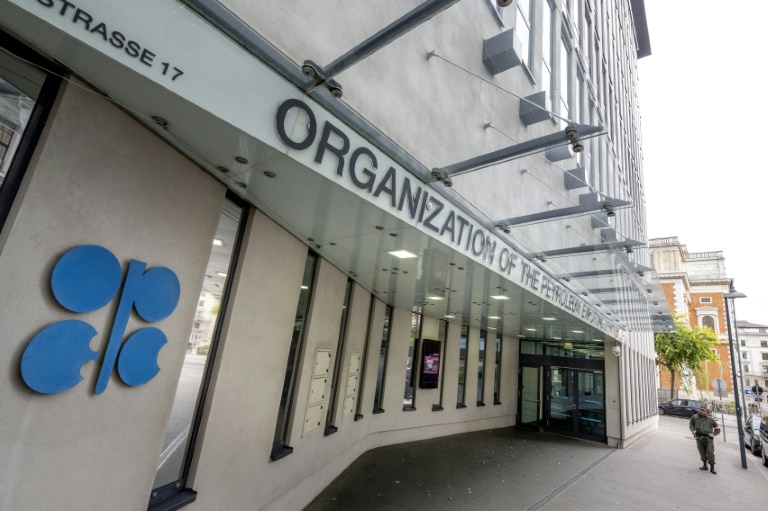
The representatives of the thirteen members of the Organization of the Petroleum Exporting Countries (OPEC) led by Riyadh, and their 10 allies headed by Moscow, decided to stick to their course agreed in October of a production cut of two million barrels per day until the end of 2023.

Sunday’s widely anticipated move was no “big surprise” given that the economy has been “slowing somewhat, pushing oil prices below $90, despite the lower production levels,” analyst Hans van Cleef with ABN AMRO said.  

Collectively known as OPEC+, the alliance said Sunday that its October decision to cut output was “purely driven by market considerations”, adding that it had been the “necessary and right course of action towards stabilizing global oil markets”. 

The OPEC+ output reduction in October represented the biggest cut since the height of the Covid pandemic in 2020, a move denounced by the United States as a concession to Moscow.

The next OPEC+ ministerial meeting is scheduled for June 4, 2023.

But the alliance said it was ready to “meet at any time and take immediate additional measures” to address market developments and support the oil market if necessary.

– Spotlight on Russia –

On Friday, the EU, G7 and Australia agreed a $60-per-barrel price cap on Russian oil, which will come into effect on Monday or soon after, alongside an EU embargo on maritime deliveries of Russian crude oil.

It will prevent seaborne shipments of Russian crude to the European Union, which account for two thirds of the bloc’s oil imports from Russia, an attempt to deprive Moscow’s war chest of billions of euros.

“We will sell oil and oil products to countries that will work with us on market terms, even if we have to reduce production somewhat,” Russia’s Deputy Prime Minister Alexander Novak said after Sunday’s quick meeting via videoconference.

Even though “inflation, the tightening of monetary policies and China’s Covid-19 epidemic” were posing risks to the market, it was still “in a better state than two months ago”, Novak said, according to Russian news agencies. 

“We are currently working on mechanisms to prohibit the use of the price cap tool at any level”, Novak added, stating that “such interference” could only cause “further market destabilization and scarcity of energy resources”.

Moscow had repeatedly denounced the incoming oil price cap, threatening to suspend deliveries to any country that adopted the measure. 

But Ukraine suggested on Saturday that the cap should have been set even lower.

For OPEC+, the big unknown in the oil equation is how heavily sanctions will hit Russian supply.

“Uncertainty on the impact on Russian oil production coming from the EU ban… and the G7 price cap and some easing of mobility restrictions in China likely supported the decision for a rollover,” UBS analyst Giovanni Staunovo said. 

“The upside risks for oil prices from this point on will increase” due to the announced EU and G7 measures in combination with supply and demand expected to remain unchanged, Van Cleef said.

– An ‘uncomfortable position’ –

Moscow’s threat to suspend deliveries to countries abiding by the price cap will put “some in a very uncomfortable position”, said OANDA analyst Craig Erlam, “choosing between losing access to cheap Russian crude or facing G7 sanctions”.

Amid economic gloom fuelled by soaring inflation and fears of China’s weaker energy demand due to its Covid-related restrictions, the two global crude benchmarks remained close to their lowest level of the year, far from their March peaks.

Since the group’s last meeting in early October, Brent North Sea oil and its US equivalent WTI have lost more than six percent of their value.

Moving forward, OPEC+ might still feel compelled to adopt “a more aggressive stance” by cutting or threatening to cut production, UniCredit analyst Edoardo Campanella said. 

“Russia might also retaliate by leveraging its influence within OPEC+ to push for more production cuts down the road, thus exacerbating the global energy crisis,” he added.

More than 500 Ukrainian localities without power: ministry

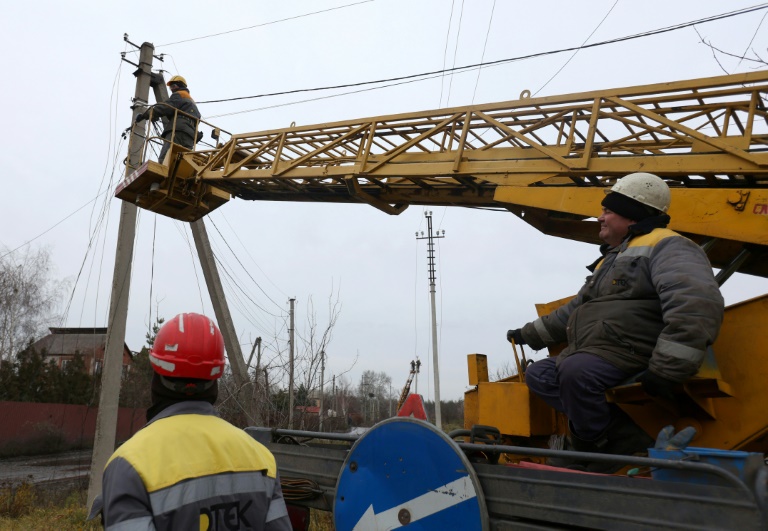
More than 500 Ukrainian localities remained without power Sunday following weeks of Russian airstrikes on the electric grid, an interior ministry official said.

“The enemy continues to attack the country’s essential infrastructure. Currently, 507 localities in eight regions of our country are cut off from electricity supplies,” deputy interior minister Yevgueny Yenin told Ukrainian television.

“The Kharkiv region is the worst hit with 112 isolated villages,” Yenin added.

Another 90 villages were cut off in the Donetsk and Kherson regions, he said, with others in the regions of Mykolaiv, Zaporizhzhia and Lugansk.

On Saturday, Ukrainian authorities — including Mykolaiv region governor Vitali Kim — had once again urged civilians to bear up in the face of continually deteriorating early winter conditions and regular power outages. 

Repeated daily power cuts have left millions of people without heat or lighting while outside temperatures have dropped below zero Celsius (32 Fahrenheit) in recent days.

With further strikes on the network widely expected, Ukrainians fear a difficult prolonged winter as well as a flood of departures by refugees from a war now into a tenth month.

Private Ukrainian energy operator DTEK said Thursday that nearly half of Ukraine’s electricity grid remains damaged after Russia began targeting Ukrainian energy facilities in October following a series of humiliating military defeats on the ground.

OPEC+ likely to maintain oil output levels

Major oil-producing countries led by Saudi Arabia and Russia look set to maintain their current output levels at a meeting Sunday, ahead of fresh sanctions against Moscow coming into force.

The alliance’s Joint Ministerial Monitoring Committee (JMMC) kicked off their gathering Sunday, a source close to OPEC told AFP, ahead of the full ministerial conference afterwards which was expected to be brief.

The 13-member Organization of the Petroleum Exporting Countries will consult with 10 other oil-producing nations including Russia — known collectively as OPEC+ — to review their decision in October to cut production by two million barrels per day.

On Friday, the EU, G7 and Australia agreed a $60-per-barrel price cap on Russian oil, which will come into effect on Monday or soon after, alongside an EU embargo on maritime deliveries of Russian crude oil.

It will prevent seaborne shipments of Russian crude to the European Union, which account for two thirds of the bloc’s oil imports from Russia, an attempt to deprive Moscow’s war chest of billions of euros.

While Russia denounced the incoming price cap on Saturday, threatening to suspend deliveries to any country that adopted the measure, Ukraine suggested the cap should have been set even lower.

For OPEC+, the big unknown in the oil equation is how heavily sanctions will hit Russian supply.

“The uncertainty for Russian supply is significant”, DNB analysts said. OPEC would therefore “aim for a low-profile meeting that leaves existing production quotas unchanged”.

– An ‘uncomfortable position’ –

Moscow’s threat to suspend deliveries to countries abiding by the price cap would put “some in a very uncomfortable position”, said OANDA analyst Craig Erlam: “Choosing between losing access to cheap Russian crude or facing G7 sanctions”.

The choice of a virtual OPEC+ meeting instead of an in-person conference at the Vienna headquarters, suggested a policy rollover, UniCredit analyst Edward Moya said.

But “deeper oil output cuts” could still not be ruled out at this stage.

Amid economic gloom fuelled by soaring inflation and fears of China’s weaker energy demand due to its Covid-related restrictions, the two global crude benchmarks remained close to their lowest level of the year, far from their March peaks.

Since the group’s last meeting in early October, Brent North Sea oil and its US equivalent, WTI, have lost more than six percent of their value.

But speculation that a further OPEC+ production cut might still be on the table boosted prices throughout the week.

“OPEC+ might feel compelled to adopt a more aggressive stance” by cutting or threatening to cut production even further, UniCredit analyst Edoardo Campanella said. 

“Russia might also retaliate by leveraging its influence within OPEC+ to push for more production cuts down the road, thus exacerbating the global energy crisis,” he added.

Germany's Scholz weathers shocks in turbulent first year

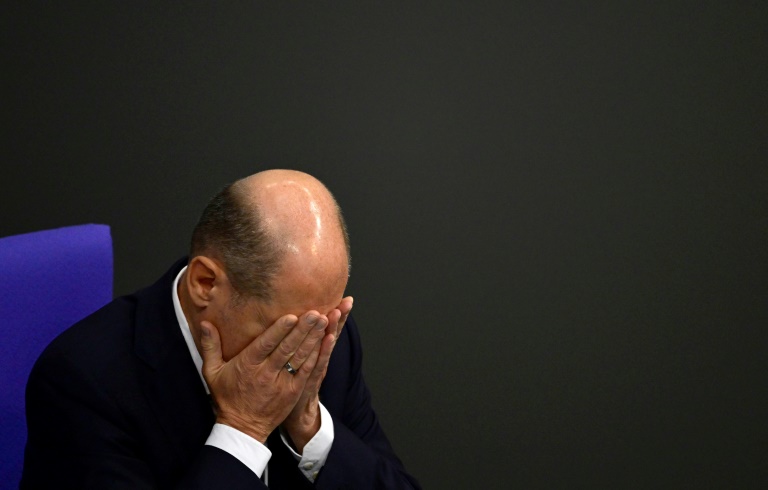
A war in his backyard, galloping economic crisis, and unhappy partners at home and abroad — German Chancellor Olaf Scholz has weathered unprecedented shocks in his first year, while struggling to make a mark on the global stage.

The ex-finance minister took office promising continuity with the era of Angela Merkel, who ended her 16 years as chancellor a widely respected figure.

But Russia’s invasion of Ukraine has forced him to rip up Germany’s post-war axioms and chart out new economic, defence and geopolitical directions for the country that prizes — and is valued for — its stability and predictability.

“We never before had a government faced with such a dramatically worsening situation, when it came to foreign and security policy, but also of course energy policy,” political scientist Ursula Muench told AFP.

Scholz’s coalition of his Social Democrats and partners Greens and liberals FDP had taken office planning ambitious climate policies and budget restraint. 

But as Moscow dwindled its energy supplies in the wake of the war, Germany has had to halt its planned nuclear exit, restart mothballed coal power stations while burning through a budgetary hole in a scrum for oil and gas to replace Russian supplies.

And in a turning point for a country whose role on the world stage was still affected by memories of World War II, Scholz announced a historic shift on defence, vowing to re-arm Germany with a massive boost in military spending.

“Going by the dramatic events this year, he did pretty well,” said Nils Diederich, a political scientist at Berlin’s Free University. 

– Turning point –

But Rachel Rizzo, a senior fellow at US think tank the Atlantic Council’s Europe Center, warned that losing momentum was a danger, even if the initial response was “impressive”.

“I think not being able to follow through with defence and security commitments is a concern,” she told AFP.

Not only is Germany trying to replenish its own military stocks, it is facing intense pressure from Ukraine to deliver what it has to help in the fightback against Russia.

The defence spending is high at a time when the treasury is also being pressed to help cushion a price shock fuelled by the energy crisis.

Huge investments are also required for the export giant to manage an economic transformation of reliance on cheap Russian energy or Chinese components to a diversified approach.

And governing in a three-way coalition means resolving each challenge inevitably involves squabbles that could unravel the fragile partnership.

Scholz’s government has managed to implement part of its programme, including raising the minimum wage and reforming unemployment benefits.

But with myriad crises not going away, the chancellor’s popularity ratings have suffered. 

A survey by the Insa institute published Sunday in tabloid Bild showed 58 percent of Germans are dissatisfied with Scholz — compared with just 22 percent a year ago — and 64 percent are dissatisfied with his government, up from 36 percent. 

– ‘Going it alone’ –

As well as disagreements at home, there have been tensions with partners abroad.

European Union allies were upset that Scholz announced a massive 200-billion-euro ($207-billion) energy fund without first consulting them, complaining he should have focused on coming up with EU-wide measures.

Tensions have also arisen in the key relationship between Berlin and Paris over issues ranging from the energy fund to German plans for defence procurement.

Unlike Merkel, who, in her time, was widely respected as the voice to reckon with in Europe, Scholz has so far failed to step into the role on the international stage.

Merkel’s departure “has left a void”, said Eric Maurice, from the Brussels office of the Robert Schuman Foundation.

Scholz is “struggling to make his mark at the European level… He is still trying to find his bearings, he does not have Merkel’s experience.”

The view Scholz was seeking to “go it alone” was reinforced when he made the first visit to China by a G7 leader since the start of the pandemic in November, accompanied by a delegation of German business leaders.

The chancellor faced accusations he was pursuing the same mercantilist, trade-focused foreign policy of previous German governments, which led to economic ties flourishing with authoritarian Russia, but ultimately left Berlin vulnerable.

As Scholz heads into his second year in the job, many of the open challenges will continue to entangle him.

High energy prices will remain a major problem, particularly for electricity-hungry German manufacturers, said Sudha David-Wilp, Berlin office director of US think tank the German Marshall Fund.

“Ensuring German competitiveness because of the increase in energy costs, particularly for industries like chemicals and steel manufacturing, is the big challenge for Scholz,” she said.

The energy fund “is just a short-term fix. No one knows when energy prices are going to come down to pre-war levels”.

Opec+ likely to maintain oil output levels

Major oil-producing countries led by Saudi Arabia and Russia look set to maintain their current output levels at a meeting Sunday, ahead of fresh sanctions against Moscow coming into force.

The 13-member Organization of the Petroleum Exporting Countries (OPEC) is due to consult with 10 other oil-producing nations, including Russia, to review their decision in October to cut production by two million barrels per day.

The OPEC+ videoconference will take place from 1100 GMT Sunday.

On Friday, the EU, G7 and Australia agreed a $60-per-barrel price cap on Russian oil, which will come into effect on Monday or soon after, alongside an EU embargo on maritime deliveries of Russian crude oil.

It will prevent seaborne shipments of Russian crude to the European Union, which account for two thirds of the bloc’s oil imports from Russia, an attempt to deprive Moscow’s war chest of billions of euros.

While Russia denounced the incoming price cap on Saturday, threatening to suspend deliveries to any country that adopted the measure, Ukraine suggested the cap should have been set even lower.

For OPEC+, the big unknown in the oil equation is how heavily sanctions will hit Russian supply.

“The uncertainty for Russian supply is significant”, DNB analysts said. OPEC would therefore “aim for a low-profile meeting that leaves existing production quotas unchanged”.

– An ‘uncomfortable position’ –

Moscow’s threat to suspend deliveries to countries abiding by the price cap would put “some in a very uncomfortable position”, said OANDA analyst Craig Erlam: “Choosing between losing access to cheap Russian crude or facing G7 sanctions”.

The choice of a virtual OPEC+ meeting instead of an in-person conference at the Vienna headquarters, suggested a policy rollover, UniCredit analyst Edward Moya said.

But “deeper oil output cuts” could still not be ruled out at this stage.

Amid economic gloom fuelled by soaring inflation and fears of China’s weaker energy demand due to its Covid-related restrictions, the two global crude benchmarks remained close to their lowest level of the year, far from their March peaks.

Since the group’s last meeting in early October, Brent North Sea oil and its US equivalent, WTI, have lost more than six percent of their value.

But speculation that a further OPEC+ production cut might still be on the table boosted prices throughout the week.

“OPEC+ might feel compelled to adopt a more aggressive stance” by cutting or threatening to cut production even further, UniCredit analyst Edoardo Campanella said. 

“Russia might also retaliate by leveraging its influence within OPEC+ to push for more production cuts down the road, thus exacerbating the global energy crisis,” he added.

Close Bitnami banner
Bitnami